Tag: economic

  • Advancing economic freedom for our veterans and service members

    Advancing economic freedom for our veterans and service members

    [ad_1]

    By Philip Martin, Chief Security Officer
    This Veterans Day, we’re committing to investing in our extraordinary veterans and service members. Our mission is to increase economic freedom in the world, and our work has always been driven by the fact that we believe we can help to build a more fair and equitable financial system for everyone.

    As a veteran myself, I’ve seen firsthand the benefits of service. I’ve also seen how difficult it can be for some veterans to be afforded the opportunities to translate their incredible skills learned in service to the business world. To harness that potential and recognize the vital and unique talents of our veterans, we are partnering with the following organizations: Bunker Labs, The COMMIT Foundation and Shift. Our partnerships will focus on two core areas:

    1. Committing $200,000 to each partner organization to support their mission to advance economic opportunities for service members, veterans, and their families
    2. Dedicating an additional $1 million for a new fund to create unique incentives for veterans and service members to learn more and participate in the cryptoeconomy. This will include bespoke training, networking, and career development opportunities

    Alex Krongard, CEO, The COMMIT Foundation: “On this Veterans Day, I am truly grateful and humbled by Coinbase’s amazing contribution towards helping our service members and their families transition into meaningful and purpose-filled post-service lives. Their sense of service and commitment to their communities and our nation is of incalculable value and needed now more than ever. Again, my sincere thanks and a promise that the COMMIT team will continue to do our utmost in support of our veterans.”

    Mike Slagh, Founder & CEO, Shift: “Shift is over the moon to partner with Coinbase to create new educational and career advancement opportunities within crypto and blockchain technologies for the military community. Our veterans represent one of our nation’s most resilient and diverse workforces, and our community’s passion for learning gives me belief that veterans have an important role to play in the modern workforce. The dedicated members of the Coinbase team have graciously volunteered their time to support our community since our company’s founding days, and I’m so grateful to begin to scale the impact that veterans and military supporters at Coinbase are already creating with military members, past and present.”

    Blake Hogan, CEO, Bunker Labs: “With the commitment and financial support of companies like Coinbase, veteran entrepreneurs across our great country will have access to the professional networks and educational resources they need and deserve, to take on the challenge of starting a business. We are excited and grateful to partner with Coinbase and thank them for their support.”

    Moving forward, we will continue to develop additional programming to support veterans and service members. That includes contributing to these existing partnerships while also recognizing the unique skills and attributes of our veterans as we build a championship team at Coinbase. To that end, we also look forward to adding more talented veterans and service members as we continue to grow.


    Advancing economic freedom for our veterans and service members was originally published in The Coinbase Blog on Medium, where people are continuing the conversation by highlighting and responding to this story.

    [ad_2]

    Source link
  • QED, Aims To Lead The Next Generation Oracle Products For DeFi With Its Robust Economic Model

    QED, Aims To Lead The Next Generation Oracle Products For DeFi With Its Robust Economic Model

    [ad_1]

    Oracles, according to Cryptopedia, are protocols for smart contracts in the blockchain industry to interact with external data. Smart contracts are essentially computer programs that run within a blockchain and automate a set of transactions when certain conditions are met. Thus, smart contracts contribute to the complete decentralization of the blockchain industry by allowing transactions to take place automatically and without the intervention of a third party.

    As appealing as the concept of blockchain as a self-contained, permissionless, and trustless system is, it would have no real-world applications if there was no way to use external, off-chain data, which is where oracles come into play.

    According to a recent report, the blockchain industry has over 77 million active users, demonstrating the constant innovation in the space, even though it is only a decade old.

    Because oracles connect the blockchain world to the outside world, there is a need to keep up with the blockchain industry’s constant innovation. However, oracles have struggled with centralized control, as some protocols are controlled by a single entity and serve as the sole source of data for smart contracts. If blockchain technology is to achieve its primary goal of decentralization, oracle networks must also be decentralized to provide smart contracts with an increased level of security and transparency.

    The Importance Of Decentralized Protocols Like QED

    One of the significant issues with introducing oracles to the blockchain is that it contradicts the ethos of blockchain technology, which is trustlessness. One way to address this is to ensure that oracles connected to the blockchain are decentralized and not governed by a single entity.

    QED is a decentralized oracle protocol with a robust economic model that connects blockchains, smart contract platforms, and off-chain data resources. QED is a decentralized oracle that aims to achieve trustlessness by distributing data points among multiple entities and modeling the blockchain network.

    DelphiOracle, QED’s base software, is the most widely used protocol on WAX.io, the world’s most trusted blockchain ecosystem for NFTs, dApps, and video games. For more than four years, the Delphi oracle has served as a multi-party source of truth, providing smart contracts with real-time prices for asset pairings on the various blockchain networks. DelphiOracle has already proven itself in the blockchain industry, and QED is built on it. The purpose of introducing QED is to solve problems inherent in existing models of oracles and blockchain systems.

    Economic Model Of QED

    The economic model of QED distinguishes it from existing Oracle protocols because it focuses on both the technological and commercial sides, which are both important when it comes to delivering and aggregating real-world data for smart contracts. The following are some of the characteristics of the QED economic model:

    • Recourse: QED is customer-centric because it protects users by providing a recourse mechanism. Clients would eventually be able to use the external collateral provided by QED to process loss restitution that may have occurred due to systemic risks.
    • Accuracy: To maximize real-time accuracy, automated systematic and reliability scoring is implemented to phase out poor-performing articles by increasing allocation to more capital-efficient oracles.
    • Decentralization: QED used distributed ledger technology as a mode of operation, promoting decentralization and eliminating the lingering issue of centralization in Oracle protocols. The native token “$QED” also serves as an economic constraint for QED.

    Final Thoughts

    QED is a breath of fresh air for Oracle protocols. It aspires to lead the next generation of Oracle protocols that provide services to smart contracts in a fully decentralized, transparent, and open manner. To make the most of its innovative economic model, QED intends to integrate with public blockchains. Furthermore, to promote scalability and interoperability, the QED protocol is also powered by the UX network. QED’s economic model was implemented to address issues with the commercial viability of existing Oracle protocols, and it would as a model for the next generation of Oracle protocols shortly.


    [ad_2]

    Source link

  • MRHB DeFi’s Khalid Howlader Leads Discussion on Inclusion at Turin Islamic Economic Forum (TIEF) | by Bit Media Buzz | Oct, 2021

    MRHB DeFi’s Khalid Howlader Leads Discussion on Inclusion at Turin Islamic Economic Forum (TIEF) | by Bit Media Buzz | Oct, 2021

    [ad_1]

    Bit Media Buzz

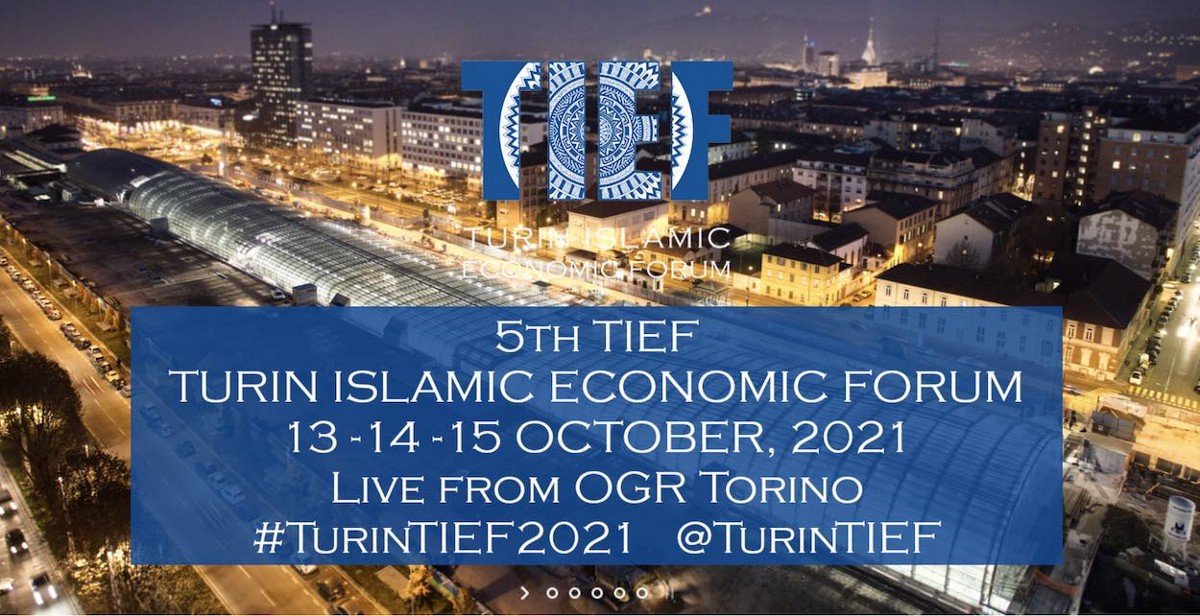
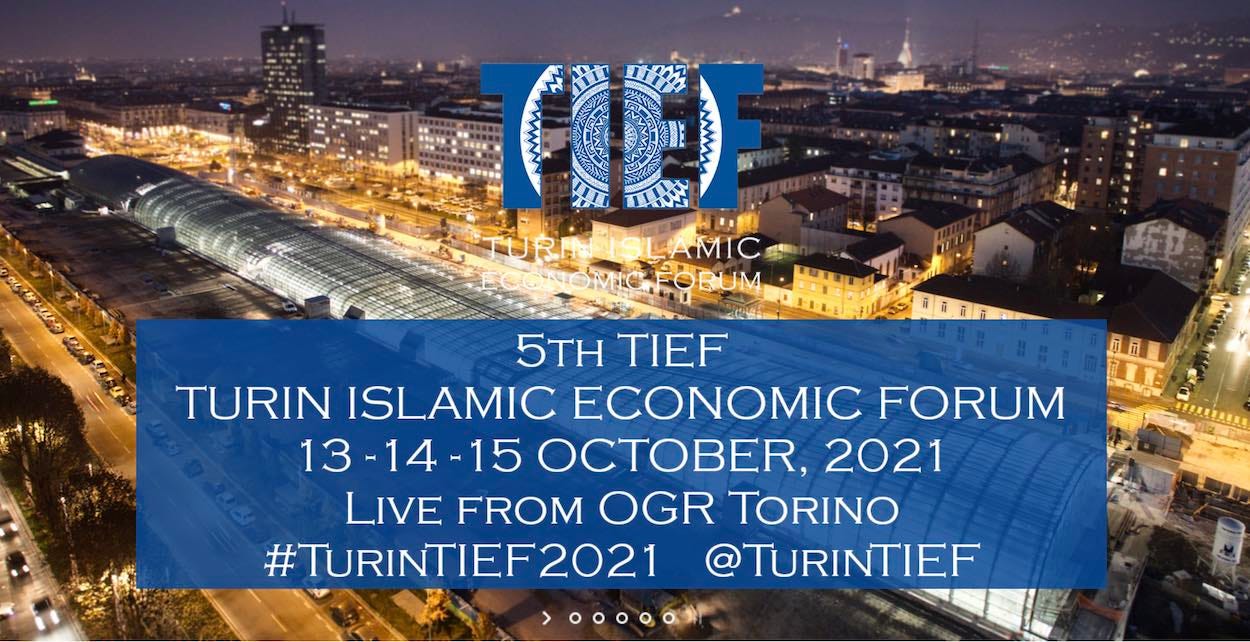
    If you are interested in developments in fintech, cryptocurrency and decentralized finance, the Chairman of MRHB DeFi Khalid Howlader, is set to appear on a panel at the upcoming Turin Islamic Economic Forum (TIEF), this Wednesday in Turin, Italy.

    According to the “State of the Global Islamic Economy Report” (Thomson Reuters, 2020/2021), with governments and banks encouraging Islamic finance and improving financial inclusion, both Muslim-majority and minority countries have started to recognize the untapped potential of the Islamic Finance sector. Islamic Finance is continuing to expand and the report states that it could become an important part of the future of developed nations’ ability to attract fresh capital for investment in infrastructure, new technologies, renewable energy, real estate and strategic resources.

    You can find out more about the event here: https://www.tief.it/?lang=en

    Khalid Howladar, is Chairman of MRHB DeFi, the world’s first ethical and faith-based decentralized finance platform.

    He is also Senior MD and Head of Credit & Sukuk for R.J. Fleming & Co. and was previously Global Head of Islamic Finance and Head of the GCC banking team at Moody’s Investors Service, London and Dubai. He has addressed audiences worldwide including at the World Bank, IMF, ECB and IIF.


    [ad_2]

    Source link

  • How crypto enables economic freedom

    How crypto enables economic freedom

    [ad_1]

    The following is an internal memo that I shared with Coinbase employees this week and would also like to share publicly to help people see how we’re working toward our mission of increasing economic freedom in the world.

    Tl;dr: Our core thesis is that greater adoption and usage of cryptocurrency will increase economic freedom in the world, because crypto solves many of the shortcomings of the current financial system that hinder economic freedom.

    Team,

    Every quarter at our company All Hands, we review our Mission (what we’re trying to achieve) and our Strategy (how we’re going to get there). One question I often hear from employees is: “How does cryptocurrency create more economic freedom in the world?” This is a great question, so I wanted to share my thoughts with all of you.

    First, a refresher: Economic freedom is a composite measure of 12 factors. It quantifies the rights of people to control their own labor and property in each country and globally. Economic freedom varies dramatically across the world, and while our economy is increasingly global, the government of any single country has significant control over the financial and economic freedoms of its people. Low economic freedom in a given country isn’t always due to malicious activity (e.g, fraud, oppression, etc) — it’s often due to mismanagement (poor monetary and fiscal policy) or simply bad infrastructure.

    Crypto and economic freedom

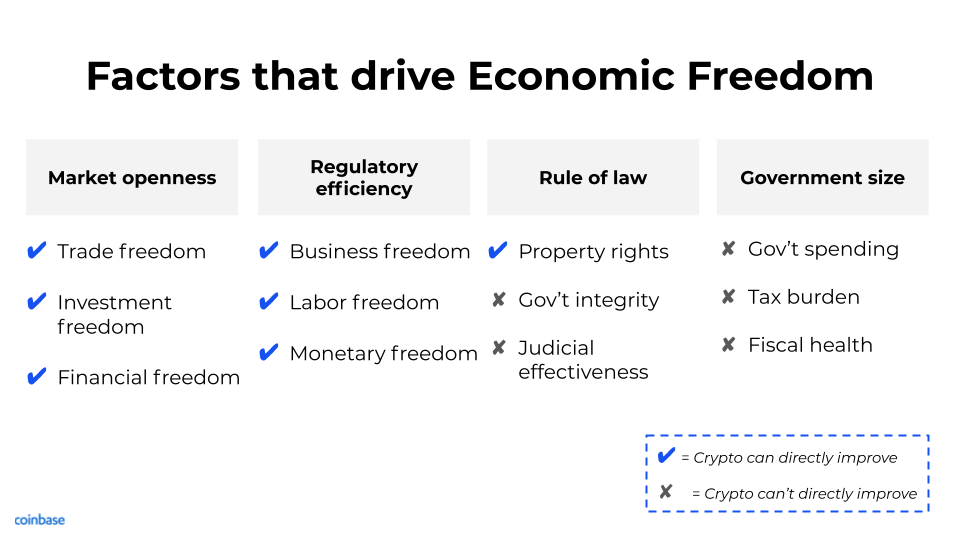
    The question to ask is: How can we build a global economy where anyone with an internet connection can participate, where property rights are enforced, and where money preserves its value? Crypto is the solution. Crypto can’t directly improve every facet of economic freedom (e.g., tax policies and government spending), but it can improve most of the underlying drivers (see below).

    Read more about each of the factors here.

    Why is crypto so uniquely positioned to increase economic freedom? Because it has these inherent properties:

    Crypto is an open, global network

    Crypto networks are open, removing the barriers of borders. It allows every person in the world to transact on shared networks, in the same way they communicate on a shared network (the internet). More importantly these networks themselves are not controlled by governments that can use their monetary systems to hinder economic freedom (and prosperity). This design principle leads to more open markets and increases trade freedom, investment freedom, financial freedom, and monetary freedom.

    Crypto enforces property rights

    Property rights allow people to save their income, grow their wealth, and plan for the long term because they know the fruits of their labor are safe from unfair seizure or theft. Before crypto, your confidence in property rights was a function of the trust you had in your government and its respect for the rule of law. With crypto, anyone can acquire and grow their wealth without intervention from trusted 3rd parties like a government or a bank, or fear that their wealth could easily be seized. Property rights are also about the ability to enter contractual agreements. In some areas around the world, a contract has little value, because you can’t be confident in its enforcement. Smart contracts move enforcement from the courts to the blockchain, enabling gains from specialization and commercial exchange.

    Crypto is unbiased

    Crypto networks are often pseudonymous (or even anonymous). They don’t care where you live, what your race or gender is, or who you voted for in the last election. Unlike the current financial system they are inherently open and unbiased. Anyone with an internet connection can create a wallet, get paid in crypto, spend in crypto and accrue wealth in crypto. Service providers like Coinbase do have compliance programs as required by law, but we don’t control access to all crypto and we don’t own the network. Anyone can access crypto networks through other providers if we make a bad decision, or are forced into bad regulation. In addition, self custody wallets like Coinbase Wallet provide an ever greater degree of freedom when it comes to financial inclusion.

    Crypto enables mobility

    As I mentioned above, there are important components of economic freedom that cryptocurrency can’t directly benefit (e.g., government integrity, tax policies, fiscal health, etc.). However, cryptocurrency does provide the conditions for mobility by reducing switching costs, allowing people to both accrue wealth and bring it across borders. Cryptocurrency is the ultimate embodiment of the power of the individual, by significantly reducing the barriers to emigration / exit, and thus increasing economic freedom.

    Conclusion

    As you can see, cryptocurrency can impact many of the factors that lead to more economic freedom. It can both help build better-functioning economies in countries with less economic freedom, and make it easier to emigrate to a better life. This is why our core thesis as a company is that greater adoption and usage of cryptocurrency will increase economic freedom in the world.

    Technology is the longest lever we can pull to improve the human condition. At its core, cryptocurrency is a technology breakthrough that allows us to build a more free and open financial system that enables the rights of people to control their own labor and property. It is the best tool that exists to advance our mission of increasing economic freedom in the world.

    What does this mean for Coinbase? Crypto is in many ways still nascent. It’s still hard to use, crypto networks are plagued with scaling challenges, and the economy built on top of crypto infrastructure is in its early days. Our strategy and roadmap is geared towards solving these challenges: We’re focused on building easy-to-use products that abstract away the complexity of blockchains, and we’re building the primitives of a functioning financial system. We still have a long way to go, but the future is bright.


    How crypto enables economic freedom was originally published in The Coinbase Blog on Medium, where people are continuing the conversation by highlighting and responding to this story.

    [ad_2]

    Source link