KR1, a blockchain and crypto-asset investment company, has now announced it has participated in the HydraDX (HDX) crowdloan and Polkadot (DOT) parachain auction. KR1 contributed a total of 350,000.00 DOT to the HydraDX crowdloan campaign, which successfully secured a parachain slot in the ongoing round of Polkadot parachain auctions.
HydraDX.io is a cross-chain liquidity protocol designed to enable frictionless liquidity for crypto assets across various chains. In contrast to most decentralized exchanges in production today, which rely on separate pools for separate assets, HydraDX’s solution enables deposits of ‘all’ assets into one shared liquidity pool, the ‘Omnipool’, unlocking unparalleled efficiencies.
The contributed DOT will be time-locked on the Polkadot blockchain for 96 weeks and will be returned to KR1 following the completion of the respective HydraDX parachain lease. Following the successful HydraDX parachain auction bid, KR1 is going to receive a to-be-determined amount of HydraDX tokens over a time period of 96 weeks in return for supporting the HydraDX crowdloan campaign.
This method of token distribution involves no direct investment of capital, instead, it is an indirect investment with the opportunity costs being the inaccessibility of the locked DOT funds as well as foregoing any staking yields on the contributed DOT for the time period.
In addition, KR1 will receive a total of 45,000,000 HDX tokens (and a yet-to-be-determined amount of Basilisk (BSX) tokens) in line with KR1’s previous backing of HydraDX’s seed funding round that was announced on December 22nd, 2020, and a much smaller, yet-to-be-determined amount of HDX tokens in line with the company’s contribution to Basilisk’s Kusama crowdloan campaign and parachain auction that was announced on September 22nd, 2021.
HDX is the native token of HydraDX. It will be used for governance, staking, and more.
“HydraDX winning a Polkadot parachain slot is the next big step for the project and a huge endorsement by the community of the protocol’s objective to bring all liquidity together in an ‘ocean of liquidity.’ We see HydraDX as the endgame of liquidity in a cross-chain world and we have a high conviction rate in the team’s ability to achieve this goal.” – Keld van Schreven, Managing Director & Co-Founder of KR1
Swing, a cross-chain infrastructure platform to trade and move crypto between blockchains, has announced that its cross-chain liquidity and bridging protocol, is now live on Binance Smart Chain (BSC).
Originally built on the Polkadot blockchain, Swing has recently expanded to several different blockchain networks, including Avalanche, Polygon, and Solana.
Acting as liquidity and bridging aggregator of the most popular decentralized finance platforms and DEXs (decentralized exchanges), with Swing, users can access the full range of popular DeFi platforms and trade seamlessly across them all without surrendering control of their funds to any third party.
Integration of Binance Smart Chain will broaden Swing’s access DeFi apps, and specifically, will allow the platform to aggregate liquidity and bridging opportunities across the most popular DEXs on BSC, including PancakeSwap, BurgerSwap, BiSwap, and more.
Binance Smart Chain is the Ethereum Virtual Machine (EVM) compatible dApp and smart contract platform from the world’s largest crypto exchange, Binance. Although created by a centralized exchange, Binance Smart Chain is a decentralized platform that hosts a number of decentralized applications.
“We are thrilled to become a part of the Binance Smart Chain (BSC) network. The number and variety of decentralized applications on Binance Smart Chain gives our protocol a chance to show what it can do. Users and traders will feel an immediate benefit by having all of the best liquidity and bridging options available in one place.” – Swing Founder, Viveik Vivekanantha
The Swing protocol is currently live on Ethereum, Polygon, Avalanche, Fantom, xDai, and now Binance Smart Chain, where it aggregates bridges and liquidity sources to find the lowest slippage on cross-chain token swaps and liquidity transfers.
Interoperability is shaping up to be one of the main themes for the cryptocurrency market in 2022 as projects across the ecosystem unveil integrations that make their networks Ethereum (ETH) Virtual Machine (EVM) compatible.
While this has been one of the long-term goals of the ecosystem as a step on the path to an interconnected network of protocols, it has also created a new decentralized finance (DeFi) market for multi-chain bridges and decentralized finance.
Here are three of the top volume cross-chain bridges that the cryptocurrency community uses to transfer assets between blockchain networks.
Multichain
Multichain (MULTI), formerly known as Anyswap, is a cross-chain router protocol that aims to become the go-to router for the emerging Web3 ecosystem.
According to data from Defi Llama, Multichain is the top-ranked cross-chain swap protocol by total value locked, with $8.95 billion currently locked on the platform.
Multichain total value locked. Source: Defi Llama
One of the main reasons for the high TVL on Multichain is the large number of blockchain networks supported by the protocol. Currently, 30 different chainscan be accessed on the network.
Blockchain protocols supported by Multichain. Source: Multichain
According to data provided by Multichain, the protocol has processed a total of $53.15 billion worth of volume since launching, with $19.08 billion of that being transacted in the past 30 days alone. There are currently 485,399 users that have interacted with the Multichain protocol, amounting to nearly 2.256 million transactions.
Multichain network statistics. Source: Multichain
Users who deposit tokens into one of the pools supported by Multichain receive a sare of the transaction fees generated by the pool in question.
The protocol’s native MULTI token is used to vote and participate in the governance of the Multichain ecosystem and has a circulating supply of 18.64 million tokens out of a total 100 million.
Synapse
Synapse (SYN) refers to itself as a “cross-chain layer ∞ protocol” that is designed to offer users interoperability between separate blockchain networks.
According to data from Defi Llama, Synapse recently hit an all-time high in total value locked of $1.16 billion prior to experiencing a wave of outflows that lowered the TVL to 740.43 million.
Total value locked on Synapse. Source: Defi Llama
The Synapse protocol currently supports 12 different chains which have a combined total bridged volume of $5.33 billion according to data from the platform’s dashboard.
Total bridged volume on each network supported by Synapse. Source: Synapse
A large percentage of the total volume recorded on Synapse has come since the start of 2022 with the protocol seeing an all-time high bridge volume of $157.8 million on Jan. 23.
Synapse bridge volume. Source: Synapse Analytics
The protocol’s native SYN token has several uses within the ecosystem. Token holders can use it to conduct community governance votes via the SynapseDAO, liquidity providers (LPs) receive a percentage yield paid out in SYN for their deposits and it is also used as a subsidy to pay for the gas expended by network validators to secure transactions across the network.
LPs also receive a share of the protocol fees earned by the Synapse platform on each transaction.
Related: Web3 innovations are replacing middlemen with middleware protocols
Celer cBridge
Another popular cross-chain bridge is the Celer cBridge, a multi-chain network that enables instant, low-cost value transfers between 19 different networks.
The cBridge is a subsector of the larger Celer (CELR) ecosystem and utilizes the CELR token for operations on the protocol and as the reward token for liquidity providers.
Along with the CELR rewards paid to LPs, a percentage of the transaction fees generated by people who use the liquidity pools to bridge funds across chains are paid out to LPs and added directly to the pools, allowing the rewards to compound.
According to data from cBridge analytics, the total value of funds locked in the bridge contract (pool-based bridge) and the funds locked in the token vault contract (canonical token bridge) currently stands at $240.92 million.
cBridge usage statistics. Source: cBridge
A total of 89,897 unique addresses have interacted with the protocol since inception and have conducted a total of $2.842 billion in transaction volume.
Similar to the transfer trend seen with Synapse, the transaction volume on cBridge has gotten noticeably higher in 2022 with a record $71.12 million being transacted on Jan. 22.
Daily transaction volume on cBridge. Source: cBridge analytics
Some of the protocols currently supported by cBridge include Ethereum, Binance Smart Chain, Avalanche, Polygon, Fantom, Metis, Harmony, Gnosis, Arbitrum and Optimism.
Want more information about trading and investing in crypto markets?
The views and opinions expressed here are solely those of the author and do not necessarily reflect the views of Cointelegraph.com. Every investment and trading move involves risk, you should conduct your own research when making a decision.
Allbridge, a cross-chain bridge that lets users transfer assets between different blockchain networks, today announced $2 million in funding led by Race Capital. Allbridge offers a simple way to bridge tokenized assets between Ethereum Virtual Machine (EVM) and non-EVM compatible blockchains.
In the seven months since launch, Allbridge has bridged over $4.8B in assets, making it the largest cross-chain asset bridge supporting Solana, Fantom, Avalanche, Celo, Polygon, Ethereum, BSC, Terra, and more.
Founded by Andriy Velykyy and Yuriy Savchenko, who have worked together since 2016 on many different crypto payments integrations and non-custodial multi-chain crypto wallets, Allbridge aims to connect all kinds of layer-1 and layer-2 networks to bring more interoperability to DeFi.
Not only does Allbridge enable users to interact with and transfer assets between EVM-based blockchains like Ethereum, Polygon, and BSC, it also bridges non-EVM compatible blockchains like Solana and Terra.
“We want to be the go-to platform that bridges every popular blockchain and digital asset on the market, enabling billions of token transfers on a daily basis. We’re also working on APIs that will enable developers to build dApps on top of Allbridge. Cross-chain swaps built on Allbridge are the easiest way to exchange any asset between any networks, enabling new functionality like cross-chain lending where users can leverage collateral on one chain in order to receive an asset on another chain.” – Andriy Velykyy, Co-Founder of Allbridge
Allbridge enables users to select the network they want to provide the liquidity to with just a couple of clicks–whenever and wherever they want.
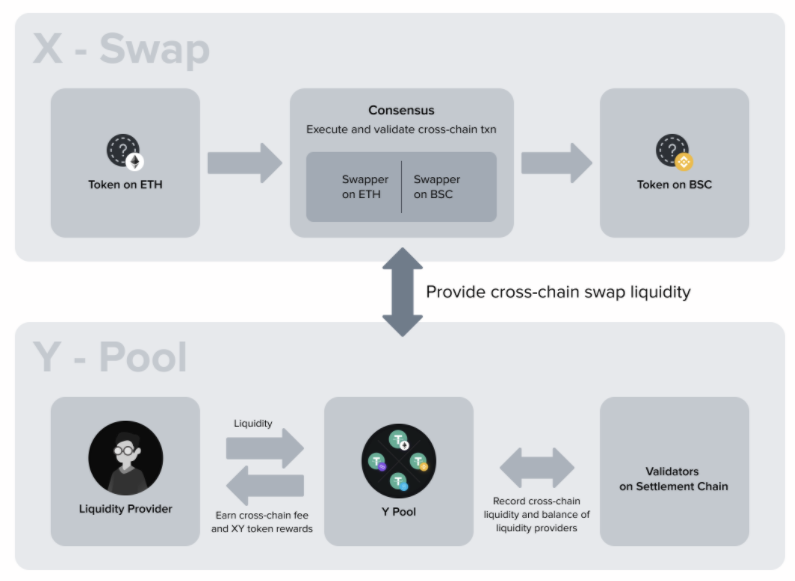
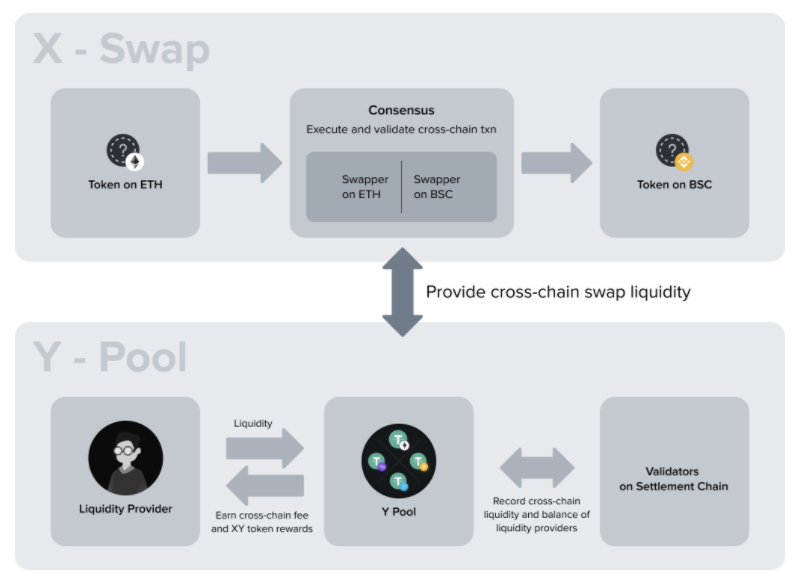
XY Finance has built an efficient and user-friendly cross-chain swap for DeFi & Metaverse and single-token liquidity provision service through X Swap and Y Pool. Of them, X Swap caters to users’ cross-chain needs between multiple chains, and the newly launched Y Pool can reimburse swapping fees and token rewards for liquidity providers.
With the coexistence of multiple chains and the boom of DeFi+NFT+GameFi, cross-chain exchange aggregators have become an essential and critical infrastructure in the entire cryptocurrency market, and the search for more efficient and convenient cross-chain exchange never stops.
XY Finance, a cross-chain swap aggregator for DeFi & Metaverse, aims to provide users with efficient cross-chain swapping services at the best price. It recently closed a $12 million round of funding from Circle (Circle Internet Financial), Infinity Ventures Crypto, Mechanism Capital, Morningstar Ventures, YGG (Yield Guild Games), and Animoca Brands. We are honored to see investors across core pillars in the industry: exchanges, venture funds, research firms, GameFi DAOs, and game developers, such as MEXC Global, TRON Foundation, gCC (gumi Cryptos Capital), Lemniscap, Evernew Capital, PANONY, Axia8, Looksrare.vc and more.
In addition to institutional investors, XY Finance gets backing from individual investors, such as Ben Chan (VP Engineering at Chainlink Labs), Kevin Tai (Co-Founder of Linear Finance), Tom Schmidt (Investment Partner at Dragonfly Capital), and Tempo (CEO of Perpetual Protocol), etc.
XY Finance’s advantage comes from the combination of two components, i.e., X Swap and Y Pool, which is also the operating model of XY Finance. Of them, X Swap will provide cross-chain transfer and swapping services for users, and Y Pool is used to incentivize users to provide liquidity. In return, liquidity providers can receive both swapping fees and governance token rewards. Currently, X Swap already supports cross-chain swap on Ethereum, BSC, Polygon and Fantom. The newly launched Y Pool has opened up liquidity provision services to users.
Simply put, X Swap will find the optimal cross-chain and transaction path for users, supporting cross-chain swaps between any assets, and allowing users to either swap assets on one specific chain or transfer/swap across two chains. For example, if you want to swap UNI on Ethereum to BUSD on BSC, you will first swap UNI to bridgeable assets (such as USDT, USDC etc.) on Ethereum, and migrate to BSC through Y Pool or bridge partners ( AnySwap, O3 Swap, and Multichain.xyz) before you finally convert to BUSD.
Although the operation seems complicated at first glance, X Swap only requires the user to initiate a transaction on the first chain, and the subsequent swap and cross-chain processes are automatically executed by the protocol, thus greatly simplifying the user’s transaction operation process.
Currently, X Swap mainly uses liquidity from DEXs such as Uniswap, SushiSwap and 1inch, while the newly launched Y Pool will allow users to provide liquidity directly on XY Finance, so that they can also earn swapping fees and XY token rewards.
The biggest advantage of Y Pool is that one pool can manage the liquidity of the same asset on multiple chains. For example, the USDT Y Pool pool can receive USDT assets from various chains such as ERC-20 USDT, BEP-20 USDT, Polygon USDT, etc., which are used to provide liquidity for X Swap. In addition, in order to balance the liquidity in the Y Pool, XY Finance proposes a rebalancing incentive mechanism that will reward users with XY Tokens for helping to rebalance assets on different chains.
Regarding XY Finance’s tokenomics in the Y Pool, in addition to the XY liquidity bonus, the founding team also allocates 80% of the swapping fees from X Swap to liquidity providers and another 20% to the DAO vault. Besides, of the fees allocated to the DAO vault and royalty income from the GalaXY Kats (an XY Finance’s NFT + GameFi project), 60% of them are used to repurchase XY Tokens from the secondary market, and 50% of the repurchased XY Tokens will be burned. This helps XY to form a virtuous cycle.
XY Finance’s native token, XY, will be offered on each chain supported by the protocol. There will be a total of 100 million tokens, of which 35% will be used for liquidity mining funds and GameFi rewards, 15% will be allocated to the team and advisors, 24% will be allocated to seed, private and strategic investors, 15% will be used for marketing and bounties, 6% will be used for public sales and 5% will be used for insurance, XY Finance will conduct an IDO on the Copper platform on December 9.
XY tokenomics
After locking XY in the staking pool, XYers can gain governance power to propose, vote, or change system parameters in real time, as well as start new Y Pools, etc. In addition, a portion of the swap fee will be allocated to XY Finance and the XY DAO as a security fund.
Regarding XY Finance’s future development plans, the agreement also plans to support Cronos, Ronin, Avalanche, Arbitrum and launch NFT Satellite, an NFT liquidity aggregator, by the end of this year; it will support more networks such as Flow, Solana and Polkadot in the first quarter of next year; more importantly, XY Finance will also support the NFT marketplace and launch the NFT wrapper and “NFT Sweeper”, and later launch the limit order swaps.
XY Finance Roadmap
Overall, XY Finance has built an efficient and user-friendly cross-chain swap aggregator and single-token liquidity provision model through X Swap and Y Pool, which not only satisfies users’ cross-chain needs across multiple chains but also helps liquidity providers earn revenue. The mutually reinforcing between the repurchase and burn mechanism and its NFT project GalaXY Kats will lend more strengths to the project. Let’s wait and see if XY Finance will be the dark horse in the cross-chain swap sector.
While DeFi promises a world where people can transfer their money without the hassle and transaction fees of banks, anybody who has tried to convert ETH to BNB recently knows it’s not so simple.
Gas fees make cross-chain transactions very expensive, hindering the free flow of crypto assets.
So, it is not surprising that cross-chain bridges have grown at an unprecedented rate, a TVL increase of 89% MoM in October as DeFi transaction volume booms in the bull market.
However, did you know that cross-chain bridges solve other problems besides, what are essentially crypto transaction fees?
As multi-chain projects and interoperability become key components of the industry, DeFi investors need to understand how cross-chain bridges work.
DeFi TVL (since January 2021) Data source: Footprint Analytics
DeFi TVL Ranking by BlockChain (since Jan 2021) Data source: Footprint Analytics
This article will look into the nature of cross-chain bridges, specifically:
How does a cross-chain bridge work?
Cross-chain bridges’ market performance.
Problems addressed by cross-chain bridges.
Selecting a cross-chain bridge.
What Is a Cross-Chain Bridge?
A cross-chain bridge or a blockchain bridge enables the transfer of tokens, assets, smart contract instructions, or data between blockchains. Two chains may have different protocols, rules, and governance models, but a cross-chain bridge connects these disparate blockchains together by interoperating securely.
A cross-chain bridge allows users to:
Deploy digital asset transactions fast and easy;
Enjoy low operational difficulty;
Take advantage of lower transfer fees on non-scalable blockchains;
Implement dApps across multiple platforms.
Here is an example of how cross-chain assets are transferred with a bridge:
When a user needs to convert an asset such as an ERC20 A token on Ethernet into another asset such as BEP20 A token on the BSC chain via AnySwap, the ERC20 A will be locked on the source chain and then notify the bridge to generate the BEP20 A on the BSC chain before sending it to the user.
In this example, the entire operation of the cross-chain bridge takes about five to 20 minutes, with an approximate gas fee in the range of $10 to $20, depending on the pre-congestion conditions in Ethereum at the time.
Data source: anyswap.exchange
How Has Crosslink Bridge Performed Recently?
The market is currently dominated mostly by Layer 2 scale-out cross-chain bridges, which are mainly built on Ethereum for better interconnection and interoperability.
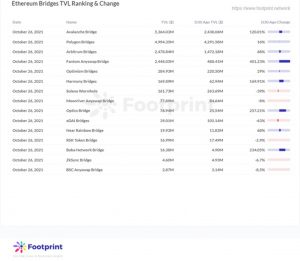
According to Footprint, the TVL of cross-chain bridges was $16.2 billion as of Oct. 26, which is an increase of over 72.25% in the last 30 days. The four largest cross-chain bridges namely, Avalanche Bridge, Polygon Bridge, Arbitrum Bridge and Fantom Anyswap Bridge, account for 95.61% of the entire cross-chain bridge, with its highest monthly increase of 401.23% last month.
Suggested articles
Trading Education: Boost Your Skills in FBS TraderGo to article >>
Data from the CoinTofu Cross-ChainBridge tool, reveal that these four cross-chain bridges have excellent user experience ratings.
TVL & share distribution across- chain bridges (since Apr 2021) Data source: Footprint Analytics
Ethereum Bridges TVL Ranking & Change Data source: Footprint Analytics
The above chart shows that Optimism has had the most active deposits from the beginning of September to yesterday, followed by Avalanche. Current transfer fees are as low as $0.25 (according to L2 Fees) and their transfer fees are variable, but with relatively small changes.
Ethereum Bridge Daily Unique Depositors (since June 2021) Data source: Footprint Analytics
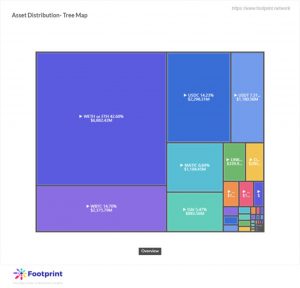
The main asset traded on cross-chain bridges is ETH (WETH), with total ETH lock-ups on the 15 cross-chain bridges valued at $6.882 billion as of Oct. 26. This represents approximately 42.6% of total lock-ups and the most used asset by investors, followed by WBTC and stablecoin USDC.
Asset Distribution- Tree Map Data source: Footprint Analytics
What Problems Do Cross-Chain Bridges Address?
Cross-chain bridges create growth across chains (reflected by Fantom and Avalanche prices, which hit gains of 12% and 18%, respectively, in the first week of November) that offer disparate asset interoperability, which is a high level of security and a better asset rendition.
Without a bridge, investors have to go through different exchanges and incur larger fees instead.
Cross-chain bridges also address the following:
Lower gas costs with increased transaction speeds;
User assets can be freely interacted with for a high user experience;
Improved productivity and usefulness of existing crypto assets;
Higher security and better privacy.
The use of cross-chain bridges is appropriate in the following scenarios:
Token transfers between Ethereum and a Layer 2 network, with assets interoperable across chains, such as faster and easier deposit of funds, withdrawal of assets and exit times to reduce operational complexity;
High fees and use in times of Ethereum congestion;
Thin assets supported by single chains and more assets supported by cross-chain bridges;
Investors can use cross-chain bridges when investing in new chains to get to the head mine faster, but need to assess the full mechanics of the new chain and its security;
Arbitrage trading across the DEX on Optimism, Arbitrum and Polygon, etc.
How to Choose the Right Cross-Chain Bridge
Consider the following criteria when selecting a cross-chain bridge:
A stable TVL exceeding USD$1 billion with a sound cross-chain mechanism and a credible execution environment reflected by gradual changes instead of abrupt fluctuations. Verification method of cross-chain information and management method of cross-chain funds must be taken into account;
Reasonable transfer costs (from USD$1 to USD$5) across the chain and interaction speeds with an estimated arrival time of 10 to 30 minutes;
Security to ensure against hackers that take advantage of vulnerabilities.
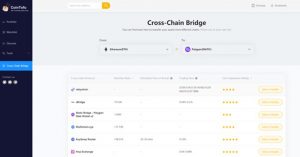
In addition, there are also a number of aggregation tools that offer a one-stop cross-chain bridge solution, of which CoinTofu has a better overall experience in terms of reaching the cross-chain page with one click and displaying the advantages of supported cross-chain bridges, estimated arrival times, transaction fees and user experience ratings.
Data source:cointofu.com
Conclusion
With the development of the DeFi industry, cross-chain bridges have become more popular than traditional exchanges. They enable interoperability and mutual integration of blockchain applications to support project owners, various blockchains, and investors as well as address the problem of capital flow and lower transaction costs to users.
Maxine Smith, a crypto writer from Singapore and a DeFi data analyst with a focus on market trends and regulations.
Finland, Helsinki, October 29, 2021. Coming up as a first-mover on the adoption of blockchain gaming metaverse on the OEC public chain (formerly known as OKExChain) is Celestial, a cross-chain gaming metaverse trending in the crypto airwaves. Deploying the concept of galactic warfare, Celestial combines the concept of GameFi, SocialFi, and NFTSwap to bring one of the finest innovations to the gaming metaverse.
Celestial has grown in popularity in the blockchain gaming ecosystem since its inception. Racking up some impressive figures, Celestial initiated a public BETA test on September 14 that contributed to over 70% of OEC public chain trading activity, resulting in high congestion of the OKexchain, with daily transactions topping 1 million at the time.
After a series of rigorous testing, the official version of the Celestial gaming platform went live on September 29th. Commenting on the impressive launch, the Celestial team reiterated their commitment to the long-term sustainability of the Celestial project:
“We are excited about the launch of our gaming platform. Being the brainchild of a multi-month period of development, innovation, and rigorous backend testing, this marks the beginning of an important phase in the Celestial roadmap just before our token generation events and subsequent listing on exchanges. We are excited about what the future holds for the blockchain gaming metaverse and we are happy to be leading this adoption.”
The Celestial platform is built to enable game players to create federations in the Celestial world, explore planets and galaxy clusters, and mine rich minerals and different resources as part of a meta-universe star-wars style game using GameFi + SocialFi + NFTSwap.
Leading up to TGE: $CELT token has recorded eye-popping success
While the impressive launch of the Celestial gaming metaverse comes as no surprise, seeing that blockchain gaming adoption has maintained an upward trajectory, the token generation event (TGE) also recorded impressive numbers. The token price soared to the top gainers category after listing on OKEx, a leading Asia-based crypto exchange.
CELT is the native token that powers the Celestial metaverse economy and is primarily used to settle all transactions in the Celestial metaverse. Since debuting on OKEx, CELT has amassed massive success for token holders after rising to the top-performing assets on the OEC public chain just after 15 days of trading activities.
Celestial dual token rotation system reduces selling pressure on CELTs
Celestial adopts a unique token system that allows a dual token rotation mechanism. In addition to $CELT, there is a sub token known as Crystals which is engineered to reduce the selling pressure on CELTs and benefit token holders in the long run.
Through an in-house mechanism known as Pledge Mining, Celestial incorporates some DeFi futures into its ecosystem to reward players.
Gamers may utilize this function to pledge mainstream currency like fiat for energy stones (CELT), which can be used to open mystery chests or traded for mainstream currency in CherrySwap. Celestial has introduced an intriguing feature to the DeFi pledge mining — the energy stone mining accelerator, xCELT, which can generate up to three times the earnings of CELT.
To obtain xCELT, users simply need to mortgage CELT. As the total mining power increases, more xCELT will be needed to keep the process running, which ultimately cushions selling pressure. Currently, the project seems to be pivoting towards decentralized finance while developing its GameFi and SocialFi features. According to Celestial:
“We think that a healthy self-rotating economic system is essential for every project; once economic development has reached its ideal state, we will enhance SocialFi and GameFi features, and the game launch will be completed.”
The warring gaming platform seeks to create a socially permeable interplanetary exploration chain game, with player community culture as the pioneer with gaming and decentralized finance as the support. As the blockchain gaming ecosystem expands, Celestial is positioning itself to lead the adoption of the cross-chain warring metaverse.
For more information on the game: Tutorial Download
Axelar, a decentralized interoperability network that connects blockchain ecosystems, applications, and users, announced it has entered into a new partnership with Keplr, the largest Cosmos interchain wallet.
The partnership will integrate the Keplr Wallet into the Axelar network to unlock liquidity within the Cosmos ecosystem and beyond. Keplr is the most considerable Cosmos wallet and offers users all-in-one tools to manage their assets, access decentralized applications (dApps), and stake tokens.
Integration Interests
Through this integration, users will be able to transact, stake, and participate in the Axelar network governance via the Keplr web and mobile wallets.
Furthermore, the partnership will also allow assets to be transferred from the Axelar network to other Cosmos chains and back via IBC; supported by both the Axelar network and Keplr.
“Keplr is the go-to wallet for Cosmos users, and we are excited for them to partner with the Axelar network and support the ecosystem. This integration is a big milestone for the multi-chain future and to connect Cosmos networks with other external ecosystems.” – Sergey Gorbunov, Co-Founder & CEO of Axelar
Integration means users will be able to move assets from all Cosmos chains to other ecosystems connected via the Axelar network, such as EVM chains like Ethereum, Avalanche, Moonbeam, and others. This will not only increase liquidity for users but will expand Keplr’s network of dApps and their utility.
“This latest integration with Axelar network is satisfying a growing demand for cross-chain asset movement support across the industry. Axelar network will lead the charge in bringing highly in-demand assets such as Bitcoin to the Interchain; and further catalyze IBC adoption.” – Josh Lee, Co-Founder of Keplr Wallet