Data from Cointelegraph Markets Pro and TradingView showed BTC/USD hitting lows of $48,335 on Bitstamp at Dec. 28’s Wall Street open.
The pair had passed $52,000 the previous day, this marking a three-week high, before pressure from sellers halted progress.
At the time of writing, Bitcoin circled $49,000 as traders took the opportunity to remind audiences of Bitcoin’s ongoing active range.
“Humans get bullish at resistance. It’s a thing,” Scott Melker summarized.
“Still ranging. Nothing has changed.”
The $52,000 trip indeed failed to attack any of the price levels previously identified as turning points, notably $53,000 — Bitcoin’s $1 trillion market cap mark.
Popular trader Pentoshi meanwhile identified $44,000 as a potential floor should the downward trend accelerate. Slightly longer timeframes offered a similar outlook based on recent behavior.
Zooming out, however, and there were bearish considerations on the horizon. William Clemente, the lead insights analyst at Blockware, identified a potential repeat of behavior immediately after 2017’s old all-time high, which led to an entire year of a bear market.
“Judgment day is coming for BTC,” he warned in Twitter comments.
Concerns loom over miracle equities readouts
Bitcoin thus presented a contrast to macro Dec. 28 as the S&P 500 hit its 69th all-time high of the year.
Related: Veteran Bitcoin hodlers are still selling record low amounts of BTC despite 70% gains in 2021
Almost a record in itself, stock market exuberance was already ruffling feathers among pundits concerned about a potential chasm between the numbers and empirical reality.
Just to put things into perspective: The S&P 500 may close today at another ATH, it would be the 69th ATH this year, 2nd most ever only behind 77 ATHs in 1995, but the average S&P 500 comp is down 18% from its ATH, suggesting a massive amount of weakness underneath the surface. pic.twitter.com/3RsPFP1Ajs
As Cointelegraph reported, the United States Federal Reserve will have a decisive role to play in shaping 2022’s market climate when it comes to Bitcoin’s performance.
In the meantime, however, BTC/USD faces a low-liquidity — and thus potentially high-volatility — holiday season.
Michael Saylor is one of the most vocal supporters of bitcoin and is CEO of MicroStrategy, the company with the largest bitcoin holdings in the world. The CEO has always been a big proponent of the digital asset, taking both a personal and professional stake in the asset.
Saylor had revealed in 2020 that he holds over 17,000 BTC. At this time, bitcoin was still trading below $30,000 and Saylor had said that he got all of his holdings for an average of $9,882. Bitcoin has since grown over 100% since the CEO made his big reveal, pushing the value of Saylor’s holdings to almost $1 billion.
Related Reading | December Turns Red For Bitcoin As Market-Wide Sell-Offs Continue
How Much Is Saylor’s BTC Worth?
Michael Saylor told The Information that he does not believe that anyone should sell any of their bitcoin and that he has actually never sold any of his bitcoin. In his 2020 reveal, he said that he held a total of $17,732 BTC, all of which he had purchased before his company MicroStrategy, had purchased its first bitcoin. At an average trading price of $13,900, Saylor’s holdings were worth a little over $246 million.
“Some have asked how much #BTC I own. I personally #hodl 17,732 BTC which I bought at $9,882 each on average. I informed MicroStrategy of these holdings before the company decided to buy #bitcoin for itself.”
Bitcoin is now trading significantly higher than it was when Saylor had made his big reveal, growing as high as $69k at his peak. Presently, the price of BTC is revolving around $48,000. At this present value, the CEO’s bitcoin holdings are now worth over $850 million.
BTC begins recovery trend | Source: BTCUSD on TradingView.com
He intends to continue holding these coins as he believes that bitcoin is headed for $6 million apiece. This means that the CEO still expects the cryptocurrency to grow another 12,000% from its current value.
How Much Bitcoin Does MicroStrategy Own?
MicroStrategy boasts the largest bitcoin holdings of any public company. The company had begun accumulating bitcoin in 2019 and has since garnered 122,478 as of its last purchase, bringing the total value of its holdings to over $6.1 billion. All of its BTC were purchased at an average price of $29,861, putting the company firmly in profit at the current value of the asset.
Related Reading | Crypto Research Analyst Puts Ethereum At $9,000 In Six Months
However, its CEO had begun purchasing bitcoin before the company. Saylor revealed that he had all of his BTC before MicroStrategy had bought its first bitcoin, adding that his personal holdings were shown to convince the company to begin investing in the digital asset.
The company, like its CEO, has no plans to sell is BTC. Instead, it has begun looking towards new ways to generate yield from the investment, which Saylor revealed at an investor day presentation held last week.
Featured image from Business Insider, chart from TradingView.com
Crypto is a rapidly growing space, with many views on how it might evolve. This series explores various ideas on crypto’s future and does not necessarily reflect the view of Coinbase.
TLDR: This post explores a typical evolution of understanding Bitcoin, how its most common criticisms can actually be strengths, and why its value proposition is unique among cryptocurrencies.
Bitcoin: Introduction and disillusionment
Many people first encounter cryptocurrency through bitcoin. They learn about private keys, mining, consensus mechanisms, and decentralization. They understand and appreciate the uniqueness of Satoshi’s invention, and the potentially transformative impacts of non-governmental money. It’s a fascinating discovery.
Not long after this “orange pill” phase, our new bitcoiner will inevitably encounter a fresh crop of criticism of bitcoin. These aren’t the standard “nocoiner” criticisms, but rather these are the “coiner” criticisms, and unlike many nocoiner critiques, they can’t be dismissed as uninformed. These criticisms are made by people who understand Bitcoin. They are sophisticated and persuasive. Our new bitcoiner finds them compelling. The bitcoiner’s eyes are opened to the many other exciting cryptocurrencies waiting in the wings to eat Bitcoin’s lunch. The new bitcoiner has now entered the “bitcoin is boring” phase¹.
Bitcoin is boring
The criticism usually includes many of the following arguments:
Bitcoin’s proof of work consensus mechanism is inefficient and inferior to proof of stake
Bitcoin is too slow — other chains reach finality much faster and therefore will support many more compelling use cases
Bitcoin can’t possibly succeed due to the lack of onchain privacy
Bitcoin’s lack of an expressive Turing complete programming language makes it less useful than other cryptocurrencies
Bitcoin is stagnant; there is no meaningful innovation in bitcoin, which means it is sure to be outcompeted
Bitcoin’s limited onchain transaction throughput will prevent it from being useful
The hot debate among the “bitcoin is boring” crowd is not about whether Bitcoin will last. They are all certain it won’t. The debate is about which among ETH or the mob of ETH-killers (let’s collectively label all these as the “web3 cryptos”) will first eclipse bitcoin. But regardless of who, how, or when, bitcoin WILL be eclipsed. It’s a dead coin walking, carried by nothing more than inertia, name recognition, and the foolishness of the Eternal September of new users flooding into crypto. Sooner or later, the world will realize this, and bitcoin will fade into irrelevance as a pioneering footnote like so many other “firsts” throughout the history of technology.
The view can be summarized as: “Bitcoin will be outcompeted.”
Nothing remotely competes with Bitcoin
There’s a huge oversight in this line of reasoning.
Proponents believe bitcoin is in competition with web3 cryptos. It’s not. It is trying to be one thing above all else: digital gold.²
Nearly every other actively developed cryptocurrency besides bitcoin has the same product vision as Ethereum: create a decentralized application platform, often called “web3.”³ They are trying to build the next internet, to enable “unstoppable apps”⁴, not build digital gold.
Once Bitcoin’s goal is understood, many of the purported weaknesses laid out in the “bitcoin is boring” view in fact reveals themselves to be strengths:
Digital gold must be transferable. Proof of work has thus far been highly censorship resistant.
Digital gold must be decentralized. Ensuring that a global network can consistently reach consensus without trusted parties is crucial.
Digital gold must be scarce. The transparency of bitcoin’s ledger ensures easy accounting of the total supply.⁵
Digital gold must be safe. Safety is aided through simplicity, driving a need to eliminate unnecessary complexity.⁶
Digital gold must be stable. Constantly changing rules are disqualifying.
Digital gold must be verifiable. Validation of the asset must be cheap and accessible.
The realization that bitcoin has a fundamentally different goal from the web3 cryptos reveals a crucial point: Bitcoin has no meaningful competitors. The web3 crowd is scratching and clawing at each other, while literally no one else is trying to play bitcoin’s game. Bitcoin is sprinting as fast as it can to get years under its belt and build the credibility required to be digital gold — a process that has no shortcuts. It can only do this by being stable, predictable, and functional over many years. For any competitors that do decide to challenge Bitcoin, they will have to overcome Bitcoin’s enormous 13 year head start. Currently, no one else has yet entered the race.
Bitcoin is boring, v2
There’s a second form of the “bitcoin is boring” argument, often a convenient fallback for those who belatedly grasp the shortcomings of the first argument. This form of the argument sees a far grander vision in crypto than “mere” digital gold, and goes something like this:
Digital gold!? Think bigger! Imagine disintermediating Facebook, Amazon, or Google. If the most innovative thing you can think to do is to digitally replicate the refinement of a largely useless metal that people value primarily due to centuries of superstition, prepare to eat my dust.
The proponent of the second version of “bitcoin is boring” might respond to the previous section with “Ok fine, so nothing competes with bitcoin because bitcoin is playing a different sport. But I’m still right, because bitcoin is shown on ESPN 8 while web3 is playing in the superbowl. So congrats on your win in the peewee league.”
The view can be summarized as: “Blockchains can be far more impactful than mere digital gold.”
Digital gold matters, and is here today
There’s nothing wrong with a moonshot. Maybe web3 can provide a democratic revolution for the internet. That’s an exciting possibility.
The error comes from dismissing bitcoin just because you also see value in something else. These are not mutually exclusive futures. Let’s review the impact of digital gold: Bitcoin is a form of value that a government cannot debase or easily seize, and it can be transferred globally with nothing but an internet connection. Such an invention is a big deal. The IMF is rightfully fearful of the threat to fiat currencies posed by nongovernmental money. The existence of web3 projects does nothing to change this potential.
In addition to an honest and thoughtful recognition of the massive impact of true digital gold, there’s another key point to consider: Bitcoin has shipped. Digital gold exists right here, right now. It is ready for investors, financial institutions, and nations.⁷
In contrast, none of the web3 projects have shipped anything close to their final product.⁸ Their current state should be considered as a successful proof of concept for what web3 could become. Readers can know that I’m right because of a simple observation: All the web3 projects have ambitious roadmaps that invariably include crucial breakthroughs to deliver results that have not yet been demonstrated. Will proof of stake effectively resist censorship? Will sharding enable true decentralized verification at scale? Will dev teams be able to step away from being critical points of centralization? Will L2s really allow for trustless scalability? Of course every web3 project insists that success in these matters is a certainty, that these questions will surely be answered in their favor. Perhaps. A truly independent minded skeptic is forced to conclude that only time will tell the answers to these questions.
Leaving the phase
Moving on from “bitcoin is boring” does not make one a bitcoiner.⁹ One can leave the phase and still run the entire gamut: bitcoin maximalist, multicoiner, or bitcoin critic. The hallmark of exit is ceasing to be dismissive of bitcoin.
Maybe bitcoin’s goals are not as interesting to you as web3 goals. But even the biggest web3 proponent has to acknowledge:
Bitcoin is not in competition with any other cryptocurrency. It is crushing its mission to be digital gold while literally no other project is even trying.
Digital gold matters, and is here today.
Recognizing those two things clearly drives the following conclusion: Bitcoin is not boring.
Footnotes
I call it a phase. That doesn’t mean that everyone goes through it, or that everyone leaves it. It’s like being rebellious in your teenage years — some teens don’t do this, and some adults have clearly never moved out of it. But enough people both enter and leave to call it a phase.
Not P2P electronic cash. The blocksize war had a very clear outcome. See the next footnote for more on electronic cash.
There are exceptions. Some cryptos aim to deliver a specific decentralized application, like object storage. Others aim to be cash. Interestingly, the “cash cryptos” can struggle with an identity crisis, since the high onchain transaction throughput requirements for payments also make the chain potentially suitable for decentralized apps. Isn’t “the new decentralized internet” more exciting than “the new decentralized venmo?” The temptation is irresistible, and they implicitly begin moving towards “web3.” Consider the OG cash crypto, Bitcoin Cash.
Unless a bunch of insiders lose a lot of money when the flagship app gets hacked. Then the app should be stopped, of course.
Privacy coins inherently suffer the risk of undetectable inflation vulnerabilities. These are not merely theoretical — they have happened to both ZEC and XMR, the two most prominent privacy coins. And don’t forget Bitcoin Private, a fiasco only made possible by the fact that BTCP is a privacy coin.
Solana recently suffered 17 hours of downtime, earning derisive criticism from many bitcoin maximalists. Interestingly, instead of reacting as if a catastrophe had occurred, a Solana developer downplayed the significance of the failure, and even suggested it could happen again. This would be absurd for bitcoin, and brought howls from the bitcoin crowd. But his view actually makes sense for what he’s building — sometimes web platforms go down. AWS recently suffered almost a day of downtime. While bad, it happens. This is a terrific anecdote for how bitcoin and web3 are playing entirely sports — 17 hours of downtime would be a disaster for digital gold, but not for an app platform.
This doesn’t mean that there’s nothing that can be added to bitcoin. Many improvements are consistent with the goal of being digital gold, such as taproot or improved transaction broadcast logic. But those are refinements to a product that has already cracked the core of its problem, and has delivered its key promise.
This tweet captures it perfectly: “We own bitcoin because it doesn’t change. We own ethereum because it does.” Ethereum can, should, and will change. Digital gold absolutely should not.
This is not a maxi manifesto. I would expect that most well informed web3 proponents would agree with most of what I’ve said here, perhaps with the exception of the skepticism about the ease with which they’ll achieve their roadmaps. Nothing in this article suggests that the web3 cryptos have the wrong objectives, or that they can’t or won’t succeed. Nothing even suggests that the web3 objectives aren’t more exciting or transformative than the digital gold objective. Nevertheless, when comparing them to one another, it’s important to point out that the objectives are different. In addition, the web3 cryptos have not yet shown that they can build everything they need to deliver on their objective. Consider watching Andreas Antonopolous’s talk: The Lion and the Shark.
Perspective: Bitcoin is not boring was originally published in The Coinbase Blog on Medium, where people are continuing the conversation by highlighting and responding to this story.
Bitcoin and altcoins have not had the best week according to reports coming out of the market. The crypto market as a whole has been enjoying months of continuous inflows following hot on the heels of the recent market rally. It has pushed crypto-assets such as bitcoin towards new highs as inflows had hit a new record alongside assets under management. But it seems that this is changing.
Coming off the back of what was 17 consecutive weeks of inflows, the market is now seeing movement in the opposite direction. While assets such as ethereum had previously recorded outflows at various times, they had been isolated to a select few. Now the whole market is seeing its first week of outflows after four months of inflows, setting a record at the same time.
Related Reading | Millennial Millionaires Are The Most Bullish On Crypto, Survey Finds
Largest Record Outflows
The total amount of outflows for last week came out to a total of $142 million. This marked the first week of outflows after a 17-week inflows streak that brought assets under management towards record highs. Not only was this the first week of outflows following over four months of inflows, but it is also the largest weekly outflow from the crypto market on record.
This follows an impressive rally from the crypto market where major cryptocurrencies touched towards a new high. There have been sell-offs all across the market as investors have taken profit and institutional investors are not left out. However, the outflows, despite being a record high, represent only a small total (0.23%) of the asset under management and are also meager compared to the outflows of 2018 that touched as high as 1.6% of total AuM.
The total inflows for the year had reached a record high of $9.5 billion, almost 50% higher than the record that was set in 2020 of $6.7 billion. So despite the outflows, inflows for the year still remain at a record high.
CoinShares also notes that the crypto market is not the only one that has recorded outflows either. Risk assets have all seen outflows after the U.S. Fed had released its statement on tapering.
Bitcoin Leads Outflows
Bitcoin took the lead for the asset with the most outflows for the week. The digital asset had seen its price plummet back to below $50,000 since hitting its all-time high of $69K but had continued to maintain inflows in the weeks following that. This marks the first outflows for over 17 weeks but remains firmly below outflows levels recorded in June that touched as high as $150 million.
Related Reading | Struggling Prices Beats Bitcoin Expectations Down From $100K To $50K
Ethereum has alternated between inflows and outflows for the last 17 weeks. The second-largest cryptocurrency also saw record outflows for the week with a total of $64 million in outflows as it continues to counter bitcoin’s outflows.
Solana, Polkadot, and multi-asset investment products were spared of the onslaught as they saw $6.7 million, $2.5 million, and $1.5 million in inflows respectively.
BTC recovers above $48K | Source: BTCUSD on TradingView.com
Featured image from Wikipedia, chart from TradingView.com
The Bitcoin NUPL indicator shows the market is currently testing a key support level that may be a junction between bullish and bearish trends.
Bitcoin NUPL Shows Market Currently Stands At Key Support Level
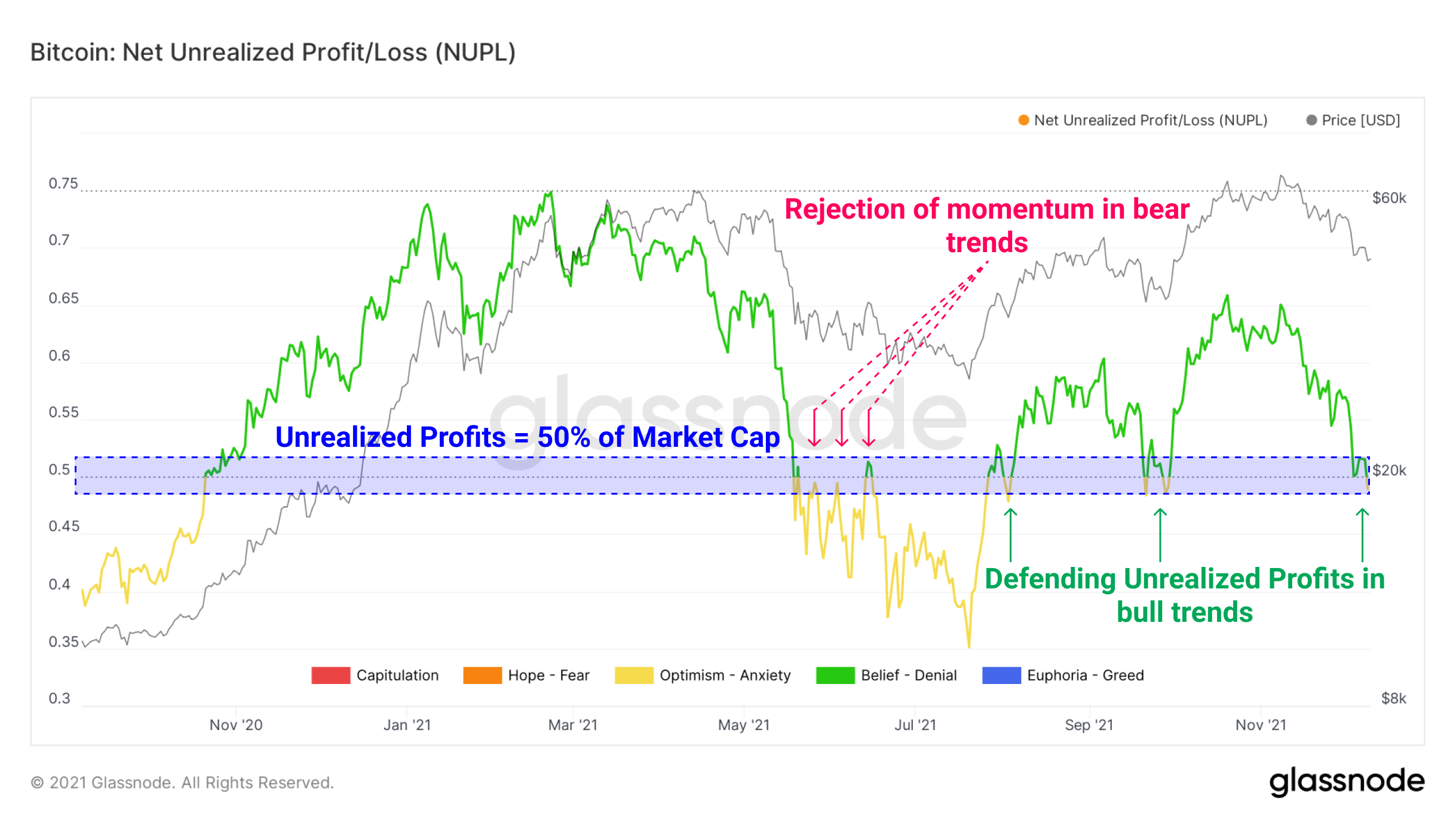
As per the latest weekly report from Glassnode, the NUPL shows that the market has entered a key zone that can decide whether the following trend will be bullish or bearish.
The Net Unrealized Profit/Loss (NUPL) is an on-chain indicator that measures the difference between the unrealized profit and loss to check whether the market as a whole is currently in a state of profit or loss.
The metric measures this by looking at what price each coin on the chain was bought at, and comparing it with the current price.
When the value of the indicator is below zero, it means the overall Bitcoin network is in a state of profit at the moment.
On the other hand, when NUPL assumes values above zero, then the market is, on an average, having unrealized gains.
Related Reading | Weekend Volatility Awakens Bitcoin Buyers, Active Addresses
Now, here is a chart that shows how the value of this Bitcoin indicator has changed over the past year:
Looks like the overall market is currently in a state of profit | Source: The Glassnode Week Onchain (Week 50)
As you can see in the above graph, there is a highlighted zone around the NUPL value of 0.5. At this value, 50% of the Bitcoin market cap is in the form of unrealized gains.
Related Reading | Goldman Sachs CEO Sidesteps Bitcoin Inquiries, Says Blockchain Is More Important
The report describes this zone as a historical battleground between the bulls and the bears. During periods of bearish trend, this zone usually provides resistance, while in times of bullish sentiment, the zone would act as support.
Now as the chart shows, the indicator seems to be touching this zone again. This type of retest has already happened a few times in the past few months, and the bulls stood strong during those.
Back during the May crash, however, the support didn’t last and the indicator shot below the zone. Afterwards each touch of the zone sent the price back down.
It’s possible that the market might hold support here as well just like the last few retests. But it’s not set in stone; any transition down here could be bad for the coin’s price, just like how it was in May.
BTC’s Price
At the time of writing, Bitcoin’s price floats around $46.9k, down 8% in the last seven days. The below chart shows the trend in the price of BTC over the last five days.
BTC's price once again plunges down | Source: BTCUSD on TradingView
Featured image from Unsplash.com, charts from TradingView.com, Glassnode.com
The year-long mantra that the crypto market would see a blow-off top in December has proven to be a dud thus far and for the last week, most cryptocurrencies have been under sell pressure and Bitcoin (BTC) is encountering difficulty in trading above $47,000.
That said, it’s not all bad news for cryptocurrency holders on Friday because several altcoins have managed to post double-digit gains due to new exchange listings and protocol upgrades.
Top 7 coins with the highest 24-hour price change. Source: Cointelegraph Markets Pro
Data from Cointelegraph Markets Pro and TradingView shows that the biggest gainers over the past 24-hours were Flux (FLUX), SafePal (SFP) and Badger DAO (BADGER).
FLUX benefits from the “Binance bump”
Flux is a GPU mineable proof-of-work protocol aimed at creating a scalable decentralized cloud infrastructure for Web 3.0 applications.
VORTECS™ data and the NewsQuakes™ alerts from Cointelegraph Markets Pro began to detect a bullish outlook for FLUX on Dec. 9, prior to the recent price rise.
The VORTECS™ Score, exclusive to Cointelegraph, is an algorithmic comparison of historical and current market conditions derived from a combination of data points including market sentiment, trading volume, recent price movements and Twitter activity.
VORTECS™ Score (green) vs. FLUX price. Source: Cointelegraph Markets Pro
As seen in the chart above, the NewsQuake™ system put out an alert for FLUX on Dec. 9, less than an hour before the price began to spike 150% over the next day.
The announcement that helped spark the rapid price rise in FLUX was a notification that Binance would be list FLUX token on its platform. Shortly after this announcement, FLUX price rallied to a new all-time high at $4.01.
SafePal adds support for nine new networks
The SafePal project is a cryptocurrency hardware and software wallet solution for investors who hold assets on the Ethereum, Binance Smart Chain and Tron network.
Data from Cointelegraph Markets Pro and TradingView shows that after hitting a low of $1.55 on Dec. 6, the price of SFP has climbed 45.84% to hit a daily high at $2.27 on Dec. 10 as its 24-hour trading volume spiked 50% to $158 million.
SFP/USDT 4-hour chart. Source: TradingView
The building strength for SFP comes as the project released an updated version of its wallet app and added support for Cardano, Nervos Network, Avalanche, Fantom, HECO Chain, Songbird, BOBA Network, Optimism and Arbitrum.
Related: Trader who called 2017 Bitcoin price crash raises concerns over ‘double top’
Badger DAO prepares to reactivate its smart contracts
Badger DAO is an open-source decentralized autonomous organization focused on building products and infrastructure that increase the utility of Bitcoin in the decentralized finance landscape.
VORTECS™ data from Cointelegraph Markets Pro began to detect a bullish outlook for BADGER on Dec. 9, prior to the recent price rise.
VORTECS™ Score (green) vs. BADGER price. Source: Cointelegraph Markets Pro
As seen in the chart above, the VORTECS™ Score for BADGER spiked into the green zone and hit a high of 75 on Dec. 9, around three hours before the price increased 48% over the day.
The positive price action for BADGER comes as the protocol tries to bounce back from a Dec. 2 exploit which resulted in the halting of the project’s smart contracts.
The overall cryptocurrency market cap now stands at $2.218 trillion and Bitcoin’s dominance rate is 40.7%.
The views and opinions expressed here are solely those of the author and do not necessarily reflect the views of Cointelegraph.com. Every investment and trading move involves risk, you should conduct your own research when making a decision.
For those who can afford it, the recent dips in Bitcoin price have been nothing more than an opportunity to buy the digital asset at a discounted price. This has certainly been the case for El Salvador and now MicroStrategy, as both these entities have moved swiftly to take advantage of the price dip to increase their holdings.
El Salvador had quickly snapped up another 100 BTC when the price had fallen to $54,000, with the president once again saying that the country got the coins at a discount. MicroStrategy, the publicly traded firm that holds the largest amount of bitcoin on its balance sheet, followed in the footsteps of El Salvador. This time buying up $414 million worth of BTC.
Related Reading | Report Shows Institutional Investors Are Abandoning Bitcoin For Altcoins
MicroStrategy Deepens Bitcoin Bet
MicroStrategy has renewed its promise to keep adding bitcoin to its balance sheet with its latest purchase. The firm which is headed by Bitcoin maximalist Michael Saylor announced that it had bought even more bitcoins to add to its already impressive holdings. MicroStrategy’s latest purchase consisted of a $414 million buy, which amounted to 7,002 BTC added to its balance.
This recent purchase brought the total of MicroStrategy’s bitcoin holdings to a whooping 121,044 coins. The firm bought the digital asset at an average of $59,187 per coin, well below its record $69K high at the beginning of November.
MicroStrategy has purchased an additional 7,002 bitcoins for ~$414.4 million in cash at an average price of ~$59,187 per #bitcoin. As of 11/29/21 we #hodl ~121,044 bitcoins acquired for ~$3.57 billion at an average price of ~$29,534 per bitcoin. $MSTRhttps://t.co/OA8VWG1bZX
BTC recovers above $57K | Source: BTCUSD on TradingView.coms
MicroStrategy has gradually filled its coffers with bitcoin and has so far spent approximately $3.57 billion in total. Despite bitcoin’s drop from its all-time high, the firm continues to remain in profit with an average price of $29,534 per bitcoin.
Companies Betting Big On Bitcoin
MicroStrategy is not the only company that has thrown its hat in the ring with bitcoin, although it holds the largest volume of all publicly traded companies. Electric vehicle maker Tesla had also announced that it holds bitcoin on its balance sheet. Tesla which is headed by another Bitcoin maximalist in the person of Elon Musk holds 48,000 BTC on its balance sheets, currently worth around $2.99 billion.
Related Reading | El Salvador Buys Bitcoin Dip As Omicron Variant Ravages Market
Galaxy Digital is headed by Mike Novogratz, an outspoken crypto bull that has reiterated the potential of bitcoin numerous times. The firm also holds16,402 bitcoins on its balance sheet, $956.69 million in today’s value.
Square Inc. headed by Twitter boss, Jack Dorsey holds 8,027 BTC, while Marathon Patent Group holds around $280.7 million in bitcoin (4,813 BTC).
A recurring theme around all these companies is that no matter when they entered the market, they are all in profit by at least 100% of the value the bitcoins cost at the time of purchase.
Featured image from Forbes, chart from TradingView.com
Sam Bankman-Fried, the founder of the crypto exchange FTX, is optimistic about Solana (SOL). He believes that Solana has the potential to scale to Bitcoin’s (BTC) mass adoption level. Bankman-Fried added that Avalanche (AVAX) also has the potential to climb to the top.
He also believes Solana is better than ethereum as it’s one of the few blockchains with a plan to accommodate mass adoption.
Related Reading | Solana Hits New All-Time High, Surpasses Cardano And Tether To Fourth Place
The 29-year old crypto founder has a net worth of $22.5 billion, making him the youngest person to enter the Forbes rich list after Mark Zuckerberg.
Cryptos With The Potential For Real Adoption
In an interview with Kitco News on Thursday, Bankman-Fried talked about bull and bear runs. And which projects would see mass institutional adoption.
When asked if he thinks Bitcoin would see its last Bull run in December before eventually crashing, Bankman-Fried responded that he could not predict the future. However, there will always be more crashes as well as more bull runs. And in the next few years, he expects to see “see substantial institutional adoption of cryptocurrencies.”
In the event of a crash, however, he says that projects with loyal followers and important use-cases are more likely to survive. Hype-driven projects, like meme coins, often crash the hardest. “Projects that have real adoption, or potential for real adoption are the ones that loyalists will be backing, even during bear markets.”
Bankman-Fried also believes that Solana could be the next Bitcoin. And that there is a possibility that it could see mass adoption very soon. As he has previously said, Solana has a plausible roadmap to scale millions of transactions per second. And that is the most important indicator.
SOL trading at $196.5 | Source: SOLUSD on TradingView.com
“I think Solana has a shot at doing so, which is really exciting. I think that there are other tokens out there as well that are aiming to scale a bit, and Avalanche is one of them.” He emphasized that the core technology of every blockchain is something that is hard to overhaul. Furthermore, he says that Solana could potentially be the base for more DeFi applications in the future.
Bankman-Fried adds that Solana’s market cap could exceed Ethereum’s market. However, it is hard to make a concrete prediction. But one thing that cannot be disputed is that Solana fixes a lot of problems with Ethereum. These include high gas fees and low transaction rates. Subsequently, many have dubbed the network “ethereum killer.”
Solana Is Better Than Ethereum
Bankman-Fried believes that in terms of scale, not many blockchains could compare to Solana. Earlier this month, he spoke at Yahoo Finance and Decrypts’s “Crypto Goes Mainstream” conference.
Related Reading | Why Billionaire Chamath Palihapitiya Invested In The Solana Ecosystem
“Solana is one of the few currently existing public blockchains that has a really plausible roadmap to scale millions of transactions per second at you know, fractions of a penny per transaction, which is a scale that you need for this,” Bankman-Fried said. “That is not where a lot of other blockchains have been focusing, including ethereum.”
Featured image by Forbes, Chart from TradingView.com
Bitcoin started a fresh increase above $58,000 against the US Dollar. BTC traded close to $60,000 and is currently correcting gains.
Bitcoin started a fresh increase above the $58,000 and $58,500 levels.
The price is now trading above $58,000 and the 100 hourly simple moving average.
There was a break below a key bullish trend line with support near $58,550 on the hourly chart of the BTC/USD pair (data feed from Kraken).
The pair must remain above $57,500 and the 100 hourly SMA to start another increase.
Bitcoin Price is Back above 100 SMA
Bitcoin price was stable above the $57,000 level. BTC started a fresh increase and was able to clear the $58,000 resistance zone. There was also a break above the $58,500 level and the 100 hourly simple moving average.
However, there was no test of the $60,000 resistance zone. A high was formed near $59,400 and the price is now correcting gains. There was a break below the $58,500 support level.
Besides, there was a break below a key bullish trend line with support near $58,550 on the hourly chart of the BTC/USD pair. The pair traded below the 23.6% Fib retracement level of the upward move from the $55,909 swing low to $59,400 high.
An immediate support is near the $58,200 level. The first major support is now forming near the $57,650 level. It is close to the 50% Fib retracement level of the upward move from the $55,909 swing low to $59,400 high.
Source: BTCUSD on TradingView.com
The next major support is near the $57,500 level and the 100 hourly SMA, below which the price could resume its decline towards the main breakdown support at $55,500.
Fresh Increase In BTC?
If bitcoin stays above the $57,500 support and the 100 hourly SMA, it could start a fresh increase. On the upside, an initial resistance is near the $59,000 level.
The next key resistance is near the $59,500 level. A close above the $59,000 and $59,500 levels may possibly push the price above $60,000. The next major resistance sits near the $61,200 level.
Technical indicators:
Hourly MACD – The MACD is now gaining pace in the bullish zone.
Hourly RSI (Relative Strength Index) – The RSI for BTC/USD is declining towards the 50 level.
Major Support Levels – $57,650, followed by $57,500.
Major Resistance Levels – $59,000, $59,500 and $60,000.
Bitcoin’s (BTC) price action hasn’t been bullish despite the $69,000 all-time high on Nov. 10. Some argue that that descending channel formed 40 days ago is the dominant trend, and $56,000 marks its current resistance.
BTC/USD price on FTX. Source: TradingView
Such bearishness follows scrutiny from United States regulators, after a Nov. 1 report from the President’s Working Group on Financial Markets suggested that stablecoin issuers in the U.S. should be subject to “appropriate federal oversight,” similar to banks and savings associations.
On Nov. 12, the Bitcoin-backed exchange-traded fund (ETF) request was rejected by the U.S. Securities and Exchange Commission. To justify the denial, the regulator cited the lack of ability of its participants to deter fraud and market manipulation in Bitcoin trading.
More recently, on Nov. 23, the chair of the U.S. Senate Committee on Banking, Housing and Urban Affairs sent notices to multiple exchanges and stablecoin issuers. The questions on consumer and investor protection on stablecoins suggest that lawmakers may be preparing a hearing on the subject.
Still, bulls might have a different take on such news as stablecoins are by no means necessary for Bitcoin to work. Furthermore, there’s not much that the U.S. government can do to suppress projects and developers willing to relocate outside its jurisdiction.
Bitcoin options mostly bullish for Friday’s expiry
Despite the 17% pullback over the past 14 days from the $69,000 all-time high, the Bitcoin call (buy) options vastly dominate Friday’s expiry.
Bitcoin options aggregate open interest for Nov. 26. Source: Bybt
At first sight, the $1.9 billion in call (buy) options dominate the weekly expiry by 113% compared with the $885 million in put (sell) instruments. But the 2.13 call-to-put ratio is deceptive because the recent drop will likely wipe out 90% of the bullish bets.
For example, if Bitcoin’s price remains below $58,000 at 8:00 am UTC on Nov. 26, only $150 million worth of those call (buy) options will be available at the expiry. There is no value in the right to buy Bitcoin at $60,000 or $70,000 if it’s trading below that price.
Bears can secure a $365 million gain sub-$56k
Below are the four most likely scenarios based on the current price action. For example, the data shows how many contracts will be available on Friday for both bulls (call) and bear (put) instruments. The imbalance favoring each side represents the theoretical profit:
Below $56,000: 720 calls vs. 7,490 puts. The net result favors bear (put) options by $365 million.
Between $56,000 and $58,000: 2,630 calls vs. 4,840 puts. The net result is $125 million favoring the bear (put) instruments.
Between $58,000 and $60,000: 3,600 calls vs. 3,850 puts. The net result is balanced.
Between $60,000 and $62,000: 6,180 calls vs. 2,340 puts. The net result shifts favoring the call (bull) instruments by $230 million.
This crude estimate considers the call options used in bullish bets and put options exclusively in neutral-to-bearish trades. However, a trader could have sold a call option, effectively gaining a negative exposure to Bitcoin above a specific price. Unfortunately, there’s no easy way to estimate this effect.
Bulls have double the incentives to defend $56,000
As displayed by the 40-day descending channel, bulls need to keep the $56,000 resistance to avoid further losing momentum. One must keep in mind that it took less than two weeks to bring Bitcoin from $41,500 to $56,000 back on Oct. 10. Therefore, maintaining this level is crucial to validate Nov. 10’s all-time high.
Moreover, if bulls manage to push Bitcoin’s price above $58,000, that will save them from a potential $365 million loss if BTC bears gain the upper hand on the back of the regulatory winds. A mere 1.5% drop from the current $56,800 might give bears just enough confidence to instill even more pain.
The views and opinions expressed here are solely those of the author and do not necessarily reflect the views of Cointelegraph. Every investment and trading move involves risk. You should conduct your own research when making a decision.