2

Tag: Bitcoin

  • Small Cap Index Lead Gains In February, But What Is Bitcoin Doing?

    Small Cap Index Lead Gains In February, But What Is Bitcoin Doing?

    [ad_1]

    Altcoins have been bigger winners than bitcoin in the recent recovery. Even though the latter led the recovery, the smaller cap coins have been making all of the waves in the space, outperforming other indexes and bitcoin included. All of this has pointed to an altcoin season after a purported ‘crypto winter’ and the gains recorded so far in February are additional proof of this.

    Small Cap Index Takes The Lead

    The whole of the crypto market had suffered from the downtrend that began in December. However, the second week of February had come to some reprieve with double-digit gains across bitcoin and all of the indexes. The small, mid, and large cap indexes have all returned gains so far, but the small cap has taken the leading, showing increased bullish momentum in the smaller cap altcoins.

    Related Reading | Bitcoin Steadies Above $45k, US Inflation Comes In At 7.5% Year Over Year

    Just two weeks into February, the small cap index has seen gains as high as 19%. This is a huge step-up for the index after it closed out January as the worst-performing index, seeing accelerated losses compared to its counterparts. The tables have now turned as the gains for the small cap index have been 4% higher than all of the others.

    Small cap index returns highest gains

    Small cap index returns highest gains | Source: Arcane Research

    Bitcoin, the mid cap, and the large cap index all returned doubled-digit gains for January. Most of the gains recorded were from a single week that saw prices surge across the crypto market.

    What About Bitcoin?

    Bitcoin has no doubt also returned impressive gains for its investors in the same time period. It may not be as high as the small cap index but still remains one of the top gainers n the space. It follows the move of the market sentiment from extreme negativity back into the positive. Momentum picking up has also helped in this case.

    Related Reading | JPMorgan Puts Bitcoin At $150,000 In The Long-Term, But What About Its ‘Fair Value’?

    The Digital asset is now trading above its 20-day moving average but remains low on the 50-day average. At its current point, the next resistance for the asset to break lies at $45,240. However, a break above a second resistance point at $46,712 is what will really solidify its entrance into another bear rally. Until then, it will likely continue to hover between $43,000 and $44,000.

    Bitcoin price chart from TradingView.com

    BTC starts another recovery trend | Source: BTCUSD on TradingView.com

    On the support side, bitcoin’s break below $43,000 will see its next support at $42,790. Not a far-off point, but if it does not hold then another decline to $40,000 may be imminent.

    Nevertheless, the digital asset has shown strong sell signals around the 50 and 100-day moving averages. Unless buyers make significant headway in holding up the price of bitcoin, bears are more likely to take over, pulling bitcoin into another stretched-out downtrend.

    Featured image from Forbes, charts from Arcane Research and TradingView.com

    [ad_2]

    Source link

  • Bitcoin Steadies Above $45k, US Inflation Comes In At 7.5% Year Over Year

    Bitcoin Steadies Above $45k, US Inflation Comes In At 7.5% Year Over Year

    [ad_1]

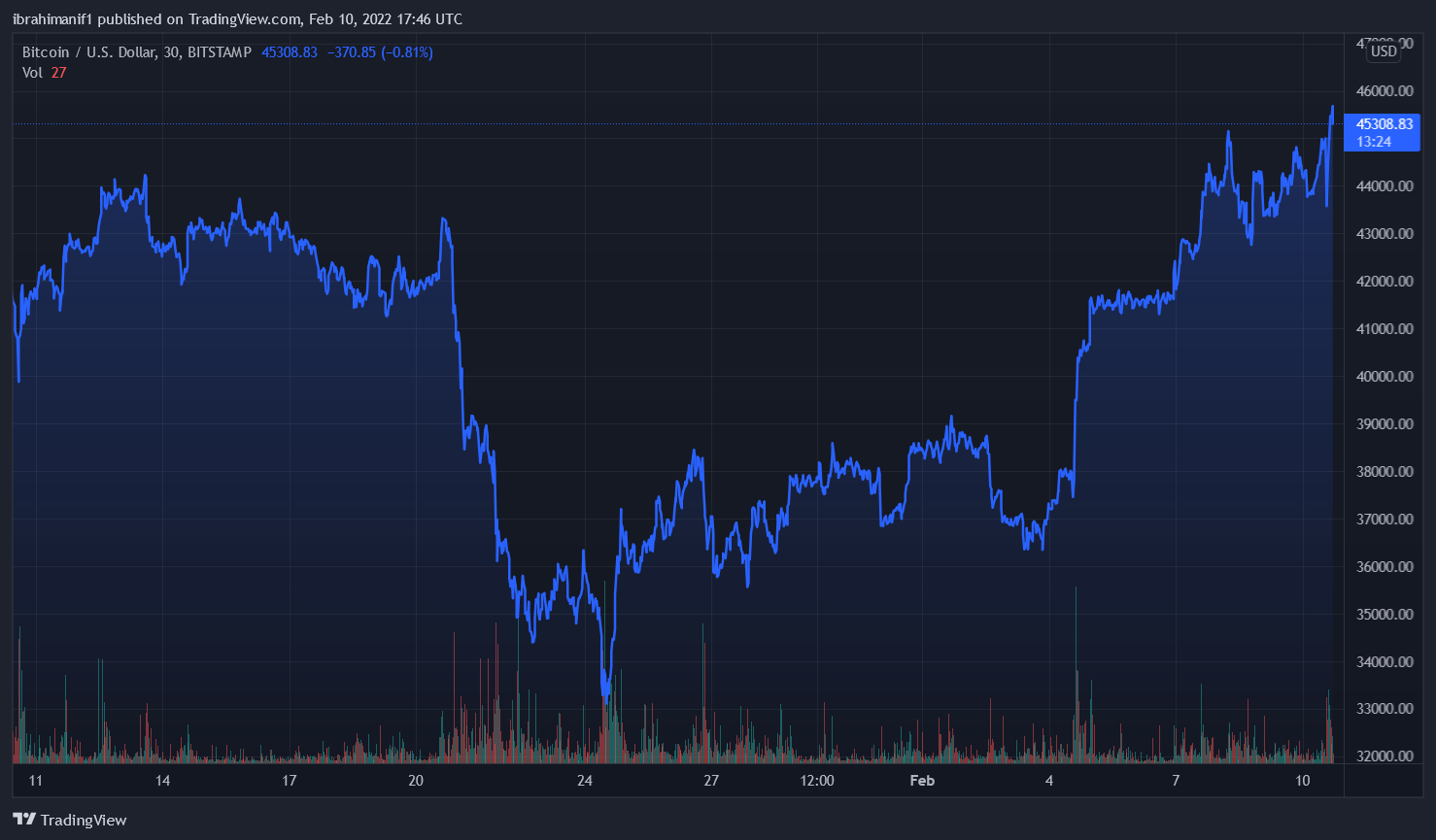
    Bitcoin price recovered to within $45k after sliding below $44k as analysts indicated probable swings for the flagship cryptocurrency. The release of US inflation rates seems to have had no effect on the king cryptocurrency.

    Bitcoin’s price rose past a crucial barrier overnight Wednesday, reaching $45,300, before falling as the broader market dipped in early trades after US markets opened.

    Bitcoin Unaffected By Inflation Rates

    Over the last 24 hours, BTC/USD has moved in a range of $43,402.81 – $45,398.91, exhibiting high volatility. Trading volume has climbed by 16.21% to $28.8 billion, while the overall market cap is around $860.47 billion dollars, leading in a 42% market dominance.

    As investors analyzed new US inflation data, which came in at 7.5% year-over-year vs an expected 7.3%, the earlier decline took shape. Risky assets like crypto and equities have reacted negatively, with all eyes on the Federal Reserve’s upcoming rate hike in March.

    Bitcoin

    BTC/USD steadies above $45k. Source: TradingView

    Despite being 0.2% higher than predicted, rising inflation did not have the same favorable impact on risk assets like Bitcoin as it had in recent months.

    The S&P 500 fell 0.23%, the Nasdaq composite fell 0.18%, and the Dow Jones Industrial Average remained barely above the flat line.

    According to analysts, the Federal Reserve may now have additional motivation to begin raising interest rates sooner due to the speed of year-over-year price increases.

    Crypto trader and analyst Michael van de Poppe observed:

    The Consumer Price Index (CPI) results for the U.S.A. are coming in at 7.5% year-over-year, the expectations were 7.3% year-over-year.$DXY is shooting up and risk-on assets are dropping down like Bitcoin & equities.Likelihood that the FED will start rate hikes in March.”

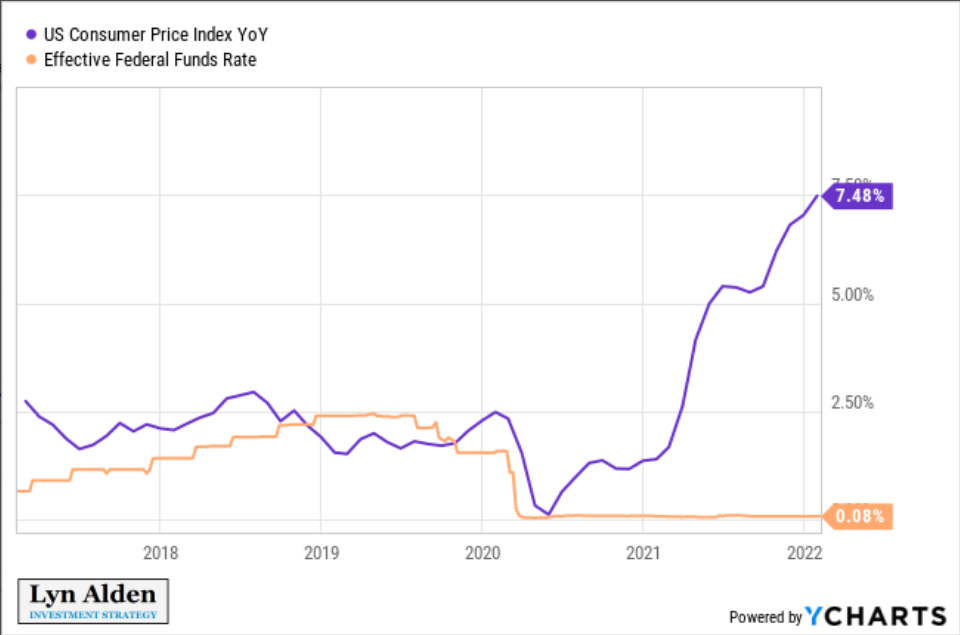
    However, for economist Lyn Alden, it was cash savers who had been losing the most from inflation. she noted alongside a chart:

    bitcoin and inflation rates

    U.S. CPI vs. effective federal funds rate chart. Source: Lyn Alden/ Twitter

    “Official inflation currently has its biggest gap over short-term interest rates since 1951. People holding cash in a bank or T-bills over the past year lost over 7% of their purchasing power.”

    Related article | Investors Take Refuge In Bitcoin As Inflation Rises

    BTC Will Hit $50k In Short term

    The Fed will be put to the test here, as they had hoped for a steady tightening cycle rather than a hasty tightening that would appear to be a policy blunder. The political pressure on the Biden administration and Democrats will increase as core inflation rises over the Fed’s objective and real average hourly earnings fall. Although November is still a long way off, this inflation report shows that price hikes are everywhere, and there is rising opposition to new fiscal stimulus measures that would exacerbate pricing pressures.

    As investors predict that pricing pressures may be peaking just before the Fed’s March policy meeting, US stocks have regained most of their inflation-related losses.

    Given the rise in global bond yields, Bitcoin prices are holding up well. Bitcoin’s optimal future environment is risk appetite, which may be tough to achieve until after the Fed’s first couple of rate hikes. Institutional investors in Bitcoin are focusing on Treasuries because the momentum trade appears to be quite simple. For the short term, Bitcoin appears to be settling in between $40,000 and $50,000.

    Cameron Winklevoss, co-founder of Gemini, feels Bitcoin is still the best inflation hedge, corroborating thoughts from the crypto community and even mainstream investors.

    Related article | Bitcoin Aims For $48K? BTC Reacts Upward To U.S. Inflation Report

    Featured image from iStockPhoto, Charts from TradingView.com


    [ad_2]

    Source link

  • Bitcoin (BTC) Leads Weekly Crypto Inflows

    Bitcoin (BTC) Leads Weekly Crypto Inflows

    [ad_1]

    The institutional crypto inflows rebounded last week after Bitcoin-related products attracted significant investment. In total, investors poured nearly $71 million into BTC investment products.

    Last week, digital asset investment products saw inflows worth $85 million. In the past three weeks, total institutional inflows in crypto products have reached $133 million. Apart from Bitcoin, a wide range of altcoins have gained the attention of institutional investors recently.

    Solana, Polkadot and Cardano witnessed inflows totaling $2.4 million, $2.2 million and $1.1 million, respectively. Digital asset Terra saw a massive spike in inflows last week. Despite the rising popularity of BTC, SOL, DOT, ADA and LUNA among institutional investors, Ethereum saw a bearish trend with outflows totaling $8.5 million in the previous week.

    “Digital asset investment products saw inflows totaling US$85m last week, marking the 3rd week of inflows totaling US$133m, suggesting continued positive sentiment amongst investors. Total assets under management (AuM) now total US$52.4bn with January 24th marking the low point in the most recent run of negative sentiment. While Europe has seen inflows (US$10.3m), the majority has been from the Americas, particularly Brazil and Canada (US$75m),” CoinShares noted in its report.

    Bitcoin AUM

    Due to the market dip in December 2021 and January 2022, the overall value of global Bitcoin assets under management have declined substantially. According to the report from CoinShares, the total value of global BTC AUM reached $34.4 billion last week. Ethereum came in the second spot with almost $13 billion worth of assets under management.

    “Bitcoin continues to lead the inflows with US$71m last week, the largest since early December with this 3-week run of inflows totaling US$108m. Volumes in Bitcoin investment products remained low last week at US$1.8bn versus US$3.4bn the previous week,” CoinShares added.

    Yesterday, BTC jumped above the price level of $44,300 for the first time since 13 January 2022.

    The institutional crypto inflows rebounded last week after Bitcoin-related products attracted significant investment. In total, investors poured nearly $71 million into BTC investment products.

    Last week, digital asset investment products saw inflows worth $85 million. In the past three weeks, total institutional inflows in crypto products have reached $133 million. Apart from Bitcoin, a wide range of altcoins have gained the attention of institutional investors recently.

    Solana, Polkadot and Cardano witnessed inflows totaling $2.4 million, $2.2 million and $1.1 million, respectively. Digital asset Terra saw a massive spike in inflows last week. Despite the rising popularity of BTC, SOL, DOT, ADA and LUNA among institutional investors, Ethereum saw a bearish trend with outflows totaling $8.5 million in the previous week.

    “Digital asset investment products saw inflows totaling US$85m last week, marking the 3rd week of inflows totaling US$133m, suggesting continued positive sentiment amongst investors. Total assets under management (AuM) now total US$52.4bn with January 24th marking the low point in the most recent run of negative sentiment. While Europe has seen inflows (US$10.3m), the majority has been from the Americas, particularly Brazil and Canada (US$75m),” CoinShares noted in its report.

    Bitcoin AUM

    Due to the market dip in December 2021 and January 2022, the overall value of global Bitcoin assets under management have declined substantially. According to the report from CoinShares, the total value of global BTC AUM reached $34.4 billion last week. Ethereum came in the second spot with almost $13 billion worth of assets under management.

    “Bitcoin continues to lead the inflows with US$71m last week, the largest since early December with this 3-week run of inflows totaling US$108m. Volumes in Bitcoin investment products remained low last week at US$1.8bn versus US$3.4bn the previous week,” CoinShares added.

    Yesterday, BTC jumped above the price level of $44,300 for the first time since 13 January 2022.

    [ad_2]

    Source link

  • Bitcoin Settles Above $43,000, But What Does The 4-Year Cycle Say?

    Bitcoin Settles Above $43,000, But What Does The 4-Year Cycle Say?

    [ad_1]

    Bitcoin has already lost its footing above $44K after breaking the coveted point to much fanfare. The downtrend has not been significant in any way but the digital asset could still end up losing more ground before the end of the trading day. Nevertheless, it has been a good run for bitcoin coming out of the weekend. As the cryptocurrency has made its bottom above $43,000, what could be expected going forward?

    Bitcoin In Four-Year Cycles

    As bitcoin has settled above $43,000, looking at other metrics to figure out where the digital asset may be headed has become imperative. In this report, we take a look at bitcoin through 4-year cycles and what it has often meant for the asset. Four years is important to the movement of bitcoin given that things like halvings happen in such timeframes. But for this, we take a look at the monthly EMA50 and how it works as the last correctional support before takeoff.

    Related Reading | TA: Bitcoin is Surging, Why Bulls Could Aim More Upsides

    The monthly exponential moving average is calculated using the past 50 periods. It is used to obtain the average price at which an asset has been acquired over a 50-day period. Thus, making it a widely used support level.

    Over the years, at four-year intervals, the monthly EMA50 has served to show the final correction support for bitcoin. The first time was between 2009 to 2013, a four-year period that ended with the monthly EMA50 working as the final correction support. The same happens between 2013 and 2017, 2017 and 2021, with the next happening between 2021 and 2025.

    For each of these, the monthly EMA50 has always stopped highly than the previous four-year cycle. Likewise, the price of bitcoin has not gone below this point.

    If this stays true, then bitcoin is likely forming its support higher than $30,000. Continuing on, this trend would put the price of the digital asset as high as $220,000 over the next four years.

    bitcoin chart

    EMA50 marks four-year cycles | Source: TradingView.com

    BTC On The Charts

    Long-term, bitcoin shows tremendous promise. With adoption expected to rise and supply on the decline, it would impose scarcity on the asset, making it even more valuable. However, in the short term, BTC continues to struggle price-wise.

    Related Reading | The Bear Signal That Suggests Another Bitcoin Crash Is Coming

    After fighting its way out of a bear trend, it remains up to the bulls to pull out from underneath the bears. Market sentiment is getting better but still remains mostly negative, making investors wary of putting more money into the market.

    Bitcoin is now trading in the $43,500 territory at the time of this writing. It lost about $2K after bursting through $45,000 in the early hours of Tuesday. But it has begun to recover after falling near $43,000.

    Bitcoin price chart from TradingView.com

    BTC slips to $43K | Source: BTCUSD on TradingView.com
    Featured image from Tokeneo, charts from TradingView.com

    [ad_2]

    Source link

  • Bitcoin Hits Two-week High Imitating The Stock Rally

    Bitcoin Hits Two-week High Imitating The Stock Rally

    [ad_1]

    Cryptocurrencies are seeing a significant recovery as investors take advantage of the recent stock market rally and increased risk appetite. Bitcoin hits its highest in two weeks, extending gains from earlier this week that had seen it climb to $41,938 per coin on Saturday morning (Jan 24th).

    Related Reading | Bitcoin mimics stocks rally, hits two-week high

    Bitcoin, the largest digital currency globally, has hit $41,938. It is 16% high from Thursday’s low and 27% from the current year’s low of $32,950.

    Bitcoin Price
    Bitcoin price hits two weeks high of $41,938. Source: Tradingview.com

    Ether, the second-largest digital currency, has scaled new heights, reaching $3K for the first time since January 21.

    Bitcoin recorded its biggest single-day gain since mid-June as fears of faster than expected Fed rate hikes led to an increase in inflation, with the cryptocurrency also being roiled by technological innovation. However, Friday’s 11% rise was enough to consider haven against this trend and get some positive press at least until Monday when everything will likely go back down again.

    Bitcoin Price Recovery: Thanks to Amazon

    Despite a long week of volatility from earnings, US stocks ended the week strong. The tech-heavy NASDAQ secured gains thanks to Amazon’s robust growth and Facebook owner Meta Platforms’ disappointing results that evening gave them more confidence in their business models moving forward.

    Related Reading | Amazon Strong Growth Attributed to the Cloud Despite Retail Headwinds

    Bitcoin has moved seamlessly into the mainstream. That resulted in investors looking to get in on the action when risk appetite is low. Ed Hindi, Chief Investment Officer of Tyr Capital, said;

    “The current panic and volatility surrounding bitcoin are based on a fundamental misunderstanding of it as an asset class. When valuations on the Nasdaq fall, misguided institutional investors start liquidating bitcoin positions en masse as if it were a tech stock.”

    The recent rise in the stock market has given other listed crypto assets a boost. As a result, some currencies even reached new highs.

    BTC Price Prediction

    Though prices for Bitcoin have seen a significant drop in the last week of January and were sitting at 47% of their all-time high, the cryptocurrency recovered slightly after reaching a low of $33K on Jan 24, 2022, and is worth about $42k.

    Buy, sell and hold? Analysts are split on whether or when to buy cryptocurrency. But more than half believe this is a good time for buyers, with only 45% disagreeing.

    The experts from the top fintech companies predict that by the end of 2022, bitcoin will reach an all-time high of $93,717 – more than 24K dollars higher than its current all-time high price.

    This is a great time to invest in cryptocurrency. Experts predict that by the end of 2025, bitcoin will trade at $192k and mount up over 300% from its November 2021 peak and reach nearly half a million dollars by 2030. While these predictions may seem lofty goals at first glance, they’re significantly less than what experts predicted back in July 2021 when their last forecast said bitcoins prices could reach 265k or 706K, respectively.

                       Featured image from Pixabay, chart from TradingView.com

    [ad_2]

    Source link

  • Bitcoin (BTC) Mining: Is It Still Profitable?

    Bitcoin (BTC) Mining: Is It Still Profitable?

    [ad_1]

    Despite price challenges and a surge in regulations around Bitcoin mining, the BTC hash rate is making new records every week. In January 2022, the mean hash rate breached the level of 183 Exahash, the highest level on record. BTC network witnessed a sooner-than-expected recovery in the mining sector after China announced a crackdown on the mining of digital assets in the region.

    Overall, the hash rate plummeted as much as 54% in May 2021. However, leading Bitcoin mining companies shifted to other global locations due to the mining-friendly approach by the relevant governments and cheap electricity. With mining rewards getting less amid Bitcoin halving events, rising competition, and energy issues, there is one key question that comes into the mind of every individual interested in this sector, is BTC mining still profitable?

    Well, analysts believe it is, and they have some strong numbers to back their claims. According to Paolo Ardoino, CTO of Bitfinex, large institutions will take more interest in Bitcoin mining in the coming months. “I expect the bitcoin hash rate to continue to rise as competition in the bitcoin mining space increases. In fact, bitcoin mining is demonstrating a strong degree of anti-fragility. Notably, the China ban in the summer of 2021 demonstrated the resilience of the sector. Businesses will continue to be attracted to the space and this in itself is a testament to the profitability of the space as a whole,” Ardoino said.

    Cost of Electricity

    According to Maria Stankevich, Chief Business Development Officer at EXMO UK, the cost of energy plays an important role in the profitability of Bitcoin mining and the reason behind leading mining players moving to locations like the US and Europe is that the price of electricity for mining is very low in the mentioned regions.

    “Bitcoin mining is still profitable in 2022. If we are going into the details, then let’s look at the different aspects of mining that we should take into consideration when we talk about its profitability. Cost of electricity, the electricity prices are very different from country to country. Russia, for example, has very low prices for electricity compared to some areas (like Siberia), so it charges a lower price for industrial electricity in order to encourage economic growth. This means that a mining farm in Siberia will pay 50% as much for the electricity you would mine at home in Germany or the USA,” Maria said.

    “Secondly, the mining hardware. There are plenty of different mining machines today, but according to different studies, the majority of the most modern machines could remain profitable at a bitcoin price between $5000 and $6000. Thirdly, reliable mining pool and fees while selling BTC. Today, there are a few very big mining pools that provide certain security to the miners. Sometimes, they have referral partnerships with some exchanges that lower commissions. But even without this mechanism, fees on the exchanges dropped significantly over the past few years, so from this point of view mining also looks profitable,” she added.

    Current Bitcoin Mining Ecosystem

    Ilman Shazhaev, Executive Chairman of OneBoost, believes that the current dynamics of the crypto market facilitate Bitcoin mining, even at a low BTC price.

    “As for BTC mining profitability, I can confidently say that it is still profitable. Bitcoin mining is especially profitable because, despite the current situation with the all-time-high hash rate (around 200 exahashes) and the price fluctuations below $40,000 (which are the least favorable conditions), the top-end devices are so energy-efficient that just around 40% of the mined Bitcoin covers the company’s expenditure, the rest is pure profit. If you compare it with a similar situation in 2018 and 2019, the expenditure back then constituted 70–80 percent with 14 nm chips,” Shazhaev noted.

    “So, without a shadow of a doubt, Bitcoin mining is profitable at the moment, and despite all the price swings during 2021, analytical reports from our data centers alone show the average statistics of an 80% profitability rate. Respectively, even taking into account all the complications for mining due to the low price and the high Bitcoin mining difficulty, mining of the first cryptocurrency clearly remains profitable,” the Executive Chairman of OneBoost, highlighted.

    Recovery

    The BTC mining sector has recovered quickly from the recent setbacks like China’s ban, Russia’s crypto rumors, Kazakhstan’s shutdown, and energy consumption-related problems. Farah Mourad, the Senior Market Analyst at XTB MENA, outlined that the recovery indicates strong Bitcoin mining fundamentals.

    “Since its crash back in June, Bitcoin mining difficulty indicator recovered from China’s crackdowns effect reaching a new all-time high. Since then, the markets expected the mining hash rate to remain in an uptrend, until the potential Russian crackdown on bitcoin mining. Would this change the expectations? It is important to note that a potential Russian crackdown on bitcoin mining, would result in a lower hash rate, which doesn’t necessarily mean more profit for miners,” Farah said.

    “The direct effect would be seen over bitcoin value and revenue. As we’ve seen post-China crackdown, miners managed to recover fast. Any potential profit for individual mining might be short-lived with the challenge of having access to extremely low-cost electricity. We continue to see a significant accumulation trend since 2021. Putin backing crypto mining might be supporting the trend for the short term as well. A potential migration is still on the table which would lead to changes in trends. Mining spreading over different jurisdictions might potentially bring more stability to hash rates,” she added.

    Despite price challenges and a surge in regulations around Bitcoin mining, the BTC hash rate is making new records every week. In January 2022, the mean hash rate breached the level of 183 Exahash, the highest level on record. BTC network witnessed a sooner-than-expected recovery in the mining sector after China announced a crackdown on the mining of digital assets in the region.

    Overall, the hash rate plummeted as much as 54% in May 2021. However, leading Bitcoin mining companies shifted to other global locations due to the mining-friendly approach by the relevant governments and cheap electricity. With mining rewards getting less amid Bitcoin halving events, rising competition, and energy issues, there is one key question that comes into the mind of every individual interested in this sector, is BTC mining still profitable?

    Well, analysts believe it is, and they have some strong numbers to back their claims. According to Paolo Ardoino, CTO of Bitfinex, large institutions will take more interest in Bitcoin mining in the coming months. “I expect the bitcoin hash rate to continue to rise as competition in the bitcoin mining space increases. In fact, bitcoin mining is demonstrating a strong degree of anti-fragility. Notably, the China ban in the summer of 2021 demonstrated the resilience of the sector. Businesses will continue to be attracted to the space and this in itself is a testament to the profitability of the space as a whole,” Ardoino said.

    Cost of Electricity

    According to Maria Stankevich, Chief Business Development Officer at EXMO UK, the cost of energy plays an important role in the profitability of Bitcoin mining and the reason behind leading mining players moving to locations like the US and Europe is that the price of electricity for mining is very low in the mentioned regions.

    “Bitcoin mining is still profitable in 2022. If we are going into the details, then let’s look at the different aspects of mining that we should take into consideration when we talk about its profitability. Cost of electricity, the electricity prices are very different from country to country. Russia, for example, has very low prices for electricity compared to some areas (like Siberia), so it charges a lower price for industrial electricity in order to encourage economic growth. This means that a mining farm in Siberia will pay 50% as much for the electricity you would mine at home in Germany or the USA,” Maria said.

    “Secondly, the mining hardware. There are plenty of different mining machines today, but according to different studies, the majority of the most modern machines could remain profitable at a bitcoin price between $5000 and $6000. Thirdly, reliable mining pool and fees while selling BTC. Today, there are a few very big mining pools that provide certain security to the miners. Sometimes, they have referral partnerships with some exchanges that lower commissions. But even without this mechanism, fees on the exchanges dropped significantly over the past few years, so from this point of view mining also looks profitable,” she added.

    Current Bitcoin Mining Ecosystem

    Ilman Shazhaev, Executive Chairman of OneBoost, believes that the current dynamics of the crypto market facilitate Bitcoin mining, even at a low BTC price.

    “As for BTC mining profitability, I can confidently say that it is still profitable. Bitcoin mining is especially profitable because, despite the current situation with the all-time-high hash rate (around 200 exahashes) and the price fluctuations below $40,000 (which are the least favorable conditions), the top-end devices are so energy-efficient that just around 40% of the mined Bitcoin covers the company’s expenditure, the rest is pure profit. If you compare it with a similar situation in 2018 and 2019, the expenditure back then constituted 70–80 percent with 14 nm chips,” Shazhaev noted.

    “So, without a shadow of a doubt, Bitcoin mining is profitable at the moment, and despite all the price swings during 2021, analytical reports from our data centers alone show the average statistics of an 80% profitability rate. Respectively, even taking into account all the complications for mining due to the low price and the high Bitcoin mining difficulty, mining of the first cryptocurrency clearly remains profitable,” the Executive Chairman of OneBoost, highlighted.

    Recovery

    The BTC mining sector has recovered quickly from the recent setbacks like China’s ban, Russia’s crypto rumors, Kazakhstan’s shutdown, and energy consumption-related problems. Farah Mourad, the Senior Market Analyst at XTB MENA, outlined that the recovery indicates strong Bitcoin mining fundamentals.

    “Since its crash back in June, Bitcoin mining difficulty indicator recovered from China’s crackdowns effect reaching a new all-time high. Since then, the markets expected the mining hash rate to remain in an uptrend, until the potential Russian crackdown on bitcoin mining. Would this change the expectations? It is important to note that a potential Russian crackdown on bitcoin mining, would result in a lower hash rate, which doesn’t necessarily mean more profit for miners,” Farah said.

    “The direct effect would be seen over bitcoin value and revenue. As we’ve seen post-China crackdown, miners managed to recover fast. Any potential profit for individual mining might be short-lived with the challenge of having access to extremely low-cost electricity. We continue to see a significant accumulation trend since 2021. Putin backing crypto mining might be supporting the trend for the short term as well. A potential migration is still on the table which would lead to changes in trends. Mining spreading over different jurisdictions might potentially bring more stability to hash rates,” she added.

    [ad_2]

    Source link
  • Bitcoin encourages transparency, long-term thinking

    Bitcoin encourages transparency, long-term thinking

    [ad_1]

    Twitter co-founder and Block (previously Square) CEO Jack Dorsey discussed the implications of a Bitcoin (BTC)-powered universal basic income (UBI) strategy with US congressional candidate and a full-time elementary school teacher, Aarika Rhodes. 

    “Obscurity of information forces and incentivizes people to negative (financial) behaviors that don’t work for them, their community or family,” said Dorsey while pointing out the lack of transparency within the existing centralized financial system.

    “If there’s one thing to focus on in Bitcoin — the operations are transparent, the code is transparent, the policy is transparent.”

    This base foundation of BTC is what Dorsey believes has the potential to solve numerous use cases and problems as a direct result of using fiat currency. Through business initiatives including Start Small, the entrepreneur has invested over $55 million across the United States and overseas to experiment on UBI.

    “We’re about to do a test of the UBI-like concept with Bitcoin as well.”

    Dorsey’s BTC-powered UBI experiment will involve creating a small-scale closed-loop community of sellers and merchants that adhere to the Bitcoin standards. Based on the happiness quotient and willingness to participate, he intends to identify use cases for wide-scale implementation.

    Rhodes strongly believes that involving Bitcoin will reduce the costs related to banking fees:

    “When you have something like Lightning (network), where you can transact at very low fees is a benefit for everyone. It doesn’t matter where are economically.”

    In terms of financial literacy, Dorsey said that adopting the Bitcoin standard inculcates long-term thinking, however, his skepticism toward a BTC-powered universal basic income will reduce based on the results portrayed by the ongoing experiments:

    “Just that action of owning it (BTC) will change people’s mindsets in fundamental ways that are net positive and compounds throughout their communities, and encourages other actions like sellers and merchants around them doing similar things.”

    Along with the benefits that come with the Bitcoin standard, Dorsey is also vigilant about its negative impacts. On an end note, he highlighted the inefficiencies within the government policies and how UBI helps address some of the challenges:

    “If you intend to help people by giving them money directly is far better than the money that the governments (federal and local) spends on these existing support structures. It’s not helping people.”

    Related: Jack Dorsey: Diem was a waste of time, Meta should’ve focused on BTC

    In a recent interview with MicroStrategy CEO Michael Saylor, Dorsey opined that Facebook (later rebranded as Meta) should’ve used an open-ended protocol like Bitcoin rather than attempting to create its own currency, Diem.

    As Cointelegraph reported, Dorsey added that making BTC more accessible would also benefit many of Meta’s instant messaging and voice-over-IP services such as Facebook Messenger, Instagram and WhatsApp.