Data shows the Bitcoin fear and greed index has now reached the highest level since the peak in November as the price of the crypto rallies up.
Bitcoin Fear And Greed Index Now Points At “Greed”
As per the latest weekly report from Arcane Research, the BTC fear and greed index has surged to values of greed sentiment this week.
The “fear and greed index” is an indicator that tells us about the current general market sentiment among Bitcoin investors.
The metric uses a numeric scale that travels from one to hundred for representing this sentiment. All values above fifty signify that investors are greedy at the moment. While those below the cutoff suggest a fearful market.
Values above 75 and below 25, that is, the values toward the ends of the range, represent extreme greed and extreme fear, respectively.
Now, here is a chart that shows the trend in the Bitcoin fear and greed index over the past year:
Looks like the value of the indicator has surged up recently | Source: Arcane Research's The Weekly Update - Week 12, 2022
As you can see in the above graph, the Bitcoin fear and greed index has sharply risen over the past week. The indicator now has a value of 56, which shows the market is getting greedy.
This value of the metric is now more than in any other period in the year 2022 so far, and is the highest since the peak in early November of last year.
Related Reading | Glassnode’s RHODL Ratio May Suggest Bitcoin Market Is Near Capitulation
Historically, Bitcoin peaks have tended to happen while the sentiment is that of extreme greed, and bottoms have formed during periods of extreme fear.
There is a popular trading technique called “contrarian investing” that makes use of this fact. Traders following this methodology think that the best time to buy is during extreme fear, while extreme greed is when one should sell.
Related Reading | Bitcoin Weekly Momentum Flips Bullish For First Time In 2022: What Data Says
This famous quote by Warren Buffet sums up this philosophy: “Be fearful when others are greedy, and greedy when others are fearful.”
So, following the line of thinking of contrarian investors, the current market sentiment turning greedy may be a sign that you should now start getting fearful instead.
BTC Price
At the time of writing, Bitcoin’s price floats around $47.3k, up 12% in the last seven days. Over the past month, the crypto has gained 26% in value.
The below chart shows the trend in the price of the coin over the last five days.
The price of Bitcoin seems to have surged up over the past few days | Source: BTCUSD on TradingView
Featured image from Unsplash.com, charts from TradingView.com, Arcane Research
Opera, one of the major crypto-friendly internet browsers, announced the integration of eight blockchains in a continued effort to introduce Web3 to more than 380 million mobile and desktop users worldwide.
In Jan. 2022, Opera launched the Crypto Browser project, a Web3-focused initiative for facilitating navigation across decentralized applications (DApp), games and metaverse platforms. As part of this initiative, the browser company added support for eight major blockchain ecosystems, including Bitcoin (BTC), Solana (SOL), Polygon (MATIC), StarkEx, Ronin, Celo, Nervos DAO and IXO.
Opera said in the announcement that its users now have access to the Polygon and Solana DApp ecosystems, as well as “the benefits of Layer 2 DeFi via StarkWare-powered DiversiFi.”
The latest integrations enable Opera users to access Polygon proof-of-stake (POS) blockchain and Ethereum L2 ecosystem via StarkEx.
Opera’s Crypto Browser project. Source: Opera
According to the company, the intention behind integrating multiple blockchains was to ensure chain agnosticism and Web3 involvement in an environment-friendly manner. Jorgen Arnesen, EVP Mobile at Opera stated:
“Ultimately, Web3 is on its way to becoming a mainstream web technology and users won’t need to know they’re interacting with it. They need to get a superior user experience and a true benefit.”
The announcement further highlighted the need for carbon-neutral solutions with low gas fees, which stands as one of the main reasons for choosing Polygon over the Ethereum blockchain.
Related: Brave to integrate with Solana blockchain on its privacy-enabled browser
Back in Nov. 2021, Opera competitor Brave browser integrated Solana blockchain to strengthen its DApps capability.
We’ve partnered with @solana to integrate it into the browser and make it the default for DApp support. We will soon bring best-in-class wallet features for the Solana blockchain into our desktop & mobile browsers. #BreakpointLisbon https://t.co/tTB7NXKWjI
Citing the partnership, Brendan Eich, CEO and co-founder of Brave said that:
“With more and more users and creators requiring tools for fast and affordable access to the decentralized Web, this integration will seamlessly pave the way for the next billion crypto users to harness applications and tokens.”
Brave is yet to announce the addition of multi-chain support to rival its growing competition.
Data from Cointelegraph Markets Pro and TradingView confirmed BTC/USD hitting multi-week highs of $45,137 Friday as Wall Street got underway.
As $45,000 reappeared for the first time since the start of the month, however, so did all-too-familiar behavior among some of Bitcoin’s biggest investors.
Attention turned to exchange Bitfinex on the day, a platform famous for large-volume traders, or whales, guiding short-term price action with their trades.
As noted by popular trader Pentoshi, the entity which had purchased BTC at the last low near $34,000 had now put in a significant ask position beginning at $45,000.
The finex whale who made the bottom (same signature) just showed up with a lot of asks presumably to close out those 34k longs. Something to watch in the coming days $BTCpic.twitter.com/gDR8qvBVEl
Blockware lead insights analyst William Clemente agreed, telling Twitter users that it was now “popcorn time” for the market.
For Cointelegraph contributor Michaël van de Poppe meanwhile flagged “a dozen” possible lower price targets should BTC/USD sweep liquidity at previous rejection points from March, these also lying just above $45,000.
“I’m not saying I’m bearish at this stage, but while we’re making this build-up, I’m not really interested into longs at this point,” he said in his latest YouTube update.
Only a rechallenge of $50,000, he added, would form the impetus to consider long positions.
“No longs” on Ethereum, says trade
Van de Poppe added that altcoins were also on the radar and that it would be interesting to see how Ether (ETH) in particular deals with upcoming resistance.
Related: What are the BTC price levels to watch as Bitcoin nears March peak?
The top ten cryptocurrencies by market cap showed clear copycat strength on daily timeframes, led by ETH/USD which matched Bitcoin’s 5% gains.
Overall still watching how #Bitcoin is going to react at resistance, and especially how $ETH will handle it there.
Cardano (ADA), while dropping several percentage points on the day, was still up 35% compared to the same time last week, making it the top-ten’s best performer.
Republican Congressman Pete Sessions from Texas has come out with a bold statement about the impact Bitcoin mining will have not just on his state but on the United States as a whole.
The Texan representative, a proponent of Bitcoin (BTC) mining, tweeted on March 22 that “Bitcoin Mining will play a critical role in rebuilding energy independence in the USA.” His statement drew a mixed bag of reactions from both supporters and critics. Wyoming’s Republican Senator Cynthia Lummis was among the supporters who responded to his tweet with a succinct “Indeed.”
#Bitcoin Mining will play a critical role in rebuilding energy independence in the USA
Both lawmakers have been vocal advocates for policies that support innovation in the crypto industry, not just for miners. As U.S. consumers suffer from a spike in gas prices due to global tensions, the debate has ramped up about how the country can reduce its dependence on external energy sources.
Sessions’ view highlights a growing compilation of research that suggests the innovations from the BTC mining industry could have global applications in industrial energy consumption and production.
As Texas has come to contribute over 14% of the country’s total Bitcoin hash rate, the stability of the state’s electrical grid and the environmental impact of miners have come to the forefront of growing criticism, as it has in other mining hubs around the world.
Despite those concerns, various researchers have suggested that the growing mining market in Texas could reduce its net environmental impact and energy demands on the public energy grid.
A March 2021 research paper detailed how flexible data centers could promote renewable energy resources. A flexible data center generates its own energy either from a small dedicated renewable power plant or draws power from the grid depending on the grid’s current state.
According to the U.S. Energy Information Administration (EIA), Texas is already the country’s leading wind power generator. Therefore, miners may already have access to renewable energy when needed. Promoting miners to utilize a flexible data center model could stimulate greater growth in renewable energy accessibility and reliability. The paper stated:
“Hence, the (integrated energy system) may contribute to grid stability by locally using generated electricity instead of feeding it into the grid.”
Software solutions firm Lancium published similar research last October. It concluded that as the mining industry grows and more operations implement a flexible data center model, it will likely prevent energy grid shortages while promoting the growth of renewable energy resources. Researcher Joshua D. Rhodes, Ph.D. said in the paper.
“As grids move towards incorporating higher levels of intermittent resources, such as wind and solar, flexible demand will play an ever more important role in keeping the electrical grid system stable.”
Related: New York Bitcoin mining moratorium bill garners more support
Texas is a significant hub of Bitcoin mining in the United States as Hive Blockchain, Riot Blockchain, Argo Blockchain, and others have operations in the Lone Star State.
According to the unconfirmed sources, Honduras may officially adopt Bitcoin by giving it a legal tender status. Honduras President, Xiomara Castro may make the announcement within several hours.
Honduras may follow the steps of El Salvador in adopting Bitcoin
Bitcoin
Bitcoin is the world’s first digital currency that was created in 2009 by a mysterious entity named Satoshi Nakamoto. As a digital currency or cryptocurrency, Bitcoin operates without a central bank or single administrator. Instead, Bitcoin can be sent via a Peer-to-Peer (P2P) networking, devoid of intermediaries.Bitcoins are not issued or backed by any governments or banks, and Bitcoin is not considered to be legal tender, although they do have status as an acknowledged transfer of value in some jurisdictions. Rather than composing a physical currency, Bitcoins are pieces of code that can be sent and received across a kind of distributed ledger network called a blockchain. Transactions on the Bitcoin network are confirmed by a network of computers (or nodes) that solve a series of complex equations. This process is called mining. In exchange for mining, the computers receive rewards in the form of new Bitcoins. Mining grows increasingly difficult over time, and the rewards get smaller and smaller. There is a total of 21 million Bitcoins. As of May 2020, there are 18.3 million Bitcoins in circulation. This number changes approximately every 10 minutes when new blocks are mined. Presently, each new block adds 12.5 bitcoins into circulation.Since its inception, Bitcoin has remained the most popular and largest cryptocurrency in terms of market cap in the world. Bitcoin’s popularity has contributed significantly to the release of thousands of other cryptocurrencies, called “altcoins.” While the crypto market was originally hegemonic, today’s landscape features countless altcoins.Bitcoin ControversyBitcoin has been extremely controversial since its original launch. Given its mercurial nature, Bitcoin has been criticized for its use in illegal transactions and money laundering.As its impossible to trace, these attributes make Bitcoin the ideal vehicle for illicit behavior. Moreover, critics point to its high electricity consumption for mining, rampant price volatility, and thefts from exchanges. Bitcoin has been seen as a speculative bubble given its lack of oversight. The crypto has weathered multiple collapses and survived over a decade so far. Unlike its launch back in 2009, Bitcoin today is viewed far differently and is much more accepted by merchants and other entities.
Bitcoin is the world’s first digital currency that was created in 2009 by a mysterious entity named Satoshi Nakamoto. As a digital currency or cryptocurrency, Bitcoin operates without a central bank or single administrator. Instead, Bitcoin can be sent via a Peer-to-Peer (P2P) networking, devoid of intermediaries.Bitcoins are not issued or backed by any governments or banks, and Bitcoin is not considered to be legal tender, although they do have status as an acknowledged transfer of value in some jurisdictions. Rather than composing a physical currency, Bitcoins are pieces of code that can be sent and received across a kind of distributed ledger network called a blockchain. Transactions on the Bitcoin network are confirmed by a network of computers (or nodes) that solve a series of complex equations. This process is called mining. In exchange for mining, the computers receive rewards in the form of new Bitcoins. Mining grows increasingly difficult over time, and the rewards get smaller and smaller. There is a total of 21 million Bitcoins. As of May 2020, there are 18.3 million Bitcoins in circulation. This number changes approximately every 10 minutes when new blocks are mined. Presently, each new block adds 12.5 bitcoins into circulation.Since its inception, Bitcoin has remained the most popular and largest cryptocurrency in terms of market cap in the world. Bitcoin’s popularity has contributed significantly to the release of thousands of other cryptocurrencies, called “altcoins.” While the crypto market was originally hegemonic, today’s landscape features countless altcoins.Bitcoin ControversyBitcoin has been extremely controversial since its original launch. Given its mercurial nature, Bitcoin has been criticized for its use in illegal transactions and money laundering.As its impossible to trace, these attributes make Bitcoin the ideal vehicle for illicit behavior. Moreover, critics point to its high electricity consumption for mining, rampant price volatility, and thefts from exchanges. Bitcoin has been seen as a speculative bubble given its lack of oversight. The crypto has weathered multiple collapses and survived over a decade so far. Unlike its launch back in 2009, Bitcoin today is viewed far differently and is much more accepted by merchants and other entities. Read this Term. The impact of such news may have on BTCUSD is unclear at this stage. The focus of the crypto markets is on the upcoming regulations, which includes NFTs and possibly the metaverse.
India 30% tax on cryptocurrencies
Cryptocurrencies
By using cryptography, virtual currencies, known as cryptocurrencies, are nearly counterfeit-proof digital currencies that are built on blockchain technology. Comprised of decentralized networks, blockchain technology is not overseen by a central authority.Therefore, cryptocurrencies function in a decentralized nature which theoretically makes them immune to government interference. The term, cryptocurrency derives from the origin of the encryption techniques that are employed to secure the networks which are used to authenticate blockchain technology. Cryptocurrencies can be thought of as systems that accept online payments which are denoted as “tokens.” Tokens are represented as internal ledger entries in blockchain technology while the term crypto is used to depict cryptographic methods and encryption algorithms such as public-private key pairs, various hashing functions, and an elliptical curve. Every cryptocurrency transaction that occurs is logged in a web-based ledger with blockchain technology.These then must be approved by a disparate network of individual nodes (computers that maintain a copy of the ledger). For every new block generated, the block must first be authenticated and confirmed ‘approved’ by each node, which makes forging the transactional history of cryptocurrencies nearly impossible. The World’s First CryptoBitcoin became the first blockchain-based cryptocurrency and to this day is still the most demanded cryptocurrency and the most valued. Bitcoin still contributes the majority of the overall cryptocurrency market volume, though several other cryptos have grown in popularity in recent years.Indeed, out of the wake of Bitcoin, iterations of Bitcoin became prevalent which resulted in a multitude of newly created or cloned cryptocurrencies. Contending cryptocurrencies that emerged after Bitcoin’s success is referred to as ‘altcoins’ and they refer to cryptocurrencies such as Bitcoin, Peercoin, Namecoin, Ethereum, Ripple, Stellar, and Dash. Cryptocurrencies promise a wide range of technological innovations that have yet to be structured into being. Simplified payments between two parties without the need for a middle man is one aspect while leveraging blockchain technology to minimize transaction and processing fees for banks is another. Of course, cryptocurrencies have their disadvantages too. This includes issues of tax evasion, money laundering, and other illicit online activities where anonymity is a dire ingredient in solicitous and fraudulent activities.
By using cryptography, virtual currencies, known as cryptocurrencies, are nearly counterfeit-proof digital currencies that are built on blockchain technology. Comprised of decentralized networks, blockchain technology is not overseen by a central authority.Therefore, cryptocurrencies function in a decentralized nature which theoretically makes them immune to government interference. The term, cryptocurrency derives from the origin of the encryption techniques that are employed to secure the networks which are used to authenticate blockchain technology. Cryptocurrencies can be thought of as systems that accept online payments which are denoted as “tokens.” Tokens are represented as internal ledger entries in blockchain technology while the term crypto is used to depict cryptographic methods and encryption algorithms such as public-private key pairs, various hashing functions, and an elliptical curve. Every cryptocurrency transaction that occurs is logged in a web-based ledger with blockchain technology.These then must be approved by a disparate network of individual nodes (computers that maintain a copy of the ledger). For every new block generated, the block must first be authenticated and confirmed ‘approved’ by each node, which makes forging the transactional history of cryptocurrencies nearly impossible. The World’s First CryptoBitcoin became the first blockchain-based cryptocurrency and to this day is still the most demanded cryptocurrency and the most valued. Bitcoin still contributes the majority of the overall cryptocurrency market volume, though several other cryptos have grown in popularity in recent years.Indeed, out of the wake of Bitcoin, iterations of Bitcoin became prevalent which resulted in a multitude of newly created or cloned cryptocurrencies. Contending cryptocurrencies that emerged after Bitcoin’s success is referred to as ‘altcoins’ and they refer to cryptocurrencies such as Bitcoin, Peercoin, Namecoin, Ethereum, Ripple, Stellar, and Dash. Cryptocurrencies promise a wide range of technological innovations that have yet to be structured into being. Simplified payments between two parties without the need for a middle man is one aspect while leveraging blockchain technology to minimize transaction and processing fees for banks is another. Of course, cryptocurrencies have their disadvantages too. This includes issues of tax evasion, money laundering, and other illicit online activities where anonymity is a dire ingredient in solicitous and fraudulent activities. Read this Term profits will commence in April. This is on top of the 1% tax deduction at source (TDS). India will tax 1% TDS on all transactions in cryptocurrencies.
Bitcoin is still looking for a direction, BTCUSD weekly chart will be shortly presented.
How will Honduras Affect Bitcoin?
In August 2021 Honduras opened the first Bitcoin ATM in the the capital of Tegucigalpa by Honduran firm TGU Consulting Group. The ATM, nicknamed by the locals as ‘la bitcoinera’ allowed to purchase ETH and BTC using the local currency.
When El Salvador only considered adopting Bitcoin a positive reaction was seen in the markets. By paying attention to BTCUSD a tight price range is noted.
source: btcusd weekly chart, tradingview
The war between Russia and Ukraine is also weighing on BTC. Based on current market conditions, Honduras intentions to provide Bitcoin a legal tender status may not have a significant impact on market price.
However, in an event other countries announce this week they are may follow suit, a more substantial reaction may take place. A break above $45,535 may be required based on the weekly chart.
source: btcusd 60min chart, tradingview
BTCUSD hourly chart shows the price is ‘compressed’ between the support and resistance levels. As an intraday breakout materializes, BTC may choose its hourly trend.
A bearish breakout (below the blue line) may drive significantly lower than a bullish breakout (above the purple line).
According to the unconfirmed sources, Honduras may officially adopt Bitcoin by giving it a legal tender status. Honduras President, Xiomara Castro may make the announcement within several hours.
Honduras may follow the steps of El Salvador in adopting Bitcoin
Bitcoin
Bitcoin is the world’s first digital currency that was created in 2009 by a mysterious entity named Satoshi Nakamoto. As a digital currency or cryptocurrency, Bitcoin operates without a central bank or single administrator. Instead, Bitcoin can be sent via a Peer-to-Peer (P2P) networking, devoid of intermediaries.Bitcoins are not issued or backed by any governments or banks, and Bitcoin is not considered to be legal tender, although they do have status as an acknowledged transfer of value in some jurisdictions. Rather than composing a physical currency, Bitcoins are pieces of code that can be sent and received across a kind of distributed ledger network called a blockchain. Transactions on the Bitcoin network are confirmed by a network of computers (or nodes) that solve a series of complex equations. This process is called mining. In exchange for mining, the computers receive rewards in the form of new Bitcoins. Mining grows increasingly difficult over time, and the rewards get smaller and smaller. There is a total of 21 million Bitcoins. As of May 2020, there are 18.3 million Bitcoins in circulation. This number changes approximately every 10 minutes when new blocks are mined. Presently, each new block adds 12.5 bitcoins into circulation.Since its inception, Bitcoin has remained the most popular and largest cryptocurrency in terms of market cap in the world. Bitcoin’s popularity has contributed significantly to the release of thousands of other cryptocurrencies, called “altcoins.” While the crypto market was originally hegemonic, today’s landscape features countless altcoins.Bitcoin ControversyBitcoin has been extremely controversial since its original launch. Given its mercurial nature, Bitcoin has been criticized for its use in illegal transactions and money laundering.As its impossible to trace, these attributes make Bitcoin the ideal vehicle for illicit behavior. Moreover, critics point to its high electricity consumption for mining, rampant price volatility, and thefts from exchanges. Bitcoin has been seen as a speculative bubble given its lack of oversight. The crypto has weathered multiple collapses and survived over a decade so far. Unlike its launch back in 2009, Bitcoin today is viewed far differently and is much more accepted by merchants and other entities.
Bitcoin is the world’s first digital currency that was created in 2009 by a mysterious entity named Satoshi Nakamoto. As a digital currency or cryptocurrency, Bitcoin operates without a central bank or single administrator. Instead, Bitcoin can be sent via a Peer-to-Peer (P2P) networking, devoid of intermediaries.Bitcoins are not issued or backed by any governments or banks, and Bitcoin is not considered to be legal tender, although they do have status as an acknowledged transfer of value in some jurisdictions. Rather than composing a physical currency, Bitcoins are pieces of code that can be sent and received across a kind of distributed ledger network called a blockchain. Transactions on the Bitcoin network are confirmed by a network of computers (or nodes) that solve a series of complex equations. This process is called mining. In exchange for mining, the computers receive rewards in the form of new Bitcoins. Mining grows increasingly difficult over time, and the rewards get smaller and smaller. There is a total of 21 million Bitcoins. As of May 2020, there are 18.3 million Bitcoins in circulation. This number changes approximately every 10 minutes when new blocks are mined. Presently, each new block adds 12.5 bitcoins into circulation.Since its inception, Bitcoin has remained the most popular and largest cryptocurrency in terms of market cap in the world. Bitcoin’s popularity has contributed significantly to the release of thousands of other cryptocurrencies, called “altcoins.” While the crypto market was originally hegemonic, today’s landscape features countless altcoins.Bitcoin ControversyBitcoin has been extremely controversial since its original launch. Given its mercurial nature, Bitcoin has been criticized for its use in illegal transactions and money laundering.As its impossible to trace, these attributes make Bitcoin the ideal vehicle for illicit behavior. Moreover, critics point to its high electricity consumption for mining, rampant price volatility, and thefts from exchanges. Bitcoin has been seen as a speculative bubble given its lack of oversight. The crypto has weathered multiple collapses and survived over a decade so far. Unlike its launch back in 2009, Bitcoin today is viewed far differently and is much more accepted by merchants and other entities. Read this Term. The impact of such news may have on BTCUSD is unclear at this stage. The focus of the crypto markets is on the upcoming regulations, which includes NFTs and possibly the metaverse.
India 30% tax on cryptocurrencies
Cryptocurrencies
By using cryptography, virtual currencies, known as cryptocurrencies, are nearly counterfeit-proof digital currencies that are built on blockchain technology. Comprised of decentralized networks, blockchain technology is not overseen by a central authority.Therefore, cryptocurrencies function in a decentralized nature which theoretically makes them immune to government interference. The term, cryptocurrency derives from the origin of the encryption techniques that are employed to secure the networks which are used to authenticate blockchain technology. Cryptocurrencies can be thought of as systems that accept online payments which are denoted as “tokens.” Tokens are represented as internal ledger entries in blockchain technology while the term crypto is used to depict cryptographic methods and encryption algorithms such as public-private key pairs, various hashing functions, and an elliptical curve. Every cryptocurrency transaction that occurs is logged in a web-based ledger with blockchain technology.These then must be approved by a disparate network of individual nodes (computers that maintain a copy of the ledger). For every new block generated, the block must first be authenticated and confirmed ‘approved’ by each node, which makes forging the transactional history of cryptocurrencies nearly impossible. The World’s First CryptoBitcoin became the first blockchain-based cryptocurrency and to this day is still the most demanded cryptocurrency and the most valued. Bitcoin still contributes the majority of the overall cryptocurrency market volume, though several other cryptos have grown in popularity in recent years.Indeed, out of the wake of Bitcoin, iterations of Bitcoin became prevalent which resulted in a multitude of newly created or cloned cryptocurrencies. Contending cryptocurrencies that emerged after Bitcoin’s success is referred to as ‘altcoins’ and they refer to cryptocurrencies such as Bitcoin, Peercoin, Namecoin, Ethereum, Ripple, Stellar, and Dash. Cryptocurrencies promise a wide range of technological innovations that have yet to be structured into being. Simplified payments between two parties without the need for a middle man is one aspect while leveraging blockchain technology to minimize transaction and processing fees for banks is another. Of course, cryptocurrencies have their disadvantages too. This includes issues of tax evasion, money laundering, and other illicit online activities where anonymity is a dire ingredient in solicitous and fraudulent activities.
By using cryptography, virtual currencies, known as cryptocurrencies, are nearly counterfeit-proof digital currencies that are built on blockchain technology. Comprised of decentralized networks, blockchain technology is not overseen by a central authority.Therefore, cryptocurrencies function in a decentralized nature which theoretically makes them immune to government interference. The term, cryptocurrency derives from the origin of the encryption techniques that are employed to secure the networks which are used to authenticate blockchain technology. Cryptocurrencies can be thought of as systems that accept online payments which are denoted as “tokens.” Tokens are represented as internal ledger entries in blockchain technology while the term crypto is used to depict cryptographic methods and encryption algorithms such as public-private key pairs, various hashing functions, and an elliptical curve. Every cryptocurrency transaction that occurs is logged in a web-based ledger with blockchain technology.These then must be approved by a disparate network of individual nodes (computers that maintain a copy of the ledger). For every new block generated, the block must first be authenticated and confirmed ‘approved’ by each node, which makes forging the transactional history of cryptocurrencies nearly impossible. The World’s First CryptoBitcoin became the first blockchain-based cryptocurrency and to this day is still the most demanded cryptocurrency and the most valued. Bitcoin still contributes the majority of the overall cryptocurrency market volume, though several other cryptos have grown in popularity in recent years.Indeed, out of the wake of Bitcoin, iterations of Bitcoin became prevalent which resulted in a multitude of newly created or cloned cryptocurrencies. Contending cryptocurrencies that emerged after Bitcoin’s success is referred to as ‘altcoins’ and they refer to cryptocurrencies such as Bitcoin, Peercoin, Namecoin, Ethereum, Ripple, Stellar, and Dash. Cryptocurrencies promise a wide range of technological innovations that have yet to be structured into being. Simplified payments between two parties without the need for a middle man is one aspect while leveraging blockchain technology to minimize transaction and processing fees for banks is another. Of course, cryptocurrencies have their disadvantages too. This includes issues of tax evasion, money laundering, and other illicit online activities where anonymity is a dire ingredient in solicitous and fraudulent activities. Read this Term profits will commence in April. This is on top of the 1% tax deduction at source (TDS). India will tax 1% TDS on all transactions in cryptocurrencies.
Bitcoin is still looking for a direction, BTCUSD weekly chart will be shortly presented.
How will Honduras Affect Bitcoin?
In August 2021 Honduras opened the first Bitcoin ATM in the the capital of Tegucigalpa by Honduran firm TGU Consulting Group. The ATM, nicknamed by the locals as ‘la bitcoinera’ allowed to purchase ETH and BTC using the local currency.
When El Salvador only considered adopting Bitcoin a positive reaction was seen in the markets. By paying attention to BTCUSD a tight price range is noted.
source: btcusd weekly chart, tradingview
The war between Russia and Ukraine is also weighing on BTC. Based on current market conditions, Honduras intentions to provide Bitcoin a legal tender status may not have a significant impact on market price.
However, in an event other countries announce this week they are may follow suit, a more substantial reaction may take place. A break above $45,535 may be required based on the weekly chart.
source: btcusd 60min chart, tradingview
BTCUSD hourly chart shows the price is ‘compressed’ between the support and resistance levels. As an intraday breakout materializes, BTC may choose its hourly trend.
A bearish breakout (below the blue line) may drive significantly lower than a bullish breakout (above the purple line).
Bitcoin (BTC) reached an all-time high of $68,788 per coin on November 10, 2021.
Since then, the world’s most sought-after cryptocurrency has experienced extraordinary volatility, and the market has appeared reactive and fragile, with the Fear & Greed Index indicating a high level of doubt and uncertainty.
Since January 5, the price of BTC has fluctuated between $35,000 and $45,000, a relatively narrow range considering the currency’s track record of fluctuation.
As a result, this could be the start of a long-awaited period of stabilization for the market’s top digital asset.
Bitcoin Yet To Regain Previous High
The flagship cryptocurrency has yet to reclaim its 2022 high of $47,800, which it achieved on January 1 and 2 — approximately three weeks before plunging to $33,183.
While Bitcoin has flirted with the $40,000 mark on several occasions this year, those growth spurts have yet to prove viable.
However, it has rallied once more this week. According to CoinMarketCap, Bitcoin gained approximately 6.65% in the last seven days and was trading at $41,770 at the time of this writing, surpassing the $40,000 mark on Friday. Other coins have also increased in value during the last few days.
Pullback To Support Levels Seen
Bitcoin’s price is edging closer to its upward limit following an almost week-long slow strut-up. As a result of the presence of many obstacles, a pullback to stable support levels for BTC is anticipated.
Bitcoin’s price is encountering numerous resistance points as it approaches the $45,000 local high. A retest of the bearish breaker zone between $42,866 and $43,754 is expected to result in a downturn to $38,887 and below.
BTC total market cap at $792.68 billion on the daily chart | Source: TradingView.com
Related Article | Shiba Inu Exodus: 32,000 Holders Lose Interest In The ‘Dogecoin Killer’
Since January 22, the BTC price has reached three identical highs and four higher lows. These swing points can be combined to construct an ascending triangle using trend lines.
This technical structure forecasts a 20% increase, calculated by adding the distance between the initial swing high and low to the $44,417 breakout point.
Bitcoin Poised For Further Rally
Given the current geopolitical landscape, rising inflation, interest rate increases, and rising oil prices, many industry specialists are already speculating on the Bitcoin price by the end of the year, as many people want a buffer against inflation and a safe haven asset.
Bloomberg recently reported that despite a huge fall to usher in the year, Bitcoin is poised for additional price gain.
Ethereum Nears $3K
Meanwhile, Ethereum (ETH) gained ground on Friday following a wild week.
Ethereum has rallied up to 5% in the last 24 hours, closing in on $3,000 for the first time in two weeks.
Ether’s growth is partly a result of efforts toward the mainnet integration of the Ethereum blockchain and the Beacon Chain.
Related Article | Ethereum Sees Biggest Exchange Withdrawals This Year – A Bump In ETH Price In The Offing?
Featured image from Coingape, chart from TradingView.com
On-chain data shows around 82% of the Bitcoin short-term holder supply is currently in loss, suggesting that capitulation may occur soon.
82% Of Bitcoin Short-Term Holder Supply Now In Loss, While Total STH Supply Declines
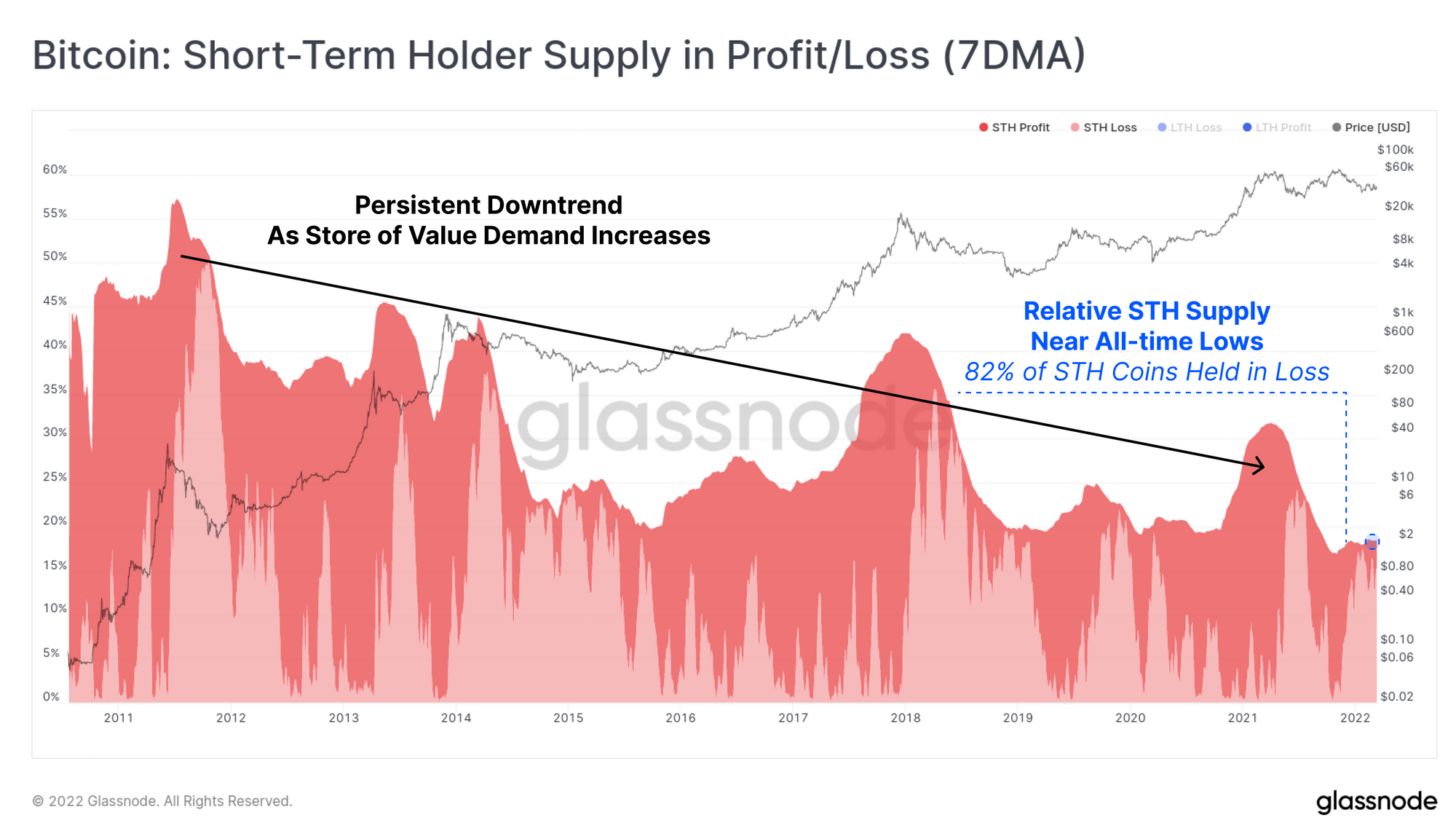
According to the latest weekly report from Glassnode, the BTC STH supply is nearing all-time lows at the moment. However, 82% of it is being held at a loss.
The “BTC short-term holder supply” is that part of the total Bitcoin supply that has been held for less than 155 days.
The investors holding this supply are usually the likeliest to sell their coins off during market volatility, and especially when a capitulation flush out occurs.
An on-chain indicator, the Bitcoin STH supply in profit/loss, tells us the percentage distribution between these coins being held at a profit and those being held at a loss.
When a high amount of this supply is in loss, there may be more sell-side pressure in the market as short-term holders capitulate easily.
Related Reading | Bitcoin MPI Rises To Highest Value Since March 2021, Bull Rally Soon?
Now, here is a chart that shows the trend in the BTC STH supply over the history of the coin:
Looks like the value of the indicator has declined over the years | Source: Glassnode's The Week Onchain - Week 11, 2022
As you can see in the above graph, the Bitcoin STH supply has been observing a constant downtrend over much of the history of the coin, and is currently near all-time low values. The decrease in this supply happens when some of the coins mature beyond the 155-day cutoff, thus becoming part of the “long-term holder supply” instead.
Since short-term holders can be a big source of sell-side pressure, the number of coins held by them severely going down can be bullish for the price of the crypto.
Related Reading | Bitcoin Hashrate Swells 15% Since Last Week As Analysts Expect Mining Difficulty To Increase
However, while the supply is low right now, around 82% of it is currently in loss. So despite the decline in total supply, these coins in loss still amount to around 2.5 million BTC, and thus they can add quite significant sell pressure to the market.
As macro uncertainties like the Russian invasion of Ukraine continue to loom over the Bitcoin market, these short-term holders may finally break and capitulate in case their coins remain in the red or go even deeper.
BTC Price
At the time of writing, Bitcoin’s price floats around $38.5k, down 1% in the last seven days. Over the past month, the crypto has lost 10% in value.
The below chart shows the trend in the price of BTC over the last five days.
BTC's price seems to have been in consolidation for a few days now | Source: BTCUSD on TradingView
Featured image from Unsplash.com, charts from TradingView.com, Glassnode.com
Over the past week, long-term holders of Bitcoin increased their spending to a level that suggests de-risking from the market, but hodling remains the predominant investing strategy.
Uncertain macroeconomic headwinds are likely to have precipitated the increase in the sell-offs last week by long-term holders and shaken some short-term holders out of their positions according to data from blockchain analytics firm Glassnode. Last week, coins older than six months accounted for 5% of total spending, which is a level not seen since last November.
Short-term holders (STH) who have held coins for less than 155 days continue to decline in number, but not necessarily due to selling. Glassnode suggests that while it is generally more common for STH to sell, the recent decline in STH supply “can only occur when large portions of the coin supply are dormant and crossing the 155-day age threshold, becoming Long-Term Holder supply.”
Bitcoin (BTC) accumulation patterns do not suggest bear market behaviors yet as overall sell pressure remains consistent. Also, more than 75% of the BTC circulating supply has been dormant for at least six months despite the recent uptick in selling. Glassnode says this is an indication that investors are still predominantly hodlers.
Long-term Bitcoin holders increased selling last week. – Glassnode
Glassnode noted that the sell-offs have been into a relatively strong market that has avoided any significant moves up or down and has remained range-bound for most of this yea. This is thought to be staving off a capitulation event which often comes at the end of a bear cycle. There has not been a significant capitulation since last May when BTC price crashed from $58,771 to $34,977 over the course of a 15-day period according to CoinGecko.
The period from the May capitulation event until October marked the last time BTC accumulation resembled bear market behavior.
BTC accumulation patterns are still above bear market trends. – Glassnode
The profit/loss ratio of STH supply is still near the all-time low set in mid-2021. Currently, 82% of STH coins are being held at a loss which Glassnode states is an indication of the later stage of a bear market when savvy investors send their coins to cold storage to lie in wait for the return to positive profit margins.
Short-term holders are in near-record losses. – Glassnode
Related: BTC price struggles below $39K ahead of expected interest rate hike by the Fed
As noted in last week’s BTC market update, exchange outflows remain quite high. Coinbase saw its largest outflows in nearly five years last week with 31,130 BTC leaving the exchange. These outflows illustrate Bitcoin’s increasing reputation as a must-have in a modern investor’s portfolio, and a further reluctance to liquidate in a hurry.
The Committee on Economic and Monetary Affairs (ECON) has
reportedly rejected a bill that aimed to ban Bitcoin (BTC) in the European
Union. According to Patrick Hansen, head of growth and strategy at Unstoppable DeFi, 32 members of the Parliament voted against, and
24 in favor.
The report noted that a majority of MEPs from the European
People’s Party (EPP), the European Conservatives and Reformists (ERC), Renew
Europe (Renew), and Identity and Democracy (ID) voted against it. In contrast,
a minority of MEPs from Greens, S&D, and GUE mainly voted in favor.
“Big relief & political success for the bitcoin &
crypto community in the EU,” Hansen said. However, he added that the MICA
regulation would likely no longer address mining but instead add the issue to
the EU sustainable finance taxonomy.
Next in the Parliament is that during the so-called “trilogues”
between the EU Commission/Parliament/Council, the MiCA draft will be
negotiated. The law will go into effect after their final agreement (in a
couple of months). Companies, however, will have a six-month transition period
to comply with the requirements.
Amendment Approved
Stefan Berger proposed an alternative amendment that does
not restrict Bitcoin mining, which was approved by the MEPs.
“Any chances left for the POW-ban? The groups that lost the
vote have one last option. They could veto a fast-track procedure of MiCA
through the trilogues & bring the discussion to the plenary of the
Parliament. They need 1/10 of the votes of the EP to do so, which they have,”
Hansen pointed out. He added: “That would bring the discussion around POW into
the high-level policy arena. As we can’t predict how that would play out, it
should be prevented. Even if it doesn’t change the vote on POW, it would
unnecessarily delay the regulation for at least a couple of months.”
The Committee on Economic and Monetary Affairs (ECON) has
reportedly rejected a bill that aimed to ban Bitcoin (BTC) in the European
Union. According to Patrick Hansen, head of growth and strategy at Unstoppable DeFi, 32 members of the Parliament voted against, and
24 in favor.
The report noted that a majority of MEPs from the European
People’s Party (EPP), the European Conservatives and Reformists (ERC), Renew
Europe (Renew), and Identity and Democracy (ID) voted against it. In contrast,
a minority of MEPs from Greens, S&D, and GUE mainly voted in favor.
“Big relief & political success for the bitcoin &
crypto community in the EU,” Hansen said. However, he added that the MICA
regulation would likely no longer address mining but instead add the issue to
the EU sustainable finance taxonomy.
Next in the Parliament is that during the so-called “trilogues”
between the EU Commission/Parliament/Council, the MiCA draft will be
negotiated. The law will go into effect after their final agreement (in a
couple of months). Companies, however, will have a six-month transition period
to comply with the requirements.
Amendment Approved
Stefan Berger proposed an alternative amendment that does
not restrict Bitcoin mining, which was approved by the MEPs.
“Any chances left for the POW-ban? The groups that lost the
vote have one last option. They could veto a fast-track procedure of MiCA
through the trilogues & bring the discussion to the plenary of the
Parliament. They need 1/10 of the votes of the EP to do so, which they have,”
Hansen pointed out. He added: “That would bring the discussion around POW into
the high-level policy arena. As we can’t predict how that would play out, it
should be prevented. Even if it doesn’t change the vote on POW, it would
unnecessarily delay the regulation for at least a couple of months.”
Bitcoin’s price is at risk of going down because investors are funding short positions in Bitcoin by borrowing digital money from exchanges. Datamish shows that investors are funding short, causing the value of Bitcoin to go down.
Bitcoin fell again on Friday, despite a surge in capital inflow from large wallet investors and institutions. Brevan Howard Asset Management LLP and Tudor Investment Corp refreshed their bitcoin holdings by adding more of the cryptocurrency to their portfolios.
Related Reading | Bitcoin Outflows Spike As 30k BTC Exits Exchanges, Reserve Plunges Down
The growing geopolitical tension and the increasingly tense crisis in Russian-Ukraine are negatively impacting investor risk appetites for both equities as well crypto. This has fueled a bearish narrative surrounding Bitcoin’s price, which plunged below $40,000 with no signs of letting up.
Cryptocurrencies are not without their risks, and it seems that even large investors know this. On March 11th of 2022, survey data from Datamish showed 1,500 Bitcoin being lent out as short positions to finance those risks- a total debt amounting close enough for a 3,603 BTC loan. Following an increase in funding for short positions, there have usually been negative consequences such as price drops.
Analysts have been monitoring the recent changes in Bitcoin price, predicting that it will continue to fall. They believe there is still a significant risk for an upcoming decline, even after its recent recovery.
The Bitcoin price recovery is attributed to the first bearish Ichimoku breakout since December 4, 2021. Analysts believe Bitcoin price has formed a bottom in the $38,000 -$38500 range. This is an important confirmation zone for trading on bitcoin. This may signal more losses for investors who have been selling assets in anticipation of an upcoming crash.
Bitcoin is trading in its bottom range | Source: BTC/USD chat from Tradingview.com
According To Reuters, Russians Flooded The UAE With Liquidation Requests
In a Russia- drowning attempt to save their fortune, company executives and financial sources told Reuters that many Russians flooded the UAE’s cryptocurrency firms with liquidation requests.
That’s not all they want to do. Some of these investors are looking for real estate in the UAE. While others plan to convert it into fiat and hide their money somewhere else – insiders reported.
Related Reading | Bitcoin Exchange Withdrawals Suggests Whales Are Accumulating
The Swiss financial industry is currently in chaos. In fact, brokers requested the withdrawal of billions of dollars worth of Bitcoin. The request came from their clients concerned that Switzerland might freeze all funds. One representative claims they have received requests for up to $2B.
The UAE has been a neutral ground for Russians and Belarusians who have come to Dubai with their money to avoid being left out during any wars that may break out. There’s even been talk of people bringing cryptocurrencies here because they know it will always stay safe no matter what side wins.
According to sources in the UAE, many Russians purchase real estate with cryptocurrency. They’re using digital forms of money both ways – bringing their resources into Dubai while getting them out from other regions.
Featured image from Pixabay, chart from Tradingview.com