If you are interested in developments in fintech, cryptocurrency and decentralized finance, the Chairman of MRHB DeFi Khalid Howlader, is set to appear on a panel at the upcoming Turin Islamic Economic Forum (TIEF), this Wednesday in Turin, Italy.
According to the “State of the Global Islamic Economy Report”(Thomson Reuters, 2020/2021), with governments and banks encouraging Islamic finance and improving financial inclusion, both Muslim-majority and minority countries have started to recognize the untapped potential of the Islamic Finance sector. Islamic Finance is continuing to expand and the report states that it could become an important part of the future of developed nations’ ability to attract fresh capital for investment in infrastructure, new technologies, renewable energy, real estate and strategic resources.
You can find out more about the event here: https://www.tief.it/?lang=en
Khalid Howladar, is Chairman of MRHB DeFi, the world’s first ethical and faith-based decentralized finance platform.
He is also Senior MD and Head of Credit & Sukuk for R.J. Fleming & Co. and was previously Global Head of Islamic Finance and Head of the GCC banking team at Moody’s Investors Service, London and Dubai. He has addressed audiences worldwide including at the World Bank, IMF, ECB and IIF.
He will be speaking at TIEF on a panel titled: Islamic Finance And Economic Inclusion, alongside Ahmed Zourhi, in a panel discussion moderated by Alberto Brugnoni, the managing partner of ASSAIF.
The panel runs from 11am, Wednesday, at the TIEF event.
You can find out more about TIEF here: https://convention.turismotorino.org/en/events/tief-2021-turin-islamic-economic-forum
You can reserve tickets here: https://www.eventbrite.com/o/tief-torino-35070425473
MRHB DeFi recently announced partnerships with Sheesha Finance, NewTribe Capital, Acreditus Partners, EMGS Group and Coinsbit India, working towards expanding its reach and visibility to people new to blockchain, as well as long time believers in the cryptocurrency and digital asset industry.
New York, NY, Oct 11, 2021 — For 175 years, the Associated Press has provided the world with accurate and fast news reporting of the most important events around the globe. With fearless staff and news bureaus in 250 locations in 100 countries, AP journalists have covered moments of great joy, scientific breakthroughs, achievement, and accomplishment as well as moments of loss, despair and agony.
AP is dropping a unique, curated collection of its rare, archived news reporting of the most memorable moments in recent world history. To release this unique series of collectibles, AP is collaborating with Metalist Lab and the collection will drop on the Binance NFT marketplace on October 19th, at 12pm UTC.
The collectibles feature AP’s coverage over the past 100 years of milestones in space, global conflicts, science and discovery, and human freedoms and advancement. The news reporting at the core of this collection consists of high-resolution images distributed around the world by AP at the time of the events.
In addition to this historic photojournalism, the collection also includes rarely seen digitized copies of the most important “News Wire Flashes” transmitted by AP with urgency to newsrooms around the world. Such flashes were the first word on events such as the moon landing and the end of WWII in Europe. In fact, AP was the first news agency in the world to report the end of that conflict.
The collectibles also include some of the news agency’s most beautiful images, such as the super blue blood moon photographed by AP in 2018, an event that’s only occurred once in 152 years.
The Associated Press believes that facts belong on-chain and distribution of this historic news reporting to the blockchain is nothing short of vital for the preservation of world history.
About Metalist Lab:
Metalist Lab is based in Australia, and is a world-leading publisher of NFTs. It brings countless outstanding NFT designers together with the top names in encryption technology, and has worked with game companies such as NetEase, news and communications agencies such as the Associated Press, as well as many high-level artists and their IPs. Recently it’s been distributing NFTs for NetEase’s globally-popular game Naraka: Bladepoint, as well as the The AP Unique Moments NFT series.
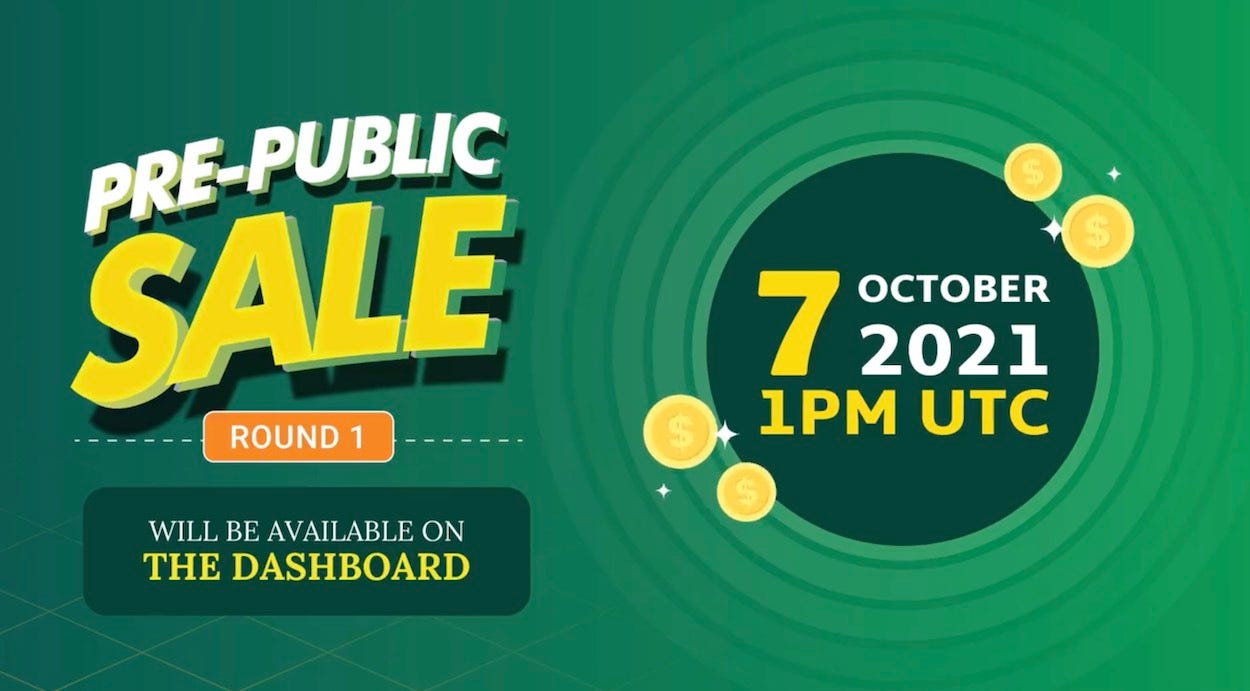
Dubai, U.A.E, Oct 7th, 2021 — Socially conscious and ethical DeFi ecosystem MRHB DeFi is democratizing access to its private sale by allowing its public community members to partake in the pre-public sale rounds. Usually reserved only for the larger and institutional investors, the earlier stage private sale rounds offer early access, with investors able to enjoy privileged pricing.
MRHB’s community has reached 20,000 members in less than four months and to better reward their early supporters, MRHB has eliminated the large minimum participation amount required, in effect, leveling the playing field for smaller investors by offering access at pre-IDO prices. MRHB has officially announced that registration for the Pre-Public Sale Round 1 starts today, 7th October at 1PM UTC.
“In line with our ethos of inclusion, MHRB DeFi is pleased to offer this unique opportunity to our loyal community who has supported us from the beginning,” says MRHB DeFi CEO Naquib Mohammed. “Our inclusive and ethical philosophies promote equitable sharing of opportunities. This applies to our token launch as well as our products, so we stay true to our vision of empowering communities.”
Strategic Investments and Strong Support from Partnerships
Having onboarded institutional investors such as Mozaic of New World Group, Sheesha Finance, Contango Digital Assets and NewTribe Capital, to name a few, the DeFi ecosystem startup has received strategic investments which also comprise partnership support in various areas including advisory, marketing, networking, amongst others.
MRHB is currently developing eight different Shariah-compliant DeFi products, with the first being its Souq NFT, an NFT creation platform and marketplace which supports multi-chain solutions.
[Sneak Peak of Souq NFT]
Closely following the launch of the Souq NFT would be the Sahal Wallet, a multi-asset, non-custodial wallet that makes it easy to invest in halal crypto assets with in-built shariah-screening.
[Sneak Peak of Sahal Wallet]
MRHB DeFi was founded with a vision of bringing societies and communities not familiar with decentralized finance into the cryptoverse, and has a particular focus on delivering halal DeFi services which adhere to the ethical investment and financing principles of Islamic faith. Such business practices include those that avoid interest, usury, exploitation and other acts deemed unethical.
With more than US$3 trillion of liquidity invested in the Islamic finance market, bringing even a tiny portion of this to DeFi will represent a major step forward in the growth of DeFi worldwide whose total value locked is estimated to be around US$150 billion.
About MRHB DeFi
MRHB DeFi is a halal, decentralised finance platform built to bring ethics to the DeFi space with an approach that supports the inclusion of faith-based and other excluded communities, in addition to existing crypto-natives. Everyone can then benefit from the full empowerment potential of DeFi to help build a true peer-to-peer financial and economic value system.
Based on the tenets of blockchain such as trust, transparency, and security, MRHB DeFi has encapsulated universally applicable principles of Shariah into those tenets of blockchain to render a suite of offerings.
The project is backed by a diverse and strong team with backgrounds spanning crypto, technology, shariah, finance and seasoned institutional veterans of industry. The public sale offering will be in December. Register your interest and read more about MRHB DeFi’s Shariah Concept Paper, Lite and White Paper here.
Melbourne, Australia, Oct 5th, 2021 — Community-focused DeFi ecosystem MRHB DeFi is teaming up with Canadian venture capital fund Contango Digital Assets to expand its reach, offering and services beyond the crypto-fluent to excluded communities globally.
Contango has made a strategic investment into MRHB DeFi, and will work alongside the MRHB DeFi team, providing expertise and experience across a wide variety of areas. The partnership will also support collaboration with influencer marketing leaders in the blockchain space, Influx Group.
Faith-based, Excluded Communities, An Untapped Opportunity
The partnershipis aimed at expanding the reach of MRHB DeFi beyond crypto-natives to engage new users and communities who are attracted to a more ethical and faith-based vision.
“This important community has been struggling to participate in DeFi opportunities and MRHB is now opening an important door to these people who wish to participate in the cryptoverse while still remaining faithful to their beliefs. We’re thrilled to be a part of that.” — Contango Managing Director Mike Grantis.
“We are first in building DeFi services that solve issues of faith, ethics, exclusion, and complexity. Our user-friendly platform provides equal opportunities to everyone, not only those who share our concern for holding crypto assets that are halal. With Contango’s support, we will continue our journey of growth and development within Islamic communities and beyond.” — MRHB DeFi CEO Naquib Mohammed.
MRHB DeFi was founded on the principle of bringing societies and communities not familiar with decentralized finance into the space, and has a particular focus on delivering halal DeFi services which adhere to the tenets of Islamic faith, such as business practices that avoid interest, usury, exploitation and other acts deemed unethical.
With more than USD 3 trillion in liquidity available in the Islamic finance market, bringing even a tiny portion of this to DeFi will represent a major step forward in the growth of DeFi worldwide, and will enable people with no experience of the market to share in its opportunities.
MRHB DeFi recently announced partnerships with Sheesha Finance, NewTribe Capital, Acreditus Partners, EMGS Group and Coinsbit India, working towards expanding its reach and visibility to people new to blockchain, as well as long time believers in the cryptocurrency and digital asset industry.
About MRHB DeFi
MRHB DeFi is a halal, decentralised finance platform built to embody the true spirit of an “Ethical and Inclusive DeFi” by following faith-based financial and business principles, where all excluded communities can benefit from the full empowerment potential of DeFi.
Based on the tenets of blockchain such as trust, transparency, and security, MRHB DeFi has encapsulated universally applicable principles of Shariah into those tenets of blockchain to render a suite of offerings. It is a complete DeFi ecosystem whose products, protocols and crypto-assets are governed primarily by the ethical, inclusive, sustainable and charitable investment principles associated with the Islamic faith or ‘Islamic Finance’ (‘IF’ as it is commonly known).
The diverse team is comprised of researchers, technocrats, influencers, Islamic fintech experts & business entrepreneurs, who came together to ensure that MRHB DeFi prevails in a manner that will impact society as a whole, essentially bridging the gap between the faith-conscious communities and the blockchain world.
Read more about MRHB DeFi’s Shariah Concept Paper, Lite and White Paper here.
Contango Digital Assets was launched to empower the financial revolution that is presented by blockchain and DeFi technology. It invests in innovative projects from around the world and fosters strategic partnerships with founders who look for more than just capital.
Learn more about Contango by visiting the official website or following the fund on Twitter.
Melbourne, Australia, Sep 29, 2021 — NewTribe Capital, a Venture Capital Private Equity Group has made a strategic investment in MRHB DeFi, the world’s first halal decentralized finance (DeFi) ecosystem.
This marks the seventh institutional investment in the DeFi ecosystem startup, following strategic investments from DeFi Mutual Fund Sheesha Finance, Dubai-based angel innovation investors Acreditus Partners and EMGS Group, the French Systems Integration company operating in the Middle East since 2003, to name a few.
NewTribe Capital: A Bold Investment Approach
With an ideology to‘Invest in People’, NewTribe Capital takes a bold stance in their approach to investing — they back only the projects they feel add value to the blockchain ecosystem.
“Our philosophy is successful because we invest in relationships, not deals,” says Dhaval Parikh, Partner at NewTribe Capital. “Deals are simply transactions. We build exceptional relationships with companies that last, collaborating on projects with conviction.”
Investing in the first ethical, inclusive and faith-based MRHB DeFi ecosystem platform aligns with NewTribe’s company ethos and strategic goals. As an early investor and supporter, NewTribe recognizes both the vision and the long-term market potential of the faith-based DeFi pioneer.
Besides investment funds, which will support the continuing technology development and growth of MRHB DeFi, NewTribe Capital will also offer network and cross marketing support for the DeFi startup.
“We’re excited about collaborating with the highly successful NewTribe Capital team who share our long term visions for ethical DeFi. This relationship creates additional opportunities and industry connections that will drive more value for our community members. NewTribe has a proven track record of helping their partners succeed, and we are delighted to welcome them amongst other strategic stakeholders in our ambitious journey,” says Naquib Mohammed, MRHB DeFi Founder & CEO.
“This strategic alliance with NewTribe Capital is the latest institutional move by MRHB DeFi as we work to establish ourselves as the dominant player in the ethical decentralized finance space,” adds Mohammed.
DeFi made accessible to Ethical and Faith-based Communities
MRHB DeFi’s vision of an inclusive and halal crypto-verse is underpinned by Islamic ethical finance principles but is suitable for all those looking for a socially conscious blockchain that avoids interest, usury, exploitation and other business practices deemed unethical.
Being Shariah-compliant means MRHB DeFi can apply a vast body of knowledge and literature of Islamic Finance to ensure higher ethical and moral standards that are typically seen in the DeFi space. These principles ensure that all business decisions are conducted in a fair and just manner and hence create an inclusive and simple crypto ‘safe-space’ for the faith-based, unbanked and communities who are currently excluded.
Global Portfolio and Partnerships
Crypto-minded investors who believe in the evolution of current capital market systems towards more decentralized and accessible models, NewTribe Capital has a portfolio of more than 70 investments with an average ROI of 4.2x and more than USD20M AUM (assets under management). Portfolio investments include Launchpool, Casper Labs, Fractal, to name a few.
Offering advisory, resourcing, legal and technical support, NewTribe also has a network of VC partners, media partners and global influencers. VC partners include Alphabit, A195 Capital, Draper Dragon and more.
About MRHB DeFi
MRHB DeFi is a halal, decentralised finance platform built to embody the true spirit of an “Ethical and Inclusive DeFi” by following faith-based financial and business principles, where all excluded communities can benefit from the full empowerment potential of DeFi.
Based on the tenets of blockchain such as trust, transparency, and security, MRHB DeFi has encapsulated universally applicable principles of Shariah into those tenets of blockchain to render a suite of offerings. It is a complete DeFi ecosystem whose products, protocols and crypto-assets are governed primarily by the ethical, inclusive, sustainable and charitable investment principles associated with the Islamic faith or ‘Islamic Finance’ (‘IF’ as it is commonly known).
The diverse team is comprised of researchers, technocrats, influencers, Islamic fintech experts & business entrepreneurs, who came together to ensure that MRHB DeFi prevails in a manner that will impact society as a whole, essentially bridging the gap between the faith-conscious communities and the blockchain world.
Read more about MRHB DeFi’s Shariah Concept Paper, Lite and White Paper here.
There is a growing need for quality decentralized exchanges.
As the global crypto demand ramps up amidst increasing popularity, the need for exchanges has concurrently risen. This has led to the entry of many new crypto exchange platforms into the mix. In the search for an exchange, both projects and users have to be careful and discerning in their choices. With crypto being largely unregulated, users are usually at the mercy of whatever exchange they are on.
Besides regulatory issues, transaction fees and speed are also areas that users need to look into, with gas fees on some chains skyrocketing and transactional delays when the network is under heavy load.
Along with conventional exchanges in the space, the need for decentralized exchanges is also growing. With regulatory pressure mounting on CEXes, decentralized finance is becoming more popular than ever. Its ability to stay out of the purview of the government means that many now flock to it. The current DeFi market capitalization stands at about $114B.
Lesser known than its more popular counterparts, MDEX.COM is an automated market maker (AMM) that originated on the Huobi ECO-chain (HECO). Amid its ups and downs, the DEX has continued to grow throughout this year. However, can it stand out from the throng?
MDEX’s current existence on both the HECO-chain and Binance Smart Chain (BSC) means that it boasts some of the fastest transfer speeds in the industry. This, combined with its low carbon footprint in comparison to Ethereum-based DEXes, makes it a strong competitor. The exchange’s mining feature means that over time the cost of transactions is similar to cheaper chains and with enough input, it can be net-zero.
MDEX first came under the spotlight for pooling the highest 24-hour transaction volume in the history of DEXes. It also recorded the highest daily trading volume for both chains reaching USD 5.05 billion establishing itself as one of the strong DEX contenders in the market. The number of current addresses holding MDX tokens stands at 277,660 in total on the BSC & HECO Chain.
Its multi-chain existence also means that there is flexibility in migration among pools. Gas fees for switching are lower than they would be otherwise and execution speed is only 3 seconds.
MDEX began as an Ethereum and HECO-chain platform that uses an Ethereum Virtual Machine (EVM) address to connect with both chains. While reinforcing cross chain interoperability, MDEX introduced an on-chain non-custodial bridge between HECO-chain and Binance Smart Chain. This allows for unprecedented flexibility, meaning that there is now accessibility between the chains. Whatever tokens are needed on either network can be accessed through MDEX without the need for an intermediary. Most DEXes are native to one chain at the moment, MDEX is one of the exceptions and aims to support even more chains simultaneously.
Last year’s crypto surge has led to a large influx of new users into the industry. Unlike seasoned traders, candlestick charts and analysis tools are like a whole new language to read for newcomers and are something they need to pick up with time. MDEX’s easy-to-use, user-friendly interface will be welcome among the droves of newcomers to crypto for its accessibility.
The exchange also features a native launchpad. Initial MDEX Offering (termed IMO on MDEX) is among one of the best choices for dev teams looking to make a splash utilising an IDO launchpad. With multi-chain compatibility, projects will gain access to a far larger audience than they would otherwise.
The platform’s IMO for Coinwind attracted a total of 8,874 participating wallet addresses and raised total funds of $385,891,505, over-collecting a staggering 25,726%. Its recent IMO for Demeter attracted 6,500 addresses, with a total of $350 million raised, and 23 million MDX tokens locked.
Yet another feather in the exchange’s cap is its allowance of liquidity locking on its network. Users can lock liquidity for selected periods of time. In addition to the rewards they gain, this also makes the network stronger by increasing liquidity for all users. With the AMM capability on the chain, along with multiple locking options, the potential for returns is higher than is generally available elsewhere.
MDEX users can earn by participating in three types of programs namely LP, Single, and Innovation. The available token pairs in liquidity pools include USDT, ETH, MDX & HT. Users can earn about 318.84% APY by staking their MDX tokens. The daily reward scheme across all programs exceeds $2 million as of Q4, 2021.
Its native token, MDX, is also widely held by users. For this metric, it is second only to Pancakeswap and comes out ahead of even the popular Uniswap. The MDEX also burns MDX periodically, creating scarcity and driving the price of the token up.
Ether’s impressive YTD gains have largely been overshadowed by the profits accrued by other smart contract-enabled projects.
There’s no denying that the last couple of years have seen the altcoin sector blossom and have a major impact on the crypto market at large. In fact, a quick look at data available on Google Trends shows us that searches related to the term “Ethereum killer” have been soaring over the past 90-days, signaling a growing interest among investors in various altcoins.
In this regard, a few cryptocurrencies — such as Cardano (ADA), Solana (SOL), Polkadot’s DOT and Terra (LUNA) — have made a major market push recently. SOL, in particular, has been turning a lot of heads among investors, thanks in large part to its most recent rally, which saw the cryptocurrency surge despite the market experiencing a massive selloff.
In addition, there are several other networks that have shown a lot of promise. For example, following the completion of its much-hyped Alonzo hard fork, Cardano, too, has been able to record substantial profits, posting numbers of +70% and +1,200% over the last 90 and 180 days, respectively.
To gain a better idea of what the aforementioned developments mean for the market at large, Cointelegraph reached out to Antoni Trenchev, managing partner and co-founder of lending platform Nexo. In his view, there is growing institutional demand for coins such as Solana’s SOL and Terra’s LUNA, something that is made evident by the fact that both assets have been able to make their way into the list of top 15 cryptocurrencies by total market capitalization. Trenchev told Cointelegraph:
“This is a reflection of companies going deeper into crypto. Over the first two months of 2021, major institutions like BlackRock, Square and MicroStrategy were only just dipping their toes into Bitcoin. Now they’ve tasted its benefits and are looking to harness the untapped potential of up-and-coming blockchains and DeFi coins that could yield higher returns.”
Trenchev highlighted that such developments suggest that the crypto market may currently be in the midst of an alt-season; however, what’s different this time around is that established coins such as ETH and Bitcoin (BTC) are showing a higher level of stability in comparison to some of these newer assets. “Think of the current situation as alt season meets institutional interest, and yes, I think we will see more and more trends like this in the future,” he said.
The stability these institutions bring became fairly evident on Sept. 16 when Solana experienced a major outage wherein instead of going into a panic-induced sell frenzy, SOL barely lost any of its value, dropping less than 10%.
Earlier this month, institutional traders flocked to Solana as demand for Ether and Bitcoin (BTC) exposure seemed to plateau. In this regard, over the first week of September, SOL-centric investment products represented a whopping 86.6% of the total weekly inflows into the crypto investment market.
More specifically, per data made available by digital asset management firm CoinShares recently, SOL’s combined investment products witnessed inflows in excess of $49.4 million between Sept. 6 and 10. Not only that, for the week, SOL saw a 275% week-over-week increase in its value, representing 86.6% of total capital inflow into the crypto investment sector.
Lastly, other digital asset products have also continued to see major cash inflows for the fourth consecutive week, with demand for different altcoins quite easily exceeding that of BTC products, with the latter only witnessing minimal inflows of $200,000. For example, it is worth highlighting that during the first half of September, multi-asset products, XRP, Polkadot’s DOT and Bitcoin Cash (BCH) were able to register sizable financial inflows of fa$3.2 million, $3.1 million, $1.7 million and $600,000, respectively.
Kadan Stadelmann, chief technical officer of end-to-end blockchain infrastructure solutions provider Komodo, told Cointelegraph that rising demand for undiscovered projects is nothing new for the crypto market. However, what separates this time from previous cycles is the sheer amount of capital flowing in from institutions. He said:
“The risk is that this will lead to faster market cycles for specific cryptocurrencies that are outliers from overall market movements. We see extreme FOMO and price increases, followed by a large sell-off and price declines. With SOL, in particular, prices are down 20% this week. That doesn’t mean it won’t quickly return back to its all-time high. It’s just that people who are new to crypto should be aware that volatility is par for the course.”
Lastly, echoing Trenchev’s view, Stadelmann believes that as we move into an increasingly decentralized future, it will become more common to see a sharp increase in the price of different altcoins. “Hundreds of DeFi projects are flying under the radar. Many of these projects have solid technology and can gain upward price momentum once institutions recognize their potential,” he said.
One of the core reasons underlying the rise of many of the above-stated altcoins has been the lack of scalability offered by the Ethereum network. In this regard, despite all of its recent highly touted functional updates, the platform is only able to process around 15–25 transactions per second in its current state — all while offering an extremely low throughput capacity.
Not only that, even though the recently concluded London hard fork was designed to help regulate Ether’s rising gas fees — after rates rose as high as $40 and $70 earlier this year during Q1 and Q2, respectively — the figure still seems to be hovering around the $15–$20 range, which is quite high for the average Ethereum customer.
Furthermore, during peak traffic hours, minting a nonfungible token (NFT) on the Ethereum network can cost up to 3 ETH, which, in many cases, may actually work out to a price point that is more than the actual NFT itself. On the other hand, Solana, as well as many other projects, not only offer faster transaction speeds but far lower gas prices, allowing for the more economical issuance of NFTs.
With Ethereum gearing up to make its transition to a proof-of-stake framework, it is expected that once the move is finally done, the platform will be able to process up to 100,000 transactions per second. However, until that day comes, it looks as though a growing list of smart contract-enabled platforms may continue to eat into Ethereum’s mammoth market share.
Ethereum’s most recent overhaul, the all-important London hard fork — which incidentally contained crucial updates such as the Ethereum Improvement Proposal 1559 — was supposed to deploy a new transaction pricing mechanism for the network, resulting in the ecosystem becoming deflationary in nature.
Available data suggests that over 336,000 ETH tokens have already been burned, with the current burn rate currently sitting at 4.9 ETH per second or about 2.7 million ETH tokens per year, which would basically take the project’s yearly supply growth rate to 2.3% while taking its issuance to around 5.3 million tokens per annum.
Moreover, Ethereum is not the only project to make use of such a deflationary setup, since Solana is also known to burn 50% of its transaction fees to regulate the supply of its native SOL token. Khalid Howladar, chairman of MRHB DeFi — a Shariah-compliant decentralized finance (DeFi) platform — told Cointelegraph:
“While it’s clear that Ethereum is the current smart contract backbone of the DeFi ecosystem, Solana is emerging as a solid competitor with potentially more upside to come. Key factors such as cost and speed mean that Solana has become a solid challenger to Ethereum’s position both within the realm of programmable money (DeFi) and programmable media (NFTs).”
In Howladar’s view, institutions are only just getting their toes wet when it comes to DeFi, and therefore, the next few months could be extremely interesting in terms of how they become further involved. “If DeFi platforms can somehow ensure basic things like consumer protection using decentralized KYC and AML, they will take vast chunks out of banks’ market share, especially as peer-to-peer economic systems take hold,” he said.
Moving forward, it will be interesting to see whether Ethereum is able to maintain its current dominance levels, especially as a growing list of smart contract-enabled alternatives continues to garner mainstream market traction.
Geneva, Switzerland — September 22, 2021: Liti Capital SA, the Swiss-based litigation funding provider disrupting private equity investing with blockchain technology, is launching ScamBusters, a revolutionary new tool that allows users to vote for which crypto-focused cases the company should pursue next.
Devoted to fighting fraud
Fraud within cryptocurrency and blockchain is rife. This year will be a record for investment fraud: 14,079 investment scams were reported to the FTC in the first quarter of 2021, and victims lost $215 million in this quarter alone. Liti Capital is bringing its expertise in picking, funding and winning court cases and inviting consumers to vote on which scams it should pursue in court next.
“The idea that scammers can freely operate in the crypto sphere without facing the consequences of their actions must end to bring trust and change the perception blockchain and crypto projects have in our society”, says Andy Christen, CVO/COO at Liti Capital.
Liti Capital commits to allocating between 5% and 10% of its yearly investment budget to finance cases that have affected its community members. Any LITI or wLITI token holder can report a purported fraud to the company.
How ScamBusters works
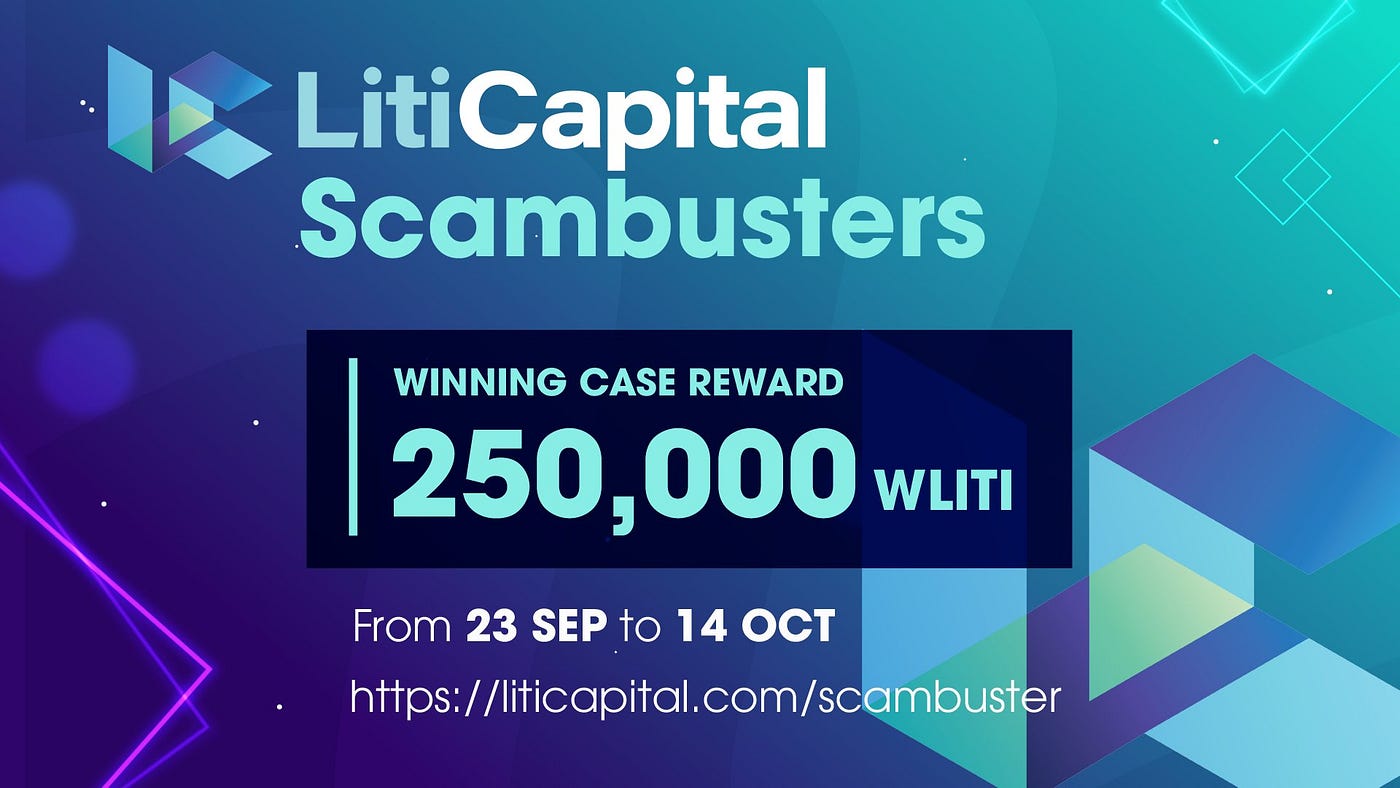
ScamBusters is a community voting event to select which crypto scam cases Liti Capital will sue. LITI and wLITI token holders can use their tokens without spending them to vote for the case(s) they think have the most merit. The more tokens they have, the more voting power they can exercise. Voters of the winning case will share an award up to 250,000 wLITI, distributed pro-rata to their votes.
Once members of the community have submitted cases on the ScamBusters website, Liti Capital instructs its team of legal experts based in 140 countries across the world to explore details of the case.
A selection of cases are then presented back to community members, with the case collecting the highest number of votes being added to Liti Capital’s portfolio. Community voting begins on September 23, 2021, with the first winning case announced on October 15, 2021.
“If cryptocurrency is going to become the de facto way people take part in the Web3 world, trust, regulation and a robust legal system are all parts of that puzzle,” says Jonas Rey, CEO at Liti Capital.
About Liti Capital
Liti Capital is bringing the litigation asset class to everyone through Blockchain technology with LITI tokens, an equity token that is a share of stock in Liti Capital SA. The launch of LITI and wLITI tokens allows any investor to engage in the high-performing litigation finance market previously only available to elite investors.
For project information, please read the Whitepaper.
For token distribution, please read Tokenomics.
Liti Capital Official Channels
Liti Capital Website: https://liticapital.com
Liti Capital Telegram: https://t.me/Liti_Capital_Official
Liti Capital Telegram Announcements: https://t.me/Liti_Capital_Official_ANN
Liti Capital LinkedIn: https://www.linkedin.com/company/liti-capital
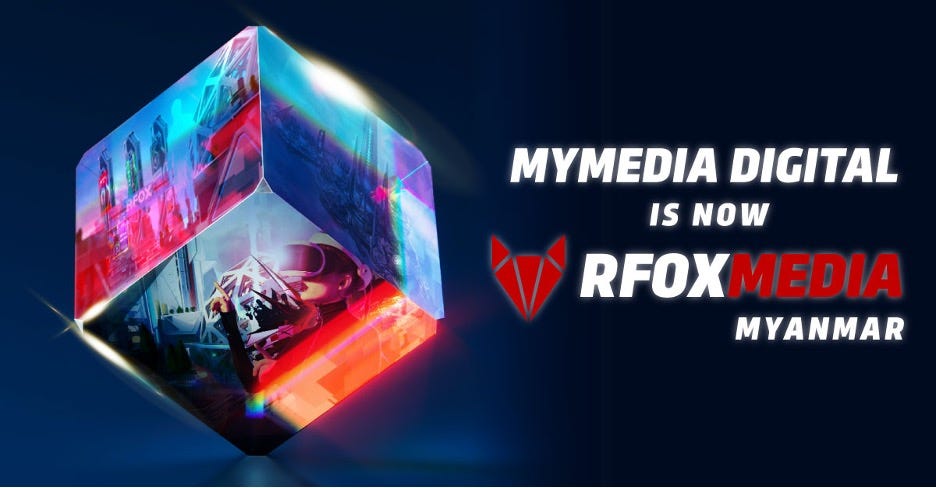
MANILA, Philippines — MYMEDIA Digital, the largest digital marketing platform in Myanmar, has rebranded into RFOX MEDIA, the new media venture that acts as the brand and marketing division for the blockchain-driven ecosystem created by Southeast Asia-based venture builder RedFOX Labs. The rebrand follows RedFOX Labs’ acquisition of MYMEDIA in February 2021.
The new RFOX MEDIA venture strengthens MYMEDIA’smarket-leading platform, which connects consumers directly to brands and influencers across food, fashion, sport, and entertainment. Advertisers that have worked with MYMEDIA include global brands such as Samsung, Huawei, Nestle, Lenovo, Grab, Oppo, Realme, VIVO, and GrandRoyal. The MYMEDIA Facebook page, which also reflects the rebrand to RFOX MEDIA, together with all social media channels and websites, have 13 million followers and 40-million-page impressions, driven by 20 million minutes of viewed video footage per month and other content that extends its reach to 30 million users per month.
Digital media marketing leader in Myanmar and Southeast Asia
As part of the rebranding and further integration within the RFOX ecosystem, RFOX MEDIA has launched a new dual-language website in Burmese and English, reflecting both its status as the digital marketing leader in Myanmar and its next phase of growth into different parts of the world, with an initial focus on Southeast Asia as a fast-growing regional hub. The expansion plans for RFOX MEDIA will drive further growth to the already-impressive social media metrics that it has gained in just one country so far.
Partnerships for games, e-commerce, digital finance and more
Amid projected international growth, RFOX MEDIA continues its work of maintaining market leadership in Myanmar by leveraging many products and services from the RFOX ecosystem. Earlier this month, RFOX MEDIA introduced RFOX Run, an upcoming jump-and-run casual game in Myanmar that will debut a new gaming rewards model called Play-to-Eat, an innovation on the increasingly popular Play-to-Earn model. Through Play-to-Eat, all winning players from Myanmar can soon get free food vouchers that they can redeem on foodpanda, the leading food delivery service in Myanmar.
Expect more innovations of this nature as RFOX MEDIA helps expand the utility of the RFOX token through partnerships for games, e-commerce, digital finance, and more industries, as well as through new solutions like the upcoming RFOX TV streaming service.
Rene Heumueller, COO of RFOX MEDIA, commented:
“I’m extremely happy to be part of RedFOX Labs as we build out RFOX MEDIA. I am passionate about building products and services that improve people’s lives, and this is the right place to be. The RFOX MEDIA team is built on the back of the existing team of MYMEDIA and pulls on years of experience and a library of content. This gives us a strong head start we need in a fiercely competitive landscape, especially as we expand our operations internationally.”
Ben Fairbank, CEO and Co-founder of RedFOX Labs, commented:
“The rebranding of MYMEDIA into RFOX MEDIA is the initial step towards applying our expertise in scaling technology and building integrations and interoperability, providing exponential value to a digital marketing platform that is ready to expand into Southeast Asia and beyond.
Our acquisition of MYMEDIA earlier this year allows us to build out equivalent platforms in other countries in Southeast Asia, leveraging a Rolodex of global advertisers already using MYMEDIA who are chomping at the bit to get exposure in the region. Southeast Asia has 360 million internet users, including 104 million aged between 25 to 34 — the most valuable age group to major advertisers.”
About RedFOX Labs
RedFOX Labs is a Southeast Asian venture builder that identifies and builds successful business models for the region’s markets. It is focused on unlocking the true market value of the Southeast Asian digital economy for high consumer demand services such as e-commerce, e-media, e-travel, and esports/gaming and focuses on adding value to the digital economy using emerging technologies such as blockchain. As a company, its value is tradable through its native token ($RFOX).
MANILA, Philippines — RFOX Media, a subsidiary of Southeast Asia based RedFOX Labs, has launched RFOX Run, a new jump-and-run casual game in Myanmar, powered by prolific tournament game platform Goama. RFOX Run introduces a new gaming rewards model called Play-to-Eat, an innovation of the increasingly popular Play-to-Earn model, where players that are identified as winners and have signed up for an RFOX ID can redeem food vouchers from foodpanda, the leading food delivery service in Myanmar.
At RedFOX Labs, we believe that blockchain companies have a responsibility to explore humanitarian approaches to the innovations they produce. Through our Play-to-Eat model, we believe that RFOX Run users will gain the dual benefits of food rewards and blockchain education, providing them with both immediate- and long-term solutions.
The top RFOX Run players can claim their prizes through the RFOX Media website by registering for an RFOX ID. Winners will receive foodpanda vouchers redeemable with a unique voucher ID, and get their choice of food delivered to their doorstep. To kickstart the campaign, RFOX Media has allocated $22,000 worth of vouchers as rewards.
The global play-to-earn market, mainly driven by blockchain-based companies, has experienced exponential growth this year, with a total market capitalization of $9.21 billion and average year-to-date growth rates of 1,604.12%, according to analysis from CoinMarketCap data on 36 identified play-to-earn companies. From a larger perspective, the video game industry is currently valued at around $170 billion and is expected to grow to $268 billion after five years, according to CoinTelegraph.
In this context, RFOX Media can become a crucial participant in the high-growth play-to-earn market through RFOX Run. Its unique approach to encourage further adoption through play-to-eat and other models reflects RedFOX Labs’ endeavors in empowering blockchain-related growth in Southeast Asia. RedFOX Labs also operates RedFOX Games, which currently runs the KOGs Slam! NFT game on closed beta testing, with more products about to launch.
Earlier this month, RFOX Media and Goama entered a partnership for the launch of RFOX Run in Myanmar, with plans to extend the relationship across the Southeast Asia region. This collaboration brings together an audience of more than 20 million Southeast Asian residents and aims at serving the largely untapped gaming market in Myanmar.
Ben Fairbank, CEO, and Co-founder of RedFOX Labs commented:
“Just weeks after we revealed the partnership between RFOX Media and Goama, I’m happy to see that it has delivered innovative results through the new RFOX Run game and the first-of-its-kind Play-to-Eat model in Myanmar. The Myanmar market is still so young, with a lot of potential, and through this collaboration we have quickly launched a new casual game that has an added benefit of rewarding top players with food. We look forward to serving millions in Myanmar with innovative gaming solutions like this, among other things we are planning to launch in the future for the country.”
Wayne Kennedy, CPO and Co-founder of Goama said:
“We at Goama are very thrilled to work with RedFOX Labs to be the first ones to bring both NFTs and tournament prizes to Myanmar! This furthers our ambition of bringing a casual eSports platform to leading apps throughout Southeast Asia. We’re also very happy to have created RFOX Run, where users can compete for the top spot and at the same time be compensated with food vouchers!”
About RedFOX Labs
RedFOX Labs is a Southeast Asian venture builder that identifies and builds successful business models for the region’s emerging markets. It is focused on unlocking the true market value of the Southeast Asian digital economy for high consumer demand services such as e-commerce, e-media, e-travel, and esports/gaming and focuses on adding value to the digital economy using emerging technologies such as blockchain. As a company, its value is tradable through its native token ($RFOX).
foodpanda is a leading delivery platform in Asia dedicated to bringing consumers a wide range of food, groceries and more, quickly and conveniently. Powered by technology and operational excellence, foodpanda is spearheading the growth of quick-commerce (q-commerce) across the region with its network of retail partners, as well as pandamart cloud stores to provide more on-demand options beyond the millions of food delivery options. foodpanda operates in more than 400 cities across 12 markets in Asia — Singapore, Hong Kong, Thailand, Malaysia, Pakistan, Taiwan, Philippines, Bangladesh, Laos, Cambodia, Myanmar, and Japan. foodpanda is a subsidiary of Delivery Hero, a global leader of the food delivery industry. www.foodpanda.com
About Goama
Goama is a leader in platform gamification, setting the benchmark in digital innovation and user engagement, working with some of the world’s biggest superapps and brands. Its turnkey solution offers a plug and play platform that creates unique gamified experiences that empower its business partners to build engaged communities. Goama has partnerships with the leading apps across 24+ countries to help them drive user engagement, increase monetization opportunities, and acquire new users. https://goama.com