Once reserved for the pros in the crypto space, staking has become a common practice across all participants in the space. Today, anyone has an opportunity to earn passive income on their crypto assets in just a few clicks, whether on a centralized exchange or DEX. Over the past two years, centralized exchanges such as Binance and Coinbase have introduced staking to their users, compelling decentralized exchanges, or DEXs, to follow suit.
At the height of the DeFi boom in 2021, over $110 billion in value was locked on decentralized platforms as staking became one of the most lucrative ways to earn passive income and relish returns on investment. On January 3, 2022, Ethereum 2.0 crossed the $34 billion mark in total value staked, showing a possible continuation of the explosive growth this year. Despite the growth, many platforms only offered staking rewards as the only viable passive income strategy for their users. One DEX, Hashbon, aims to change this by adding a reward system that complements staking with them – the staking referral program.
Hashbon, one of the first cross-chain DEXs, announced the launch of their own staking program, “Hashbon Rocket”, last December to give HASH holders an opportunity to earn the highest possible APY and APR among all the available staking opportunities. Midway through the month, the ‘Hashbon Rocket Staking Referral Program’ launched, providing all HASH holders with an additional revenue stream.
Hashbon DEX launches its Staking Referral Program
Following a wonderful reception to the staking program in the past month, Hashbon DEX extended its earning possibilities through the first-of-its-kind staking referral program. The Hashbon Staking Referral Program allows people to invite their friends and family to the platform and earn 10% of their friends’ staking earnings. According to a statement, every HASH staker can simply share their referral link with their friends and family and earn 10% of the rewards the referral makes during staking.
Hashbon offers users a fast, secure, and cheap platform to swap tokens across multiple networks, supporting newbies in their journey into decentralized finance (DeFi). Apart from staking and DEX, Hashbon also offers users a payment gateway that will let merchants accept payments in over 30 cryptocurrencies with 0% commission. The latest referral program joins a host of earning programs on the platform including being an arbiter for Hashbon Rocket, who votes for the transactions.
Unlike other staking platforms, Hashbon offers both ERC20 and BEP20 token staking. Users can stake their HASH tokens on Unifarm or the BSC chain to receive their rewards. The longer the staking period, the higher the APR. According to the company’s statement, any user barring U.S. citizens can participate in the staking or referral programs. The platform’s smart contract and token code are audited by CertiK to protect them from manipulation or hacks, which could lead to the loss of users’ funds.
Why referrals should be a thing in crypto staking programs
As explained above, referrals look to be the next big breakout in the crypto staking space. With every project offering “high APRs”, referral programs give a standout appeal to new users, while being the most effective way to generate leads to the projects. According to Forbes, referrals is the most efficient marketing and sale tactic that generates the highest ROI.
As the crypto staking field grows by the day, rewarding users with referral bonuses could be a sure way to grow your community. According to Grigory Bibaev, CEO and Founder of Hashbon, referrals are key to the growth of the DEX, staking program, and payment gateway. Finally, the platform aims to “satisfy the community’s CeFi and DeFi cravings” by offering new rewarding opportunities for every user joining the platform, Bibaev added.
Liechtenstein-based crypto exchange LCX has confirmed the compromise of one of its hot wallets after temporarily suspending all deposits and withdrawals on the platform.
The hack was first identified by PeckShield, a blockchain security company, based on the suspicious transfer of ERC-20 tokens from LXC to an unknown Ethereum (ETH) wallet.
hot wallet compromised? @lcx https://t.co/uL5a7oCFfM
The probable hot wallet compromise was soon confirmed by the exchange as it announced the loss of numerous tokens including ETH, USD Coin (USDC) and other tokens including its in-house LCX token.
Ethereum blockchain based assets such as ETH, USDC, EURe, LCX and other assets have been moved to the
Hacker ETH Wallet: 0x165402279F2C081C54B00f0E08812F3fd4560A05
Based on PeckShield’s investigation, LCX lost a cumulative of $6.8 million after the hacker successfully transferred eight types of tokens that included Sandbox (SAND), Quant (QNT), Chainlink (LINK), Enjin Coin (ENJ) and Maker (MKR).
Details of the stolen funds on LCX. Source: PeckShield.
At the time of writing, LCX has not shared any plans to help return the stolen funds. However, the company has confirmed to take security measures to protect other wallets and assets:
“During this difficult period, we greatly appreciate the support from our customers, other exchanges, security experts, and the broader crypto community.”
LCX has not yet responded to Cointelegraph’s request for comment.
Related: ImmuneFi report $10B in DeFi hacks and losses across 2021
A recent report from security platform ImmuneFi found that crypto companies incurred losses of over $10.2 billion in 2021 due to hacks, scams and other malicious activities.
As Cointelegraph reported, ImmuneFi identified 120 instances of crypto exploits and rug-pulls, the highest-valued hack being Poly Network at $613 million, followed by Venus and BitMart with $200 million and $150 million, respectively.
Crypto industry media company, CoinDesk, has formally joined a legal case involving
stablecoin
Stablecoin
Unlike other cryptocurrencies like Bitcoin and Ethereum, stablecoins are cryptocurrencies that have been designed to keep a stable value. Placing a greater emphasis on stability over volatility can be a huge draw for some investors. Many individuals can be turned off from large swings and uncertainty presented by cryptos relative to other traditional assets.Stablecoins control for this volatility by being pegged to another cryptocurrency, fiat money, or to exchange-traded commodities, including gold, silver, or others. Advantages of StablecoinsOf note, stablecoins redeemable in currency, commodities, or fiat money are also said to be backed, whereas those tied to an algorithm are not considered to be so.There are several advantages of asset backed crypto. First, these coins are stabilized by assets that fluctuate outside of the crypto space, that is. This can help mitigate the financial risk associated with these assets.For example, Bitcoin and altcoins are highly correlated, so that cryptocurrency holders cannot escape periodic price falls. Stablecoins control for this vulnerability, allowing for the diversification of risk in a portfolio.Stablecoins also possess a mechanism for redeeming the asset backing them. This grants an additional level of confidence associated with the coin and are unlikely to drop below the value of the underlying physical asset, due to the effects such as arbitrage.For example, fiat-pegged coins are coins that are tied to a specified amount of fiat currency, usually on a one-to-one ratio (i.e.1 StablecoinX = $1). The companies that issue these currencies must have fiat reserves in the equivalent amount of the stablecoins they have issued.Crypto-pegged stablecoins constitute coins that are tied to a specified amount of another cryptocurrency, such as Bitcoin or Ethereum. Algorithmic stablecoins use supply-and-demand to automatically maintain a stable value.
Unlike other cryptocurrencies like Bitcoin and Ethereum, stablecoins are cryptocurrencies that have been designed to keep a stable value. Placing a greater emphasis on stability over volatility can be a huge draw for some investors. Many individuals can be turned off from large swings and uncertainty presented by cryptos relative to other traditional assets.Stablecoins control for this volatility by being pegged to another cryptocurrency, fiat money, or to exchange-traded commodities, including gold, silver, or others. Advantages of StablecoinsOf note, stablecoins redeemable in currency, commodities, or fiat money are also said to be backed, whereas those tied to an algorithm are not considered to be so.There are several advantages of asset backed crypto. First, these coins are stabilized by assets that fluctuate outside of the crypto space, that is. This can help mitigate the financial risk associated with these assets.For example, Bitcoin and altcoins are highly correlated, so that cryptocurrency holders cannot escape periodic price falls. Stablecoins control for this vulnerability, allowing for the diversification of risk in a portfolio.Stablecoins also possess a mechanism for redeeming the asset backing them. This grants an additional level of confidence associated with the coin and are unlikely to drop below the value of the underlying physical asset, due to the effects such as arbitrage.For example, fiat-pegged coins are coins that are tied to a specified amount of fiat currency, usually on a one-to-one ratio (i.e.1 StablecoinX = $1). The companies that issue these currencies must have fiat reserves in the equivalent amount of the stablecoins they have issued.Crypto-pegged stablecoins constitute coins that are tied to a specified amount of another cryptocurrency, such as Bitcoin or Ethereum. Algorithmic stablecoins use supply-and-demand to automatically maintain a stable value. Read this Term operator Tether and the New York Attorney General’s office. The matter involves the release of Tether’s breakdown of its reserve composition.
The conflict started in June last year when CoinDesk filed a Freedom of Information Law Request (FOIL) for documents that detail Tether’s reserve breakdown. Normally, New York’s Freedom of Information Law allows members of the public to submit requests for access to government records, like court documents or records involving lawmakers and their work.
In May last year, Tether produced the reserve breakdown information to the New York Attorney General as part of its settlement agreement with the agency. The settlement agreement closed a longlegal fight between Tether and crypto
exchange
Exchange
An exchange is known as a marketplace that supports the trading of derivatives, commodities, securities, and other financial instruments.Generally, an exchange is accessible through a digital platform or sometimes at a tangible address where investors organize to perform trading. Among the chief responsibilities of an exchange would be to uphold honest and fair-trading practices. These are instrumental in making sure that the distribution of supported security rates on that exchange are effectively relevant with real-time pricing.Depending upon where you reside, an exchange may be referred to as a bourse or a share exchange while, as a whole, exchanges are present within the majority of countries. Who is Listed on an Exchange?As trading continues to transition more to electronic exchanges, transactions become more dispersed through varying exchanges. This in turn has caused a surge in the implementation of trading algorithms and high-frequency trading applications. In order for a company to be listed on a stock exchange for example, a company must divulge information such as minimum capital requirements, audited earnings reports, and financial reports.Not all exchanges are created equally, with some outperforming other exchanges significantly. The most high-profile exchanges to date include the New York Stock Exchange (NYSE), the Tokyo Stock Exchange (TSE), the London Stock Exchange (LSE), and the Nasdaq. Outside of trading, a stock exchange may be used by companies aiming to raise capital, this is most commonly seen in the form of initial public offerings (IPOs).Exchanges can now handle other asset classes, given the rise of cryptocurrencies as a more popularized form of trading.
An exchange is known as a marketplace that supports the trading of derivatives, commodities, securities, and other financial instruments.Generally, an exchange is accessible through a digital platform or sometimes at a tangible address where investors organize to perform trading. Among the chief responsibilities of an exchange would be to uphold honest and fair-trading practices. These are instrumental in making sure that the distribution of supported security rates on that exchange are effectively relevant with real-time pricing.Depending upon where you reside, an exchange may be referred to as a bourse or a share exchange while, as a whole, exchanges are present within the majority of countries. Who is Listed on an Exchange?As trading continues to transition more to electronic exchanges, transactions become more dispersed through varying exchanges. This in turn has caused a surge in the implementation of trading algorithms and high-frequency trading applications. In order for a company to be listed on a stock exchange for example, a company must divulge information such as minimum capital requirements, audited earnings reports, and financial reports.Not all exchanges are created equally, with some outperforming other exchanges significantly. The most high-profile exchanges to date include the New York Stock Exchange (NYSE), the Tokyo Stock Exchange (TSE), the London Stock Exchange (LSE), and the Nasdaq. Outside of trading, a stock exchange may be used by companies aiming to raise capital, this is most commonly seen in the form of initial public offerings (IPOs).Exchanges can now handle other asset classes, given the rise of cryptocurrencies as a more popularized form of trading. Read this Term Bitfinex over whether Tether’s parent company, iFinex, co-mingled funds and misrepresented the reserve backing of USDT stablecoin.
Initially, Tether’s attorney asked the Attorney General’s Records Access Officers to deny the request, and they complied. But CoinDesk later appealed such a decision and saw success when Freedom of Information Law Appeals Officer Kathryn Sheingold granted access to the documents.
The dispute is still ongoing. Tether is now trying to block access to the documents. The company claims that handing over the requested information would compromise its competitive advantage. The company further argues that providing the requested information would compromise its investment strategy, which other firms could use to close the competitive gap between themselves and Tether. Tether also claims that the information in the documents would compromise its relationship with its partners who are crucial to the aspects of its business that draw customers.
But CoinDesk says that it is only interested in the document that shows Tether’s breakdown of its reserves, which was sent to the Attorney General in May last year. However, Tether maintains that such information is already accessible to the public in a form that does not compromise the company’s competitive advantage. In other words, Tether does not want to disclose further information about its business. The company fears that doing so would allow bad actors access to compliance information that could enable them to poke holes in the company’s compliance system.
Mystery on Tether’s Reserve Assets
Questions about stablecoins, especially the one called Tether, have been knocking around financial circles for months. The major question is whether stablecoins are stable as they claim to be? A Tether coin is claimed to be worth $1. Tether puts all these dollars in a bank to back the USDT cryptocurrency one to one, and keep their price stable at $1. However, many people still ask a big question about the largest stablecoin issuer (Tether): whether Tether really has the $71 billion in a bank somewhere backing the 71 billion Tethers in circulation?
Critics have raised questions about Tether as a potential systemic risk on the crypto ecosystem. Last year, Tether put out a testimony about its reserves to reassure users that the popular stablecoin is stable. However, the testimony seems unlikely to reassure most vocal critics. Some critics fear that the real use of Tether stablecoin is to keep the price of Bitcoin high. The company has been investigated by the New York Attorney General for claims around its backing and settled with the New York Attorney General’s Office with an $18.5 million fine in February last year.
When Tether was launched in 2014, it claimed that each Tether (USDT) was backed 1:1 with US dollars. In March 2019, the company updated its website to state that all Tether tokens are backed 100% by Tether’s reserves. For the first time, Tether revealed a breakdown of its reserves in March 2021. Its testimony showed that the company held almost 76% of its reserves in cash and cash equivalents and other short-term deposits and commercial paper. The rest is held in secured loans, bonds, and other investments, including Bitcoin.
Fears around stablecoins are not just limited to Tether. In October last year, the chairman of the US Securities and Exchange Commission Gary Gensler asked Congress to give the SEC more authority to regulate cryptocurrency.
Crypto industry media company, CoinDesk, has formally joined a legal case involving
stablecoin
Stablecoin
Unlike other cryptocurrencies like Bitcoin and Ethereum, stablecoins are cryptocurrencies that have been designed to keep a stable value. Placing a greater emphasis on stability over volatility can be a huge draw for some investors. Many individuals can be turned off from large swings and uncertainty presented by cryptos relative to other traditional assets.Stablecoins control for this volatility by being pegged to another cryptocurrency, fiat money, or to exchange-traded commodities, including gold, silver, or others. Advantages of StablecoinsOf note, stablecoins redeemable in currency, commodities, or fiat money are also said to be backed, whereas those tied to an algorithm are not considered to be so.There are several advantages of asset backed crypto. First, these coins are stabilized by assets that fluctuate outside of the crypto space, that is. This can help mitigate the financial risk associated with these assets.For example, Bitcoin and altcoins are highly correlated, so that cryptocurrency holders cannot escape periodic price falls. Stablecoins control for this vulnerability, allowing for the diversification of risk in a portfolio.Stablecoins also possess a mechanism for redeeming the asset backing them. This grants an additional level of confidence associated with the coin and are unlikely to drop below the value of the underlying physical asset, due to the effects such as arbitrage.For example, fiat-pegged coins are coins that are tied to a specified amount of fiat currency, usually on a one-to-one ratio (i.e.1 StablecoinX = $1). The companies that issue these currencies must have fiat reserves in the equivalent amount of the stablecoins they have issued.Crypto-pegged stablecoins constitute coins that are tied to a specified amount of another cryptocurrency, such as Bitcoin or Ethereum. Algorithmic stablecoins use supply-and-demand to automatically maintain a stable value.
Unlike other cryptocurrencies like Bitcoin and Ethereum, stablecoins are cryptocurrencies that have been designed to keep a stable value. Placing a greater emphasis on stability over volatility can be a huge draw for some investors. Many individuals can be turned off from large swings and uncertainty presented by cryptos relative to other traditional assets.Stablecoins control for this volatility by being pegged to another cryptocurrency, fiat money, or to exchange-traded commodities, including gold, silver, or others. Advantages of StablecoinsOf note, stablecoins redeemable in currency, commodities, or fiat money are also said to be backed, whereas those tied to an algorithm are not considered to be so.There are several advantages of asset backed crypto. First, these coins are stabilized by assets that fluctuate outside of the crypto space, that is. This can help mitigate the financial risk associated with these assets.For example, Bitcoin and altcoins are highly correlated, so that cryptocurrency holders cannot escape periodic price falls. Stablecoins control for this vulnerability, allowing for the diversification of risk in a portfolio.Stablecoins also possess a mechanism for redeeming the asset backing them. This grants an additional level of confidence associated with the coin and are unlikely to drop below the value of the underlying physical asset, due to the effects such as arbitrage.For example, fiat-pegged coins are coins that are tied to a specified amount of fiat currency, usually on a one-to-one ratio (i.e.1 StablecoinX = $1). The companies that issue these currencies must have fiat reserves in the equivalent amount of the stablecoins they have issued.Crypto-pegged stablecoins constitute coins that are tied to a specified amount of another cryptocurrency, such as Bitcoin or Ethereum. Algorithmic stablecoins use supply-and-demand to automatically maintain a stable value. Read this Term operator Tether and the New York Attorney General’s office. The matter involves the release of Tether’s breakdown of its reserve composition.
The conflict started in June last year when CoinDesk filed a Freedom of Information Law Request (FOIL) for documents that detail Tether’s reserve breakdown. Normally, New York’s Freedom of Information Law allows members of the public to submit requests for access to government records, like court documents or records involving lawmakers and their work.
In May last year, Tether produced the reserve breakdown information to the New York Attorney General as part of its settlement agreement with the agency. The settlement agreement closed a longlegal fight between Tether and crypto
exchange
Exchange
An exchange is known as a marketplace that supports the trading of derivatives, commodities, securities, and other financial instruments.Generally, an exchange is accessible through a digital platform or sometimes at a tangible address where investors organize to perform trading. Among the chief responsibilities of an exchange would be to uphold honest and fair-trading practices. These are instrumental in making sure that the distribution of supported security rates on that exchange are effectively relevant with real-time pricing.Depending upon where you reside, an exchange may be referred to as a bourse or a share exchange while, as a whole, exchanges are present within the majority of countries. Who is Listed on an Exchange?As trading continues to transition more to electronic exchanges, transactions become more dispersed through varying exchanges. This in turn has caused a surge in the implementation of trading algorithms and high-frequency trading applications. In order for a company to be listed on a stock exchange for example, a company must divulge information such as minimum capital requirements, audited earnings reports, and financial reports.Not all exchanges are created equally, with some outperforming other exchanges significantly. The most high-profile exchanges to date include the New York Stock Exchange (NYSE), the Tokyo Stock Exchange (TSE), the London Stock Exchange (LSE), and the Nasdaq. Outside of trading, a stock exchange may be used by companies aiming to raise capital, this is most commonly seen in the form of initial public offerings (IPOs).Exchanges can now handle other asset classes, given the rise of cryptocurrencies as a more popularized form of trading.
An exchange is known as a marketplace that supports the trading of derivatives, commodities, securities, and other financial instruments.Generally, an exchange is accessible through a digital platform or sometimes at a tangible address where investors organize to perform trading. Among the chief responsibilities of an exchange would be to uphold honest and fair-trading practices. These are instrumental in making sure that the distribution of supported security rates on that exchange are effectively relevant with real-time pricing.Depending upon where you reside, an exchange may be referred to as a bourse or a share exchange while, as a whole, exchanges are present within the majority of countries. Who is Listed on an Exchange?As trading continues to transition more to electronic exchanges, transactions become more dispersed through varying exchanges. This in turn has caused a surge in the implementation of trading algorithms and high-frequency trading applications. In order for a company to be listed on a stock exchange for example, a company must divulge information such as minimum capital requirements, audited earnings reports, and financial reports.Not all exchanges are created equally, with some outperforming other exchanges significantly. The most high-profile exchanges to date include the New York Stock Exchange (NYSE), the Tokyo Stock Exchange (TSE), the London Stock Exchange (LSE), and the Nasdaq. Outside of trading, a stock exchange may be used by companies aiming to raise capital, this is most commonly seen in the form of initial public offerings (IPOs).Exchanges can now handle other asset classes, given the rise of cryptocurrencies as a more popularized form of trading. Read this Term Bitfinex over whether Tether’s parent company, iFinex, co-mingled funds and misrepresented the reserve backing of USDT stablecoin.
Initially, Tether’s attorney asked the Attorney General’s Records Access Officers to deny the request, and they complied. But CoinDesk later appealed such a decision and saw success when Freedom of Information Law Appeals Officer Kathryn Sheingold granted access to the documents.
The dispute is still ongoing. Tether is now trying to block access to the documents. The company claims that handing over the requested information would compromise its competitive advantage. The company further argues that providing the requested information would compromise its investment strategy, which other firms could use to close the competitive gap between themselves and Tether. Tether also claims that the information in the documents would compromise its relationship with its partners who are crucial to the aspects of its business that draw customers.
But CoinDesk says that it is only interested in the document that shows Tether’s breakdown of its reserves, which was sent to the Attorney General in May last year. However, Tether maintains that such information is already accessible to the public in a form that does not compromise the company’s competitive advantage. In other words, Tether does not want to disclose further information about its business. The company fears that doing so would allow bad actors access to compliance information that could enable them to poke holes in the company’s compliance system.
Mystery on Tether’s Reserve Assets
Questions about stablecoins, especially the one called Tether, have been knocking around financial circles for months. The major question is whether stablecoins are stable as they claim to be? A Tether coin is claimed to be worth $1. Tether puts all these dollars in a bank to back the USDT cryptocurrency one to one, and keep their price stable at $1. However, many people still ask a big question about the largest stablecoin issuer (Tether): whether Tether really has the $71 billion in a bank somewhere backing the 71 billion Tethers in circulation?
Critics have raised questions about Tether as a potential systemic risk on the crypto ecosystem. Last year, Tether put out a testimony about its reserves to reassure users that the popular stablecoin is stable. However, the testimony seems unlikely to reassure most vocal critics. Some critics fear that the real use of Tether stablecoin is to keep the price of Bitcoin high. The company has been investigated by the New York Attorney General for claims around its backing and settled with the New York Attorney General’s Office with an $18.5 million fine in February last year.
When Tether was launched in 2014, it claimed that each Tether (USDT) was backed 1:1 with US dollars. In March 2019, the company updated its website to state that all Tether tokens are backed 100% by Tether’s reserves. For the first time, Tether revealed a breakdown of its reserves in March 2021. Its testimony showed that the company held almost 76% of its reserves in cash and cash equivalents and other short-term deposits and commercial paper. The rest is held in secured loans, bonds, and other investments, including Bitcoin.
Fears around stablecoins are not just limited to Tether. In October last year, the chairman of the US Securities and Exchange Commission Gary Gensler asked Congress to give the SEC more authority to regulate cryptocurrency.
$RAIN is the token behind Rainmaker Games, a platform dedicated to helping users all around the world engage in play-to-earn games in the most seamless way possible. 25 million rain tokens are currently sitting in the reserve. Those tokens are the ones that went unsold during the project’s fair token launch that took place via Copper Launch last month.
That reserve is how users are going to get paid for staking their tokens and supporting the project. But just because it’s starting out with 25 million tokens, doesn’t mean it’s going to stay that way. The project might increase the amount of $RAIN tokens available and staking pools as tokens begin to vest and get unlocked through the Community Incentives reserve.
Rainmaker Games is going to make it much easier for gamers to earn revenue while playing games and interacting with each other, and with staking now live, it’s going to reward even those that aren’t playing games but are clearly dedicated to supporting the platform.
It’s time to learn more about the $RAIN token, how to stake $RAIN tokens, and what the potential payout is for users.
The Two Staking Options That Put More $RAIN In User’s Wallets
Rainmaker Games is giving users two simple ways to stake $RAIN tokens: single-side staking and liquidity pool (LP) staking.
Earning $RAIN with Single-side Staking
In single-side staking, users simply deposit $RAIN directly into the staking pool and earn rewards. The pool pays out 20% of the total daily rewards provided by the staking reserve. Users don’t have to do anything else to get that 20%.
The other option is to stake through liquidity pools.
LP Staking $RAIN Tokens
Rainmaker Games is using Uniswap V2 for its liquidity pools. Users can deposit RAIN-ETH Uniswap LP tokens after adding liquidity to the exchange. Anybody using a different version of Uniswap (V1 or V3) will not receive staking rewards, so be sure to use V2. This pool receives 80% of the staking rewards paid out by the Community Incentives reserve.
Staking Bonuses for Making It $RAIN Even More
Rainmaker Games’ staking initiative provides users with a linear bonus structure that multiplies the number of token rewards for stakers that lock in their tokens for a set period of time. The longer tokens are staked for, the greater the bonus.
Here’s a quick look at the bonus reward formula:
1 (standard weight) + The Amount of Weeks locked/52 weeks = The Time Waited Ratio Being Used
Here’s a quick breakdown of the results the bonuses can yield for users:
No bonus— staker does not want to lock their tokens
25x bonus— staker locks their tokens for a period of 13 weeks
5x bonus— staker locks their tokens for a period of 26 weeks
75x bonus— staker locks their tokens for a period of 37 weeks
2x bonus— staker locks their tokens for a period of 52 weeks
Instructions for Staking $RAIN
The first step to staking $RAIN is to simply log onto the project’s staking portal. Users then connect their MetaMask wallet by clicking the Connect button in the right-hand corner of the page. Support for other wallets is coming soon.
The next step is to select the desired staking pool (make sure you’re using Uniswap V2). Before clicking the Stake button, users can take a look at the specific details of the pool selected. Clicking the Stake button leads to another screen where the user can choose either flexible or locked-in options for their staking. Locking in means earning greater rewards in exchange for giving up flexibility.
The Rainmaker Games blog offers a more in-depth step-by-step guide to staking.
It’s about to be pouring $RAIN in the crypto gaming world. Gamers and interested stakers can join the revolution by staking tokens or by following the RAIN community on Telegram or the project’s website.
Bitcoin (BTC) and the U.S. equity markets fell sharply on Jan. 5, reacting negatively to the minutes from the Federal Reserve’s December FOMC meeting, which showed that the members expect the balance sheet reduction to start after the Fed begins hiking interest rates in early 2022.
Adding to the negative sentiment was the shutdown of the world’s second-biggest Bitcoin mining hub in Kazakhstan, where the internet has been shut down following massive protests by citizens. This caused a dip of about 13.4% in the Bitcoin network’s overall hash rate from 205,000 petahash per second (PH/s) to 177,330 PH/s.
According to Galaxy Digital Holdings CEO Mike Novogratz, the current decline was with low volumes and he believes that the markets will be volatile in the next few days. Novogratz suggests that a huge amount of “institutional demand” was waiting on the sidelines and he expects Bitcoin to bottom out in the $38,000 to $40,000 zone.
Could Bitcoin and major altcoins continue to face selling or will they bounce off strong support levels? Let’s study the charts of the top-10 cryptocurrencies to find out.
BTC/USDT
The range-bound action in Bitcoin resolved to the downside on Jan. 5 when bears pulled the price below the strong support at $45,456. This suggests that supply exceeds demand.
BTC/USDT daily chart. Source: TradingView
There was a meek attempt to defend the $42,500 support on Jan. 6 but sustained selling has pulled the price close to the next support at $39,600. This leg down has invalidated the positive divergence that was forming on the relative strength index (RSI).
The downsloping moving averages and the RSI near the oversold zone suggest that bears are in control. If bears sink and sustain the price below $39,600, the BTC/USDT pair could nosedive to $30,000.
On the contrary, if the price rebounds off $39,600, the bulls will again try to push the pair above the 20-day exponential moving average ($46,811). Such a move will be the first indication that the downtrend could be ending.
The bullish momentum could pick up on a break and close above the 50-day simple moving average ($50,610).
ETH/USDT
Ether (ETH) turned down from the 20-day EMA ($3,756) on Jan. 5 and plunged below the Dec. 4 intraday low at $3,503.68. This suggests that bears have reasserted their supremacy.
ETH/USDT daily chart. Source: TradingView
The downsloping moving averages and the RSI in the oversold zone suggest that bears are in command. If bears sustain the price below $3,250, the decline could extend to the support line of the channel.
The bulls will attempt to defend this level and push the price to the resistance line of the channel. A break and close above the channel will signal a change in trend.
Alternatively, if bears sink the price below the channel, the ETH/USDT pair could decline to the strong support at $2,652.
BNB/USDT
Binance Coin (BNB) broke below the strong psychological support at $500 on Jan. 5. Follow-up selling has pulled the price to the next support at $435.30.
BNB/USDT daily chart. Source: TradingView
If the price bounces off the current level, the BNB/USDT pair could rally to $500 where the bears are likely to mount a stiff resistance. The downsloping moving averages and the RSI in the oversold zone suggest that bears are in control.
If the $435.30 support gives way, the pair could extend its decline to $392.20 and later to $320. This negative view will be negated if the price breaks and sustains above the channel. Such a move could open the doors for a possible move to $575.
SOL/USDT
Solana (SOL) plummeted below $167.88 and the Dec. 13 intraday low at $148.04 on Jan. 5. This indicated that bears have reasserted their dominance.
SOL/USDT daily chart. Source: TradingView
The selling has continued and the bears will now try to pull the SOL/USDT pair to the strong support at $116. This level could attract strong buying from the bulls but the relief rally is likely to face selling near the 20-day EMA ($170).
Such a move will indicate that the sentiment remains negative and traders are selling on rallies. That could increase the likelihood of a break below $116. The next stop may be the support line of the channel.
The buyers will have to push and sustain the pair above the resistance line of the channel to signal that the downtrend could be ending.
ADA/USDT
Cardano (ADA) turned down from the 20-day EMA ($1.33) on Jan. 5 and dropped to the strong support at $1.18. The bulls have successfully defended this level but have failed to push the price above the 20-day EMA.
ADA/USDT daily chart. Source: TradingView
If bears pull the price below $1.18, the ADA/USDT pair could drop to the critical support at $1. This is an important support to watch out for because if it cracks, the selling momentum could pick up and the pair could slide to $0.68.
On the contrary, if bulls drive the price above the moving averages, the pair could rise to the resistance line of the channel. A break and close above the channel will signal a possible change in trend. The pair could then rally to $1.87.
XRP/USDT
XRP broke below the $0.75 support on Jan. 5 but the long tail on the candlestick suggests that bulls purchased this dip. However, a minor negative is that the buyers have not been able to build upon the rebound.
XRP/USDT daily chart. Source: TradingView
The XRP/USDT pair formed a Doji candlestick pattern on Jan. 8 and the bulls are currently attempting to sink the price below $0.75. If that happens, the downtrend could resume and the pair may drop to $0.60.
The downsloping moving averages and the RSI in the negative zone indicate that bears are in command. Contrary to this assumption, if the price rebounds off the current level, the bulls will attempt to push the pair above the moving averages.
If they succeed, it will suggest that the selling pressure may be reducing. The pair could then rise to $1.
LUNA/USDT
Terra’s LUNA token plummeted below the 20-day EMA ($81) on Jan. 5, indicating that short-term traders may have booked profits after bulls failed to clear the hurdle at $93.81.
LUNA/USDT daily chart. Source: TradingView
The bears have pulled the price to the 50-day SMA ($69), which may act as a strong support. If the price rebounds off the current level, the bulls will try to push the LUNA/USDT pair to the downtrend line of the descending channel.
A break and close above the channel will indicate that the correction may be over. The bulls will then try to push the price to $93.81. On the contrary, a break and close below the 50-day SMA could intensify selling and the pair may drop to the psychological support at $50.
Related: Bitcoin and Ether heading $100K and $5K in 2022: Bloomberg Intelligence
DOT/USDT
Polkadot (DOT) is range-bound in a downtrend. The price has been oscillating between $22.66 and $32.78 for the past few days.
DOT/USDT daily chart. Source: TradingView
The 20-day EMA ($28) has started to turn down and the RSI has dipped into the negative territory, suggesting that bears have the upper hand. If sellers sink and sustain the price below $22.66, the DOT/USDT pair could plunge to $16.81.
Contrary to this assumption, if the price rebounds off $22.66, the bulls will try to push the pair to $32.78. A break and close above this level could signal a possible change in trend. The pair could first rise to $40 and later to $44.
AVAX/USDT
Avalanche (AVAX) broke below the $98 support on Jan. 5 and has dropped to the uptrend line of the symmetrical triangle today. The bulls will attempt to defend this level and push the price back to the downtrend line.
AVAX/USDT daily chart. Source: TradingView
The 20-day EMA ($104) has turned down and the RSI is below 38, indicating that rallies are likely to be sold into. If the bounce off the current level turns down either from $98 or from the 20-day EMA, the possibility of a break below the triangle increases.
The AVAX/USDT pair could then decline to the $75.50 support where the bulls will try to arrest the decline. This negative view will invalidate if the price turns up and breaks above the triangle. The pair could then rise to $128.
DOGE/USDT
Dogecoin (DOGE) dipped below the $0.15 support on Jan. 5 but the long tail on the candlestick shows that bulls defended this level. That was followed by a Doji candlestick pattern on Jan. 6, indicating indecision among the bulls and the bears.
DOGE/USDT daily chart. Source: TradingView
The bears tried to resolve the uncertainty to the downside today but the bulls are not willing to relent. However, unless buyers quickly push the DOGE/USDT pair above the 20-day EMA ($0.17), the risk of a break and close below $0.15 increases.
If that happens, the pair could slide to $0.13 and then to $0.10. Alternatively, if bulls push the price above the 20-day EMA, it will suggest that buyers are attempting a comeback. The pair could then rise to $0.19 and if bulls clear this hurdle, the rally may extend to $0.22.
The views and opinions expressed here are solely those of the author and do not necessarily reflect the views of Cointelegraph. Every investment and trading move involves risk. You should conduct your own research when making a decision.
On January 7, Autonomy Network, a DeFi protocol, announced the launch of a unique decentralized application (DApp) known as ‘AutoSwap’ on Binance Smart Chain (BSC)
blockchain
Blockchain
Blockchain comprises a digital network of blocks with a comprehensive ledger of transactions made in a cryptocurrency such as Bitcoin or other altcoins.One of the signature features of blockchain is that it is maintained across more than one computer. The ledger can be public or private (permissioned.) In this sense, blockchain is immune to the manipulation of data making it not only open but verifiable. Because a blockchain is stored across a network of computers, it is very difficult to tamper with. The Evolution of BlockchainBlockchain was originally invented by an individual or group of people under the name of Satoshi Nakamoto in 2008. The purpose of blockchain was originally to serve as the public transaction ledger of Bitcoin, the world’s first cryptocurrency.In particular, bundles of transaction data, called “blocks”, are added to the ledger in a chronological fashion, forming a “chain.” These blocks include things like date, time, dollar amount, and (in some cases) the public addresses of the sender and the receiver.The computers responsible for upholding a blockchain network are called “nodes.” These nodes carry out the duties necessary to confirm the transactions and add them to the ledger. In exchange for their work, the nodes receive rewards in the form of crypto tokens.By storing data via a peer-to-peer network (P2P), blockchain controls for a wide range of risks that are traditionally inherent with data being held centrally.Of note, P2P blockchain networks lack centralized points of vulnerability. Consequently, hackers cannot exploit these networks via normalized means nor does the network possess a central failure point.In order to hack or alter a blockchain’s ledger, more than half of the nodes must be compromised. Looking ahead, blockchain technology is an area of extensive research across multiple industries, including financial services and payments, among others.
Blockchain comprises a digital network of blocks with a comprehensive ledger of transactions made in a cryptocurrency such as Bitcoin or other altcoins.One of the signature features of blockchain is that it is maintained across more than one computer. The ledger can be public or private (permissioned.) In this sense, blockchain is immune to the manipulation of data making it not only open but verifiable. Because a blockchain is stored across a network of computers, it is very difficult to tamper with. The Evolution of BlockchainBlockchain was originally invented by an individual or group of people under the name of Satoshi Nakamoto in 2008. The purpose of blockchain was originally to serve as the public transaction ledger of Bitcoin, the world’s first cryptocurrency.In particular, bundles of transaction data, called “blocks”, are added to the ledger in a chronological fashion, forming a “chain.” These blocks include things like date, time, dollar amount, and (in some cases) the public addresses of the sender and the receiver.The computers responsible for upholding a blockchain network are called “nodes.” These nodes carry out the duties necessary to confirm the transactions and add them to the ledger. In exchange for their work, the nodes receive rewards in the form of crypto tokens.By storing data via a peer-to-peer network (P2P), blockchain controls for a wide range of risks that are traditionally inherent with data being held centrally.Of note, P2P blockchain networks lack centralized points of vulnerability. Consequently, hackers cannot exploit these networks via normalized means nor does the network possess a central failure point.In order to hack or alter a blockchain’s ledger, more than half of the nodes must be compromised. Looking ahead, blockchain technology is an area of extensive research across multiple industries, including financial services and payments, among others. Read this Term network. The AutoSwap is considered as the first-ever DApp that stops losses, provides limit orders, prevents impermanent losses, executes arbitrary orders, and provides recurring payments for decentralized exchanges like PancakeSwap that run on BSC blockchain.
The AutoSwap is not just available on the Binance Smart Chain blockchain network. The
DApp
Dapp
A dapp, or decentralized application, is a computer application that runs on a distributed network. Dapps are most commonly associated with the blockchain networks that support them, such as Ethereum.Because dapps are decentralized, they do not exist under the purview of a centralized custodian or authority. The original Ethereum white paper effectively splits dapps into three types. This includes apps that manage money, apps where money is involved (but also requires another piece), and apps designated as the “other” category, which includes voting and governance systems.The type of app represents one in which a user may need to exchange ether as a way to settle a contract with another user. This uses the network’s distributed computer nodes as a way to facilitate the distribution of this data.Meanwhile, the second type of app melds money with information located outside the blockchain. Finally, in order to execute, ‘smart contracts’ are utilized that rely on so-called “oracles” to relay up-to-date information about the outside world. Understanding Dapps in Real World ApplicationsFor example, a standard application such as Twitter is run by a centralized authority. While these kinds of apps have thousands of users located around the globe, the backend of the app is controlled by a single entity. If there is a problem with the Tweets on Twitter, the company that runs the app can delete them. However, if Twitter was a dapp, all of the tweets that have been posted could not be deleted by the dapp’s creators. Instead, the poster may have the option to edit their posts, but each of the various versions of a post would remain there forever.
A dapp, or decentralized application, is a computer application that runs on a distributed network. Dapps are most commonly associated with the blockchain networks that support them, such as Ethereum.Because dapps are decentralized, they do not exist under the purview of a centralized custodian or authority. The original Ethereum white paper effectively splits dapps into three types. This includes apps that manage money, apps where money is involved (but also requires another piece), and apps designated as the “other” category, which includes voting and governance systems.The type of app represents one in which a user may need to exchange ether as a way to settle a contract with another user. This uses the network’s distributed computer nodes as a way to facilitate the distribution of this data.Meanwhile, the second type of app melds money with information located outside the blockchain. Finally, in order to execute, ‘smart contracts’ are utilized that rely on so-called “oracles” to relay up-to-date information about the outside world. Understanding Dapps in Real World ApplicationsFor example, a standard application such as Twitter is run by a centralized authority. While these kinds of apps have thousands of users located around the globe, the backend of the app is controlled by a single entity. If there is a problem with the Tweets on Twitter, the company that runs the app can delete them. However, if Twitter was a dapp, all of the tweets that have been posted could not be deleted by the dapp’s creators. Instead, the poster may have the option to edit their posts, but each of the various versions of a post would remain there forever. Read this Term is also available on major blockchains such as Solana, Polygon, Avalanche, and Ethereum that support decentralized application development. The launch of AutoSwap therefore marks a significant development within the DeFi ecosystem. This is the first time when the DApp is becoming available for decentralized exchanges. Loss protection, stop loss, and limit orders features were only available on centralized exchanges. The introduction of such features on decentralized exchanges therefore enables DEX traders to boost returns and better manage risks without having to look at the screen 24/7. Autonomy Network is an off-the-shelf decentralized automation protocol that enables crypto users to automate their orders to stay active even when the traders go to sleep.
Lack of automation solutions such as recurring payment, loss protection, stop losses, and limit orders was a real problem especially with the rapidly growing trading volumes in decentralized exchanges. As a result, many decentralized exchanges have partnered with Autonomy Network to allow their users experience the same features available in centralized exchanges. For instance, SokuSwap decentralized exchange has successfully integrated Autonomy Network on its Binance Smart Chain network. Pangolin decentralized exchange is integrating Autonomy‘s impermanent loss prevention, stop losses, and limit orders features on its Avalanche network. Pangolin wants to improve its overall usability and to offer better risk management to users and liquidity provider tokens by integrating the Autonomy Network. ApeSwap will soon integrate Autonomy-powered limit orders on its Binance Smart Chain network.
Autonomy Network is not just automating trading. It can also be integrated into DAO management tools, lending protocols, NFT projects, and metaverse projects to create arbitrary actions to be triggered under arbitrary conditions. A perfect example is SushiSwap’s lending and margin trading platform Kashi, which has integrated the Autonomy Network to automate self-liquidations.
Lastly, crypto users need to understand such developments are occurring before Autonomy Network launches its native token. The protocol is preparing for its Initial DEX Offering (IDO) that would enable the launch of its token next month.
How DeFi Is Transforming Business Financial Services
The development by the Autonomy Network protocol comes at a time when DeFi is significantly automating the financial industry sector. The use of blockchain technology is removing the need of counterparties and addressing risks through technology advancement. Currently $2 trillion USD in digital currency exists under management. Cryptocurrencies such as Bitcoin and Ether are becoming more widely accepted for payments. DeFi firm Compound Labs released USDC-based loans that guarantee at least a 4% yield, which is much higher than traditional products. Besides that, many DeFi platforms are providing cross-border access to capital with rates that are far better, which would have been otherwise unavailable. As a result, the transaction in banking industry is starting to see Defi’s potential to overhaul the inflexibility of current processes. The adoption of DeFi in transaction banking is opening up new capital opportunities for larger firms and increasing liquidity for small-and-medium size businesses. For instance, US Bank and Morgan Stanley are now providing crypto products for their wealth management clients.
On January 7, Autonomy Network, a DeFi protocol, announced the launch of a unique decentralized application (DApp) known as ‘AutoSwap’ on Binance Smart Chain (BSC)
blockchain
Blockchain
Blockchain comprises a digital network of blocks with a comprehensive ledger of transactions made in a cryptocurrency such as Bitcoin or other altcoins.One of the signature features of blockchain is that it is maintained across more than one computer. The ledger can be public or private (permissioned.) In this sense, blockchain is immune to the manipulation of data making it not only open but verifiable. Because a blockchain is stored across a network of computers, it is very difficult to tamper with. The Evolution of BlockchainBlockchain was originally invented by an individual or group of people under the name of Satoshi Nakamoto in 2008. The purpose of blockchain was originally to serve as the public transaction ledger of Bitcoin, the world’s first cryptocurrency.In particular, bundles of transaction data, called “blocks”, are added to the ledger in a chronological fashion, forming a “chain.” These blocks include things like date, time, dollar amount, and (in some cases) the public addresses of the sender and the receiver.The computers responsible for upholding a blockchain network are called “nodes.” These nodes carry out the duties necessary to confirm the transactions and add them to the ledger. In exchange for their work, the nodes receive rewards in the form of crypto tokens.By storing data via a peer-to-peer network (P2P), blockchain controls for a wide range of risks that are traditionally inherent with data being held centrally.Of note, P2P blockchain networks lack centralized points of vulnerability. Consequently, hackers cannot exploit these networks via normalized means nor does the network possess a central failure point.In order to hack or alter a blockchain’s ledger, more than half of the nodes must be compromised. Looking ahead, blockchain technology is an area of extensive research across multiple industries, including financial services and payments, among others.
Blockchain comprises a digital network of blocks with a comprehensive ledger of transactions made in a cryptocurrency such as Bitcoin or other altcoins.One of the signature features of blockchain is that it is maintained across more than one computer. The ledger can be public or private (permissioned.) In this sense, blockchain is immune to the manipulation of data making it not only open but verifiable. Because a blockchain is stored across a network of computers, it is very difficult to tamper with. The Evolution of BlockchainBlockchain was originally invented by an individual or group of people under the name of Satoshi Nakamoto in 2008. The purpose of blockchain was originally to serve as the public transaction ledger of Bitcoin, the world’s first cryptocurrency.In particular, bundles of transaction data, called “blocks”, are added to the ledger in a chronological fashion, forming a “chain.” These blocks include things like date, time, dollar amount, and (in some cases) the public addresses of the sender and the receiver.The computers responsible for upholding a blockchain network are called “nodes.” These nodes carry out the duties necessary to confirm the transactions and add them to the ledger. In exchange for their work, the nodes receive rewards in the form of crypto tokens.By storing data via a peer-to-peer network (P2P), blockchain controls for a wide range of risks that are traditionally inherent with data being held centrally.Of note, P2P blockchain networks lack centralized points of vulnerability. Consequently, hackers cannot exploit these networks via normalized means nor does the network possess a central failure point.In order to hack or alter a blockchain’s ledger, more than half of the nodes must be compromised. Looking ahead, blockchain technology is an area of extensive research across multiple industries, including financial services and payments, among others. Read this Term network. The AutoSwap is considered as the first-ever DApp that stops losses, provides limit orders, prevents impermanent losses, executes arbitrary orders, and provides recurring payments for decentralized exchanges like PancakeSwap that run on BSC blockchain.
The AutoSwap is not just available on the Binance Smart Chain blockchain network. The
DApp
Dapp
A dapp, or decentralized application, is a computer application that runs on a distributed network. Dapps are most commonly associated with the blockchain networks that support them, such as Ethereum.Because dapps are decentralized, they do not exist under the purview of a centralized custodian or authority. The original Ethereum white paper effectively splits dapps into three types. This includes apps that manage money, apps where money is involved (but also requires another piece), and apps designated as the “other” category, which includes voting and governance systems.The type of app represents one in which a user may need to exchange ether as a way to settle a contract with another user. This uses the network’s distributed computer nodes as a way to facilitate the distribution of this data.Meanwhile, the second type of app melds money with information located outside the blockchain. Finally, in order to execute, ‘smart contracts’ are utilized that rely on so-called “oracles” to relay up-to-date information about the outside world. Understanding Dapps in Real World ApplicationsFor example, a standard application such as Twitter is run by a centralized authority. While these kinds of apps have thousands of users located around the globe, the backend of the app is controlled by a single entity. If there is a problem with the Tweets on Twitter, the company that runs the app can delete them. However, if Twitter was a dapp, all of the tweets that have been posted could not be deleted by the dapp’s creators. Instead, the poster may have the option to edit their posts, but each of the various versions of a post would remain there forever.
A dapp, or decentralized application, is a computer application that runs on a distributed network. Dapps are most commonly associated with the blockchain networks that support them, such as Ethereum.Because dapps are decentralized, they do not exist under the purview of a centralized custodian or authority. The original Ethereum white paper effectively splits dapps into three types. This includes apps that manage money, apps where money is involved (but also requires another piece), and apps designated as the “other” category, which includes voting and governance systems.The type of app represents one in which a user may need to exchange ether as a way to settle a contract with another user. This uses the network’s distributed computer nodes as a way to facilitate the distribution of this data.Meanwhile, the second type of app melds money with information located outside the blockchain. Finally, in order to execute, ‘smart contracts’ are utilized that rely on so-called “oracles” to relay up-to-date information about the outside world. Understanding Dapps in Real World ApplicationsFor example, a standard application such as Twitter is run by a centralized authority. While these kinds of apps have thousands of users located around the globe, the backend of the app is controlled by a single entity. If there is a problem with the Tweets on Twitter, the company that runs the app can delete them. However, if Twitter was a dapp, all of the tweets that have been posted could not be deleted by the dapp’s creators. Instead, the poster may have the option to edit their posts, but each of the various versions of a post would remain there forever. Read this Term is also available on major blockchains such as Solana, Polygon, Avalanche, and Ethereum that support decentralized application development. The launch of AutoSwap therefore marks a significant development within the DeFi ecosystem. This is the first time when the DApp is becoming available for decentralized exchanges. Loss protection, stop loss, and limit orders features were only available on centralized exchanges. The introduction of such features on decentralized exchanges therefore enables DEX traders to boost returns and better manage risks without having to look at the screen 24/7. Autonomy Network is an off-the-shelf decentralized automation protocol that enables crypto users to automate their orders to stay active even when the traders go to sleep.
Lack of automation solutions such as recurring payment, loss protection, stop losses, and limit orders was a real problem especially with the rapidly growing trading volumes in decentralized exchanges. As a result, many decentralized exchanges have partnered with Autonomy Network to allow their users experience the same features available in centralized exchanges. For instance, SokuSwap decentralized exchange has successfully integrated Autonomy Network on its Binance Smart Chain network. Pangolin decentralized exchange is integrating Autonomy‘s impermanent loss prevention, stop losses, and limit orders features on its Avalanche network. Pangolin wants to improve its overall usability and to offer better risk management to users and liquidity provider tokens by integrating the Autonomy Network. ApeSwap will soon integrate Autonomy-powered limit orders on its Binance Smart Chain network.
Autonomy Network is not just automating trading. It can also be integrated into DAO management tools, lending protocols, NFT projects, and metaverse projects to create arbitrary actions to be triggered under arbitrary conditions. A perfect example is SushiSwap’s lending and margin trading platform Kashi, which has integrated the Autonomy Network to automate self-liquidations.
Lastly, crypto users need to understand such developments are occurring before Autonomy Network launches its native token. The protocol is preparing for its Initial DEX Offering (IDO) that would enable the launch of its token next month.
How DeFi Is Transforming Business Financial Services
The development by the Autonomy Network protocol comes at a time when DeFi is significantly automating the financial industry sector. The use of blockchain technology is removing the need of counterparties and addressing risks through technology advancement. Currently $2 trillion USD in digital currency exists under management. Cryptocurrencies such as Bitcoin and Ether are becoming more widely accepted for payments. DeFi firm Compound Labs released USDC-based loans that guarantee at least a 4% yield, which is much higher than traditional products. Besides that, many DeFi platforms are providing cross-border access to capital with rates that are far better, which would have been otherwise unavailable. As a result, the transaction in banking industry is starting to see Defi’s potential to overhaul the inflexibility of current processes. The adoption of DeFi in transaction banking is opening up new capital opportunities for larger firms and increasing liquidity for small-and-medium size businesses. For instance, US Bank and Morgan Stanley are now providing crypto products for their wealth management clients.
Ertha, one of the most highly-anticipated metaverse projects, recently launched it’s native ERTHA token to much success on Huobi Primelist. The play-to-earn game made huge progress in 2021 and is now poised to deliver a one-of-a-kind experience to fans of NFT gaming later this year.
Thanks to the project’s meteoric rise, Ertha has attracted the attention of some of the biggest names in DeFi, bringing about high-profile investments and now, a valuable partnership with a team well renowned for its glowing reputation within the game development community.
Ertha is partnering with Cryowar, a next-generation play-to-earn arena brawler powered by the Solana blockchain. The Cryowar team’s dedication to their craft and commitment to spotlighting NFT gaming combines the two teams’ shared values. The partnership will be exciting news for both sets of communities, as their exchange of ideas is sure to open up new avenues and perspectives, collectively pushing the boundaries of blockchain gaming.
More About Cryowar
Cryowar is an NFT-powered real-time multiplayer 1v1v1 arena brawler. Developed in Unreal Engine 4 for the Solana blockchain, the game’s closed beta has been released to excellent reviews. Players engage in fierce multi-realm battles in an expansive Medieval Sci-Fi metaverse playable on PC, Android, and iOS.
The Cryowar team’s journey began during 2018’s Gamescom in Cologne, Germany. Four members of the development team were present to showcase an early build of their game to the show’s attendees. Gamescom is famous for drawing in gamers from across the world, and while pressure was high, the team’s demo impressed, setting the stage for a bright and prosperous future.
Partnering with Industry Leaders
Whilst an experienced team and strong fundamentals are crucial elements of any project’s success, so too are the partnerships formed along the way. Each is essential in generating the necessary exposure required to attract new players across the globe. The Cryowar teams’s success in this area has been proven through their partnerships with DeFi giants including, Mechanism Capital, GD10 Ventures, Polygon Studios, Animoca Brands, Kucoin Labs, and Alameda Research.
Cross-Metaverse Promotions? Stay Tuned
Ertha joins this list of prestigious partners at the opportune moment and fans should expect the collaboration to extend far beyond the exchange of ideas and concepts. There is also the exciting prospect of cross-metaverse NFTs adding extra excitement to the continued expansion of Ertha’s vast world map.
Much to the delight of NFT gaming fans, Ertha has just completed its TGE debuting first on Huobi Primelist and then on PancakeSwap. It’s an exciting time for everyone associated with the project with 2022 shaping up to be a huge year for the game. To join one of the most welcoming and active communities in blockchain gaming, head over to Discord, or follow the project’s announcements on Twitter.
Decentralized lending platform Aave has launched its permissioned lending and liquidity service Aave Arc to help institutions participate in regulation-compliant decentralized finance.
As opposed to its permissionless cross-chain counterparts on the platform, Aave Arc is a permissioned liquidity pool specifically designed for institutions to maintain regulatory compliance in the decentralized finance (DeFi) space.
The first of 30 entities lined up for the whitelist for Aave Arc was Fireblocks, the institutional digital asset custodian. It explained in a Jan. 5 announcement the pool “enables whitelisted institutions to securely participate in DeFi as liquidity suppliers and borrowers.”
Users of Aave Arc must perform due diligence procedures such as know your customer/ anti-money laundering (KYC/AML) in order to gain access.
Slides from Aave’s first reveal of the permissioned pool in July 2021.
Fireblocks also serves as a whitelisting agent for Aave Arc, ensuring other institutions that wish to join the permission pool perform KYC/AML requirements. Aave cannot perform this task itself because it is not a regulated entity such as a bank or other traditional finance institution.
As the whitelisting agent, Fireblocks has already approved “30 licensed financial institutions to participate on Aave Arc as suppliers, borrowers, and liquidators.”
Among some of the whitelisted entities are Anubi Capital, Canvas Digital, CoinShares, GSR, and crypto yield aggregator Celsius.
Related: SBF ‘optimistic’ about institutional crypto adoption in 2022
Aave’s new permissioned liquidity pool aims to onboard more institutions to the burgeoning DeFi space that has $133 billion in total value locked (TVL) as of time of writing. That TVL has grown 4.5 times since Jan. 10 of 2021 according to DappRadar.
While institutions began purchasing cryptocurrency in increasingly sizable portions in 2021, most remained skittish about dabbling in DeFi due to compliance hurdles and regulatory uncertainty.
WonderFi Technologies announced yesterday that the company has entered into a definitive agreement to purchase First Ledger Corp, the parent company of Canada’s Bitbuy Technologies, one of the leading crypto platforms in the country.
Founded in 2016, Bitbuy is an approved cryptocurrency marketplace in Canada. Through the acquisition, WonderFi is planning to establish itself as a prominent crypto and DeFi platform in the region. Due to surging interest in digital assets, Bitbuy saw immense growth in 2021.
The crypto platform serves more than 375,000 users. Over $4.4 billion has been transacted through the platform. In November last year, Bitbuy became the first approved crypto marketplace in Canada.
During the 12 months ended 30 September 2021, Bitbuy generated more than $31 million in revenue. Approved by both Boards of Directors of WonderFi and Bitbuy, the mentioned acquisition is expected to close in Q1 of 2022.
“The integration of WonderFi and Bitbuy is a huge step forward in our mission of democratizing finance through easy and secure access to DeFi and crypto,” said Ben Samaroo, the CEO of WonderFi. “A licensed marketplace serves as a crucial gateway to the digital asset economy and facilitates a robust end-to-end, unified client experience. The integration of Bitbuy’s product suite will accelerate and expand the reach and scope that WonderFi can offer to the market, and will drive long-term growth and value for the Company.”
Details of the Acquisition
Providing details of the acquisition, WonderFi highlighted that the company is planning to retain all employees of Bitbuy. Moreover, the acquisition will add more than 375,000 registered users to the WonderFi ecosystem.
“Under the terms of the agreement, the consideration to Bitbuy shareholders will consist of 70 million newly issued common shares of WonderFi, $20 million in upfront cash, and $30 million in deferred cash via a vendor-takeback note due in 12 months, implying an aggregate transaction value of approximately $206 million. WonderFi will use its balance sheet to fund the cash consideration,” the company added.
WonderFi Technologies announced yesterday that the company has entered into a definitive agreement to purchase First Ledger Corp, the parent company of Canada’s Bitbuy Technologies, one of the leading crypto platforms in the country.
Founded in 2016, Bitbuy is an approved cryptocurrency marketplace in Canada. Through the acquisition, WonderFi is planning to establish itself as a prominent crypto and DeFi platform in the region. Due to surging interest in digital assets, Bitbuy saw immense growth in 2021.
The crypto platform serves more than 375,000 users. Over $4.4 billion has been transacted through the platform. In November last year, Bitbuy became the first approved crypto marketplace in Canada.
During the 12 months ended 30 September 2021, Bitbuy generated more than $31 million in revenue. Approved by both Boards of Directors of WonderFi and Bitbuy, the mentioned acquisition is expected to close in Q1 of 2022.
“The integration of WonderFi and Bitbuy is a huge step forward in our mission of democratizing finance through easy and secure access to DeFi and crypto,” said Ben Samaroo, the CEO of WonderFi. “A licensed marketplace serves as a crucial gateway to the digital asset economy and facilitates a robust end-to-end, unified client experience. The integration of Bitbuy’s product suite will accelerate and expand the reach and scope that WonderFi can offer to the market, and will drive long-term growth and value for the Company.”
Details of the Acquisition
Providing details of the acquisition, WonderFi highlighted that the company is planning to retain all employees of Bitbuy. Moreover, the acquisition will add more than 375,000 registered users to the WonderFi ecosystem.
“Under the terms of the agreement, the consideration to Bitbuy shareholders will consist of 70 million newly issued common shares of WonderFi, $20 million in upfront cash, and $30 million in deferred cash via a vendor-takeback note due in 12 months, implying an aggregate transaction value of approximately $206 million. WonderFi will use its balance sheet to fund the cash consideration,” the company added.
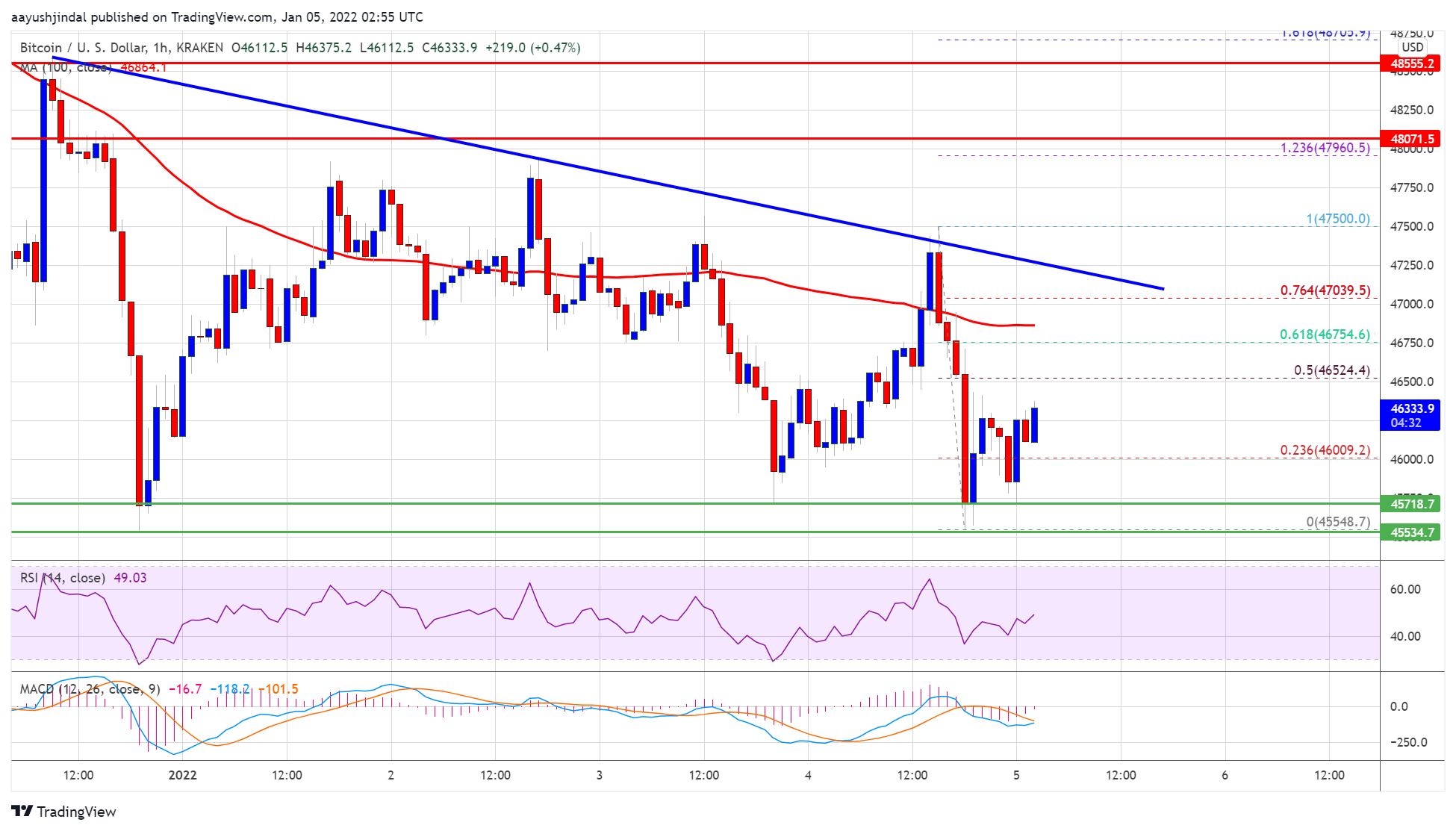
Bitcoin is still well below the $48,000 resistance against the US Dollar. BTC remains at a risk of a sharp decline if it fails to stay above the $45,500 support zone.
Bitcoin is trading in a bearish zone below the $48,000 resistance level.
The price is trading below $47,000 and the 100 hourly simple moving average.
There is a major bearish trend line forming with resistance near $47,000 on the hourly chart of the BTC/USD pair (data feed from Kraken).
The pair might start a strong recovery wave if it stays above the $45,500 support zone.
Bitcoin Price Eyes Recovery
Bitcoin price attempted a fresh increase above the $47,000 level. However, BTC failed to clear the $47,500 level and started a fresh decline.
There was a clear move below the $47,200 and $47,000 levels. The price even dived below the $46,000 support zone. Finally, the bulls defended the main $45,500 support zone. A low is formed near $45,548 and the price is now consolidating losses.
Bitcoin is trading below $47,000 and the 100 hourly simple moving average. It recovered a few points above the 23.6% Fib retracement level of the recent drop from the $47,500 swing high to $45,548 low.
An initial resistance is near the $46,500 level. It is near the 50% Fib retracement level of the recent drop from the $47,500 swing high to $45,548 low. The first major resistance on the upside is near the $47,000 level. There is also a major bearish trend line forming with resistance near $47,000 on the hourly chart of the BTC/USD pair.
Source: BTCUSD on TradingView.com
A clear move above the $47,000 resistance zone and the trend line could start a strong recovery. The next major resistance is near the $48,000 level.
More Losses In BTC?
If bitcoin fails to recover above $46,500, it could continue to move down. An immediate support is near the $46,000 zone. The first major support is near $45,500.
A downside break below the $45,500 level could push the price further lower. In the stated case, the price may possibly decline towards the $43,000 level in the coming sessions.
Technical indicators:
Hourly MACD – The MACD is now losing pace in the bearish zone.
Hourly RSI (Relative Strength Index) – The RSI for BTC/USD is near the 50 level.
Major Support Levels – $46,000, followed by $45,500.
Major Resistance Levels – $46,500, $47,000 and $47,500.