Mozaic focuses on investing in innovative tech companies seeking to re-invent their industry ecosystems — across emerging, growth and mature markets.
London, United Kingdom — Oct 14th, 2021 — Community-focused DeFi platform MRHB DeFi has received a strategic investment from London-based investment platform Mozaic to support its transformative vision of bringing the value of the cryptoverse to financially excluded communities around the world. Mozaic is part of New World Group — a global diversified investment company with more than USD 2.5 Billion of group assets-under-management.
The UK presentsa key opportunity to nurture a financially inclusive cryptoverse and this investment is aimed at expanding the reach of MRHB DeFi beyond its core Asia and Middle East base to support the engagement of new UK users and communities who are seeking a more ethical and or faith-based approach to crypto market participation.
“With a current market capitalisation of USD 2 trillion and growing — the crypto asset space represents an exciting growth opportunity for us and MRHB DeFi’s focus on ethical and inclusive finance resonates strongly with Mozaic’s investment thesis,” says New World Group Partner Sonny Gupta.
“The strength and commitment of the MRHB team made them natural partners for our inaugural investment into the decentralised finance sector,” he adds.
“Mozaic’s investment focus on robust and scalable technology businesses with a mindset of long-term value creation, made them natural partners for us as we build the world’s first ethical DeFi platform” says MRHB DeFi CEO Naquib Mohammed.
“The UK represents a key strategic investor community for MRHB DeFi — and one which we hope to engage better with high quality institutional partners,” he also notes.
MRHB DeFi was founded with a vision of providing greater access to excluded and cautious communities to the growing opportunities and utilities of the cryptoverse, and has a particular focus on delivering faith-based DeFi services which adhere to the ethical investment and financing principles rooted in Islamic Finance, many of which align with the United Nations Sustainable Development Goals. Such business practices include those that avoid interest, usury, social exploitation and other acts deemed unethical as well as support sustainability, asset/utility backed financing, transparency and equitable risk/reward sharing.
With the Islamic Finance industry sized at around USD 3 trillion of assets, bringing even a small portion of Shariah-sensitive liquidity into DeFi will represent a major boost to the total value of the DeFi sector worldwide.
The investment from Mozaic follows investments from Contango Digital Assets, NewTribe Capital, Sheesha Finance, Acreditus Partners and other institutional investors.
About MRHB DeFi
MRHB DeFi is a decentralised finance platform built to bring ethics to the DeFi space with an approach that supports the inclusion of faith-based and other excluded communities in addition to existing crypto-natives so that everyone can benefit from the full empowerment potential of DeFi to help build a true peer-to-peer financial and economic value system.
Based on the tenets of blockchain such as trust, transparency, and security, MRHB DeFi has encapsulated universally applicable principles of Islamic Finance into those tenets of blockchain to render a suite of offerings that are also ESG compliant.
The project is backed by a diverse and strong team with backgrounds spanning crypto, technology, faith-compliant investing, finance and seasoned institutional veterans of industry. The public sale offering will be in December. Register your interest and read more about MRHB DeFi’s Shariah Concept Paper, Lite and White Paper here.
New World Group is a global diversified investment company with offices in London and Kuala Lumpur. The firm builds, acquires, invests, and scales businesses focusing on long-term growth. New World Group adds value to its partners and portfolio companies through origination and execution to value realisation.
New World Group and its businesses, including Mozaic, take a global perspective across sectors in which they act as investors, operators and business builders with offices and partners across the world’s most exciting, high growth markets. The company has made 15+ investments to-date and manages more than USD 2.5 billion across 25 countries.
Learn more about New World Group by visiting its official website.
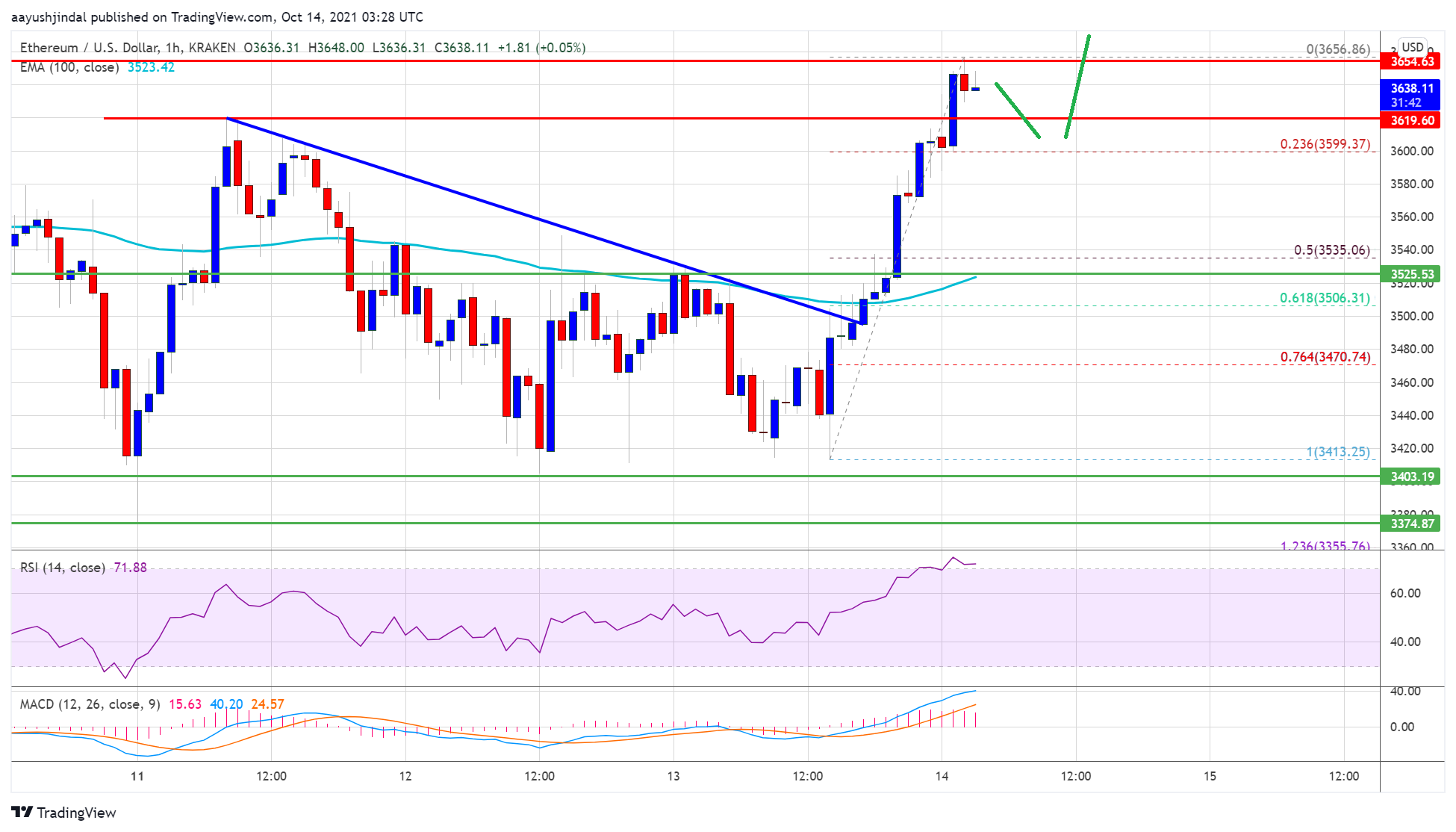
Ethereum started a fresh increase from the $3,400 support zone against the US Dollar. ETH price could accelerate higher once there is a clear break above $3,650.
Ethereum started a fresh increase above the $3,500 and $3,550 resistance levels.
The price is now trading above $3,550 and the 100 hourly simple moving average.
There was a break above a key bearish trend line with resistance near $3,500 on the hourly chart of ETH/USD (data feed via Kraken).
The pair could start a fresh rally if there is a clear break above $3,650 and $3,660.
Ethereum Price Gains Pace
Ethereum remained well supported above the $3,400 zone. ETH started a fresh increase above the $3,500 resistance zone and the 100 hourly simple moving average, similar to bitcoin.
There was also a break above a key bearish trend line with resistance near $3,500 on the hourly chart of ETH/USD. The pair is now trading above the $3,550 resistance zone. Ether price even surpassed the $3,600 resistance zone.
A high is formed near $3,656 and the price is now consolidating gains. It is well above the 23.6% Fib retracement level of the recent upward move from the $3,413 swing low to $3,656 high. The price is now showing positive signs above the $3,630. An immediate resistance on the upside is near the $3,650 level.
Source: ETHUSD on TradingView.com
The next major resistance is near the $3,660 level, above which the price might start a fresh surge. In the stated case, the price could climb towards the $3,750 level. Any more gains could set the pace for a move towards the $4,000 level in the near term.
Dips Limited in ETH?
If ethereum fails to continue higher above the $3,650 and $3,660 resistance levels, it could start a fresh downside correction. An initial support on the downside is near the $3,600 level.
The first key support is now forming near the $3,550 level. It is near the 50% Fib retracement level of the recent upward move from the $3,413 swing low to $3,656 high. If there is a downside break below the $3,550 and $3,535 support levels, the price could decline further. The next key support is near $3,450.
Technical Indicators
Hourly MACD – The MACD for ETH/USD is gaining pace in the bullish zone.
Hourly RSI – The RSI for ETH/USD is now above the 60 level.
FROST is a round-optimal threshold Schnorr signature protocol. Here we introduce why Coinbase decided to use FROST, what FROST is, and what we discovered while evaluating FROST.
Why FROST?
In order to improve efficiency of Coinbase’s threshold-signing systems, we decided to explore the FROST threshold Schnorr signature protocol, which features the following advantages over other Schnorr-based threshold signature protocols [GJKR03, SS01]:
Low round complexity in both the distributed key-generation and signing phases. The distributed key generation phase can be completed in 2 rounds. The signing phase can be completed in less or equal to 3 rounds depending on whether we use a signature aggregator role and a preprocessing stage. That is,
1-round signing with a trusted signature aggregator and a preprocessing stage.
2-round signing with a trusted signature aggregator, but no preprocessing stage.
3-round signing without a trusted signature aggregator and no preprocessing stage.
Concurrent security. The signing phase is secure when performed concurrently. That is, an unlimited number of signature operations can be performed in parallel. In contrast with other threshold Schnorr signature protocols, there are existing Schnorr-based threshold signature protocols, such as [GJKR03, SS01], that have the same round complexity, but they suffer from limited concurrency to protect against the attack of Drijvers et al. [DEF19]. This attack was originally proposed in a Schnorr multi-signature n-out-of-n setting, but it also applies similarly in a threshold t-out-of-n setting with the same parameters for an adversary that controls up to t-1 participants. We refer readers to section 2.6 of the FROST draft for more details. To prevent this attack without limiting concurrency, FROST binds each participant’s response to a specific message as well as the set of participants and their set of elliptic curve (EC) points used for that particular signing operation. In doing so, combining responses over different messages or EC point pairs results in an invalid signature, thwarting attacks such as those of Drijvers, et al.
Secure against dishonest majority. FROST is secure against adversaries which control up to t-1 signers in the signing phase.
Simple cryptographic building blocks and assumptions. FROST is built upon the threshold Shamir secret sharing and Feldman verifiable secret sharing schemes and it relies only on the discrete logarithm assumption.
How does FROST work?
Before we introduce how FROST works, we first recall how the standalone Schnorr signature works.
A Schnorr digital signature algorithm is a triple of algorithms: (KeyGen, Sign, Verify).
Let G be a group generator of a cyclic group with prime order p, and let H be a cryptographic hash function mapping to the field Zₚ* . A Schnorr signature is generated over a message m by the following steps:
KeyGen -> (sk, vk)
Randomly sample the secret key sk <- Zₚ.
Return (sk, vk = sk * G).
Sign(sk, m) -> sig
Randomly sample a secret nonce k <- Zₚ.
R = k * G
c = H(m, R)
z = k + sk * c (mod p)
Return signature sig = (z, c)
Verify(vk, m, sig) -> true/false
Parse sig = (z’, c’)
R’ = z * G -c * vk
c’ = H(m, R’)
Return true if c = c’, otherwise return false.
We call (sk, vk) the secret and verification keys respectively. We call m the message being signed and sig the Schnorr digital signature.
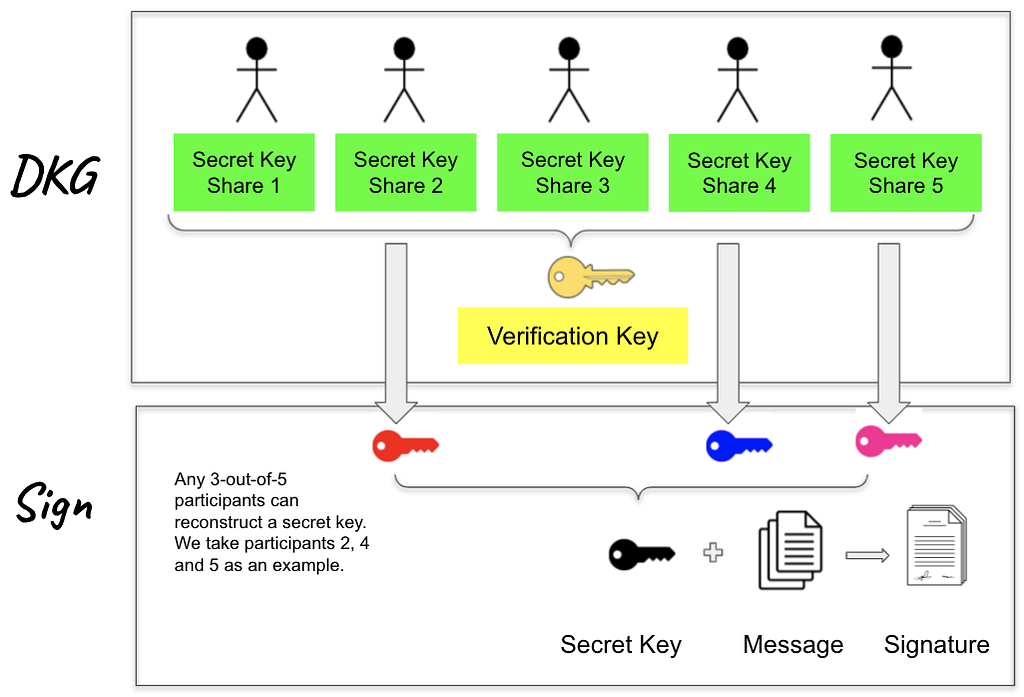
FROST is a threshold Schnorr signature protocol that contains two important components. First, n participants run a distributed key generation (DKG) protocol to generate a common verification key; at the end, each participant obtains a private secret key share and a public verification key share. Afterwards, any t-out-of-n participants can run a threshold signing protocol to collaboratively generate a valid Schnorr signature. The figure below gives a high-level sketch of how FROST works in the case of t = 3 and n = 5.
(3, 5) — FROST DKG + Threshold Signing Overview
In the following context, we introduce FROST distributed key generation and threshold signing in more technical details.
FROST — distributed key generation (DKG). The secret signing key in Schnorr signature is an element in the field Zₚ. The goal of this phase is to generate long-lived secret key shares and a joint verification key. This phase is run by n participants. FROST builds its own key generation phase upon Pedersen’s DKG [GJKR03], in which it uses both Shamir secret sharing and Feldman’s verifiable secret sharing schemes as subroutines. In addition, FROST also requires each participant to demonstrate knowledge of their own secret by sending to other participants a zero-knowledge proof, which itself is a Schnorr signature. This additional step protects against rogue-key attacks in the setting where t ≥ n/2.
At the end of the DKG protocol, a joint verification key vk is generated. Also, each participant Pᵢ holds a value (i, skᵢ) that is their long-lived secret share and a verification key share vkᵢ = skᵢ*G. Participant Pᵢ’s verification key share vkᵢis used by other participants to verify the correctness of Pᵢ’s signature shares in the signing phase, while the verification key vk is used by external parties to verify signatures issued by the group.
FROST — threshold signing. We now introduce the signing protocol for FROST. This phase builds upon known techniques that employ additive secret sharing and share conversion to non-interactively generate the nonce for each signature. This phase also leverages binding techniques to avoid known forgery attacks without limiting concurrency.
Our implementation is slightly adapted from the FROST draft. In our implementation, we opted to not use the signature aggregator role. Instead, each participant is a signature aggregator. This design is more secure: all the participants of the protocol verify what others have computed to achieve a higher level of security and reduce risk. In contrast with other open source libraries, as far as we know, we are the first to implement FROST without the signature aggregator role. Furthermore, we have chosen not to do the (one-time) preprocessing stage in order to speed up the implementation. In the preprocessing stage, each participant prepares a fixed number of EC point pairs for further use, which is run for a single time for multiple threshold signing phases. However, we take this stage as an additional round and only prepare a single pair of EC points, which means we run it every time for each threshold signing phase. In more detail, there are two major differences between our implementation and the original draft.
First, the signature aggregator, as described in the draft, validates messages that are broadcast by cosigners and computes the final signature. In our implementation, we do not use such a role. Instead, each participant simply performs a broadcast in place of a signature aggregator performing coordination. Note that FROST can be instantiated without such a signature aggregator as stressed in the draft. Also, implementing it in a decentralized way is more appropriate to Coinbase’s multiparty computation approach.
Second, the protocol in the draft uses a preprocessing stage prior to signing, where each participant Pᵢ samples a sequence number, say Q, of single-use nonces (dᵢⱼ, eᵢⱼ), computes and broadcasts pairs of public points (Dᵢⱼ = dᵢⱼ*G, Eᵢⱼ = eᵢⱼ*G) for further use in subsequent signing rounds, where j = 1….Q. This preprocessing stage is a once-for-all stage. That is, each participant can prepare a fixed number of EC point pairs, say Q, and broadcast them to the signature aggregator, then the signature aggregator distributes these EC point pairs to all participants for further use. Once these pairs of EC points are used up, then these participants should run another preprocessing stage. Since we opted to not use such a signature aggregator role in our implementation, we have chosen instead to let each participant generate a single pair of EC points (Dᵢ, Eᵢ). Therefore, there is no preprocessing stage in our implementation and thus there are 3 rounds in our threshold signing phase instead of 2. Also note that whether our implementation contains the preprocessing stage or not simply depends on how many EC point pairs are generated in signing round 1. If each participant generates a Q number of EC point pairs in the signing round 1, then this round can be viewed as the preprocessing stage and our implementation becomes a 2-round signing protocol.
We describe how these three signing rounds work and give some technical details.
Signing Round 1. Each participant Pᵢ begins by generating a single private nonce pair (dᵢ, eᵢ) and corresponding pair of EC points (Dᵢ, Eᵢ) and broadcasts this pair of points to all other participants. Each participant stores these pairs of EC points received for use later. Signing rounds 2 and 3 are the actual operations in which t-out-of-n participants cooperate to create a valid Schnorr signature.
Signing Round 2. To create a valid Schnorr signature, any t participants work together to execute this round. The core technique behind this round is t-out-of-t additive secret sharing. This technique creates the secret nonce k = SUM(kᵢ), which is the same value generated in the single-party Schnorr signing algorithm, and each kᵢ is the share computed by participant Pᵢ. To do this, each participant prepares the set of pairs of EC points B = (D₁, E₁)……(Dₜ, Eₜ) received in round 1, and then computes kᵢ = dᵢ+eᵢ*rᵢ , where rᵢ=H(i, m, B) and H is a hash function whose outputs are in the field Zₚ. Computing rᵢ is important since it works as a binding value for each participant to prevent the forgery attack. Then each participant computes the commitment Rᵢ=Dᵢ+Eᵢ*rᵢ such that it binds the message m, the set of signing participants and each participant’s EC points to each signature share, such that signature shares for one message cannot be used for another. This prevents the forgery attack because attackers cannot combine signature shares across distinct signing operations or permute the set of signers or published points for each signer. The commitment for the set of signers is then simply R = SUM(Rᵢ). As in single-party Schnorr signatures, each participant computes the challenge c = H(m, R).
Having computed the challenge c, each participant is able to compute the response zᵢ to the challenge using the single-use nonces (dᵢ, eᵢ) and the long-term secret shares skᵢ, which are t-out-of-n (degree t-1) Shamir secret shares of the group’s long-lived key sk. One main observation that FROST leverages is that if kᵢ are additive shares of k, then each kᵢ/Lᵢ are t-out-of-n Shamir shares of k, where Lᵢ is the Lagrange coefficient for participant Pᵢ. That is, Lᵢ = prod(i/(j-i)), where j = 1,…,t, j ≠i. This observation is due to the work by Benaloh and Leichter [BL88] and the work by Cramer, Damgaard and Ishai [CDI05]. They present a non-interactive mechanism for participants to locally convert additive shares generated via the Benaloh and Leichter t-out-of-n secret sharing construction to Shamir’s polynomial form. FROST uses the simplest t-out-of-t case of this transformation. Thus kᵢ/Lᵢ+skᵢ*c are degree t-1 Shamir secret shares of the correct response z = k+sk*c for a plain (single-party) Schnorr signature. Using share conversion again and the value each participant has computed (namely, kᵢ = dᵢ+eᵢ*rᵢ), we get that zᵢ=dᵢ+eᵢ*rᵢ+Lᵢ*skᵢ*c are t-out-of-t additive shares of z. At the end of signing round 2, each participant broadcasts zᵢ to other participants.
Signing Round 3. After receiving zᵢ from all other participants, each participant checks the consistency of these reported zᵢ, with their pair of EC points (Dᵢ, Eᵢ) and their verification key share vkᵢ. This can be done by checking the equation zᵢ*G = Rᵢ+c*Lᵢ*vkᵢ. Once all zᵢ are valid, then each participant computes z = SUM(zᵢ) and output (z, c) as the final Schnorr signature. This signature will verify properly to any party unaware that FROST was used to generate the signature, and can check it with the standard single-party Schnorr verification equation with vk as the verification key. As we have mentioned, we do not use the signature aggregator role in our implementation. Thus, each participant works as a signature aggregator. Therefore, we let each participant self-verify its own signature before outputting it.
Implementation Challenges
We referred to some known FROST implementations: two Rust implementations — one by ZCash foundation and another by frost-dalek — but they are not appropriate to our tech stack. One Golang implementation is from the Taurus group, but unfortunately this Go implementation is not ready for production use and has not been externally audited. As a result, we decided to implement the protocol in-house.
One feature of FROST signing is that each participant must know Lagrange coefficients for each participant in order to compute zᵢ. This is uncommon in other threshold signature protocols that use Feldman verifiable secret sharing as a sub-protocol, so there are few existing Go libraries to support THIS. Most existing libraries support generating secret shares, polynomials, and their interpolation, but do not support Lagrange coefficient computation. To fill in this technical gap, we implemented participants’ Lagrange coefficients given arbitraryt participant IDs as input. Before running the threshold signing protocol, it takes input IDs of the t participants and generates all Lagrange coefficients. As the FROST draft suggests, we assign these coefficients to each participant before signing to improve performance.
Summary
FROST is a flexible, round-optimized Schnorr threshold signature scheme that minimizes the network overhead of producing Schnorr signatures in a threshold setting while allowing for unrestricted parallelism of signing operations and only a threshold number of signing participants. We introduce FROST, highlight its features, and describe it in a fully decentralized approach (i.e., without any third-party signature aggregator). This post exposes what Coinbase discovered while evaluating and implementing the FROST protocol and we look forward to adding it to our suite of threshold signing services.
If you are interested in cutting-edge cryptography, Coinbase is hiring.
FROST: Flexible Round-Optimized Schnorr Threshold Signatures was originally published in The Coinbase Blog on Medium, where people are continuing the conversation by highlighting and responding to this story.
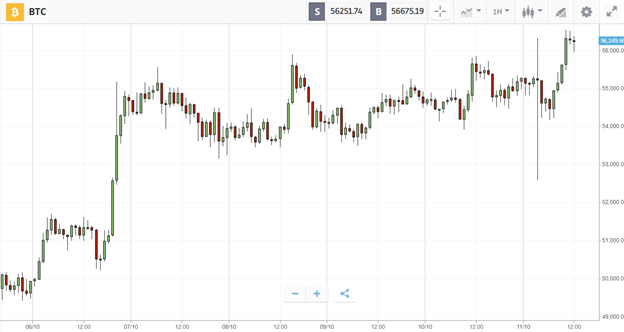
Bitcoin has surpassed $56K, reclaiming its trillion dollar market cap as the U.S. treasury rules out minting a platinum coin of the same value.
The move higher comes on a raft of positive news: the U.S. Securities and Exchange Commission (SEC) has approved an exchange-traded fund (ETF) giving exposure to companies holding crypto, the investment firm founded by billionaire George Soros has revealed a Bitcoin allocation, and Brazil is following El Salvador by preparing a bill that will make the cryptoasset a recognized currency.
All this action has put Bitcoin center stage with over 15% weekly gains, but several altcoins have also put on a wild performance. Shiba Inu doubled in price and Stellar added 8% on a new partnership with MoneyGram. Meanwhile, Tezos gave back recent gains by sinking 14%.
This Week’s Highlights
Shiba shakes off the leash with 100% weekly gains
Regulatory fears fade as White House weighs executive order
eToro launches Filecoin and Polkadot on its investment platform
Shiba shakes off the leash with 100% weekly gains
Shiba Inu Token has doubled in value over the last week, running ahead of the pack to reach twelfth place in the market cap rankings.
At its highest point, Shiba was up over 300%. This followed a tweet from Elon Musk about his dog Floki of the same breed, and the launch of 10,000 Shiboshi NFTs on the recently launched decentralized exchange ShibaSwap.
Meanwhile, Musk’s pet project Dogecoin is laying low. The rival canine-themed crypto finished the week with 4% losses.
Regulatory fears fade as White House weighs executive order
The rising prices come as the Biden administration considers an executive order to regulate the crypto industry.
This is widely expected to be bullish as it follows positive comments from the heads of U.S. government agencies. SEC Chair Gary Gensler told Congress on Tuesday that the agency has no plans to follow China into a crypto ban, joining Federal Reserve Chairman Jerome Powell, who expressed the same sentiment at the end of September.
Instead of a ban, more nurturing regulation might come in the form of the “Clarity for Digital Tokens Act of 2021.” This bill was proposed last Tuesday and would create a “safe harbor” for projects that raise funds to build decentralized networks.
eToro launches Filecoin and Polkadot on its investment platform
eToro has added two more assets to its crypto offering, bringing the total number of cryptoassets available to 31.
The new cryptos are Filecoin (FIL), which powers a decentralized storage network, and Polkadot (DOT), a platform for cross-chain transfers.
Week ahead
As Bitcoin continues to close in on all-time highs, chatter about the approval of a Bitcoin ETF in the U.S. is reaching fever pitch.
The first ETF to be approved could be the ProShares Bitcoin Strategy ETF, backed by Bitcoin futures, which is due to be decided on October 18th.
Meanwhile, traders will be keeping their eyes peeled for broader regulatory developments from the highest branches of the U.S. government.
If you are interested in developments in fintech, cryptocurrency and decentralized finance, the Chairman of MRHB DeFi Khalid Howlader, is set to appear on a panel at the upcoming Turin Islamic Economic Forum (TIEF), this Wednesday in Turin, Italy.
According to the “State of the Global Islamic Economy Report”(Thomson Reuters, 2020/2021), with governments and banks encouraging Islamic finance and improving financial inclusion, both Muslim-majority and minority countries have started to recognize the untapped potential of the Islamic Finance sector. Islamic Finance is continuing to expand and the report states that it could become an important part of the future of developed nations’ ability to attract fresh capital for investment in infrastructure, new technologies, renewable energy, real estate and strategic resources.
You can find out more about the event here: https://www.tief.it/?lang=en
Khalid Howladar, is Chairman of MRHB DeFi, the world’s first ethical and faith-based decentralized finance platform.
He is also Senior MD and Head of Credit & Sukuk for R.J. Fleming & Co. and was previously Global Head of Islamic Finance and Head of the GCC banking team at Moody’s Investors Service, London and Dubai. He has addressed audiences worldwide including at the World Bank, IMF, ECB and IIF.
He will be speaking at TIEF on a panel titled: Islamic Finance And Economic Inclusion, alongside Ahmed Zourhi, in a panel discussion moderated by Alberto Brugnoni, the managing partner of ASSAIF.
The panel runs from 11am, Wednesday, at the TIEF event.
You can find out more about TIEF here: https://convention.turismotorino.org/en/events/tief-2021-turin-islamic-economic-forum
You can reserve tickets here: https://www.eventbrite.com/o/tief-torino-35070425473
MRHB DeFi recently announced partnerships with Sheesha Finance, NewTribe Capital, Acreditus Partners, EMGS Group and Coinsbit India, working towards expanding its reach and visibility to people new to blockchain, as well as long time believers in the cryptocurrency and digital asset industry.
Video sharing platform YouTube removed the 251,000-subscriber channel of Anthony ‘Pomp’ Pompliano, co-founder of Morgan Creek Digital and host of The Pomp Podcast, before later restoring it.
In an Oct. 11 update on his Twitter account, Pompliano — a Bitcoin (BTC) bull known for his interviews educating skeptics and others on crypto — said he received a message from YouTube claiming a recent livestreamed interview with stock-to-flow model creator PlanB encouraged “illegal activities.” Pompliano’s entire channel was unavailable for roughly two hours before being returned to the platform, with all videos on BTC and crypto viewable to the public.
“[YouTube] first stated that the content, an interview on Bitcoin, was harmful and dangerous,” said Pomp. “They then stated that we would receive a strike, but then I received a second email saying the channel was being deleted seconds later.”
According to Pomp, he had received no “strikes” — violations of YouTube’s community guidelines; three strikes within 90 day can result in a channel being permanently removed — and the video seemingly didn’t have any questionable content or otherwise. However, the platform’s guidelines state it has the right to remove channels for “a single case of severe abuse” or for accounts dedicated to content including hate speech, harassment, or impersonation.
YouTube had previously targeted crypto-related content on the platform, with its algorithms labeling videos on BTC and other cryptocurrencies as “harmful content,” and leaving human reviewers to assess any grounds for appeal. In Pomp’s case, he was able to get the attention of YouTube’s support team on Twitter within minutes — likely due to his 1.1 million followers and verified account. However, other crypto content creators have reported waiting days after having their channels similarly terminated.
Related: Content creators fed up with YouTube now have a compelling alternative
The seemingly arbitrary removal of the account of a major player in the crypto space highlights the danger of relying on a centralized platform like YouTube. Last week, Facebook, Instagram and WhatsApp went offline for roughly six hours, likely disrupting community engagement around crypto and blockchain projects.
In addition, YouTube has been at the center of attention for attempting to purge videos related to misinformation on health around the COVID-19 pandemic. In August, the platform said it had removed more than one million video “related to dangerous coronavirus information” since February 2020.
Coinbase Voices is a collection of employee stories that highlight the expertise of our Coinbase team and share their journeys to crypto. In this post, Nemil Dalal, Head of Crypto, reflects on his three years at Coinbase and shares some of his key takeaways.
Soon after college, I consulted for one of the world’s top banks. What I saw horrified me.
Despite their dominance, their tech systems were a mess of spaghetti built over 40 years, with much of the code still running on proprietary COBOL mainframes when the world had long ago moved onto mobile phones, open APIs, and easier to use programming languages. It was clear to me that tech innovation would not come from our existing financial system.
Two years later, I was in India exploring how to extend microcredit using mobile payments. Few of the poorest had access to financial services that many of us are used to. It was clear to me that it would be transformational if we could make financial services more accessible.
Then one day in 2012, I met the founders of a tiny startup called Coinbase and read the Bitcoin whitepaper. While I didn’t know how crypto would grow, I also knew that the world would never be the same again: suddenly, we had an open, worldwide protocol that anyone could access and that any developer could build on top of.
My first major love in crypto was smart contracts: tiny pieces of code that let us program money.
[A deposit function in a smart contract “bank” circa 2016]
With this code, a programmer could define a safe deposit box or an entirely digital bank that anyone in the world can access and where your money was kept secure. I started writing my own smart contracts, audited those of some leading teams, and then launched a decentralized finance protocol.
Eventually, Coinbase acquired my company and asked me to first lead USDC, now a $25 BN US dollar backed stablecoin. Today, I lead Product for their Crypto team, the team that connects Coinbase to the blockchain, manages billions of dollars, and brainstorms foundational innovations.
Our team is composed of brilliant cryptographers, engineers, product managers, user researchers, and data scientists who get to dream up the future.
How is crypto different from other parts of tech?
On the face of it, crypto is just like every other part of tech: fast moving, world impacting, growing quickly. In reality, there are three things that distinguish it:
The Revolution will be Decentralized Unlike other industries, innovation isn’t led by the same cast of big tech companies in a top down way. In fact, many of the most exciting innovations come from companies like Coinbase down to garage size startups.
In fact, many of the leading companies in the world are woefully underinvested and underprepared for the world of blockchains. It’s a space where small groups of people can make a dramatic impact. And you don’t need to be in a handful of tech-forward companies based in Silicon Valley; you can contribute from anywhere in the world.
Crypto innovations are more democratic and grassroots than most other industries.
Frenetic and “Stagnant” Nearly every part of tech likes to brag how fast moving it is. But crypto is a world to itself.
One day, the blockchain is invented. The next day, smart contracts let us build decentralized finance. Stablecoins take off. Digital Art NFTs, some of which are created by rappers and celebrity artists, are suddenly worth millions of dollars and sold through Sotheby’s.
Crypto isn’t for the faint of heart. You’ll need to be constantly learning. If you’re on top now, it can be one innovation away from crashing down on you.
In crypto, we have years of “stagnation” and then dizzying price increases in frenetic bull markets. These bull markets are powerful ways to get tens of millions of people into crypto, but the winters are when so much innovation actually happens.
Ultimately, today’s crypto is a remarkable opportunity to get the best education of your life, every day.
Misfits In the early years, crypto was composed of misfits: people exploring the death of the nation state, goldbugs, anarchists. The more rational you were, the less likely you would have been able to see the potential. Even though crypto has gone mainstream, it still values this founding ethos.
Namely, being a misfit or an outsider can give you unique perspectives. After all, challenging a financial system built over millennia requires out of the box thinking and a willingness to challenge long standing assumptions.
What misconceptions are there about getting into crypto?
Crypto is more than payments To the external observer, the most obvious use case for crypto seems to be payments. International remittances are huge, funds can take days to arrive, and fees are far from 0.
In reality, crypto is the technology for financial expression that will underpin every asset we have. It can improve payments, but it will transform other industries from lending to trading to money.
In short, we’re building an internet of finance. Rather than payments or a replacement for money, crypto is the rails on which every financial product we have will eventually live.
It’s Never Too Late First, it’s never too late. When I first started playing in crypto in 2014, I was pretty sure it was too late. The price of Bitcoin had skyrocketed and all the exciting things seemed to be done. Little did I know.
Even today, the vast majority of the world doesn’t use crypto. We have much to do if we want to make crypto accessible, usable, and safe for everyone. Crypto is at a unique moment where small groups of people can do world-changing work.
Passion and learning required, not engineering experience Second, you don’t need to be a crypto expert to enable the crypto revolution. The most experience anyone has in crypto is one decade, and even in that time, the space has changed dramatically enough that the lessons of even a year ago no longer apply. Unlike other spaces, the “experts” in crypto aren’t that far apart from someone just joining.
You don’t need to be an engineer or techy to have an impact. The internet needed software engineers, designers, hardware engineers, telecom experts, policy makers, and entrepreneurs. Similarly, crypto needs a wide tent of smart contract engineers, web engineers, design, user research, compliance, legal, economists, financial experts, cryptographers, and more. Crypto will not grow without a wide tent of disciplines and diverse perspectives that communes and dreams together.
What is critical is a passion for what crypto can enable — a worldwide, open financial system — and a desire to constantly be learning. Without it, you can’t keep up with the dramatic daily innovation and stay motivated through the inevitable down cycles.
In crypto, we have a saying: to the moon. It’ll take a village to get there.
Coinbase Voices: It’s not too late to get into crypto was originally published in The Coinbase Blog on Medium, where people are continuing the conversation by highlighting and responding to this story.
New York, NY, Oct 11, 2021 — For 175 years, the Associated Press has provided the world with accurate and fast news reporting of the most important events around the globe. With fearless staff and news bureaus in 250 locations in 100 countries, AP journalists have covered moments of great joy, scientific breakthroughs, achievement, and accomplishment as well as moments of loss, despair and agony.
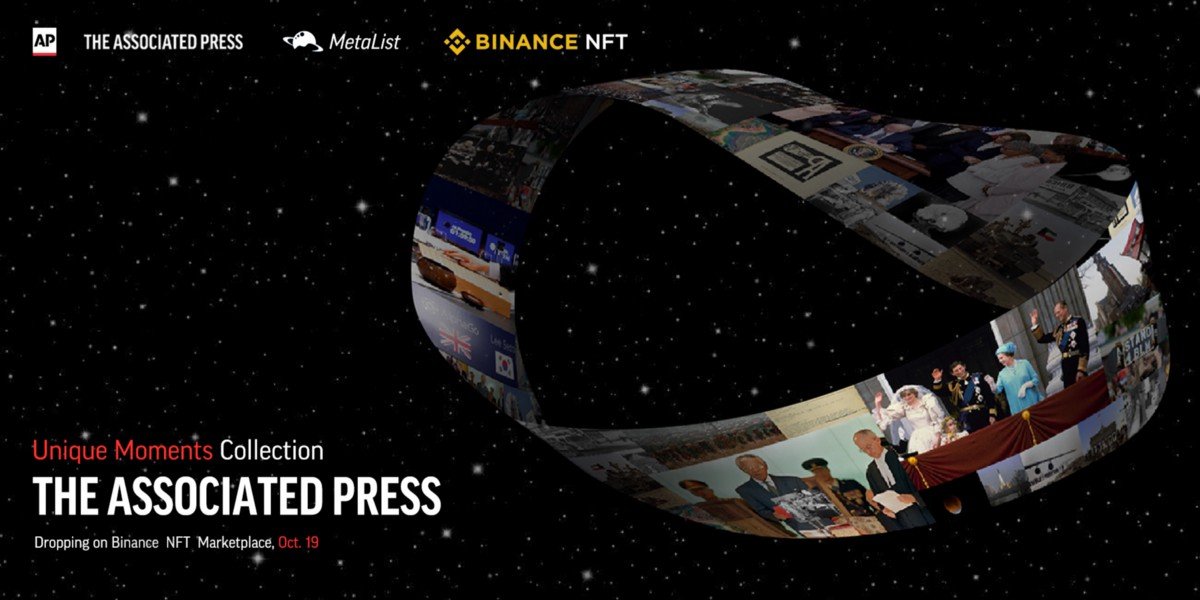
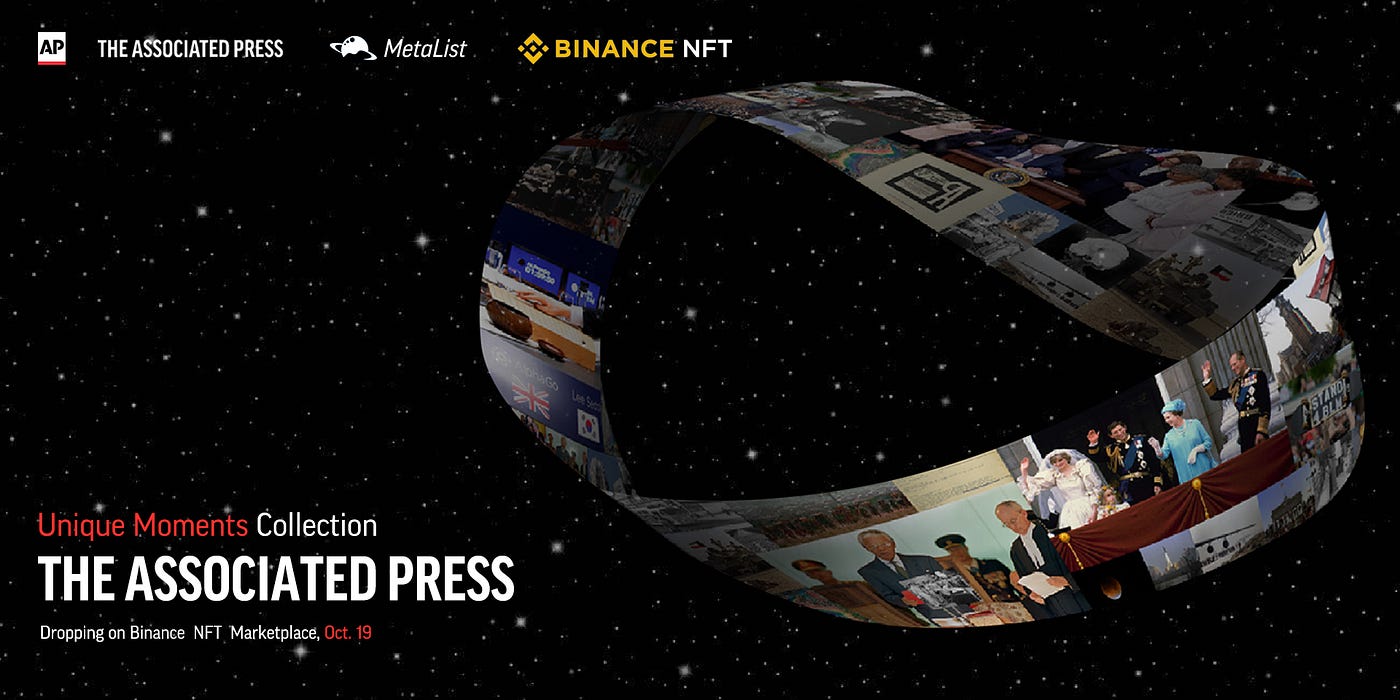
AP is dropping a unique, curated collection of its rare, archived news reporting of the most memorable moments in recent world history. To release this unique series of collectibles, AP is collaborating with Metalist Lab and the collection will drop on the Binance NFT marketplace on October 19th, at 12pm UTC.
The collectibles feature AP’s coverage over the past 100 years of milestones in space, global conflicts, science and discovery, and human freedoms and advancement. The news reporting at the core of this collection consists of high-resolution images distributed around the world by AP at the time of the events.
In addition to this historic photojournalism, the collection also includes rarely seen digitized copies of the most important “News Wire Flashes” transmitted by AP with urgency to newsrooms around the world. Such flashes were the first word on events such as the moon landing and the end of WWII in Europe. In fact, AP was the first news agency in the world to report the end of that conflict.
The collectibles also include some of the news agency’s most beautiful images, such as the super blue blood moon photographed by AP in 2018, an event that’s only occurred once in 152 years.
The Associated Press believes that facts belong on-chain and distribution of this historic news reporting to the blockchain is nothing short of vital for the preservation of world history.
About Metalist Lab:
Metalist Lab is based in Australia, and is a world-leading publisher of NFTs. It brings countless outstanding NFT designers together with the top names in encryption technology, and has worked with game companies such as NetEase, news and communications agencies such as the Associated Press, as well as many high-level artists and their IPs. Recently it’s been distributing NFTs for NetEase’s globally-popular game Naraka: Bladepoint, as well as the The AP Unique Moments NFT series.
Dataset from Foundry shows that four states in the U.S. have the highest Bitcoin hash rate distribution. The dataset shows that many Bitcoin miners are headed to New York, Kentucky, Georgia, and Texas.
Foundry U.S. is the largest mining pool in North America and the fifth-largest globally. The hash rate is a measure of collective mining power. A mining pool enables miners to combine their hashing power with other miners all over the world.
Bitcoin Mining In The U.S.
According to the data, within the U.S., New York accounts for 19.9% of bitcoin’s hash rate, 18.7% in Kentucky, 17.3% is in Georgia, and 14% in Texas.
Source: Foundry U.S.
At the Texas Blockchain Summit in Austin on October 8, 2021, Nic Carter, co-founder of Castle Island Ventures, presented Foundry’s data. “This is the first time we’ve actually had state-level insight on where miners are unless you wanted to go cobble through all the public filings and try to figure it out that way,”
He added that “This is a much more efficient way of figuring out where mining occurs in America.”
However, Carter pointed out that the Foundry dataset does not consider all the U.S. mining hash rates as not all U.S.-based mining farms use its services. One of the largest publicly traded mining companies in America, Riot Blockchain, with a huge presence in Texas, does not use Foundry. Therefore, the dataset does not account for its hash rate. Texas’ mining presence is understated and could possibly be higher than the 14% quoted.
BTC trading at over $55K | Source: BTCUSD on TradingView.com
Many of the states with the highest Bitcoin hash rates also have high proportions of renewable energy. This fact may have started changing the narrative that bitcoin is bad for the environment.
Related Reading | $425bn Wiped Off Crypto Market As Musk Says Bitcoin Is Bad For The Environment
According to CNBC, a lot of the miners are moving to these states because they have cheap and renewable sources of power. Data from the U.S. Energy Information Administration (EIA) shows that a third of New York’s in-state generation comes from renewables sources. Kentucky, which has the second-highest hash rate, is also known for its hydroelectric and wind power. The state’s government recently passed a law that grants certain tax exemptions to crypto mining operations.
Carter also said that the migration of miners to the U.S. is positive because it means much lower carbon intensity.
Texas Leads Bitcoin Mining
Although Texas ranks fourth according to the data, experts believe it is the top mining destination in the U.S. The state houses mining giants like Riot Blockchain, and the Chinese mining service platform Bitdeer.
A report from earlier this year shows that large orders for mining ASICs are also being delivered to Texas.
Related Reading | Bitcoin Mining Moves to Texas, Bitmain Announces Partner for Massive New Facility
Crypto-friendly lawmakers, a deregulated power grid with real-time spot pricing, and access to significant renewable energy, as well as stranded or flared natural gas, are what make Texas attractive to miners, according to CNBC.
Featured image by Finance Magnates, Chart from TradingView.com