The United Kingdom’s Financial Conduct Authority (FCA) is slowly approving the registration of crypto companies one at a time: the most recent one being NYDIG subsidiary Bottlepay, which is a Bitcoin-based payments company.
Announced on Tuesday, the company highlighted that it has become the first Lightning Network payments company to receive the British financial market regulator’s approval as a crypto business.
“Our registration with the FCA is an achievement not just for Bottlepay, but for the
Lightning Network
Lightning Network
The Lightning Network is a second-layer payment protocol that operates on top of a blockchain-based cryptocurrency. It enables fast transactions among participating nodes and has been touted as a solution to the Bitcoin scalability problem.This framework features a peer-to-peer (P2P) system for making micropayments of cryptocurrency via a network of bidirectional payment channels without delegating custody of funds.Transactions on the Lightning Network are only added to the blockchain when the two parties that are involved in a payment channel open or close the channel. Therefore, multiple transactions can be sent within a single channel without requiring the consensus of the entire blockchain, making the transaction process considerably faster. Normalized use of the Lightning Network involves the opening of a payment channel by committing a funding transaction to the relevant base blockchain or first layer. This in turn is followed by making any number of Lightning transactions that update the distribution of the channel’s funds without broadcasting those to the blockchain.Additionally, these may or may not be followed by closing the payment channel by broadcasting the final version of the settlement transaction to distribute the channel’s funds.How Does the Lightning Network Affect Everyday Users?For example, one Lightning Network user, Jim, can open a payment channel with a local corner store and deposit $100 worth of Bitcoin in it. Every time he visits the store, he can use his balance to instantly buy whatever he pleases. At the same time, Jane, another Lightning Network user, has opened up a channel with the cafe next to the corner shop. She also buys things from the corner shop. Because Jim has opened a channel with the corner store, Jane can also use the Lightning Network to pay for things there. Similarly, Jim can use the Lightning Network at the cafe.
The Lightning Network is a second-layer payment protocol that operates on top of a blockchain-based cryptocurrency. It enables fast transactions among participating nodes and has been touted as a solution to the Bitcoin scalability problem.This framework features a peer-to-peer (P2P) system for making micropayments of cryptocurrency via a network of bidirectional payment channels without delegating custody of funds.Transactions on the Lightning Network are only added to the blockchain when the two parties that are involved in a payment channel open or close the channel. Therefore, multiple transactions can be sent within a single channel without requiring the consensus of the entire blockchain, making the transaction process considerably faster. Normalized use of the Lightning Network involves the opening of a payment channel by committing a funding transaction to the relevant base blockchain or first layer. This in turn is followed by making any number of Lightning transactions that update the distribution of the channel’s funds without broadcasting those to the blockchain.Additionally, these may or may not be followed by closing the payment channel by broadcasting the final version of the settlement transaction to distribute the channel’s funds.How Does the Lightning Network Affect Everyday Users?For example, one Lightning Network user, Jim, can open a payment channel with a local corner store and deposit $100 worth of Bitcoin in it. Every time he visits the store, he can use his balance to instantly buy whatever he pleases. At the same time, Jane, another Lightning Network user, has opened up a channel with the cafe next to the corner shop. She also buys things from the corner shop. Because Jim has opened a channel with the corner store, Jane can also use the Lightning Network to pay for things there. Similarly, Jim can use the Lightning Network at the cafe. Read this Term,” said Pete Cheyne, the Founder of Bottlepay. “This registration goes to show that we can build the financial infrastructure of the future while upholding the regulatory and compliance standards of today.”
Lightning Network
The lightning network was introduced to overcome the limitations of the
Bitcoin
Bitcoin
Bitcoin is the world’s first digital currency that was created in 2009 by a mysterious entity named Satoshi Nakamoto. As a digital currency or cryptocurrency, Bitcoin operates without a central bank or single administrator. Instead, Bitcoin can be sent via a Peer-to-Peer (P2P) networking, devoid of intermediaries.Bitcoins are not issued or backed by any governments or banks, and Bitcoin is not considered to be legal tender, although they do have status as an acknowledged transfer of value in some jurisdictions. Rather than composing a physical currency, Bitcoins are pieces of code that can be sent and received across a kind of distributed ledger network called a blockchain. Transactions on the Bitcoin network are confirmed by a network of computers (or nodes) that solve a series of complex equations. This process is called mining. In exchange for mining, the computers receive rewards in the form of new Bitcoins. Mining grows increasingly difficult over time, and the rewards get smaller and smaller. There is a total of 21 million Bitcoins. As of May 2020, there are 18.3 million Bitcoins in circulation. This number changes approximately every 10 minutes when new blocks are mined. Presently, each new block adds 12.5 bitcoins into circulation.Since its inception, Bitcoin has remained the most popular and largest cryptocurrency in terms of market cap in the world. Bitcoin’s popularity has contributed significantly to the release of thousands of other cryptocurrencies, called “altcoins.” While the crypto market was originally hegemonic, today’s landscape features countless altcoins.Bitcoin ControversyBitcoin has been extremely controversial since its original launch. Given its mercurial nature, Bitcoin has been criticized for its use in illegal transactions and money laundering.As its impossible to trace, these attributes make Bitcoin the ideal vehicle for illicit behavior. Moreover, critics point to its high electricity consumption for mining, rampant price volatility, and thefts from exchanges. Bitcoin has been seen as a speculative bubble given its lack of oversight. The crypto has weathered multiple collapses and survived over a decade so far. Unlike its launch back in 2009, Bitcoin today is viewed far differently and is much more accepted by merchants and other entities.
Bitcoin is the world’s first digital currency that was created in 2009 by a mysterious entity named Satoshi Nakamoto. As a digital currency or cryptocurrency, Bitcoin operates without a central bank or single administrator. Instead, Bitcoin can be sent via a Peer-to-Peer (P2P) networking, devoid of intermediaries.Bitcoins are not issued or backed by any governments or banks, and Bitcoin is not considered to be legal tender, although they do have status as an acknowledged transfer of value in some jurisdictions. Rather than composing a physical currency, Bitcoins are pieces of code that can be sent and received across a kind of distributed ledger network called a blockchain. Transactions on the Bitcoin network are confirmed by a network of computers (or nodes) that solve a series of complex equations. This process is called mining. In exchange for mining, the computers receive rewards in the form of new Bitcoins. Mining grows increasingly difficult over time, and the rewards get smaller and smaller. There is a total of 21 million Bitcoins. As of May 2020, there are 18.3 million Bitcoins in circulation. This number changes approximately every 10 minutes when new blocks are mined. Presently, each new block adds 12.5 bitcoins into circulation.Since its inception, Bitcoin has remained the most popular and largest cryptocurrency in terms of market cap in the world. Bitcoin’s popularity has contributed significantly to the release of thousands of other cryptocurrencies, called “altcoins.” While the crypto market was originally hegemonic, today’s landscape features countless altcoins.Bitcoin ControversyBitcoin has been extremely controversial since its original launch. Given its mercurial nature, Bitcoin has been criticized for its use in illegal transactions and money laundering.As its impossible to trace, these attributes make Bitcoin the ideal vehicle for illicit behavior. Moreover, critics point to its high electricity consumption for mining, rampant price volatility, and thefts from exchanges. Bitcoin has been seen as a speculative bubble given its lack of oversight. The crypto has weathered multiple collapses and survived over a decade so far. Unlike its launch back in 2009, Bitcoin today is viewed far differently and is much more accepted by merchants and other entities. Read this Term network and make it suitable for making small and instant payments. However, the majority of the crypto industry is yet to adopt the supplementary technology.
Meanwhile, Bottlepay is focused on building an instant payment network and is allowing users to make payments in Bitcoin, pound sterling and euro.
“We are incredibly proud of what the Bottlepay team has accomplished,” said NYDIG President, Yan Zhao. “Securing FCA registration is a breakthrough event and is a testament to NYDIG’s and Bottlepay’s commitment to compliance. Together with Bottlepay, we will continue to work hard to make the Bitcoin network accessible to all.”
The FCA mandated the registration of all cryptocurrency platforms operating in the United Kingdom last year. Though the initial deadline was short, the regulator extended it until March 2022 due to the massive backlog on its part to review the submitted applications. So far only a handful of crypto companies have gained the FCA’s nod, but interestingly dozens of companies withdrew their applications, meaning they do not want to offer their services in the British market.
The United Kingdom’s Financial Conduct Authority (FCA) is slowly approving the registration of crypto companies one at a time: the most recent one being NYDIG subsidiary Bottlepay, which is a Bitcoin-based payments company.
Announced on Tuesday, the company highlighted that it has become the first Lightning Network payments company to receive the British financial market regulator’s approval as a crypto business.
“Our registration with the FCA is an achievement not just for Bottlepay, but for the
Lightning Network
Lightning Network
The Lightning Network is a second-layer payment protocol that operates on top of a blockchain-based cryptocurrency. It enables fast transactions among participating nodes and has been touted as a solution to the Bitcoin scalability problem.This framework features a peer-to-peer (P2P) system for making micropayments of cryptocurrency via a network of bidirectional payment channels without delegating custody of funds.Transactions on the Lightning Network are only added to the blockchain when the two parties that are involved in a payment channel open or close the channel. Therefore, multiple transactions can be sent within a single channel without requiring the consensus of the entire blockchain, making the transaction process considerably faster. Normalized use of the Lightning Network involves the opening of a payment channel by committing a funding transaction to the relevant base blockchain or first layer. This in turn is followed by making any number of Lightning transactions that update the distribution of the channel’s funds without broadcasting those to the blockchain.Additionally, these may or may not be followed by closing the payment channel by broadcasting the final version of the settlement transaction to distribute the channel’s funds.How Does the Lightning Network Affect Everyday Users?For example, one Lightning Network user, Jim, can open a payment channel with a local corner store and deposit $100 worth of Bitcoin in it. Every time he visits the store, he can use his balance to instantly buy whatever he pleases. At the same time, Jane, another Lightning Network user, has opened up a channel with the cafe next to the corner shop. She also buys things from the corner shop. Because Jim has opened a channel with the corner store, Jane can also use the Lightning Network to pay for things there. Similarly, Jim can use the Lightning Network at the cafe.
The Lightning Network is a second-layer payment protocol that operates on top of a blockchain-based cryptocurrency. It enables fast transactions among participating nodes and has been touted as a solution to the Bitcoin scalability problem.This framework features a peer-to-peer (P2P) system for making micropayments of cryptocurrency via a network of bidirectional payment channels without delegating custody of funds.Transactions on the Lightning Network are only added to the blockchain when the two parties that are involved in a payment channel open or close the channel. Therefore, multiple transactions can be sent within a single channel without requiring the consensus of the entire blockchain, making the transaction process considerably faster. Normalized use of the Lightning Network involves the opening of a payment channel by committing a funding transaction to the relevant base blockchain or first layer. This in turn is followed by making any number of Lightning transactions that update the distribution of the channel’s funds without broadcasting those to the blockchain.Additionally, these may or may not be followed by closing the payment channel by broadcasting the final version of the settlement transaction to distribute the channel’s funds.How Does the Lightning Network Affect Everyday Users?For example, one Lightning Network user, Jim, can open a payment channel with a local corner store and deposit $100 worth of Bitcoin in it. Every time he visits the store, he can use his balance to instantly buy whatever he pleases. At the same time, Jane, another Lightning Network user, has opened up a channel with the cafe next to the corner shop. She also buys things from the corner shop. Because Jim has opened a channel with the corner store, Jane can also use the Lightning Network to pay for things there. Similarly, Jim can use the Lightning Network at the cafe. Read this Term,” said Pete Cheyne, the Founder of Bottlepay. “This registration goes to show that we can build the financial infrastructure of the future while upholding the regulatory and compliance standards of today.”
Lightning Network
The lightning network was introduced to overcome the limitations of the
Bitcoin
Bitcoin
Bitcoin is the world’s first digital currency that was created in 2009 by a mysterious entity named Satoshi Nakamoto. As a digital currency or cryptocurrency, Bitcoin operates without a central bank or single administrator. Instead, Bitcoin can be sent via a Peer-to-Peer (P2P) networking, devoid of intermediaries.Bitcoins are not issued or backed by any governments or banks, and Bitcoin is not considered to be legal tender, although they do have status as an acknowledged transfer of value in some jurisdictions. Rather than composing a physical currency, Bitcoins are pieces of code that can be sent and received across a kind of distributed ledger network called a blockchain. Transactions on the Bitcoin network are confirmed by a network of computers (or nodes) that solve a series of complex equations. This process is called mining. In exchange for mining, the computers receive rewards in the form of new Bitcoins. Mining grows increasingly difficult over time, and the rewards get smaller and smaller. There is a total of 21 million Bitcoins. As of May 2020, there are 18.3 million Bitcoins in circulation. This number changes approximately every 10 minutes when new blocks are mined. Presently, each new block adds 12.5 bitcoins into circulation.Since its inception, Bitcoin has remained the most popular and largest cryptocurrency in terms of market cap in the world. Bitcoin’s popularity has contributed significantly to the release of thousands of other cryptocurrencies, called “altcoins.” While the crypto market was originally hegemonic, today’s landscape features countless altcoins.Bitcoin ControversyBitcoin has been extremely controversial since its original launch. Given its mercurial nature, Bitcoin has been criticized for its use in illegal transactions and money laundering.As its impossible to trace, these attributes make Bitcoin the ideal vehicle for illicit behavior. Moreover, critics point to its high electricity consumption for mining, rampant price volatility, and thefts from exchanges. Bitcoin has been seen as a speculative bubble given its lack of oversight. The crypto has weathered multiple collapses and survived over a decade so far. Unlike its launch back in 2009, Bitcoin today is viewed far differently and is much more accepted by merchants and other entities.
Bitcoin is the world’s first digital currency that was created in 2009 by a mysterious entity named Satoshi Nakamoto. As a digital currency or cryptocurrency, Bitcoin operates without a central bank or single administrator. Instead, Bitcoin can be sent via a Peer-to-Peer (P2P) networking, devoid of intermediaries.Bitcoins are not issued or backed by any governments or banks, and Bitcoin is not considered to be legal tender, although they do have status as an acknowledged transfer of value in some jurisdictions. Rather than composing a physical currency, Bitcoins are pieces of code that can be sent and received across a kind of distributed ledger network called a blockchain. Transactions on the Bitcoin network are confirmed by a network of computers (or nodes) that solve a series of complex equations. This process is called mining. In exchange for mining, the computers receive rewards in the form of new Bitcoins. Mining grows increasingly difficult over time, and the rewards get smaller and smaller. There is a total of 21 million Bitcoins. As of May 2020, there are 18.3 million Bitcoins in circulation. This number changes approximately every 10 minutes when new blocks are mined. Presently, each new block adds 12.5 bitcoins into circulation.Since its inception, Bitcoin has remained the most popular and largest cryptocurrency in terms of market cap in the world. Bitcoin’s popularity has contributed significantly to the release of thousands of other cryptocurrencies, called “altcoins.” While the crypto market was originally hegemonic, today’s landscape features countless altcoins.Bitcoin ControversyBitcoin has been extremely controversial since its original launch. Given its mercurial nature, Bitcoin has been criticized for its use in illegal transactions and money laundering.As its impossible to trace, these attributes make Bitcoin the ideal vehicle for illicit behavior. Moreover, critics point to its high electricity consumption for mining, rampant price volatility, and thefts from exchanges. Bitcoin has been seen as a speculative bubble given its lack of oversight. The crypto has weathered multiple collapses and survived over a decade so far. Unlike its launch back in 2009, Bitcoin today is viewed far differently and is much more accepted by merchants and other entities. Read this Term network and make it suitable for making small and instant payments. However, the majority of the crypto industry is yet to adopt the supplementary technology.
Meanwhile, Bottlepay is focused on building an instant payment network and is allowing users to make payments in Bitcoin, pound sterling and euro.
“We are incredibly proud of what the Bottlepay team has accomplished,” said NYDIG President, Yan Zhao. “Securing FCA registration is a breakthrough event and is a testament to NYDIG’s and Bottlepay’s commitment to compliance. Together with Bottlepay, we will continue to work hard to make the Bitcoin network accessible to all.”
The FCA mandated the registration of all cryptocurrency platforms operating in the United Kingdom last year. Though the initial deadline was short, the regulator extended it until March 2022 due to the massive backlog on its part to review the submitted applications. So far only a handful of crypto companies have gained the FCA’s nod, but interestingly dozens of companies withdrew their applications, meaning they do not want to offer their services in the British market.
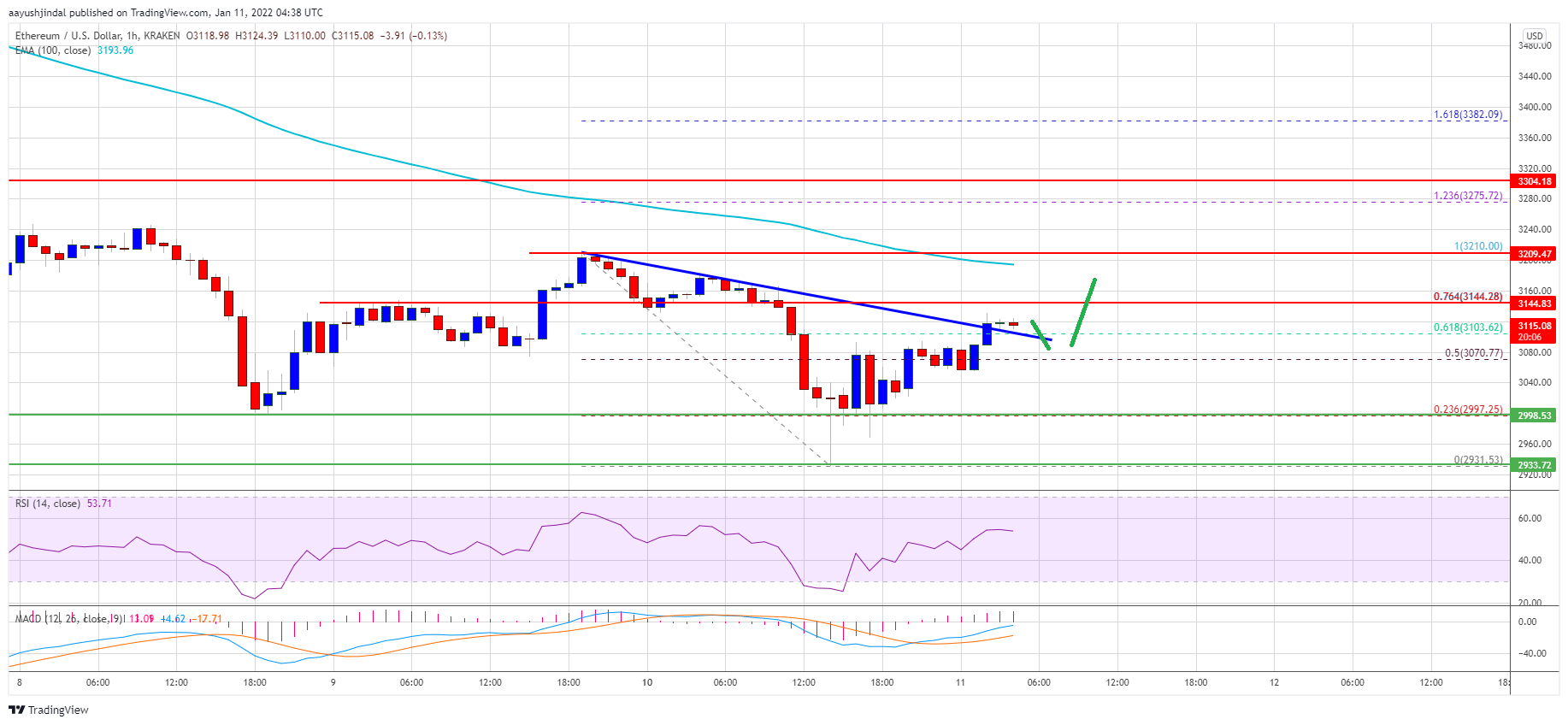
Ethereum fell to $2,930 before correcting higher against the US Dollar. ETH price is rising and a close above $3,200 could spark a strong recovery.
Ethereum extended decline and broke the $3,000 support zone.
The price is trading below $3,200 and the 100 hourly simple moving average.
There was a break above a major bearish trend line with resistance near $3,110 on the hourly chart of ETH/USD (data feed via Kraken).
The pair could start a major recovery wave if there is a close above $3,200.
Ethereum Price Eyes Steady Recovery
Ethereum failed to climb above $3,200 and extended its decline. ETH declined below the $3,050 and $3,000 support levels to move further into a bearish zone.
The price spiked towards $2,920 and traded as low as $2,931. Recently, there was a sharp upside correction above the $3,000 and $3,050 levels. Besides, there was a break above a major bearish trend line with resistance near $3,110 on the hourly chart of ETH/USD.
Ether price settled above the 61.8% Fib retracement level of the downward move from the $3,210 swing high to $2,931 low. It is now consolidating above the $3,100 level.
On the upside, an immediate resistance is near the $3,145 level. It is near the 76.4% Fib retracement level of the downward move from the $3,210 swing high to $2,931 low. The next major resistance is near the $3,200 level and the 100 hourly simple moving average.
Source: ETHUSD on TradingView.com
A clear upside break above the $3,200 level could spark a decent recovery wave. The next key resistance is near the $3,300 level. Any more gains could send the price towards the $3,420 level in the near term.
Fresh Decline in ETH?
If ethereum fails to start a fresh increase above the $3,200 level, it could start another decline. An initial support on the downside is near the $3,060 level.
The first key support is now forming near the $3,000 level. A downside break below the $3,000 level might put a lot of pressure on the bulls. In the stated case, there is a risk of a new monthly low below the $2,931 level.
Technical Indicators
Hourly MACD – The MACD for ETH/USD is slowly losing pace in the bullish zone.
Hourly RSI – The RSI for ETH/USD is above the 50 level.
Monday marked the start of the TotalEnergies Africa Cup of Nations tournament — the largest men’s football championship series in Africa. At the same time, Binance announced its official partnership with the Confederation of African Football as well as its official sponsorship for the AFCON 2021 tournament, becoming the first crypto and blockchain sponsor for the event.
Through this sponsorship, Binance will also be promoting CAF’s social media content which will include the Assist of the Day, Assist of the Week and Assist of the Tournament. This content will cover games from five cities in Cameroon across all six venues.
Veron Mosengo-Omba, the General Secretary for the CAF, was “delighted to welcome Binance as an official sponsor of the AFCON tournament this year.” Mosengo-Omba said that he is optimistic that this partnership will “push African football to a new level.”
AFCON 2021 marks the start of the African sports calendar and will continue until Feb 6.
Binance’s partnership with CAF is a part of an ongoing campaign to provide financial services to Africans who they say would normally have very limited access to banks and other financial institutions. So far, Binance says it has already given over 541,000 Africans access to free classes on crypto.
Binance Director for Africa Emmanuel Babalola stated: “Football is the most popular sport in Africa.” He said that they hope this sponsorship will further “corroborate our mission to take crypto mainstream across the continent.”
We’re often asked a version of this question: “What’s it really like to work at Coinbase?”
Our culture doc provides a great overall perspective on working here, but I think it’s important to address this question head-on, too.
The bottom line: We work incredibly hard at Coinbase — for most of us, Coinbase is the most intense place we’ve ever worked. That intensity is only magnified by the current moment in crypto, and it often results in long days and long weeks.
However, because of that intensity, we’re also deliberate about finding time to recover between sprints. How deliberate? This year, we’re experimenting with four recharge weeks (roughly one per quarter), when nearly the entire company will shut down so we can all enjoy downtime without work piling up.
Four weeks of coordinated recharge time might sound like a lot of time off for a company in hypergrowth, but given the intensity of our work throughout the year, we think this is the best way to ensure our pace is sustainable for the long term.
We know this approach wouldn’t work for every company, and we also know Coinbase isn’t for everyone. But if you want to work at the cutting edge of crypto and tech — and if you’re excited about pushing your skills to the limit while knowing you’ll have regular opportunities to recharge — there’s no better place to be.
An all-in environment
Why is Coinbase so intense? Because the massive opportunity in front of us demands the best from each of us, every day.
We’re upfront about this in our culture doc, but it’s worth emphasizing: “We are a winning team, not a family, and have high expectations for performance and delivering results…. We have an intense work culture, and are regularly pushed out of our comfort zones.”
What’s this mean in practice?
It means we don’t promise 9 a.m. — 5 p.m. hours or 40-hour work weeks — many days and weeks are long, because that’s what it takes to get the job done.
It means we can’t simply do more in some areas by doing less in others — the risk of missing out on a huge opportunity is too great.
It means we aren’t wedded to long-term plans — yes, we thoughtfully map out quarterly and annual plans, but we’re prepared to pivot at a moment’s notice if we see a better opportunity to serve our customers.
We’re laser-focused on achieving our mission of increasing economic freedom in the world, and we encourage our teams to set “uncomfortably ambitious” goals. That’s the only way we can stay ahead.
An ‘act like an owner’ mentality
One of our cultural tenets is “act like an owner.” We expect our employees to take 100% responsibility for achieving our mission, but we also empower them to work in the way that’s best for them, and to rest and recharge between their sprints.
We do this in part through our remote-first stance, which enables almost all employees to choose whether to work from an office, from home, or through a hybrid approach — whatever works best for them and their families. This policy has been hugely successful, enabling us to hire top talent from around the world and earning positive reviews from our employees.
We also empower employees to take charge of their well-being through our flexible time off (FTO) policy (in eligible countries), which means most employees don’t need to accrue time off before using it or worry about hitting an annual limit.
Despite our FTO policy for most employees, we realized in 2020 that many employees weren’t taking enough time off to recharge, either because they didn’t want to force their teammates to cover for them or because they didn’t want to fall behind on their work.
We knew this was unsustainable, so we scheduled a recharge week at the end of 2020 and two recharge weeks in 2021, when nearly the entire company would shut down. (Teams with critical 24/7 responsibilities, such as customer service and security, scheduled alternate recharge weeks.)
Subsequent employee surveys made it clear: recharge weeks work. In fact, 52% of employees said recharge days and weeks were the primary tool that helped them rest and recover in 2021.
That feedback — and our expectation that this year will be just as intense as last year — prompted us to schedule four recharge weeks for 2022, roughly one per quarter. We have no expectation we’ll continue with four recharge weeks beyond 2022 — we’ll evaluate as we go — but we’re confident this is the right approach for us this year.
Even though we’ve scheduled four recharge weeks for 2022, we didn’t make any changes to our FTO policy — we’ve encouraged employees to schedule vacations during our recharge weeks when they can, but we know that’s not always possible, and that’s OK.
We also know that, despite our best intentions, there are times when some employees need to work through a recharge week. When this happens, we do our best to make it up to them so they have dedicated time to recharge, too. We’re OK with this tradeoff — we prefer to implement a solution that regularly works for 90% of employees than to endlessly search for an elusive “perfect” solution.
Acting like an owner truly is key to success at Coinbase — our top performers take recharge seriously, but they also don’t hesitate to jump in and deliver for the company whenever and however is needed.
A once-in-a-career opportunity — and we’re hiring
There’s no denying that Coinbase is one of the most exciting places to work right now.
In just the last 12 months, we’ve tripled our headcount, expanded into new markets, brought new crypto innovations to our customers and become a publicly traded company — and we still feel we’re just getting started.
As we say in our culture doc, “We are optimistic about the future and determined to get there.”
If you share that optimism, and if my description of working at Coinbase resonates with you, take a look at our Careers page — we’re hiring for hundreds of roles in dozens of fields, and we want exceptional people in every seat, working together towards our mission.
Working at Coinbase: Intense and demanding, balanced by deliberate recharge time was originally published in The Coinbase Blog on Medium, where people are continuing the conversation by highlighting and responding to this story.
Since the start of 2022, the crypto market cap has been shrinking. Bitcoin is leading the latest market dump. The crypto asset lost nearly 20% of its value in the last 10 days as its market cap dipped below $800 billion.
Bitcoin is not the only digital asset facing a market correction these days. Ethereum’s performance is even worst. ETH plunged heavily over the weekend and reached a low of $3,035 on Saturday. The digital asset has lost almost a quarter of its value since the start of 2022.
Crypto analysts across the market called the correction a natural portfolio adjustment after a substantial bullish rally in 2021. However, some short-term investors are worried about Bitcoin’s lackluster network activity this year.
“With one week of 2022 in the books, crypto market caps have been shrinking quite rapidly. Whale behaviors and on-chain fundamentals haven’t been looking so hot. But during these times, it’s often easy to forget that social sentiment plays a major role in how and when things will turn around,” Santiment noted in its report.
Bitcoin and Institutions
2021 was a remarkable year for Bitcoin in terms of institutional adoption. With technology giants like Tesla announcing multi-billion dollar investment in the crypto asset, existing BTC holders increased their crypto holdings. In 2022, leading crypto investors are optimistic about the wider adoption of Bitcoin. In a discussion with CNBC last week, Mike Novogratz, CEO of Galaxy Digital, said that many institutions are planning to add Bitcoin to their balance sheets.
“We see a tremendous amount of institutional demand on the sidelines. I’m not nervous in the medium-term. I know big institutions that are going through their process to put positions on. They’re going to see those as attractive levels to buy. On the charts, $38,000, $40,000 feel like where we should bottom,” Novogratz explained.
Since the start of 2022, the crypto market cap has been shrinking. Bitcoin is leading the latest market dump. The crypto asset lost nearly 20% of its value in the last 10 days as its market cap dipped below $800 billion.
Bitcoin is not the only digital asset facing a market correction these days. Ethereum’s performance is even worst. ETH plunged heavily over the weekend and reached a low of $3,035 on Saturday. The digital asset has lost almost a quarter of its value since the start of 2022.
Crypto analysts across the market called the correction a natural portfolio adjustment after a substantial bullish rally in 2021. However, some short-term investors are worried about Bitcoin’s lackluster network activity this year.
“With one week of 2022 in the books, crypto market caps have been shrinking quite rapidly. Whale behaviors and on-chain fundamentals haven’t been looking so hot. But during these times, it’s often easy to forget that social sentiment plays a major role in how and when things will turn around,” Santiment noted in its report.
Bitcoin and Institutions
2021 was a remarkable year for Bitcoin in terms of institutional adoption. With technology giants like Tesla announcing multi-billion dollar investment in the crypto asset, existing BTC holders increased their crypto holdings. In 2022, leading crypto investors are optimistic about the wider adoption of Bitcoin. In a discussion with CNBC last week, Mike Novogratz, CEO of Galaxy Digital, said that many institutions are planning to add Bitcoin to their balance sheets.
“We see a tremendous amount of institutional demand on the sidelines. I’m not nervous in the medium-term. I know big institutions that are going through their process to put positions on. They’re going to see those as attractive levels to buy. On the charts, $38,000, $40,000 feel like where we should bottom,” Novogratz explained.
Once reserved for the pros in the crypto space, staking has become a common practice across all participants in the space. Today, anyone has an opportunity to earn passive income on their crypto assets in just a few clicks, whether on a centralized exchange or DEX. Over the past two years, centralized exchanges such as Binance and Coinbase have introduced staking to their users, compelling decentralized exchanges, or DEXs, to follow suit.
At the height of the DeFi boom in 2021, over $110 billion in value was locked on decentralized platforms as staking became one of the most lucrative ways to earn passive income and relish returns on investment. On January 3, 2022, Ethereum 2.0 crossed the $34 billion mark in total value staked, showing a possible continuation of the explosive growth this year. Despite the growth, many platforms only offered staking rewards as the only viable passive income strategy for their users. One DEX, Hashbon, aims to change this by adding a reward system that complements staking with them – the staking referral program.
Hashbon, one of the first cross-chain DEXs, announced the launch of their own staking program, “Hashbon Rocket”, last December to give HASH holders an opportunity to earn the highest possible APY and APR among all the available staking opportunities. Midway through the month, the ‘Hashbon Rocket Staking Referral Program’ launched, providing all HASH holders with an additional revenue stream.
Hashbon DEX launches its Staking Referral Program
Following a wonderful reception to the staking program in the past month, Hashbon DEX extended its earning possibilities through the first-of-its-kind staking referral program. The Hashbon Staking Referral Program allows people to invite their friends and family to the platform and earn 10% of their friends’ staking earnings. According to a statement, every HASH staker can simply share their referral link with their friends and family and earn 10% of the rewards the referral makes during staking.
Hashbon offers users a fast, secure, and cheap platform to swap tokens across multiple networks, supporting newbies in their journey into decentralized finance (DeFi). Apart from staking and DEX, Hashbon also offers users a payment gateway that will let merchants accept payments in over 30 cryptocurrencies with 0% commission. The latest referral program joins a host of earning programs on the platform including being an arbiter for Hashbon Rocket, who votes for the transactions.
Unlike other staking platforms, Hashbon offers both ERC20 and BEP20 token staking. Users can stake their HASH tokens on Unifarm or the BSC chain to receive their rewards. The longer the staking period, the higher the APR. According to the company’s statement, any user barring U.S. citizens can participate in the staking or referral programs. The platform’s smart contract and token code are audited by CertiK to protect them from manipulation or hacks, which could lead to the loss of users’ funds.
Why referrals should be a thing in crypto staking programs
As explained above, referrals look to be the next big breakout in the crypto staking space. With every project offering “high APRs”, referral programs give a standout appeal to new users, while being the most effective way to generate leads to the projects. According to Forbes, referrals is the most efficient marketing and sale tactic that generates the highest ROI.
As the crypto staking field grows by the day, rewarding users with referral bonuses could be a sure way to grow your community. According to Grigory Bibaev, CEO and Founder of Hashbon, referrals are key to the growth of the DEX, staking program, and payment gateway. Finally, the platform aims to “satisfy the community’s CeFi and DeFi cravings” by offering new rewarding opportunities for every user joining the platform, Bibaev added.
Liechtenstein-based crypto exchange LCX has confirmed the compromise of one of its hot wallets after temporarily suspending all deposits and withdrawals on the platform.
The hack was first identified by PeckShield, a blockchain security company, based on the suspicious transfer of ERC-20 tokens from LXC to an unknown Ethereum (ETH) wallet.
hot wallet compromised? @lcx https://t.co/uL5a7oCFfM
The probable hot wallet compromise was soon confirmed by the exchange as it announced the loss of numerous tokens including ETH, USD Coin (USDC) and other tokens including its in-house LCX token.
Ethereum blockchain based assets such as ETH, USDC, EURe, LCX and other assets have been moved to the
Hacker ETH Wallet: 0x165402279F2C081C54B00f0E08812F3fd4560A05
Based on PeckShield’s investigation, LCX lost a cumulative of $6.8 million after the hacker successfully transferred eight types of tokens that included Sandbox (SAND), Quant (QNT), Chainlink (LINK), Enjin Coin (ENJ) and Maker (MKR).
Details of the stolen funds on LCX. Source: PeckShield.
At the time of writing, LCX has not shared any plans to help return the stolen funds. However, the company has confirmed to take security measures to protect other wallets and assets:
“During this difficult period, we greatly appreciate the support from our customers, other exchanges, security experts, and the broader crypto community.”
LCX has not yet responded to Cointelegraph’s request for comment.
Related: ImmuneFi report $10B in DeFi hacks and losses across 2021
A recent report from security platform ImmuneFi found that crypto companies incurred losses of over $10.2 billion in 2021 due to hacks, scams and other malicious activities.
As Cointelegraph reported, ImmuneFi identified 120 instances of crypto exploits and rug-pulls, the highest-valued hack being Poly Network at $613 million, followed by Venus and BitMart with $200 million and $150 million, respectively.
Crypto industry media company, CoinDesk, has formally joined a legal case involving
stablecoin
Stablecoin
Unlike other cryptocurrencies like Bitcoin and Ethereum, stablecoins are cryptocurrencies that have been designed to keep a stable value. Placing a greater emphasis on stability over volatility can be a huge draw for some investors. Many individuals can be turned off from large swings and uncertainty presented by cryptos relative to other traditional assets.Stablecoins control for this volatility by being pegged to another cryptocurrency, fiat money, or to exchange-traded commodities, including gold, silver, or others. Advantages of StablecoinsOf note, stablecoins redeemable in currency, commodities, or fiat money are also said to be backed, whereas those tied to an algorithm are not considered to be so.There are several advantages of asset backed crypto. First, these coins are stabilized by assets that fluctuate outside of the crypto space, that is. This can help mitigate the financial risk associated with these assets.For example, Bitcoin and altcoins are highly correlated, so that cryptocurrency holders cannot escape periodic price falls. Stablecoins control for this vulnerability, allowing for the diversification of risk in a portfolio.Stablecoins also possess a mechanism for redeeming the asset backing them. This grants an additional level of confidence associated with the coin and are unlikely to drop below the value of the underlying physical asset, due to the effects such as arbitrage.For example, fiat-pegged coins are coins that are tied to a specified amount of fiat currency, usually on a one-to-one ratio (i.e.1 StablecoinX = $1). The companies that issue these currencies must have fiat reserves in the equivalent amount of the stablecoins they have issued.Crypto-pegged stablecoins constitute coins that are tied to a specified amount of another cryptocurrency, such as Bitcoin or Ethereum. Algorithmic stablecoins use supply-and-demand to automatically maintain a stable value.
Unlike other cryptocurrencies like Bitcoin and Ethereum, stablecoins are cryptocurrencies that have been designed to keep a stable value. Placing a greater emphasis on stability over volatility can be a huge draw for some investors. Many individuals can be turned off from large swings and uncertainty presented by cryptos relative to other traditional assets.Stablecoins control for this volatility by being pegged to another cryptocurrency, fiat money, or to exchange-traded commodities, including gold, silver, or others. Advantages of StablecoinsOf note, stablecoins redeemable in currency, commodities, or fiat money are also said to be backed, whereas those tied to an algorithm are not considered to be so.There are several advantages of asset backed crypto. First, these coins are stabilized by assets that fluctuate outside of the crypto space, that is. This can help mitigate the financial risk associated with these assets.For example, Bitcoin and altcoins are highly correlated, so that cryptocurrency holders cannot escape periodic price falls. Stablecoins control for this vulnerability, allowing for the diversification of risk in a portfolio.Stablecoins also possess a mechanism for redeeming the asset backing them. This grants an additional level of confidence associated with the coin and are unlikely to drop below the value of the underlying physical asset, due to the effects such as arbitrage.For example, fiat-pegged coins are coins that are tied to a specified amount of fiat currency, usually on a one-to-one ratio (i.e.1 StablecoinX = $1). The companies that issue these currencies must have fiat reserves in the equivalent amount of the stablecoins they have issued.Crypto-pegged stablecoins constitute coins that are tied to a specified amount of another cryptocurrency, such as Bitcoin or Ethereum. Algorithmic stablecoins use supply-and-demand to automatically maintain a stable value. Read this Term operator Tether and the New York Attorney General’s office. The matter involves the release of Tether’s breakdown of its reserve composition.
The conflict started in June last year when CoinDesk filed a Freedom of Information Law Request (FOIL) for documents that detail Tether’s reserve breakdown. Normally, New York’s Freedom of Information Law allows members of the public to submit requests for access to government records, like court documents or records involving lawmakers and their work.
In May last year, Tether produced the reserve breakdown information to the New York Attorney General as part of its settlement agreement with the agency. The settlement agreement closed a longlegal fight between Tether and crypto
exchange
Exchange
An exchange is known as a marketplace that supports the trading of derivatives, commodities, securities, and other financial instruments.Generally, an exchange is accessible through a digital platform or sometimes at a tangible address where investors organize to perform trading. Among the chief responsibilities of an exchange would be to uphold honest and fair-trading practices. These are instrumental in making sure that the distribution of supported security rates on that exchange are effectively relevant with real-time pricing.Depending upon where you reside, an exchange may be referred to as a bourse or a share exchange while, as a whole, exchanges are present within the majority of countries. Who is Listed on an Exchange?As trading continues to transition more to electronic exchanges, transactions become more dispersed through varying exchanges. This in turn has caused a surge in the implementation of trading algorithms and high-frequency trading applications. In order for a company to be listed on a stock exchange for example, a company must divulge information such as minimum capital requirements, audited earnings reports, and financial reports.Not all exchanges are created equally, with some outperforming other exchanges significantly. The most high-profile exchanges to date include the New York Stock Exchange (NYSE), the Tokyo Stock Exchange (TSE), the London Stock Exchange (LSE), and the Nasdaq. Outside of trading, a stock exchange may be used by companies aiming to raise capital, this is most commonly seen in the form of initial public offerings (IPOs).Exchanges can now handle other asset classes, given the rise of cryptocurrencies as a more popularized form of trading.
An exchange is known as a marketplace that supports the trading of derivatives, commodities, securities, and other financial instruments.Generally, an exchange is accessible through a digital platform or sometimes at a tangible address where investors organize to perform trading. Among the chief responsibilities of an exchange would be to uphold honest and fair-trading practices. These are instrumental in making sure that the distribution of supported security rates on that exchange are effectively relevant with real-time pricing.Depending upon where you reside, an exchange may be referred to as a bourse or a share exchange while, as a whole, exchanges are present within the majority of countries. Who is Listed on an Exchange?As trading continues to transition more to electronic exchanges, transactions become more dispersed through varying exchanges. This in turn has caused a surge in the implementation of trading algorithms and high-frequency trading applications. In order for a company to be listed on a stock exchange for example, a company must divulge information such as minimum capital requirements, audited earnings reports, and financial reports.Not all exchanges are created equally, with some outperforming other exchanges significantly. The most high-profile exchanges to date include the New York Stock Exchange (NYSE), the Tokyo Stock Exchange (TSE), the London Stock Exchange (LSE), and the Nasdaq. Outside of trading, a stock exchange may be used by companies aiming to raise capital, this is most commonly seen in the form of initial public offerings (IPOs).Exchanges can now handle other asset classes, given the rise of cryptocurrencies as a more popularized form of trading. Read this Term Bitfinex over whether Tether’s parent company, iFinex, co-mingled funds and misrepresented the reserve backing of USDT stablecoin.
Initially, Tether’s attorney asked the Attorney General’s Records Access Officers to deny the request, and they complied. But CoinDesk later appealed such a decision and saw success when Freedom of Information Law Appeals Officer Kathryn Sheingold granted access to the documents.
The dispute is still ongoing. Tether is now trying to block access to the documents. The company claims that handing over the requested information would compromise its competitive advantage. The company further argues that providing the requested information would compromise its investment strategy, which other firms could use to close the competitive gap between themselves and Tether. Tether also claims that the information in the documents would compromise its relationship with its partners who are crucial to the aspects of its business that draw customers.
But CoinDesk says that it is only interested in the document that shows Tether’s breakdown of its reserves, which was sent to the Attorney General in May last year. However, Tether maintains that such information is already accessible to the public in a form that does not compromise the company’s competitive advantage. In other words, Tether does not want to disclose further information about its business. The company fears that doing so would allow bad actors access to compliance information that could enable them to poke holes in the company’s compliance system.
Mystery on Tether’s Reserve Assets
Questions about stablecoins, especially the one called Tether, have been knocking around financial circles for months. The major question is whether stablecoins are stable as they claim to be? A Tether coin is claimed to be worth $1. Tether puts all these dollars in a bank to back the USDT cryptocurrency one to one, and keep their price stable at $1. However, many people still ask a big question about the largest stablecoin issuer (Tether): whether Tether really has the $71 billion in a bank somewhere backing the 71 billion Tethers in circulation?
Critics have raised questions about Tether as a potential systemic risk on the crypto ecosystem. Last year, Tether put out a testimony about its reserves to reassure users that the popular stablecoin is stable. However, the testimony seems unlikely to reassure most vocal critics. Some critics fear that the real use of Tether stablecoin is to keep the price of Bitcoin high. The company has been investigated by the New York Attorney General for claims around its backing and settled with the New York Attorney General’s Office with an $18.5 million fine in February last year.
When Tether was launched in 2014, it claimed that each Tether (USDT) was backed 1:1 with US dollars. In March 2019, the company updated its website to state that all Tether tokens are backed 100% by Tether’s reserves. For the first time, Tether revealed a breakdown of its reserves in March 2021. Its testimony showed that the company held almost 76% of its reserves in cash and cash equivalents and other short-term deposits and commercial paper. The rest is held in secured loans, bonds, and other investments, including Bitcoin.
Fears around stablecoins are not just limited to Tether. In October last year, the chairman of the US Securities and Exchange Commission Gary Gensler asked Congress to give the SEC more authority to regulate cryptocurrency.
Crypto industry media company, CoinDesk, has formally joined a legal case involving
stablecoin
Stablecoin
Unlike other cryptocurrencies like Bitcoin and Ethereum, stablecoins are cryptocurrencies that have been designed to keep a stable value. Placing a greater emphasis on stability over volatility can be a huge draw for some investors. Many individuals can be turned off from large swings and uncertainty presented by cryptos relative to other traditional assets.Stablecoins control for this volatility by being pegged to another cryptocurrency, fiat money, or to exchange-traded commodities, including gold, silver, or others. Advantages of StablecoinsOf note, stablecoins redeemable in currency, commodities, or fiat money are also said to be backed, whereas those tied to an algorithm are not considered to be so.There are several advantages of asset backed crypto. First, these coins are stabilized by assets that fluctuate outside of the crypto space, that is. This can help mitigate the financial risk associated with these assets.For example, Bitcoin and altcoins are highly correlated, so that cryptocurrency holders cannot escape periodic price falls. Stablecoins control for this vulnerability, allowing for the diversification of risk in a portfolio.Stablecoins also possess a mechanism for redeeming the asset backing them. This grants an additional level of confidence associated with the coin and are unlikely to drop below the value of the underlying physical asset, due to the effects such as arbitrage.For example, fiat-pegged coins are coins that are tied to a specified amount of fiat currency, usually on a one-to-one ratio (i.e.1 StablecoinX = $1). The companies that issue these currencies must have fiat reserves in the equivalent amount of the stablecoins they have issued.Crypto-pegged stablecoins constitute coins that are tied to a specified amount of another cryptocurrency, such as Bitcoin or Ethereum. Algorithmic stablecoins use supply-and-demand to automatically maintain a stable value.
Unlike other cryptocurrencies like Bitcoin and Ethereum, stablecoins are cryptocurrencies that have been designed to keep a stable value. Placing a greater emphasis on stability over volatility can be a huge draw for some investors. Many individuals can be turned off from large swings and uncertainty presented by cryptos relative to other traditional assets.Stablecoins control for this volatility by being pegged to another cryptocurrency, fiat money, or to exchange-traded commodities, including gold, silver, or others. Advantages of StablecoinsOf note, stablecoins redeemable in currency, commodities, or fiat money are also said to be backed, whereas those tied to an algorithm are not considered to be so.There are several advantages of asset backed crypto. First, these coins are stabilized by assets that fluctuate outside of the crypto space, that is. This can help mitigate the financial risk associated with these assets.For example, Bitcoin and altcoins are highly correlated, so that cryptocurrency holders cannot escape periodic price falls. Stablecoins control for this vulnerability, allowing for the diversification of risk in a portfolio.Stablecoins also possess a mechanism for redeeming the asset backing them. This grants an additional level of confidence associated with the coin and are unlikely to drop below the value of the underlying physical asset, due to the effects such as arbitrage.For example, fiat-pegged coins are coins that are tied to a specified amount of fiat currency, usually on a one-to-one ratio (i.e.1 StablecoinX = $1). The companies that issue these currencies must have fiat reserves in the equivalent amount of the stablecoins they have issued.Crypto-pegged stablecoins constitute coins that are tied to a specified amount of another cryptocurrency, such as Bitcoin or Ethereum. Algorithmic stablecoins use supply-and-demand to automatically maintain a stable value. Read this Term operator Tether and the New York Attorney General’s office. The matter involves the release of Tether’s breakdown of its reserve composition.
The conflict started in June last year when CoinDesk filed a Freedom of Information Law Request (FOIL) for documents that detail Tether’s reserve breakdown. Normally, New York’s Freedom of Information Law allows members of the public to submit requests for access to government records, like court documents or records involving lawmakers and their work.
In May last year, Tether produced the reserve breakdown information to the New York Attorney General as part of its settlement agreement with the agency. The settlement agreement closed a longlegal fight between Tether and crypto
exchange
Exchange
An exchange is known as a marketplace that supports the trading of derivatives, commodities, securities, and other financial instruments.Generally, an exchange is accessible through a digital platform or sometimes at a tangible address where investors organize to perform trading. Among the chief responsibilities of an exchange would be to uphold honest and fair-trading practices. These are instrumental in making sure that the distribution of supported security rates on that exchange are effectively relevant with real-time pricing.Depending upon where you reside, an exchange may be referred to as a bourse or a share exchange while, as a whole, exchanges are present within the majority of countries. Who is Listed on an Exchange?As trading continues to transition more to electronic exchanges, transactions become more dispersed through varying exchanges. This in turn has caused a surge in the implementation of trading algorithms and high-frequency trading applications. In order for a company to be listed on a stock exchange for example, a company must divulge information such as minimum capital requirements, audited earnings reports, and financial reports.Not all exchanges are created equally, with some outperforming other exchanges significantly. The most high-profile exchanges to date include the New York Stock Exchange (NYSE), the Tokyo Stock Exchange (TSE), the London Stock Exchange (LSE), and the Nasdaq. Outside of trading, a stock exchange may be used by companies aiming to raise capital, this is most commonly seen in the form of initial public offerings (IPOs).Exchanges can now handle other asset classes, given the rise of cryptocurrencies as a more popularized form of trading.
An exchange is known as a marketplace that supports the trading of derivatives, commodities, securities, and other financial instruments.Generally, an exchange is accessible through a digital platform or sometimes at a tangible address where investors organize to perform trading. Among the chief responsibilities of an exchange would be to uphold honest and fair-trading practices. These are instrumental in making sure that the distribution of supported security rates on that exchange are effectively relevant with real-time pricing.Depending upon where you reside, an exchange may be referred to as a bourse or a share exchange while, as a whole, exchanges are present within the majority of countries. Who is Listed on an Exchange?As trading continues to transition more to electronic exchanges, transactions become more dispersed through varying exchanges. This in turn has caused a surge in the implementation of trading algorithms and high-frequency trading applications. In order for a company to be listed on a stock exchange for example, a company must divulge information such as minimum capital requirements, audited earnings reports, and financial reports.Not all exchanges are created equally, with some outperforming other exchanges significantly. The most high-profile exchanges to date include the New York Stock Exchange (NYSE), the Tokyo Stock Exchange (TSE), the London Stock Exchange (LSE), and the Nasdaq. Outside of trading, a stock exchange may be used by companies aiming to raise capital, this is most commonly seen in the form of initial public offerings (IPOs).Exchanges can now handle other asset classes, given the rise of cryptocurrencies as a more popularized form of trading. Read this Term Bitfinex over whether Tether’s parent company, iFinex, co-mingled funds and misrepresented the reserve backing of USDT stablecoin.
Initially, Tether’s attorney asked the Attorney General’s Records Access Officers to deny the request, and they complied. But CoinDesk later appealed such a decision and saw success when Freedom of Information Law Appeals Officer Kathryn Sheingold granted access to the documents.
The dispute is still ongoing. Tether is now trying to block access to the documents. The company claims that handing over the requested information would compromise its competitive advantage. The company further argues that providing the requested information would compromise its investment strategy, which other firms could use to close the competitive gap between themselves and Tether. Tether also claims that the information in the documents would compromise its relationship with its partners who are crucial to the aspects of its business that draw customers.
But CoinDesk says that it is only interested in the document that shows Tether’s breakdown of its reserves, which was sent to the Attorney General in May last year. However, Tether maintains that such information is already accessible to the public in a form that does not compromise the company’s competitive advantage. In other words, Tether does not want to disclose further information about its business. The company fears that doing so would allow bad actors access to compliance information that could enable them to poke holes in the company’s compliance system.
Mystery on Tether’s Reserve Assets
Questions about stablecoins, especially the one called Tether, have been knocking around financial circles for months. The major question is whether stablecoins are stable as they claim to be? A Tether coin is claimed to be worth $1. Tether puts all these dollars in a bank to back the USDT cryptocurrency one to one, and keep their price stable at $1. However, many people still ask a big question about the largest stablecoin issuer (Tether): whether Tether really has the $71 billion in a bank somewhere backing the 71 billion Tethers in circulation?
Critics have raised questions about Tether as a potential systemic risk on the crypto ecosystem. Last year, Tether put out a testimony about its reserves to reassure users that the popular stablecoin is stable. However, the testimony seems unlikely to reassure most vocal critics. Some critics fear that the real use of Tether stablecoin is to keep the price of Bitcoin high. The company has been investigated by the New York Attorney General for claims around its backing and settled with the New York Attorney General’s Office with an $18.5 million fine in February last year.
When Tether was launched in 2014, it claimed that each Tether (USDT) was backed 1:1 with US dollars. In March 2019, the company updated its website to state that all Tether tokens are backed 100% by Tether’s reserves. For the first time, Tether revealed a breakdown of its reserves in March 2021. Its testimony showed that the company held almost 76% of its reserves in cash and cash equivalents and other short-term deposits and commercial paper. The rest is held in secured loans, bonds, and other investments, including Bitcoin.
Fears around stablecoins are not just limited to Tether. In October last year, the chairman of the US Securities and Exchange Commission Gary Gensler asked Congress to give the SEC more authority to regulate cryptocurrency.
$RAIN is the token behind Rainmaker Games, a platform dedicated to helping users all around the world engage in play-to-earn games in the most seamless way possible. 25 million rain tokens are currently sitting in the reserve. Those tokens are the ones that went unsold during the project’s fair token launch that took place via Copper Launch last month.
That reserve is how users are going to get paid for staking their tokens and supporting the project. But just because it’s starting out with 25 million tokens, doesn’t mean it’s going to stay that way. The project might increase the amount of $RAIN tokens available and staking pools as tokens begin to vest and get unlocked through the Community Incentives reserve.
Rainmaker Games is going to make it much easier for gamers to earn revenue while playing games and interacting with each other, and with staking now live, it’s going to reward even those that aren’t playing games but are clearly dedicated to supporting the platform.
It’s time to learn more about the $RAIN token, how to stake $RAIN tokens, and what the potential payout is for users.
The Two Staking Options That Put More $RAIN In User’s Wallets
Rainmaker Games is giving users two simple ways to stake $RAIN tokens: single-side staking and liquidity pool (LP) staking.
Earning $RAIN with Single-side Staking
In single-side staking, users simply deposit $RAIN directly into the staking pool and earn rewards. The pool pays out 20% of the total daily rewards provided by the staking reserve. Users don’t have to do anything else to get that 20%.
The other option is to stake through liquidity pools.
LP Staking $RAIN Tokens
Rainmaker Games is using Uniswap V2 for its liquidity pools. Users can deposit RAIN-ETH Uniswap LP tokens after adding liquidity to the exchange. Anybody using a different version of Uniswap (V1 or V3) will not receive staking rewards, so be sure to use V2. This pool receives 80% of the staking rewards paid out by the Community Incentives reserve.
Staking Bonuses for Making It $RAIN Even More
Rainmaker Games’ staking initiative provides users with a linear bonus structure that multiplies the number of token rewards for stakers that lock in their tokens for a set period of time. The longer tokens are staked for, the greater the bonus.
Here’s a quick look at the bonus reward formula:
1 (standard weight) + The Amount of Weeks locked/52 weeks = The Time Waited Ratio Being Used
Here’s a quick breakdown of the results the bonuses can yield for users:
No bonus— staker does not want to lock their tokens
25x bonus— staker locks their tokens for a period of 13 weeks
5x bonus— staker locks their tokens for a period of 26 weeks
75x bonus— staker locks their tokens for a period of 37 weeks
2x bonus— staker locks their tokens for a period of 52 weeks
Instructions for Staking $RAIN
The first step to staking $RAIN is to simply log onto the project’s staking portal. Users then connect their MetaMask wallet by clicking the Connect button in the right-hand corner of the page. Support for other wallets is coming soon.
The next step is to select the desired staking pool (make sure you’re using Uniswap V2). Before clicking the Stake button, users can take a look at the specific details of the pool selected. Clicking the Stake button leads to another screen where the user can choose either flexible or locked-in options for their staking. Locking in means earning greater rewards in exchange for giving up flexibility.
The Rainmaker Games blog offers a more in-depth step-by-step guide to staking.
It’s about to be pouring $RAIN in the crypto gaming world. Gamers and interested stakers can join the revolution by staking tokens or by following the RAIN community on Telegram or the project’s website.
Bitcoin (BTC) and the U.S. equity markets fell sharply on Jan. 5, reacting negatively to the minutes from the Federal Reserve’s December FOMC meeting, which showed that the members expect the balance sheet reduction to start after the Fed begins hiking interest rates in early 2022.
Adding to the negative sentiment was the shutdown of the world’s second-biggest Bitcoin mining hub in Kazakhstan, where the internet has been shut down following massive protests by citizens. This caused a dip of about 13.4% in the Bitcoin network’s overall hash rate from 205,000 petahash per second (PH/s) to 177,330 PH/s.
According to Galaxy Digital Holdings CEO Mike Novogratz, the current decline was with low volumes and he believes that the markets will be volatile in the next few days. Novogratz suggests that a huge amount of “institutional demand” was waiting on the sidelines and he expects Bitcoin to bottom out in the $38,000 to $40,000 zone.
Could Bitcoin and major altcoins continue to face selling or will they bounce off strong support levels? Let’s study the charts of the top-10 cryptocurrencies to find out.
BTC/USDT
The range-bound action in Bitcoin resolved to the downside on Jan. 5 when bears pulled the price below the strong support at $45,456. This suggests that supply exceeds demand.
BTC/USDT daily chart. Source: TradingView
There was a meek attempt to defend the $42,500 support on Jan. 6 but sustained selling has pulled the price close to the next support at $39,600. This leg down has invalidated the positive divergence that was forming on the relative strength index (RSI).
The downsloping moving averages and the RSI near the oversold zone suggest that bears are in control. If bears sink and sustain the price below $39,600, the BTC/USDT pair could nosedive to $30,000.
On the contrary, if the price rebounds off $39,600, the bulls will again try to push the pair above the 20-day exponential moving average ($46,811). Such a move will be the first indication that the downtrend could be ending.
The bullish momentum could pick up on a break and close above the 50-day simple moving average ($50,610).
ETH/USDT
Ether (ETH) turned down from the 20-day EMA ($3,756) on Jan. 5 and plunged below the Dec. 4 intraday low at $3,503.68. This suggests that bears have reasserted their supremacy.
ETH/USDT daily chart. Source: TradingView
The downsloping moving averages and the RSI in the oversold zone suggest that bears are in command. If bears sustain the price below $3,250, the decline could extend to the support line of the channel.
The bulls will attempt to defend this level and push the price to the resistance line of the channel. A break and close above the channel will signal a change in trend.
Alternatively, if bears sink the price below the channel, the ETH/USDT pair could decline to the strong support at $2,652.
BNB/USDT
Binance Coin (BNB) broke below the strong psychological support at $500 on Jan. 5. Follow-up selling has pulled the price to the next support at $435.30.
BNB/USDT daily chart. Source: TradingView
If the price bounces off the current level, the BNB/USDT pair could rally to $500 where the bears are likely to mount a stiff resistance. The downsloping moving averages and the RSI in the oversold zone suggest that bears are in control.
If the $435.30 support gives way, the pair could extend its decline to $392.20 and later to $320. This negative view will be negated if the price breaks and sustains above the channel. Such a move could open the doors for a possible move to $575.
SOL/USDT
Solana (SOL) plummeted below $167.88 and the Dec. 13 intraday low at $148.04 on Jan. 5. This indicated that bears have reasserted their dominance.
SOL/USDT daily chart. Source: TradingView
The selling has continued and the bears will now try to pull the SOL/USDT pair to the strong support at $116. This level could attract strong buying from the bulls but the relief rally is likely to face selling near the 20-day EMA ($170).
Such a move will indicate that the sentiment remains negative and traders are selling on rallies. That could increase the likelihood of a break below $116. The next stop may be the support line of the channel.
The buyers will have to push and sustain the pair above the resistance line of the channel to signal that the downtrend could be ending.
ADA/USDT
Cardano (ADA) turned down from the 20-day EMA ($1.33) on Jan. 5 and dropped to the strong support at $1.18. The bulls have successfully defended this level but have failed to push the price above the 20-day EMA.
ADA/USDT daily chart. Source: TradingView
If bears pull the price below $1.18, the ADA/USDT pair could drop to the critical support at $1. This is an important support to watch out for because if it cracks, the selling momentum could pick up and the pair could slide to $0.68.
On the contrary, if bulls drive the price above the moving averages, the pair could rise to the resistance line of the channel. A break and close above the channel will signal a possible change in trend. The pair could then rally to $1.87.
XRP/USDT
XRP broke below the $0.75 support on Jan. 5 but the long tail on the candlestick suggests that bulls purchased this dip. However, a minor negative is that the buyers have not been able to build upon the rebound.
XRP/USDT daily chart. Source: TradingView
The XRP/USDT pair formed a Doji candlestick pattern on Jan. 8 and the bulls are currently attempting to sink the price below $0.75. If that happens, the downtrend could resume and the pair may drop to $0.60.
The downsloping moving averages and the RSI in the negative zone indicate that bears are in command. Contrary to this assumption, if the price rebounds off the current level, the bulls will attempt to push the pair above the moving averages.
If they succeed, it will suggest that the selling pressure may be reducing. The pair could then rise to $1.
LUNA/USDT
Terra’s LUNA token plummeted below the 20-day EMA ($81) on Jan. 5, indicating that short-term traders may have booked profits after bulls failed to clear the hurdle at $93.81.
LUNA/USDT daily chart. Source: TradingView
The bears have pulled the price to the 50-day SMA ($69), which may act as a strong support. If the price rebounds off the current level, the bulls will try to push the LUNA/USDT pair to the downtrend line of the descending channel.
A break and close above the channel will indicate that the correction may be over. The bulls will then try to push the price to $93.81. On the contrary, a break and close below the 50-day SMA could intensify selling and the pair may drop to the psychological support at $50.
Related: Bitcoin and Ether heading $100K and $5K in 2022: Bloomberg Intelligence
DOT/USDT
Polkadot (DOT) is range-bound in a downtrend. The price has been oscillating between $22.66 and $32.78 for the past few days.
DOT/USDT daily chart. Source: TradingView
The 20-day EMA ($28) has started to turn down and the RSI has dipped into the negative territory, suggesting that bears have the upper hand. If sellers sink and sustain the price below $22.66, the DOT/USDT pair could plunge to $16.81.
Contrary to this assumption, if the price rebounds off $22.66, the bulls will try to push the pair to $32.78. A break and close above this level could signal a possible change in trend. The pair could first rise to $40 and later to $44.
AVAX/USDT
Avalanche (AVAX) broke below the $98 support on Jan. 5 and has dropped to the uptrend line of the symmetrical triangle today. The bulls will attempt to defend this level and push the price back to the downtrend line.
AVAX/USDT daily chart. Source: TradingView
The 20-day EMA ($104) has turned down and the RSI is below 38, indicating that rallies are likely to be sold into. If the bounce off the current level turns down either from $98 or from the 20-day EMA, the possibility of a break below the triangle increases.
The AVAX/USDT pair could then decline to the $75.50 support where the bulls will try to arrest the decline. This negative view will invalidate if the price turns up and breaks above the triangle. The pair could then rise to $128.
DOGE/USDT
Dogecoin (DOGE) dipped below the $0.15 support on Jan. 5 but the long tail on the candlestick shows that bulls defended this level. That was followed by a Doji candlestick pattern on Jan. 6, indicating indecision among the bulls and the bears.
DOGE/USDT daily chart. Source: TradingView
The bears tried to resolve the uncertainty to the downside today but the bulls are not willing to relent. However, unless buyers quickly push the DOGE/USDT pair above the 20-day EMA ($0.17), the risk of a break and close below $0.15 increases.
If that happens, the pair could slide to $0.13 and then to $0.10. Alternatively, if bulls push the price above the 20-day EMA, it will suggest that buyers are attempting a comeback. The pair could then rise to $0.19 and if bulls clear this hurdle, the rally may extend to $0.22.
The views and opinions expressed here are solely those of the author and do not necessarily reflect the views of Cointelegraph. Every investment and trading move involves risk. You should conduct your own research when making a decision.