Ethereum crumbled with the market during the last crash and is yet to recover to previous levels. The crash was characterized by sell-offs and liquidations from all angles, which continued even when the price dumped further. Fear of a bear market sparked this as investors wanted to get out before the price fell further. But not everyone followed this trend of dumping.
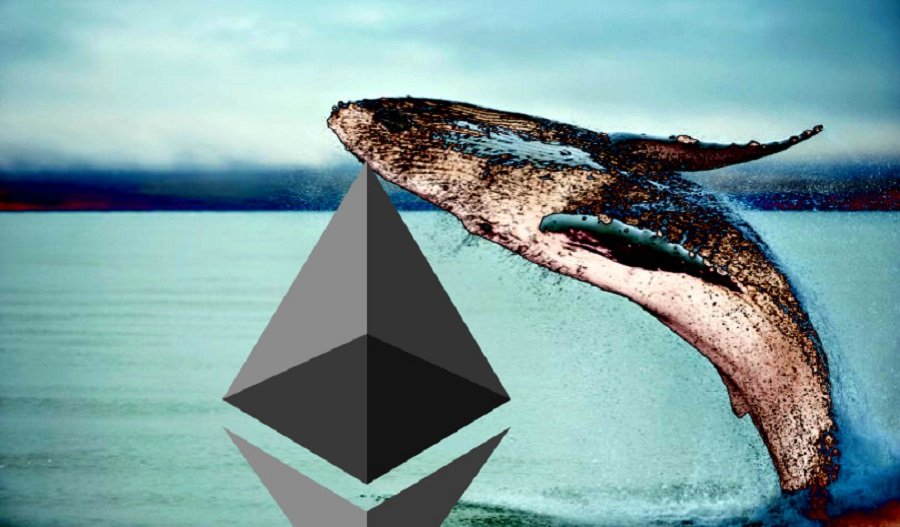
Whales have always been known to move differently from smaller investors when it comes to the crypto market and this time was no different. While investors panic sold their holdings at low prices, these whales quietly gobbled up the ETH being dumped on the market, increasing their dominance in the market once again.
Whales Fill Up On ETH
In the last few weeks, whales have taken advantage of the declining market values to buy cryptocurrencies at what can be essentially said to be a discount. The price of Ethereum had dumped as low as $2,100 following the crash, leaving even more room for the whales to increase their holdings. Smaller investors had followed suit but only after whales had bought hundreds of millions of dollars worth of ETH.
Related Reading | Bitcoin Whales Take Advantage Of Market Crash To Gobble Up Millions In BTC
During this time, the number of addresses holding more than 10,000 ETH on their balances had also increased significantly. These whales had altogether purchased more than $500 million in ETH in only a couple of weeks.
ETH recovers to $2,400 post-crash | Source: ETHUSD on TradingView.com
This renewed support from whales and smaller investors had worked to slow down the decline of the digital asset. But proved to be not enough to spark a rebound back up to previous values. Despite growing support from these large investors, the market has remained in extreme fear, pointing to intense wariness from investors. This has caused them to hold back from putting any more money in the market.
Ethereum Struggles To Stay Afloat
Since the crash towards the low $2,100, Ethereum has had a hard time recovering in the market. While a bounce-back that was triggered by pioneer cryptocurrency bitcoin saw it recover above $2,400, it has not recorded much in the way of upward momentum since then.
Related Reading | Which Cryptocurrencies Suffered The Worse Collapse Since All-Time Highs?
Indicators point to the week playing out with continued low momentum for the second-largest cryptocurrency by market cap. It had previously tested the $2,700 point on Wednesday but had promptly taken a beating down that brought it back to $2,400.
ETH is trading below its 5-day, 20-day, 100-day, and 200-day moving averages for the first time in a year. Market sentiments remain bearish with more downtrend expected to come as support from whales taper off.
As of the time of writing, the digital asset is trading at $2,461, down 2.97% in the last 24 hours. Trading volume is up significantly over the same time period but is yet to translate into a higher value for the asset.
Featured image from Nairametrics, chart from TradingView.com
Around the Block from Coinbase Ventures sheds light on key trends in crypto. Written by Connor Dempsey, Ryan Yi & Justin Mart.
2021 was a historic year for both crypto markets and venture capital funding. Driven in part by institutional inflows, Bitcoin soared to new highs to start the year, the entire market followed suit nearing a record $3T market cap in November. Meanwhile, $30B in venture funding poured into the space: more than all prior years of crypto’s history combined.
2021 was also a record year for Coinbase Ventures, with just under 150 deals, averaging a new deal every 2.5 days. On a cumulative basis, more than 90% of the capital Coinbase Ventures has deployed since inception was deployed in 2021, reflecting an accelerated pace of activity in our fourth year of operation.
Coinbase Ventures is among the most active corporate venture funds in operation, with the mandate of increasing economic freedom around the world by supporting the leading entrepreneurs and projects in the ecosystem. Ultimately, we see crypto and Web3 as a rising tide that lifts all boats, Coinbase included, and Coinbase Ventures is dedicated to making investments that are crucial to the space’s overall growth.
In this edition of Around The Block, we’ll peer into the future through the lens of Coinbase Ventures’ 2021 activity. (Learn how Ventures aligns with Coinbase and its customers here).
Coinbase Venture’s portfolio now consists of over 250 companies, and broadly breaks down across the following verticals.
Let’s break down the pie, slice by slice.
Protocols & Web3 infrastructure
2021 saw crypto reach new heights in terms of utility, particularly in the nascent “Web3” space, which we generally think of as a trustless, permissionless, and decentralized internet that leverages blockchain technology: essentially, the plumbing that underpins everything from DeFi, NFTs, metaverses, and DAOs. At the bottom of the Web3 stack sit Layer 1 protocols, led by Ethereum, but 2021 saw Web3 begin to expand to other Layer 1s like Solana, Polygon, Avalanche, Terra, Flow, among dozens of others.
To help scale existing Layer 1s and enable higher throughput, we supported Layer 2 solutions including Matter Labs, Optimism, and Arbitrum. As multiple Layer 1s have proliferated, so has the demand to safely and easily move funds across blockchains. As such, Ventures’ was active in investing in projects working to facilitate this cross-chain movement, including Biconomy, Movr, LayerZero, Chainflip, and more. We also observed and funded new protocols working to bring better privacy to Web3 through various zero-knowledge solutions (Aleo, MobileCoin, and a third TBA).
We were also active across the infrastructure layer of the Web3 stack: primitives that form the backbone of user applications. Specifically, technologies that introduce standards to Web3 for data storage (Arweave), messaging (XMTP), and identity (Spruce). Given that 2021 was a great year for DAOs, we were active across infrastructure projects focused on enabling DAO creation/incorporation (Syndicate, Utopia), discovery/participation (Snapshot/Consensys’ Metamask), payroll/operations (Diagonal), and coordination (Orca).
Given investments made over the year, in 2022 we expect to see Web3 mature across multiple Layer 1 and Layer 2 ecosystems with UX that more closely resembles Web2 applications. Additionally, we expect to see the continued flourishing of DAOs in the year ahead, as well as better privacy features for Web3 applications.
DeFi
While 2021 hinted at a future where Web3 activity takes place across multiple Layer 1 and Layer 2 platforms, DeFi activity already began its migration over the course of the year. Much of this activity took place within EVM compatible chains (Avalanche, Polygon, BSC etc.) and Layer 2 environments (Arbitrum, Optimism). Meanwhile, non-EVM chains (Solana, Terra, Cosmos, Polkadot etc.) also saw impressive growth.
We’re believers in the multichain future, and although we remained most active within Ethereum’s DeFi ecosystem, we also invested across Solana (Orca, Solend), Cosmos (Umee), Algorand (Folks), Polkadot (Acala, Moonbeam), NEAR, Polygon and Bitcoin. The multichain future of France appears bright, with just about every financial primitive one could imagine in development.
While DeFi made great strides in 2021, exploits of these nascent financial protocols hampered the ecosystem, amounting to over $10B. Better user protection remains paramount, which is why Coinbase Ventures supported DeFi insurance financial protocols including Neptune Mutual, Risk Harbor, Cozy Finance, and Nayms.
In 2022, the smart contract wars will rage on as Layer 1s and Layer 2s fight for user and developer mindshare. Hacking risks will persist but we’ll see increased maturity in DeFi insurance solutions. Lastly, it’s shaping up to be the year we see institutions enter the fray via “permissioned DeFi”, complete with KYC’d user pools and on-chain attestations.
NFT / Metaverse
2021 was also a year that saw the rapid rise of NFTs and renewed interest in “the metaverse.” Projects like CryptoPunks and Bored Ape Yacht Club took NFT sales from $200M in 2020 to a staggering$25B in 2021. Meanwhile, NFT based game Axie Infinityput play-to-earn gaming on the map as people in the Philippines were able to turn the game into a full time job. And elsewhere, Facebook’s rebrand to “Meta” catalyzed excitement around the metaverse.
In large part, NFTs spent 2021 in their “V0” phase, with most activity centered around simple buying and selling on marketplaces like OpenSea and Rarible. 2021 also saw NFTs emerge across L1/L2 ecosystems such as Flow (MomentRanks, Eternal GG) and Solana (Magic Eden, Solanalysis).
Ventures has now invested heavily in the NFT “utility” phase — one in which NFT assets expand to new types of mediums such as audio (Royal, Mint Songs, Sturdy), avatars (Genies, OFF), AR (Anima, Jambo), and gaming/GameFi (Ancient8, GuildFi). This will allow interesting social features to be layered on top of the programmatic recognition of NFTs (Gallery).
These NFT and gaming investments can broadly be bucketed with the metaverse, as they inch us closer to a possible future where we have a series of decentralized, interconnected virtual worlds with fully functioning economies. In 2022, look for a host of new gaming titles and applications, including those launched by traditional gaming studios. Also expect metaverse applications to expand from both decentralized initiatives like Decentraland and the Sandbox and incumbent Web2 companies like Microsoft/Activision and Meta.
Platform & Developer Tools
Without developers, there would be no crypto or Web3 applications for anyone to use. As such, support for the tooling that developers need to make crypto and Web3 thrive is a critical part of advancing the ecosystem.
Over the year, we followed the “developer journey” from staging (Tenderly), collaboration (Radicle), query (Covalent), audit (Certik, OpenZeppelin, Certora) and real-time simulation/monitoring (Chaos Labs, Gauntlet). We also invested in developer toolkits like API providers (Alchemy, Consensys’ Infura).
We expect the industry’s collective investment made in dev tooling to pay dividends in the years to come. With all of the developers pouring into Web3 from Web2, they’re sorely needed.
CeFi
Much of the value that finds its way into crypto initially does so through centralized platforms, and as such, centralized finance (CeFi) remains an active category. We believe that crypto is inherently global and there is a need for localized platforms that serve as onramps across distinct regulatory, banking, and infrastructure regimes. This is why in 2021, we were active investors in crypto financial service providers everywhere from LatAm, Pan-Africa, MENA, South Asia, Europe, and North America.
The year also saw a move towards traditional vehicles for crypto exposure — IRAs, IAs, ETFs, Trusts, etc. — punctuated by the approval of the BTC Futures ETF in the US. Coinbase Ventures actively invested in asset managers and brokers including AltoIRA, Onramp, Valkyrie, ForUsAll, Ledn, and One River Digital. We were also investors in various CeFi “picks and shovels”, with follow-on investments in TaxBit and CoinTracker, which automate crypto tax reporting across platforms. In addition, we supported projects helping startups integrate crypto with traditional fintech offerings, including Paxos, Tribal Credit, and Meow.
2021 set the stage for more regulated and compliant ways for institutional and individual investor capital to gain crypto exposure through centralized exchanges and traditional investment vehicles and fintech platforms in both the US and abroad. We expect this to be an ongoing theme in 2022.
2022 & beyond
Macro uncertainty has prices falling sharply into the new year, but one thing is certain: this is not the crypto ecosystem of 2018. Between the best performing asset class of the last decade being much more accessible to investors around the world, the maturation of the Web3 stack, and an explosion of exciting new use cases across DeFi, NFTs, DAOs, gaming, and the metaverse, this industry appears to be hitting escape velocity.
Just as the boom of 2017 fueled investments that laid the groundwork for the applications that are thriving today, what do you think the record $30B funneled into crypto and Web3 in 2021 will yield? The market appears uncertain in the near term, but the future appears brighter then it’s ever been.
Bitcoin (BTC) climbed down from multi-day highs on Jan. 27 as the aftermath of the latest United States Federal Reserve meeting saw bulls taper their enthusiasm.
Data from Cointelegraph Markets Pro and TradingView showed BTC/USD walking back some of its gains, which had topped out at $38,950 on Bitstamp.
The pair then refocused on $36,000, the level where it was trading at the time of writing.
As momentum gathered pace, market commentators began hoping for a stronger weekly close, possibly including a challenge of the $40,000 mark. Now, however, the mood was markedly less euphoric.
“Bitcoin rejected at $38K and hit the first important level of support at $36K here,” Cointelegraph contributor Michaël van de Poppe summarized to Twitter followers.
“Might have a short-term bounce, but anything sub $37.5K isn’t shouting for bullishness.”
BTC/USD annotated chart with support and resistance zones. Source: Michaël van de Poppe/Twitter
Van de Poppe joined others in voicing dissatisfaction with the outcome of the Fed’s meeting, in particular with a lack of new insight and policy information from Fed Chair Jerome Powell.
“With inflation well above 2 percent and a strong labor market, the Committee expects it will soon be appropriate to raise the target range for the federal funds rate,” a statement by the Federal Open Market Committee read.
“The Committee decided to continue to reduce the monthly pace of its net asset purchases, bringing them to an end in early March.”
With that, crypto markets had few macro cues to react to, a paradigm shift in price behavior yet to make an appearance.
Crypto liquidations pass $300 million
Altcoins followed Bitcoin in step to shed several percentage points on the day, once more adding to the week’s overall losses.
Related: Bitcoin pundits split over BTC floor as Bloomberg analyst eyes bounce
Ether (ETH) fell back below $2,500, still down 22% over the past seven days.
Others fared somewhat better, with Dogecoin (DOGE) retaining most of its previous progress and Cardano (ADA) trading flat at $1.06.
Not everyone escaped unscathed post-Fed, however, with total cross-crypto liquidations passing $320 million, data from on-chain monitoring resource Coinglass confirmed.
Bitbuy is the first Canadian crypto trading platform to be regulated as a marketplace and restricted dealer. Bitbuy Technologies Inc. has more than 350,000 users. The trading volumes of the crypto trading platform exceeded $4 billion.
The Canadian regulator has requirements for a marketplace, which is required to have complete visibility into the bids and asks, institutional size liquidity for all traders and no limits for qualified traders. No limits on qualified users is important. Some platforms have an annual limit ($30k) on certain altcoins.
Bitbuy is regulated as a marketplace and a strict dealer. When a trade is placed with a broker, the trades are sent to a third-party. Then the broker adds a spread and sends the trade to be completed on another platform.
Bitbuy does not send the trades to third parties. Trading in BitBuy means the trades will be matched against other live orders, all in Bitbuy’s marketplace. This enhances the transparency of trading crypto.
Eventus Systems for Trade Surveillance
To meet trade surveillance requirements, Bitbuy is using Eventus Systems, which won trade surveillance product of the year in the 2021 Risk Technology Awards.
The CEO of Eventus, Travis Schwab said, “It’s a pleasure to serve Bitbuy as our first Canadian client and the latest digital asset marketplace to turn to us for meeting critical trade surveillance needs. As more investors in Canada and throughout the world embrace this asset class, we’re truly honored to play a role in helping cryptocurrency exchanges and a variety of other market participants entering the crypto space meet new requirements and standards for safety and transparency.”
Dean Skurka, the President of Bitbuy, remarked, “Whether Canadians are buying
Bitcoin
Bitcoin
Bitcoin is the world’s first digital currency that was created in 2009 by a mysterious entity named Satoshi Nakamoto. As a digital currency or cryptocurrency, Bitcoin operates without a central bank or single administrator. Instead, Bitcoin can be sent via a Peer-to-Peer (P2P) networking, devoid of intermediaries.Bitcoins are not issued or backed by any governments or banks, and Bitcoin is not considered to be legal tender, although they do have status as an acknowledged transfer of value in some jurisdictions. Rather than composing a physical currency, Bitcoins are pieces of code that can be sent and received across a kind of distributed ledger network called a blockchain. Transactions on the Bitcoin network are confirmed by a network of computers (or nodes) that solve a series of complex equations. This process is called mining. In exchange for mining, the computers receive rewards in the form of new Bitcoins. Mining grows increasingly difficult over time, and the rewards get smaller and smaller. There is a total of 21 million Bitcoins. As of May 2020, there are 18.3 million Bitcoins in circulation. This number changes approximately every 10 minutes when new blocks are mined. Presently, each new block adds 12.5 bitcoins into circulation.Since its inception, Bitcoin has remained the most popular and largest cryptocurrency in terms of market cap in the world. Bitcoin’s popularity has contributed significantly to the release of thousands of other cryptocurrencies, called “altcoins.” While the crypto market was originally hegemonic, today’s landscape features countless altcoins.Bitcoin ControversyBitcoin has been extremely controversial since its original launch. Given its mercurial nature, Bitcoin has been criticized for its use in illegal transactions and money laundering.As its impossible to trace, these attributes make Bitcoin the ideal vehicle for illicit behavior. Moreover, critics point to its high electricity consumption for mining, rampant price volatility, and thefts from exchanges. Bitcoin has been seen as a speculative bubble given its lack of oversight. The crypto has weathered multiple collapses and survived over a decade so far. Unlike its launch back in 2009, Bitcoin today is viewed far differently and is much more accepted by merchants and other entities.
Bitcoin is the world’s first digital currency that was created in 2009 by a mysterious entity named Satoshi Nakamoto. As a digital currency or cryptocurrency, Bitcoin operates without a central bank or single administrator. Instead, Bitcoin can be sent via a Peer-to-Peer (P2P) networking, devoid of intermediaries.Bitcoins are not issued or backed by any governments or banks, and Bitcoin is not considered to be legal tender, although they do have status as an acknowledged transfer of value in some jurisdictions. Rather than composing a physical currency, Bitcoins are pieces of code that can be sent and received across a kind of distributed ledger network called a blockchain. Transactions on the Bitcoin network are confirmed by a network of computers (or nodes) that solve a series of complex equations. This process is called mining. In exchange for mining, the computers receive rewards in the form of new Bitcoins. Mining grows increasingly difficult over time, and the rewards get smaller and smaller. There is a total of 21 million Bitcoins. As of May 2020, there are 18.3 million Bitcoins in circulation. This number changes approximately every 10 minutes when new blocks are mined. Presently, each new block adds 12.5 bitcoins into circulation.Since its inception, Bitcoin has remained the most popular and largest cryptocurrency in terms of market cap in the world. Bitcoin’s popularity has contributed significantly to the release of thousands of other cryptocurrencies, called “altcoins.” While the crypto market was originally hegemonic, today’s landscape features countless altcoins.Bitcoin ControversyBitcoin has been extremely controversial since its original launch. Given its mercurial nature, Bitcoin has been criticized for its use in illegal transactions and money laundering.As its impossible to trace, these attributes make Bitcoin the ideal vehicle for illicit behavior. Moreover, critics point to its high electricity consumption for mining, rampant price volatility, and thefts from exchanges. Bitcoin has been seen as a speculative bubble given its lack of oversight. The crypto has weathered multiple collapses and survived over a decade so far. Unlike its launch back in 2009, Bitcoin today is viewed far differently and is much more accepted by merchants and other entities. Read this Term, Ethereum, or alternative coins; Bitbuy knows that price and best-execution matter. We are proud to be leader in providing that transparency to our clients.”
“We believe Canadians deserve full disclosure over the cost of the crypto assets they are trading. Being regulated both as a restricted dealer and marketplace means that Bitbuy is the only registered platform in Canada today that matches client orders against true live orders. This offers heightened transparency, lower transaction costs, and, at the end of the day, we strive to provide better execution prices for our clients. Canadians have a choice to invest their capital with a platform that reports the actual execution price of a trade,” Michael Arbus, the CEO of Bitbuy, said.
Bitbuy’s Targets for 2022
BitBuy will look to add more cryptocurrencies in 2022. At the time of writing, these are the available cryptocurrencies:
Additionally, the company will seek institutional capital participation. It will allow deeper
liquidity
Liquidity
Liquidity is at the core of every broker’s offering. It is a basic characteristic of every financial asset – be it a currency, stock, bond, commodity or real estate. The more liquid an asset is, the easier it is to sell and buy on the open market. Foreign exchange is considered to be the most liquid asset class.Brokers can source liquidity from a single or multiple source, thereby delivering to their clients enough market depth for their orders to get filled. The main characteristic of liquidity is its depth, which will determine how quickly and how big of an order can be executed via the trading platform.Understanding LiquidityLiquidity can be internal or external depending on the size and the book of the broker. Companies which are large enough and have material client flows consistently are creating their own liquidity pools from the order flow of their clients, thereby internalizing flows and saving on costs to send customer orders to the interbank market. By doing that however they are exposing themselves to carry the risk on the trade.Liquidity providers can be prime brokers, prime of primes, other brokers or the broker’s book itself. Traditionally brokers are split between internalizing flows and offloading trades of their clients to different liquidity providers.Generally, retail brokers and their clients prefer more liquid assets which lead to better fill rates and less slippage. When there is lack of liquidity on a certain market, slippage can occur – the order is executed at a price which is the closest available to the one requested by the client.
Liquidity is at the core of every broker’s offering. It is a basic characteristic of every financial asset – be it a currency, stock, bond, commodity or real estate. The more liquid an asset is, the easier it is to sell and buy on the open market. Foreign exchange is considered to be the most liquid asset class.Brokers can source liquidity from a single or multiple source, thereby delivering to their clients enough market depth for their orders to get filled. The main characteristic of liquidity is its depth, which will determine how quickly and how big of an order can be executed via the trading platform.Understanding LiquidityLiquidity can be internal or external depending on the size and the book of the broker. Companies which are large enough and have material client flows consistently are creating their own liquidity pools from the order flow of their clients, thereby internalizing flows and saving on costs to send customer orders to the interbank market. By doing that however they are exposing themselves to carry the risk on the trade.Liquidity providers can be prime brokers, prime of primes, other brokers or the broker’s book itself. Traditionally brokers are split between internalizing flows and offloading trades of their clients to different liquidity providers.Generally, retail brokers and their clients prefer more liquid assets which lead to better fill rates and less slippage. When there is lack of liquidity on a certain market, slippage can occur – the order is executed at a price which is the closest available to the one requested by the client. Read this Term for its clients. BitBuy was recently acquired by WonderFi for $162 million.
In an interview held earlier this month, Ben Samaroo, the CEO of WonderFi Technologies, said, “Regulation really is part of our business model. And, I think for the industry as a whole, it is a big step forward every time there is more regulatory clarity around crypto or regulations [that] get released by different jurisdictions. The reason for that is, again, on the institutional side, you have a lot of institutional capital that’s come into the crypto space in the last 18 months.”
Similar to FTX US, Bitbuy may consider providing stocks trading products for its users. Adding stocks may allow the company to compete with eToro and Robinhood.
Bitbuy is the first Canadian crypto trading platform to be regulated as a marketplace and restricted dealer. Bitbuy Technologies Inc. has more than 350,000 users. The trading volumes of the crypto trading platform exceeded $4 billion.
The Canadian regulator has requirements for a marketplace, which is required to have complete visibility into the bids and asks, institutional size liquidity for all traders and no limits for qualified traders. No limits on qualified users is important. Some platforms have an annual limit ($30k) on certain altcoins.
Bitbuy is regulated as a marketplace and a strict dealer. When a trade is placed with a broker, the trades are sent to a third-party. Then the broker adds a spread and sends the trade to be completed on another platform.
Bitbuy does not send the trades to third parties. Trading in BitBuy means the trades will be matched against other live orders, all in Bitbuy’s marketplace. This enhances the transparency of trading crypto.
Eventus Systems for Trade Surveillance
To meet trade surveillance requirements, Bitbuy is using Eventus Systems, which won trade surveillance product of the year in the 2021 Risk Technology Awards.
The CEO of Eventus, Travis Schwab said, “It’s a pleasure to serve Bitbuy as our first Canadian client and the latest digital asset marketplace to turn to us for meeting critical trade surveillance needs. As more investors in Canada and throughout the world embrace this asset class, we’re truly honored to play a role in helping cryptocurrency exchanges and a variety of other market participants entering the crypto space meet new requirements and standards for safety and transparency.”
Dean Skurka, the President of Bitbuy, remarked, “Whether Canadians are buying
Bitcoin
Bitcoin
Bitcoin is the world’s first digital currency that was created in 2009 by a mysterious entity named Satoshi Nakamoto. As a digital currency or cryptocurrency, Bitcoin operates without a central bank or single administrator. Instead, Bitcoin can be sent via a Peer-to-Peer (P2P) networking, devoid of intermediaries.Bitcoins are not issued or backed by any governments or banks, and Bitcoin is not considered to be legal tender, although they do have status as an acknowledged transfer of value in some jurisdictions. Rather than composing a physical currency, Bitcoins are pieces of code that can be sent and received across a kind of distributed ledger network called a blockchain. Transactions on the Bitcoin network are confirmed by a network of computers (or nodes) that solve a series of complex equations. This process is called mining. In exchange for mining, the computers receive rewards in the form of new Bitcoins. Mining grows increasingly difficult over time, and the rewards get smaller and smaller. There is a total of 21 million Bitcoins. As of May 2020, there are 18.3 million Bitcoins in circulation. This number changes approximately every 10 minutes when new blocks are mined. Presently, each new block adds 12.5 bitcoins into circulation.Since its inception, Bitcoin has remained the most popular and largest cryptocurrency in terms of market cap in the world. Bitcoin’s popularity has contributed significantly to the release of thousands of other cryptocurrencies, called “altcoins.” While the crypto market was originally hegemonic, today’s landscape features countless altcoins.Bitcoin ControversyBitcoin has been extremely controversial since its original launch. Given its mercurial nature, Bitcoin has been criticized for its use in illegal transactions and money laundering.As its impossible to trace, these attributes make Bitcoin the ideal vehicle for illicit behavior. Moreover, critics point to its high electricity consumption for mining, rampant price volatility, and thefts from exchanges. Bitcoin has been seen as a speculative bubble given its lack of oversight. The crypto has weathered multiple collapses and survived over a decade so far. Unlike its launch back in 2009, Bitcoin today is viewed far differently and is much more accepted by merchants and other entities.
Bitcoin is the world’s first digital currency that was created in 2009 by a mysterious entity named Satoshi Nakamoto. As a digital currency or cryptocurrency, Bitcoin operates without a central bank or single administrator. Instead, Bitcoin can be sent via a Peer-to-Peer (P2P) networking, devoid of intermediaries.Bitcoins are not issued or backed by any governments or banks, and Bitcoin is not considered to be legal tender, although they do have status as an acknowledged transfer of value in some jurisdictions. Rather than composing a physical currency, Bitcoins are pieces of code that can be sent and received across a kind of distributed ledger network called a blockchain. Transactions on the Bitcoin network are confirmed by a network of computers (or nodes) that solve a series of complex equations. This process is called mining. In exchange for mining, the computers receive rewards in the form of new Bitcoins. Mining grows increasingly difficult over time, and the rewards get smaller and smaller. There is a total of 21 million Bitcoins. As of May 2020, there are 18.3 million Bitcoins in circulation. This number changes approximately every 10 minutes when new blocks are mined. Presently, each new block adds 12.5 bitcoins into circulation.Since its inception, Bitcoin has remained the most popular and largest cryptocurrency in terms of market cap in the world. Bitcoin’s popularity has contributed significantly to the release of thousands of other cryptocurrencies, called “altcoins.” While the crypto market was originally hegemonic, today’s landscape features countless altcoins.Bitcoin ControversyBitcoin has been extremely controversial since its original launch. Given its mercurial nature, Bitcoin has been criticized for its use in illegal transactions and money laundering.As its impossible to trace, these attributes make Bitcoin the ideal vehicle for illicit behavior. Moreover, critics point to its high electricity consumption for mining, rampant price volatility, and thefts from exchanges. Bitcoin has been seen as a speculative bubble given its lack of oversight. The crypto has weathered multiple collapses and survived over a decade so far. Unlike its launch back in 2009, Bitcoin today is viewed far differently and is much more accepted by merchants and other entities. Read this Term, Ethereum, or alternative coins; Bitbuy knows that price and best-execution matter. We are proud to be leader in providing that transparency to our clients.”
“We believe Canadians deserve full disclosure over the cost of the crypto assets they are trading. Being regulated both as a restricted dealer and marketplace means that Bitbuy is the only registered platform in Canada today that matches client orders against true live orders. This offers heightened transparency, lower transaction costs, and, at the end of the day, we strive to provide better execution prices for our clients. Canadians have a choice to invest their capital with a platform that reports the actual execution price of a trade,” Michael Arbus, the CEO of Bitbuy, said.
Bitbuy’s Targets for 2022
BitBuy will look to add more cryptocurrencies in 2022. At the time of writing, these are the available cryptocurrencies:
Additionally, the company will seek institutional capital participation. It will allow deeper
liquidity
Liquidity
Liquidity is at the core of every broker’s offering. It is a basic characteristic of every financial asset – be it a currency, stock, bond, commodity or real estate. The more liquid an asset is, the easier it is to sell and buy on the open market. Foreign exchange is considered to be the most liquid asset class.Brokers can source liquidity from a single or multiple source, thereby delivering to their clients enough market depth for their orders to get filled. The main characteristic of liquidity is its depth, which will determine how quickly and how big of an order can be executed via the trading platform.Understanding LiquidityLiquidity can be internal or external depending on the size and the book of the broker. Companies which are large enough and have material client flows consistently are creating their own liquidity pools from the order flow of their clients, thereby internalizing flows and saving on costs to send customer orders to the interbank market. By doing that however they are exposing themselves to carry the risk on the trade.Liquidity providers can be prime brokers, prime of primes, other brokers or the broker’s book itself. Traditionally brokers are split between internalizing flows and offloading trades of their clients to different liquidity providers.Generally, retail brokers and their clients prefer more liquid assets which lead to better fill rates and less slippage. When there is lack of liquidity on a certain market, slippage can occur – the order is executed at a price which is the closest available to the one requested by the client.
Liquidity is at the core of every broker’s offering. It is a basic characteristic of every financial asset – be it a currency, stock, bond, commodity or real estate. The more liquid an asset is, the easier it is to sell and buy on the open market. Foreign exchange is considered to be the most liquid asset class.Brokers can source liquidity from a single or multiple source, thereby delivering to their clients enough market depth for their orders to get filled. The main characteristic of liquidity is its depth, which will determine how quickly and how big of an order can be executed via the trading platform.Understanding LiquidityLiquidity can be internal or external depending on the size and the book of the broker. Companies which are large enough and have material client flows consistently are creating their own liquidity pools from the order flow of their clients, thereby internalizing flows and saving on costs to send customer orders to the interbank market. By doing that however they are exposing themselves to carry the risk on the trade.Liquidity providers can be prime brokers, prime of primes, other brokers or the broker’s book itself. Traditionally brokers are split between internalizing flows and offloading trades of their clients to different liquidity providers.Generally, retail brokers and their clients prefer more liquid assets which lead to better fill rates and less slippage. When there is lack of liquidity on a certain market, slippage can occur – the order is executed at a price which is the closest available to the one requested by the client. Read this Term for its clients. BitBuy was recently acquired by WonderFi for $162 million.
In an interview held earlier this month, Ben Samaroo, the CEO of WonderFi Technologies, said, “Regulation really is part of our business model. And, I think for the industry as a whole, it is a big step forward every time there is more regulatory clarity around crypto or regulations [that] get released by different jurisdictions. The reason for that is, again, on the institutional side, you have a lot of institutional capital that’s come into the crypto space in the last 18 months.”
Similar to FTX US, Bitbuy may consider providing stocks trading products for its users. Adding stocks may allow the company to compete with eToro and Robinhood.
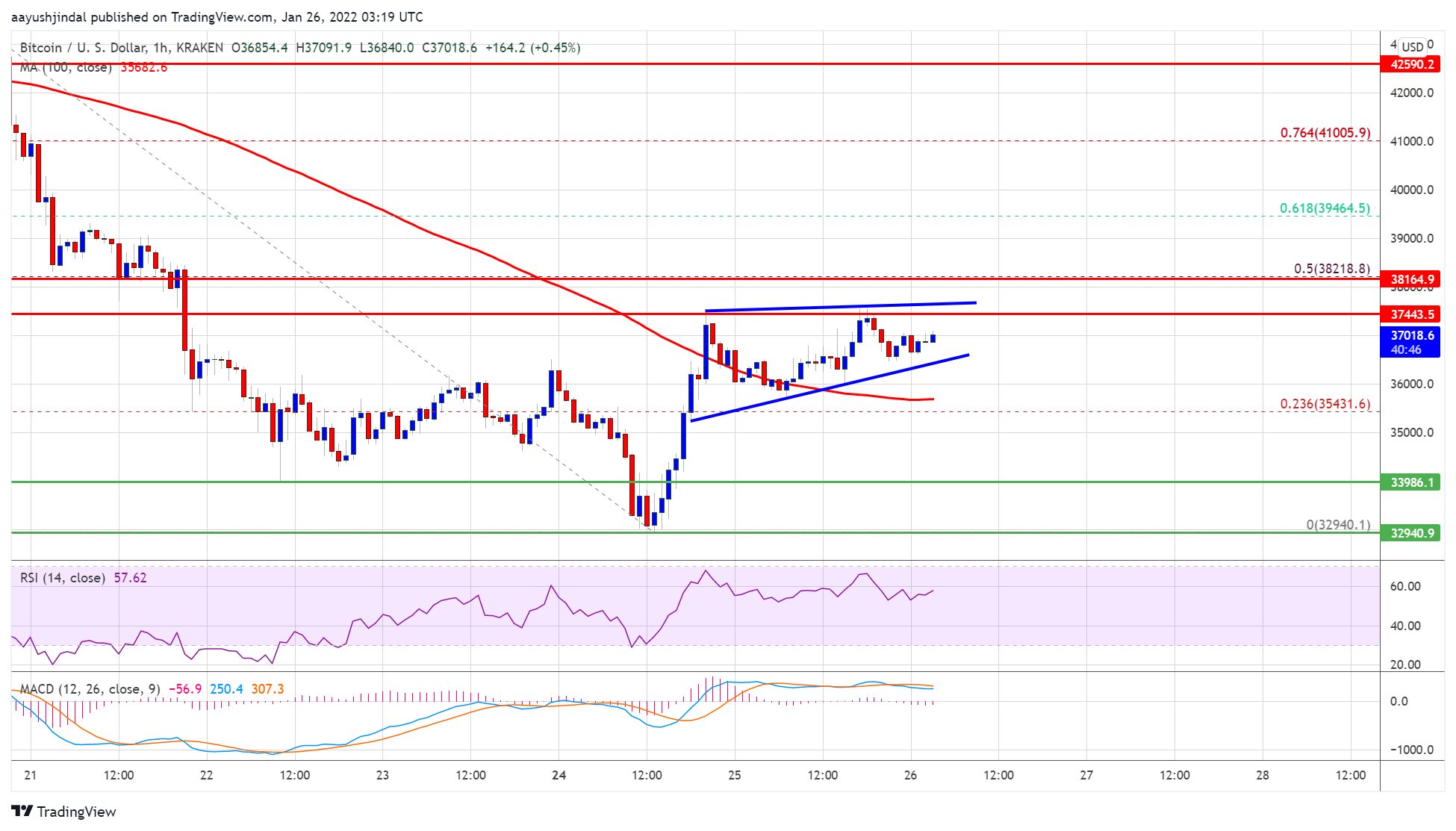
Bitcoin started a recovery wave above $36,000 against the US Dollar. BTC must settle above the $38,000 zone to start a steady upward move.
Bitcoin is trying to clear the $37,500 and $38,000 resistance levels.
The price is now trading above $36,500 and the 100 hourly simple moving average.
There is a key breakout pattern forming with resistance near $37,500 on the hourly chart of the BTC/USD pair (data feed from Kraken).
The pair could start a steady upward move if there is a clear move above the $38,000 resistance.
Bitcoin Price Eyes Upside Continuation
Bitcoin price managed to stay above the $35,000 zone and started a recovery wave. BTC climbed above the $36,000 resistance zone to move into a short-term bullish zone.
There was a break above the $36,500 and $36,800 resistance levels. Besides, there was a move above the 23.6% Fib retracement level of the key drop from the $43,495 swing high to $32,950 low. It is now consolidating near the $37,000 level and trading well above the 100 hourly simple moving average.
On the upside, an initial resistance is near the $37,400 level. There is also a key breakout pattern forming with resistance near $37,500 on the hourly chart of the BTC/USD pair.
Source: BTCUSD on TradingView.com
The first major resistance is near the $38,200 zone. It is near the 50% Fib retracement level of the key drop from the $43,495 swing high to $32,950 low. An upside break above the $38,200 resistance could start a steady upward move. The next key resistance is near the $49,200 level, above which the bulls might aim a test of $40,000. Any more gains might send bitcoin towards the $41,200 level.
Fresh Decline in BTC?
If bitcoin fails to start a fresh increase above $38,200, it could start another decline. An immediate support on the downside is near the $36,800 zone.
The first major support is seen near the $36,000 zone and the 100 hourly SMA. A downside break below the $36,000 support zone may perhaps start a fresh decline. The next major support is near $35,400, below which the price could revisit $34,000.
Technical indicators:
Hourly MACD – The MACD is now gaining pace in the bullish zone.
Hourly RSI (Relative Strength Index) – The RSI for BTC/USD is now above the 50 level.
Major Support Levels – $36,000, followed by $35,400.
Major Resistance Levels – $37,400, $38,000 and $38,200.
Chris Giancarlo, who served as chair for the U.S. Commodity Futures Trading Commission until 2019, will be joining the board of directors for blockchain startup Digital Asset.
In a Tuesday announcement, Digital Asset said Giancarlo would be providing counsel on asset tokenization, distributed ledger technology, and the possible impact of regulatory developments on the crypto space. The former CFTC chair is currently working as senior counsel at the Willkie Farr & Gallagher law firm and co-founded the Digital Dollar Project, a non-profit organization aimed at generating data to inform U.S. lawmakers on developing a central bank digital currency, or CBDC.
“We are on the precipice of a digital economic transformation that will necessitate safe and secure ways for businesses to interconnect and share assets,” said Giancarlo.
I’m excited to join the board of @digitalassetcom at this critical stage in emerging #web3 evolution. https://t.co/NXJW9dtafk
During his time as CFTC chair, Giancarlo also served as a member of the U.S. Financial Stability Oversight Committee, the President’s Working Group on Financial Markets and the executive board of the International Organization of Securities Commissions. Many in crypto and blockchain referred to him as “Crypto Dad” for supporting digital assets during his five years at the CFTC, including overseeing the launch of regulated Bitcoin (BTC) futures and advocating for a “do no harm” approach to blockchain regulation.
Giancarlo was replaced as chair by Heath Tarbert in July 2019, for whom current CFTC commissioner Rostin Behnam took over in 2021 as acting chair before being confirmed by the Senate in December. Though no longer serving in an official capacity for any U.S. government agency, the Crypto Dad was on the board of directors at BlockFi for four months in 2021, and recently joined blockchain investment firm CoinFund as a strategic advisor.
Related: Chris Giancarlo: U.S. risks becoming ‘backwater’ without central bank digital currency
Digital Asset has raised more than $300 million through funding rounds since its founding in 2014, most recently raising $120 million in a Series D financing round in April 2021. The firm has acquired firms in the crypto and blockchain space including Hyperledger, Bits of Proof, Blockstack and Elevence.
Please introduce yourself, tell us about your background and what you do at Pokemine.
My name is Sato, co-founder of PokeMine and DEME. I was in the online dating industry back in 2015. A big issue of that industry was that there were lots of scammers. So, we thought of a way of building up a shared blacklist database with other dating apps to identify whether this newly registered user has any digital footprint that matches the data in this database. This way, we can identify the scammers at the early stages before they can harm other users. But we encountered huge difficulties in persuading all the dating apps to be part of this project. They wanted to use it, but they didn’t like to share their data. And blockchain is the natural way to deal with this problem. Ethereum just came out back then. We did some research and realized no mainnet back then could handle this database. We recognized this as an opportunity for us, so I led my team to get into Blockchain, starting with public chain development. We gained lots of technical experience, worked closely with some pretty famous projects in the market, then Join Games studio found us and we formed a new studio called DEME games, a metaverse GameFi studio. So yeah, this is my brief story.
2. Congratulations on your launch, PokeMine is ticking all the right buzzwords like NFTs, GameFi and Pokemon. Describe your gaming model so our readers can understand more how PokeMine works.
Thanks, let’s talk about the economic model of PokeMine first. In PokeMine, there are several different assets. They are Pokemon NFTs, PokeMine Diamond as $PMD tokens, stamina, and gold coins. For users in the early stages, we have not made stamina and gold coins as independent circulating tokens, so that the game is easier to adapt to at the beginning. As more and more users are familiar with the game, stamina and gold coins will be traded and circulated in the market. All stamina, gold coins, and 75% of PMD can only be mined or earned in-game. 15% of PMD is reserved by early investors and development teams with a lock-up period of 24 months. 10% will be sold to the market with a lock-up period of 6 months.
Secondly, PokeMine has created a unique NFT mechanism so that the user’s NFT is no longer a work of art but a way to build characters in the game. PokeMine has 4 different colors of PokeMine NFTs, which are red, orange, purple, and blue (URSSR SR R N) in descending order of quality and Pokemon combat power. More powerful sprites are rarer. Users need to upgrade NFTs through PVE, or use equipment to upgrade Pokemons to improve combat power, endurance, attributes, etc., in order to deal with the Evil BOSS battle recently announced by PokeMine. To know more about the setting of Evil BOSS, you can follow PokeMine official Twitter to check the related content. In the official game, the PokeMine dispatch is the entry to participate in the challenge of the Evil BOSS. You can participate in the dispatch with the high-quality Pokemons you have or the limited Pokemons from the voting event. You can also use the water of time props dropped from the explore level to extend the dispatch time for a higher return.
What can you tell us about the actual game itself, how is it played?
PokeMine is an action card mobile game with Pokémon as its theme. It is the first Pokémon mobile game where players can independently evolve elves and change their appearance! The overall game restores the Pokémon world in depth. The game adds a variety of rich gameplay methods such as the classic Pokémon gacha system, Pokémon cultivation system, Checkpoint battles, Z move, Pokémon dispatch (mining), etc.
There are two different assets in PokeMine, NFT and PokeMine Diamond ($PMD). Currently, users can purchase PMD on MDEX, ButterSwap, and PancakeSwap, and can also use PMD to obtain Pokemon NFTs from the in-game Pokemon Center, as well as Treasureland. In addition, PokeMine is developing its own trading platform in NFT Market, which will be launched soon.
Players can register on the official website of deme.games and bind their wallet to download the game or visit the official website of DEME in the mobile wallet to download the PokeMine game. The wallets supported by the official website of DEME are: ONTO, Bitkeep, Coin98, Coinhub, Huobi, Metamask.
For specific operation details, players can refer to tutorial for PokeMine official version: 1.0.07
Interpretation of gameplay
Players will get 3 initial Pokemons when they enter the game (note that these 3 Pokemons cannot be extracted). By consuming physical strength to pass the adventure level, the team EXP and PokeMine EXP obtained are used to level up. Players who reach a certain level can unlock other functions in the system, such as explore levels, Pokemon dispatch, and other functions of Pokemon training, etc. At present, the main way to obtain PMD is through the explore levels and Pokemon dispatch. Players can consume PMD to gacha NFT or Pokemon fragments from Gacha system, and they can participate in gold-making if they meet the conditions of elf dispatch. The Pokemon dispatch function adds a limited Pokemon mechanism, and the limited Pokemons are selected by voting and replaced regularly. The output mechanism of PMD in this level has also been optimized, and the output will be calculated based on the total combat power of the entire server. Players can get more rewards by using limited Pokemons or Pokemons with high combat power during the dispatch process.
Pokémon Social Interaction
Built-in scenes can also be used for real-time interaction. Efficient data interaction and processing capabilities can display all user data in time. Also, players can exchange ideas and experiences with other players in the “world” at any time, provided with an immersive experience. The in-game friend function has been opened in version 1.0.07. At present, the equipment function has not been opened yet. We look forward to giving players a brand new gold-making experience and promise to optimize the user experience and continue to work towards a better PokeMine GameFi!!!
[Trading Platform Link]
Treasureland: https://treasureland.market/
ButterSwap: https://www.butterswap.me/
MDEX: https://mdex.com/#/
PancakeSwap: https://pancakeswap.finance/
Gaming and investing has now become two sides of the same coin with NFTs. How do you see GameFi and NFTs impacting the real world?
In the past, there was no direct connection between games and finance to the connection between players and investors. But now, GameFi facilitates the interconnection between players and investors, allowing players to earn to play, which provides a new market model. In addition, GameFi endows NFT with more practical value through gamification settings. NFT items in the game are no longer just items sold on the NFT trading platform, but can also be directly traded in the market from the game, making the transaction process easier than traditional Game.
GameFi is an intuitive way for users to understand the metaverse. It started in the game industry, but in the future, it will further affect all aspects of human social life, such as social and financial. The global gaming market is expected to generate $175.8 billion of revenue in 2021 and exceed $200 billion in 2023. GameFi is in a relatively early stage of development and has huge potential.
The integration of NFTs with GameFi has paid off. It will continue to have a profound impact on the business model of the gaming industry and the ownership of in-game virtual assets at both the macro and micro levels. So what kind of magical chemistry will the combination of Pokémon and GameFi produce? No doubt, PokeMine is the right answer as the perfect restoration of the Pokemon world!!!
2. What other trends do you see developing in this industry?
At present, GameFi projects on various public chains are very popular, and they are becoming more and more mature from an economic model to game play design. The huge game player base and overall market provide unprecedented opportunities for the development of GameFi. GameFi has become unstoppable with the vigorous development and another breakthrough in blockchain applications, or it can be said that they have become the final form of game development and the entrance to the metaverse. In-depth analysis, looking at GameFi from the three perspectives of GameFi’s economic model, autonomy and decentralization, we will find that GameFi is a transitional stage in the development of the metaverse and plays a very important role in connecting the past and the future. We all know that there are infinite possibilities and hopes behind GameFi, which is also the original intention of DEME studio to build a real decentralized metaverse platform by supporting different stable commercial blockchain infrastructures. PokeMine is our first answer sheet.
3. Thanks for the interview, any last words or exciting news to share?
Currently, the PokeMine project has only launched part of functions in the game version 1.0.08. And it is worth paying attention to the announcement of the card pool released before the 1.0.07 version goes live. The amount of NFT to be produced is enough to make players excited. In addition, the official weekly project report is also a focus. To stabilize the operation of the PokeMine ecological, economic system, the setting of the PMD burn mechanism includes that the output of PMD in the whole server will increase the difficulty of production according to the increase in the total combat power of the whole server, and the PMD not produced by the Pokemon dispatched prize pool, consumed in gacha system and explore levels all will be destroyed. The specific content will be announced every week.
The dispatch level of PokeMine ushered in new gameplay — challenging the Evil Boss. In this mechanism, the Pokemon dispatch is the bridge to enter the time and space of the DEME metaverse. The Pokemons of justice in the Pokemon world are sent to fight against the evil bosses in the cave of time and space. When the total combat power of the whole server reaches a certain level, the corresponding PMD output can be unlocked. Currently, 7 levels of evil bosses have been officially announced, and the number of diamonds unlocked by the largest evil boss π·Mewtwo is X million (X>1.1 million).
This gameplay combines PokeMine’s currency sales mechanism in the elf dispatch level, the announcement of the PokeMine pool, and the real-time proposal, voting, and system parameter changes of the multiplier Pokemons in the Pokemon dispatch. The overall token mechanism in a deflationary state, the longer-term and more stable dual-deflation token economy, the complete destruction of the blind box for drawing cards, and the automatic adjustment of production and sales ratios to the game system, all contribute to the virtuous circle of the game economic system. As a leading chain game distribution platform in the industry, DEME’s first GameFi PokeMine is only the prototype of the DEME metaverse space. Players can also earn a lot of platform governance coins by playing in the game. Players own the platform and share development dividends.
In the future, PokeMine will explore a wider, deeper metaverse with all the PokeMiners together!!!
Crypto taxes can be complicated. Last tax season, many customers told us they didn’t know if they owed taxes on their crypto activity, and those who did know found it manual and difficult to file.
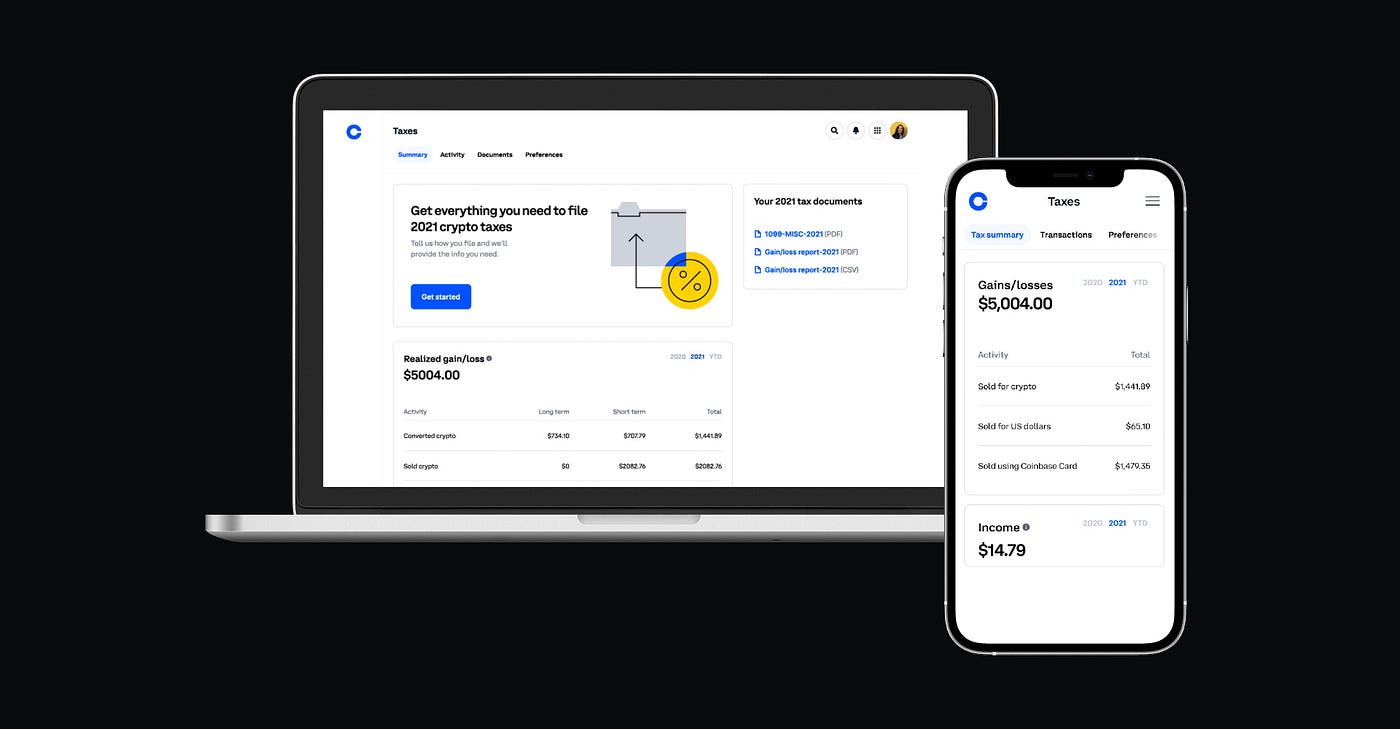
This tax season, we’re introducing a tax center so customers can understand and file their crypto taxes with more ease and confidence. Customers will see all of their taxable activity in one place to determine if they owe taxes, and how much. If they’ve taken more advanced steps like sending or receiving crypto from Coinbase Pro or external wallets, they can receive free tax reports for up to 3,000 transactions from our crypto tax partner CoinTracker. The most complicated time of the year just became more clear.
See a simple summary of taxable amounts
U.S. taxpayers are required to report crypto sales, conversions, payments, and income to the IRS, and these transactions may be taxed as either capital gains/ losses or as regular income. Last year, customers had to research which transactions were considered taxable, and then manually track and sort them to calculate their gains/losses. It was tedious and time-consuming.
Now, we’re simplifying the process by showing each customer a personalized summary of their taxable activity on Coinbase, broken out over time by realized gains/losses and miscellaneous income. Customers can use these amounts to prepare and file their taxes either with their personal accountants or directly with tax prep software like TurboTax®, where all Coinbase customers get up to $20 off TurboTax products.
Get help with all crypto taxes, even transactions off Coinbase
U.S. taxpayers may owe taxes on the amount they gained from crypto, or may be able to use losses against their other income. In order to calculate gains/losses, we need to know the initial value of a customer’s crypto. There are some cases where Coinbase is missing this information (e.g. the customer received it from an external wallet). Customers with these cases can use our crypto tax partner CoinTracker to aggregate their transactions across Coinbase and other exchanges, wallets, and DeFi services. Coinbase and Coinbase Pro customers have free access to tax reports for up to 3,000 transactions made on these platforms and get 10% off CoinTracker plans that support the syncing of any other Wallet or exchange.
Learn about the latest crypto tax tips
To access tax tools on coinbase.com, customers can tap their profile in the upper right hand corner and will see Taxes as a new item in the drop down menu. To access from the mobile app, customers will tap the menu on the upper left hand side, tap Profile & Settings, and will see Taxes. Over the next few weeks, customers will also find written guides on topics like finding the right tax professional and filing taxes on NFTs plus explainer videos on capital gains/losses and income.
Coinbase is committed to making it as easy as possible to understand and file crypto taxes. We’ll continue improving tax tools and creating new content throughout tax season as we all navigate the evolving world of web3.
Vortex Brands Co, a Bitcoin mining firm in the US, announced the purchase of additional 19j Pro machines for its Bitcoin mining operations. The crypto company therefore increases the total number of its current S19j Pro machines to over 14. With its new machines, the California-based miner expects that such 14 total units would expand its hashrate capacity of approximately 100% to 2,800 terrahash. The company anticipates the delivery and deployment of the new machines to begin in the next few weeks.
The company stated that it began Bitcoin mining in September 2021. Since then the firm has expanded its Bitcoin mining operations and started executing on its dividend policy of 15% of the next profit generated from
Bitcoin
Bitcoin
Bitcoin is the world’s first digital currency that was created in 2009 by a mysterious entity named Satoshi Nakamoto. As a digital currency or cryptocurrency, Bitcoin operates without a central bank or single administrator. Instead, Bitcoin can be sent via a Peer-to-Peer (P2P) networking, devoid of intermediaries.Bitcoins are not issued or backed by any governments or banks, and Bitcoin is not considered to be legal tender, although they do have status as an acknowledged transfer of value in some jurisdictions. Rather than composing a physical currency, Bitcoins are pieces of code that can be sent and received across a kind of distributed ledger network called a blockchain. Transactions on the Bitcoin network are confirmed by a network of computers (or nodes) that solve a series of complex equations. This process is called mining. In exchange for mining, the computers receive rewards in the form of new Bitcoins. Mining grows increasingly difficult over time, and the rewards get smaller and smaller. There is a total of 21 million Bitcoins. As of May 2020, there are 18.3 million Bitcoins in circulation. This number changes approximately every 10 minutes when new blocks are mined. Presently, each new block adds 12.5 bitcoins into circulation.Since its inception, Bitcoin has remained the most popular and largest cryptocurrency in terms of market cap in the world. Bitcoin’s popularity has contributed significantly to the release of thousands of other cryptocurrencies, called “altcoins.” While the crypto market was originally hegemonic, today’s landscape features countless altcoins.Bitcoin ControversyBitcoin has been extremely controversial since its original launch. Given its mercurial nature, Bitcoin has been criticized for its use in illegal transactions and money laundering.As its impossible to trace, these attributes make Bitcoin the ideal vehicle for illicit behavior. Moreover, critics point to its high electricity consumption for mining, rampant price volatility, and thefts from exchanges. Bitcoin has been seen as a speculative bubble given its lack of oversight. The crypto has weathered multiple collapses and survived over a decade so far. Unlike its launch back in 2009, Bitcoin today is viewed far differently and is much more accepted by merchants and other entities.
Bitcoin is the world’s first digital currency that was created in 2009 by a mysterious entity named Satoshi Nakamoto. As a digital currency or cryptocurrency, Bitcoin operates without a central bank or single administrator. Instead, Bitcoin can be sent via a Peer-to-Peer (P2P) networking, devoid of intermediaries.Bitcoins are not issued or backed by any governments or banks, and Bitcoin is not considered to be legal tender, although they do have status as an acknowledged transfer of value in some jurisdictions. Rather than composing a physical currency, Bitcoins are pieces of code that can be sent and received across a kind of distributed ledger network called a blockchain. Transactions on the Bitcoin network are confirmed by a network of computers (or nodes) that solve a series of complex equations. This process is called mining. In exchange for mining, the computers receive rewards in the form of new Bitcoins. Mining grows increasingly difficult over time, and the rewards get smaller and smaller. There is a total of 21 million Bitcoins. As of May 2020, there are 18.3 million Bitcoins in circulation. This number changes approximately every 10 minutes when new blocks are mined. Presently, each new block adds 12.5 bitcoins into circulation.Since its inception, Bitcoin has remained the most popular and largest cryptocurrency in terms of market cap in the world. Bitcoin’s popularity has contributed significantly to the release of thousands of other cryptocurrencies, called “altcoins.” While the crypto market was originally hegemonic, today’s landscape features countless altcoins.Bitcoin ControversyBitcoin has been extremely controversial since its original launch. Given its mercurial nature, Bitcoin has been criticized for its use in illegal transactions and money laundering.As its impossible to trace, these attributes make Bitcoin the ideal vehicle for illicit behavior. Moreover, critics point to its high electricity consumption for mining, rampant price volatility, and thefts from exchanges. Bitcoin has been seen as a speculative bubble given its lack of oversight. The crypto has weathered multiple collapses and survived over a decade so far. Unlike its launch back in 2009, Bitcoin today is viewed far differently and is much more accepted by merchants and other entities. Read this Term mining operations. Vortex Brands further stated: “As promised, we will provide as much transparency as possible to our shareholders regarding our Bitcoin Mining operations. As part of this, we will provide updates from the mining results to provide our shareholders with up-to-date information instead of making them wait until quarterly filings are made. Shareholders are encouraged to follow progress by viewing our corporate Bitcoin wallet address, to track our daily progress.”
Moving Along the Trend
The announcement by Vortex Brands echoes other
crypto mining
Crypto Mining
Cryptocurrency mining is defined as the process through which the transactions of a digital currency are authenticated then published to blockchain. For every crypto transaction conducted, a crypto miner is in charge of authenticating the information which, if approved, is then updated in the blockchain. Currently, the most popular cryptocurrencies being mined are Bitcoin, Litecoin, Ethereum Classic, Monero, and DASH. How is Cryptocurrency Mined?The process of crypto mining itself involves the solving of complex mathematical equations through the application of cryptographic hash functions. The crypto miner who can solve the solution first can authorize that cryptocurrency transaction while also receiving small cryptocurrency payments in exchange for services rendered. Crypto mining is competitive, tedious, and generally requires that miners possess advanced computers with specialized hardware, increased processing power, and an unwavering internet connection. Electricity, cost of internet, and computing hardware make up the bulk of the expenses that affect the net revenue created through crypto mining. Most cryptocurrency miners generate no than a couple of dollars per day. To perform crypto mining, miners must possess computer hardware that is accompanied by a graphical processing unit (GPU) chip or an application-specific integrated circuit (ASIC). Recommended computer brands include both Windows and Linux since non-Windows systems tend to have a difficult configuration process. Once acquired, crypto miners must ensure that they have a constant internet connection, have a means to cool-off hardware, possess a legitimate cryptocurrency mining software.Miners also often require membership with both online mining pools and cryptocurrency exchanges.
Cryptocurrency mining is defined as the process through which the transactions of a digital currency are authenticated then published to blockchain. For every crypto transaction conducted, a crypto miner is in charge of authenticating the information which, if approved, is then updated in the blockchain. Currently, the most popular cryptocurrencies being mined are Bitcoin, Litecoin, Ethereum Classic, Monero, and DASH. How is Cryptocurrency Mined?The process of crypto mining itself involves the solving of complex mathematical equations through the application of cryptographic hash functions. The crypto miner who can solve the solution first can authorize that cryptocurrency transaction while also receiving small cryptocurrency payments in exchange for services rendered. Crypto mining is competitive, tedious, and generally requires that miners possess advanced computers with specialized hardware, increased processing power, and an unwavering internet connection. Electricity, cost of internet, and computing hardware make up the bulk of the expenses that affect the net revenue created through crypto mining. Most cryptocurrency miners generate no than a couple of dollars per day. To perform crypto mining, miners must possess computer hardware that is accompanied by a graphical processing unit (GPU) chip or an application-specific integrated circuit (ASIC). Recommended computer brands include both Windows and Linux since non-Windows systems tend to have a difficult configuration process. Once acquired, crypto miners must ensure that they have a constant internet connection, have a means to cool-off hardware, possess a legitimate cryptocurrency mining software.Miners also often require membership with both online mining pools and cryptocurrency exchanges. Read this Term firms that are also working on expanding their mining operations to meet the rising demand. In January last year, Blockstream, a blockchain services provider, bought Bitcoin mining machines from MicroBT, a Shenzhen-based provider. Blockstream deployed the newly bought machines across its multiple facilities in Canada and the US. Currently, the firm is producing Bitcoin mining services to institutional clients seeking turnkey solutions. Some of its clients include LinkedIn Founder, Reid Hoffman, the Fidelity Center for Applied Technology (FCAT), among many other prominent names. HIVE blockchain technology also recently bought 750 additional Bitmain S17+ Antminer machines to expand its operational capacity.HIVE owns crypto mining facilities in Iceland, Sweden, and Canada, which produce newly minted digital currencies such as Ethereum and Bitcoin continuously. With uncertainty in China, crypto mining activities have significantly increased in other locations such as Nordic nations, the US and UK.
Vortex Brands Co, a Bitcoin mining firm in the US, announced the purchase of additional 19j Pro machines for its Bitcoin mining operations. The crypto company therefore increases the total number of its current S19j Pro machines to over 14. With its new machines, the California-based miner expects that such 14 total units would expand its hashrate capacity of approximately 100% to 2,800 terrahash. The company anticipates the delivery and deployment of the new machines to begin in the next few weeks.
The company stated that it began Bitcoin mining in September 2021. Since then the firm has expanded its Bitcoin mining operations and started executing on its dividend policy of 15% of the next profit generated from
Bitcoin
Bitcoin
Bitcoin is the world’s first digital currency that was created in 2009 by a mysterious entity named Satoshi Nakamoto. As a digital currency or cryptocurrency, Bitcoin operates without a central bank or single administrator. Instead, Bitcoin can be sent via a Peer-to-Peer (P2P) networking, devoid of intermediaries.Bitcoins are not issued or backed by any governments or banks, and Bitcoin is not considered to be legal tender, although they do have status as an acknowledged transfer of value in some jurisdictions. Rather than composing a physical currency, Bitcoins are pieces of code that can be sent and received across a kind of distributed ledger network called a blockchain. Transactions on the Bitcoin network are confirmed by a network of computers (or nodes) that solve a series of complex equations. This process is called mining. In exchange for mining, the computers receive rewards in the form of new Bitcoins. Mining grows increasingly difficult over time, and the rewards get smaller and smaller. There is a total of 21 million Bitcoins. As of May 2020, there are 18.3 million Bitcoins in circulation. This number changes approximately every 10 minutes when new blocks are mined. Presently, each new block adds 12.5 bitcoins into circulation.Since its inception, Bitcoin has remained the most popular and largest cryptocurrency in terms of market cap in the world. Bitcoin’s popularity has contributed significantly to the release of thousands of other cryptocurrencies, called “altcoins.” While the crypto market was originally hegemonic, today’s landscape features countless altcoins.Bitcoin ControversyBitcoin has been extremely controversial since its original launch. Given its mercurial nature, Bitcoin has been criticized for its use in illegal transactions and money laundering.As its impossible to trace, these attributes make Bitcoin the ideal vehicle for illicit behavior. Moreover, critics point to its high electricity consumption for mining, rampant price volatility, and thefts from exchanges. Bitcoin has been seen as a speculative bubble given its lack of oversight. The crypto has weathered multiple collapses and survived over a decade so far. Unlike its launch back in 2009, Bitcoin today is viewed far differently and is much more accepted by merchants and other entities.
Bitcoin is the world’s first digital currency that was created in 2009 by a mysterious entity named Satoshi Nakamoto. As a digital currency or cryptocurrency, Bitcoin operates without a central bank or single administrator. Instead, Bitcoin can be sent via a Peer-to-Peer (P2P) networking, devoid of intermediaries.Bitcoins are not issued or backed by any governments or banks, and Bitcoin is not considered to be legal tender, although they do have status as an acknowledged transfer of value in some jurisdictions. Rather than composing a physical currency, Bitcoins are pieces of code that can be sent and received across a kind of distributed ledger network called a blockchain. Transactions on the Bitcoin network are confirmed by a network of computers (or nodes) that solve a series of complex equations. This process is called mining. In exchange for mining, the computers receive rewards in the form of new Bitcoins. Mining grows increasingly difficult over time, and the rewards get smaller and smaller. There is a total of 21 million Bitcoins. As of May 2020, there are 18.3 million Bitcoins in circulation. This number changes approximately every 10 minutes when new blocks are mined. Presently, each new block adds 12.5 bitcoins into circulation.Since its inception, Bitcoin has remained the most popular and largest cryptocurrency in terms of market cap in the world. Bitcoin’s popularity has contributed significantly to the release of thousands of other cryptocurrencies, called “altcoins.” While the crypto market was originally hegemonic, today’s landscape features countless altcoins.Bitcoin ControversyBitcoin has been extremely controversial since its original launch. Given its mercurial nature, Bitcoin has been criticized for its use in illegal transactions and money laundering.As its impossible to trace, these attributes make Bitcoin the ideal vehicle for illicit behavior. Moreover, critics point to its high electricity consumption for mining, rampant price volatility, and thefts from exchanges. Bitcoin has been seen as a speculative bubble given its lack of oversight. The crypto has weathered multiple collapses and survived over a decade so far. Unlike its launch back in 2009, Bitcoin today is viewed far differently and is much more accepted by merchants and other entities. Read this Term mining operations. Vortex Brands further stated: “As promised, we will provide as much transparency as possible to our shareholders regarding our Bitcoin Mining operations. As part of this, we will provide updates from the mining results to provide our shareholders with up-to-date information instead of making them wait until quarterly filings are made. Shareholders are encouraged to follow progress by viewing our corporate Bitcoin wallet address, to track our daily progress.”
Moving Along the Trend
The announcement by Vortex Brands echoes other
crypto mining
Crypto Mining
Cryptocurrency mining is defined as the process through which the transactions of a digital currency are authenticated then published to blockchain. For every crypto transaction conducted, a crypto miner is in charge of authenticating the information which, if approved, is then updated in the blockchain. Currently, the most popular cryptocurrencies being mined are Bitcoin, Litecoin, Ethereum Classic, Monero, and DASH. How is Cryptocurrency Mined?The process of crypto mining itself involves the solving of complex mathematical equations through the application of cryptographic hash functions. The crypto miner who can solve the solution first can authorize that cryptocurrency transaction while also receiving small cryptocurrency payments in exchange for services rendered. Crypto mining is competitive, tedious, and generally requires that miners possess advanced computers with specialized hardware, increased processing power, and an unwavering internet connection. Electricity, cost of internet, and computing hardware make up the bulk of the expenses that affect the net revenue created through crypto mining. Most cryptocurrency miners generate no than a couple of dollars per day. To perform crypto mining, miners must possess computer hardware that is accompanied by a graphical processing unit (GPU) chip or an application-specific integrated circuit (ASIC). Recommended computer brands include both Windows and Linux since non-Windows systems tend to have a difficult configuration process. Once acquired, crypto miners must ensure that they have a constant internet connection, have a means to cool-off hardware, possess a legitimate cryptocurrency mining software.Miners also often require membership with both online mining pools and cryptocurrency exchanges.
Cryptocurrency mining is defined as the process through which the transactions of a digital currency are authenticated then published to blockchain. For every crypto transaction conducted, a crypto miner is in charge of authenticating the information which, if approved, is then updated in the blockchain. Currently, the most popular cryptocurrencies being mined are Bitcoin, Litecoin, Ethereum Classic, Monero, and DASH. How is Cryptocurrency Mined?The process of crypto mining itself involves the solving of complex mathematical equations through the application of cryptographic hash functions. The crypto miner who can solve the solution first can authorize that cryptocurrency transaction while also receiving small cryptocurrency payments in exchange for services rendered. Crypto mining is competitive, tedious, and generally requires that miners possess advanced computers with specialized hardware, increased processing power, and an unwavering internet connection. Electricity, cost of internet, and computing hardware make up the bulk of the expenses that affect the net revenue created through crypto mining. Most cryptocurrency miners generate no than a couple of dollars per day. To perform crypto mining, miners must possess computer hardware that is accompanied by a graphical processing unit (GPU) chip or an application-specific integrated circuit (ASIC). Recommended computer brands include both Windows and Linux since non-Windows systems tend to have a difficult configuration process. Once acquired, crypto miners must ensure that they have a constant internet connection, have a means to cool-off hardware, possess a legitimate cryptocurrency mining software.Miners also often require membership with both online mining pools and cryptocurrency exchanges. Read this Term firms that are also working on expanding their mining operations to meet the rising demand. In January last year, Blockstream, a blockchain services provider, bought Bitcoin mining machines from MicroBT, a Shenzhen-based provider. Blockstream deployed the newly bought machines across its multiple facilities in Canada and the US. Currently, the firm is producing Bitcoin mining services to institutional clients seeking turnkey solutions. Some of its clients include LinkedIn Founder, Reid Hoffman, the Fidelity Center for Applied Technology (FCAT), among many other prominent names. HIVE blockchain technology also recently bought 750 additional Bitmain S17+ Antminer machines to expand its operational capacity.HIVE owns crypto mining facilities in Iceland, Sweden, and Canada, which produce newly minted digital currencies such as Ethereum and Bitcoin continuously. With uncertainty in China, crypto mining activities have significantly increased in other locations such as Nordic nations, the US and UK.
In a world where money is power, power is centralized in the hands of those who control money. Dependent on them, the people of the world suffer, slowly watching their financial opportunities vanish. If individuals are to determine their own financial futures – and thus their lives – power must be decentralized and returned to them.
Failures of Fintech and Traditional Finance
In a panic to uphold their economies, world governments printed tens of trillions of dollars during the COVID-19 pandemic, consequently diluting the buying power of citizens globally. Now, inflation is on the rise – 6.8% in the United States, 4.48% in India, and 3.8% in the UK. World governments have made it very clear that they can print as much money as they like, regardless of the cost. People are tired of their fates being dependent on the state’s policies – money printing, bank bailouts, trade wars, and business subsidies – policies that rob them of financial opportunities.
Fintech does as much to reduce access to financial services as it does to increase it. Inhumane automated systems determine insurance rates, big players on Wall Street manipulate the markets, financial institutions harvest people for their data, and governments take a piece of every dollar that citizens earn before they’re even paid.
But that’s only for those lucky enough to have access to financial services in the first place. While bank accounts and loans are common in Western countries, many people have no financial access at all. To the unbanked, college loans, homeownership, insurance coverage, investing opportunities, and stable pay are all unfamiliar privileges.
A New Financial System
DeFi stands for Decentralized Finance, a new type of financial system in which individuals use cryptocurrency technologies to provide financial services to each other, without the need for centralized authorities or middlemen (like banks and escrow services).
DeFi is powered by blockchains, decentralized records of transactions; smart contracts, bits of software that run on decentralized computers and enforce agreements in cyberspace. Together, blockchains and smart contracts enable trustless financial cooperation, in which all financial agreements are automatically enforced. This eliminated the need for banks, credit agencies, loan officers, and escrow accounts. Blockchain and smart contracts replace them all, removing middlemen, making finance more efficient, and lowering barriers to entry.
Because DeFi is decentralized, nobody can prevent others from joining. Anybody can visit a DeFi platform in their browser and instantly gain access to cryptocurrency trading, Peer-to-Peer loans, and high-yield saving programs. Here are some additional benefits of DeFi:
The unbanked can use DeFi to bank themselves.
DeFi allows individuals to earn passive income by providing services to others.
There are no credit scores, meaning that all people have equal access.
Growing DeFi ecosystems themselves act as major investment opportunities.
So then, why hasn’t DeFi caught on? The truth is that DeFi is new, and some of the kinks are yet to be worked out. While the engineering behind DeFi platforms is safe and secure, most are difficult to understand and use. This is where DeFiChain, a people-oriented DeFi platform, can help.
DeFiChain believes in empowering individuals and understands the needs of users. This pushes them to create fast, intelligent and transparent decentralized financial services that are accessible to everyone. Let’s look at a few things they’re working on that make DeFi easy:
A secure platform built on Bitcoins principles
A thorough learning platform with easy-to-understand DeFi guides and educational videos.
A fully-fledged mobile app that can be used to exchange tokens and liquidity mine for up to 200%+ APR rewards.
An innovative platform for users to mint stock-based tokens, providing users with exposure to securities.
Little Victories of DeFi
While it hasn’t hit mass adoption quite yet, DeFi is making waves and generating buzz. Brands like Adidas, Coca-Cola, and several others entered the DeFi NFT space. Bitcoin ETFs have seen a few successful launches around the world. Homes are selling through the blockchain. Sports teams score sponsorships from cryptocurrency projects. And El Salvador adopted Blockchain as legal tender. DeFi victories pop up everywhere, and the world slowly becomes a freer place.