Tag: Voices

  • Coinbase Voices: Why I decided on a career in crypto | by Coinbase | Jan, 2022

    Coinbase Voices: Why I decided on a career in crypto | by Coinbase | Jan, 2022

    [ad_1]

    Coinbase

    Coinbase Voices is a collection of employee stories that highlight the expertise of our Coinbase team and share their journeys to crypto. In this post, Carolina Verdelho, Senior Recruiting Manager, discusses her experience as an international recruiter and how she’s using it to help shape the future of Coinbase.

    Tell us about your journey to becoming a Sr. Recruiting Manager. What does your job entail?

    I’ve been in Recruiting for more than 15 years now, and have always worked with tech companies. I started my career in Brazil, working in traditional tech like Dell and Oracle, hiring people across all of Latin America in technical, sales and business positions.

    My first language is Portuguese, but because I had exposure to other countries from the start, I also learned to speak Spanish and English. I didn’t expect to get into Recruiting at first — in fact, it was my last choice of careers. Now, don’t even think about taking me away from it! It’s what I love.

    What made you want to work at Coinbase?

    I had worked for almost nine years at Facebook when I decided I needed something new. One day, I was talking with a friend and shared that I wanted to do something different, but didn’t know what that was. He pointed out that when I joined Dell, the company was going to Retail, and when I joined Oracle, it was launching software as a service. When I joined Facebook, no one knew what social media would turn out to be. I joined at a pivotal time in those companies’ journeys. He said, “I think you should do that again.” He works for a blockchain company and suggested that I try the crypto environment. I wasn’t sure, but I started doing some homework and changed my status to Open on LinkedIn. To my surprise, someone from Coinbase reached out to me, along with five other crypto companies. I thought, maybe my friend is right — maybe it is for me. From there, I started talking to people at Coinbase and learning more about what the company had to offer.

    Candidates often ask me during interviews: Why did you decide to leave Facebook and join Coinbase? I find myself giving the same answer that I gave when I joined Facebook nine years ago. At that time, it was a company of 4,000 global employees. I remember the VP of Engineering asked me why I wanted to join, and what I thought the company would be in five years. I told her, “I don’t know what this company is going to be in the next five years — and that’s exactly why I want to join. I want to help build it.” It’s the same for Coinbase — I don’t know where we’ll be in five years, but I want to help us get there.

    What project are you working on over the next 60 days?

    My role has changed quite a bit since I joined Coinbase in May of this year. I wear three different hats: I manage a Recruiting team hiring engineering managers in the United States; I’m helping to stand up recruiting efforts in Latin America, including Brazil and others; and, I’m doing the same for EMEA, in the UK, Ireland, Israel and more.

    Internationally, we are starting everything from scratch — hiring recruiters, finding agencies who will help us, and establishing a system for how to hire in each country. We’re in hyper-growth mode, and it’s an exciting time to be here — especially on the Recruiting team.

    What’s it like working for a remote-first company? What advice would you give to someone considering it?

    I was at Facebook when the pandemic hit and everyone went remote, and was later offered the opportunity to work from home full-time. When I was looking to join another company, that was one of the mandatory requirements for me.

    Remote work allows me to balance managing a family — a husband, kids and a dog — while also working and being as available as I can be. It doesn’t make sense for me to commute 30–40 minutes in the car when I could be doing something productive, like supporting my team or finding a solution to a problem. Working remotely is the best use of my time.

    I also love that we have a lot of tools that help us interact with each other. We use Slack and Google Meet to connect, so I don’t miss out on meeting people. I think I know people better now in this virtual environment than I did face-to-face. I get to know more about them and really talk to them instead of just seeing each other in passing.

    The one piece of advice I would give to people is to set boundaries. I make sure I have a dedicated workspace where I can be 100% focused on what I’m doing. When I’m there, my brain recognizes that I’m working. Then, when I’m done and it’s time to be with my family, I can close the door and detach from work.

    Finally, just because I can be at the computer at any time doesn’t mean I’m available at any time. If you don’t set boundaries upfront, things will be difficult. Use your ‘me’ time to be with your family, take care of yourself, exercise, read a book, go for a walk — get fresh air. It’s important to set aside time in your day to recharge, then hit the ground running when it’s time to work.

    What’s it like onboarding remotely?

    I really had a hard time the first two days at Coinbase — it was difficult for me to understand what was going on. I told my husband, “What have I done?” He reminded me that I was at a company for nine years and things would be different now. In the days following, people were very open to supporting me, explaining things, and helping me understand why we do things the way we do here.

    I think onboarding remotely is a bit of a challenge because you’re essentially opening a different computer in the same place you were working the day before, for a different company. After a few days, I started to catch on — I think giving time to acclimate to the culture and providing access to resources makes a huge difference. I had an amazing buddy who helped me onboard and was always available and checking on me. That was a total game-changer.

    What do you value most about Coinbase’s culture? What do you think sets it apart?

    I took a leadership course a few years back, where the teacher said that we should hire people not only by their skills or experience, but by their values, and that the values of the person should match the values of the company. Before I interviewed with Coinbase, I read the values and asked myself if I could work and operate following them. The answer is a huge yes.

    There’s a cultural value here that’s very important to me: Act Like an Owner. It might be because I’m driving a lot of things for international expansion, but I strongly believe that I shouldn’t expect or wait around for others to take care of something for me. I should own it and ensure its successful completion.

    I think what sets Coinbase apart for me is the winning combination of a solid business foundation, a very strong leadership team, and the excitement of hyper-growth. You don’t find this often. Being able to join this company and put your fingerprint on this growth and say, “Hey, I was the one who did this, who moved this needle or helped jumpstart that initiative,” that’s such a rare and exciting opportunity. Coinbase also gives people the responsibility and accountability to push the company forward — everyone feels like they’re a part of something bigger than themselves, and that’s something that I love.

    Tell us something about you that we wouldn’t know from your LinkedIn profile.

    Something not many people know is that my first job was working at the video rental store, Blockbuster. I was watching a documentary about the company a few weeks ago and thinking back on all that I learned in that experience: How to listen to people, how to approach people that I don’t know, how to offer my help and manage expectations. I learned a lot from that experience, and I’m very thankful.

    I can also say that I learned a lot from my recruiting experience there. I walked away thinking, how can I do better for people? How can I be respectful of their time and feelings? Maybe being a part of that process helped shape the Recruiting professional I am today.

    [ad_2]

    Source link
  • Coinbase Voices: Creating her own path in crypto

    Coinbase Voices: Creating her own path in crypto

    [ad_1]

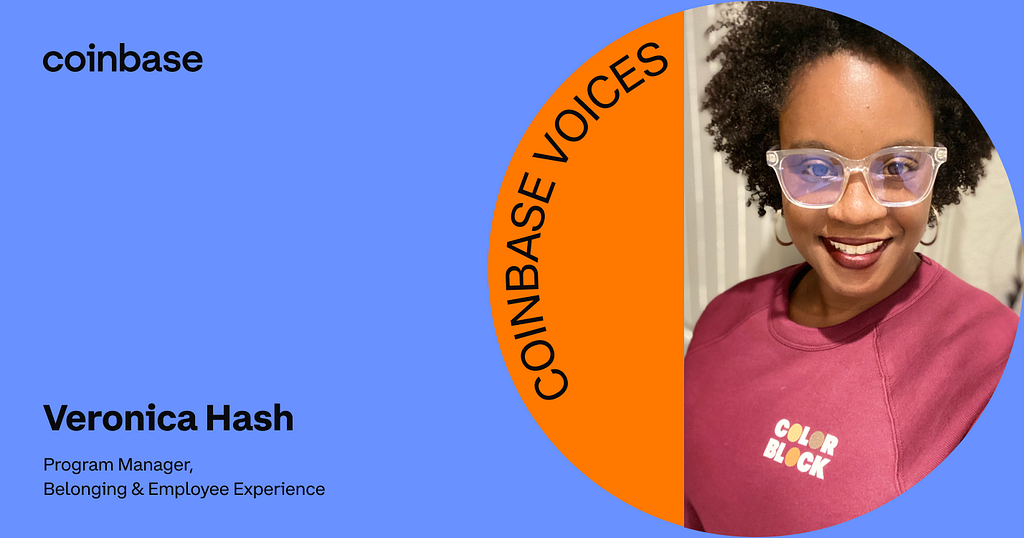
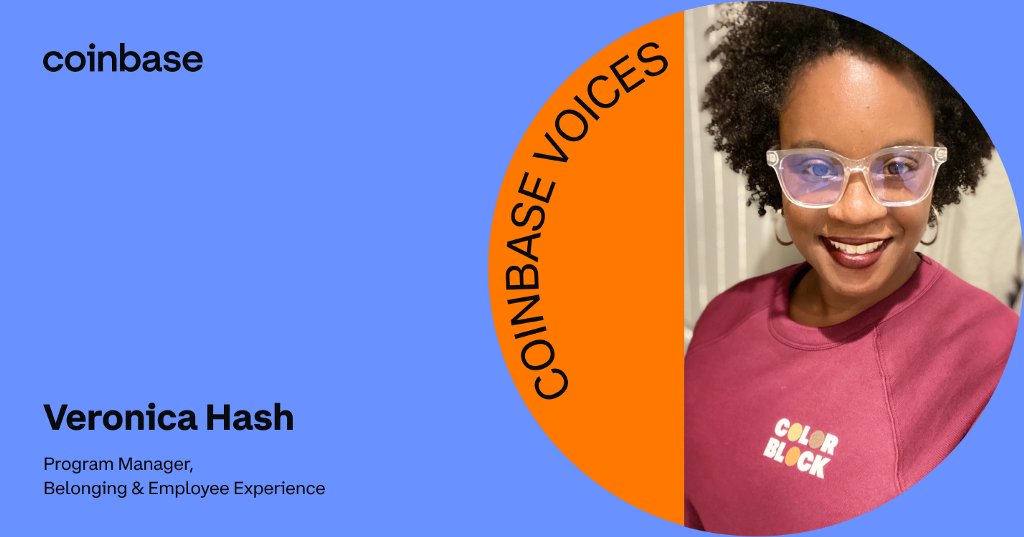
    Veronica Hash, Program Manager for Belonging, Inclusion and Diversity, shares her crypto journey and gives insight into her path at Coinbase

    Tell us about what you do. What does it mean to be the Program Manager for Belonging, Inclusion and Diversity (BID) at Coinbase?

    My day to day varies (which I absolutely love), but it always starts with coffee and organizing/prioritizing my workday.

    As the Program Manager for Belonging, Inclusion and Diversity (BID), my goal is to make sure that Coinbase is a place where people of all walks of life can see themselves thriving and growing. I consider myself a master connector, an empathetic listener, and someone who uses creativity and emotional intelligence to achieve my program’s goals. I partner closely with our phenomenal Employee Resource Groups, People and Marketing & Comms teams on projects around recruiting, mentorship, retention and community building within Coinbase.

    How did you first get interested in crypto?

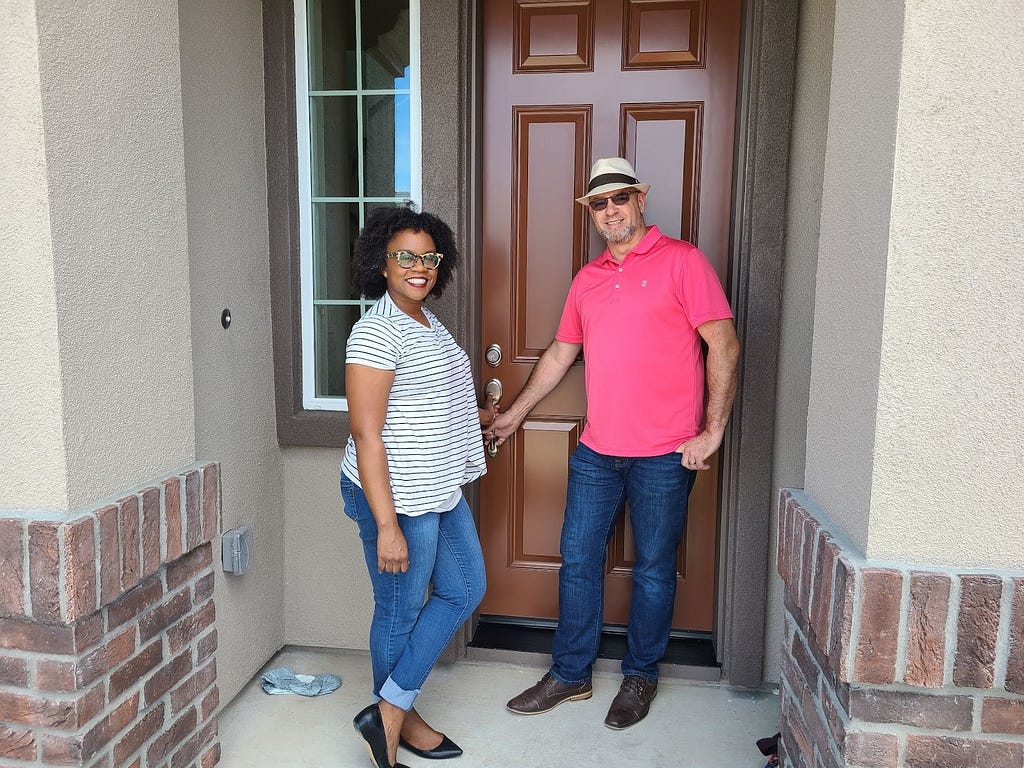
    I got interested in crypto through my husband. He used to trade in the stock exchange years ago and became fascinated with crypto’s ability to change the game. We bought some bitcoin back in 2015 at the whopping price of $280 a coin and held on to it. When the bull run came in 2017, we cashed out and bought our first house! Quite a feat in the San Francisco Bay Area, where real estate is shall we say, not the most affordable. Then, we bought back in at the bottom — held — and in 2020, we did it AGAIN!

    What’s the story of how you started working at Coinbase?

    In early 2019, I got laid off from my dream job while I was six months pregnant, but it turned out to be a blessing in disguise. I got to spend six months with my baby girl and reevaluate my priorities. I wanted a role with work-life balance, the ability to grow in my career, and a really great team.

    When I was ready to return to work, a recruiter introduced me to the opportunity at Coinbase. Once I heard the company name, I WAS IN! I mean, crypto was kinda my thing because of my earlier success investing in crypto, but funny enough, I never actually considered working in the industry.

    You came in as an executive assistant, so how did you make the switch to a new career path? Any advice for others who would like to do the same?

    Being an executive assistant for 10+ years absolutely prepared me for this role. Organization, people skills, project management — those are all things EAs have in spades. I was open about my aspirations with my manager, and around the one year mark, I started getting more serious about what internal mobility might look like for me. I also have an amazing mentor through our Growth, Empowerment and Mentorship, aka GEM program, who suggested — given my passion for BID — that I look into the program manager role.

    My advice: first of all, make sure you are killing it in your current role — document and share your wins and be proactive in asking for feedback. Second, meet as many people in the company that you can — have informal coffee chats and informational interviews. Those relationships may turn into formal mentorships or they may alert you when they know a role in their org is going to open. And last, when you apply, make sure you are competitive — Coinbase hires top talent for every seat — make sure you’re clear about the value you will bring to the team.

    What inspires you to log on every day? Do you ever fear burning out, given the somewhat emotional nature of your role?

    My team is super supportive and collaborative. I get energy from the intellectual side of my work — when I am writing, reading, and researching. I also thrive on the partnerships we are building right now.

    Burnout is real, so yes, I can for sure get afraid of that. One thing I have learned is to not let myself become siloed. My BID team may be small, but we have allies and champions at all levels and in varied orgs within the company. I am not in this alone.

    What are you most proud of (can be little things or a major moment)?

    I am most proud of an internal talk I gave during Black History Month called, “Authentic Leadership in the Black Community.” I shared vulnerably the pros and cons of growing up in a predominantly white community; my early years of addiction and how I approached the deep work required to bring out my authentic self. It was so powerful and real. I remember feeling so supported by everyone’s comments in the chat and Slack messages afterwards.

    I am also incredibly proud of the work I do to spread the message about our BID work. I love challenging narratives and misconceptions folks may have about Coinbase. I am a deep believer in face to face conversation and being candid. When we recently acquired a company, I hosted a “Keepin’ it Real” session so we could answer any questions or address any concerns they may have had from an employee experience standpoint. This is one reason why we created this “Coinbase Voices” series. I want our voices to be heard.

    What are you currently excited about in the crypto ecosystem?

    I recently started learning about staking and earning yield on our holdings and wow — that’s been an awesome passive income stream. I’m a creative so I absolutely love the intersection of art and crypto: a great example is the real adrenaline rush I got from watching “Love is in the Air” by Bansky get auctioned off at Sotheby’s. Not only was it a Banksy (I was waiting to see if it would self-destruct), but it was also the first time the auction house would accept crypto (BTC and ETH) as a form of payment.

    What are you passionate about outside of work?

    Family is everything! Super grateful for mine!


    Coinbase Voices: Creating her own path in crypto was originally published in The Coinbase Blog on Medium, where people are continuing the conversation by highlighting and responding to this story.

    [ad_2]

    Source link

  • Coinbase Voices: It’s not too late to get into crypto

    Coinbase Voices: It’s not too late to get into crypto

    [ad_1]

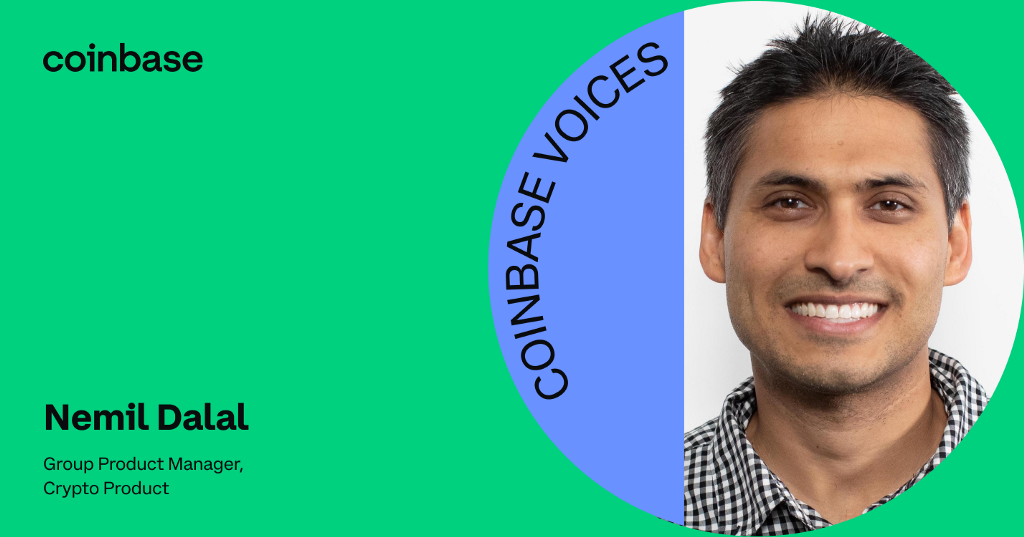
    Coinbase Voices is a collection of employee stories that highlight the expertise of our Coinbase team and share their journeys to crypto. In this post, Nemil Dalal, Head of Crypto, reflects on his three years at Coinbase and shares some of his key takeaways.

    Soon after college, I consulted for one of the world’s top banks. What I saw horrified me.

    Despite their dominance, their tech systems were a mess of spaghetti built over 40 years, with much of the code still running on proprietary COBOL mainframes when the world had long ago moved onto mobile phones, open APIs, and easier to use programming languages. It was clear to me that tech innovation would not come from our existing financial system.

    Two years later, I was in India exploring how to extend microcredit using mobile payments. Few of the poorest had access to financial services that many of us are used to. It was clear to me that it would be transformational if we could make financial services more accessible.

    Then one day in 2012, I met the founders of a tiny startup called Coinbase and read the Bitcoin whitepaper. While I didn’t know how crypto would grow, I also knew that the world would never be the same again: suddenly, we had an open, worldwide protocol that anyone could access and that any developer could build on top of.

    My first major love in crypto was smart contracts: tiny pieces of code that let us program money.

    function deposit() public payable returns (uint) {
    require((balances[msg.sender] + msg.value) >= balances[msg.sender]);
    balances[msg.sender] += msg.value;
    emit LogDepositMade(msg.sender, msg.value);
    return balances[msg.sender];
    }

    [A deposit function in a smart contract “bank” circa 2016]

    With this code, a programmer could define a safe deposit box or an entirely digital bank that anyone in the world can access and where your money was kept secure. I started writing my own smart contracts, audited those of some leading teams, and then launched a decentralized finance protocol.

    Eventually, Coinbase acquired my company and asked me to first lead USDC, now a $25 BN US dollar backed stablecoin. Today, I lead Product for their Crypto team, the team that connects Coinbase to the blockchain, manages billions of dollars, and brainstorms foundational innovations.

    Our team is composed of brilliant cryptographers, engineers, product managers, user researchers, and data scientists who get to dream up the future.

    How is crypto different from other parts of tech?

    On the face of it, crypto is just like every other part of tech: fast moving, world impacting, growing quickly. In reality, there are three things that distinguish it:

    The Revolution will be Decentralized
    Unlike other industries, innovation isn’t led by the same cast of big tech companies in a top down way. In fact, many of the most exciting innovations come from companies like Coinbase down to garage size startups.

    In fact, many of the leading companies in the world are woefully underinvested and underprepared for the world of blockchains. It’s a space where small groups of people can make a dramatic impact. And you don’t need to be in a handful of tech-forward companies based in Silicon Valley; you can contribute from anywhere in the world.

    Crypto innovations are more democratic and grassroots than most other industries.

    Frenetic and “Stagnant”
    Nearly every part of tech likes to brag how fast moving it is. But crypto is a world to itself.

    One day, the blockchain is invented. The next day, smart contracts let us build decentralized finance. Stablecoins take off. Digital Art NFTs, some of which are created by rappers and celebrity artists, are suddenly worth millions of dollars and sold through Sotheby’s.

    Crypto isn’t for the faint of heart. You’ll need to be constantly learning. If you’re on top now, it can be one innovation away from crashing down on you.

    In crypto, we have years of “stagnation” and then dizzying price increases in frenetic bull markets. These bull markets are powerful ways to get tens of millions of people into crypto, but the winters are when so much innovation actually happens.

    Ultimately, today’s crypto is a remarkable opportunity to get the best education of your life, every day.

    Misfits
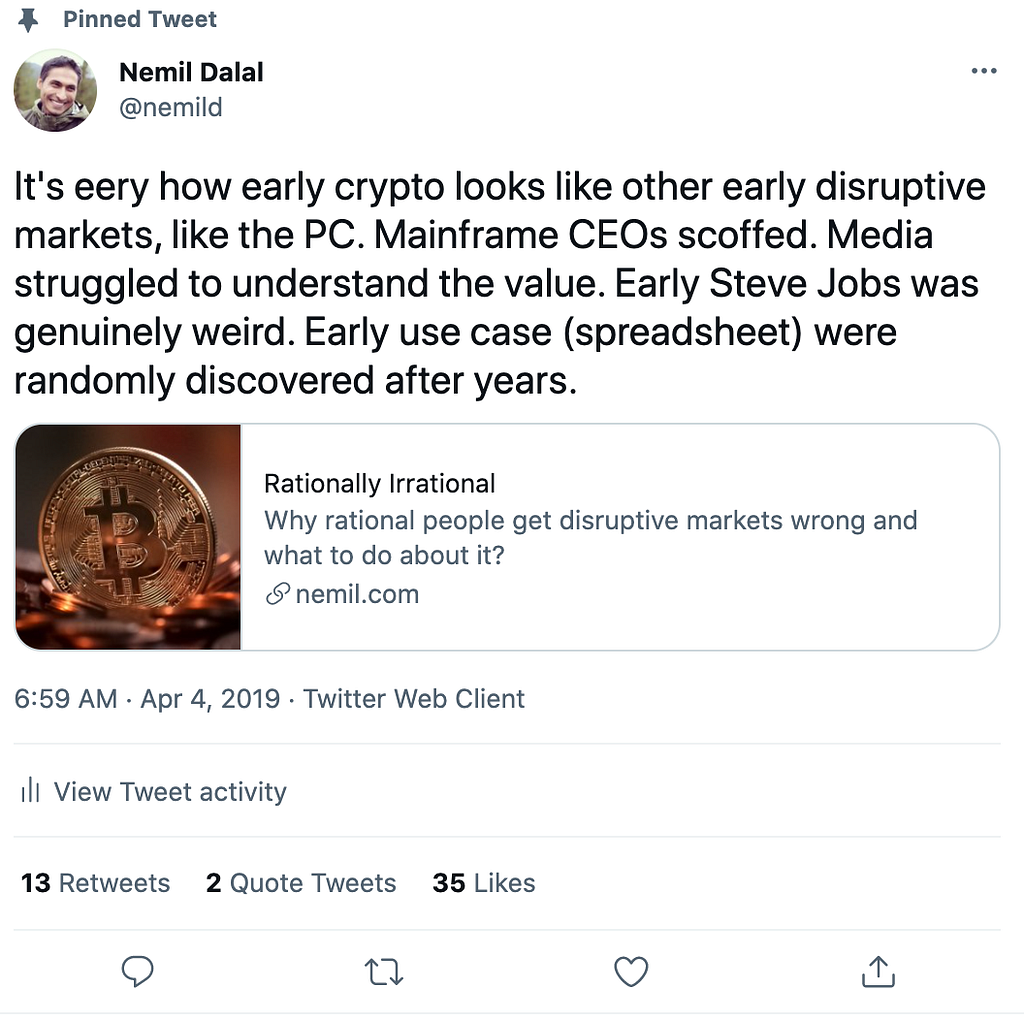
    In the early years, crypto was composed of misfits: people exploring the death of the nation state, goldbugs, anarchists. The more rational you were, the less likely you would have been able to see the potential. Even though crypto has gone mainstream, it still values this founding ethos.

    Source: https://twitter.com/nemild/status/1113803344827441153?s=20

    Namely, being a misfit or an outsider can give you unique perspectives. After all, challenging a financial system built over millennia requires out of the box thinking and a willingness to challenge long standing assumptions.

    What misconceptions are there about getting into crypto?

    Crypto is more than payments
    To the external observer, the most obvious use case for crypto seems to be payments. International remittances are huge, funds can take days to arrive, and fees are far from 0.

    In reality, crypto is the technology for financial expression that will underpin every asset we have. It can improve payments, but it will transform other industries from lending to trading to money.

    In short, we’re building an internet of finance. Rather than payments or a replacement for money, crypto is the rails on which every financial product we have will eventually live.

    It’s Never Too Late
    First, it’s never too late. When I first started playing in crypto in 2014, I was pretty sure it was too late. The price of Bitcoin had skyrocketed and all the exciting things seemed to be done. Little did I know.

    Even today, the vast majority of the world doesn’t use crypto. We have much to do if we want to make crypto accessible, usable, and safe for everyone. Crypto is at a unique moment where small groups of people can do world-changing work.

    Passion and learning required, not engineering experience
    Second, you don’t need to be a crypto expert to enable the crypto revolution. The most experience anyone has in crypto is one decade, and even in that time, the space has changed dramatically enough that the lessons of even a year ago no longer apply. Unlike other spaces, the “experts” in crypto aren’t that far apart from someone just joining.

    You don’t need to be an engineer or techy to have an impact. The internet needed software engineers, designers, hardware engineers, telecom experts, policy makers, and entrepreneurs. Similarly, crypto needs a wide tent of smart contract engineers, web engineers, design, user research, compliance, legal, economists, financial experts, cryptographers, and more. Crypto will not grow without a wide tent of disciplines and diverse perspectives that communes and dreams together.

    What is critical is a passion for what crypto can enable — a worldwide, open financial system — and a desire to constantly be learning. Without it, you can’t keep up with the dramatic daily innovation and stay motivated through the inevitable down cycles.

    In crypto, we have a saying: to the moon. It’ll take a village to get there.


    Coinbase Voices: It’s not too late to get into crypto was originally published in The Coinbase Blog on Medium, where people are continuing the conversation by highlighting and responding to this story.


    [ad_2]

    Source link