Crypto-focused venture firm Framework Ventures has raised $400 million in new funding to invest in early-stage companies across the Web3, blockchain gaming and decentralized finance (DeFi) industries.
The completed raise will go towards “FVIII,” an oversubscribed fund worth $400 million, the company announced Tuesday. Approximately $200 million of that total will be allocated to the emerging blockchain gaming industry.
The venture firm, which had early exposure to DeFi, now has over $1.4 billion in assets under management. Framework Ventures was an early investor in projects such as Chainlink, Aave and The Graph.
Like DeFi in 2020, gaming and Web3 have been identified as the next major growth plays for the blockchain industry. Axie Infinity — a popular play-to-earn game constructed around collecting digital pet avatars called Axies —has provided a solid use case for this emerging paradigm. According to blockchain analytics platform Nansen, there are currently 2.8 million unique addresses holding 11.1 million Axies.
Web3 and NFTs stole the show at SXSW 2022, while BTC and cryptocurrency enjoyed very little focus. https://t.co/e38F0Hifon
As Cointelegraph reported, Web3 is also fostering the continued growth of the nonfungible token market by giving creators the ability to create NFTs with actual use cases inside virtual ecosystems.
Related: An open invitation for women to join the Web3 movement
Venture funds and other smart money investors have been keen to back Web3 development companies. On Tuesday, Cointelegraph reported that KuCoin ecosystem companies had launched a $100 million Web3 developer fund focusing on NFT projects. Separately, crypto exchange CoinDCX has raised $135 million to support India-based Web3 projects.
Beyond the blockchain industry, it’s believed that the play-to-earn model could have a significant impact on the future of gaming. Myspace co-founder and former CEO Chris DeWolfe told Cointelgraph that the business model of play-to-earn gives players more control over their in-game experiences.
The last time ETH Denver was held in person, ETH’s market cap stood at $30B, DeFi hadn’t had its breakout summer, and few people outside of the 6,000 attendees knew what an NFT was. Fast forward to 2022 and a 10x in ETH’s market cap, the rise of NFTs, a DAO resurgence, and a year where Ethereum did more transactional volume than Visa, a record crowd of 12,000 in Colorado were met with an entirely different energy.
What had historically been an event for hackers and coders received an infusion of artists and creatives, as well as a governor, a former presidential candidate, and a heavy dose of EDM — a reflection of Ethereum and crypto’s growing awareness within the mainstream.
Despite the new faces, ETH Denver retained its authentic quirky disposition, complete with bright neon colors and Vitalik dressed as a “Bufficorn”. Beyond a lone Doge Lambo, the main event was mostly free of flash and still felt authentically Ethereum.
Attendee sentiment
Even amidst a 50% market drawdown from late November highs and multi-hour long check-ins in the frigid cold, builder energy was sky high. Where Ethereum was still finding its footing during last ETH Denver, this year’s event featured heavy discussion across all of the new verticals thriving today: DeFi, NFTs, DAOs, gaming, and more.
It was also apparent just how much private capital is still flowing into crypto, undeterred by macro market headwinds: with seed stage deals raising at a minimum $50M and seed token rounds going for $100M+ (no shipped code needed), one might argue too much. In either case, it’s clearly a builders market.
Real Politik
In addition to investor and builder excitement, there was also a noticeable presence from mainstream politicians: most notably, Colorado Governor Jared Polis and the Forward Party’s Andrew Yang. With crypto and Web3’s growing popularity, it seems many in government are seeing the upside to embracing this emerging constituency.
In addition to posing with Vitalik, Gov. Polis announced during the conference that Colorado will accept crypto as payment for taxes in addition to making Colorado, “the first digital state” with favorable regulations for the crypto economy. This mirrors the positions of other crypto-forward governors like Miami’s Francis Suarez and New York’s Eric Adams.
Photo credit: Westword
In a surprise appearance, Andrew Yang took the stage with Bankless’s David Hoffman, sharing his thoughts on why Web3 represents “the biggest anti-povery opportunity of our time.” His appearance came on the heels of his Lobby3 initiative, which will advocate for thoughtful regulation in Washington to support crypto innovation.
All of the while, Biden’s executive order on crypto regulation loomed large (however if you bumped into CoinCenter’s Neeraj he would have told you that the EO is nothing to panic over). Either way, it’s clear that crypto has entered the fore of the American political discussion.
NFT Mania
Beyond the bullish builder sentiment, private investor froth, and political participation, NFTs were everywhere in Denver. NFT art installations, musicians performing with their NFTs on display, and some events even requiring NFTs to gain entry (shoutout ecodao).
POAP (Proof of Attendance Protocol) NFTs, which give people digital mementos commemorating attendance of a particular event by scanning a QR code, were particularly pervasive. The inventive ways different projects found to engage via POAPs suggests that they may be the next mainstream crypto community use case.
If you were mingling at any of the NFT centric events, odds are you bumped into a former FAANG employee newly entering the NFT space. A sign that despite the macro market downturn, NFT mania is still in full swing and the brain drain from Web2 to Web3 continues.
Signs of DAObt
Following a year that saw ConstitutionDAO capture global attention, DAOs have regained much of the crypto limelight. Conference booths were packed with projects building DAO infrastructure and discussions on how decentralized autonomous can rewire the world were prevalent.
While DAO enthusiasm was evident, many noted that DAO participants were starting to show signs of fatigue with many DAOs struggling to retain contributors. Joseph Delong, former CTO of SushiSwap who notably left the decentralized project, gave a memorable talk on why DAOs simply need more structure to be effective (also discussed in our recent podcast with Orca Protocol’s Julia Rosenberg).
With over 1B in startup equity for DAO tooling and under 200 DAOs, it begs the question: is there enough DAO to go around?
The long term outlook of DAOs seems to be bright, but the industry is still grappling with how exactly DAOs should function. Given that there’s no standardization around DAO operation, it’s hard to know what tools they actually need. As such, the DAO infrastructure sector will likely see a lot of turbulence over the near to medium term.
The Merge
After years in the making, experts stated that Ethereum’s transition to proof-of-stake is expected to happen in Q2 or Q3 this year. As a quick refresh, Ethereum’s PoS chain (the beacon chain) has been operational since December 2020, however all applications still live on the proof of work chain. The merge basically consists of migrating these applications to the PoS chain.
As such, the merge was a major point of discussion for devs this year. If all goes well, ETH holders won’t have to do anything, but developers and infrastructure providers are in preparation mode. This includes running testnets and conducting dry runs in anticipation for the real thing.
The Ethereum ecosystem is making a big bet on PoS in conjunction with layer 2 scaling solutions (rollups). In a post-merge world, Ethereum will transition to become a settlement layer for large transactions while most user activity is pushed to layer 2. This will create an environment where all EVM compatible layer 1s compete with ETH L2s for users and developer mindshare.
Also prepping for the merge, is Coinbase Cloud, which powers a portion of Coinbase’s ETH staking product as well as node infrastructure for many players in the space. Cloud developers showed up in force hosting a hackathon, a variety of panels, workshops, and a party for over 500 attendees. Learn more about how Coinbase Cloud is thinking about client diversity ahead of the merge here.
A builders market
In the days since ETH Denver wrapped, the market drawdown intensified as Russia escalated the situation in Ukraine. While crypto has rebounded, markets will likely remain shaky given the uncertainty of the current geopolitical situation. Regardless, teams building the next generation of Ethereum and Web3 remain well funded and the building will continue.
As evident by the increased diversity of both projects and participants at this year’s conference, what gets built on Ethereum will keep venturing out in a myriad of new exciting directions.
Around the Block from Coinbase Ventures sheds light on key trends in crypto. Written by Connor Dempsey, Ryan Yi & Justin Mart.
2021 was a historic year for both crypto markets and venture capital funding. Driven in part by institutional inflows, Bitcoin soared to new highs to start the year, the entire market followed suit nearing a record $3T market cap in November. Meanwhile, $30B in venture funding poured into the space: more than all prior years of crypto’s history combined.
2021 was also a record year for Coinbase Ventures, with just under 150 deals, averaging a new deal every 2.5 days. On a cumulative basis, more than 90% of the capital Coinbase Ventures has deployed since inception was deployed in 2021, reflecting an accelerated pace of activity in our fourth year of operation.
Coinbase Ventures is among the most active corporate venture funds in operation, with the mandate of increasing economic freedom around the world by supporting the leading entrepreneurs and projects in the ecosystem. Ultimately, we see crypto and Web3 as a rising tide that lifts all boats, Coinbase included, and Coinbase Ventures is dedicated to making investments that are crucial to the space’s overall growth.
In this edition of Around The Block, we’ll peer into the future through the lens of Coinbase Ventures’ 2021 activity. (Learn how Ventures aligns with Coinbase and its customers here).
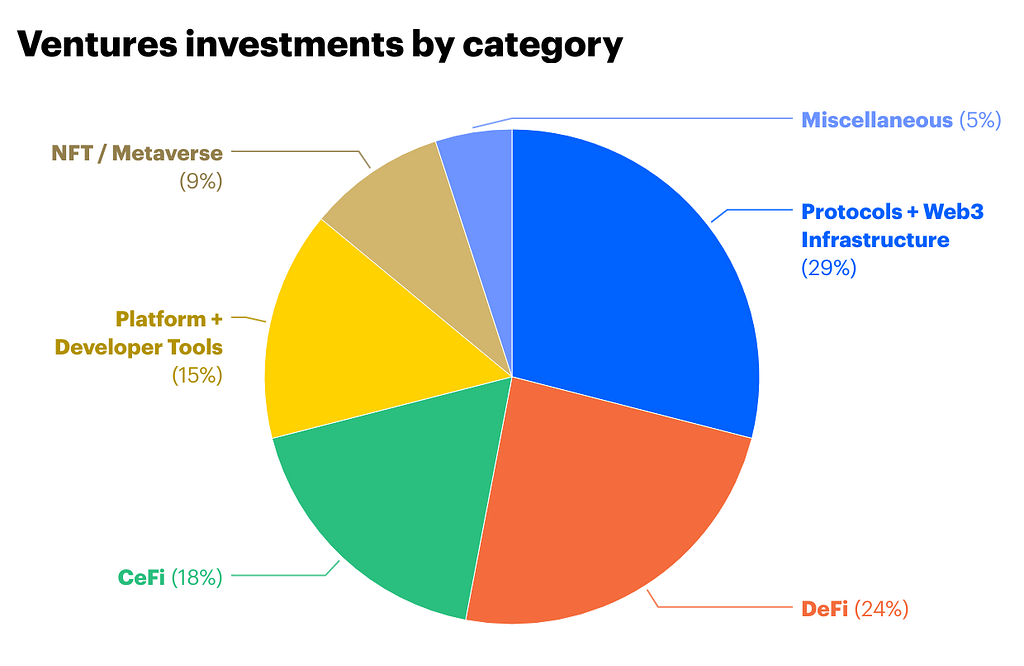
Coinbase Venture’s portfolio now consists of over 250 companies, and broadly breaks down across the following verticals.
Let’s break down the pie, slice by slice.
Protocols & Web3 infrastructure
2021 saw crypto reach new heights in terms of utility, particularly in the nascent “Web3” space, which we generally think of as a trustless, permissionless, and decentralized internet that leverages blockchain technology: essentially, the plumbing that underpins everything from DeFi, NFTs, metaverses, and DAOs. At the bottom of the Web3 stack sit Layer 1 protocols, led by Ethereum, but 2021 saw Web3 begin to expand to other Layer 1s like Solana, Polygon, Avalanche, Terra, Flow, among dozens of others.
To help scale existing Layer 1s and enable higher throughput, we supported Layer 2 solutions including Matter Labs, Optimism, and Arbitrum. As multiple Layer 1s have proliferated, so has the demand to safely and easily move funds across blockchains. As such, Ventures’ was active in investing in projects working to facilitate this cross-chain movement, including Biconomy, Movr, LayerZero, Chainflip, and more. We also observed and funded new protocols working to bring better privacy to Web3 through various zero-knowledge solutions (Aleo, MobileCoin, and a third TBA).
We were also active across the infrastructure layer of the Web3 stack: primitives that form the backbone of user applications. Specifically, technologies that introduce standards to Web3 for data storage (Arweave), messaging (XMTP), and identity (Spruce). Given that 2021 was a great year for DAOs, we were active across infrastructure projects focused on enabling DAO creation/incorporation (Syndicate, Utopia), discovery/participation (Snapshot/Consensys’ Metamask), payroll/operations (Diagonal), and coordination (Orca).
Given investments made over the year, in 2022 we expect to see Web3 mature across multiple Layer 1 and Layer 2 ecosystems with UX that more closely resembles Web2 applications. Additionally, we expect to see the continued flourishing of DAOs in the year ahead, as well as better privacy features for Web3 applications.
DeFi
While 2021 hinted at a future where Web3 activity takes place across multiple Layer 1 and Layer 2 platforms, DeFi activity already began its migration over the course of the year. Much of this activity took place within EVM compatible chains (Avalanche, Polygon, BSC etc.) and Layer 2 environments (Arbitrum, Optimism). Meanwhile, non-EVM chains (Solana, Terra, Cosmos, Polkadot etc.) also saw impressive growth.
We’re believers in the multichain future, and although we remained most active within Ethereum’s DeFi ecosystem, we also invested across Solana (Orca, Solend), Cosmos (Umee), Algorand (Folks), Polkadot (Acala, Moonbeam), NEAR, Polygon and Bitcoin. The multichain future of France appears bright, with just about every financial primitive one could imagine in development.
While DeFi made great strides in 2021, exploits of these nascent financial protocols hampered the ecosystem, amounting to over $10B. Better user protection remains paramount, which is why Coinbase Ventures supported DeFi insurance financial protocols including Neptune Mutual, Risk Harbor, Cozy Finance, and Nayms.
In 2022, the smart contract wars will rage on as Layer 1s and Layer 2s fight for user and developer mindshare. Hacking risks will persist but we’ll see increased maturity in DeFi insurance solutions. Lastly, it’s shaping up to be the year we see institutions enter the fray via “permissioned DeFi”, complete with KYC’d user pools and on-chain attestations.
NFT / Metaverse
2021 was also a year that saw the rapid rise of NFTs and renewed interest in “the metaverse.” Projects like CryptoPunks and Bored Ape Yacht Club took NFT sales from $200M in 2020 to a staggering$25B in 2021. Meanwhile, NFT based game Axie Infinityput play-to-earn gaming on the map as people in the Philippines were able to turn the game into a full time job. And elsewhere, Facebook’s rebrand to “Meta” catalyzed excitement around the metaverse.
In large part, NFTs spent 2021 in their “V0” phase, with most activity centered around simple buying and selling on marketplaces like OpenSea and Rarible. 2021 also saw NFTs emerge across L1/L2 ecosystems such as Flow (MomentRanks, Eternal GG) and Solana (Magic Eden, Solanalysis).
Ventures has now invested heavily in the NFT “utility” phase — one in which NFT assets expand to new types of mediums such as audio (Royal, Mint Songs, Sturdy), avatars (Genies, OFF), AR (Anima, Jambo), and gaming/GameFi (Ancient8, GuildFi). This will allow interesting social features to be layered on top of the programmatic recognition of NFTs (Gallery).
These NFT and gaming investments can broadly be bucketed with the metaverse, as they inch us closer to a possible future where we have a series of decentralized, interconnected virtual worlds with fully functioning economies. In 2022, look for a host of new gaming titles and applications, including those launched by traditional gaming studios. Also expect metaverse applications to expand from both decentralized initiatives like Decentraland and the Sandbox and incumbent Web2 companies like Microsoft/Activision and Meta.
Platform & Developer Tools
Without developers, there would be no crypto or Web3 applications for anyone to use. As such, support for the tooling that developers need to make crypto and Web3 thrive is a critical part of advancing the ecosystem.
Over the year, we followed the “developer journey” from staging (Tenderly), collaboration (Radicle), query (Covalent), audit (Certik, OpenZeppelin, Certora) and real-time simulation/monitoring (Chaos Labs, Gauntlet). We also invested in developer toolkits like API providers (Alchemy, Consensys’ Infura).
We expect the industry’s collective investment made in dev tooling to pay dividends in the years to come. With all of the developers pouring into Web3 from Web2, they’re sorely needed.
CeFi
Much of the value that finds its way into crypto initially does so through centralized platforms, and as such, centralized finance (CeFi) remains an active category. We believe that crypto is inherently global and there is a need for localized platforms that serve as onramps across distinct regulatory, banking, and infrastructure regimes. This is why in 2021, we were active investors in crypto financial service providers everywhere from LatAm, Pan-Africa, MENA, South Asia, Europe, and North America.
The year also saw a move towards traditional vehicles for crypto exposure — IRAs, IAs, ETFs, Trusts, etc. — punctuated by the approval of the BTC Futures ETF in the US. Coinbase Ventures actively invested in asset managers and brokers including AltoIRA, Onramp, Valkyrie, ForUsAll, Ledn, and One River Digital. We were also investors in various CeFi “picks and shovels”, with follow-on investments in TaxBit and CoinTracker, which automate crypto tax reporting across platforms. In addition, we supported projects helping startups integrate crypto with traditional fintech offerings, including Paxos, Tribal Credit, and Meow.
2021 set the stage for more regulated and compliant ways for institutional and individual investor capital to gain crypto exposure through centralized exchanges and traditional investment vehicles and fintech platforms in both the US and abroad. We expect this to be an ongoing theme in 2022.
2022 & beyond
Macro uncertainty has prices falling sharply into the new year, but one thing is certain: this is not the crypto ecosystem of 2018. Between the best performing asset class of the last decade being much more accessible to investors around the world, the maturation of the Web3 stack, and an explosion of exciting new use cases across DeFi, NFTs, DAOs, gaming, and the metaverse, this industry appears to be hitting escape velocity.
Just as the boom of 2017 fueled investments that laid the groundwork for the applications that are thriving today, what do you think the record $30B funneled into crypto and Web3 in 2021 will yield? The market appears uncertain in the near term, but the future appears brighter then it’s ever been.
Leading independent investment fund led by Kraken Alumni, Kraken Ventures today announced that it has secured $65 million for an early-stage fund to invest in companies working in the global crypto and financial technology (Fintech) ecosystem.
Kraken acted as the anchor LP in the latest funding. Additionally, the fund witnessed investment from a wide range of international institutional investors. Kraken Ventures aims to boost innovation in the crypto ecosystem through the support of emerging companies.
The fund focuses on areas including financial infrastructure, Web3, decentralized finance (Defi), consumer crypto protocols as well as enabling technologies, such as AI and Machine Learning. According to the details shared by Kraken Ventures, it has made several investments in some of the leading crypto companies including Anchorage and Messari.
“We’re extremely pleased to have successfully closed our first fund,” said Brandon Gath, Managing Partner of Kraken Ventures. “Our long-term view on investing, and the possibility to leverage Kraken’s experience in building a truly global, scalable platform, definitely contributed to the overwhelming interest we received from investors. Our focus now is to put that money to work and help some of the most innovative projects and their exceptionally talented founders accelerate the development of their companies and protocols.”
Headquartered in Texas, Kraken Ventures has team members in London and New York. The fund makes initial investments in the range of $500K and $2 million. According to the company, its investment strategy is based on the long-term horizon.
Appointment of Laurens De Poorter
To expand its presence in Europe, Kraken Ventures recently announced the appointment of Laurens De Poorter as Head of Europe. The newly appointed Head of Europe will be based in London. “The European crypto scene is booming. Deal count doubled in the last two years and continues to accelerate,” said Laurens De Poorter.
Leading independent investment fund led by Kraken Alumni, Kraken Ventures today announced that it has secured $65 million for an early-stage fund to invest in companies working in the global crypto and financial technology (Fintech) ecosystem.
Kraken acted as the anchor LP in the latest funding. Additionally, the fund witnessed investment from a wide range of international institutional investors. Kraken Ventures aims to boost innovation in the crypto ecosystem through the support of emerging companies.
The fund focuses on areas including financial infrastructure, Web3, decentralized finance (Defi), consumer crypto protocols as well as enabling technologies, such as AI and Machine Learning. According to the details shared by Kraken Ventures, it has made several investments in some of the leading crypto companies including Anchorage and Messari.
“We’re extremely pleased to have successfully closed our first fund,” said Brandon Gath, Managing Partner of Kraken Ventures. “Our long-term view on investing, and the possibility to leverage Kraken’s experience in building a truly global, scalable platform, definitely contributed to the overwhelming interest we received from investors. Our focus now is to put that money to work and help some of the most innovative projects and their exceptionally talented founders accelerate the development of their companies and protocols.”
Headquartered in Texas, Kraken Ventures has team members in London and New York. The fund makes initial investments in the range of $500K and $2 million. According to the company, its investment strategy is based on the long-term horizon.
Appointment of Laurens De Poorter
To expand its presence in Europe, Kraken Ventures recently announced the appointment of Laurens De Poorter as Head of Europe. The newly appointed Head of Europe will be based in London. “The European crypto scene is booming. Deal count doubled in the last two years and continues to accelerate,” said Laurens De Poorter.
Reddit co-founder Alexis Ohanian has teamed up with Solana Ventures to launch a new investment fund dedicated to Web3 and social projects, potentially setting the stage for the next wave of budding crypto startups.
Ohanian announced Tuesday at the Breakpoint conference in Lisbon, Portugal that his Seven Seven Six venture firm and Solana Ventures have allocated $100 million to Web3 and “decentralized social projects.” In an accompanying news release, the internet entrepreneur touted his venture firm’s expertise in “identifying and investing in early social and crypto trends,” which include Reddit, Patreon and Coinbase, among others.
Raj Gokal, the COO of Solana Labs, said “Web3 turns users and creators into owners and stakeholders, a change that can’t come soon enough to social media.”
Centralized social media platforms such as Facebook are said to generate hundreds of billions of dollars in annual revenue, mostly through advertising and without rewarding content creators for their contributions. While efforts to “decentralize” social media have been underway since at least 2017, no blockchain-based social project has reached mainstream adoption. Seven Seven Six and Solana Ventures said they will prioritize technologies and applications that [eliminate] value extraction from centralized intermediaries.”
Related: BREAKING: Facebook rebrands to Meta as focus expands beyond social media
Solana Ventures has been highly active on the investment front, having only recently spearheaded a $100 million fund dedicated to Web3 gaming, also known as GameFi. Similar funds were also launched by Sanctor Capital and Huobi Group. Over $17 billion in venture capital has flowed to crypto- and blockchain-focused startups so far in 2021.
Around the Block from Coinbase Ventures sheds light on key trends impacting the crypto ecosystem. In this edition, the Ventures team provides an update on Coinbase Ventures activity in 2021-Q3, and key learnings from around the industry.
Coinbase Ventures (or “Ventures”) has grown into one of the most active VC investors in crypto by deal count. In Q3, Ventures made a record 49 investments, averaging a new deal every ~1.8 days. This is up from 28 investments made in Q2, and 24 in Q1. As of Q3 2021, the Ventures portfolio size stands at over 200+ companies and projects.
On a cumulative basis, 90% of the capital invested by Ventures has been deployed in 2021 YTD, reflecting the accelerated pace of Coinbase Ventures in its fourth year of operation. 50% of the new unique “logos” in the portfolio have also come in 2021.
Motivation & philosophy
Coinbase Ventures primary mandate is to support the growing crypto ecosystem. As such, we invest broadly across the space in strong entrepreneurs driving crypto forward. We want the crypto ecosystem to bloom and are not focused exclusively on specific outcomes (as is typical with corporate venture capital).
Ultimately, we see crypto as a rising tide, and growth in the ecosystem lifts all boats — Coinbase included. Traditional strategic benefits, such as commercial partnerships and potential M&A, are great, but we view them as icing on the cake.
Investment Categories
Coinbase Ventures investments range from six-figure seed deals to multi-million dollar growth rounds. There are many ways to slice our investments, but at the highest level we break down the market across the following categories: Protocols + Web3 infrastructure, DeFi, CeFi, Platform + Developer Tools, NFT / Metaverse, and Miscellaneous.
Our current distribution of total investments by company is as follows:
Key Themes & Learnings
*Coinbase Ventures portfolio company
In our most active quarter to date, we saw heavy development across centralized finance (CeFi) in the United States, Layer-1/Layer-2, cross-chain protocols, as well as Web3 tooling. Here’s some of the major themes we observed.
Regulators and centralized players waded deeper into the crypto waters
Regulatory bodies made their presence more widely known in Q3, as the SEC and Treasury Department in the US, and the Financial Action Task Force (FATF) internationally, all stepped up engagement across the crypto ecosystem. This has introduced some forms of regulatory risk for early stage protocols and teams. On the flip side, the largest cap asset scored positive tailwinds in the form of the BTC Futures ETF approval which we believe will allow latent capital to enter crypto markets, leading to significant volumes, inflows, and interest.
Web 2.0 companies like Square, Twitter, Stripe, and Tik Tok also expanded their crypto strategies in Q3. Square announced a Bitcoin based platform for financial services, Twitter revealed future BTC Lightning and NFT integrations, and Stripe announced its return to crypto with a new dedicated crypto team. Tik Tok announced a partnership with ImmutableX* to launch a creator-led NFT collection.
Meanwhile, banks, fintechs, and broker dealers moved to further integrate crypto into their product offerings, enabled by Coinbase Prime, Coinbase Cloud and other third party platforms. All in all, the crypto industry made tremendous strides with respect to maturation and institutional adoption over the quarter.
The multichain ecosystem hit its stride
Following years of development on solutions designed to alleviate bottlenecks on Ethereum, scaling is finally here with a range of Layer-1 and Layer-2 ecosystems taking off. The majority of the current traction is on solutions leveraging EVM (Ethereum Virtual Machine) compatibility, allowing users and developers to migrate to new environments with relatively low switching costs. Users can access EVM compatible L1s like Avalanche, or sidechains/L2s like Polygon*/Arbitrum*/Optimism* with their existing wallets. Solidity smart contracts can also be generally copy + pasted to any EVM compatible L1/L2, which has led to implementations of popular DeFi applications across multiple chains.
As CeFi exchanges have been slow to integrate with these new L1s/L2s, we saw traction across newly launched cross-chain bridges. These bridges facilitated the movement of billions in funds from Ethereum to various L1s/L2s.
While EVM compatible applications written in Solidity saw the most traction on L1s and L2s in Q3, other ecosystems are bringing more expressive programmability to the table. New primitives focused on more familiar programming languages like Rust (Solana, Polkadot), Golang (Cosmos), and Move (Facebook Diem*, Flow*) may usher in a wave of new Web 2.0 developers to the industry.
Better Web3 UX is on the way
In Q3 we saw further development of Web3 tooling that will simplify the experience of Web3 interactions. XMTP* is spearheading a messaging standard across Web3 addresses. Spruce* is standardizing “OAuth” (open authorization), which will allow users to securely share digital credentials, private files, and sensitive media with Web 3 applications. Snapshot* is making it simple to access governance forums and decisions across Dapps.
Meanwhile, a tremendous amount of work is being done to create added security for Web3 applications. OpenZeppelin’s decentralization effort, Forta*, is making progress on real-time security monitoring of smart contracts with the goal of providing more transparency around smart contract code execution, detection of bugs, and eventually, the prevention of hacks in real-time. Similarly, Certik* is providing a “fast-and-easy” automated audit tool to help Dapps go-to-market more quickly.
Simultaneously, the DAO tech stack continues to evolve, with the technical and legal formation of on-chain communities beginning to take hold. Syndicate* (among others) aims to be the “AngelList of crypto” through the creation of a decentralized investing protocol and social network.
NFT 2.0 & crypto gaming took flight
Q3 also saw a ton of development focused on NFT creator tools that will ultimately broaden the scope of NFT use cases and audiences while creating new social features.
Meanwhile, NFT based gaming continued to accelerate led by Axie Infinity, as its play-to-earn model took hold in emerging markets (Philippines, Brazil, India among others) attracting 2M DAUs and generating over $2B in revenue. Loot Project also captivated the industry by introducing an inverted model for game development. This was done by first releasing NFT based game assets to the public in order to bootstrap a community and incentivize further development.
Stay tuned
Stayed tuned for more insights and updates from the Coinbase Ventures team in the future. Also check out previous editions of Around The Block that you may have missed:
The Coinbase Ventures Guide to NFTs
Loot Project: the first community owned NFT gaming platform
Axie Infinity, Yield Guild Games & the play-to-earn economy
Coinbase Ventures 2021-Q3 activity and takeaways was originally published in The Coinbase Blog on Medium, where people are continuing the conversation by highlighting and responding to this story.
When I joined Coinbase in Spring 2018, I spoke with our founder and CEO, Brian Armstrong, about booting up Coinbase Ventures. Brian said, “Write a blog post about what you intend to do.” I did, sent it to him, and he said, “Looks good.” I said, “Now what?” He said: “Go launch it!”
Just over three years later, Coinbase Ventures has more than 150 investments in our portfolio. These investments include bets across all sorts of compelling areas in crypto, from international plays (Bitso, a Latin American exchange) to crypto tax players (CoinTracker and TaxBit) to marketplaces (Dapper Labs and OpenSea) to infrastructure plays (Spacemesh and Starkware) to decentralized finance, or DeFi (Uniswap and Compound).
Imagine if you were Google or Facebook in the early days and had made investments in some of the most promising emerging internet companies of the time, from Stripe to Shopify. That’s exactly what we’re achieving in the crypto ecosystem via Coinbase Ventures, our investing arm whose structure mirrors our commitment as a company to decentralization — the team, effort, and decision making is decentralized, and we’re investing in companies that are making this decentralized world possible.
Here are some answers to questions I get:
What’s the common theme? Easy. We invest in amazing teams who are executing on the most important new ideas in crypto.
What will success look like? We want the crypto ecosystem to bloom. We don’t solely invest to generate ROI (Return on Investment), but we’re keeping pace with the best VC funds in terms of returns and ultimately, we’re focused on driving innovation that helps us further our mission to increase economic freedom in the world.
Do the companies have to be of strategic interest to Coinbase (M&A, partnership, or other)? Not at all. That can often be a side benefit, but really we want to invest in amazing entrepreneurs and companies that are building the ecosystem, including potential competitors in certain areas.
Do we invest in competitors? Yes! These companies may look competitive to Coinbase from the outset, but these are still-early days of the industry and we’re committed to building out the cryptoeconomy. Also, Coinbase is a multi-product company and competitors of one product can and often are critical partners for another product.
What is Coinbase Ventures’ secret sauce? OK, here’s the real secret. It’s a labor of love. We don’t have any dedicated employees solely responsible for Coinbase Ventures. Shan Aggarwal, our Head of Corp Dev, oversees it in addition to his demanding day job, and we have a group of exceptional, crypto-native employees such as Justin Mart and Ryan Yi, who do this nights and weekends because they love it so much. My theory is that we’re doing so well because of this. We have no LPs (Limited Partners), no committees, no heavy infrastructure, no marketing, nothing. Just a bunch of passionate employees who use their networks, know-how, and love of crypto to find the best players in the space to invest in.
Coinbase Ventures: Investing for a Decentralized World was originally published in The Coinbase Blog on Medium, where people are continuing the conversation by highlighting and responding to this story.