N26 has launched N26 Crypto, a new cryptocurrency trading
product aimed at optimizing the customer experience in France. This latest
offering enables N26 customers in France to invest in over 200 cryptocurrencies
directly through the N26 application.
The introduction of N26 Crypto signifies the company’s focus
on providing accessible and efficient cryptocurrency investment options to its
clientele. Eligible clients with French or German IBANs can access N26 Crypto
across all membership tiers, including free accounts, without incurring
additional costs.
According to the firm, transparency and security are
paramount in N26 Crypto’s design. Users will have clear insights into their
cryptocurrency portfolios and transaction histories within the application. N26 emphasizes adherence to
regulatory requirements and industry standards to ensure a compliant and secure
trading environment.
La banque @N26FR ouvre son offre N26 #Crypto à tous ses clients en France 🇫🇷
Qu’est-ce que cela change pour les clients situés dans l’Hexagone ? 🤔
N26 has partnered with Bitpanda GmbH to
develop and launch N26 Crypto, ensuring robust execution of trades and custody
of assets. This partnership underscores N26’s dedication to delivering reliable
cryptocurrency services to its customers.
Introduction of N26’s New Trading Product in Austria
Earlier, N26
introduced a new trading product accessible through its mobile banking app,
starting with a rollout in Austria, as reported by Finance Magnates. The product
enables users to trade stocks and ETFs. Notably, it features a fixed fee of
0.90 EUR per trade, aiming for competitive pricing. This move marks a
significant step for the digital bank into the investment arena.
Notably, fractional share investing from as low as 1 EUR
enhances accessibility for smaller investors. The launch features over 100
ETFs, with plans to expand to over 1,000 stocks and ETFs in Germany and
Austria. Future developments include free savings plans, diversifying N26’s
offerings. Eligible Austrian customers will gain access first, with German
expansion slated in the coming months, followed by further European markets.
N26 has launched N26 Crypto, a new cryptocurrency trading
product aimed at optimizing the customer experience in France. This latest
offering enables N26 customers in France to invest in over 200 cryptocurrencies
directly through the N26 application.
The introduction of N26 Crypto signifies the company’s focus
on providing accessible and efficient cryptocurrency investment options to its
clientele. Eligible clients with French or German IBANs can access N26 Crypto
across all membership tiers, including free accounts, without incurring
additional costs.
According to the firm, transparency and security are
paramount in N26 Crypto’s design. Users will have clear insights into their
cryptocurrency portfolios and transaction histories within the application. N26 emphasizes adherence to
regulatory requirements and industry standards to ensure a compliant and secure
trading environment.
La banque @N26FR ouvre son offre N26 #Crypto à tous ses clients en France 🇫🇷
Qu’est-ce que cela change pour les clients situés dans l’Hexagone ? 🤔
N26 has partnered with Bitpanda GmbH to
develop and launch N26 Crypto, ensuring robust execution of trades and custody
of assets. This partnership underscores N26’s dedication to delivering reliable
cryptocurrency services to its customers.
Introduction of N26’s New Trading Product in Austria
Earlier, N26
introduced a new trading product accessible through its mobile banking app,
starting with a rollout in Austria, as reported by Finance Magnates. The product
enables users to trade stocks and ETFs. Notably, it features a fixed fee of
0.90 EUR per trade, aiming for competitive pricing. This move marks a
significant step for the digital bank into the investment arena.
Notably, fractional share investing from as low as 1 EUR
enhances accessibility for smaller investors. The launch features over 100
ETFs, with plans to expand to over 1,000 stocks and ETFs in Germany and
Austria. Future developments include free savings plans, diversifying N26’s
offerings. Eligible Austrian customers will gain access first, with German
expansion slated in the coming months, followed by further European markets.
Expand your dapp’s reach with just a few lines of code
By Sid Coelho-Prabhu, Product Management Director, Wallet
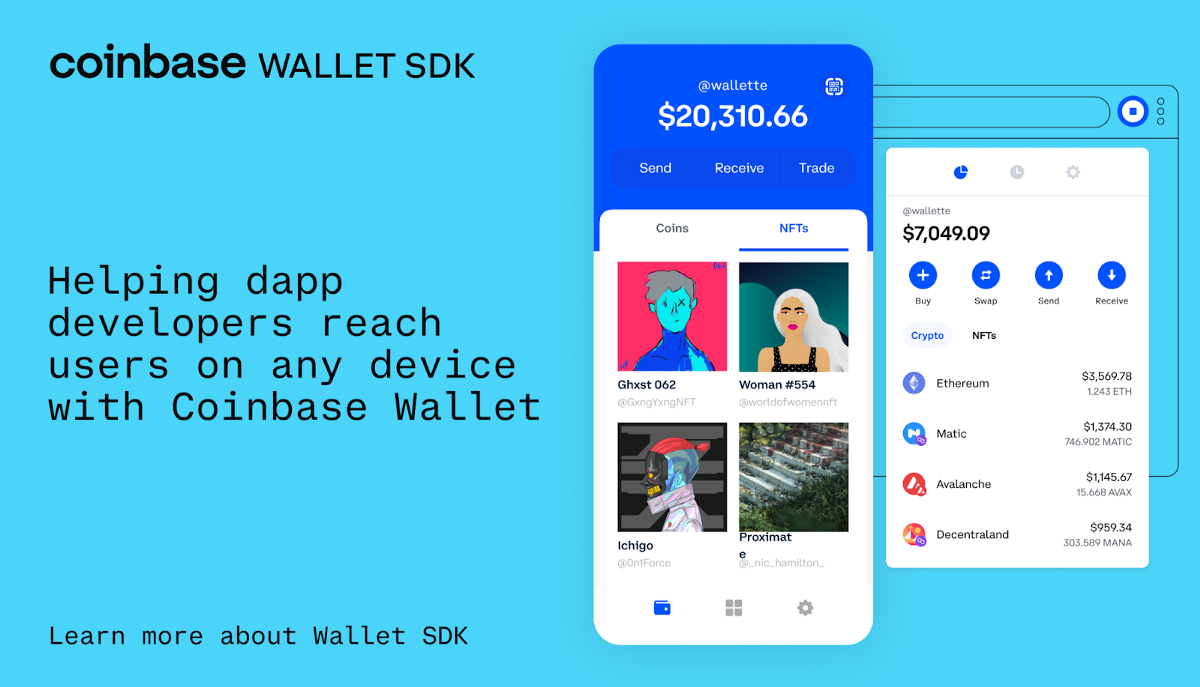
Millions of people choose Coinbase Wallet to use dapps, earn yield with DeFi, trade more than hundreds of thousands of assets, and hold their NFTs. In just minutes you can integrate Coinbase Wallet in your dapp, expanding your reach to users on all of their devices — and open your dapp up to the multichain Coinbase ecosystem of over 89M users across 85 countries, on whatever device they prefer.
With just a few lines of code, you can open up access to your dapp to Coinbase Wallet users across the iOS and Android mobile apps as well as the Wallet browser extension on Chrome.
Coinbase Wallet SDK takes just 5 minutes to integrate and doesn’t require you to deploy any additional infrastructure. You can learn how to integrate with Coinbase Wallet in our technical documentation, read our post on using web3-react to connect, or watch the Coinbase Wallet SDK demo.
We are dedicated to making the benefits of crypto and the entire web3 ecosystem accessible to all — regardless of network or blockchain, country or currency, crypto savvy or crypto skeptical. We’re building Coinbase Wallet to reflect that commitment. With support for all EVM-compatible chains, including Avalanche, BNB Chain, Polygon, and many more, you can access millions of users for your dapp across the most popular ecosystems.
We also know that security is top-of-mind for anyone building in the web3 ecosystem. By offering integration with the most trusted and secure name in crypto, you can help put your users at ease while they explore your dapp, confident that their crypto and data are safe.
The built-in trust offered by Coinbase Wallet shows: As of February 2022 it’s the most downloaded mobile dapp wallet in the United States. Integrating your dapp with Coinbase Wallet can immediately unlock access to 12M Wallet users, with the potential to reach the full Coinbase ecosystem of over 89M users in 85 countries.
We see Coinbase Wallet SDK as a critical way to expand access to dapps, which is why we want this experience to be available to everyone in the crypto community. To make that possible, Coinbase Wallet SDK is open-source, making it available for any dapp developer that wants to integrate it into their product.
Crypto is just getting started, and Coinbase Wallet is your key to what’s next. For developers, Coinbase Wallet is the best self-custody wallet to integrate with, as it’s the most trusted name in crypto and offers unparalleled reach to 89M users across the entire Coinbase ecosystem. Coinbase Wallet also offers the most user-friendly self-custody experience, unlocking the entire world of crypto, including collecting NFTs, earning yield on your crypto, accessing play-to-earn games, engaging in DeFi, participating in DAOs, and more. To learn more, visit our website.
Disclaimer:
Coinbase Wallet is a self-custody wallet providing software services subject to Coinbase Wallet Terms of Service and Privacy Policy. Coinbase Wallet is distinct from Coinbase.com, and private keys for Coinbase Wallet are stored directly by the user and not by Coinbase. Fees may apply. You do not need a Coinbase.com account to use Coinbase Wallet.
With the recent attack on OpenSea highlighting blockchain vulnerabilities, Charles Guillemet, the CTO of Ledger warns users about “blind signing” which he defines as “consenting a transaction to be signed blindly, without understanding what it means.”
In an interview with Cointelegraph, Guillemet broke down the problems and highlighted issues with blind signing. The Ledger CTO notes that consenting to transactions requires signing a message to be sent to the blockchain. A user is the only one capable of signing transactions with the private key, while others can verify if it’s correct. “The issue is that this message is not intelligible by default. It’s a digital payload,” says Guillemet.
Guillemet also explained that when a coin transfer is signed, it’s normally supported by a wallet that “properly parses the payload and displays its intent.” However, when it comes to signing complex interactions with smart contracts, Guillemet says that “parsing the display is not always properly supported and you have no choice but consenting blindly for a transaction that you don’t understand.”
“It’s risky because you can think you’re signing a transaction to move part of your funds to address A while you actually sign a transaction to move all your funds to address B.”
Related: OpenSea disables features temporarily as contract migration completes
The security expert also gave examples where blind signing led to significant losses. In the most recent OpenSea exploit, users encountered a phishing attack that resulted in the loss of $1.7 million worth in nonfungible tokens (NFTs). Guillemet notes that in this incident, the attackers tricked their victims into blind-signing a message that made them consent to sell all their NFTs for 0 ETH.
“The attacker had only to sign a transaction saying ‘I’m ok to buy these NFTs for 0 ETH,’ and then presented these two messages to OpenSea to actually execute the transaction swapping 0 ETH against all the victims’ NFTs.”
When asked what he thinks is the solution to the issue of blind signing, Guillemet turned to an old crypto adage, “don’t trust, verify.” He tells crypto users to “always verify the transaction you consent to sign.” One suggestion that the security expert brought up is signing transactions using trusted displays that can be found on hardware wallets.
Boost Insurance, an insurance infrastructure-as-a-service platform, alongside go-to-market partner, Breach Insurance, a company that provides insurance technology and regulated insurance products for the cryptocurrency market, today announced the launch of Crypto Shield, an insurance product for cryptocurrency available to retail wallet holders.
Crypto Shield covers the theft of cryptocurrency while in the custody of a qualified custodian.
The Crypto Shield product allows individuals to purchase protection for their crypto wallets held by select custodians. In the case that the custodian is breached or suffers a social engineering attack resulting in lost assets, individuals insured under Crypto Shield can be reimbursed for the value of their policy.
Boost + Breach
While there is some commercial insurance available to cryptocurrency institutions, Breach envisioned Crypto Shield as a solution to the protection gap that currently exists for individuals holding crypto, securing a partnership with Boost to assist in bringing the Crypto Shield product to life.
Boost’s insurance infrastructure-as-a-service packages the necessary operational, technological, compliance, and capital requirements for new insurance programs into a white-label solution, enabling insurtechs like Breach to swiftly launch new lines of business.
“Boost’s deep expertise and insurance infrastructure-as-a-service platform, and Relm’s industry-leading crypto reinsurance capabilities, have positioned Breach to bring a highly complex insurance product to the market in a beautifully delivered customer experience.” – Eyhab Aejaz, Co-Founder & CEO at Breach
To deliver that product in a seamless experience, Boost and Breach’s platforms connect via API, allowing Boost’s policy administration system to deliver back-end management for the Crypto Shield product. Breach’s customers are then able to purchase and manage every part of their policy and claims process, all from within Breach’s proprietary crypto insurance platform.
“With Boost’s infrastructure-as-a-service platform, companies like Breach can launch and deliver innovative new insurance offerings, at a fraction of the time and cost required to build a full-stack insurance program from scratch.” – Alex Maffeo, CEO & Founder of Boost
In addition to powering the new product, Boost and Breach partnered to source and secure the necessary reinsurance backing from industry expert Relm Insurance Ltd. (Relm), underwritten by Trisura Specialty Insurance Company. Operating out of Bermuda, Relm is a capacity provider to the crypto sector with a track record of insuring companies across the ecosystem. Relm has recently been awarded an ‘A Exceptional’ Financial Stability Rating (FSR) by Demotech.
“Relm’s partnership with Boost and Breach to reinsure the US’s first cryptocurrency insurance product for retail wallet holders is a milestone in supporting the development of crypto and blockchain technologies.” – Joe Ziolkowski, CEO at Relm
A guide to the multi-chain future, sidechains, and layer-2 solutions
Around the Block from Coinbase Ventures sheds light on key trends in crypto. Written by Justin Mart & Connor Dempsey.
As of late 2021, Ethereum has grown to support thousands of applications from decentralized finance, NFTs, gaming and more. The entire network settles trillions of dollars in transactions annually, with over $170 billion locked on the platform.
But as the saying goes, more money, more problems. Ethereum’s decentralized design ends up limiting the amount of transactions it can process to just 15 per second. Since Ethereum’s popularity far exceeds 15 transactions per second, the result is long waits and fees as high as $200 per transaction. Ultimately, thisprices out many users and limits the types of applications Ethereum can handle today.
If smart-contract based blockchains are to ever grow to support finance and Web 3 applications for billions of users, scaling solutions are needed. Thankfully, the cavalry is beginning to arrive, with many proposed solutions coming online recently.
In this edition of Around The Block, we explore the crypto world’s collective quest to scale.*
To compete or to complement?
The goal is to increase the number of transactions that openly accessible smart contract platforms can handle, while retaining sufficient decentralization. Remember, it would be trivial to scale smart contract platforms through a centralized solution managed by a single entity (Visa can handle 45,000 transactions per second), but then we’d be right back to where we started: a world owned by a handful of powerful centralized actors.
The approaches being taken to fix this problem come twofold: (1) build brand new networks competitive to Ethereum that can handle more activity, or (2) build complementary networks that can handle Ethereum’s excess capacity.
Broadly, they break out across a few categories:
Layer 1 blockchains (competitive to Ethereum)
Sidechains (somewhat complementary to Ethereum)
Layer 2 networks (complementary to Ethereum)
While each differs in architecture and approach, the goal is the same: let users actually use the networks (eg, interact with DeFi, NFTs, etc) without paying exorbitant fees or experiencing long wait times.
Layer 1s
Ethereum is considered a layer 1 blockchain — an independent network that secures user funds and executes transactions all in one place. Want to swap 100 USDC for DAI using a DeFi application like Uniswap? Ethereum is where it all happens.
Competing layer 1s do everything Ethereum does, but in a brand new network, soup to nuts. They’re differentiated by new system designs that enable higher throughput, leading to lower transaction fees, but usually at the cost of increased centralization.
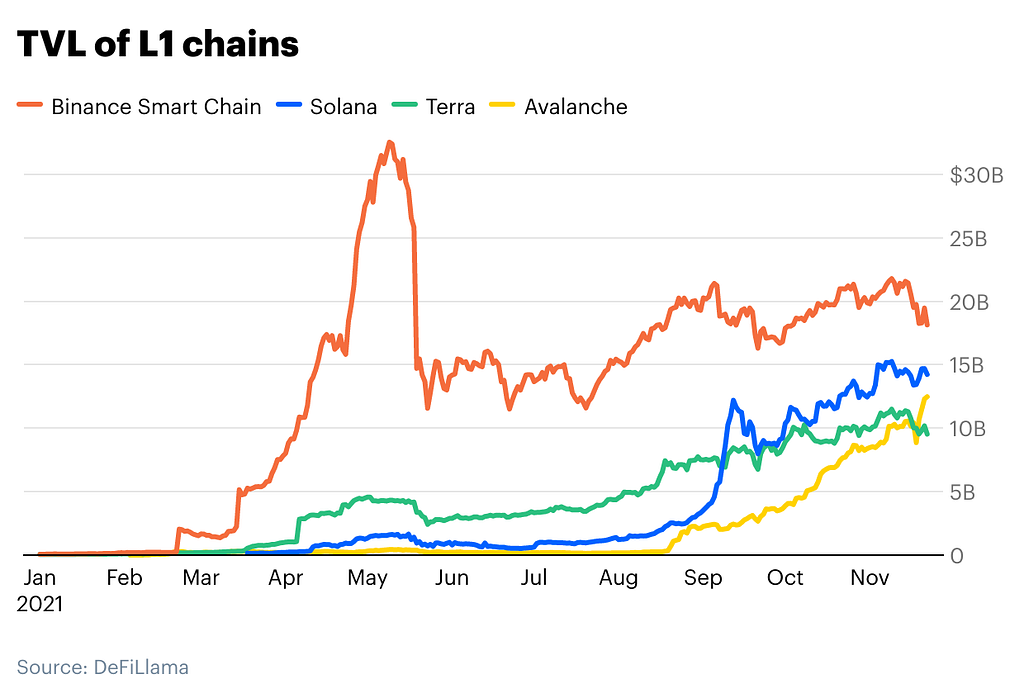
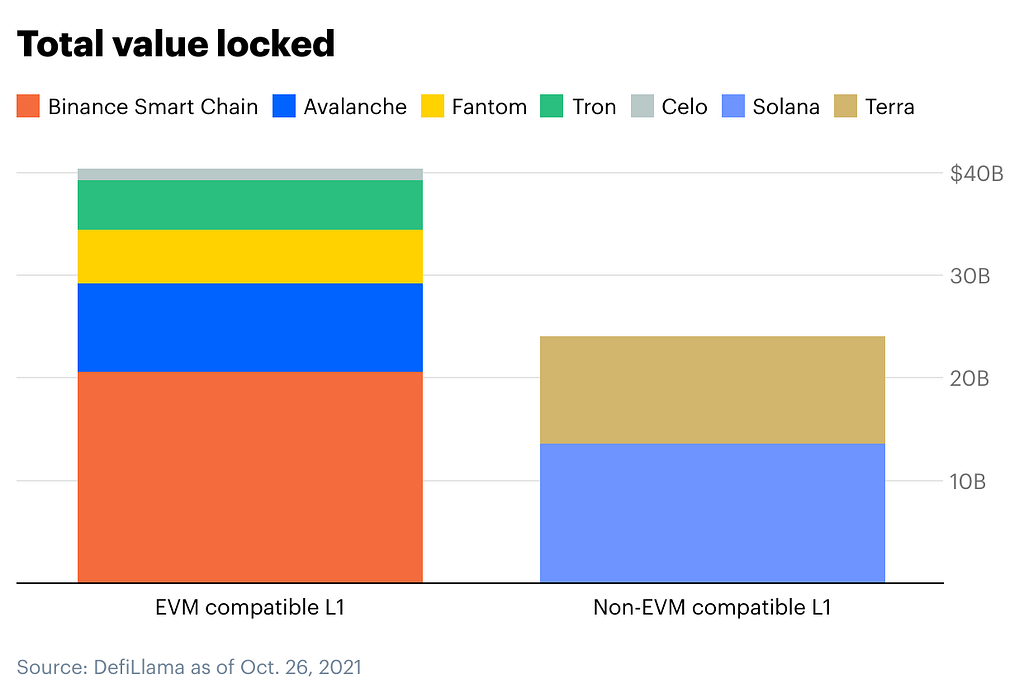
New layer 1s have come online in droves over the last 10 months, with the aggregate value on these networks rocketing from $0 to ~$75B over the same time period. This field is currently led by Solana, Avalanche, Terra, and Binance Smart Chain, each with growing ecosystems that have reached over $10 billion in value.
Leading non-ETH L1s by TVL
All layer 1s are in competition to attract both developers and users. Doing so without any of Ethereum’s tooling and infrastructure that make it easy to build and use applications, is difficult. To bridge this gap, many layer 1s employ a tactic called EVM compatibility.
EVM stands for the Ethereum Virtual Machine, and it’s essentially the brain that performs computation to make transactions happen. By making their networks compatible with the EVM, Ethereum developers can easily deploy their existing Ethereum applications to a new layer 1 by essentially copying and pasting their code. Users can also easily access EVM compatible layer 1s with their existing wallets, making it simple for them to migrate.
Take Binance Smart Chain (BSC) as an example. By launching an EVM compatible network and tweaking the consensus design to enable higher throughput and cheaper transactions, BSC saw usage explode last summer across dozens of DeFi applications all resembling popular Ethereum apps like Uniswap and Curve. Avalanche, Fantom, Tron, and Celo have also taken the same approach.
Conversely, Terra and Solana do not currently support EVM compatibility.
TVL of EVM compatible vs non-EVM compatible L1s
Interoperable Chains
In a slightly different layer 1 bucket are blockchain ecosystems like Cosmos and Polkadot. Rather than build new stand-alone blockchains, these projects built standards that let developers create application specific blockchains capable of talking to each other. This can allow, for example, tokens from a gaming blockchain to be used within applications built on a separate blockchain for social networking.
There is currently over $100B+ sitting on chains built using Cosmos’ standard that can eventually interoperate. Meanwhile, Polkadot recently reached a milestone that will similarly unite its ecosystem of blockchains.
In short, there’s now a diverse landscape of direct Ethereum competitors, with more on the way.
Sidechains
The distinction between sidechains and new layer 1s is admittedly a fuzzy one. Sidechains are very similar to EVM-compatible layer 1s, except that they’ve been purpose built to handle Ethereum’s excess capacity, rather than compete with Ethereum as a whole. These ecosystems are closely aligned with the Ethereum community and host Ethereum apps in a complementary fashion.
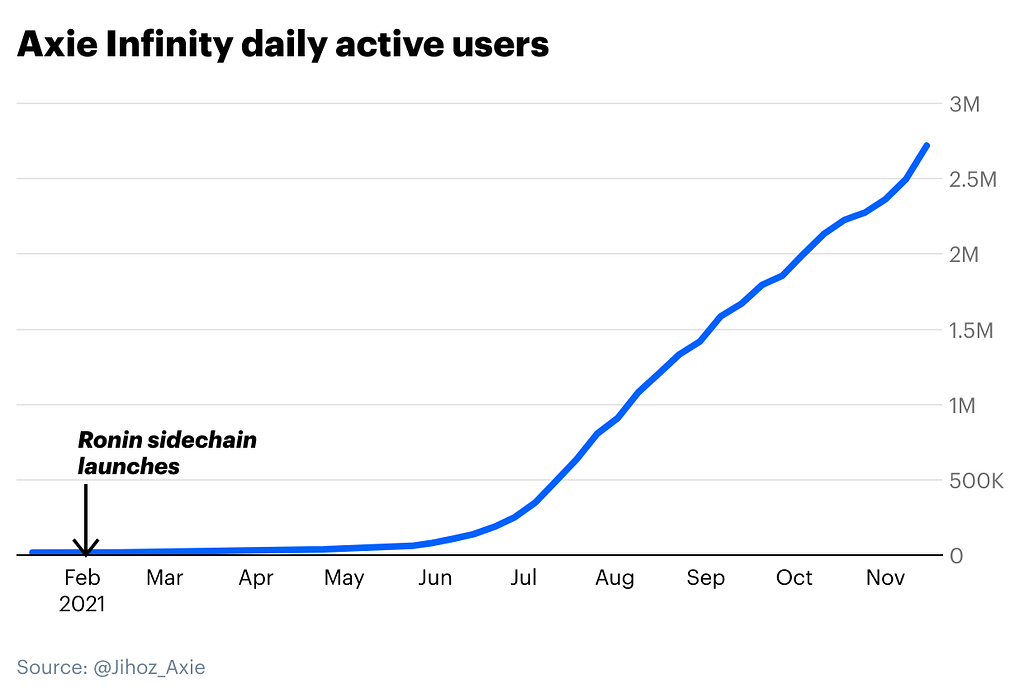
Axie Infinity’s Ronin sidechain is a prime example. Axie Infinity is an NFT game originally built on Ethereum. Since Ethereum fees made playing the game prohibitively expensive, the Ronin sidechain was built to allow users to move their NFTs and tokens from Ethereum to a low fee environment. This made the game affordable to more users, and preceded an explosion in the game’s popularity.
As of this writing, users have moved over $7.5B from Ethereum to Ronin to play Axie Infinity.
Polygon POS
Where sidechains like Ronin are application specific, others are suited for more general purpose applications. Right now, Polygon’s proof-of-stake (POS) sidechain is the industry leader with nearly $5B in value deployed over 100 DeFi and gaming applications including familiar names like Aave and Sushiswap, as well as a Uniswap clone called Quickswap.
Again, Polygon POS really doesn’t look that different from an EVM compatible layer-1. However, it’s been built as part of a framework to scale Ethereum rather than compete with it. The Polygon team sees a future where Ethereum remains the dominant blockchain for high value transactions and value storage, while everyday transactions move to Polygon’s lower-cost blockchains. (Polygon POS also maintains a special relationship with Ethereum through a process known as checkpointing).
With transaction fees of less than a penny, Polygon’s vision of the future looks plausible. And with the help of incentive programs, users have flocked to Polygon POS with daily transactions surpassing Ethereum (though spam transactions inflate this number).
Layer 2s (Rollups)
Layer 1s and sidechains both have a distinct challenge: securing their blockchains. To do so, they must pay a new cohort of miners or proof of stake validators to verify and secure transactions, usually in the form of inflation from a base token (e.g. Polygon’s $MATIC, Avalanche’s $AVAX).
However, this brings notable downsides:
Having a base token naturally makes your ecosystem more competitive rather than complementary to Ethereum
Validating and securing transactions is a complex and challenging task that your network is responsible for indefinitely
Wouldn’t it be nice if we could create scalable ecosystems that borrowed from Ethereum’s security? Enter layer 2 networks, and “rollups” in particular. In a nutshell, layer 2s are independent ecosystems that sit on top of Ethereum in such a way that relies on Ethereum for security.
Critically, this means that layer 2s do not need to have a native token — so not only are they more complementary to Ethereum, they are essentially part of Ethereum. The Ethereum roadmap even pays homage to this idea by signaling that Ethereum 2.0 will be “rollup centric.”
How rollups work
Layer 2s are commonly called rollups because they “rollup” or bundle transactions together and execute them in a new environment, before sending the updated transaction data back to Ethereum. Rather than have the Ethereum network process 1,000 Uniswap transactions individually (expensive!), the computation is offloaded on a layer 2 rollup before submitting the results back to Ethereum (cheap!).
However, when results are posted back to Ethereum, how does Ethereum know that the data is correct and valid? And how can Ethereum prevent anyone from posting incorrect information? These are critical questions that differentiate the two types of rollups: Optimistic rollups, and Zero Knowledge rollups (ZK rollups).
Optimistic Rollups
When submitting results back to Ethereum, optimistic rollups “optimistically” assume that they’re valid. In other words, they let the operators of the rollup post any data they want (including potentially incorrect / fraudulent data), and just assume it’s correct — an optimistic outlook no doubt! But there are ways to fight fraud. As a check and balance, there is a window of time after any withdrawal where anyone watching can call out fraud (remember blockchains are transparent, anyone can watch what’s happening). In the event that one of these watchers can mathematically prove that fraud occurred (by submitting a fraud proof), the rollup reverts any fraudulent transactions and penalizes the bad actor and rewards the watcher (a clever incentive system!).
The drawback is a brief delay when you move funds between the rollup and Ethereum, waiting to see if any watchers catch any fraud. In some cases this can be up to a week, but we expect these delays to come down over time.
The key point is that optimistic rollups are intrinsically tied to Ethereum and ready to help Ethereum scale today. Accordingly, we’ve seen strong nascent growth with many leading DeFi projects moving to the leading optimistic rollups — Arbitrum and Optimistic Ethereum.
Arbitrum & Optimistic Ethereum
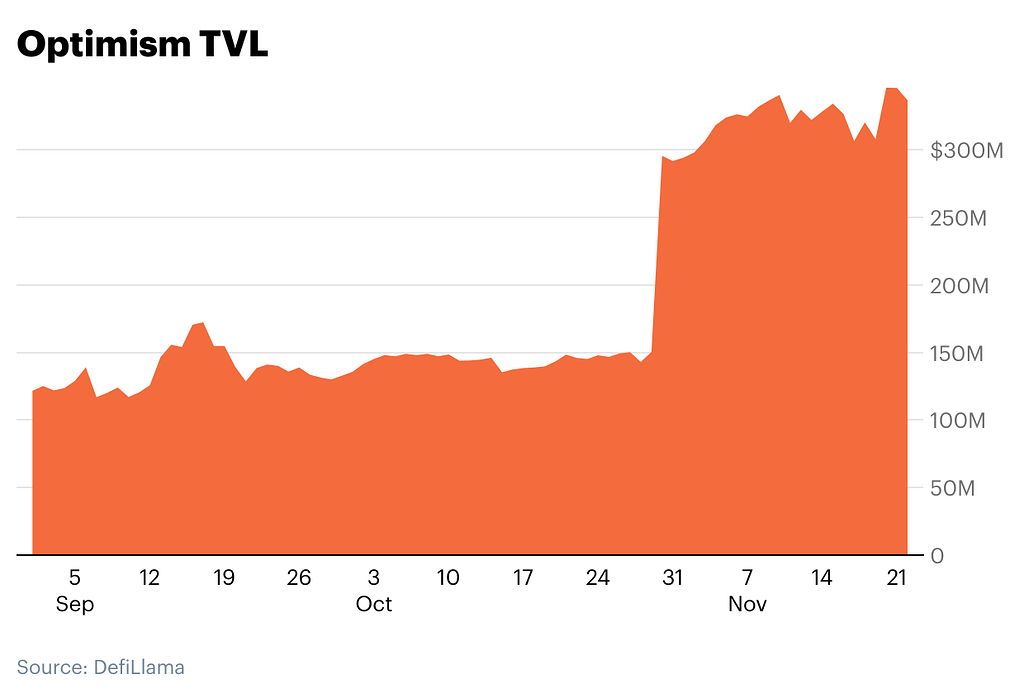
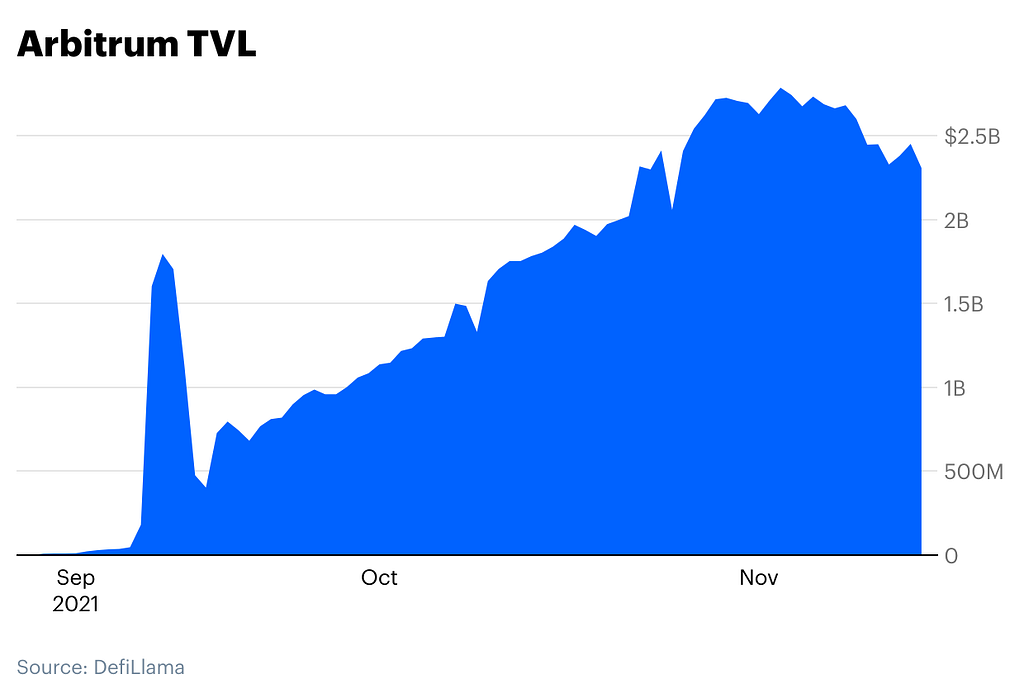
Arbitrum (by Off-chain Labs) and Optimistic Ethereum (by Optimism) are the two main projects implementing optimistic rollups today. Notably, both are still in their early stages, with both companies maintaining levels of centralized control but with plans to decentralize over time.
It’s estimated that once mature, optimistic roll ups can offer anywhere from a 10–100x improvement in scalability. Even in their early days, DeFi applications on Arbitrum and Optimism have already accrued billions in network value.
Optimism is earlier in its adoption curve with over $300M in TVL deployed across 7 DeFi applications, most notably Uniswap, Synthetix, and 1inch.
Arbitrum is further along, with around $2.5B in TVL across 60+ applications including familiar DeFi protocols like Curve, Sushiswap, and Balancer.
Aribtrum has also been selected as Reddit’s scaling solution of choice for their long awaited efforts to tokenize community points for the social media platform’s 500 million monthly active users.
ZK Rollups
Where optimistic rollups assume the transactions are valid and leave room for others to prove fraud, ZK rollups do the work of actually proving to the Ethereum network that transactions are valid.
Along with the results of the bundled transactions, they submit what’s called a validity proof to an Ethereum smart contract. As the name suggests, validity proofs let the Ethereum network verify that the transactions are valid, making it impossible for the relayer to cheat the system. This eliminates the need for a fraud proof window, so moving funds between Ethereum and ZK-rollups is effectively instant.
While instant settlement and no withdrawal times sound great, ZK rollups are not without tradeoffs. First, generating validity proofs is computationally intensive, so you need high powered machines to make them work. Second, the complexity surrounding validity proofs makes it more difficult to support EVM compatibility, limiting the types of smart contracts that can be deployed to ZK-rollups. As such, optimistic rollups have been first to market and are more capable of addressing Ethereum’s scaling woes today, but ZK-rollups may become a better technical solution in the long run.
ZK Rollup Adoption
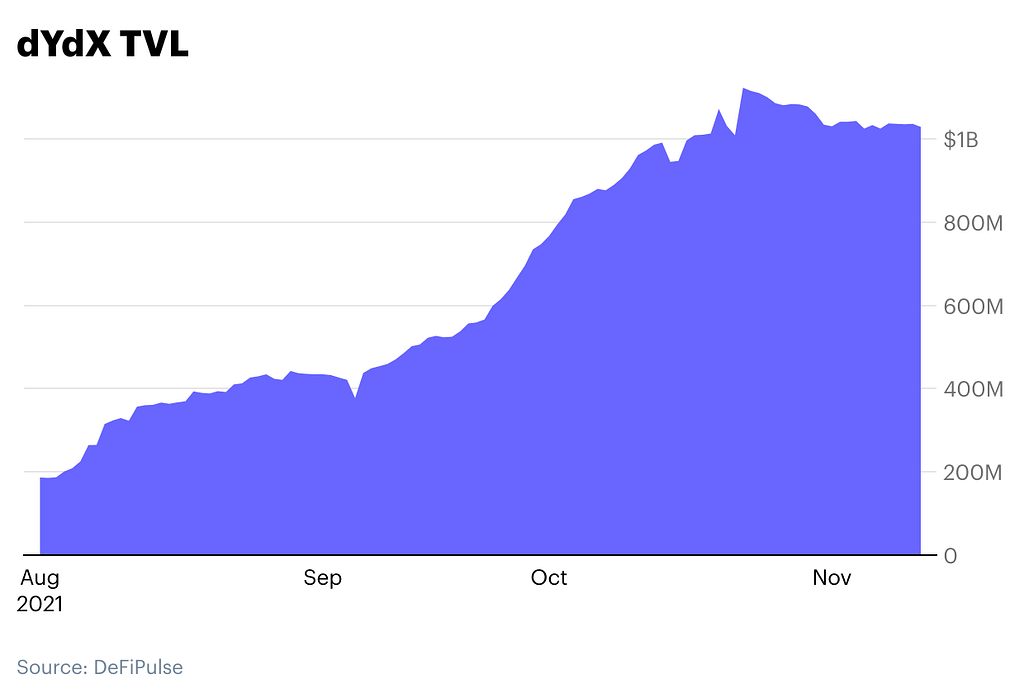
The ZK rollup landscape runs deep, with multiple teams and implementations in the works and in production. Some prominent players include Starkware, Matter Labs, Hermez, and Aztec. Today, ZK-rollups mainly support relatively simple applications such as payments or exchanges (owing to limitations on what types of applications ZK-rollups can support today). For example, derivatives exchange dYdX employs a ZK rollup solution from Starkware (StarkEx) to support nearly 5 million weekly transactions and $1B+ in TVL.
The real prize however, is ZK rollup solutions that are fully EVM compatible and thus capable of supporting popular general applications (like the full suite of DeFi apps) without the withdrawal delays of optimistic rollups. The main players in this realm are MatterLab’s zkSync 2.0, Starkware’s Starknet, Polygon Hermez’s zkEVM, and Polygon Miden, which are all currently working towards mainnet launch. (Aztec, meanwhile, is focused on applying zk proofs to privacy).
Many in the industry (Vitalik included) are looking at ZK rollups in conjunction with Ethereum 2.0 as the long term solution to scaling Ethereum, mainly stemming from their ability to fundamentally handle hundreds of thousands of transactions per second without compromising on security or decentralization.The upcoming rollouts of fully EVM compatible ZK rollups will be one of the key things to watch as the quest to scale Ethereum progresses.
A fragmenting world
In the long run, these scaling solutions are necessary if smart contract platforms are to scale to billions of users. In the near term, these solutions, however, may present significant challenges for users and crypto operators alike. Navigating from Ethereum to these networks requires using cross-chain bridges, which is complex for users and carries latent risk. For example, several cross-chain bridges have already been the target of $100+ million dollar exploits.
More importantly, the multi-chain world fragments composability and liquidity. Consider that Sushiswap is currently implemented on Ethereum, Binance Smart Chain, Avalanche, Polygon, and Arbitrum. Where Sushiswap’s liquidity was once concentrated on one network (Ethereum), it’s now spread across five different networks.
Ethereum applications have long benefited from composability — i.e. Sushiswap on Ethereum is plug-and-play with other Ethereum apps like Aave or Compound. As applications spread out to new networks, an application implemented on one layer 1/sidechain/layer 2 is no longer composable with apps implemented on another, limiting usability and creating challenges for users and developers.
An uncertain future
Will new layer 1s like Avalanche or Solana continue to grow to compete with Ethereum? Will blockchain ecosystems like Cosmos or Polkadot proliferate? Will sidechains continue to run in harmony with Ethereum, taking on its excess capacity? Or will rollups in conjunction with Ethereum 2.0 win out? No one can say for sure.
While the future is uncertain, everyone can take solace in the knowledge that there are so many smart teams dedicated to tackling the most challenging problems that open, permissionless networks face. Just as broadband ultimately helped the internet support a host of revolutionary applications like YouTube and Uber, we believe that we’ll eventually look at the winning scaling solutions in the same light.
* This post focuses on scaling smart-contract based blockchains. Bitcoin scaling is best saved for a future post.
Scaling Ethereum & crypto for a billion users was originally published in The Coinbase Blog on Medium, where people are continuing the conversation by highlighting and responding to this story.
There are now over 100 million wallet addresses in the world, and the number of crypto and non-fungible token (NFT) enthusiasts keeps growing every day. The crypto community has economic power, interlinking relationships and seamless communication potential, but why doesn’t it have its own social media? A truly native crypto- and NFT-dedicated social media platform with a high density of fans has not yet been born.
For crypto markets to grow in sizeand participants, there needs to be increased trust. For those who aren’t crypto native, the landscape can be bewildering. There are also dangers from scammers and spammers. It’s hard to fully protect users from these bad actors, but one way is to create a venue where they can get accurate information and not get played — a dedicated public opinion forum and social media platform for crypto communities.
Furthermore, the current model of social media is inherently extractive. The platforms take their customers’ data and sell it on, while serving them increasingly intrusive advertising. As the saying goes: Users aren’t paying for social media; they are the product. This must change, and one way is through a fusion of social and finance (SocialFi), which puts the economics back in the hands of users.
SocialFi aims to deliver benefits and rewards to users through the financialization and tokenization of social influence. Monaco Planet is a next-generation SocialFi platform that successfully completed its first round of multi-million-dollar financing with Three Arrows Capital and IMO Ventures. It goes live on Nov. 28.
Monaco Planet attacks the problem of spammers and scammers by requiring login through wallets such as MetaMask. Because users can showcase their NFT collections on their personal profile page, their level of engagement and dedication identifies true influencers. Users who publish and show their own activities can follow verified key opinion leaders (KOL) throughout the community. The platform can also rank users by net worth and influence of their NFTs, fostering organic connections between KOLs and users.
By introducing the concept of write-to-earn, content creation itself serves as a form of mining. Active content creators and discussion participants on Monaco Planet continuously reap the benefits in the form of native tokens. Most native tokens will be distributed to users who generate content, creating a form of mining that is sustainable, inclusive and genuinely productive.
A true SocialFi platform belongs to its users. And as the vast majority of Monaco Planet’s native currency will be distributed to users as rewards for content creation, Monaco Planet functions as a true decentralized autonomous organization, governed by native token holders who can send in proposals and vote. As a SocialFi platform, the ownership and governance of Monaco Planet are determined by the users themselves. Moreover, holders of native tokens will enjoy the currency appreciation brought by the platform’s growing economic activity.
As early users of Monaco Planet’s SocialFi platform, NFT holders will be the initial beneficiaries of content mining. They will enjoy the first batch of airdrops and act as mining leads during the first month of invitation-only membership. NFT holders will have exclusive quotas and whitelists for participating in popular projects and the privilege of increased visibility of posts, broadcasting and building groups.
Monaco Planet’s SocialFi makes it clear: Influence you can trust is now a currency that can be minted.
You can learn more about Monaco Planet at monaconft.io, follow the project on Twitter and join the conversation on Discord.
Stablecoins and their use in decentralized finance (DeFi) have played a key role in the 2021 cryptocurrency bull market because allow investors to participate in the ever-growing number of protocols that offer high yield staking pools and they ease the process of transacting without needing to use a centralized exchange.
One project that has seen a significant amount of adoption thanks to its focus on creating a truly decentralized ecosystem and asset-backed stablecoin is the Abracadabra.money DeFi protocol and its native SPELL token.
Data from Cointelegraph Markets Pro and TradingView shows that after hitting a low of $0.0114 on Oct. 15, the price of SPELL rallied 178.55% to establish a new record high at $0.035 on Nov. 1 as its 24-hour trading volume spiked to $109.82 million.
SPELL/USD 4-hour chart. Source: TradingView
Three reasons why SPELL is attracting the attention of DeFi users are the growth of Magic Internet Money (MIM) as a fully decentralized, cross-chain capable stablecoin, numerous cross-chain integrations that have expanded the MIM and SPELL’s reach throughout the ecosystem and the token’s governance and tokenomic structure.
Decentralized stablecoin growth
One of the biggest factors attracting the attention of active DeFi users is Abracadabra’s native Magic Internet Money stablecoin which is a fully collateralized and minted by depositing interest-bearing assets on the DeFi protocol.
The growing popularity and adoption of MIM can be seen by the increasing total value locked on Abracadabra, which reached a record $4.15 billion on Nov. 1 according to data from Defi Llama.
Total value locked on Abracadabra.money. Source: Defi Llama
There has also been steady growth MIM’s circulating supply, which stands at $1.933 billion according to data from CoinMarketCap. The most recent expansion is in large part due to the expansion of assets that can be pledged as collateral to mint MIM, which now includes popular tokens like Shiba Inu (SHIB), FTX Token (FTT), wrapped Olympus (OHM) and Fantom (FTM).
Cross-chain integrations extend SPELL’s reach
A second reason inv are taking a closer look at SPELL is its expanding ecosystem which has recently added cross-chain support for multiple blockchain networks including Fantom and the Binance Smart Chain (BSC).
BSC is the most recent addition to the Abracadabra ecosystem after the community voted to add support for the network in a vote that closed on Oct. 30.
♂️!
A new governance proposal is out to decide whether we should deploy https://t.co/gHWEQJMoOc on #BSC!
Other blockchain protocols currently supported by Abracadabra include Ethereum (ETH), Arbitrum and Avalanche (AVAX), and the platform also benefits from multiple cross-protocol partnerships including integrations with Convex Finance (CVX), Yearn Finance (YFI), Curve Finance (CRV) and SushiSwap (SUSHI).
Related: Magic Internet Money races past $1B, sets sights on MakerDao
Favorable tokenomics and a decreasing circulating supply
Another factor catching the eye of DeFi investors is the tokenomic structure of SPELL which includes governance votes on emissions to control inflation.
The team behind SPELL regularly monitors the emission schedule across the various DeFi pools in its ecosystem to ensure that new tokens are being minted and utilized in the most beneficial way for the protocol and holders.
Due to increasing adoption and the uptick in price price, a large number of tokens originally set to be minted are no longer needed so the team decided to decrease the emission schedule by 20% beginning on Nov. 1. This effectively removed 8.7 billion SPELL tokens from the current circulating supply.
Going forward, the outlook for the project remains bullish and the team also has plans to further integrate SPELL and MIM to the Fantom ecosystem and also offer new staking opportunities in Arbitrum and Avalanche.
The views and opinions expressed here are solely those of the author and do not necessarily reflect the views of Cointelegraph.com. Every investment and trading move involves risk, you should conduct your own research when making a decision.
Payments processor Strike has announced the launch of a new feature that will allow users to convert their paychecks to bitcoin. This feature brings workers one step closer to collecting their paychecks in bitcoin. Instead of the employer paying out wages and salaries in BTC, employees can take the paychecks they receive and convert them to cryptocurrency in one easy step.
Receiving Paychecks In Bitcoin
Strike is enabling users to convert all or some of their paychecks into BTC. Instead of cashing into fiat and then having to change back to BTC, users can directly convert to BTC using the paycheck that they receive. The feature is known as “Pay Me in Bitcoin” was announced on Thursday and is one of Strike’s efforts to make BTC readily available to its users.
Related Reading | Why We Could See The First Approved U.S. Bitcoin ETF In October
Strike is best known for helping El Salvador in their journey to bitcoin adoption, but they are also a bitcoin-focused payments processor that allows users to receive and pay in BTC. And with the new feature, get paid in BTC with no hassles.
Strike completely bypasses the need for employers to adopt and start paying their employees in cryptocurrencies. Instead giving employees the power to decide if they would rather convert their paychecks to fiat currency or cryptocurrencies. This also means that employees are not limited by the payments options their employers use. It doesn’t matter the company individuals work for, they can choose to have their paychecks deposited in bitcoin.
BTC price trading above $61,300 | Source: BTCUSD on TradingView.com
Following The Lead Of Coinbase
Strike’s announcement of the “Pay Me in Bitcoin” feature comes only a few weeks after Coinbase launched a similar feature. In the announcement post, Coinbase shared that customers were now able to deposit their paychecks directly to cryptocurrencies to ease their trading activities and just like Strike, streamline the process of users converting their money to cryptocurrencies.
The feature has been welcome in the crypto space as investors can now decide to deposit their full paycheck or a portion of it into their cryptocurrency tradings accounts. Customers could also choose to deposit their paychecks directly to U.S. dollars on Coinbase, which they can then use to carry out their trading activities on the platform.
Related Reading | Bitcoin Breaks $60,000 Ahead Of SEC ETF Approvals
Similar to Coinbase, Strike announced that the feature will initially be available to users in the United States. Roll-outs for other countries may be in the works but there has been no confirmation of these. Although users can only convert their paycheck to bitcoin on Strike, Coinbase offers users a wider variety as they can convert their paychecks to the over 100 cryptocurrencies currently listed on the exchange.
Featured image from Inc. Magazine, chart from TradingView.com
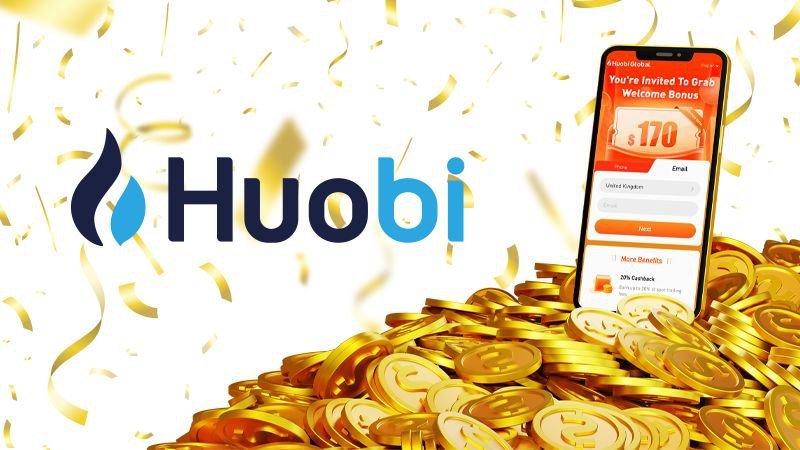
The new users of Huobi Global will receive a bonus. Huobi announces “Welcome Bonus — a $170 Sign-up bonus” for its new users.
According to a recent announcement from Huobi Global, the platform now offers a “$170 Sign-up bonus” for its new users. Users who are signing up on Huobi Global will be eligible to participate in the campaign and enjoy the “Welcome Bonus”.
Huobi Global is a leading global virtual asset exchange. It provides users access to more than 390 cryptocurrencies which includes mainstream cryptocurrencies such as BTC, ETH, and ADA.
Adding to its features and updates, Huobi Global has also announced that it is going to offer a unique trading experience for its new users. The platform’s primary focus is its ecosystem which ensures security, sustainability, and safety for its users. By making its customers the top priority, Huobi Global continues to achieve long-term success, which enables it to hold the leading position in the crypto market.
Huobi Global is ranked in 5th position, according to Coinmarketcap. Users can enjoy more than 900 pairs of cryptocurrencies on the platform. The constant updates and advancements in the platform has continues to drive more investors and users to Huobi Global. The position that Huobi Global still holds says it all that the trading platform operates in compliance with all laws and regulations.
170 USD Sign-up Bonus
In order to participate in Huobi Global’s Welcome Bonus, users should comply with the Terms & Conditions of the campaign:
Participants of the “Welcome Bonus” should be only new users.
Users must finish the new user tasks within 15 days and redeem their bonus within 30 days.
Users must redeem the bonuses individually after completing each task.
Each bonus can be redeemed only once.
Huobi Global claims the right to disqualify users who engage in fraudulent practices or to revoke accounts for any confirmed multi-account registration.
Users from mainland China, Venezuela, Singapore, Iran, North Korea, Cuba, Syria, and Sudan are not eligible for this campaign.
If you are a new user of Huobi Global, then you can participate and enjoy the “Welcome Bonus” campaign. Don’t miss the opportunity to receive its $170 Sign-up Bonus!
Customers of leading U.S. crypto exchange Coinbase have spent the weekend panicking after the exchange mistakenly sent emails to users stating their two-factor authentication (2FA) settings had been changed.
On Aug. 27, Coinbase accidentally sent the email to 125,000 of its customers, resulting in widespread public backlash.
Coinbase took to Twitter on Aug. 29 to apologize for the mishap, stating: “We’re laser-focused on building trust and security into the crypto community so that the open financial system we all want is a reality. We recognize that issues like this can hurt that trust.”
I got the reply and panicked someone accessed my account or made withdrawals. Immediately logged in and reset my password after verifying nothing happened.
Despite Coinbase’s apology, many of its users reported taking significant measures in response to the email while fearing that their accounts were being targeted by hackers, including overhauling security settings and liquidating their crypto holdings.
Comments on the exchange’s social media also suggest that numerous customers were unable to access the Coinbase app for several days after the incident.
Same here. the app still says “we’re having connection issues” while other Coinbase users I know, who didn’t get the SMS yesterday, can still log in.
“We will continue to work to gain back the trust of every one of our customers who was impacted by those notifications,” Coinbase added.
The firm also announced it is reimbursing users with $100 worth of Bitcoin (BTC).
The exchange posted its apology in the r/Coinbase subreddit on Aug. 30 to mixed reactions from customers.
Redditor “CoCraic_PNW” claimed they were yet to receive the promised $100 credit despite having received the 2FA message on both Coinbase and Coinbase pro, pledging to move their business to another exchange in light of the incident.
“Film2021” also stated that they were yet to receive the $100 BTC worth of credit and are currently looking to migrate their funds from Coinbase to a rival exchange.
However, not everyone is wielding their pitchforks at Coinbase, with Redditor “Leagance” praising the firm for promptly offering compensation for its error:
“Just got my $100. Thanks Coinbase. Regardless of the situation it was nice to know how quickly and easily I was able to lockdown my account if there was some sort of 2FA change.”
Related: Bitstamp and Ledger execs weigh customer service debate after Coinbase saga
The incident comes just days after it was reported that thousands of disgruntled customers claim their Coinbase accounts were hacked and emptied.
According to a CNBC story published Aug. 24, thousands of users assert that Coinbase’s support has failed to respond to requests for help relating to the alleged incident.
“Interviews with Coinbase customers around the country and a review of thousands of complaints reveal a pattern of account takeovers, where users see money suddenly vanish from their account, followed by poor customer service from Coinbase that made those users feel left hanging and angry,” CNBC wrote.
Earlier this month, Coinbase announced a new support phone line for customers who believe their account has been hacked.