Tag: USD

  • NFT GameFi Paladin Pandas Raises USD 4 Million in Funds and Launch $BAMB Token | by Bit Media Buzz | Apr, 2022

    NFT GameFi Paladin Pandas Raises USD 4 Million in Funds and Launch $BAMB Token | by Bit Media Buzz | Apr, 2022

    [ad_1]

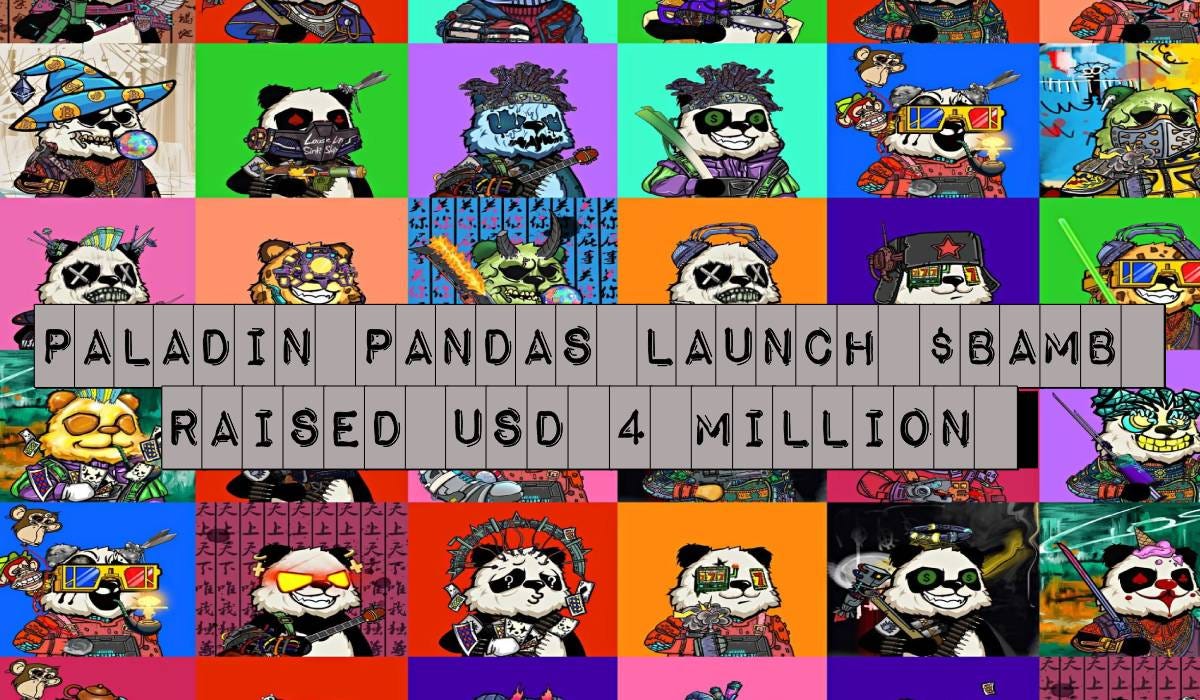
    OHDAT-affiliated NFT Game Project Paladin Pandas launched their ERC-20 Token $BAMB on the Ethereum chain on April 6th 2022. This established Paladin Pandas as one of the first NFT projects that has completed both the launch of their play-to-earn game and their token.

    A hand-drawn 10K NFT collection launched on Opensea on September 28th 2021, Paladin Pandas sold out in 32 minutes. It was ranked №6 on the daily volume leaderboard, №13 on the weekly volume leaderboard and featured on the OpenSea homepage.

    NFT whale owners including influencer and top collector, Zeneca_33, COLE, co-founder of Pudgy Penguins, and NFT influencers Josh Ong and NFT Girl, as well as crypto artist JN Silva, all added Paladin Pandas to their collection.

    This led to recognition from established VCs and other institutions and angel investors and OHDAT raised funding totalling US$4M from Future Capital, Hashkey Capital, Innoangel, Y2Z Capital, Vincent Niu, the founder of Sky9 Capital and Mandy Wang, the founder of Odaily. The funds raised were to go towards launching new projects and implementing the Open World social simulation game and MMORPG game, highlighted on their Roadmap 2.0.

    On January 25th, Paladin Pandas launched ‘PvE game Space Expedition’, where players send their Pandas to planets on an expedition (with 15 stages each) while strategically putting the Pandas into teams of 3 to retrieve the lost $BAMB (Bamboonium) through battles and mini-games. Since categories like element, class, weapon all matter in the gameplay, players need to select the right pandas to buy and be sent to battle, involving strategy gameplay.

    All $BAMB earned from the PvE game is locked in the players’ $BAMB balance, to be unlocked and claimable at a weekly rate of 15%. The lockup can be lifted if players manage to get on the PvP daily/weekly leaderboard.

    On March 9th, PvP: ‘Panda v. Panda’ open demo was officially released, a 1V1 3D combat game for true gamers. Players pay $BAMB to enter the arena and loot more $BAMB from other players. With 48 weapons, 7 basic moves and 21 stages, the gameplay is not limited to a ‘Stake-to-Earn’ mechanism; it is an actual ‘Play-to-Earn’ NFT game with delightful strategy gaming, which is a stab at revolutionizing NFT gaming. Up to now, which can be quite monotonous when the focus is only on the earnings. The PvP open demo initiated the “Clean the rugs’ campaign and airdropped 40K $BAMB tokens to the gamefi project holdlers.

    Giving perks to all NFT holders was taken into account when devising the Paladin Pandas ecosystem. Mandatory to use a Paladin Panda to enter the game, so as to extend the user base to more NFT gamers, non-holders can also rent Pandas by paying $BAMB. The rental limit for each Panda is 2x for PvE and 3x for PvP.

    Besides being an in-game currency, $BAMB has several utilities. First, $BAMB can be staked along with LP tokens to mine 5% of the overall supply, a total of 25M $BAMB. Second, $BAMB can be swapped to Power Raffle tickets, which is a WEB3 raffle machine to win blue chip NFT projects with minimum entry fees. Third, $BAMB holders are able to access exclusive online store merchandise, in-game marketplace boosts, and also the whitelist marketplace to consume their tokens.

    To celebrate the $BAMB launch, the OHDAT team will incentivize Panda owners with 2 airdrops. First, 60 Rent Tickets will be dropped to 30K new addresses for mining the game, for their first run. Second, 1.5% of the overall supply, totaling 7.5M $BAMB will be airdropped to all Panda holders. Prioritizing fun gaming features, Paladin Pandas aims for $BAMB to be a “blue chip token” in the NFT market over the long term.

    Paladin Pandas Links

    Opensea: https://opensea.io/collection/paladin-pandas

    Twitter: https://twitter.com/Paladin_Pandas

    Discord: http://discord.gg/paladin-pandas

    Website: https://paladinpandas.com

    Tokenomics: https://paladin-pandas.gitbook.io/usdbamb-tokenomics/


    [ad_2]

    Source link
  • Fact Check: USD Coin is the largest regulated stablecoin in the world

    Fact Check: USD Coin is the largest regulated stablecoin in the world

    [ad_1]

    We all need to work together to move crypto adoption forward, and it’s important that we all start with facts. So we have to correct the record after reading the article titled “A Regulated Stablecoin Means Having a Regulator” by Dan Burstein, Chief Compliance Officer of Paxos. In case you missed it, the article was an inaccurate attack on USDC (market cap: $27.5B) which is minted by CENTRE (a consortium of which Coinbase and Circle are members). USDC is one of several alternatives to the stablecoin issued by Paxos (market cap: $900M). Coinbase remains coin agnostic and supports many stablecoins on our platform, including Paxos and USDC. However we felt it important to share this post in our effort to fact check misinformation and mischaracterizations about crypto. Let’s get started.

    “Neither USDC nor Tether is a regulated digital asset, for the simple reason that neither token has a regulator.”

    Fact Check: USDC is indeed regulated. USDC is regulated as a stored value instrument (just like a pre-paid card). Stored value products are regulated under state money transmission laws. As the issuer of USDC, Circle is subject to oversight by 46 state regulators, which conduct frequent exams of Circle’s activities.

    “In fact, neither USDC nor Tether tokens are “stablecoins” in anything other than name. These tokens are backed by illiquid and risky debt obligations — a critical weakness that no prudential regulator would allow to exist as this creates undue risk for their customers.”

    Fact Check: The assets backing USDC are prescribed by the state regulators which provide companies like Circle a list of permissible investments in which the USD backing USDC can be invested. Here is an example from the state of California. These are the same laws that protect the fiat money customers hold at Coinbase or Paypal. These laws are essentially customer protection laws, designed with the clear purpose of ensuring that the stored value is safe. (You can see the make-up of the assets backing USDC here — they all have investment-grade credit ratings.)

    “Proper regulation of financial services firms — which must include comprehensive oversight of the products and services offered by those firms — is the only way to protect clients and customers. What does that mean tangibly? There is direct oversight of client protections, resolution planning if there is a failure, privacy protections, consistent reserving practices plus audits and exams to verify this.

    Fact Check: Regulation is key. Circle, the issuer of USDC is a money services business registered with FinCEN and 46 state regulators. Reserves are reported to the states pursuant to money transmission laws. Circle, and hence the reserve, is audited by Grant Thornton, a leading global accounting firm. You can find Circle’s 2020 audited financial statements here. Further, every month, Grant Thornton attests (i.e., verifies publicly) that the reserve balance equals the USDC in circulation. You can find those attestations here.

    “The issuer can (and often does) use consumer funds to pursue risky high-yield investments for its own financial gain.”

    Fact Check: Nope, not USDC. State Permissible Investment requirements address this risk. The USDC reserve contains no high-yield investments.

    “In the case of USDC, reserves are held on Circle’s balance sheet, implying that Circle views USDC reserves as its own property.”

    Fact Check: Many issuers of stored value instruments report the reserve assets on balance sheet, this is a common and acceptable accounting practice and should not be misunderstood to mean that Circle views USDC reserves as its own corporate property. The key to test this is to verify that an offsetting liability to the asset is also reported. In Circle’s publicly-filed financial statements you can clearly see that the reserve is “segregated for the benefit of USDC holders,” and that there is a corresponding liability of “Deposits from USDC holders,” making clear that the funds belong to the holders of USDC.

    Summary:
    Coinbase encourages its customers and all crypto market participants to research the cryptocurrencies they transact with. Stablecoins have different reserves and customers should pay attention to those reserves. USDC is regulated and has reserves that comply with state licenses and have a proven record of stability.


    Fact Check: USD Coin is the largest regulated stablecoin in the world was originally published in The Coinbase Blog on Medium, where people are continuing the conversation by highlighting and responding to this story.

    [ad_2]

    Source link

  • $8m USD in NFT Sales, $38k price for an NFT?! What are Wicked Cranium NFTs?

    $8m USD in NFT Sales, $38k price for an NFT?! What are Wicked Cranium NFTs?

    [ad_1]

    According to data from NFT market analyst NonFungible, NFT sales have nearly tripled in value since Q3 2021, rising from a 7-day average of $16.8 million worth of sales, to just over $44.3 million.

    The astronomical figure follows a surge in activity in the space that saw sales peak at $176 million per day earlier this year. World-renowned auction houses, Sotheby’s and Christie’s got in on the action, with the latter hosting the now-infamous Beeple Collection sale, raising a record $69 million.

    Several of the largest players in the NFT space, including Cryptopunks and Bored Ape Yacht Club, continue to see spectacular sales, with Cryptopunks alone selling just under $15 million worth of NFTs on average over the past 7 days. Despite the market saturation, a new kid on the NFT block, Wicked Craniums is storming into the market, curating a dedicated fanbase. But what are Wicked Craniums and why are they so popular?

    Wicked Craniums: The New Kid on the Block

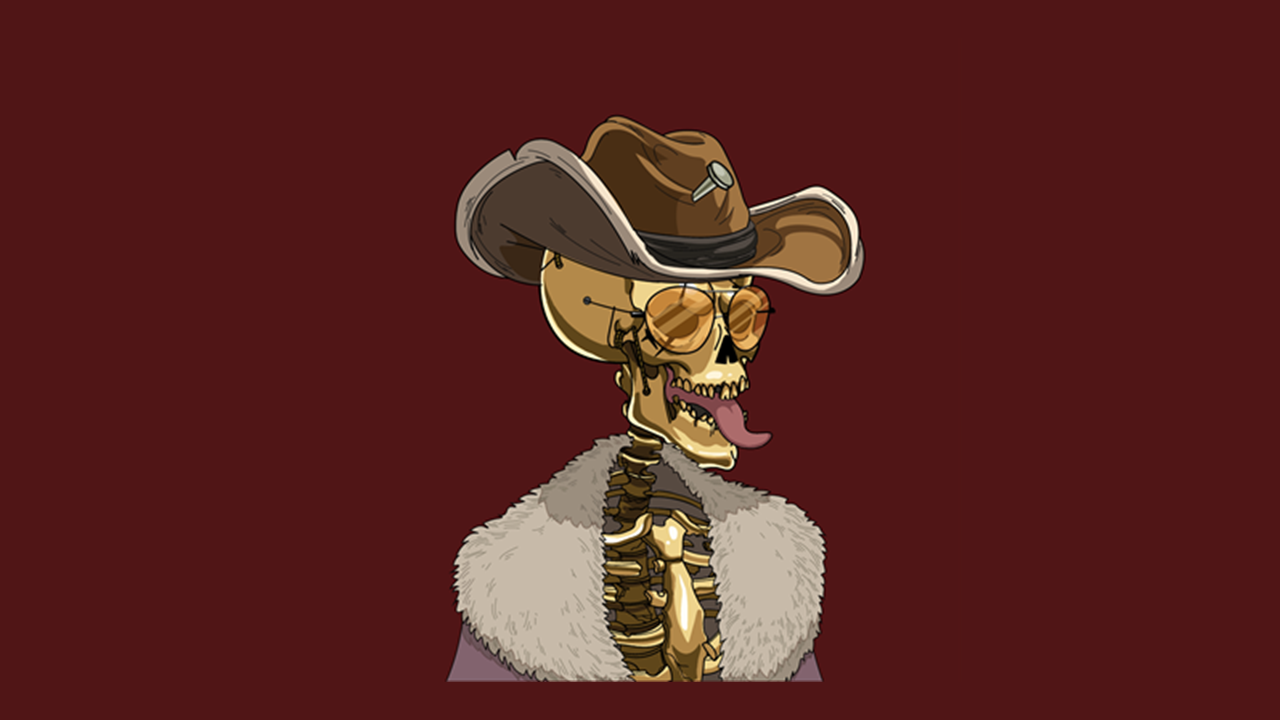
    Wicked Craniums are an NFT art collection hosted on OpenSea. Each piece is a skeleton-themed caricature that represents one of 10,762 “Craniums” belonging to a fictional island called Osseous. There are over 180 differentiable features that make each Cranium unique and highly collectible.

    A Cranium:

    Priced at 0.06 ETH (~$113.70 at current market rates), each Cranium affords its owners several features, including access to a members-only social platform called The Cradle, in which Craniums can share introductions, social media handles, and images. There are also a number of members-only projects that kick off as more Craniums are sold and each owner also has full commercial and use rights for each Cranium.

    NFTs Roar, Wicked Cranium Sales Soar

    The unique theme and combination of features has transformed Wicked Craniums into one of the best-performing NFT projects. Despite being capped at 645.72 ETH, within 48 hours of their release, all Craniums had sold out, and been re-sold, raising 4,311 ETH (~$8.2 million).

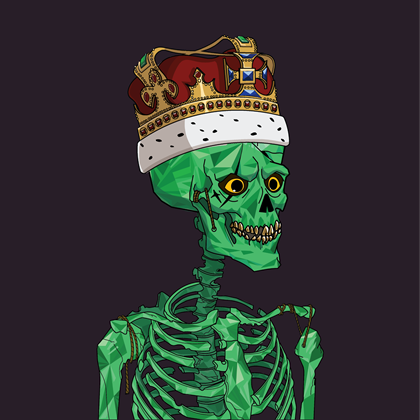
    The most expensive Cranium sold, inconspicuously named Wicked Cranium #1875, raised $38,000 (19 ETH) alone, and is now being re-sold on NFT marketplace, OpenSea, for almost $200,000 (100 ETH). The Cranium itself is unique in its character, depicting a yellow-eyed, green skeleton whose joints are weakly held together. Atop its head sits a crown reminiscent of that worn by The Queen at Britain’s State Opening of Parliament.

    Many more similarly extravagant Craniums are for sale on OpenSea, including an even more regal skeleton (Wicked Cranium #3622) and a skeleton depicting a member of the clergy crossed with a love-struck sailor. (Wicked Cranium #2664).

    Watch This Space

    These high resale prices suggest that Wicked Craniums has created something that is undoubtedly desired by a vast quantity of NFT collectors.  The attraction has even reached into the celebrity realm, with lead singer of heavy metal group Avenged Sevenfold, M Shadows, trading his signature “The Dark Knight” guitar for a Cranium named Synyster Gates.

    Synyster Gates:

    These milestones suggest a great future for the franchise and inevitably more record-breaking sales. For now, Wicked Cranium owners can be confident in their art collectibles as digital art based NFTs become more widely adopted by the overall online community.

    Join the Wicked Cranium community on Discord and in The Cradle, and follow updates on the latest Craniums on their Website, Twitter and Instagram.


    [ad_2]

    Source link