One of the most common requests we receive from customers is to be able to trade more assets on our platform. As we continue to add assets to our exchange and platforms we have decided that we will no longer post individual blog posts and will only use Twitter to announce new asset listings.
Please make sure to follow @CoinbaseAssets for new asset announcements for Coinbase.com, iOS and Android apps, as well as Advanced Trading, Coinbase Pro, Coinbase Prime, Coinbase Custody and any new geo-fencing restrictions that may be lifted.
Please also make sure to follow @CoinbaseExch for new asset announcements for Coinbase Exchange and to be alerted as order books will launch in phases, auction mode then limit-only or full trading mode. If at any point one of the new order books does not meet our assessment for a healthy and orderly market, we may keep the book in one state for a longer period of time or suspend trading as per our Trading Rules.
To see a list of supported assets on Coinbase check out our new Asset Directory.
###
Please note: Coinbase Ventures may be an investor in the crypto projects we offer, and additionally, Coinbase may hold such tokens on its balance sheet for operational purposes. A list of Coinbase Ventures investments is available at https://ventures.coinbase.com/. Coinbase intends to maintain its investment in these entities for the foreseeable future and maintains internal policies that address the timing of permissible disposition of any related digital assets, if applicable. All assets, regardless of whether Coinbase Ventures holds an investment or Coinbase holds for operational purposes, are subject to the same strict review guidelines and review process.
Crypto is a new type of asset. Besides potential day to day or hour to hour volatility, each crypto asset has unique features. Make sure you research and understand individual assets before you transact.
All images provided herein are by Coinbase.
######
Update to asset listing announcements was originally published in The Coinbase Blog on Medium, where people are continuing the conversation by highlighting and responding to this story.
By Joe Waltman, Group Product Manager, GiveCrypto.org
Hope everyone had a wonderful summer. GiveCrypto just concluded its first full quarter as a part of Coinbase, so we wanted to share an update with those who are following our progress. As always, we’d love to hear from you.
Coinbase Integrations
As mentioned in previous updates, we’ve been experimenting with ways to make it as easy as possible for Coinbase users to donate to charity. Coinbase has over 68 million verified users, many of whom transact significant sums of crypto on a regular basis. We see a golden opportunity to facilitate charitable donations inside this ecosystem.
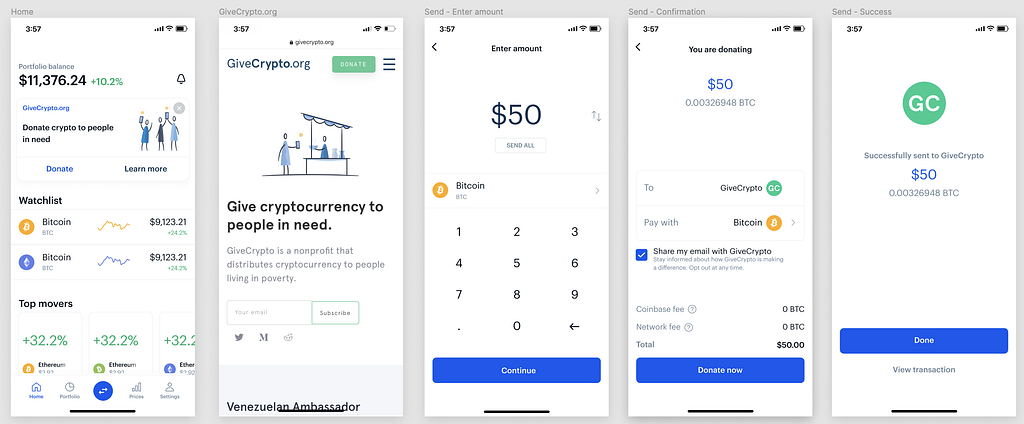
Example of the previous, multi-step flow required to donate in the Coinbase app
We have tried to integrate a donation function into Coinbase’s UI before, but we limited those past attempts to banners on Coinbase’s web and mobile properties. Those banners didn’t drive much traffic, and when they did, the user would have to go through a multi-step flow to donate. Because of that, donation volume has been relatively low.
Though these modest attempts weren’t the most effective, we chose to take this cautious approach for good reason: We wanted to be sure that we didn’t confuse users or impact Coinbase conversion rates. We also wanted to minimize the technical complexity of integrating a more prominent donation function until we and Coinbase were fully ready to do so.
We now understand that the real opportunity lies in integrating donation options into primary transactional flows like buy and sell. From integrating back-end services to solving a variety of other technical challenges, we know this won’t be simple. But finding a way for Coinbase users to seamlessly donate crypto would be a big accomplishment — not just for us, but also for the crypto community.
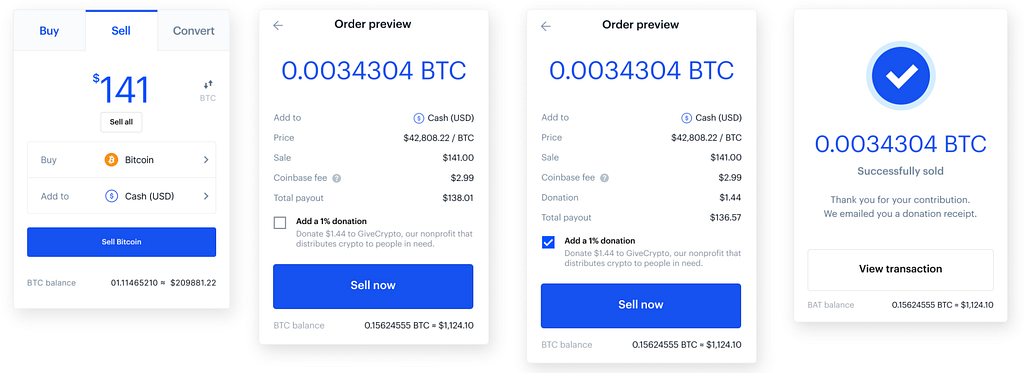
Mock-up of a donate one percent integration in the sell flow
The current plan is to experiment with a ‘donate one percent of your transaction’ mechanic within Coinbase’s “sell” flow. At first, only a small percentage of Coinbase users will be exposed to this experiment as we observe how they impact key guardrail metrics. We’ll then analyze those results to determine our path forward.
As an aside, I’d like to take this opportunity to express how exciting it is to be involved in the innovation we’re witnessing in this industry. We have long believed that Coinbase has the potential to become a leader in the world of philanthropy, and our experience working together has only reinforced that belief. Perhaps one day we’ll be able to promote the verb “give” to a first-class citizen, so to speak, equal to the likes of “buy” and “sell.”
Ambassador Program
Before we give an update on the current status of the ambassador program, it probably makes sense to review the program’s history.
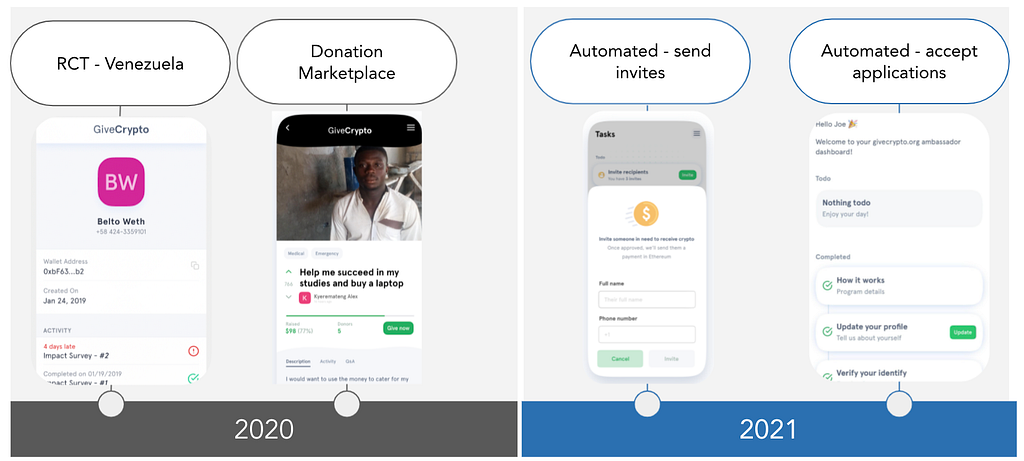
We launched the ambassador program in 2019 and spent the first half of 2020 implementing an RCT in Venezuela. We spent the second half of 2020 experimenting with a crypto donation marketplace that would be similar to GoFundMe or DonorsChoose but fully crypto-based. Ultimately, this didn’t accomplish what we hoped it would, so we decided to pivot back to the ambassador program in early 2021.
Our goal for 2021 was to automate as much of the program as possible so that it could be scaled in the near future. To minimize the manual workload, we started out by automating most of the program’s operational components, but we only invited people we felt we could trust. Giving away money on the internet tends to attract scammers, and we needed some assurances that people would use our funds in good faith.
We quickly learned that it would be hard to recruit ambassadors at scale if we only acquired them through high-trust channels such as labor marketplaces and social media networks. Once we realized that we would need to cast a wider net, we launched a version of the ambassador program that allows anybody to apply.
Before launching this updated version of the ambassador program, we developed fraud detection metrics designed to mitigate Sybil attacks. In simple terms, this helped us ensure that the ambassadors who applied to the program were who they said they were.
In the same update, we also tried to devise a trust score, which is a way of programmatically identifying which ambassadors are acting in good faith. We defined a good-faith ambassador as one who meets two criteria: they select recipients who are actually in need; and their recipients actually do what they say they’ll do with the funds.
Once we recruited a few hundred ambassadors, we found we needed to augment the automated scoring with significant manual investigation and intervention to thwart bad-faith behavior. We’ve thus realized that until our automations have undergone further maturation and validation, we’ll need to filter down the incoming audience.
For these reasons, we have decided to make the following changes:
Focus on the following countries: Venezuela, Colombia and El Salvador
Hire a manager in each country, whose primary job is to recruit trusted ambassadors. We will closely monitor these ambassadors and use the data to inform our automation process.
Monitor the activities of each ambassador’s recipients. We plan to give “good” ambassadors more invites and to extend the length of payment periods for “good”’ recipients.
Begin measuring the impact of donations via self-reported questionnaires and spot checks, which will be overseen by the local manager as well as high-quality ambassadors.
This revised approach will provide the following benefits.
Provide locations with different characteristics (i.e. inflation, crypto adoption, smartphone penetration and regulatory acceptance) but still have high levels of need and minimal logistical challenges (i.e. timezone and localization)
Reduce our team’s need to manually supervise the program
Improve the ratio of high-quality ambassadors signing up
Allow us to facilitate redemption options for recipients, such as stores and cash-out partners
Train and validate our data models on what good behavior looks like across various geographies
We have already started rolling out components of this plan and look forward to more enhancements in Q4. Between this program’s growth and the new donation options, we’re thrilled to see our work paying off.
GiveCrypto Q3 Update was originally published in The Coinbase Blog on Medium, where people are continuing the conversation by highlighting and responding to this story.
The Apple App Store reportedly blocked a Gnosis Safe crypto wallet app update due to it hosting NFTs that weren’t purchased inside the app.
Lukas Schor —a product developer at Ethereum-based crypto wallet provider Gnosis Safe — revealed the firm ran into trouble when it submitted an updated version of its app to the IOS app store earlier this month.
Schor noted on Sept. 14 that despite the update having nothing to do with non-fungibles, the App Store flagged a sample image that displayed an NFT in the app’s description section, even though it had been up for “many months.”
Apple is blocking a release of our @gnosissafe mobile app because we display NFTs in it. After 2 weeks of back-and-forth, I felt that we need to talk publicly about this to raise awareness.
See the thread for details and why this might affect other wallets and apps as well.
While the app is still listed in the store along with the image displaying the NFT, it appears that Apple is blocking the update due to its guidelines around digital content.
According to screenshots he shared of Gnosis’ correspondence with Apple support over email, the tech giant stated that while “NFTs are not mentioned specifically” in its guidelines, apps are not allowed to provide access to “previously purchased digital content” bought outside of the app store.
This essentially means that apps cannot provide any NFT-related services unless they are integrated with Apple payment methods.
“If you choose not to implement in-app purchase, it would be appropriate to revise your app so that does not access previously purchased digital content,” the email concluded.
⛔️ This shows how access to Web3 still relies heavily on gatekeepers like Apple ❗️ It’s an industry problem, as the same arguments apply to any wallet displaying NFTs or games making use of NFTs We need to find better ways to make Web3 accessible on mobile permissionlessly
Schor stated that Gnosis will submit an appeal over the decision as he called on Apple to clarify its guidelines around NFTs. He also suggested that the firm has no plans to walk back its NFT support in its app:
“Permissionless access to Web3 is core to our values, so we are willing to go the extra mile to clear this up. Simply removing NFTs from our app is definitely not an option for us.”
Apple currently prohibits the inclusion of payment rails beyond those offered by the firm in apps listed in its store. While Gnosis doesn’t sell NFTs in its app, Apple charges a flat 30% commission of in-app purchases of digital goods and services.
This policy may not last for much longer however, as Judge Yvonne Gonzalez Rogers issued a permanent injunction in the Epic Games vs Apple case on Sept.10 that will potentially see a major change to the app store.
Epic Games, the creators of widely popular online game Fortnite built its own in-game payment system last year to circumvent Apple’s in-app payment system, which resulted in the game being delisted from the App-store.
In August 2020, Epic took legal action against Apple and specifically took aim against the firm’s in-app payments policies.
In Judge Rogers’ first ruling on the case on Friday, she issued an order for Apple to allow alternate payment options in apps listed on its store, with the injunction set to go into effect on Dec. 9, 2021 — unless it is enjoined by a higher court.