Italian professional soccer club AC Milan will be releasing its first-ever nonfungible token (NFT) project in collaboration with the BitMEX crypto exchange. Proceeds will go to Fondazione Milan, the clubs’ charity arm.
The limited-edition collection will feature 75,817 NFTs, a number representative of the capacity of the club’s home ground, San Siro stadium. It will depict a 3D image of a jersey found in South Sudan by Danish war photographer Jan Grarup who was in the country documenting widespread flooding last December.
BitMEX partnered with AC Milan to contribute to the project by providing trading discounts and “other benefits” to the first 10,000 pre-orders. BitMEX will also donate to Fondazione Milan by purchasing a “large number” of the NFTs.
As per the announcement, the club says the proceeds will contribute to funding its charitable causes around the world, specifically mentioning the ongoing crisis in Ukraine and a UNICEF project in South Sudan.
Magic Eden to accept tokens from DeGods and Aurory projects
Magic Eden, the largest marketplace by volume for Solana NFTs, according to DappRadar, has confirmed it will accept the tokens from popular Solana NFT projects “DeGods DUST” and Aurory’s “AURY” within the coming weeks.
The marketplace first teased integration of the DUST token in late March, tweeting “brb integrating $DUST” on March 31. On April 1, a drawing of a Magic Eden-themed bar with the caption “$AURY” was tweeted.
— Magic Eden Solana’s Leading NFT Marketplace (@MagicEden) April 1, 2022
“DeGods” is the most traded collection in 30 days on Magic Eden, according to its own statistics, and has an all-time trading volume on the platform of 307,121 Solana (SOL), or $33.8 million at the time of writing. “Aurory” is in third place overall in sales volume for a Solana NFT project according to DappRadar, with an all-time volume of $79.5 million.
Related: Content creators introducing a new paradigm with NFTs
The integration of the tokens may be the latest attempt by the platform to solidify itself as Solana’s native NFT marketplace after OpenSea announced it will integrate Solana, putting the two platforms in direct competition.
According to reports, Tiffany Huang, head of content and marketing at Magic Eden, stated that the platform was looking to integrate tokens from other “blue chip” NFT collections.
Solana NFT sales are gaining momentum
Solana NFTs are seeing a significant gain in volume. In the last 24 hours, the NFT sales volume on the Solana blockchain has hit over $9.2 million — an increase of 51.5% — according to analytics firm CryptoSlam.
It comes after a drop was seen in the trading volume of Solana NFTs following the March 30 announcement that OpenSea would integrate the blockchain when OpenSea announced the Solana integration. On April 6, the day before the integration was live, trading volume decreased by 34.4%.
Ethereum is still the top network when it comes to NFTs, with $49.4 million in sales made in the last 24 hours.
Other Nifty News
Starbucks has announced its foray into NFTs, with CEO Howard Schultz stating that ”sometime before the end of the calendar year, we are going to be in the NFT business.”
Autograph, the NFT platform co-founded by Tom Brady, has signed a multi-year partnership with ESPN to create a docuseries and NFT collection titled “Man in the Arena: Tom Brady,” which details the career of the NFL legend.
By Sonia Pinto, Senior Product Marketing Manager and Alexis Hamel, Product Manager, Custody
Coinbase Prime offers custody and trading for more than 50 DeFi coins and tokens, across a wide range of segments, including DEXs, lend, and borrow.We facilitate governance for a growing number of tokens including UNI, COMP, and MKR. This gives our customers the opportunity to directly participate in the governance of DeFi projects.
Asset managers, like Grayscale and Bitwise, are increasingly stepping into DeFi beyond Bitcoin and Ethereum. FinTechs are also expanding their DeFi offerings to cater to growing demand. Venture capital funding for blockchain startups reached $25 billion last year, up 713% from $3.1 billion in 2020. Coinbase Ventures, A16Z and Paradigm are some of the VCs doubling down on DeFi.
As one of the most trusted names in the industry, Coinbase offers access to a broad range of assets, customized account support, and a rapidly growing number of capabilities for our clients to participate in DeFi.
DeFi Opportunities
While Bitcoin or Ethereum are the currency of the blockchains, Defi tokens are built on top of the blockchain and represent a wide range of new opportunities for institutions. As of January 2022, nearly $200 Billion was deposited through smart contracts across major blockchains. This measure is referred to as the Total Value Locked (TVL). Ethereum-based projects alone account for 60% of DeFi TVL.
Defi offers a global, open alternative to financial services consumers utilize today — including savings, loans, trading, and insurance — creating a financial system that is automated, accessible 24/7, permissionless and more transparent. DeFi protocols with the highest adoption rates include Compound and Aave for lending, Curve for stablecoins swap, Uniswap for token swaps, or DYDX for derivatives.
Where do I start?
Gain access to our prime broker by navigating to coinbase.com/prime. Click “Get started” and fill in the required information to apply for a Coinbase Prime account. For our existing clients who have a Coinbase Custody, or Coinbase Exchange account, please contact your account manager or PrimeOps@coinbase.com.
The crypto market seems to have lost its luster for a while now, with the overall market valuation falling below $2-trillion. Despite Bitcoin’s 13th birthday celebrations, the crypto carnage has persisted. The blue-chip cryptos are now battling for action with a dramatic drop in volumes. However, the current drop has not affected some tokens and has not deterred investors, who are now looking for tokens to fill their bags. Here are a few expert-picked crypto tokens that are showing great potential.
Axie Infinity ($AXS)
Axie Infinity is a play-to-earn game that allows users to buy, breed, and sell Axies (pets) against one another in order to win in-game crypto called the smooth love potions, which you can convert into real money.
Players can cash out their tokens regularly. Smooth Love Potion ($SLP) and Axie Infinity Shard ($AXS) are the two types of tokens in the game, and both are tradable on crypto exchanges. $SLP is used for in-game transactions and rewards whereas $AXS is the governance token that powers the entire ecosystem. Axie Infinity, which runs on its own sidechain Ronin, has gained enormous popularity in 2021.
Decentraland ($MANA)
$MANA is the native token of Decentraland, a growing blockchain-powered virtual world based on the Ethereum blockchain. This project began in 2017 as a foundation for developing multiplayer games, but it quickly gained traction due to the metaverse buzz in 2021. The Decentraland Builder contains hundreds of 3D objects that players can use to build or manufacture nearly anything in this virtual environment as game tokens.
Players can use free and open marketplaces to buy and sell virtual parcels built inside Decentraland. It comes as no surprise that $MANA is one of the most popular cryptocurrencies of 2021. Players can also use $MANA to buy in-game items like avatar costumes, as well as vote on future Decentraland developments where a single $MANA token represents a single vote.
Gala ($GALA)
Gala is a P2E game based on the Ethereum network with its own native token called $GALA. It was founded in 2019 by Eric Schiermeyer, one of the co-founders of the leading mobile game company Zynga, that created popular games like Mafia Wars and Farmville. The game already has 1.3 million registered users and its goal with blockchain is to give users more power over their gaming experiences.
The game aims to change the reality in which players spend thousands of dollars on in-game items and spend countless hours playing the game, only to have it all taken away with the click of a button. Gala leverages NFTs that allow users to vote on new games and influence how they operate. $GALA token is the heart of the system that can be used to purchase NFTs as well as in-game items. Gala One has already released their flagship game Town Star, and there are many more games in the works that are expected to launch in 2022.
The Sandbox ($SAND)
The Sandbox is an Ethereum-based project that allows users to construct and explore galaxies in a virtual cosmos. Initially, it launched as a normal mobile and PC game but Animoca Brands then turned into a blockchain gaming ecosystem powered by crypto and NFTs.
Players in the system create and design their own characters in order to access the Sandbox metaverse’s many landscapes, games, and centers. The produced digital objects may then be monetized with NFTs and sold for $SAND tokens on the Sandbox Marketplace. Unlike other popular play-to-earn games, the Sandbox does not have a preset gameplay universe. Instead, it takes a dynamic approach, allowing users to personalize anything using free and easy design tools.
FireZard ($ZARD)
FireZard is a new P2E game based on the Binance Smart Chain (BSC) network. It is the first Trading Card Game that passively and instantly rewards investors in an attractive and collectible way through NFTs. The game revolves around the major five dragons that are employed to compete with other players. Each FireZard NFT Card represents a dragon and has its own set of features.
Moreover, the Cards are not only collectible, but they have an instant win prize attached to them that is worth anything from 0.1 BNB to 5 BNB. Players of this game are massively rewarded with the game’s native tokens, $ZARD, and $FLAME. $FLAME tokens will only be used for in-game activities, whereas $ZARD tokens will play a much larger role in propelling the platform. With the game still in its early stages, $ZARD is expected to explode in the coming months.
2022 Will be the Year of Gaming Crypto
Blockchain gaming is a rapidly expanding area within the crypto and blockchain sectors, and it is likely to expand more in the coming months. These are some of the projects that have a lot of potential and should be looked into further for 2022 and beyond.
Interoperability is shaping up to be one of the main themes for the cryptocurrency market in 2022 as projects across the ecosystem unveil integrations that make their networks Ethereum (ETH) Virtual Machine (EVM) compatible.
While this has been one of the long-term goals of the ecosystem as a step on the path to an interconnected network of protocols, it has also created a new decentralized finance (DeFi) market for multi-chain bridges and decentralized finance.
Here are three of the top volume cross-chain bridges that the cryptocurrency community uses to transfer assets between blockchain networks.
Multichain
Multichain (MULTI), formerly known as Anyswap, is a cross-chain router protocol that aims to become the go-to router for the emerging Web3 ecosystem.
According to data from Defi Llama, Multichain is the top-ranked cross-chain swap protocol by total value locked, with $8.95 billion currently locked on the platform.
Multichain total value locked. Source: Defi Llama
One of the main reasons for the high TVL on Multichain is the large number of blockchain networks supported by the protocol. Currently, 30 different chainscan be accessed on the network.
Blockchain protocols supported by Multichain. Source: Multichain
According to data provided by Multichain, the protocol has processed a total of $53.15 billion worth of volume since launching, with $19.08 billion of that being transacted in the past 30 days alone. There are currently 485,399 users that have interacted with the Multichain protocol, amounting to nearly 2.256 million transactions.
Multichain network statistics. Source: Multichain
Users who deposit tokens into one of the pools supported by Multichain receive a sare of the transaction fees generated by the pool in question.
The protocol’s native MULTI token is used to vote and participate in the governance of the Multichain ecosystem and has a circulating supply of 18.64 million tokens out of a total 100 million.
Synapse
Synapse (SYN) refers to itself as a “cross-chain layer ∞ protocol” that is designed to offer users interoperability between separate blockchain networks.
According to data from Defi Llama, Synapse recently hit an all-time high in total value locked of $1.16 billion prior to experiencing a wave of outflows that lowered the TVL to 740.43 million.
Total value locked on Synapse. Source: Defi Llama
The Synapse protocol currently supports 12 different chains which have a combined total bridged volume of $5.33 billion according to data from the platform’s dashboard.
Total bridged volume on each network supported by Synapse. Source: Synapse
A large percentage of the total volume recorded on Synapse has come since the start of 2022 with the protocol seeing an all-time high bridge volume of $157.8 million on Jan. 23.
Synapse bridge volume. Source: Synapse Analytics
The protocol’s native SYN token has several uses within the ecosystem. Token holders can use it to conduct community governance votes via the SynapseDAO, liquidity providers (LPs) receive a percentage yield paid out in SYN for their deposits and it is also used as a subsidy to pay for the gas expended by network validators to secure transactions across the network.
LPs also receive a share of the protocol fees earned by the Synapse platform on each transaction.
Related: Web3 innovations are replacing middlemen with middleware protocols
Celer cBridge
Another popular cross-chain bridge is the Celer cBridge, a multi-chain network that enables instant, low-cost value transfers between 19 different networks.
The cBridge is a subsector of the larger Celer (CELR) ecosystem and utilizes the CELR token for operations on the protocol and as the reward token for liquidity providers.
Along with the CELR rewards paid to LPs, a percentage of the transaction fees generated by people who use the liquidity pools to bridge funds across chains are paid out to LPs and added directly to the pools, allowing the rewards to compound.
According to data from cBridge analytics, the total value of funds locked in the bridge contract (pool-based bridge) and the funds locked in the token vault contract (canonical token bridge) currently stands at $240.92 million.
cBridge usage statistics. Source: cBridge
A total of 89,897 unique addresses have interacted with the protocol since inception and have conducted a total of $2.842 billion in transaction volume.
Similar to the transfer trend seen with Synapse, the transaction volume on cBridge has gotten noticeably higher in 2022 with a record $71.12 million being transacted on Jan. 22.
Daily transaction volume on cBridge. Source: cBridge analytics
Some of the protocols currently supported by cBridge include Ethereum, Binance Smart Chain, Avalanche, Polygon, Fantom, Metis, Harmony, Gnosis, Arbitrum and Optimism.
Want more information about trading and investing in crypto markets?
The views and opinions expressed here are solely those of the author and do not necessarily reflect the views of Cointelegraph.com. Every investment and trading move involves risk, you should conduct your own research when making a decision.
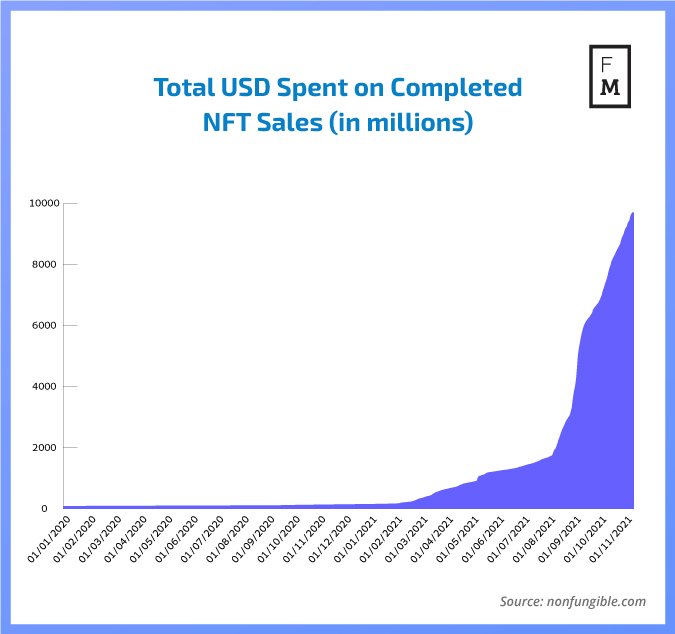
Although the first non-fungible token (NFT) was launched as early as 2015, the market fever around this exciting asset class did not kick off until 2020 when it broke all-time records. The value of NFTs sold in the third quarter of this year reached a record level of $10.7 billion, and the craze around them is no longer reserved exclusively for a narrow group of crypto and blockchain enthusiasts.
The NFT industry has embraced digital artists, celebrities, actors and large companies to look at and engage in this fast-growing industry as a way to maximize profits and build brand awareness. But, are NFTs suitable for everyone? Do they bring added value to retail investment platforms, foreign exchange (Forex) and contracts for difference (CFD) brokers?
Finance Magnates has x-rayed what stands behind the success of CryptoPunks, Bored Apes and other digital collectibles, and it has discussed the subject with industry experts asking if they see an opportunity for Forex and contracts for difference brokers to use NFTs as promotional or trading assets.
Non-Fungible Token (NFT) = An Opportunity for Your Brand?
Famous brands and large companies have quickly discovered that NFTs can be a great way to build popularity among new economy participants and take advantage of the booming trend. As experts point out, it can be a great product for advertising new products and building brand awareness.
“With NFTs, brands can create a buzz about a new product, create scarce and exclusive collectible assets to tell the brand story, or even support causes through token sales. Consumers today like to see brands driving sustainability efforts, which can be seen in the rise of ESG investments. So, brands might look to attract this demographic with NFTs,” Charlotte Day, Director of the Contentworks Agency, said.
As the pandemic months have shown, retail investors aimed trading stands not so far from gamification, and experts have repeatedly commented on the gamification of the industry (commission-free trading platforms gaining huge popularity, such as Robinhood).
Suggested articles
$100,000 Battle: PrimeXBT Debuts New Contests ModuleGo to article >>
According to Philip Gunwhy, the Chief Marketing Officer for the NFT ecosystem, Blockasset, “traditional finance (or TradFi) moves slower than crypto, but it is inevitable that more and more brokers will enter the space in the future.” “It was only in 2020 that many institutions started to look at Bitcoin for the first time. That is still more or less the case today, save for those who are looking into Ethereum. Although NFTs have been around for around five years now, they have only really caught on in 2021. As the space matures, we can see many traditional brokers looking to break in: there is already evidence of that now, with crypto-native firms like Three Arrows Capital dropping millions of dollars on blue chips like Fidenza and Ringers,” Gunwhy commented.
CFDs for NFT-oriented Stocks?
One of the most attractive ways for CFD brokers to tap into this rapidly building market is by offering clients access to NFT-oriented stocks. This is the simplest and easiest method to implement initially. The list of companies related to the non-fungible tokens is long and among the most popular ones you can find: Cloudflare (NET), Mattel (MAT), Dolphin Entertainment (DLPN), Takung Art (TKAT), PLBY Group (PLBY), Funko (FNKO) and, of course, Twitter (TWTR).
Cloudflare’s stock price increased 350% last year, and in 2021 it has gained another 156%. In the case of Mattel, the appreciation is not as high but is also attractive for investors, amounting to over 50% since the beginning of 2020. Moreover, investors are very interested in Funko shares, which have grown by 65% YTD. Such rates of return will undoubtedly be of interest to current and new potential clients.
To get the full article and the bigger picture on NFT phenomena, get our latest Quarterly Intelligence Report.
Some believe that 2021 will be the year of ‘dogs’ for cryptocurrency. Dogecoin (DOGE) and Shiba Inu (SHIB), the canine combo, lead the meme currency pack in terms of price and market value. DOGE has increased almost 8,000 percent since the beginning of the year and is ranked #9 by market value on CoinMarketCap as of November 2021. SHIB, its opponent, has pumped more than 60,000,000% since January.
Things move quickly in the meme coin world, as they do in most internet jokes because nobody cares about anything they read on social media for more than a few minutes. This means that coins must be generated quickly in order to be classified as a meme currency rather than simply another random coin. In this article, we will discuss Meme tokens, their good side, bad side and their future.
What Are Meme Coins?
Meme coins are cryptocurrencies that have garnered a lot of attention in a short period of time, mainly due to influencers and retail investors pushing them online. People are doing a debate on several meme coins like Safemoon vs Shiba Inu or Shib vs Doge etc.
Dogecoin is the first meme coin, having been developed in 2013 as a joke based on a meme. It gained popularity once Elon Musk began tweeting about it, and regular investors began purchasing it in droves.
Developers have launched a spate of joke currencies after Dogecoin since anybody can build a new cryptocurrency. Many of these currencies are Dogecoin spinoffs, such as Shiba Inu, but there are dozens of additional meme coins to choose from.
Dogecoin Overview
Dogecoin is crypto similar to Bitcoin and Ethereum, but it’s not the same as either of these prominent coins. Dogecoin was named after a once-popular meme and was founded, at least in part, as a lighthearted joke for
Meggie Nahatakyan
cryptocurrency aficionados. Despite its strange genesis story, Dogecoin has skyrocketed in popularity in 2021, becoming the sixth-largest cryptocurrency by market valuation as of writing.
Billy Marcus and Jackson Palmer, two software programmers, invented Dogecoin in late 2013. Palmer created the cryptocurrency’s logo by mistyping the term “doge” to represent a Shiba Inu dog, a popular joke at the time.
Shiba Inu Overview
Shiba Inu is an Ethereum-based altcoin (an alternative cryptocurrency to Bitcoin) using the Shiba Inu, a Japanese breed of hunting dog, as its symbol. Shiba Inu is widely regarded as a viable alternative to Dogecoin; in fact, Shiba Inu supporters refer to it as “the Dogecoin killer.”
Shiba Inu and Dogecoin are meme coins, which are cryptocurrencies connected with a theme, in the instance of Shiba Inu and Dogecoin, the Shiba Inu dog, but they’re more often made as a prank or inside joke than as a legitimate digital product. While Dogecoin was established in December 2013, Ryoshi, an unidentified individual or group, invented Shiba Inu in August 2020.
Cryptocurrency vs Meme Coins
Meme coins are a sort of cryptocurrency, however, there is one significant distinction between cryptocurrencies and meme coins, and that difference is mostly the aim.
Bitcoin and Ethereum, two major cryptocurrencies, were created to answer real-world issues. The ultimate objective is for it to be widely accepted by merchants, resulting in the creation of a new kind of decentralized currency that will revolutionize a range of sectors.
Meme coins, on the other hand, currently serve no real-world use, and the majority of them were established for profit. Many investors sell quickly once their prices rise in order to earn a rapid profit. Because meme coins now have no practical utility.
Meme Coins Good Sides
When Dogecoin originally appeared in 2013, it was thought to be a prank. No one imagined this coin could be anything other than a meme, even in their wildest imaginations. Doge is now worth $100,000 if you purchased it for $1,000 last year. Consider those who bought Dogecoin in 2013 because they thought it was a joke (or simply for fun).
Suggested articles
How Blockchain is Helping Half A Billion Africans Solve the Identity ProblemGo to article >>
If you put more than $1,000 into it, you’ll get a better return. Doge has proven to be one of the most profitable cryptocurrencies in history, and it is still bringing money to individuals. This is not a coincidence. Nowadays, investors are pouring money into Meme currencies, with Shiba Inu being the most recent example, reaching an all-time high in November 2021.
Meme Coins Bad Ugly Sides
Meme coins may have experienced exponential growth in 2021, but trading and investing in meme coins, like other cryptocurrencies, entails significant financial risk.
Meme coin tokenomics might be worrisome. Bitcoin has a deflationary tendency, a blockchain, a well-written whitepaper, and an established ecosystem. In comparison to Bitcoin, most meme currencies are inflationary and have no limit on supply. The community’s collective humour frequently determines its ecology, use cases, and basics. Only a handful of meme coins have been created using major cryptocurrency technologies. DOGE, for example, got its technology from Litecoin (LTC), whereas SHIB was constructed on the Ethereum network.
As the meme coin market grows, you should be cautious that certain projects may try to take advantage of the enthusiasm to defraud traders. For example, in only one week, Squid Game (SQUID), a meme currency based on the famous Netflix program of the same name, increased by almost 86,000%. The development team, on the other hand, immediately rug-pulled, causing the price to collapse by 99%. Worse, holders have been barred from selling their SQUID tokens.
Meme Coin Future
It might be difficult to predict if a meme coin will be bullish or bearish. Meme currencies often lack a market value and a high circulating quantity, making them very inexpensive and easy to get. Because meme currencies are frequently inexpensive and easy to obtain, there are several other aspects to consider while predicting the future of any meme currency.
The growing popularity of meme tokens and dogecoins is being fueled in part by social media. Elon Musk is one of the market factors that has frequently been indirectly impacting the price fluctuations of DOGE and Floki Inu (FLOKI) via erratic Twitter updates.
Such an attitude might be immensely destructive to cryptocurrencies in the long term. This might reverse the industry’s overall trajectory toward pushing the financial world towards an even more gloomy future.
Nonetheless, new meme tokens and dog coins join the market on a daily basis, and regular investors tend to purchase them with the aim of replicating the profits made by DODGE and SHIB in the past. In fact, the excitement around dogecoins has developed to the point that it is apparently driving demand for genuine dogs.
Are They Worth the Investment?
Even the most experienced investors face ups and downs while investing in meme coins. However, by finding out and implementing the proper knowledge, one may limit the dangers while maximizing profits. There are thousands of meme currencies to choose from, and the vast majority of them are frauds. As a result, in order to compete in this market, you must be at your best.
The reality is that diamonds may be found amid stones; you simply have to know where to look and how to look. These particular meme coins have the potential to create 1000 for early investors.
Before investing in any meme currency, spend some time researching the token’s community to learn about the creators’ priorities. Do they have a long-term plan for community building and long-term growth? Are they more interested in raising the price and pressuring consumers to buy? The former is a positive thing, whilst the latter is a warning sign. Additionally, it would be helpful if you could find out whether the initiative has a whitepaper outlining its true goal and objective.
Final Thoughts
With new meme currencies hitting the market every day and traders seeking to emulate DOGE and SHIB’s earnings, it is crucial to DYOR before investing in any meme currency. Remember that meme coins are quite volatile compared to other digital currencies. Trading or investing in cryptocurrency is fraught with danger. Meme coins are heavily community-driven and may fall abruptly, so never invest money you can’t afford to lose.
Meggie Nahatakyan, Crypto Analyst at the Top Coins.
Ether’s impressive YTD gains have largely been overshadowed by the profits accrued by other smart contract-enabled projects.
There’s no denying that the last couple of years have seen the altcoin sector blossom and have a major impact on the crypto market at large. In fact, a quick look at data available on Google Trends shows us that searches related to the term “Ethereum killer” have been soaring over the past 90-days, signaling a growing interest among investors in various altcoins.
In this regard, a few cryptocurrencies — such as Cardano (ADA), Solana (SOL), Polkadot’s DOT and Terra (LUNA) — have made a major market push recently. SOL, in particular, has been turning a lot of heads among investors, thanks in large part to its most recent rally, which saw the cryptocurrency surge despite the market experiencing a massive selloff.
In addition, there are several other networks that have shown a lot of promise. For example, following the completion of its much-hyped Alonzo hard fork, Cardano, too, has been able to record substantial profits, posting numbers of +70% and +1,200% over the last 90 and 180 days, respectively.
To gain a better idea of what the aforementioned developments mean for the market at large, Cointelegraph reached out to Antoni Trenchev, managing partner and co-founder of lending platform Nexo. In his view, there is growing institutional demand for coins such as Solana’s SOL and Terra’s LUNA, something that is made evident by the fact that both assets have been able to make their way into the list of top 15 cryptocurrencies by total market capitalization. Trenchev told Cointelegraph:
“This is a reflection of companies going deeper into crypto. Over the first two months of 2021, major institutions like BlackRock, Square and MicroStrategy were only just dipping their toes into Bitcoin. Now they’ve tasted its benefits and are looking to harness the untapped potential of up-and-coming blockchains and DeFi coins that could yield higher returns.”
Trenchev highlighted that such developments suggest that the crypto market may currently be in the midst of an alt-season; however, what’s different this time around is that established coins such as ETH and Bitcoin (BTC) are showing a higher level of stability in comparison to some of these newer assets. “Think of the current situation as alt season meets institutional interest, and yes, I think we will see more and more trends like this in the future,” he said.
The stability these institutions bring became fairly evident on Sept. 16 when Solana experienced a major outage wherein instead of going into a panic-induced sell frenzy, SOL barely lost any of its value, dropping less than 10%.
Earlier this month, institutional traders flocked to Solana as demand for Ether and Bitcoin (BTC) exposure seemed to plateau. In this regard, over the first week of September, SOL-centric investment products represented a whopping 86.6% of the total weekly inflows into the crypto investment market.
More specifically, per data made available by digital asset management firm CoinShares recently, SOL’s combined investment products witnessed inflows in excess of $49.4 million between Sept. 6 and 10. Not only that, for the week, SOL saw a 275% week-over-week increase in its value, representing 86.6% of total capital inflow into the crypto investment sector.
Lastly, other digital asset products have also continued to see major cash inflows for the fourth consecutive week, with demand for different altcoins quite easily exceeding that of BTC products, with the latter only witnessing minimal inflows of $200,000. For example, it is worth highlighting that during the first half of September, multi-asset products, XRP, Polkadot’s DOT and Bitcoin Cash (BCH) were able to register sizable financial inflows of fa$3.2 million, $3.1 million, $1.7 million and $600,000, respectively.
Kadan Stadelmann, chief technical officer of end-to-end blockchain infrastructure solutions provider Komodo, told Cointelegraph that rising demand for undiscovered projects is nothing new for the crypto market. However, what separates this time from previous cycles is the sheer amount of capital flowing in from institutions. He said:
“The risk is that this will lead to faster market cycles for specific cryptocurrencies that are outliers from overall market movements. We see extreme FOMO and price increases, followed by a large sell-off and price declines. With SOL, in particular, prices are down 20% this week. That doesn’t mean it won’t quickly return back to its all-time high. It’s just that people who are new to crypto should be aware that volatility is par for the course.”
Lastly, echoing Trenchev’s view, Stadelmann believes that as we move into an increasingly decentralized future, it will become more common to see a sharp increase in the price of different altcoins. “Hundreds of DeFi projects are flying under the radar. Many of these projects have solid technology and can gain upward price momentum once institutions recognize their potential,” he said.
One of the core reasons underlying the rise of many of the above-stated altcoins has been the lack of scalability offered by the Ethereum network. In this regard, despite all of its recent highly touted functional updates, the platform is only able to process around 15–25 transactions per second in its current state — all while offering an extremely low throughput capacity.
Not only that, even though the recently concluded London hard fork was designed to help regulate Ether’s rising gas fees — after rates rose as high as $40 and $70 earlier this year during Q1 and Q2, respectively — the figure still seems to be hovering around the $15–$20 range, which is quite high for the average Ethereum customer.
Furthermore, during peak traffic hours, minting a nonfungible token (NFT) on the Ethereum network can cost up to 3 ETH, which, in many cases, may actually work out to a price point that is more than the actual NFT itself. On the other hand, Solana, as well as many other projects, not only offer faster transaction speeds but far lower gas prices, allowing for the more economical issuance of NFTs.
With Ethereum gearing up to make its transition to a proof-of-stake framework, it is expected that once the move is finally done, the platform will be able to process up to 100,000 transactions per second. However, until that day comes, it looks as though a growing list of smart contract-enabled platforms may continue to eat into Ethereum’s mammoth market share.
Ethereum’s most recent overhaul, the all-important London hard fork — which incidentally contained crucial updates such as the Ethereum Improvement Proposal 1559 — was supposed to deploy a new transaction pricing mechanism for the network, resulting in the ecosystem becoming deflationary in nature.
Available data suggests that over 336,000 ETH tokens have already been burned, with the current burn rate currently sitting at 4.9 ETH per second or about 2.7 million ETH tokens per year, which would basically take the project’s yearly supply growth rate to 2.3% while taking its issuance to around 5.3 million tokens per annum.
Moreover, Ethereum is not the only project to make use of such a deflationary setup, since Solana is also known to burn 50% of its transaction fees to regulate the supply of its native SOL token. Khalid Howladar, chairman of MRHB DeFi — a Shariah-compliant decentralized finance (DeFi) platform — told Cointelegraph:
“While it’s clear that Ethereum is the current smart contract backbone of the DeFi ecosystem, Solana is emerging as a solid competitor with potentially more upside to come. Key factors such as cost and speed mean that Solana has become a solid challenger to Ethereum’s position both within the realm of programmable money (DeFi) and programmable media (NFTs).”
In Howladar’s view, institutions are only just getting their toes wet when it comes to DeFi, and therefore, the next few months could be extremely interesting in terms of how they become further involved. “If DeFi platforms can somehow ensure basic things like consumer protection using decentralized KYC and AML, they will take vast chunks out of banks’ market share, especially as peer-to-peer economic systems take hold,” he said.
Moving forward, it will be interesting to see whether Ethereum is able to maintain its current dominance levels, especially as a growing list of smart contract-enabled alternatives continues to garner mainstream market traction.
Geneva, Switzerland, August 30, 2021 — Liti Capital’s wLITI token, a wrapped version of the Swiss company’s LITI equity token, lists today on Changelly PRO, 30 August 3 PM UTC. $wLITI pairs with BTC and USDT are now available for trading.
This comes less than a week after listing on Bitcoin.com Exchange and less than two weeks on HitBTC. The Changelly PRO team has expressed their warm welcome to the litigation financing token.
“We are happy to welcome $wLITI to our big family of carefully curated cryptocurrencies and hope that our users will gain maximum benefits from this collaboration. We are proud to partner with a company that provides financial resources, strategic solutions and renowned connections to the best law firms worldwide to help plaintiffs obtain court awards for damages or losses they have suffered,” says the Changelly PRO spokesperson.
Liti Capital, a Swiss-based blockchain private equity fund specializing in raising capital for legal cases, is making waves in traditional investing by bringing litigation financing to the masses, an investment practice traditionally monopolized by hedge fund heavyweights and elite investors.
Litigation financing is the practice of bringing in investors to cover the cost of a lawsuit or arbitration in exchange for a portion of the profit. Litigation financing specialists, such as Liti Capital, purchase litigation assets for cases they deem to have a high chance of winning.
“We appreciate the amazing support that established exchanges such as Changelly PRO have shown for our $wLITI token. With high profile projects in the blockchain and decentralized finance spaces finally attracting mainstream interest, we are excited to explore the possibilities for $wLITI as a wrapped version of an equity token that offers regular people the chance to invest in an asset class that previously wasn’t available to them,” says Liti Capital CEO Jonas Rey.
wLITI is an ERC-20 wrapped version of the LITI equity token. Launched on June 29, 2021, the wLITI token is suitable for trading on centralized exchanges (CEXes) like Changelly PRO, and also on DEXes, whereas the LITI token is only available through liticapital.com after meeting KYC requirements.
Liti Capital uses the blockchain to manage its share registry. Development of its own blockchain-based case management tools is on its roadmap.
wLITI can be exchanged for LITI at a token buyer’s request via Liti Capital’s app or website, which converts LITI to wLITI at a 1:5000 ratio and vice versa. The tokens will always maintain this ratio. The buyer is then able to trade their wLITI freely. Liti Capital does not directly sell wLITI.
LITI is a true digital share of Liti Capital that has voting rights, pays dividends and is protected under Swiss law. LITI is purposely not designed to be on exchanges at this time.
Both tokens represent Liti Capital, whose mantra is “Private Equity for All.” Liti Capital works exclusively in a single form of private equity — Litigation Finance, also called third party funding. This asset class has remained almost entirely exclusive to hedge funds and venture capitalists since its inception several decades ago. Litigation Finance is the practice of financing all or part of a legal case on behalf of a plaintiff for an agreed upon percentage of the court award.
Once Liti Capital purchases a portion of ownership of a case, it provides capital that can be used in many ways: legal fees, case management and strategy, expert witnesses, intelligence work and whatever else is needed to give the plaintiff the best chance of winning the case and collecting the award. The portion owned by Liti Capital becomes a “litigation asset” that backs the LITI token.
On 19 August 2021, Liti Capital announced that it was funding a claim against Binance, which would enable affected individuals to pursue compensation in relation to the exchange failing on 19 May 2021. This failure resulted in the trading accounts (including Futures, Margin, and Leveraged Token products) of at least 700 and potentially thousands of individuals being effectively untradeable for hours, causing traders to suffer losses that could exceed one hundred million dollars.
Listing Details
Trading Opening: Aug. 30, 2021 3 PM UTC
Trading Pairs: wLITI/BTC | wLITI/USDT
About Liti Capital
Switzerland-based Liti Capital is a Swiss limited liability company specializing in litigation finance and fintech. Liti Capital buys litigation assets to fund lawsuits and provides a complete strategic solution along with connections to top law firms to help clients win their cases. Tokenized shares of the company lower the barrier of entry for retail investors and give token holders a vote in the company’s decision-making process. Dividends are distributed to LITI token holders upon the success of the plaintiff. Jonas Rey, co-founder of Liti Capital, also heads Athena Intelligence, one of the most successful intelligence agencies in Switzerland. His two co-founders, Andy Christen and Jaime Delgado, bring operational, innovation and technical skills to round out the leadership team.
Liti Capital recently onboarded seasoned industry leader David Kay as chief information officer and executive chairman. Boasting more than a decade of experience as funding partner and portfolio manager of a billion-dollar private equity fund in the litigation financing space, Kay successfully enforced what was at the time the largest international arbitration award in history, bringing in over $1 billion in cash and securities.
For project information, please read the Whitepaper.
For token distribution, please read Tokenomics.
Liti Capital Official Channels
Liti Capital Website: https://liticapital.com
Liti Capital Telegram: https://t.me/Liti_Capital_Official
Liti Capital Telegram Announcements: https://t.me/Liti_Capital_Official_ANN
Liti Capital LinkedIn: https://www.linkedin.com/company/liti-capital
Liti Capital Medium: https://medium.com/@liticapital
Liti Capital Reddit: https://www.reddit.com/r/liticapital
About Changelly
Changelly provides an ecosystem of products and services that enables customers to have a one-stop-shop experience when engaging with crypto.
Operating since 2015, Changelly acts as an intermediary between crypto exchanges and users, offering access to 200+ cryptocurrencies that can be effortlessly swapped within 10 minutes on desktop and on the go via the Changelly mobile app.
In 2020, Changelly branched out to accommodate the needs of traders. Changelly PRO has been built as a platform focused on the customer’s needs, effectively enabling retail buying and selling of digital tokens and coins. Piggy-backing on the great support system found within Changelly, Changelly PRO will provide the community with high limits, effective pricing, fast execution and 24/7 live support.
A cryptocurrency enthusiast who exploited a bug in the ICON network to mint a large amount of its native ICX token can pursue entitlement claims according to a California federal judge.
On Monday, Aug. 9, U.S. District Judge William H. Orrick said that the case raises novel questions about digital property. He added that plaintiff Mark Shin had adequately alleged that the ICON Foundation was wrong to freeze his crypto asset accounts after he took advantage of its flawed code.
According to Law360, the allegations were enough to allow the case to go forward, with Judge Orrick denying the bulk of ICON Foundation’s motion to dismiss the claims.
According to court filings, Shin discovered a bug in the ICON Network’s code after a software update in August 2020. When attempting to transfer staked tokens, Shin discovered that 25,000 new native ICX tokens had appeared in his wallet.
He thought that there was a “visual bug with the wallet software” and attempted the process again whereby another 25,000 ICX tokens were generated.
The code flaw allowed Shin to create a total of 14 million new ICX tokens worth around $7.8 million at the time. Many of those tokens he then transferred to the Kraken and Binance cryptocurrency exchanges.
According to the court order, Shin acknowledged that “the authors and developers of the [software update] may not have intended for the network proposal to behave as it did,” but argued that he was the new lawful owner of the tokens since the code changes had been adopted.
He claimed that ICON disagreed and asked Binance and Kraken to have his accounts frozen, saying that he had attacked the network. The judge agreed with the plaintiff’s claims of possible token ownership rights allowing the case to proceed, stating:
“The inquiry at this stage, however, is whether Shin has plausibly alleged possessory interest in the ICX tokens. I find that he has.”
Ted Normand of Roche Freedman who is representing Shin added that the case raises questions over decentralization claims some networks make:
“If you’re a DeFi company issuing assets… you can’t have a decentralized ecosystem only when it’s convenient.”
The South Korean blockchain project has fallen from its previous lofty positions in the market capitalization charts as ICX tokens have tumbled in price and largely missed out on this bull market. Today, ICX trades at $1.12, down 91.5% from its January 2018 all-time high of a little over $13.
Related:ICON (ICX) unaffected by South Korean tax investigation into ICONLOOP, says chairman
Polygon has announced the integration of yield optimization vaults on the Maker Network. The blockchain-enabled protocol, formerly referred to as the Matic Chain, tweeted on Wednesday that it “will be opening a vault on Maker” and investing $50M of MATIC tokens as agreed liquidity from the treasury.
With the recent integration, it means the protocol has now broadened in scope, vision, and transformation to become an Ethereum scaling aggregator.
Related Reading | Scaramucci’s Skybridge Capital Launches Ethereum Fund
Such feet, among others, would see the protocol network providing developers with L2 solutions. This will be in addition to the POS/Plasma chain – mainnet, launched in April 2020.
Key Terms Explained
About The Polygon
Polygon provides the core components and tools to join the new, borderless economy and society. Two key platforms materialize it: The polygon framework and the Polygon protocol.
With these technologies, any project can quickly spin up a dedicated blockchain network that combines the best features of “stand-alone blockchains (sovereignty, scalability, and flexibility) and Ethereum (security, interoperability and developer experience).”
Plus, these blockchains are friendly with all the existing Ethereum tools such as Metamask, MyCrypto, Remix, etc. So again, the exchange of information among themselves and with Ethereum is facilitated.
Related Reading | Why Terra (LUNA) Will Reward Users With New Community Bounty Program
Summary: Polygon is a blockchain protocol and a framework for creating and connecting Ethereum-compatible blockchain networks.
One is collapsing together scalable solutions on Ethereum and supporting multiple chains in the Ethereum ecosystem.
What Is Matic Token?
MATIC, the native token of Polygon, is an ERC-20 token running on the Ethereum blockchain. The tokens are used for payment services on Polygon and as a settlement currency between users who operate within the Polygon ecosystem.
MATIC set to follow an upward trend in the daily chart. Source: MATICUSD Tradingview
This has turned out to be quite positive for the MATIC community as the token as hovering in the green-zone marking 1% of growth at the time of writing this article.
As an integral part of the announcement, $50M of MATIC tokens have been committed by Polygon on the newly opened vault on Maker.
About MakerDAO
MakerDAO is an organization developing technology for borrowing, savings, and a stable cryptocurrency on the Ethereum blockchain.
It has created a protocol permitting anyone with ETH and a MetaMask wallet to loan themselves money in the form of a stable coin referred to as “DAI.”
Related Reading | Ethereum Upgrades Could Jumpstart $40 Billion Staking Industry, JP Morgan
By integrating loans with a stable currency, MakerDAO typically allows anyone to borrow money and reliably predict how much they had to pay back. This alleviates the fear that used to come in the era of crypto to crypto borrowing.
Polygon Is Elated
Polygon board, opening a vault on Maker and committing $50M of MATIC tokens as seed liquidity from the treasury, sincerely thanks the MakerDAO community and team.
They appreciate the effort to quickly process the entire governance activities/polls and their feedback to onboard MATIC as collateral.
“This is a crucial development in Polygon’s long-term vision and commitment to develop the Ethereum scaling landscape and entice the gifted builders and engaged community members,” the board reveals.
Following this, Polygon will be minting DAI, which will invest in the Ethereum ecosystem.
Vault Projects On Polygon
Similarly, there are few other networks opening vaults on polygon technology. Beefy Finance, for instance, launched its first Beefy yield optimizing vault In Polygon on the 28th of April, 2021.
The finance tech is a Decentralized, Multi-Chain Yield Optimizer platform that allows its users to earn compound interest on their crypto holdings. In addition, it has launched a new Ape Swap vault deployed on Polygon.
Quarries On The Project
Despite the attractiveness, there have been some skeptical postures on the project.
Many keen crypto lovers and observers are quarrying that, If approved, would Polygon utilize this class of vault themselves?
Are there any specifically identified users – individual or entity – who have expressed an intention to use this class of vault if MakerDAO onboarded this collateral? Well, for now the MATIC community seems to be appreciating the latest development.
Featured image from Pixabay, chart from TradingView.com