Data shows the Bitcoin fear and greed index has now reached the highest level since the peak in November as the price of the crypto rallies up.
Bitcoin Fear And Greed Index Now Points At “Greed”
As per the latest weekly report from Arcane Research, the BTC fear and greed index has surged to values of greed sentiment this week.
The “fear and greed index” is an indicator that tells us about the current general market sentiment among Bitcoin investors.
The metric uses a numeric scale that travels from one to hundred for representing this sentiment. All values above fifty signify that investors are greedy at the moment. While those below the cutoff suggest a fearful market.
Values above 75 and below 25, that is, the values toward the ends of the range, represent extreme greed and extreme fear, respectively.
Now, here is a chart that shows the trend in the Bitcoin fear and greed index over the past year:
Looks like the value of the indicator has surged up recently | Source: Arcane Research's The Weekly Update - Week 12, 2022
As you can see in the above graph, the Bitcoin fear and greed index has sharply risen over the past week. The indicator now has a value of 56, which shows the market is getting greedy.
This value of the metric is now more than in any other period in the year 2022 so far, and is the highest since the peak in early November of last year.
Related Reading | Glassnode’s RHODL Ratio May Suggest Bitcoin Market Is Near Capitulation
Historically, Bitcoin peaks have tended to happen while the sentiment is that of extreme greed, and bottoms have formed during periods of extreme fear.
There is a popular trading technique called “contrarian investing” that makes use of this fact. Traders following this methodology think that the best time to buy is during extreme fear, while extreme greed is when one should sell.
Related Reading | Bitcoin Weekly Momentum Flips Bullish For First Time In 2022: What Data Says
This famous quote by Warren Buffet sums up this philosophy: “Be fearful when others are greedy, and greedy when others are fearful.”
So, following the line of thinking of contrarian investors, the current market sentiment turning greedy may be a sign that you should now start getting fearful instead.
BTC Price
At the time of writing, Bitcoin’s price floats around $47.3k, up 12% in the last seven days. Over the past month, the crypto has gained 26% in value.
The below chart shows the trend in the price of the coin over the last five days.
The price of Bitcoin seems to have surged up over the past few days | Source: BTCUSD on TradingView
Featured image from Unsplash.com, charts from TradingView.com, Arcane Research
Ethereum co-founder Vitalik Buterin graced the front page of Time Magazine this month after he was interviewed by the publication about the potential perils of the industry he helped tocreate.
During the 80-minute interview, Buterin explained the “dystopian potential” of digital assets if implemented incorrectly. Among his biggest worries are overzealous investors, high transaction fees and public displays of wealth by those claiming to have made a fortune trading crypto and nonfungible tokens (NFTs).
The interview also delved into other Ethereum-focused pain points for Buterin, such as how much power to exercise in the community during highly contentious periods in its evolution, including the infamous 2016 hack of a Decentralized Autonomous Organization, or DAO. The interview painted Buterin as a pragmatic leader taking a “middle ground” approach to solving issues that impact the community.
Over the years, Buterin has used his personal blog to advocate for technical solutions related to Ethereum’s development. In December 2021, he published “Endgame,” a thought experiment that explores the evolution of Ethereum 2.0, which is now referred to as the “consensus layer.” In the post, Buterin suggested improvements to network scalability with notable trade-offs — chief among them being the centralization of block production.
Related: Andreessen Horowitz invests $70M in Ethereum staking protocol Lido
The ETH cinematic universe is getting bigger: ETH 2.0 scaling, zk-Rollups, L2s & more. Meanwhile, @VitalikButerin just released his ‘endgame’ plan that solidifies his mission for a deflationary age. https://t.co/CbIo3WZXNH
While Ethereum’s evolution to a proof-of-stake chain remains mired in delays, the investing community has high hopes for the future. Ethereum’s Beacon Chain now has over 316,000 validators and roughly 10.1. billion ETH staked.
We’re often asked a version of this question: “What’s it really like to work at Coinbase?”
Our culture doc provides a great overall perspective on working here, but I think it’s important to address this question head-on, too.
The bottom line: We work incredibly hard at Coinbase — for most of us, Coinbase is the most intense place we’ve ever worked. That intensity is only magnified by the current moment in crypto, and it often results in long days and long weeks.
However, because of that intensity, we’re also deliberate about finding time to recover between sprints. How deliberate? This year, we’re experimenting with four recharge weeks (roughly one per quarter), when nearly the entire company will shut down so we can all enjoy downtime without work piling up.
Four weeks of coordinated recharge time might sound like a lot of time off for a company in hypergrowth, but given the intensity of our work throughout the year, we think this is the best way to ensure our pace is sustainable for the long term.
We know this approach wouldn’t work for every company, and we also know Coinbase isn’t for everyone. But if you want to work at the cutting edge of crypto and tech — and if you’re excited about pushing your skills to the limit while knowing you’ll have regular opportunities to recharge — there’s no better place to be.
An all-in environment
Why is Coinbase so intense? Because the massive opportunity in front of us demands the best from each of us, every day.
We’re upfront about this in our culture doc, but it’s worth emphasizing: “We are a winning team, not a family, and have high expectations for performance and delivering results…. We have an intense work culture, and are regularly pushed out of our comfort zones.”
What’s this mean in practice?
It means we don’t promise 9 a.m. — 5 p.m. hours or 40-hour work weeks — many days and weeks are long, because that’s what it takes to get the job done.
It means we can’t simply do more in some areas by doing less in others — the risk of missing out on a huge opportunity is too great.
It means we aren’t wedded to long-term plans — yes, we thoughtfully map out quarterly and annual plans, but we’re prepared to pivot at a moment’s notice if we see a better opportunity to serve our customers.
We’re laser-focused on achieving our mission of increasing economic freedom in the world, and we encourage our teams to set “uncomfortably ambitious” goals. That’s the only way we can stay ahead.
An ‘act like an owner’ mentality
One of our cultural tenets is “act like an owner.” We expect our employees to take 100% responsibility for achieving our mission, but we also empower them to work in the way that’s best for them, and to rest and recharge between their sprints.
We do this in part through our remote-first stance, which enables almost all employees to choose whether to work from an office, from home, or through a hybrid approach — whatever works best for them and their families. This policy has been hugely successful, enabling us to hire top talent from around the world and earning positive reviews from our employees.
We also empower employees to take charge of their well-being through our flexible time off (FTO) policy (in eligible countries), which means most employees don’t need to accrue time off before using it or worry about hitting an annual limit.
Despite our FTO policy for most employees, we realized in 2020 that many employees weren’t taking enough time off to recharge, either because they didn’t want to force their teammates to cover for them or because they didn’t want to fall behind on their work.
We knew this was unsustainable, so we scheduled a recharge week at the end of 2020 and two recharge weeks in 2021, when nearly the entire company would shut down. (Teams with critical 24/7 responsibilities, such as customer service and security, scheduled alternate recharge weeks.)
Subsequent employee surveys made it clear: recharge weeks work. In fact, 52% of employees said recharge days and weeks were the primary tool that helped them rest and recover in 2021.
That feedback — and our expectation that this year will be just as intense as last year — prompted us to schedule four recharge weeks for 2022, roughly one per quarter. We have no expectation we’ll continue with four recharge weeks beyond 2022 — we’ll evaluate as we go — but we’re confident this is the right approach for us this year.
Even though we’ve scheduled four recharge weeks for 2022, we didn’t make any changes to our FTO policy — we’ve encouraged employees to schedule vacations during our recharge weeks when they can, but we know that’s not always possible, and that’s OK.
We also know that, despite our best intentions, there are times when some employees need to work through a recharge week. When this happens, we do our best to make it up to them so they have dedicated time to recharge, too. We’re OK with this tradeoff — we prefer to implement a solution that regularly works for 90% of employees than to endlessly search for an elusive “perfect” solution.
Acting like an owner truly is key to success at Coinbase — our top performers take recharge seriously, but they also don’t hesitate to jump in and deliver for the company whenever and however is needed.
A once-in-a-career opportunity — and we’re hiring
There’s no denying that Coinbase is one of the most exciting places to work right now.
In just the last 12 months, we’ve tripled our headcount, expanded into new markets, brought new crypto innovations to our customers and become a publicly traded company — and we still feel we’re just getting started.
As we say in our culture doc, “We are optimistic about the future and determined to get there.”
If you share that optimism, and if my description of working at Coinbase resonates with you, take a look at our Careers page — we’re hiring for hundreds of roles in dozens of fields, and we want exceptional people in every seat, working together towards our mission.
Working at Coinbase: Intense and demanding, balanced by deliberate recharge time was originally published in The Coinbase Blog on Medium, where people are continuing the conversation by highlighting and responding to this story.
As 2021 draws to a close, the premier lineup in the DeFi landscape largely consists of synthetic asset platforms (SAPs). An SAP is any platform that enables users to mint synthetics, which are derivatives whose values are pegged to existing assets in real time. As long as oracles can supply a reliable price feed, synthetics can represent any asset in the world and take on its price — be it a stock, commodity or crypto asset.
As such, SAPs finally bridge the gap between emergent DeFi platforms and legacy finance, allowing investors to place their bets on any asset anywhere, and all from the cozy confines of their favorite blockchain ecosystem. Decentralized and operating on Ethereum’s layer one, SAPs would appear to be crypto’s next major growth catalyst. However, unlike for sound money and verifiable artwork, in the world of collateralized lending, decentralization and secure ownership only make up half the equation.
Collateralized debt
In traditional finance, instruments of collateralized debt are among the world’s most prominent financial assets, boasting a cumulative valuation of nearly $1 trillion. Most people know them as mortgages — a term whose etymology traces back to thirteenth-century France and which translates, literally, as “death pledge.” Perhaps morbid or melodramatic to the average individual, but to the many millions who lost their retirement accounts, life savings, homes and livelihoods in the aftermath of the 2008 financial crisis, the terms “death pledge” and “collateral damage” are not only appropriate but par for the course in conveying the anguish and agony that await those who partake in collateralized lending without first understanding the risks and ramifications that come with it.
Here’s the gut-wrencher: To receive a loan, a debtor puts forward collateral that becomes contractually locked with a creditor, who may seize the collateral in the event the debtor becomes unable to service the debt. Unfortunately, servicing collateralized debt is not as simple as making punctual interest payments, as the value of the underlying collateral may deviate drastically in response to volatility in the broader market — like the sudden collapse of the U.S. subprime housing sector. If the value of a debtor’s collateral falls below a predefined threshold, the creditor — be it a bulge-bracket bank or decentralized protocol — has the right to assume possession and liquidate the collateral at market value to recoup the outstanding loan principal. If the term death pledge is too much to stomach, you might well call it the rug pull of a lifetime.
Related: US debt ceiling crisis: A catalyst for crypto’s ultimate decoupling?
Whether issued on Wall Street or the Ethereum blockchain, the risks involved with collateralized financial products cannot be merely decentralized away. Liquidation triggers are fundamentally rooted in exposure to the volatility of a broader macroeconomic environment, which neither developers nor financiers can control.
MakerDAO’s lesson for DeFi space
Take MakerDAO, for example, an exceptionally decentralized SAP whose collateralized stablecoin DAI is pegged meticulously to the U.S. dollar. On the surface, Maker offered an enticing opportunity for investors, who could stake their otherwise dormant crypto holdings to mint a synthetic dollar. Stable though DAI may be, the distributed collateral pool that backs it is composed of some of the world’s most volatile assets — namely, Ether (ETH) and Bitcoin (BTC).
To prevent crypto market downturns from triggering mass liquidations, the Maker protocol requires over-collateralization to the tune of 150%. In other words, users only receive two-thirds of what they inject into the protocol in dollar terms, a model that neither appeals to traders nor supports adequate capital efficiency in the ecosystem. To add insult to injury, the ever-volatile crypto market proved Maker’s steep collateral requirements insufficient in March 2020, when a 70% drawdown liquidated Maker users across the board for losses totaling over $6 million.
Learning from Maker’s hardships, prominent SAPs have taken additional measures to prevent catastrophic mass liquidations on their platforms. Or, more accurately, they’ve taken more of the same measure: Mirror Protocol requires collateralization levels of up to 250%, and Synthetix demands an audacious 500% from users. Of course, over-collateralization of this magnitude is hardly sufficient to compete with traditional finance, where centralized brokerages provide better metrics hand-over-fist. But there’s another problem, too.
To crypto traders for whom exorbitant collateralization requirements and liquidation risks are unpalatable, it makes more sense to ditch SAPs altogether and purchase synthetic stocks and commodities in secondary markets. As a consequence of the shift in demand, significant pricing premiums now persist for many synthetics, thereby eroding the real-world parity they were designed to uphold and once again pushing users back to traditional finance, where they can purchase the assets they want less the brazen crypto markup.
The need for change
At this stage, DeFi has reached a plateau and is stagnating. Meaningful progress demands a radical tokenomic model for collateral management that redefines the relationship between capital efficiency and risk exposure. As the eloquent Albert Einstein professed nearly a century ago:
”No problem can be solved by thinking at the same level of consciousness that created it.”
On this accord, SAPs currently remain fixated on upgrading and enhancing collateralization models — that is, optimizing what already exists. None dares to broach the realm of radical transformation.
As 2022 dawns and crypto enters a new year, an innovative collateralization model will take DeFi by storm. Rather than locking excess collateral into a contract, users will be able to burn collateral to mint synthetics at an even ratio. That means dollar-for-dollar, sat-for-sat, one-to-one, users get out what they put in — and they’ll never get liquidated or margin called.
The key element that underpins such a model is a native token with an elastic supply. When a user first burns an SAP’s native token to mint synthetics there is little benefit to be perceived. But when the same user burns synthetics to re-mint native tokens on the way out, SAP’s burn-and-mint protocol works its magic. Any deviations that exist between the user’s original burned collateral and minted synthetics will be taken care of by the protocol, which marginally expands or contracts the supply of the native token to cover the difference.
A radical new paradigm, the burn-and-mint collateral model does away with the drawbacks of liquidations and margin calls without decimating the capital efficiency or price parity that give synthetics their power in the first place. In the year ahead, as degens and number crunchers of all creeds continue forth on their quest for yields, the capital of the crypto mass market will migrate to platforms that adopt various iterations of burn-and-mint mechanisms.
As the DeFi landscape experiences its next major transition, all eyes will turn to liquidity management. Deep liquidity stands to be the critical component that will allow SAPs to facilitate large-volume exits from their ecosystems without producing unacceptable volatility. On DeFi platforms where collateral management has been a concern of the past, liquidity management will separate DeFi’s next iteration of blue-chip SAPs from those that do not make the cut.
This article does not contain investment advice or recommendations. Every investment and trading move involves risk, and readers should conduct their own research when making a decision.
The views, thoughts and opinions expressed here are the author’s alone and do not necessarily reflect or represent the views and opinions of Cointelegraph.
Alex Shipp is a professional writer and strategist in the digital asset space with a background in traditional finance and economics as well as the emerging fields of decentralized system architecture, tokenomics, blockchain and digital assets. Alex has been professionally involved in the digital asset space since 2017 and currently serves as a strategist at Offshift, a writer, editor and strategist for the Elastos Foundation and an ecosystem representative at DAO Cyber Republic.
The amount of cryptocurrencies on the market has skyrocketed from 500 in 2014 to nearly 7,000 only seven years later in October 2021. A reported 14% of people in the United States — which roughly equals 21.2 million people — have purchased some form of cryptocurrency, with more than 300 million crypto owners estimated worldwide.
It’s clear: Cryptocurrency is here to stay, and its path to global recognition and success has only just begun. I have shared before how and why innovative sectors of longevity and biotech should cooperate with digital currency visionaries to future-proof their work. Crypto founders, CEOs and purchasers are already breaking down barriers and contributing to a more decentralized future in their everyday lives. By empowering individuals with access to diverse assets and opportunities to invest outside of traditional financial offerings, the cryptocurrency industry is creating a future built with innovation in mind.
I see no reason why this innovation should remain locked in these tech-oriented sectors — the philanthropic world can and should benefit as well. Accepting donations in crypto is a straightforward first step that demonstrates to the broader community that an organization acknowledges its importance and is ready to embrace disruptive technology.
Philanthropic initiatives
Several philanthropic initiatives in our field of longevity have already done so. The SENS Research Foundation is a leading longevity research organization that aims to research, develop and promote comprehensive solutions for aging-related diseases. By educating the general public about new advancements and attracting educated donors, the SENS Foundation supports projects working to cure heart disease, cancer and Alzheimer’s. Notably, it has made cryptocurrencies an integral part of its operations. SENS accepts donations made in 72 different cryptocurrencies ranging from Bitcoin (BTC) and Ether (ETH) to Dogecoin (DOGE) and Aave (AAVE).
In 2018, Vitalik Buterin donated $2.4 million in ETH to the Foundation, and other crypto visionaries have followed suit. Richard Heart, the founder of HEX, launched an airdrop in partnership with SENS that called on users to donate a portion of their cryptocurrencies and be entered to win Heart’s new cryptocurrency PulseChain. The PulseChain airdrop raised over $25 million to support the Foundation’s work, which is clear proof that collaboration between cryptocurrency and longevity can be an incredibly powerful tool.
Related: Cryptocurrency can actually make a difference by helping people
I would be remiss to overlook the newly announced Longevity Science Foundation, which I help run. We accept donations in all major cryptocurrencies and plan to work closely with leaders in the crypto industry to build a decentralized and transparent mode of funding. Because all donors, crypto leaders included, receive voting rights in the Foundation’s funding decisions, the Foundation has committed to supporting projects that reflect the most visionary ways of viewing the world.
But of course, accepting cryptocurrency donations is not a phenomenon limited to longevity nonprofits and foundations. Other founders and fundraising teams are waking up to the incredible power of cryptocurrency and the decentralization it offers. For example, The Giving Block provides tools for any non-profit to accept cryptocurrency donations as well as makes it easier for philanthropists to make donations in their preferred digital currency to 400+ organizations like the American Cancer Society and No Kid Hungry.
Several other worldwide non-profits, including St. Jude Children’s Research Hospital and World Relief, are following suit. If these global entities known for their charitable work and admirable goals can embrace cryptocurrency and the donors behind it, so should other nonprofit organizations.
Related: Digitizing charity: We can do better at doing good
Call for action
It is time for the philanthropic and non-profit sectors to wake up to the potential of digital currencies. Longer human lifespans, and many other important advancements, are in our reach, but support from diverse industries and minds is critical.
Adopting principles from the crypto industry, such as decentralization and tokenization, can enrich these foundations and modernize their operations while accepting donations in cryptocurrencies will help ensure that innovators and change-makers can contribute to major advancements. Together, we can build a better future with all the tools (and currencies!) at our disposal.
The views, thoughts and opinions expressed here are the author’s alone and do not necessarily reflect or represent the views and opinions of Cointelegraph.
Garri Zmudze is a managing partner at LongeVC, a Switzerland and Cyprus-based venture capital firm accelerating innovative startups in biotech and longevity. He is a seasoned business expert and angel investor with several successful exits across biotech and tech companies. He is a long-time supporter and investor in biotech companies including Insilico Medicine, Deep Longevity and Basepaws.
XRP is trading at an attractive price level following its correction from April’s peak. Though the cryptocurrency is still one of the largest in terms of market capitalization, is it a good time to buy it?
XRP was issued by San Francisco-headquartered Ripple and the token is RippleNet’s native digital currency, meaning it has major real-world usage. Ripple’s partnership with big banks all around the world for blockchain-based cross-border payments boosts the future usage of XRP.
But, XRP remains one of the most controversial cryptocurrencies. Many crypto enthusiasts were critical of the token from early days due to its centralization structure and Ripple having control on XRP’s supply. However, the biggest blow to XRP came when the US Securities and Commission Exchange (SEC) filed a lawsuit against the company alleging that XRP is an unregistered security, and Ripple illegally raised it with its sale.
XRP Bulls
That followed the delisting of the cryptocurrency from several US-based crypto exchanges, and the XRP token went down to around $0.13.
But, things pivoted as Ripple found support in Asia. Crypto whales jumped in to buy the dip and pumped the prices aggressively, and along with the positive sentiments around the overall crypto market, XRP prices breached the $1.83 mark within a month.
“The SEC suing Ripple simply delays the inevitable that XRP gets regulatory clarity and is deemed: NOT a security. What this headline does do, however, is scare retail investors into selling and scare the new investors from buying XRP,” CryptoClear Founder, Johnny McCamley earlier told Finance Magnates.
Suggested articles
PayRetailers Continues its Strong Growth in 2021Go to article >>
What’s Going On?
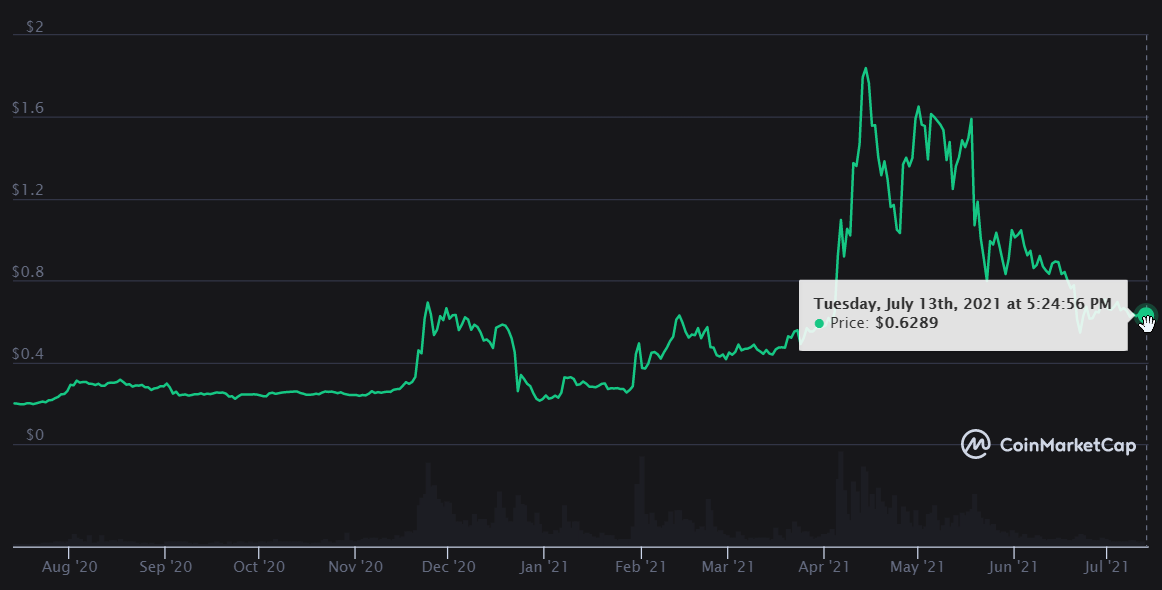
However, the ongoing correction of the cryptocurrency market pushed down the XRP prices again. The token is trading at $0.62, as of press time, which is more than 66 percent lower than its peak achieved in April.
From a technical standpoint, demand for XRP remains better than other cryptocurrencies. Ripple earlier reported that the demand for XRP surged in the first quarter of 2021. The company’s total XRP sales reached $150.34 million in the first quarter of 2021, which is a jump of approximately 97% compared to Q4 of 2020.
“XRP is currently trending horizontally around $0.62, which is a sharp drop for April 15 when it almost reached $2. As things stand, things look pretty glum for Ripple having met continuous resistance at the 20-day SMA. Further rejection could potentially take XRP to the $0.55 support wall,” said Gate.io CMO, Marie Tatibouet. “My suggestion would be to wait to see if XRP opens a candlestick above the 20-day SMA or not.”
XRP Price Levels, Source: Coinmarketcap.com
In addition, whales have accelerated their activities with XRP. Finance Magnates recently reported that multiple crypto whales are transferring millions of dollars in XRP out of cryptocurrency exchanges.
Currently, XRP has a total market cap of over $28.6 billion and is the sixth-largest digital currency, according to Coinmarketcap.com.
Meanwhile, the ongoing litigations against Ripple can make or break XRP prices. “In the short term, I expect XRP to keep trending around the levels that it is at right now,” Tatibouet added. “In the long-term, assuming a favorable result in the SEC lawsuit, XRP could go back up to $2 at the very least, and then it could jump to $5 and reach new all-time high levels.”