[ad_1]
By Brian Armstrong, CEO and Cofounder, & Alex Reeve, Identity Product Lead
These days, everyone is talking about the Metaverse.
Primitive Metaverse platforms are selling virtual land for millions of dollars. Billions more are being invested in Metaverse startups. And Mark Zuckerberg recently renamed his entire company to reflect a focus on building the Metaverse.
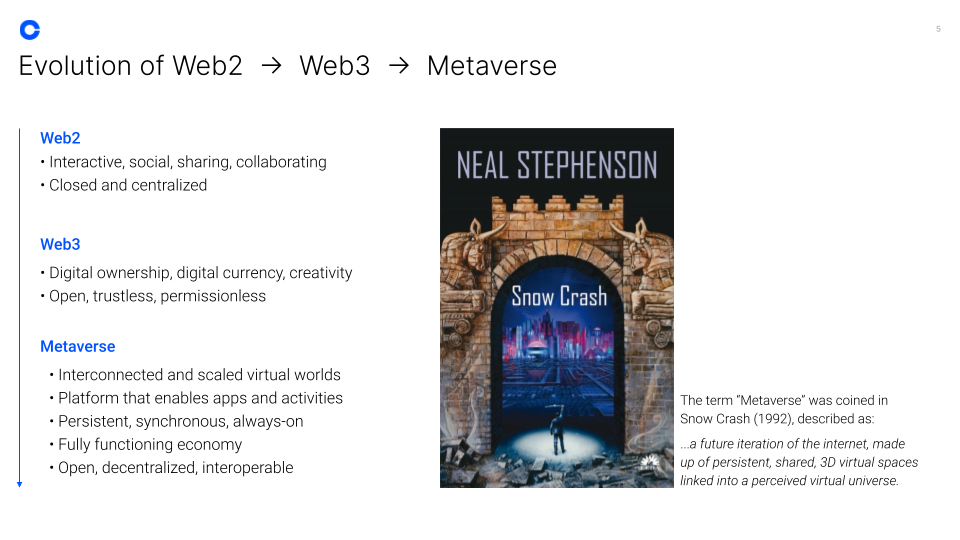
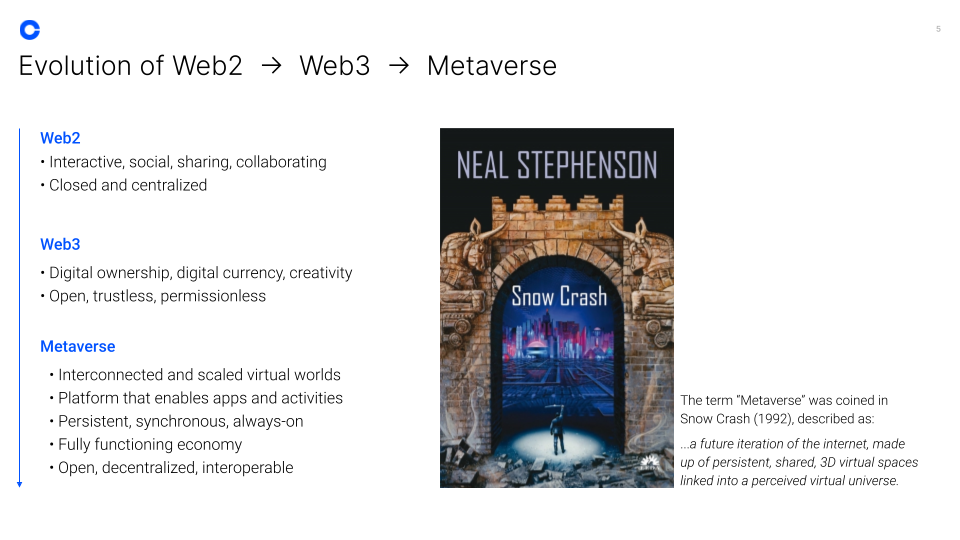
The term “Metaverse” is not new. It was first used by author Neal Stephenson in his 1992 novel “Snow Crash.” But as technology improves, and we spend more of our lives online, more people are starting to think about what’s next — and how the future might revolutionize both the digital and the physical world.
Recently, our team put together an internal presentation about the Metaverse, who’s working on it, and how crypto will help make it real. I thought the presentation was well done, so I’m sharing most of the slides here.
Defining the Metaverse
At Coinbase, our thinking about the Metaverse has been heavily influenced by venture capitalist and writer Matthew Ball (you can find his work here). Like Matt, we define the Metaverse as:
The future of the internet: A massively-scaled, persistent, interactive, and interoperable real-time platform comprised of interconnected virtual worlds where people can socialize, work, transact, play, and create.
The earliest version of the internet, Web1, was about accessing static web pages. Web2 is about interactive, social experiences within closed ecosystems. And Web3 will be about digital ownership within an open, decentralized environment.
The Metaverse is the distant evolution of Web3. In its most complete form, it will be a series of decentralized, interconnected virtual worlds with a fully functioning economy where people can do just about anything they can do in the physical world.
Importantly, the Metaverse is not the same thing as gaming (an activity you can do within the Metaverse), or virtual reality (a way of interfacing with the Metaverse). It’s also not the same as Web3 (a distant ancestor of the Metaverse).
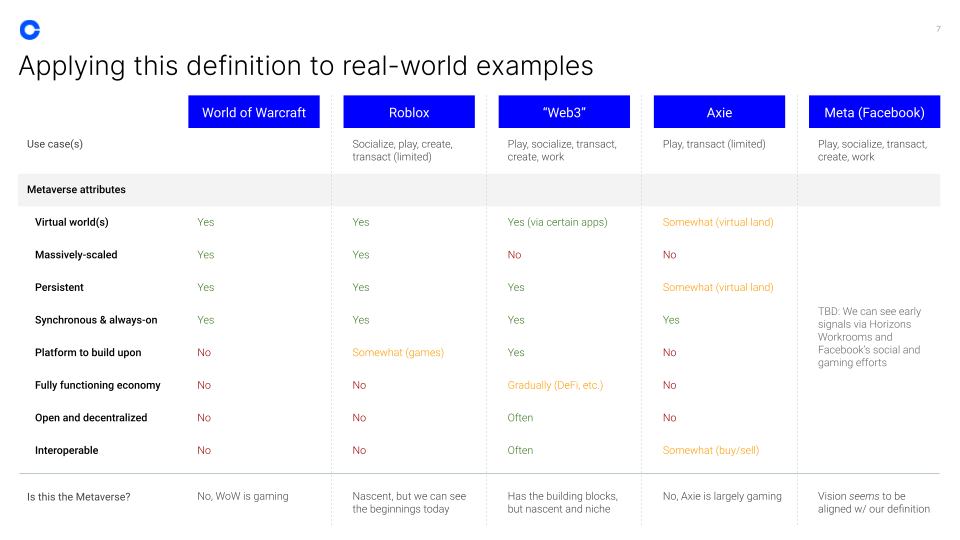
To illustrate this, here’s how some current platforms stack up against our definition of the Metaverse:
Elements of the Metaverse
While the full Metaverse is years away, it will rest on a foundation that’s being built right now.
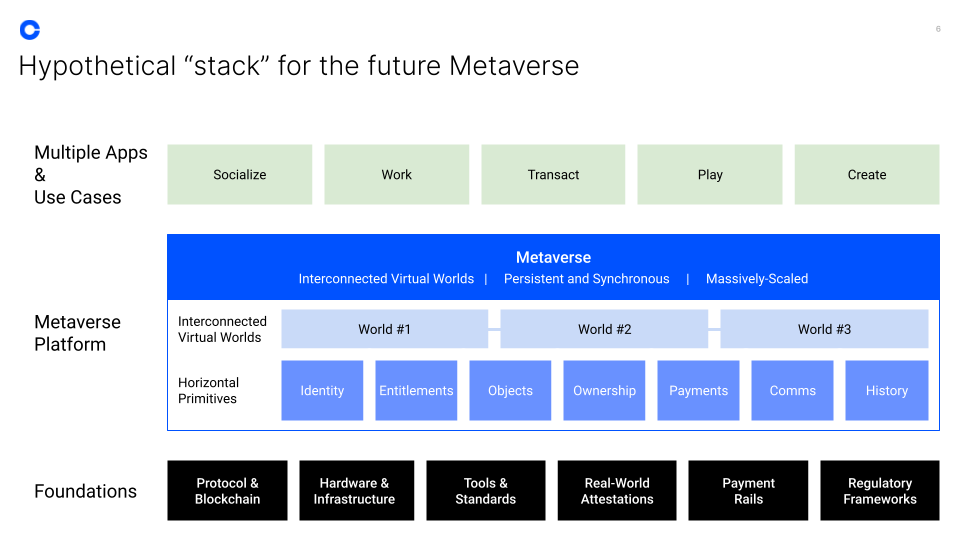
Like the internet today, the Metaverse will rely on hardware and infrastructure, tools and standards, and regulatory frameworks — most of which haven’t been fully developed yet.
But unlike today’s internet, there won’t just be one Metaverse. There will be many Metaverses, and they’ll be interconnected. That’s why it will be important for any Metaverse to be trustless — meaning people can interact directly without going through an intermediary — and permissionless — meaning anyone can participate without authorization from a governing body.
To achieve this, the Metaverse will rely on blockchain to transfer identity and ownership across virtual worlds, attestation to verify them, and payment rails that allow people buy, sell, and earn income within a decentralized economy.
Who’s building the Metaverse today?
While we can’t build anything close to the full Metaverse yet, different companies and organizations are experimenting with different elements of it. Most fall into three categories:
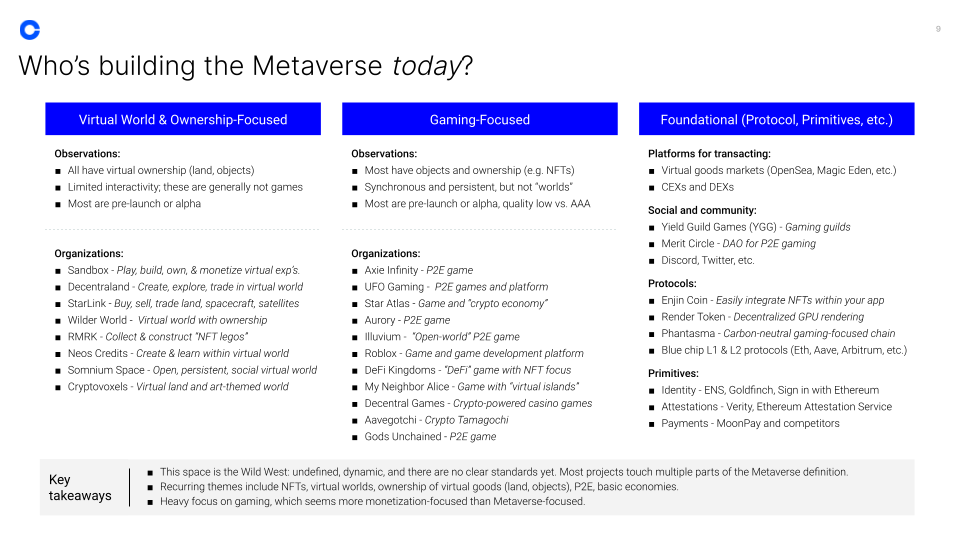
The Metaverse ecosystem is still very much in its infancy: emergent and yet to be defined. That’s its beauty too. There’s a heavy focus on gaming, mostly because it’s easy to monetize. But we’re beginning to see glimpses of what the future might look like.
Identity
Identity determines who you are, what you can access and do, and how you’re represented across the worlds of the Metaverse.
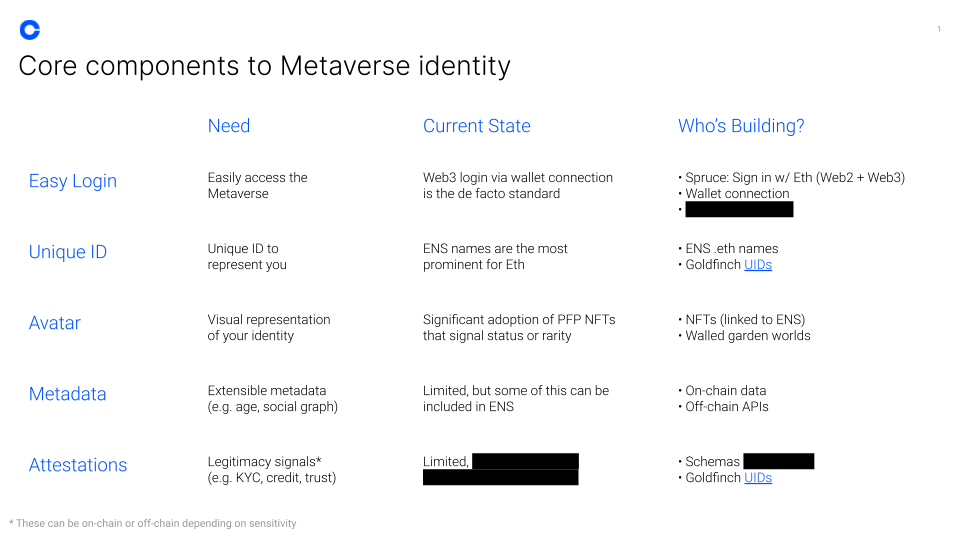
In the Metaverse, our identities will have to include an easy login, a unique ID, an avatar that represents us, metadata that follows us, and attestation so we can prove who we are. Here’s where each of those pieces stands today:
Where Coinbase comes in
At Coinbase, we want to help pull all the pieces of identity together — essentially creating an identity on-ramp into the Metaverse.
That’s the idea behind our work with ENS, which makes it possible to create a unique username NFT that resolves to a wallet. Eventually, this will allow users to carry a unique ID across different worlds in the Metaverse.
We’re also working on technology that will allow you to purchase your avatar, define and maintain your public profile, and establish trust. And we’re working on features like Sign in with [Eth/Coinbase], which could allow users to sign into every app in the Metaverse.
Conclusion
At the end of the day, this isn’t about expanding our business or making money. It’s about building a critical piece of the Metaverse ecosystem, and helping crypto grow in the right way.
We know that the Metaverse will exist, and we know it will be a series of interconnected virtual worlds. Our goal is to make it easy for anyone to establish their identity and gain access to those worlds in a way that’s simple, trusted, and decentralized.
If we succeed, it will allow the Metaverse to reach its full potential — and keep it free and open to everyone.
How Coinbase thinks about the Metaverse was originally published in The Coinbase Blog on Medium, where people are continuing the conversation by highlighting and responding to this story.
[ad_2]
Source link