[ad_1]
 On March 29, 2024, with a trading price of $70,075, and oscillating within a 24-hour range of $68,362 to $71,754, bitcoin’s current market behavior reveals significant consolidation and neutrality. Bitcoin Bitcoin’s 1-hour chart reveals recent volatility, with a significant bounce from a low of approximately $68,362, suggesting a strong support level. Conversely, the resistance near […]
[ad_2]
Source link
Tag: technical
-

Bitcoin Technical Analysis: BTC Consolidation Points to Potential Shifts Ahead
-

Ethereum Prints Bullish Technical Pattern, Why Close Above $3,200 Is Critical
[ad_1]
Ethereum fell to $2,930 before correcting higher against the US Dollar. ETH price is rising and a close above $3,200 could spark a strong recovery.
- Ethereum extended decline and broke the $3,000 support zone.
- The price is trading below $3,200 and the 100 hourly simple moving average.
- There was a break above a major bearish trend line with resistance near $3,110 on the hourly chart of ETH/USD (data feed via Kraken).
- The pair could start a major recovery wave if there is a close above $3,200.
Ethereum Price Eyes Steady Recovery
Ethereum failed to climb above $3,200 and extended its decline. ETH declined below the $3,050 and $3,000 support levels to move further into a bearish zone.
The price spiked towards $2,920 and traded as low as $2,931. Recently, there was a sharp upside correction above the $3,000 and $3,050 levels. Besides, there was a break above a major bearish trend line with resistance near $3,110 on the hourly chart of ETH/USD.
Ether price settled above the 61.8% Fib retracement level of the downward move from the $3,210 swing high to $2,931 low. It is now consolidating above the $3,100 level.
On the upside, an immediate resistance is near the $3,145 level. It is near the 76.4% Fib retracement level of the downward move from the $3,210 swing high to $2,931 low. The next major resistance is near the $3,200 level and the 100 hourly simple moving average.
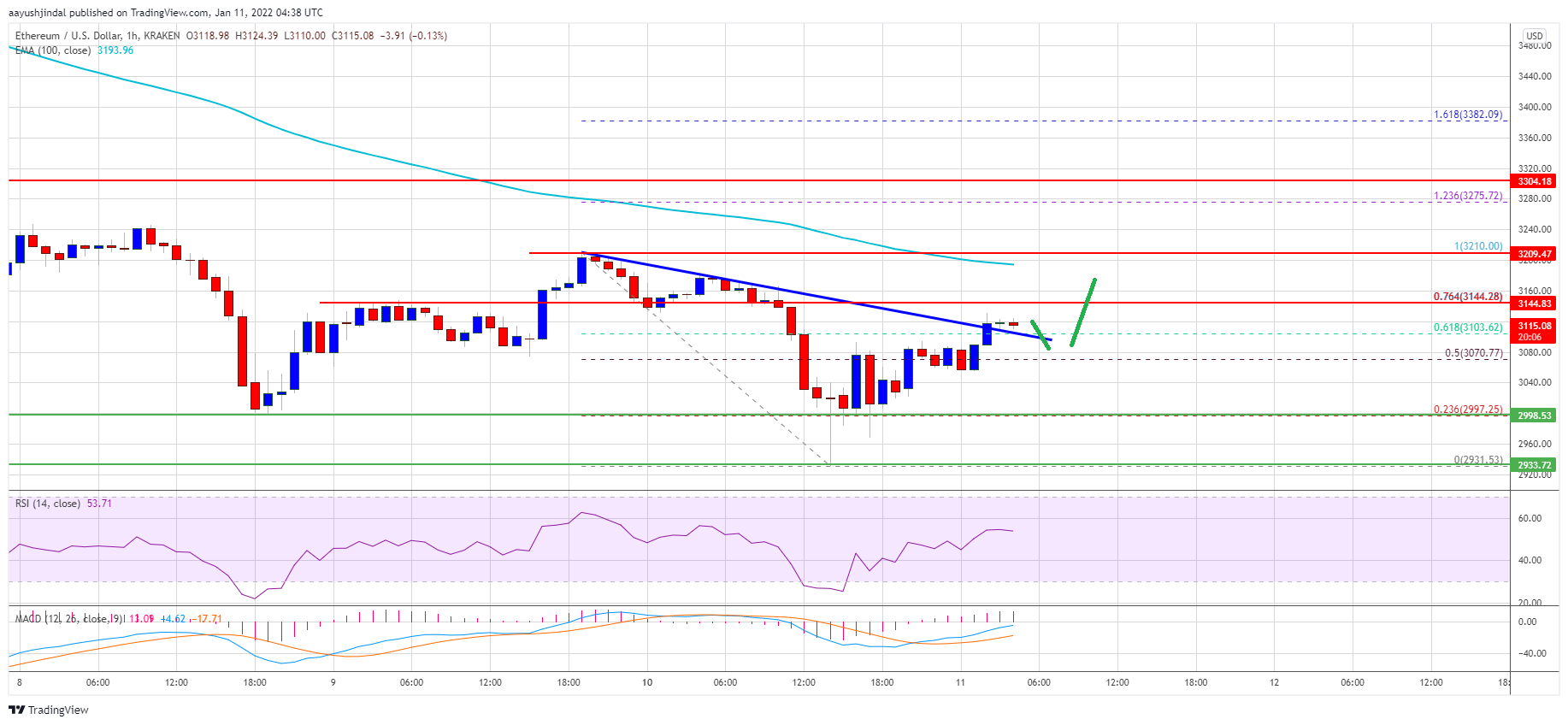
Source: ETHUSD on TradingView.com
A clear upside break above the $3,200 level could spark a decent recovery wave. The next key resistance is near the $3,300 level. Any more gains could send the price towards the $3,420 level in the near term.
Fresh Decline in ETH?
If ethereum fails to start a fresh increase above the $3,200 level, it could start another decline. An initial support on the downside is near the $3,060 level.
The first key support is now forming near the $3,000 level. A downside break below the $3,000 level might put a lot of pressure on the bulls. In the stated case, there is a risk of a new monthly low below the $2,931 level.
Technical Indicators
Hourly MACD – The MACD for ETH/USD is slowly losing pace in the bullish zone.
Hourly RSI – The RSI for ETH/USD is above the 50 level.
Major Support Level – $3,060
Major Resistance Level – $3,200
[ad_2]
Source link -

The technical benefits of EIP-1559
[ad_1]
By Yuga Cohler
TLDR: EIP-1559 transactions have allowed Coinbase and Coinbase users to save ETH on gas prices without sacrificing confirmation times. Coinbase has also burned a lot of ETH, permanently reducing the supply of the second largest cryptocurrency by market capitalization.
On August 5, 2021, Ethereum’s “London” upgrade launched successfully on mainnet as the last hard fork before the transition to Proof-of-Stake / ETH 2.0. As one of the most anticipated upgrades, London included a significant change in Ethereum’s monetary policy and transaction fee structure — EIP-1559 — that has proven beneficial to both Coinbase and ETH holders at large.
In legacy transactions prior to London, senders would specify a single gas_price they were willing to pay for their transaction, and miners would select transactions based on a first-price auction. With London, the gas prices that senders pay are in part determined by a block-to-block base_fee_per_gas, which rises and falls with usage of the network.
EIP-1559 transactions allow senders to specify two values: max_fee_per_gas and max_priority_fee_per_gas. The former is an upper bound on the total gas price the sender is willing to pay, while the latter is an upper bound on the gas price the sender is willing to pay to the miner of the transaction. The effective_gas_price, i.e. the amount that the sender actually pays, is then computed as:
priority_fee_per_gas = min(
  transaction.max_priority_fee_per_gas,
  transaction.max_fee_per_gas — block.base_fee_per_gas
)
effective_gas_price = priority_fee_per_gas + block.base_fee_per_gas
The block’s base_fee_per_gas is burned, thereby making the native currency more deflationary and returning value to ETH holders.
While there was significant uncertainty surrounding the market effects of EIP-1559, we at Coinbase took a proactive approach to ensure that our infrastructure was prepared to send EIP-1559 transactions on day one of the fork. Based on the work of people such as Zsolt Felföldi and Frederik Bolding, we developed a novel gas pricing algorithm for these transactions. Crucially, it leverages the new eth_feeHistory JSON RPC API that allows us to dynamically compute an appropriate max_priority_fee_per_gas based on market conditions.
We rolled out this change gradually so that we could compare the metrics of legacy and EIP-1559 transactions. Our findings were surprising:
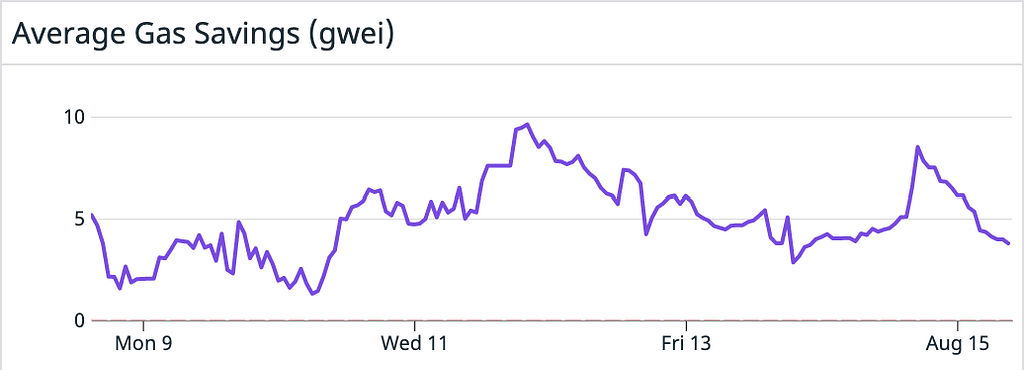
- On average, we saved about 9% on effective gas prices (this was computed as the difference in confirmed gas price between legacy transactions and EIP-1559 transactions).
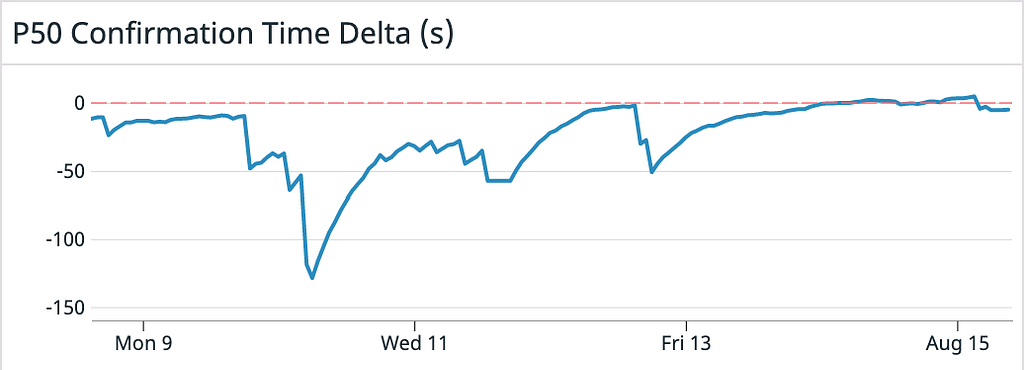
- At the same time, we improved our broadcast-to-confirmation time by 11 seconds, or 0.7 blocks (this was computed as the difference in broadcast-to-confirmation time between legacy transactions and EIP-1559 transactions).
Fig 1. Average gas savings from EIP-1559 transactions in gwei Fig 2. P50 broadcast-to-confirmation time delta between EIP-1559 and legacy transactions in seconds As Taylor Monahan posits, we suspect that we are able to simultaneously save on gas price and improve confirmation time because we specify a max_fee_per_gas that is significantly larger than the current base_fee_per_gas. This makes the effective priority_fee_per_gas larger than the equivalent legacy transaction, incentivizing miners to include our EIP-1559 transaction in the next block.
Coinbase executes a large number of transactions on Ethereum to source liquidity and provide withdrawals for our customers, so these savings add up. As of September 27, 2021, Coinbase has burned 13,800 ETH, for an average of about 254 ETH per day. This means we save about 27 ETH per day on gas prices from EIP-1559 transactions. Seeing this data, we have rolled out EIP-1559 to 95% of transactions, preserving a small holdback for data collection purposes. We intend on eventually rolling it out to 100%.
The London upgrade was a remarkable achievement not just for Ethereum, but for decentralized financial networks as a whole. A diverse group of participants across the world came together to implement a complex shift in one of the core mechanisms that dictates market prices. We’re looking forward to continuing to work with the Ethereum community to push forward the cutting edge of DApps & DeFi, and usher in the new era of ETH 2.0.
If you are interested in building the future of finance, check out our open roles here.
The technical benefits of EIP-1559 was originally published in The Coinbase Blog on Medium, where people are continuing the conversation by highlighting and responding to this story.
[ad_2]
Source link