Aparna Chennapragada, Chief Product Officer at Robinhood, made some statements about the interest of the trading platform
Trading Platform
In the FX space, a currency trading platform is a software provided by brokers to their respective client base, garnering access as traders in the broader market. Most commonly, this reflects an online interface or mobile app, complete with tools for order processing.Every broker needs one or more trading platforms to accommodate the needs of different clients. Being the backbone of the company’s offering, a trading platform provides clients with quotes, a selection of instruments to trade, real-time updates on quotes, charts and is the main frontend which customers are facing.Brokers either use existing trading platforms and sometimes customize them, or develop their own platform from scratch. Since the beginning of the retail FX trading business MetaQuotes and its platforms MetaTrader 4 (MT4) and MetaTrader 5 (MT5) have been the industry standard, especially when it comes to automated trading.MT4 Shows Resiliency While MT4 has long been seen as ubiquitous amongst brokers’ offerings, a targeted push by MetaQuotes themselves has led to broader adoption of MT5 in recent years. Advanced trading platforms such as MT4 or MT5 also allow access to a wide range of asset classes available for trading.The development of trading platforms over the past decade has failed to successfully dethrone MT4 or MT5, notably in the retail market. However, in institutional markets, brokerage companies and banking entities also construct and utilize proprietary currency trading platforms to help satisfy internal needs with trades executed through institutional trading channels.By far the most important parameter for many retail clients is the optionality and pairs available on trading platforms. Additionally, demand by traders has led to a greater emphasis on newer features such as advanced charting and other tools.
In the FX space, a currency trading platform is a software provided by brokers to their respective client base, garnering access as traders in the broader market. Most commonly, this reflects an online interface or mobile app, complete with tools for order processing.Every broker needs one or more trading platforms to accommodate the needs of different clients. Being the backbone of the company’s offering, a trading platform provides clients with quotes, a selection of instruments to trade, real-time updates on quotes, charts and is the main frontend which customers are facing.Brokers either use existing trading platforms and sometimes customize them, or develop their own platform from scratch. Since the beginning of the retail FX trading business MetaQuotes and its platforms MetaTrader 4 (MT4) and MetaTrader 5 (MT5) have been the industry standard, especially when it comes to automated trading.MT4 Shows Resiliency While MT4 has long been seen as ubiquitous amongst brokers’ offerings, a targeted push by MetaQuotes themselves has led to broader adoption of MT5 in recent years. Advanced trading platforms such as MT4 or MT5 also allow access to a wide range of asset classes available for trading.The development of trading platforms over the past decade has failed to successfully dethrone MT4 or MT5, notably in the retail market. However, in institutional markets, brokerage companies and banking entities also construct and utilize proprietary currency trading platforms to help satisfy internal needs with trades executed through institutional trading channels.By far the most important parameter for many retail clients is the optionality and pairs available on trading platforms. Additionally, demand by traders has led to a greater emphasis on newer features such as advanced charting and other tools. Read this Term towards the non-fungible tokens (NFTs) industry, saying that they’re ‘fascinated.’
In fact, Chennapragada stated that there is ‘a lot of potential’ in using NFTs nowadays that Robinhood spotted. “We absolutely think about NFTs. I have been fascinated by them, and I think that the crypto team is excited. We are always looking at what makes sense here, in terms of products to offer through Robinhood,” she commented in an interview with The Verge.
Robinhood’s CPO, in particular, talked about what Axie has been doing in the NFT industry with the in-game sphere. “The reason I ask about NFTs, in particular, is that when you think about products on smartphones that allow you to transact — where you push a button and spend some money, and then digital goods move around — Robinhood is actually very unique. It does not pay a 30% commission to either of the smartphone platforms, even if you are buying Bitcoin
Bitcoin
Bitcoin is the world’s first digital currency that was created in 2009 by a mysterious entity named Satoshi Nakamoto. As a digital currency or cryptocurrency, Bitcoin operates without a central bank or single administrator. Instead, Bitcoin can be sent via a Peer-to-Peer (P2P) networking, devoid of intermediaries.Bitcoins are not issued or backed by any governments or banks, and Bitcoin is not considered to be legal tender, although they do have status as an acknowledged transfer of value in some jurisdictions. Rather than composing a physical currency, Bitcoins are pieces of code that can be sent and received across a kind of distributed ledger network called a blockchain. Transactions on the Bitcoin network are confirmed by a network of computers (or nodes) that solve a series of complex equations. This process is called mining. In exchange for mining, the computers receive rewards in the form of new Bitcoins. Mining grows increasingly difficult over time, and the rewards get smaller and smaller. There is a total of 21 million Bitcoins. As of May 2020, there are 18.3 million Bitcoins in circulation. This number changes approximately every 10 minutes when new blocks are mined. Presently, each new block adds 12.5 bitcoins into circulation.Since its inception, Bitcoin has remained the most popular and largest cryptocurrency in terms of market cap in the world. Bitcoin’s popularity has contributed significantly to the release of thousands of other cryptocurrencies, called “altcoins.” While the crypto market was originally hegemonic, today’s landscape features countless altcoins.Bitcoin ControversyBitcoin has been extremely controversial since its original launch. Given its mercurial nature, Bitcoin has been criticized for its use in illegal transactions and money laundering.As its impossible to trace, these attributes make Bitcoin the ideal vehicle for illicit behavior. Moreover, critics point to its high electricity consumption for mining, rampant price volatility, and thefts from exchanges. Bitcoin has been seen as a speculative bubble given its lack of oversight. The crypto has weathered multiple collapses and survived over a decade so far. Unlike its launch back in 2009, Bitcoin today is viewed far differently and is much more accepted by merchants and other entities.
Bitcoin is the world’s first digital currency that was created in 2009 by a mysterious entity named Satoshi Nakamoto. As a digital currency or cryptocurrency, Bitcoin operates without a central bank or single administrator. Instead, Bitcoin can be sent via a Peer-to-Peer (P2P) networking, devoid of intermediaries.Bitcoins are not issued or backed by any governments or banks, and Bitcoin is not considered to be legal tender, although they do have status as an acknowledged transfer of value in some jurisdictions. Rather than composing a physical currency, Bitcoins are pieces of code that can be sent and received across a kind of distributed ledger network called a blockchain. Transactions on the Bitcoin network are confirmed by a network of computers (or nodes) that solve a series of complex equations. This process is called mining. In exchange for mining, the computers receive rewards in the form of new Bitcoins. Mining grows increasingly difficult over time, and the rewards get smaller and smaller. There is a total of 21 million Bitcoins. As of May 2020, there are 18.3 million Bitcoins in circulation. This number changes approximately every 10 minutes when new blocks are mined. Presently, each new block adds 12.5 bitcoins into circulation.Since its inception, Bitcoin has remained the most popular and largest cryptocurrency in terms of market cap in the world. Bitcoin’s popularity has contributed significantly to the release of thousands of other cryptocurrencies, called “altcoins.” While the crypto market was originally hegemonic, today’s landscape features countless altcoins.Bitcoin ControversyBitcoin has been extremely controversial since its original launch. Given its mercurial nature, Bitcoin has been criticized for its use in illegal transactions and money laundering.As its impossible to trace, these attributes make Bitcoin the ideal vehicle for illicit behavior. Moreover, critics point to its high electricity consumption for mining, rampant price volatility, and thefts from exchanges. Bitcoin has been seen as a speculative bubble given its lack of oversight. The crypto has weathered multiple collapses and survived over a decade so far. Unlike its launch back in 2009, Bitcoin today is viewed far differently and is much more accepted by merchants and other entities. Read this Term, which is a digital good. Because it’s money. Which is a very philosophical, like you’re dancing on the head of a pin there, that Apple has not said, ‘I want 30%’,” Chennapragada noted.
Moreover, she highlighted that NFTs could be an end in itself in some cases, making them a ‘really fascinating opportunity.’ However, she didn’t specify whether the company plans to launch or not any NFT offerings in the future, but she pointed out the following: “I think, as a team, and a company, we are looking at the space and saying, ‘How can we best participate? What are the customer problems that we can solve?’”
Settlement with Vermont Regulators
Recently, Robinhood reached an agreement to settle $640,000 with Vermont’s financial regulator, DFR, over the platform’s outages and account supervision issues.
Aparna Chennapragada, Chief Product Officer at Robinhood, made some statements about the interest of the trading platform
Trading Platform
In the FX space, a currency trading platform is a software provided by brokers to their respective client base, garnering access as traders in the broader market. Most commonly, this reflects an online interface or mobile app, complete with tools for order processing.Every broker needs one or more trading platforms to accommodate the needs of different clients. Being the backbone of the company’s offering, a trading platform provides clients with quotes, a selection of instruments to trade, real-time updates on quotes, charts and is the main frontend which customers are facing.Brokers either use existing trading platforms and sometimes customize them, or develop their own platform from scratch. Since the beginning of the retail FX trading business MetaQuotes and its platforms MetaTrader 4 (MT4) and MetaTrader 5 (MT5) have been the industry standard, especially when it comes to automated trading.MT4 Shows Resiliency While MT4 has long been seen as ubiquitous amongst brokers’ offerings, a targeted push by MetaQuotes themselves has led to broader adoption of MT5 in recent years. Advanced trading platforms such as MT4 or MT5 also allow access to a wide range of asset classes available for trading.The development of trading platforms over the past decade has failed to successfully dethrone MT4 or MT5, notably in the retail market. However, in institutional markets, brokerage companies and banking entities also construct and utilize proprietary currency trading platforms to help satisfy internal needs with trades executed through institutional trading channels.By far the most important parameter for many retail clients is the optionality and pairs available on trading platforms. Additionally, demand by traders has led to a greater emphasis on newer features such as advanced charting and other tools.
In the FX space, a currency trading platform is a software provided by brokers to their respective client base, garnering access as traders in the broader market. Most commonly, this reflects an online interface or mobile app, complete with tools for order processing.Every broker needs one or more trading platforms to accommodate the needs of different clients. Being the backbone of the company’s offering, a trading platform provides clients with quotes, a selection of instruments to trade, real-time updates on quotes, charts and is the main frontend which customers are facing.Brokers either use existing trading platforms and sometimes customize them, or develop their own platform from scratch. Since the beginning of the retail FX trading business MetaQuotes and its platforms MetaTrader 4 (MT4) and MetaTrader 5 (MT5) have been the industry standard, especially when it comes to automated trading.MT4 Shows Resiliency While MT4 has long been seen as ubiquitous amongst brokers’ offerings, a targeted push by MetaQuotes themselves has led to broader adoption of MT5 in recent years. Advanced trading platforms such as MT4 or MT5 also allow access to a wide range of asset classes available for trading.The development of trading platforms over the past decade has failed to successfully dethrone MT4 or MT5, notably in the retail market. However, in institutional markets, brokerage companies and banking entities also construct and utilize proprietary currency trading platforms to help satisfy internal needs with trades executed through institutional trading channels.By far the most important parameter for many retail clients is the optionality and pairs available on trading platforms. Additionally, demand by traders has led to a greater emphasis on newer features such as advanced charting and other tools. Read this Term towards the non-fungible tokens (NFTs) industry, saying that they’re ‘fascinated.’
In fact, Chennapragada stated that there is ‘a lot of potential’ in using NFTs nowadays that Robinhood spotted. “We absolutely think about NFTs. I have been fascinated by them, and I think that the crypto team is excited. We are always looking at what makes sense here, in terms of products to offer through Robinhood,” she commented in an interview with The Verge.
Robinhood’s CPO, in particular, talked about what Axie has been doing in the NFT industry with the in-game sphere. “The reason I ask about NFTs, in particular, is that when you think about products on smartphones that allow you to transact — where you push a button and spend some money, and then digital goods move around — Robinhood is actually very unique. It does not pay a 30% commission to either of the smartphone platforms, even if you are buying Bitcoin
Bitcoin
Bitcoin is the world’s first digital currency that was created in 2009 by a mysterious entity named Satoshi Nakamoto. As a digital currency or cryptocurrency, Bitcoin operates without a central bank or single administrator. Instead, Bitcoin can be sent via a Peer-to-Peer (P2P) networking, devoid of intermediaries.Bitcoins are not issued or backed by any governments or banks, and Bitcoin is not considered to be legal tender, although they do have status as an acknowledged transfer of value in some jurisdictions. Rather than composing a physical currency, Bitcoins are pieces of code that can be sent and received across a kind of distributed ledger network called a blockchain. Transactions on the Bitcoin network are confirmed by a network of computers (or nodes) that solve a series of complex equations. This process is called mining. In exchange for mining, the computers receive rewards in the form of new Bitcoins. Mining grows increasingly difficult over time, and the rewards get smaller and smaller. There is a total of 21 million Bitcoins. As of May 2020, there are 18.3 million Bitcoins in circulation. This number changes approximately every 10 minutes when new blocks are mined. Presently, each new block adds 12.5 bitcoins into circulation.Since its inception, Bitcoin has remained the most popular and largest cryptocurrency in terms of market cap in the world. Bitcoin’s popularity has contributed significantly to the release of thousands of other cryptocurrencies, called “altcoins.” While the crypto market was originally hegemonic, today’s landscape features countless altcoins.Bitcoin ControversyBitcoin has been extremely controversial since its original launch. Given its mercurial nature, Bitcoin has been criticized for its use in illegal transactions and money laundering.As its impossible to trace, these attributes make Bitcoin the ideal vehicle for illicit behavior. Moreover, critics point to its high electricity consumption for mining, rampant price volatility, and thefts from exchanges. Bitcoin has been seen as a speculative bubble given its lack of oversight. The crypto has weathered multiple collapses and survived over a decade so far. Unlike its launch back in 2009, Bitcoin today is viewed far differently and is much more accepted by merchants and other entities.
Bitcoin is the world’s first digital currency that was created in 2009 by a mysterious entity named Satoshi Nakamoto. As a digital currency or cryptocurrency, Bitcoin operates without a central bank or single administrator. Instead, Bitcoin can be sent via a Peer-to-Peer (P2P) networking, devoid of intermediaries.Bitcoins are not issued or backed by any governments or banks, and Bitcoin is not considered to be legal tender, although they do have status as an acknowledged transfer of value in some jurisdictions. Rather than composing a physical currency, Bitcoins are pieces of code that can be sent and received across a kind of distributed ledger network called a blockchain. Transactions on the Bitcoin network are confirmed by a network of computers (or nodes) that solve a series of complex equations. This process is called mining. In exchange for mining, the computers receive rewards in the form of new Bitcoins. Mining grows increasingly difficult over time, and the rewards get smaller and smaller. There is a total of 21 million Bitcoins. As of May 2020, there are 18.3 million Bitcoins in circulation. This number changes approximately every 10 minutes when new blocks are mined. Presently, each new block adds 12.5 bitcoins into circulation.Since its inception, Bitcoin has remained the most popular and largest cryptocurrency in terms of market cap in the world. Bitcoin’s popularity has contributed significantly to the release of thousands of other cryptocurrencies, called “altcoins.” While the crypto market was originally hegemonic, today’s landscape features countless altcoins.Bitcoin ControversyBitcoin has been extremely controversial since its original launch. Given its mercurial nature, Bitcoin has been criticized for its use in illegal transactions and money laundering.As its impossible to trace, these attributes make Bitcoin the ideal vehicle for illicit behavior. Moreover, critics point to its high electricity consumption for mining, rampant price volatility, and thefts from exchanges. Bitcoin has been seen as a speculative bubble given its lack of oversight. The crypto has weathered multiple collapses and survived over a decade so far. Unlike its launch back in 2009, Bitcoin today is viewed far differently and is much more accepted by merchants and other entities. Read this Term, which is a digital good. Because it’s money. Which is a very philosophical, like you’re dancing on the head of a pin there, that Apple has not said, ‘I want 30%’,” Chennapragada noted.
Moreover, she highlighted that NFTs could be an end in itself in some cases, making them a ‘really fascinating opportunity.’ However, she didn’t specify whether the company plans to launch or not any NFT offerings in the future, but she pointed out the following: “I think, as a team, and a company, we are looking at the space and saying, ‘How can we best participate? What are the customer problems that we can solve?’”
Settlement with Vermont Regulators
Recently, Robinhood reached an agreement to settle $640,000 with Vermont’s financial regulator, DFR, over the platform’s outages and account supervision issues.
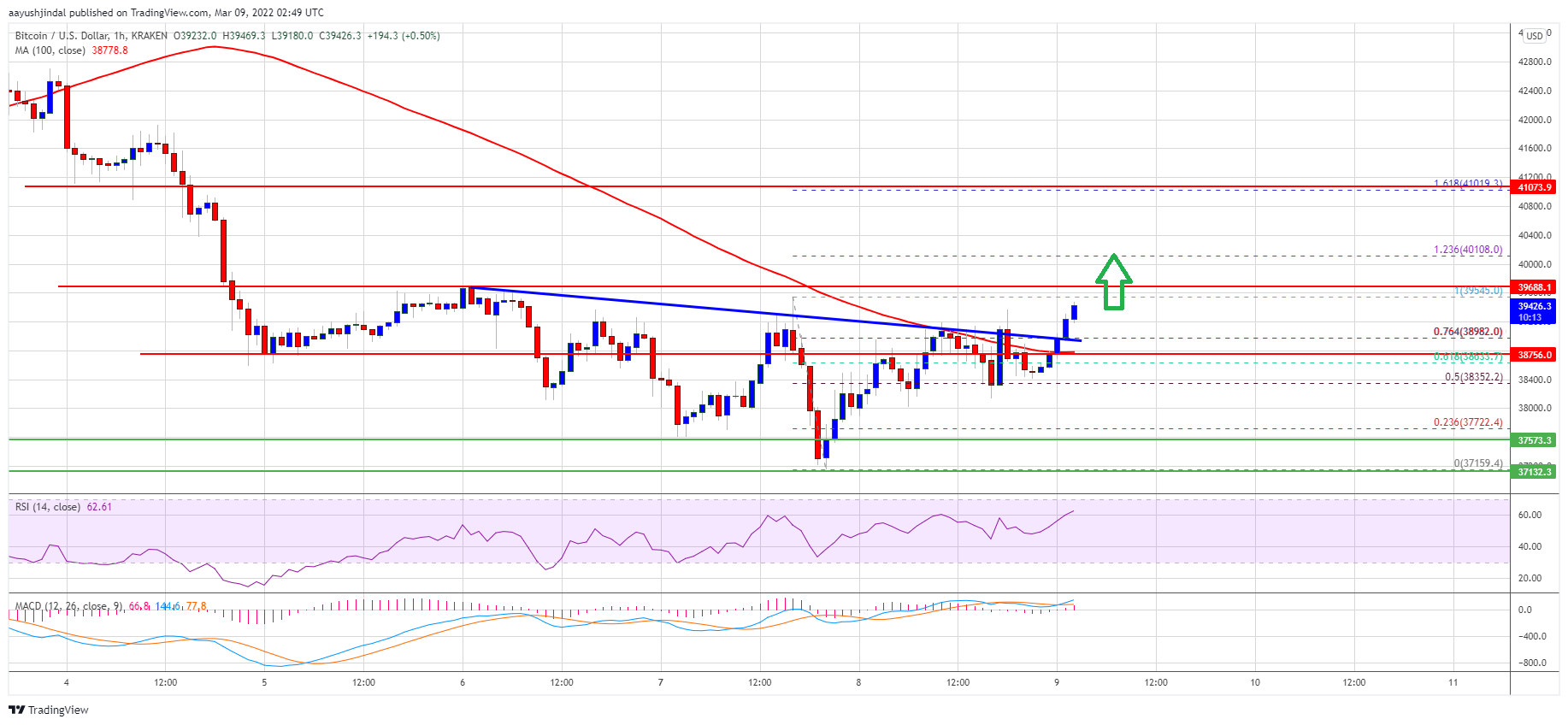
Bitcoin is correcting losses and trading above $39,000 against the US Dollar. BTC could gain bullish momentum if it clears the $40,000 resistance zone.
Bitcoin is slowly recovering and trading above the $39,000 zone.
The price is trading above $39,200 and the 100 hourly simple moving average.
There was a break above a major bearish trend line with resistance near $38,980 on the hourly chart of the BTC/USD pair (data feed from Kraken).
The pair might accelerate higher and could even surpass the $40,000 resistance zone.
Bitcoin Price Starts Correction
Bitcoin price extended decline below the $38,000 support zone. However, BTC found support near the $37,150 zone and started a decent recovery wave.
A low was formed near $37,159 before the price corrected higher. There was a move above the $38,000 and $38,500 resistance levels. The price was able to climb above the 76.4% Fib retracement level of the downward move from the $39,545 swing high to $37,159 low.
Besides, there was a break above a major bearish trend line with resistance near $38,980 on the hourly chart of the BTC/USD pair. Bitcoin is now trading above $39,200 and the 100 hourly simple moving average.
On the upside, an immediate resistance is near the $39,545 swing high. The next major resistance is near the $40,000 level. If there is a clear move above the $40,000 resistance zone, the price might accelerate higher. In the stated case, the price could rise towards the $41,000 zone.
Source: BTCUSD on TradingView.com
The 1.618 Fib extension level of the downward move from the $39,545 swing high to $37,159 low is also near the $41,000 level. Any more gains might send the price towards the $42,200 level.
Another Rejection in BTC?
If bitcoin fails to clear the $40,000 resistance zone, it could start another decline. An immediate support on the downside is near the $39,150 zone.
The next major support is seen near the $38,800 level and the 100 hourly simple moving average. If there is a downside break below the $38,800 support, the price might gain bearish momentum. In the stated case, there is a risk of a move towards the $37,500 level.
Technical indicators:
Hourly MACD – The MACD is now gaining pace in the bullish zone.
Hourly RSI (Relative Strength Index) – The RSI for BTC/USD is now above the 50 level.
Major Support Levels – $39,150, followed by $38,800.
Major Resistance Levels – $39,545, $40,000 and $41,000.
Bitcoin (BTC) bulls are betting on a solid month for BTC price action, as November traditionally sees strong gains for United States stocks.
Data shows that November has been the best performing month for the S&P 500 since 1985.
November 2021 has stiff competition
With “Uptober” already the biggest month in terms of gains for Bitcoin in 2021, odds are stocks could act as a catalyst for further upside in “Moonvember.”
Median S&P 500 progress in November over the past 35 years has been just over 2% — making it the only month to achieve those median returns.
At the same time, over 70% of years have seen positive returns, and Bitcoin’s history is similar.
In November, BTC/USD has ended up higher than when it started with the exception of just two years: 2018 (-36.5%) and 2019 (-17.2%).
2020 conversely saw 43% gains, leaving the door open for a rematch in line with expectations.
BTC/USD monthly returns table. Source: Bybt
As Cointelegraph reported, these predict a volatile but ultimately extremely beneficial month as Bitcoin approaches its Q4 peak.
“Highest monthly close in history. Congrats Bitcoin and congrats y’all,” an optimistic TechDev summarized on Nov. 1.
“We are now headed toward our second monthly RSI peak like every cycle before. Nowhere near a top. Trust the indicators.”
TechDev is eyeing either copycat retrace of 2017’s top sequence or that of 1970s gold, both apt to send BTC/USD far beyond $100,000.
Bitcoin’s relationship to traditional markets has come into examination in recent months as the cryptocurrency begins to carve out its own path away from macro.
Related: ‘Uptober’ closes at record high in best month of 2021 — 5 things to watch in Bitcoin this week
A test of trader resolve may come as soon as this week as the Federal Reserve prepares new comments on asset purchase tapering.
For Bitcoin, the decision whether or not to allow a regulated exchange-traded fund (ETF) in the U.S. this month may yet steer price action far away from predictions — especially if a rejection is seen.
As proponents point out slowness in following other countries, VanEck — one of over 40 applicants — has revealed it is mulling applying to launch a spot ETF in Australia.
Buying an asset in a downtrend can be a risky maneuver because most investors struggle to spot reversals and as the trend deepens traders take on deep losses. In instances like these, being able to spot descending channel patterns can help traders avoid buying in a bearish trend.
A “descending channel,” also known as a “bearish price channel” is formed by drawing two downward trendlines, parallel to each other, which confine the price action of the asset.
Descending channel basics
In a downtrend, the price action forms a series of lower highs and lower lows. A descending channel is drawn by joining the lower highs and the lower lows using parallel trendlines. The main trendline is drawn first where two or more lower highs are connected. Then a parallel line, also called the channel line, is drawn connecting the lower lows.
The price action inside a descending channel continues to move south as bears sell on any relief rallies to the main trendline.
Descending channel pattern. Source: TradingView
The asset in the chart above is in a downtrend, forming lower highs and lower lows. The main trendline is drawn by joining two lower highs (marked as ellipses) while the parallel channel line is drawn by joining the two reaction lows.
When the price reaches the channel line, bulls believe that the price has become attractive and they buy, but the bears are in no mood to allow the bulls to have their way. They sell when the price reaches the main trendline and the trend remains down.
The trading inside the channel is usually random but bound between the two parallel lines. A break below the channel indicates that the bearish momentum has picked up and that could result in a spike down.
Conversely, a breakout of the descending channel suggests a possible change in trend. Sometimes these breakouts result in a new uptrend, but on other occasions the price action forms a range before resuming the downtrend.
Descending channel breakouts
THETA/USDT daily chart. Source: TradingView
The chart above shows THETA token in a descending channel where the main trendline is formed by joining the two lower highs made on April 16 and May 9. The parallel line drawn from the reaction low on April 18 forms the channel line.
As seen above, the price action is largely caged between these two lines. The bulls pushed the price above the channel on June 17 but could not sustain the higher levels. The bears again quickly pulled the price back into the channel, trapping the aggressive bulls.
There were a few spikes below the channel line but the long tails on the candlesticks show that bulls used these dips to buy. This shows how the lines act as strong support and resistance.
Finally, the price broke above the channel on July 24 and after a minor consolidation, the recovery continued. This confirmed a legitimate breakout, indicating a possible trend change.
XMR/USDT daily chart. Source: TradingView
Monero (XMR) topped out on June 23, 2019, and then started a downtrend. The main trendline of the channel was formed by connecting the lower highs on July 8, 2019, and Aug. 8, 2019, while the channel line was drawn from the low on July 16, 2019. The XMR/USDT pair continued to trade inside the channel until Jan. 4, 2020.
The bulls pushed and closed the price above the channel on Jan. 5, 2020. This signaled a possible change in trend. The target objective can be arrived at by adding the height of the channel to the breakout level.
In the above case, the depth of the channel was $31.50. Adding this to the breakout level at $51.80, gave a target objective of $83.30. The pair easily exceeded the pattern target and turned down from $96.90 on Feb. 15, 2020.
This suggests that traders should use the target as a guide but decide on closing the position after analyzing other supportive indicators and patterns.
Descending channel breakdowns
LUNA/USDT daily chart. Source: TradingView
Terra’s LUNA token topped out at $22.40 on March 21. Thereafter, it started trading inside a descending channel pattern. The bears pulled the price below the channel line on April 18 but they could not sustain the lower levels. The bulls pushed the price back into the channel on April 23 and trapped the aggressive bears.
The sellers again broke below the channel line on May 19. Attempts by the bulls to push the price back into the channel failed on May 20 and May 21, confirming a valid breakdown. The pattern target of the breakdown was $5.10 and the LUNA/USDT pair bottomed out at $3.91.
Take care to not mix up bull flags and descending channels
BTC/USDT daily chart. Source: TradingView
Bitcoin (BTC) rallied sharply from $17,572.33 on Dec. 11, 2020 to $41,950 on Jan. 8, 2021. Subsequently, the price corrected inside two parallel lines, which was a bullish flag pattern but could have been easily mistaken for a descending channel.
Thomas Bulkowski, author of the book Encyclopedia of Chart Patterns, says when a pattern is less than three weeks long, it is a flag, but longer than that can be considered as a channel.
In the above example, the correction lasted for just over three weeks and the price resumed its up-move after breaking out of the flag.
The views and opinions expressed here are solely those of the author and do not necessarily reflect the views of Cointelegraph.com. Every investment and trading move involves risk, you should conduct your own research when making a decision.
Bitcoin price just touched $46,000 for the first time in months following the worst second quarter selloff on record. The push has continued beyond yesterday’s weekly close – a pivotal close that left behind an extremely bullish battle call.
The pattern, called “Three White Soldiers,” is often the sign of a powerful uptrend brewing, but it often arrives with a feign of weakness. Here is more about the potentially important pattern and what it could mean for the current crypto market cycle.
Bitcoin Bulls Prepare For Battle With Three White Soldiers Pattern
Bitcoin price recently took a bullish turn after spending weeks grinding at support around $30,000. Repeated failure by bears to push prices lower gave bulls the confidence to make close to a 50% recovery from highs set earlier in the year.
Three full weeks of uptrend confirmed with last night’s weekly close has formed a bullish Japanese candlestick pattern called “Three White Soldiers.”
Related Reading | The Idea That The Bitcoin Bottom Is In Is Broadening
According to Investopedia, Three White Soldiers “suggests a strong change in market sentiment” and is characterized by three similarly sized candle bodies in a row. It is “important to note that the strong moves higher could create temporary overbought conditions,” the site continues.
If the pattern is valid, a short term retracement could result, followed by an explosive uptrend. A similar pattern appeared almost one year ago to the day, and the result was nine months of the most powerful uptrend Bitcoin has ever seen.
Bitcoin has potentially formed a powerful bullish pattern | Source: BTCUSD on TradingView.com
Three Black Crows Example In Crypto: With And Without A Trap
A similar sized drop as the August 2020 bear trap in crypto would take Bitcoin price back to around $35,000 before going on an absolute tear and potentially the last leg up of the bull run.
Bears might not get their short-lived trap this time around, either. As with most chart patterns, any bullish signal has an opposite bearish signal. The counter-signal to the Three White Soldiers is called Three Black Crows and is a signal that Bitcoin has felt the bite from before.
Three Black Crows with and without retracement | Source: BTCUSD on TradingView.com
Three Black Crows appeared before the plummet to the bear market bottom, and the same signal popped up once again at the June 2019 peak at around $14,000 per BTC.
Related Reading | A Generational Bitcoin Buy Signal Is Almost Back
In the first scenario, there was no retracement and Bitcoin simply fell like a ton of bricks through support. In the second scenario, there was a bull trap in October 2019 and an over 40% retest. The move broke records for one of the largest daily in history, but failed to break the resistance level and reclaim it as support.
After another failure, Bitcoin price fell back to its bear market bottom in Black Thursday 2020. If the two bullish signals (Three White Soldiers) also alternate in terms or retracement, there could be no bull trap, and instead the cryptocurrency slices through resistance as easily at support fell in December 2018.
Follow @TonySpilotroBTC on Twitter or via the TonyTradesBTC Telegram. Content is educational and should not be considered investment advice.
Featured image from iStockPhoto, Charts from TradingView.com