Tag: Service

  • Canadian bitcoin exchange and transfer service Shakepay raises $44M

    Canadian bitcoin exchange and transfer service Shakepay raises $44M

    [ad_1]

    Shakepay, a Canadian-based exchange platform for bitcoin (BTC) and ether (ETH), announced it closed $44 million in Series A funding. The round was led by QED Investors, a US-based venture capital firm.

    “We love our devoted community of shakers, and this funding is going right to work to bring you more products and services to help you earn, access, and build wealth in bitcoin. In 2021, we grew 381% to more than 900,000 shakers with $6B in total volume and grew our team from around 20 people to 75 across Canada. Just imagine what this funding could mean for 2022 and the future beyond.”
    – The Shakepay Team

    As part of the capital raise, Matt Burton, Partner at QED Investors, will join Shakepay’s board of directors, alongside founders, Jean Amiouny, CEO, and Roy Breidi, CTO.

    Ongoing participation also came from Boost VC and BoxOne Ventures, while Series A newly included participation from Golden Ventures, Broadhaven, Henri Machalani, Mike Murchison, Jevon MacDonald, Mark MacLeod, Dan Debow, Farhan Thawar, and several product leaders from Shopify.

    [ad_2]

    Source link

  • How Salvadorans Will Use Bitcoin To Pay For Their Bills: Bitrefill Launches Payment Service

    How Salvadorans Will Use Bitcoin To Pay For Their Bills: Bitrefill Launches Payment Service

    [ad_1]

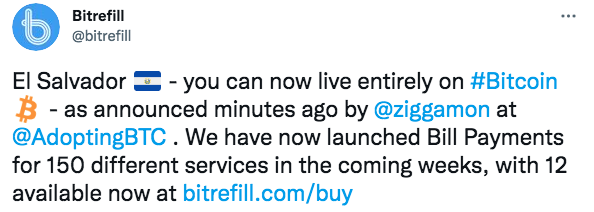
    Bitrefill, the startup that offers Bitcoin-funded prepaid cards for different services worldwide, launched a new bill-payment service that allows Salvadorans to pay for multiple basic needs using Bitcoin. The company made the announcement during the three-day conference Adopting Bitcoin carried in El Salvador, which brought together “the Bitcoin and Lightning community”.

    Bitcoin has been a legal tender in El Salvador since September 7th, but many businesses were not sticking to the requirement of accomodating the digital coin as a payment method into their operations, Bitrefill’s CEO noted. Some have even stated they rather lose sales. Bitrefill aims to offer a solution for businesses so they can easily adapt to using Bitcoin and ease their current worries.

    Related Reading | There Are More People Using Bitcoin Wallets Than Bank Accounts, Says El Salvador President

    Bitrefill’s bill-payment method will allow Salvadorians to pay for 150 different services using Bitcoin, including internet, water, insurance, loans, taxes, mortgage, social security services, university expenses, and others. They also allowed payments overseas. 12 services are available at the moment on the website, and they will be adding the rest over the next few weeks.

    The platform will be using Bitcoins Lightning Network and on-chain transactions, which allows low fees. “El Salvador can now live entire on Bitcoin”, stated the company.

    The feature is offered in alliance with Puntoexpress, a local payment platform. The payment process was simplified for the users so they only need to provide an email address to redeem a voucher code and receipt.

    El Salvador, A Bitcoin Land

    Bitrefill reported they have processed 187,000 purchases in El Salvador during 2021, and 88% come from the country’s capital, San Salvador. There was a peak of 20,000 payments in September when the ‘Bitcoin law’ went into effect.

    The majority of Salvadorians reportedly use the Chivo digital wallet, an app created by the government, as the preferred payment method for Bitrefill purchases.

    Bitrefill’s CEO, Sergej Kotliar, stated that they now have headquarters established in El Salvador, a manager in the country, and they are hiring for all roles to cover the company’s needs. He shared his strategy is to be directly involved in the country by being present and maintaining contact with people who provide him with different approaches and information that the company can use to design other services.

    The CEO thinks El Salvador could become an example model that other countries could follow. The company also stated in a tweet:

    The most important part is that the 80% of unbanked people can now pay for almost everything online, products, services, bills, from the comfort of their home (or their relatives in the USA).

    El Salvador’s adoption of Bitcoin has been a bumpy road. However, the Chivo Wallet surpasses 2.2 million users a few weeks after its launch, gaining around 8,500 new users per hour and reaching 3 million later on. The citizens received $30 each as an incentive for downloading the app, but some reported to Reuters they had problems using it and making withdrawals.

    The government remains optimistic, although challenges lay ahead. We are yet to see if innovation and good strategies can help close the gap between the government’s vision and the tension around Salvadorians.

    Related Reading | El Salvador Calls Another Bitcoin Dip With $25 Million Purchase

    Bitcoin
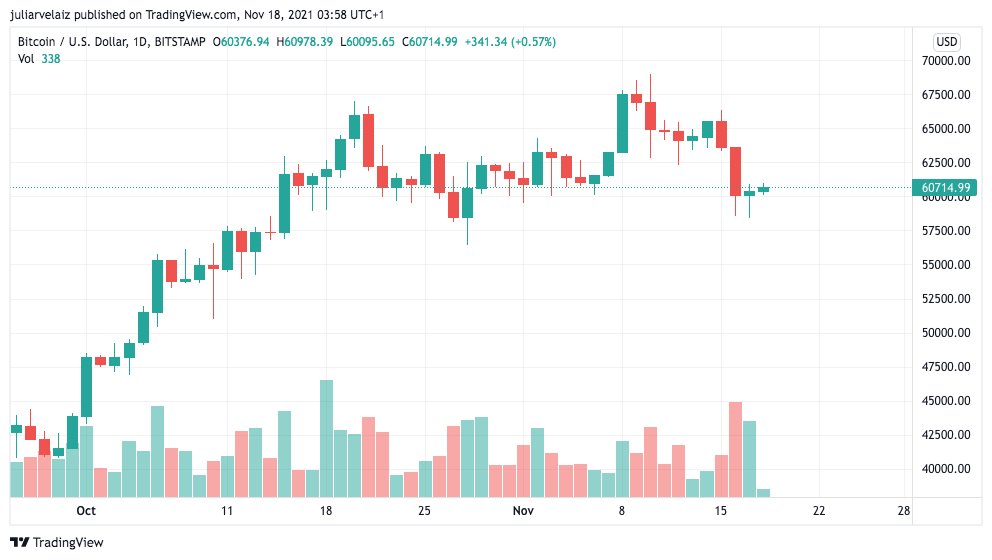
    Bitcoin trading at $60,714 in the daily chart | Source: BTCUSD on TradingView.com

    [ad_2]

    Source link

  • Advancing economic freedom for our veterans and service members

    Advancing economic freedom for our veterans and service members

    [ad_1]

    By Philip Martin, Chief Security Officer

    This Veterans Day, we’re committing to investing in our extraordinary veterans and service members. Our mission is to increase economic freedom in the world, and our work has always been driven by the fact that we believe we can help to build a more fair and equitable financial system for everyone.

    As a veteran myself, I’ve seen firsthand the benefits of service. I’ve also seen how difficult it can be for some veterans to be afforded the opportunities to translate their incredible skills learned in service to the business world. To harness that potential and recognize the vital and unique talents of our veterans, we are partnering with the following organizations: Bunker Labs, The COMMIT Foundation and Shift. Our partnerships will focus on two core areas:

    1. Committing $200,000 to each partner organization to support their mission to advance economic opportunities for service members, veterans, and their families
    2. Dedicating an additional $1 million for a new fund to create unique incentives for veterans and service members to learn more and participate in the cryptoeconomy. This will include bespoke training, networking, and career development opportunities

    Alex Krongard, CEO, The COMMIT Foundation: “On this Veterans Day, I am truly grateful and humbled by Coinbase’s amazing contribution towards helping our service members and their families transition into meaningful and purpose-filled post-service lives. Their sense of service and commitment to their communities and our nation is of incalculable value and needed now more than ever. Again, my sincere thanks and a promise that the COMMIT team will continue to do our utmost in support of our veterans.”

    Mike Slagh, Founder & CEO, Shift: “Shift is over the moon to partner with Coinbase to create new educational and career advancement opportunities within crypto and blockchain technologies for the military community. Our veterans represent one of our nation’s most resilient and diverse workforces, and our community’s passion for learning gives me belief that veterans have an important role to play in the modern workforce. The dedicated members of the Coinbase team have graciously volunteered their time to support our community since our company’s founding days, and I’m so grateful to begin to scale the impact that veterans and military supporters at Coinbase are already creating with military members, past and present.”

    Blake Hogan, CEO, Bunker Labs: “With the commitment and financial support of companies like Coinbase, veteran entrepreneurs across our great country will have access to the professional networks and educational resources they need and deserve, to take on the challenge of starting a business. We are excited and grateful to partner with Coinbase and thank them for their support.”

    Moving forward, we will continue to develop additional programming to support veterans and service members. That includes contributing to these existing partnerships while also recognizing the unique skills and attributes of our veterans as we build a championship team at Coinbase. To that end, we also look forward to adding more talented veterans and service members as we continue to grow.


    Advancing economic freedom for our veterans and service members was originally published in The Coinbase Blog on Medium, where people are continuing the conversation by highlighting and responding to this story.

    [ad_2]

    Source link

  • Mimo DeFi Launches Polygon Support for Lower Fees & Faster Service | by Bit Media Buzz | Aug, 2021

    Mimo DeFi Launches Polygon Support for Lower Fees & Faster Service | by Bit Media Buzz | Aug, 2021

    [ad_1]

    Bit Media Buzz
    Mimo is Now Officially Live on Polygon

    Singapore, Aug 9th, 2021 — Mimo, home of the world’s first decentralized, algorithmically-pegged EUR token, is now officially live on Polygon.

    Polygon lands a massive integration with Mimo. With easy access to blockchain services all on the strength of a euro stable token, the newly merged DeFi project brings a valuable utility to the network.

    [ad_2]

    Source link

  • Fintech for a Better Future: 5 Trends That Are Improving Financial Service

    Fintech for a Better Future: 5 Trends That Are Improving Financial Service

    [ad_1]

    For many people, financial technology is somewhat incidental. It is a passing part of daily life: we interact with fintech when we send money online, check our bank balances with our mobile phones, or use an app to buy cryptocurrency.

    However, for much of the world fintech is so much more. Financial technology can and will play an important role in the ways that societies develop. With the advent of internet accessibility, fintech is reaching a larger group of people than ever before.

    Bank Account Alternative. Business Account IBAN.

    Here are some of the most important ways that fintech itself is changing, and that fintech is changing the world.

    #1: Microservice Architecture Is Building More Flexible & Secure Financial Services

    In the earlier days of financial technology, systems architecture was often created in a monolithic fashion: systems were built as a single unit, only alterable by making changes to the source code. In some cases, this kind of design meant that if part of a financial services system went down, the entire thing could be compromised.

    Microservice architecture was designed to make digital financial services more flexible and secure. This kind of system design breaks down monolithic structures into smaller, independent services that can be deployed for specific purposes.

    For example, an older system design could consist of a payments service, a credit auditing service, and an international money transfer mechanism that were all combined into a single piece of software. If the company that operated the software wanted to change the credit auditing service, it would have to update the entire system at once.

    However, with a microservice architecture, the payments service, a credit auditing service, and an international money transfer mechanism could still operate within the same ecosystem as separate, independent entities. Therefore, if the system operator wanted to make changes to the credit auditing service, it could do so without disturbing any of the other pieces of the system.

    While this architectural concept can be applied in the world of centralized financial services, it seems to borrow from the concept of ‘money legos’ that came from the decentralized finance (DeFi) sphere.

    #2: Decentralized Finance (DeFi) Is Larger & More Diverse than Ever Before

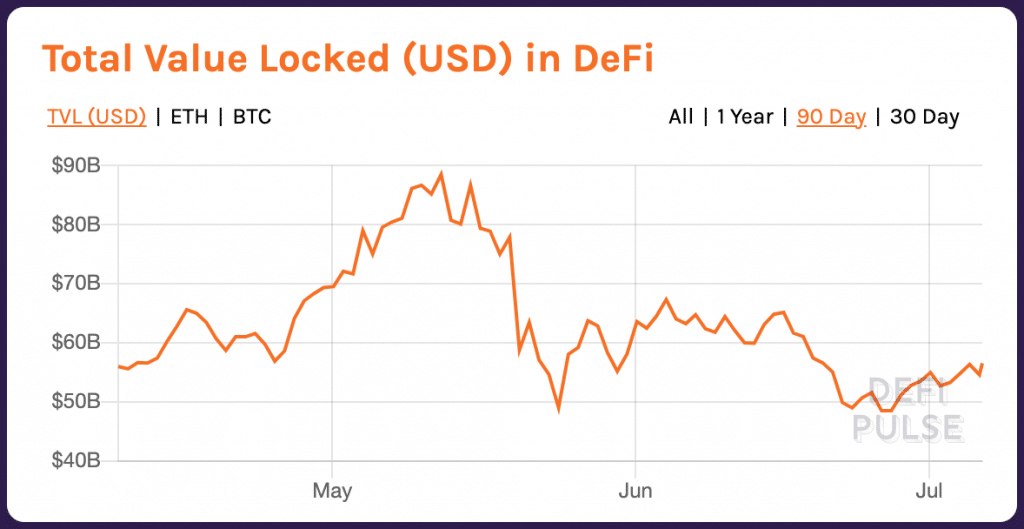
    Seven months into 2021, decentralized finance is bigger than it has ever been. At the beginning of the year, the total value locked (TVL) in the DeFi ecosystem was equivalent to roughly $20 billion; today, DeFi’s TVL is roughly $56 billion. At its peak in May, the TVL was roughly $90 billion.
    As the size of the DeFi ecosystem continues to grow, so too have the number of DeFi use cases. DeFi platforms have been built for asset management, digital identity, insurance, derivatives, synthetics assets, digital asset exchanges, analytics, risk management tools and more.

    Because of the risks associated with many decentralized finance platforms, institutional players have largely stayed out of the DeFi world. Therefore, the vast majority of DeFi’s growth has come from retail users and investors.

    However, some platforms are taking steps to create the infrastructure to support the entrance of institutional players into DeFi. For example, DeFi lending platform Aave announced earlier this week that it will be launching Aave Pro, a permissioned platform that will support institutional usage. Aave said that the launch is coming in response to ‘extensive demand from various institutions’.

    #3: The Advent of Artificial Intelligence (AI), Machine Learning, and Predictive Analytics

    Artificial intelligence and machine learning have a variety of use cases across financial technology. However, one of the most prominent use cases is monitoring, analyzing and predicting customer behavior. For example, AI can be used to determine how and when users of an online banking service might run into technical trouble, and then offer assistance through a chatbot.

    Suggested articles

    Swiss Fintech Set to Change the Landscape of Isolated Financial ServicesGo to article >>

    The use of AI and machine learning is expected to continue to grow with regard to financial regulations and policy compliance, algorithmic trading and fraud detection. AI systems can also play an important role in financial institutions’ anti-money laundering and counter-terrorism operations.

    According to Planet Compliance, “the sectors that are expected to be most affected include insurance, financial data, asset management, decentralized exchanges and lending.”

    #4: Sustainability Is More Important to Fintech Users than Ever

    The climate crisis has wreaked havoc in much of the world, and many new areas that were previously unaffected by climate change have recently undergone serious incidents. For example, the Pacific Northwest is currently in the midst of the worst heat waves in recorded history.

    As a result, everyone is expected to do their part in the battle against climate catastrophe. This has touched the financial world in a fairly significant way: for example, some cryptocurrencies have been under fire this year for their heavy energy consumption.

    Therefore, it is likely that financial technology companies across the board will be increasingly expected to demonstrate their sustainability initiatives.

    Fintech companies and financial institutions may be held to a higher standard in terms of who they do business with. Dr Thomas Puschmann, Director Swiss FinTech Innovation Lab, said in a recent interview with Finance.Swiss that for example, in the lending sector, “[banks] need to know what firms are investing in sustainable solutions for the future.”

    However, there are some significant challenges in terms of sustainability data collection that could guide the decision-making process of many fintech firms and banks.

    “Take, for example, the value chain of a company. Today, we know the greenhouse gas emissions that a firm emits, these so-called Scope 1 emissions and Scope 2 emissions. Scope 1 are the ones that come out of your house; Scope 2 are the ones that you purchase in the form of energy from your energy provider; but Scope 3 emissions, which very often make up to 75 percent of all greenhouse gas emissions, come from anywhere in the supply chain that you can’t control and don’t even know it.”

    “So you need data for that to decide if you want to lend money to such a firm,” he said.

    #5: Fintech Companies Have More Power to Financial Inclusion

    Cryptocurrency and decentralized finance have long been slated as technologies that can provide financial services and opportunities to users in developing markets. However, the opportunity to take root in emerging economies is open to fintech companies.

    In 2021, there has been massive unmet demand for financial services in the developing world. At the same time, the number of smartphone holders in emerging markets is continuing to increase This presents an important opportunity for fintech companies that can provide mobile-based services to users in untapped markets.

    In an article entitled “Fintech and Sustainable Development: Assessing the Implications,” authors Juan Carlos, Castilla-Rubio, Nick Robins and Simon Zadek said that financial technology can support the growth of developing markets by “[unlocking] greater financial inclusion by reducing the costs for payments and providing better access to capital domestically and internationally.”

    Moreover, the paper said that fintech can “Provide financial markets with the level playing field and market integrity needed for long-term real economy investments aligned with the sustainable development agenda,” among other things.

    It’s a Big, Big World out There

    These are just a few of the ways that developments in financial technology are changing financial services as we know them.

    What are your thoughts on the ways that fintech is impacting the world around you? Let us know in the comments below.

    [ad_2]

    Source link