In a post on X (formerly Twitter), Lucie, the marketing lead for Shiba Inu, has provided potential investors with a new set of guidelines for evaluating projects within the Shibarium ecosystem, a dedicated layer-2 blockchain aimed at enhancing the Shiba Inu network. This guidance focuses on critical factors that reflect a project’s contribution to the ecosystem’s growth and sustainability.
Five Investment Rules For Shibarium Projects
1. SHIB Token Burn: Lucie emphasized the importance of SHIB token burning as a primary metric. Token burning, or permanently removing tokens from circulation, is a strategy used to induce scarcity and potentially enhance the token’s value over time. Lucie assesses the impact of SHIB burns on the ecosystem’s overall health and price stability.
2. Metaverse Development: The second rule focuses on whether projects are planning or currently building within the Shiba Inu Metaverse. As SHIB: The Metaverse represents a burgeoning area for development, investments in this space could signal forward-thinking and innovative capabilities within the Shibarium projects.
3. Engagement with BONE Token: BONE ShibaSwap (BONE), serves as the gas token for transactions within Shibarium. Lucie queries whether a project is involved in burning BONE or creating utilities around it that increase its appeal and functional use within the ecosystem. This utility can significantly impact the token’s demand and usage patterns.
4. LEASH Token Utilization: Another crucial factor is the use of Doge Killer (LEASH), another significant token in the ecosystem. Projects’ plans for incorporating LEASH into their functionalities or governance structures reflect their integration depth within the Shibarium network.
5. Verified Contributions to Shibarium: The final criterion involves assessing the tangible, positive contributions a project has made towards improving Shibarium, with a necessity for these contributions to be verifiable on the blockchain. This transparency ensures that the projects not only promise but also deliver real value to the ecosystem.
Examples Of Shiba Inu Projects Meeting Lucie’s Criteria
Lucie named several projects that exemplify her investment rules. WoofSwap, for example, has been a proactive participant in SHIB and BONE burning through its inscription tokens and the launch of its meme coin, DAMN. This activity helps reduce the circulation of key tokens, potentially driving up their value.
Shib Dream and Shib CoOp were cited for their contributions to building within the Shiba Inu Metaverse, a significant area of development that could herald new utility and user engagement within the ecosystem. K9 Finance has been noted for enhancing liquidity and staking mechanisms for BONE, creating more robust economic incentives and utility for the token.
In terms of blockchain-verifiable contributions, projects like LumiBots, Mantra Protocol, NestX, and Shib CoOp assist in NFT adoption on Shibarium, facilitating a broader use case for digital assets within the ecosystem. DEX MARSWAP was highlighted for its role in facilitating Shiboshis staking and supporting new projects within the ecosystem.
Shib Dream responded enthusiastically to Lucie’s endorsement: “All great projects! We have burned over a Billion Shib. Invested over 30K in Shibarium Projects. Building in the Metaverse. Gave back over $60K to the community. Good Deeds – Over $10k in Donations. Not using Leash yet going to figure that out. Other things coming soon. SHIBARIUM. Keep Building. Keep Dreaming.”
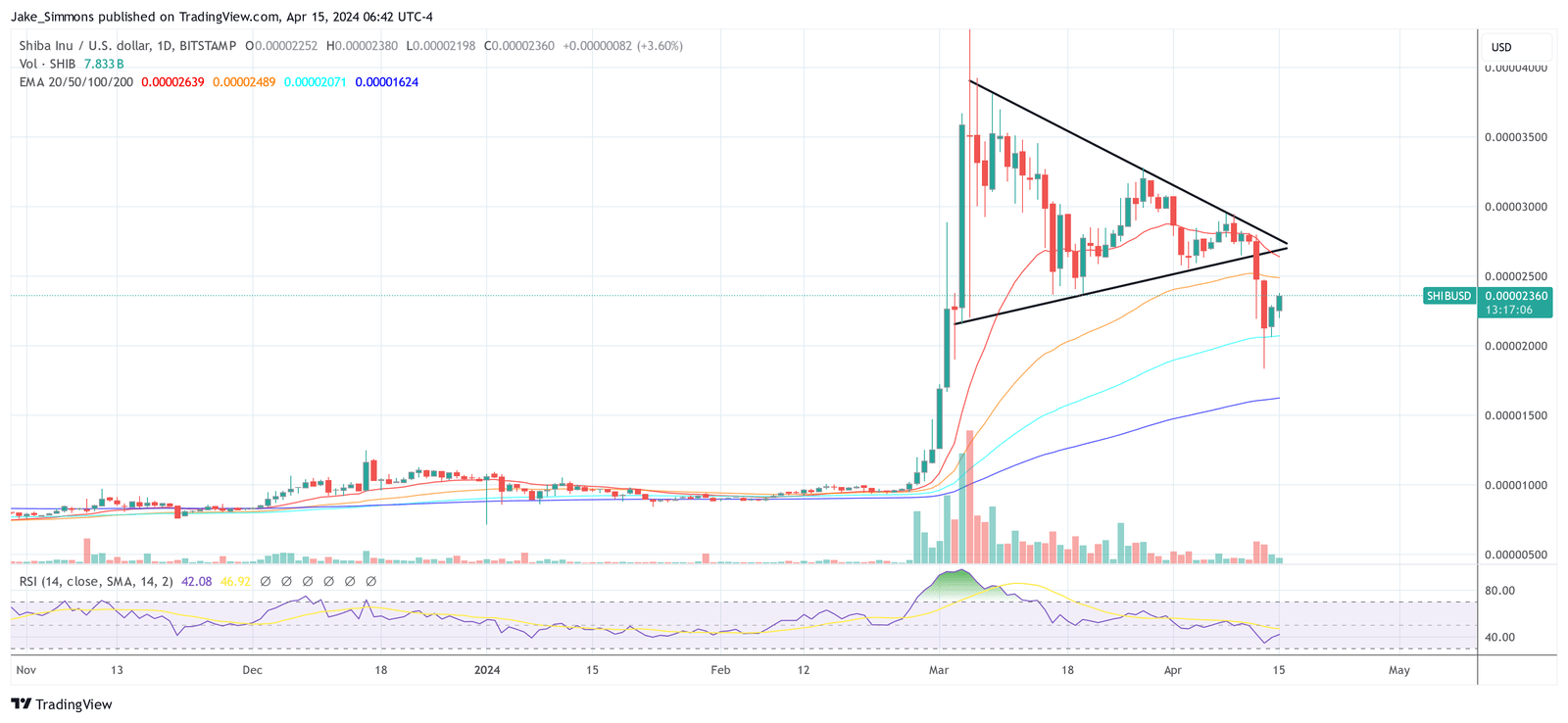
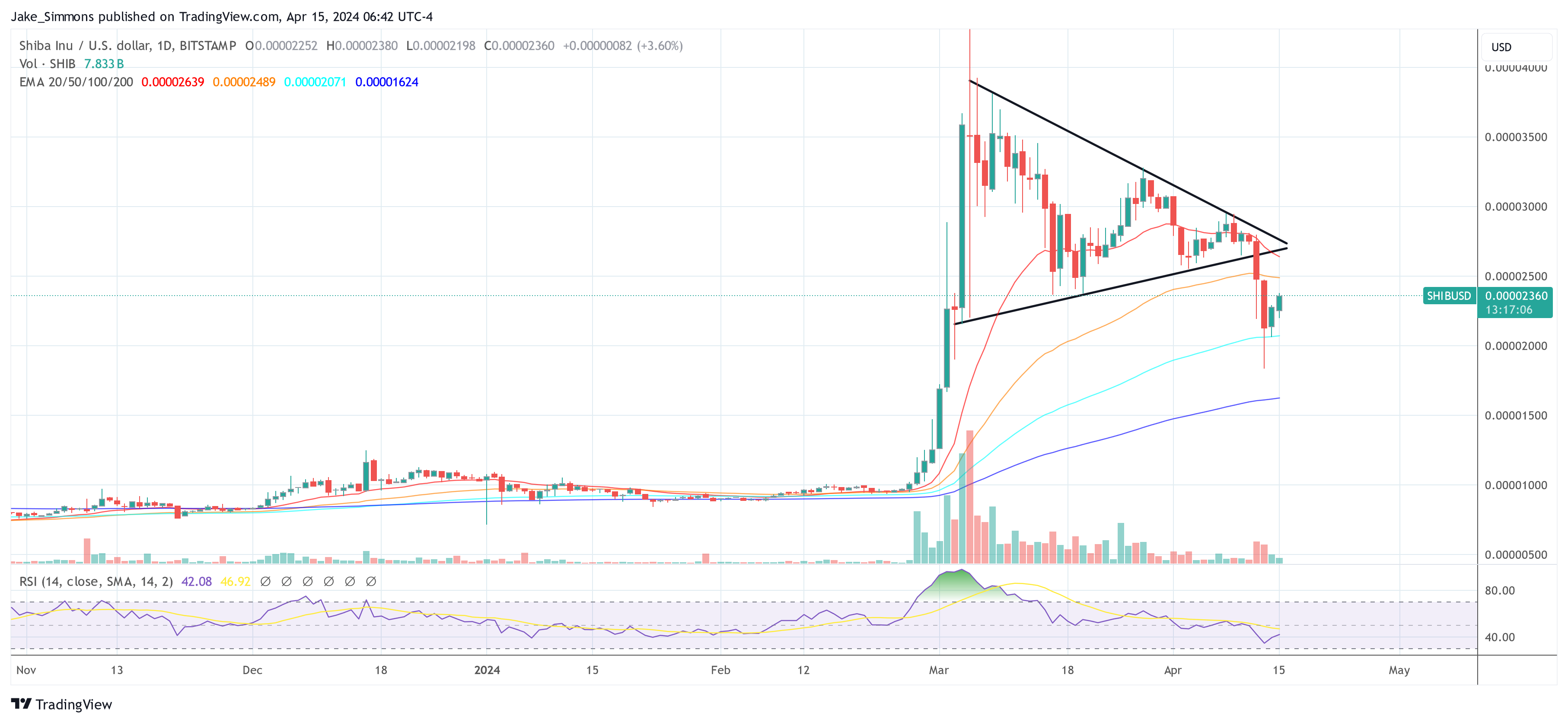
At press time, SHIB traded at $0.00002360.
SHIB breaks the symmetrical triangle to the downside, 1-day chart | Source: SHIBUSD on TradingView.com
Featured image created with DALL·E, chart from TradingView.com
Disclaimer: The article is provided for educational purposes only. It does not represent the opinions of NewsBTC on whether to buy, sell or hold any investments and naturally investing carries risks. You are advised to conduct your own research before making any investment decisions. Use information provided on this website entirely at your own risk.
Ron Wyden, a US Democrat Senator from Oregon and one of the most influential members of Congress in the country, has warned that a tough stance on cryptos could be unhealthy for the booming industry.
The congressman asked his colleagues to protect crypto innovators despite accusations of the industry being friendly with money laundering and fraud.
“There is obviously a debate [about stricter regulation
Regulation
Like any other industry with a high net worth, the financial services industry is tightly regulated to help curb illicit behavior and manipulation. Each asset class has its own set of protocols put in place to combat their respective forms of abuse.In the foreign exchange space, regulation is assumed by authorities in multiple jurisdictions, though ultimately lacking a binding international order. Who are the Industry’s Leading Regulators?Regulators such as the UK’s Financial Conduct Authority (FCA), the US’ Securities and Exchange Commission (SEC), Australian Security and Investment Commission (ASIC), and the Cyprus Securities and Exchange Commission (CySEC) are the most widely dealt with authorities in the FX industry.In its most basic sense, regulators help ensure the filing of reports and transmission of data to help police and monitor activity by brokers. Regulators also serve as a countermeasure against market abuse and malpractice by brokers. Brokers adhering to a list of mandated rules are authorized to provide investment activities in a given jurisdiction. By extension, many unauthorized or unregulated entities will also seek to market their services illegally or function as a clone of a regulated operation.Regulators are essential in snuffing out these scam operations as they prevent significant risks for investors.In terms of reporting, brokers are also required to regularly file reports about their clients’ positions to the relevant regulatory authorities. The most-recent regulatory push in the aftermath of the Great Financial Crisis of 2008 has delivered a material shift in the regulatory reporting landscape.Brokers typically outsource the reporting to other companies which are connecting the trade repositories used by regulators to the broker’s systems and are handling this crucial element of compliance.Beyond FX, regulators help reconcile all matters of oversight and are watchdogs for each industry. With ever-changing information and protocols, regulators are always working to promote fairer and more transparent business practices from brokers or exchanges.
Like any other industry with a high net worth, the financial services industry is tightly regulated to help curb illicit behavior and manipulation. Each asset class has its own set of protocols put in place to combat their respective forms of abuse.In the foreign exchange space, regulation is assumed by authorities in multiple jurisdictions, though ultimately lacking a binding international order. Who are the Industry’s Leading Regulators?Regulators such as the UK’s Financial Conduct Authority (FCA), the US’ Securities and Exchange Commission (SEC), Australian Security and Investment Commission (ASIC), and the Cyprus Securities and Exchange Commission (CySEC) are the most widely dealt with authorities in the FX industry.In its most basic sense, regulators help ensure the filing of reports and transmission of data to help police and monitor activity by brokers. Regulators also serve as a countermeasure against market abuse and malpractice by brokers. Brokers adhering to a list of mandated rules are authorized to provide investment activities in a given jurisdiction. By extension, many unauthorized or unregulated entities will also seek to market their services illegally or function as a clone of a regulated operation.Regulators are essential in snuffing out these scam operations as they prevent significant risks for investors.In terms of reporting, brokers are also required to regularly file reports about their clients’ positions to the relevant regulatory authorities. The most-recent regulatory push in the aftermath of the Great Financial Crisis of 2008 has delivered a material shift in the regulatory reporting landscape.Brokers typically outsource the reporting to other companies which are connecting the trade repositories used by regulators to the broker’s systems and are handling this crucial element of compliance.Beyond FX, regulators help reconcile all matters of oversight and are watchdogs for each industry. With ever-changing information and protocols, regulators are always working to promote fairer and more transparent business practices from brokers or exchanges. Read this Term], but I want to be on the side of the innovator. When I think about crypto, I think about remittances, or somebody who has a kid 1,000 miles away and wants to get them help in an emergency, rather than going through scores of banks, credit card companies,” Rep. Wyden told the Financial Times in an interview.
He added that he strives for innovations and will always be on that side. “That’s where my heart lies,” Wyden commented. The Senator is currently the chair of the Senate finance committee and one of the proponents of the US internet regulation.
Last year, Gary Gensler, the Chairman of the US Securities and Exchange Commission (SEC), recently expressed his views about Bitcoin and other cryptocurrency assets in a discussion with the House Committee on Financial Services. Gensler stated that the US will not completely follow China’s lead in banning cryptocurrencies
Cryptocurrencies
By using cryptography, virtual currencies, known as cryptocurrencies, are nearly counterfeit-proof digital currencies that are built on blockchain technology. Comprised of decentralized networks, blockchain technology is not overseen by a central authority.Therefore, cryptocurrencies function in a decentralized nature which theoretically makes them immune to government interference. The term, cryptocurrency derives from the origin of the encryption techniques that are employed to secure the networks which are used to authenticate blockchain technology. Cryptocurrencies can be thought of as systems that accept online payments which are denoted as “tokens.” Tokens are represented as internal ledger entries in blockchain technology while the term crypto is used to depict cryptographic methods and encryption algorithms such as public-private key pairs, various hashing functions, and an elliptical curve. Every cryptocurrency transaction that occurs is logged in a web-based ledger with blockchain technology.These then must be approved by a disparate network of individual nodes (computers that maintain a copy of the ledger). For every new block generated, the block must first be authenticated and confirmed ‘approved’ by each node, which makes forging the transactional history of cryptocurrencies nearly impossible. The World’s First CryptoBitcoin became the first blockchain-based cryptocurrency and to this day is still the most demanded cryptocurrency and the most valued. Bitcoin still contributes the majority of the overall cryptocurrency market volume, though several other cryptos have grown in popularity in recent years.Indeed, out of the wake of Bitcoin, iterations of Bitcoin became prevalent which resulted in a multitude of newly created or cloned cryptocurrencies. Contending cryptocurrencies that emerged after Bitcoin’s success is referred to as ‘altcoins’ and they refer to cryptocurrencies such as Bitcoin, Peercoin, Namecoin, Ethereum, Ripple, Stellar, and Dash. Cryptocurrencies promise a wide range of technological innovations that have yet to be structured into being. Simplified payments between two parties without the need for a middle man is one aspect while leveraging blockchain technology to minimize transaction and processing fees for banks is another. Of course, cryptocurrencies have their disadvantages too. This includes issues of tax evasion, money laundering, and other illicit online activities where anonymity is a dire ingredient in solicitous and fraudulent activities.
By using cryptography, virtual currencies, known as cryptocurrencies, are nearly counterfeit-proof digital currencies that are built on blockchain technology. Comprised of decentralized networks, blockchain technology is not overseen by a central authority.Therefore, cryptocurrencies function in a decentralized nature which theoretically makes them immune to government interference. The term, cryptocurrency derives from the origin of the encryption techniques that are employed to secure the networks which are used to authenticate blockchain technology. Cryptocurrencies can be thought of as systems that accept online payments which are denoted as “tokens.” Tokens are represented as internal ledger entries in blockchain technology while the term crypto is used to depict cryptographic methods and encryption algorithms such as public-private key pairs, various hashing functions, and an elliptical curve. Every cryptocurrency transaction that occurs is logged in a web-based ledger with blockchain technology.These then must be approved by a disparate network of individual nodes (computers that maintain a copy of the ledger). For every new block generated, the block must first be authenticated and confirmed ‘approved’ by each node, which makes forging the transactional history of cryptocurrencies nearly impossible. The World’s First CryptoBitcoin became the first blockchain-based cryptocurrency and to this day is still the most demanded cryptocurrency and the most valued. Bitcoin still contributes the majority of the overall cryptocurrency market volume, though several other cryptos have grown in popularity in recent years.Indeed, out of the wake of Bitcoin, iterations of Bitcoin became prevalent which resulted in a multitude of newly created or cloned cryptocurrencies. Contending cryptocurrencies that emerged after Bitcoin’s success is referred to as ‘altcoins’ and they refer to cryptocurrencies such as Bitcoin, Peercoin, Namecoin, Ethereum, Ripple, Stellar, and Dash. Cryptocurrencies promise a wide range of technological innovations that have yet to be structured into being. Simplified payments between two parties without the need for a middle man is one aspect while leveraging blockchain technology to minimize transaction and processing fees for banks is another. Of course, cryptocurrencies have their disadvantages too. This includes issues of tax evasion, money laundering, and other illicit online activities where anonymity is a dire ingredient in solicitous and fraudulent activities. Read this Term.
He pointed out at that time that any decision regarding a crypto ban would be up to Congress. “Our approach is really quite different,” Gensler said in the latest discussion.
China Crypto Crackdown
In 2021, China imposed a ban on all crypto-related activities, including mining. However, despite the reason that the US cryptocurrency ecosystem is still uncertain about the potential regulations in the region, the overall adoption has increased sharply in the last few months.
Four of Wyden’s colleagues recently wrote to Janet Yellen, US Treasury Secretary, expressing their concerns about cryptocurrencies being used to bypass international sanctions.
Ron Wyden, a US Democrat Senator from Oregon and one of the most influential members of Congress in the country, has warned that a tough stance on cryptos could be unhealthy for the booming industry.
The congressman asked his colleagues to protect crypto innovators despite accusations of the industry being friendly with money laundering and fraud.
“There is obviously a debate [about stricter regulation
Regulation
Like any other industry with a high net worth, the financial services industry is tightly regulated to help curb illicit behavior and manipulation. Each asset class has its own set of protocols put in place to combat their respective forms of abuse.In the foreign exchange space, regulation is assumed by authorities in multiple jurisdictions, though ultimately lacking a binding international order. Who are the Industry’s Leading Regulators?Regulators such as the UK’s Financial Conduct Authority (FCA), the US’ Securities and Exchange Commission (SEC), Australian Security and Investment Commission (ASIC), and the Cyprus Securities and Exchange Commission (CySEC) are the most widely dealt with authorities in the FX industry.In its most basic sense, regulators help ensure the filing of reports and transmission of data to help police and monitor activity by brokers. Regulators also serve as a countermeasure against market abuse and malpractice by brokers. Brokers adhering to a list of mandated rules are authorized to provide investment activities in a given jurisdiction. By extension, many unauthorized or unregulated entities will also seek to market their services illegally or function as a clone of a regulated operation.Regulators are essential in snuffing out these scam operations as they prevent significant risks for investors.In terms of reporting, brokers are also required to regularly file reports about their clients’ positions to the relevant regulatory authorities. The most-recent regulatory push in the aftermath of the Great Financial Crisis of 2008 has delivered a material shift in the regulatory reporting landscape.Brokers typically outsource the reporting to other companies which are connecting the trade repositories used by regulators to the broker’s systems and are handling this crucial element of compliance.Beyond FX, regulators help reconcile all matters of oversight and are watchdogs for each industry. With ever-changing information and protocols, regulators are always working to promote fairer and more transparent business practices from brokers or exchanges.
Like any other industry with a high net worth, the financial services industry is tightly regulated to help curb illicit behavior and manipulation. Each asset class has its own set of protocols put in place to combat their respective forms of abuse.In the foreign exchange space, regulation is assumed by authorities in multiple jurisdictions, though ultimately lacking a binding international order. Who are the Industry’s Leading Regulators?Regulators such as the UK’s Financial Conduct Authority (FCA), the US’ Securities and Exchange Commission (SEC), Australian Security and Investment Commission (ASIC), and the Cyprus Securities and Exchange Commission (CySEC) are the most widely dealt with authorities in the FX industry.In its most basic sense, regulators help ensure the filing of reports and transmission of data to help police and monitor activity by brokers. Regulators also serve as a countermeasure against market abuse and malpractice by brokers. Brokers adhering to a list of mandated rules are authorized to provide investment activities in a given jurisdiction. By extension, many unauthorized or unregulated entities will also seek to market their services illegally or function as a clone of a regulated operation.Regulators are essential in snuffing out these scam operations as they prevent significant risks for investors.In terms of reporting, brokers are also required to regularly file reports about their clients’ positions to the relevant regulatory authorities. The most-recent regulatory push in the aftermath of the Great Financial Crisis of 2008 has delivered a material shift in the regulatory reporting landscape.Brokers typically outsource the reporting to other companies which are connecting the trade repositories used by regulators to the broker’s systems and are handling this crucial element of compliance.Beyond FX, regulators help reconcile all matters of oversight and are watchdogs for each industry. With ever-changing information and protocols, regulators are always working to promote fairer and more transparent business practices from brokers or exchanges. Read this Term], but I want to be on the side of the innovator. When I think about crypto, I think about remittances, or somebody who has a kid 1,000 miles away and wants to get them help in an emergency, rather than going through scores of banks, credit card companies,” Rep. Wyden told the Financial Times in an interview.
He added that he strives for innovations and will always be on that side. “That’s where my heart lies,” Wyden commented. The Senator is currently the chair of the Senate finance committee and one of the proponents of the US internet regulation.
Last year, Gary Gensler, the Chairman of the US Securities and Exchange Commission (SEC), recently expressed his views about Bitcoin and other cryptocurrency assets in a discussion with the House Committee on Financial Services. Gensler stated that the US will not completely follow China’s lead in banning cryptocurrencies
Cryptocurrencies
By using cryptography, virtual currencies, known as cryptocurrencies, are nearly counterfeit-proof digital currencies that are built on blockchain technology. Comprised of decentralized networks, blockchain technology is not overseen by a central authority.Therefore, cryptocurrencies function in a decentralized nature which theoretically makes them immune to government interference. The term, cryptocurrency derives from the origin of the encryption techniques that are employed to secure the networks which are used to authenticate blockchain technology. Cryptocurrencies can be thought of as systems that accept online payments which are denoted as “tokens.” Tokens are represented as internal ledger entries in blockchain technology while the term crypto is used to depict cryptographic methods and encryption algorithms such as public-private key pairs, various hashing functions, and an elliptical curve. Every cryptocurrency transaction that occurs is logged in a web-based ledger with blockchain technology.These then must be approved by a disparate network of individual nodes (computers that maintain a copy of the ledger). For every new block generated, the block must first be authenticated and confirmed ‘approved’ by each node, which makes forging the transactional history of cryptocurrencies nearly impossible. The World’s First CryptoBitcoin became the first blockchain-based cryptocurrency and to this day is still the most demanded cryptocurrency and the most valued. Bitcoin still contributes the majority of the overall cryptocurrency market volume, though several other cryptos have grown in popularity in recent years.Indeed, out of the wake of Bitcoin, iterations of Bitcoin became prevalent which resulted in a multitude of newly created or cloned cryptocurrencies. Contending cryptocurrencies that emerged after Bitcoin’s success is referred to as ‘altcoins’ and they refer to cryptocurrencies such as Bitcoin, Peercoin, Namecoin, Ethereum, Ripple, Stellar, and Dash. Cryptocurrencies promise a wide range of technological innovations that have yet to be structured into being. Simplified payments between two parties without the need for a middle man is one aspect while leveraging blockchain technology to minimize transaction and processing fees for banks is another. Of course, cryptocurrencies have their disadvantages too. This includes issues of tax evasion, money laundering, and other illicit online activities where anonymity is a dire ingredient in solicitous and fraudulent activities.
By using cryptography, virtual currencies, known as cryptocurrencies, are nearly counterfeit-proof digital currencies that are built on blockchain technology. Comprised of decentralized networks, blockchain technology is not overseen by a central authority.Therefore, cryptocurrencies function in a decentralized nature which theoretically makes them immune to government interference. The term, cryptocurrency derives from the origin of the encryption techniques that are employed to secure the networks which are used to authenticate blockchain technology. Cryptocurrencies can be thought of as systems that accept online payments which are denoted as “tokens.” Tokens are represented as internal ledger entries in blockchain technology while the term crypto is used to depict cryptographic methods and encryption algorithms such as public-private key pairs, various hashing functions, and an elliptical curve. Every cryptocurrency transaction that occurs is logged in a web-based ledger with blockchain technology.These then must be approved by a disparate network of individual nodes (computers that maintain a copy of the ledger). For every new block generated, the block must first be authenticated and confirmed ‘approved’ by each node, which makes forging the transactional history of cryptocurrencies nearly impossible. The World’s First CryptoBitcoin became the first blockchain-based cryptocurrency and to this day is still the most demanded cryptocurrency and the most valued. Bitcoin still contributes the majority of the overall cryptocurrency market volume, though several other cryptos have grown in popularity in recent years.Indeed, out of the wake of Bitcoin, iterations of Bitcoin became prevalent which resulted in a multitude of newly created or cloned cryptocurrencies. Contending cryptocurrencies that emerged after Bitcoin’s success is referred to as ‘altcoins’ and they refer to cryptocurrencies such as Bitcoin, Peercoin, Namecoin, Ethereum, Ripple, Stellar, and Dash. Cryptocurrencies promise a wide range of technological innovations that have yet to be structured into being. Simplified payments between two parties without the need for a middle man is one aspect while leveraging blockchain technology to minimize transaction and processing fees for banks is another. Of course, cryptocurrencies have their disadvantages too. This includes issues of tax evasion, money laundering, and other illicit online activities where anonymity is a dire ingredient in solicitous and fraudulent activities. Read this Term.
He pointed out at that time that any decision regarding a crypto ban would be up to Congress. “Our approach is really quite different,” Gensler said in the latest discussion.
China Crypto Crackdown
In 2021, China imposed a ban on all crypto-related activities, including mining. However, despite the reason that the US cryptocurrency ecosystem is still uncertain about the potential regulations in the region, the overall adoption has increased sharply in the last few months.
Four of Wyden’s colleagues recently wrote to Janet Yellen, US Treasury Secretary, expressing their concerns about cryptocurrencies being used to bypass international sanctions.