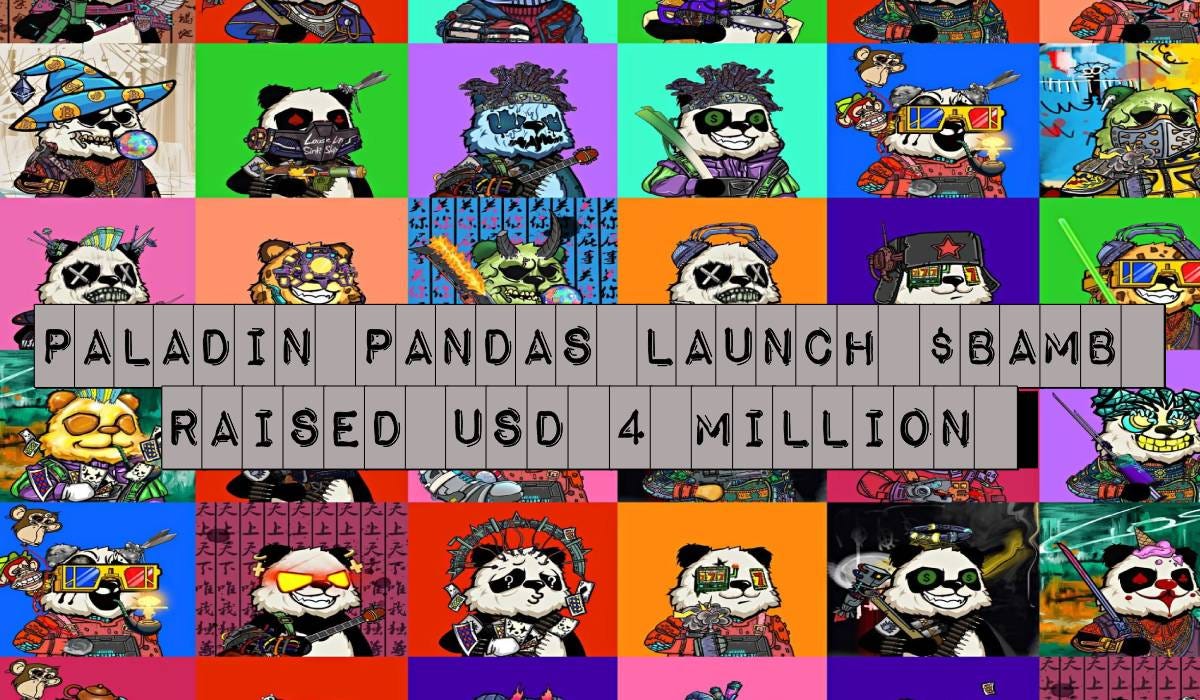
OHDAT-affiliated NFT Game Project Paladin Pandas launched their ERC-20 Token $BAMB on the Ethereum chain on April 6th 2022. This established Paladin Pandas as one of the first NFT projects that has completed both the launch of their play-to-earn game and their token.
A hand-drawn 10K NFT collection launched on Opensea on September 28th 2021, Paladin Pandas sold out in 32 minutes. It was ranked №6 on the daily volume leaderboard, №13 on the weekly volume leaderboard and featured on the OpenSea homepage.
NFT whale owners including influencer and top collector, Zeneca_33, COLE, co-founder of Pudgy Penguins, and NFT influencers Josh Ong and NFT Girl, as well as crypto artist JN Silva, all added Paladin Pandas to their collection.
This led to recognition from established VCs and other institutions and angel investors and OHDAT raised funding totalling US$4M from Future Capital, Hashkey Capital, Innoangel, Y2Z Capital, Vincent Niu, the founder of Sky9 Capital and Mandy Wang, the founder of Odaily. The funds raised were to go towards launching new projects and implementing the Open World social simulation game and MMORPG game, highlighted on their Roadmap 2.0.
On January 25th, Paladin Pandas launched ‘PvE game Space Expedition’, where players send their Pandas to planets on an expedition (with 15 stages each) while strategically putting the Pandas into teams of 3 to retrieve the lost $BAMB (Bamboonium) through battles and mini-games. Since categories like element, class, weapon all matter in the gameplay, players need to select the right pandas to buy and be sent to battle, involving strategy gameplay.
All $BAMB earned from the PvE game is locked in the players’ $BAMB balance, to be unlocked and claimable at a weekly rate of 15%. The lockup can be lifted if players manage to get on the PvP daily/weekly leaderboard.
On March 9th, PvP: ‘Panda v. Panda’ open demo was officially released, a 1V1 3D combat game for true gamers. Players pay $BAMB to enter the arena and loot more $BAMB from other players. With 48 weapons, 7 basic moves and 21 stages, the gameplay is not limited to a ‘Stake-to-Earn’ mechanism; it is an actual ‘Play-to-Earn’ NFT game with delightful strategy gaming, which is a stab at revolutionizing NFT gaming. Up to now, which can be quite monotonous when the focus is only on the earnings. The PvP open demo initiated the “Clean the rugs’ campaign and airdropped 40K $BAMB tokens to the gamefi project holdlers.
Giving perks to all NFT holders was taken into account when devising the Paladin Pandas ecosystem. Mandatory to use a Paladin Panda to enter the game, so as to extend the user base to more NFT gamers, non-holders can also rent Pandas by paying $BAMB. The rental limit for each Panda is 2x for PvE and 3x for PvP.
Besides being an in-game currency, $BAMB has several utilities. First, $BAMB can be staked along with LP tokens to mine 5% of the overall supply, a total of 25M $BAMB. Second, $BAMB can be swapped to Power Raffle tickets, which is a WEB3 raffle machine to win blue chip NFT projects with minimum entry fees. Third, $BAMB holders are able to access exclusive online store merchandise, in-game marketplace boosts, and also the whitelist marketplace to consume their tokens.
To celebrate the $BAMB launch, the OHDAT team will incentivize Panda owners with 2 airdrops. First, 60 Rent Tickets will be dropped to 30K new addresses for mining the game, for their first run. Second, 1.5% of the overall supply, totaling 7.5M $BAMB will be airdropped to all Panda holders. Prioritizing fun gaming features, Paladin Pandas aims for $BAMB to be a “blue chip token” in the NFT market over the long term.
ConsenSys, a blockchain
Blockchain
Blockchain comprises a digital network of blocks with a comprehensive ledger of transactions made in a cryptocurrency such as Bitcoin or other altcoins.One of the signature features of blockchain is that it is maintained across more than one computer. The ledger can be public or private (permissioned.) In this sense, blockchain is immune to the manipulation of data making it not only open but verifiable. Because a blockchain is stored across a network of computers, it is very difficult to tamper with. The Evolution of BlockchainBlockchain was originally invented by an individual or group of people under the name of Satoshi Nakamoto in 2008. The purpose of blockchain was originally to serve as the public transaction ledger of Bitcoin, the world’s first cryptocurrency.In particular, bundles of transaction data, called “blocks”, are added to the ledger in a chronological fashion, forming a “chain.” These blocks include things like date, time, dollar amount, and (in some cases) the public addresses of the sender and the receiver.The computers responsible for upholding a blockchain network are called “nodes.” These nodes carry out the duties necessary to confirm the transactions and add them to the ledger. In exchange for their work, the nodes receive rewards in the form of crypto tokens.By storing data via a peer-to-peer network (P2P), blockchain controls for a wide range of risks that are traditionally inherent with data being held centrally.Of note, P2P blockchain networks lack centralized points of vulnerability. Consequently, hackers cannot exploit these networks via normalized means nor does the network possess a central failure point.In order to hack or alter a blockchain’s ledger, more than half of the nodes must be compromised. Looking ahead, blockchain technology is an area of extensive research across multiple industries, including financial services and payments, among others.
Blockchain comprises a digital network of blocks with a comprehensive ledger of transactions made in a cryptocurrency such as Bitcoin or other altcoins.One of the signature features of blockchain is that it is maintained across more than one computer. The ledger can be public or private (permissioned.) In this sense, blockchain is immune to the manipulation of data making it not only open but verifiable. Because a blockchain is stored across a network of computers, it is very difficult to tamper with. The Evolution of BlockchainBlockchain was originally invented by an individual or group of people under the name of Satoshi Nakamoto in 2008. The purpose of blockchain was originally to serve as the public transaction ledger of Bitcoin, the world’s first cryptocurrency.In particular, bundles of transaction data, called “blocks”, are added to the ledger in a chronological fashion, forming a “chain.” These blocks include things like date, time, dollar amount, and (in some cases) the public addresses of the sender and the receiver.The computers responsible for upholding a blockchain network are called “nodes.” These nodes carry out the duties necessary to confirm the transactions and add them to the ledger. In exchange for their work, the nodes receive rewards in the form of crypto tokens.By storing data via a peer-to-peer network (P2P), blockchain controls for a wide range of risks that are traditionally inherent with data being held centrally.Of note, P2P blockchain networks lack centralized points of vulnerability. Consequently, hackers cannot exploit these networks via normalized means nor does the network possess a central failure point.In order to hack or alter a blockchain’s ledger, more than half of the nodes must be compromised. Looking ahead, blockchain technology is an area of extensive research across multiple industries, including financial services and payments, among others. Read this Term technology solutions provider, announced on Tuesday that it had closed a $450 million financing round, bringing its valuation to over $7 billion. According to the press release, ParaFi Capital led the funding raise.
New investors joined them, including Temasek, SoftBank Vision Fund 2, Microsoft, Anthos Capital, Sound Ventures, and C Ventures. The United Talent Agency’s venture fund, UTA VC, and Third Point also participated in this round of funding. In this transaction, Sullivan & Cromwell LLP acted as ConsenSys’ legal advisor.
“I think of ConsenSys as a broad and deep capabilities machine for the decentralized protocols ecosystem, able to rapidly capitalize at scale on fundamental new constructs that emerge, such as developer tooling, tokenization, token launches, wallets, security audits, DeFi (1.0, 2.0 and beyond), NFTs, bridges, Layer-2 scaling, DAOs, and more. This view has resonated with our crypto native and growth investors in a Series D that will enable us to execute powerful growth strategies,” Joseph Lubin, Founder and CEO of ConsenSys, commented.
According to ConsenSys’ treasury strategy, the proceeds from this round will be converted to ETH in order to rebalance the ratio of ETH to USD equivalents. They added to ConsenSys’ “ultra sound money” position in advance of Ethereum’s merger to Proof of Stake.
A significant amount of Ethereum, stablecoins, and other crypto assets have been accumulated by ConsenSys over the years, which is actively investing them in DeFi protocols and via staking
Staking
Staking is defined as the process of holding funds in a cryptocurrency wallet to support the operations of a blockchain network. In particular, staking represents a bid to secure a volume of crypto to receive rewards. In most case however, this process relies on users participating in blockchain-related activities via a personal crypto wallet.The concept of staking is also closely tied to the Proof-of-Stake (PoS). PoS is a type of consensus algorithm in which a blockchain network aims to achieve distributed consensus.This notably differs from Proof-of-Work (PoW) blockchains that instead rely on mining to verify and validate new blocks.Conversely, PoS chains produce and validate new blocks through staking. This allows for blocks to be produced without relying on mining hardware. As such, instead of competing for the next block with heavy computation work, PoS validators are selected based on the number of coins they are committing to stake.Users that stake larger amounts of coins have a higher chance of being chosen as the next block validator. Staking ExplainedStaking requires a direct investment in the cryptocurrency, while each PoS blockchain has its particular staking currency.The production of blocks via staking enables a higher degree of scalability. Moreover, some chains have also moved to adopt the Delegated Proof of Staking (DPoS) model. DPoS allows users to simply signal their support through other participants of the network. In other words, a trusted participant works on behalf of users during decision-making events.The delegated validators or nodes are the ones that handle the major operations and overall governance of a blockchain network. These participate in the processes of reaching consensus and defining key governance parameters.
Staking is defined as the process of holding funds in a cryptocurrency wallet to support the operations of a blockchain network. In particular, staking represents a bid to secure a volume of crypto to receive rewards. In most case however, this process relies on users participating in blockchain-related activities via a personal crypto wallet.The concept of staking is also closely tied to the Proof-of-Stake (PoS). PoS is a type of consensus algorithm in which a blockchain network aims to achieve distributed consensus.This notably differs from Proof-of-Work (PoW) blockchains that instead rely on mining to verify and validate new blocks.Conversely, PoS chains produce and validate new blocks through staking. This allows for blocks to be produced without relying on mining hardware. As such, instead of competing for the next block with heavy computation work, PoS validators are selected based on the number of coins they are committing to stake.Users that stake larger amounts of coins have a higher chance of being chosen as the next block validator. Staking ExplainedStaking requires a direct investment in the cryptocurrency, while each PoS blockchain has its particular staking currency.The production of blocks via staking enables a higher degree of scalability. Moreover, some chains have also moved to adopt the Delegated Proof of Staking (DPoS) model. DPoS allows users to simply signal their support through other participants of the network. In other words, a trusted participant works on behalf of users during decision-making events.The delegated validators or nodes are the ones that handle the major operations and overall governance of a blockchain network. These participate in the processes of reaching consensus and defining key governance parameters. Read this Term using its own financial infrastructures, such as MetaMask Institutional and Codefi Staking.
MyCrypto Acquisition
Recently, ConsenSys announced the acquisition of MyCrypto, a market-leading Web3 wallet. Following the acquisition, ConsenSys will combine MyCrypto with its popular MetaMask wallet.
MetaMask and MyCrypto will integrate their efforts under a shared brand to enhance the security of all their products and build a cohesive user experience across browser, extension, mobile and desktop wallets.
ConsenSys, a blockchain
Blockchain
Blockchain comprises a digital network of blocks with a comprehensive ledger of transactions made in a cryptocurrency such as Bitcoin or other altcoins.One of the signature features of blockchain is that it is maintained across more than one computer. The ledger can be public or private (permissioned.) In this sense, blockchain is immune to the manipulation of data making it not only open but verifiable. Because a blockchain is stored across a network of computers, it is very difficult to tamper with. The Evolution of BlockchainBlockchain was originally invented by an individual or group of people under the name of Satoshi Nakamoto in 2008. The purpose of blockchain was originally to serve as the public transaction ledger of Bitcoin, the world’s first cryptocurrency.In particular, bundles of transaction data, called “blocks”, are added to the ledger in a chronological fashion, forming a “chain.” These blocks include things like date, time, dollar amount, and (in some cases) the public addresses of the sender and the receiver.The computers responsible for upholding a blockchain network are called “nodes.” These nodes carry out the duties necessary to confirm the transactions and add them to the ledger. In exchange for their work, the nodes receive rewards in the form of crypto tokens.By storing data via a peer-to-peer network (P2P), blockchain controls for a wide range of risks that are traditionally inherent with data being held centrally.Of note, P2P blockchain networks lack centralized points of vulnerability. Consequently, hackers cannot exploit these networks via normalized means nor does the network possess a central failure point.In order to hack or alter a blockchain’s ledger, more than half of the nodes must be compromised. Looking ahead, blockchain technology is an area of extensive research across multiple industries, including financial services and payments, among others.
Blockchain comprises a digital network of blocks with a comprehensive ledger of transactions made in a cryptocurrency such as Bitcoin or other altcoins.One of the signature features of blockchain is that it is maintained across more than one computer. The ledger can be public or private (permissioned.) In this sense, blockchain is immune to the manipulation of data making it not only open but verifiable. Because a blockchain is stored across a network of computers, it is very difficult to tamper with. The Evolution of BlockchainBlockchain was originally invented by an individual or group of people under the name of Satoshi Nakamoto in 2008. The purpose of blockchain was originally to serve as the public transaction ledger of Bitcoin, the world’s first cryptocurrency.In particular, bundles of transaction data, called “blocks”, are added to the ledger in a chronological fashion, forming a “chain.” These blocks include things like date, time, dollar amount, and (in some cases) the public addresses of the sender and the receiver.The computers responsible for upholding a blockchain network are called “nodes.” These nodes carry out the duties necessary to confirm the transactions and add them to the ledger. In exchange for their work, the nodes receive rewards in the form of crypto tokens.By storing data via a peer-to-peer network (P2P), blockchain controls for a wide range of risks that are traditionally inherent with data being held centrally.Of note, P2P blockchain networks lack centralized points of vulnerability. Consequently, hackers cannot exploit these networks via normalized means nor does the network possess a central failure point.In order to hack or alter a blockchain’s ledger, more than half of the nodes must be compromised. Looking ahead, blockchain technology is an area of extensive research across multiple industries, including financial services and payments, among others. Read this Term technology solutions provider, announced on Tuesday that it had closed a $450 million financing round, bringing its valuation to over $7 billion. According to the press release, ParaFi Capital led the funding raise.
New investors joined them, including Temasek, SoftBank Vision Fund 2, Microsoft, Anthos Capital, Sound Ventures, and C Ventures. The United Talent Agency’s venture fund, UTA VC, and Third Point also participated in this round of funding. In this transaction, Sullivan & Cromwell LLP acted as ConsenSys’ legal advisor.
“I think of ConsenSys as a broad and deep capabilities machine for the decentralized protocols ecosystem, able to rapidly capitalize at scale on fundamental new constructs that emerge, such as developer tooling, tokenization, token launches, wallets, security audits, DeFi (1.0, 2.0 and beyond), NFTs, bridges, Layer-2 scaling, DAOs, and more. This view has resonated with our crypto native and growth investors in a Series D that will enable us to execute powerful growth strategies,” Joseph Lubin, Founder and CEO of ConsenSys, commented.
According to ConsenSys’ treasury strategy, the proceeds from this round will be converted to ETH in order to rebalance the ratio of ETH to USD equivalents. They added to ConsenSys’ “ultra sound money” position in advance of Ethereum’s merger to Proof of Stake.
A significant amount of Ethereum, stablecoins, and other crypto assets have been accumulated by ConsenSys over the years, which is actively investing them in DeFi protocols and via staking
Staking
Staking is defined as the process of holding funds in a cryptocurrency wallet to support the operations of a blockchain network. In particular, staking represents a bid to secure a volume of crypto to receive rewards. In most case however, this process relies on users participating in blockchain-related activities via a personal crypto wallet.The concept of staking is also closely tied to the Proof-of-Stake (PoS). PoS is a type of consensus algorithm in which a blockchain network aims to achieve distributed consensus.This notably differs from Proof-of-Work (PoW) blockchains that instead rely on mining to verify and validate new blocks.Conversely, PoS chains produce and validate new blocks through staking. This allows for blocks to be produced without relying on mining hardware. As such, instead of competing for the next block with heavy computation work, PoS validators are selected based on the number of coins they are committing to stake.Users that stake larger amounts of coins have a higher chance of being chosen as the next block validator. Staking ExplainedStaking requires a direct investment in the cryptocurrency, while each PoS blockchain has its particular staking currency.The production of blocks via staking enables a higher degree of scalability. Moreover, some chains have also moved to adopt the Delegated Proof of Staking (DPoS) model. DPoS allows users to simply signal their support through other participants of the network. In other words, a trusted participant works on behalf of users during decision-making events.The delegated validators or nodes are the ones that handle the major operations and overall governance of a blockchain network. These participate in the processes of reaching consensus and defining key governance parameters.
Staking is defined as the process of holding funds in a cryptocurrency wallet to support the operations of a blockchain network. In particular, staking represents a bid to secure a volume of crypto to receive rewards. In most case however, this process relies on users participating in blockchain-related activities via a personal crypto wallet.The concept of staking is also closely tied to the Proof-of-Stake (PoS). PoS is a type of consensus algorithm in which a blockchain network aims to achieve distributed consensus.This notably differs from Proof-of-Work (PoW) blockchains that instead rely on mining to verify and validate new blocks.Conversely, PoS chains produce and validate new blocks through staking. This allows for blocks to be produced without relying on mining hardware. As such, instead of competing for the next block with heavy computation work, PoS validators are selected based on the number of coins they are committing to stake.Users that stake larger amounts of coins have a higher chance of being chosen as the next block validator. Staking ExplainedStaking requires a direct investment in the cryptocurrency, while each PoS blockchain has its particular staking currency.The production of blocks via staking enables a higher degree of scalability. Moreover, some chains have also moved to adopt the Delegated Proof of Staking (DPoS) model. DPoS allows users to simply signal their support through other participants of the network. In other words, a trusted participant works on behalf of users during decision-making events.The delegated validators or nodes are the ones that handle the major operations and overall governance of a blockchain network. These participate in the processes of reaching consensus and defining key governance parameters. Read this Term using its own financial infrastructures, such as MetaMask Institutional and Codefi Staking.
MyCrypto Acquisition
Recently, ConsenSys announced the acquisition of MyCrypto, a market-leading Web3 wallet. Following the acquisition, ConsenSys will combine MyCrypto with its popular MetaMask wallet.
MetaMask and MyCrypto will integrate their efforts under a shared brand to enhance the security of all their products and build a cohesive user experience across browser, extension, mobile and desktop wallets.
The conflict between Russia and Ukraine took center stage last month. The issue not only changed the global political landscape but also the economies of both countries. The financial infrastructure in Russia and Ukraine shattered in the past few weeks, but, for different reasons.
While the financial system in Ukraine broke down due to Russia’s aggression, Russia itself suffered severely due to economic sanctions. In the recent mayhem, crypto came to the rescue for Ukraine. Not to replace the existing financial system, but to support the humanitarian aid efforts and recovery initiatives. According to Alex Bornyakov, Ukraine’s Deputy Minister at the Ministry of Digital Transformation, the country has received a total of almost $100 million in crypto donations.
Ukraine has already spent nearly $15 million worth of crypto donations on military supplies. The nation has received crypto support in a wide range of digital currencies including Bitcoin and Ethereum. Apart from donations, the adoption of crypto assets has also increased in the country amid demolished banking system in the region.
On the other hand, the usage of cryptocurrencies climbed in Russia as well. The Ruble-denominated volumes are soaring. Reason? “Rising Sanctions”. Just in the past week, financial services giants like PayPal and Western Union suspended operations in Russia. In an effort to circumvent sanctions, Russians are moving towards digital assets for daily transactions. But, is it that easy to avoid sanctions through crypto? The answer is “No”. Especially under increasing regulatory pressure on the crypto ecosystem.
However, the bottom line is that the adoption of crypto assets is surging in Russia and Ukraine. To dig deeper into the details about the rising use of digital assets in both countries, Finance Magnates sat down with prominent crypto stakeholders to have their opinion.
“Once again, cryptocurrencies have demonstrated their value through a series of unfortunate events for human lives. The Ukrainian and Russian economies lie in shambles for different reasons. In the first two weeks of conflict, cryptocurrency was used as a tool of peace and war, but chiefly as an instrument that empowers individuals amidst a clash of nations,” Brian Pasfield, CTO at Fringe Finance, said.
“This is not the first armed conflict in the cryptocurrency age. Yet, it is proving to be the first in which cryptocurrency will be able to fulfill its intended role of returning power to individuals,” he added.
Crypto in Limelight
“The Russian invasion of Ukraine has brought cryptocurrencies into the limelight. It gave them more exposure in the media and among individuals in Russia and Ukraine who were looking to protect their assets from the effects of war. Cryptos have brought another dimension to the geopolitical equation as they have acted as an alternative to the traditional financial system to a certain extent when the latter seemed to fail in both Russia and Ukraine,” Daniel Takieddine, CEO MENA at BDSwiss, explained.
Takieddine mentioned that the authorities in Ukraine have made significant efforts in the past few weeks to make the crypto community realize the magnitude of the issue.
Need for Regulation
According to Takieddine, it is important for global regulatory authorities to introduce clear crypto regulations.
“The popularity of digital assets during the conflict has also brought up the need for adequate regulation. In this regard, European and American authorities sped up the process of creating a regulatory framework in order to make sure that Russia would not be able to use cryptocurrencies to circumvent sanctions,” Takieddine added.
Potential of Crypto
“The role of digital currencies in the Russia-Ukraine conflict represents the tip of the iceberg when it comes to the inherent capabilities of the nascent asset class to make a difference in social conflicts. The current situation once again shows how to complete dependence on traditional finance can put people in a hopeless situation. I believe it is worth considering crypto as an independent decentralized finance system that will be above sanctions and serve all sides, as it is currently doing in this Eastern European conflict, for the common good,” Daniele Casamassima, the Chief Executive Officer at Pure, said.
Alternative Assets
The recent surge in the adoption of crypto reinforced the idea of digital currencies as alternative assets. Joaquim Matinero Tor, a Blockchain Associate at Roca Junyent, said: “Due to this war in Ukraine we’ve seen that cryptos are good as alternative assets. The foreign minister of Ukraine asked for donations in BTC, ETH & other cryptos. This change of paradigm has shown the world that it’s a real alternative when things go wrong, and people started believing that such a “wallet” protects all their savings and investments,” Tor noted.
The conflict between Russia and Ukraine took center stage last month. The issue not only changed the global political landscape but also the economies of both countries. The financial infrastructure in Russia and Ukraine shattered in the past few weeks, but, for different reasons.
While the financial system in Ukraine broke down due to Russia’s aggression, Russia itself suffered severely due to economic sanctions. In the recent mayhem, crypto came to the rescue for Ukraine. Not to replace the existing financial system, but to support the humanitarian aid efforts and recovery initiatives. According to Alex Bornyakov, Ukraine’s Deputy Minister at the Ministry of Digital Transformation, the country has received a total of almost $100 million in crypto donations.
Ukraine has already spent nearly $15 million worth of crypto donations on military supplies. The nation has received crypto support in a wide range of digital currencies including Bitcoin and Ethereum. Apart from donations, the adoption of crypto assets has also increased in the country amid demolished banking system in the region.
On the other hand, the usage of cryptocurrencies climbed in Russia as well. The Ruble-denominated volumes are soaring. Reason? “Rising Sanctions”. Just in the past week, financial services giants like PayPal and Western Union suspended operations in Russia. In an effort to circumvent sanctions, Russians are moving towards digital assets for daily transactions. But, is it that easy to avoid sanctions through crypto? The answer is “No”. Especially under increasing regulatory pressure on the crypto ecosystem.
However, the bottom line is that the adoption of crypto assets is surging in Russia and Ukraine. To dig deeper into the details about the rising use of digital assets in both countries, Finance Magnates sat down with prominent crypto stakeholders to have their opinion.
“Once again, cryptocurrencies have demonstrated their value through a series of unfortunate events for human lives. The Ukrainian and Russian economies lie in shambles for different reasons. In the first two weeks of conflict, cryptocurrency was used as a tool of peace and war, but chiefly as an instrument that empowers individuals amidst a clash of nations,” Brian Pasfield, CTO at Fringe Finance, said.
“This is not the first armed conflict in the cryptocurrency age. Yet, it is proving to be the first in which cryptocurrency will be able to fulfill its intended role of returning power to individuals,” he added.
Crypto in Limelight
“The Russian invasion of Ukraine has brought cryptocurrencies into the limelight. It gave them more exposure in the media and among individuals in Russia and Ukraine who were looking to protect their assets from the effects of war. Cryptos have brought another dimension to the geopolitical equation as they have acted as an alternative to the traditional financial system to a certain extent when the latter seemed to fail in both Russia and Ukraine,” Daniel Takieddine, CEO MENA at BDSwiss, explained.
Takieddine mentioned that the authorities in Ukraine have made significant efforts in the past few weeks to make the crypto community realize the magnitude of the issue.
Need for Regulation
According to Takieddine, it is important for global regulatory authorities to introduce clear crypto regulations.
“The popularity of digital assets during the conflict has also brought up the need for adequate regulation. In this regard, European and American authorities sped up the process of creating a regulatory framework in order to make sure that Russia would not be able to use cryptocurrencies to circumvent sanctions,” Takieddine added.
Potential of Crypto
“The role of digital currencies in the Russia-Ukraine conflict represents the tip of the iceberg when it comes to the inherent capabilities of the nascent asset class to make a difference in social conflicts. The current situation once again shows how to complete dependence on traditional finance can put people in a hopeless situation. I believe it is worth considering crypto as an independent decentralized finance system that will be above sanctions and serve all sides, as it is currently doing in this Eastern European conflict, for the common good,” Daniele Casamassima, the Chief Executive Officer at Pure, said.
Alternative Assets
The recent surge in the adoption of crypto reinforced the idea of digital currencies as alternative assets. Joaquim Matinero Tor, a Blockchain Associate at Roca Junyent, said: “Due to this war in Ukraine we’ve seen that cryptos are good as alternative assets. The foreign minister of Ukraine asked for donations in BTC, ETH & other cryptos. This change of paradigm has shown the world that it’s a real alternative when things go wrong, and people started believing that such a “wallet” protects all their savings and investments,” Tor noted.
Ron Wyden, a US Democrat Senator from Oregon and one of the most influential members of Congress in the country, has warned that a tough stance on cryptos could be unhealthy for the booming industry.
The congressman asked his colleagues to protect crypto innovators despite accusations of the industry being friendly with money laundering and fraud.
“There is obviously a debate [about stricter regulation
Regulation
Like any other industry with a high net worth, the financial services industry is tightly regulated to help curb illicit behavior and manipulation. Each asset class has its own set of protocols put in place to combat their respective forms of abuse.In the foreign exchange space, regulation is assumed by authorities in multiple jurisdictions, though ultimately lacking a binding international order. Who are the Industry’s Leading Regulators?Regulators such as the UK’s Financial Conduct Authority (FCA), the US’ Securities and Exchange Commission (SEC), Australian Security and Investment Commission (ASIC), and the Cyprus Securities and Exchange Commission (CySEC) are the most widely dealt with authorities in the FX industry.In its most basic sense, regulators help ensure the filing of reports and transmission of data to help police and monitor activity by brokers. Regulators also serve as a countermeasure against market abuse and malpractice by brokers. Brokers adhering to a list of mandated rules are authorized to provide investment activities in a given jurisdiction. By extension, many unauthorized or unregulated entities will also seek to market their services illegally or function as a clone of a regulated operation.Regulators are essential in snuffing out these scam operations as they prevent significant risks for investors.In terms of reporting, brokers are also required to regularly file reports about their clients’ positions to the relevant regulatory authorities. The most-recent regulatory push in the aftermath of the Great Financial Crisis of 2008 has delivered a material shift in the regulatory reporting landscape.Brokers typically outsource the reporting to other companies which are connecting the trade repositories used by regulators to the broker’s systems and are handling this crucial element of compliance.Beyond FX, regulators help reconcile all matters of oversight and are watchdogs for each industry. With ever-changing information and protocols, regulators are always working to promote fairer and more transparent business practices from brokers or exchanges.
Like any other industry with a high net worth, the financial services industry is tightly regulated to help curb illicit behavior and manipulation. Each asset class has its own set of protocols put in place to combat their respective forms of abuse.In the foreign exchange space, regulation is assumed by authorities in multiple jurisdictions, though ultimately lacking a binding international order. Who are the Industry’s Leading Regulators?Regulators such as the UK’s Financial Conduct Authority (FCA), the US’ Securities and Exchange Commission (SEC), Australian Security and Investment Commission (ASIC), and the Cyprus Securities and Exchange Commission (CySEC) are the most widely dealt with authorities in the FX industry.In its most basic sense, regulators help ensure the filing of reports and transmission of data to help police and monitor activity by brokers. Regulators also serve as a countermeasure against market abuse and malpractice by brokers. Brokers adhering to a list of mandated rules are authorized to provide investment activities in a given jurisdiction. By extension, many unauthorized or unregulated entities will also seek to market their services illegally or function as a clone of a regulated operation.Regulators are essential in snuffing out these scam operations as they prevent significant risks for investors.In terms of reporting, brokers are also required to regularly file reports about their clients’ positions to the relevant regulatory authorities. The most-recent regulatory push in the aftermath of the Great Financial Crisis of 2008 has delivered a material shift in the regulatory reporting landscape.Brokers typically outsource the reporting to other companies which are connecting the trade repositories used by regulators to the broker’s systems and are handling this crucial element of compliance.Beyond FX, regulators help reconcile all matters of oversight and are watchdogs for each industry. With ever-changing information and protocols, regulators are always working to promote fairer and more transparent business practices from brokers or exchanges. Read this Term], but I want to be on the side of the innovator. When I think about crypto, I think about remittances, or somebody who has a kid 1,000 miles away and wants to get them help in an emergency, rather than going through scores of banks, credit card companies,” Rep. Wyden told the Financial Times in an interview.
He added that he strives for innovations and will always be on that side. “That’s where my heart lies,” Wyden commented. The Senator is currently the chair of the Senate finance committee and one of the proponents of the US internet regulation.
Last year, Gary Gensler, the Chairman of the US Securities and Exchange Commission (SEC), recently expressed his views about Bitcoin and other cryptocurrency assets in a discussion with the House Committee on Financial Services. Gensler stated that the US will not completely follow China’s lead in banning cryptocurrencies
Cryptocurrencies
By using cryptography, virtual currencies, known as cryptocurrencies, are nearly counterfeit-proof digital currencies that are built on blockchain technology. Comprised of decentralized networks, blockchain technology is not overseen by a central authority.Therefore, cryptocurrencies function in a decentralized nature which theoretically makes them immune to government interference. The term, cryptocurrency derives from the origin of the encryption techniques that are employed to secure the networks which are used to authenticate blockchain technology. Cryptocurrencies can be thought of as systems that accept online payments which are denoted as “tokens.” Tokens are represented as internal ledger entries in blockchain technology while the term crypto is used to depict cryptographic methods and encryption algorithms such as public-private key pairs, various hashing functions, and an elliptical curve. Every cryptocurrency transaction that occurs is logged in a web-based ledger with blockchain technology.These then must be approved by a disparate network of individual nodes (computers that maintain a copy of the ledger). For every new block generated, the block must first be authenticated and confirmed ‘approved’ by each node, which makes forging the transactional history of cryptocurrencies nearly impossible. The World’s First CryptoBitcoin became the first blockchain-based cryptocurrency and to this day is still the most demanded cryptocurrency and the most valued. Bitcoin still contributes the majority of the overall cryptocurrency market volume, though several other cryptos have grown in popularity in recent years.Indeed, out of the wake of Bitcoin, iterations of Bitcoin became prevalent which resulted in a multitude of newly created or cloned cryptocurrencies. Contending cryptocurrencies that emerged after Bitcoin’s success is referred to as ‘altcoins’ and they refer to cryptocurrencies such as Bitcoin, Peercoin, Namecoin, Ethereum, Ripple, Stellar, and Dash. Cryptocurrencies promise a wide range of technological innovations that have yet to be structured into being. Simplified payments between two parties without the need for a middle man is one aspect while leveraging blockchain technology to minimize transaction and processing fees for banks is another. Of course, cryptocurrencies have their disadvantages too. This includes issues of tax evasion, money laundering, and other illicit online activities where anonymity is a dire ingredient in solicitous and fraudulent activities.
By using cryptography, virtual currencies, known as cryptocurrencies, are nearly counterfeit-proof digital currencies that are built on blockchain technology. Comprised of decentralized networks, blockchain technology is not overseen by a central authority.Therefore, cryptocurrencies function in a decentralized nature which theoretically makes them immune to government interference. The term, cryptocurrency derives from the origin of the encryption techniques that are employed to secure the networks which are used to authenticate blockchain technology. Cryptocurrencies can be thought of as systems that accept online payments which are denoted as “tokens.” Tokens are represented as internal ledger entries in blockchain technology while the term crypto is used to depict cryptographic methods and encryption algorithms such as public-private key pairs, various hashing functions, and an elliptical curve. Every cryptocurrency transaction that occurs is logged in a web-based ledger with blockchain technology.These then must be approved by a disparate network of individual nodes (computers that maintain a copy of the ledger). For every new block generated, the block must first be authenticated and confirmed ‘approved’ by each node, which makes forging the transactional history of cryptocurrencies nearly impossible. The World’s First CryptoBitcoin became the first blockchain-based cryptocurrency and to this day is still the most demanded cryptocurrency and the most valued. Bitcoin still contributes the majority of the overall cryptocurrency market volume, though several other cryptos have grown in popularity in recent years.Indeed, out of the wake of Bitcoin, iterations of Bitcoin became prevalent which resulted in a multitude of newly created or cloned cryptocurrencies. Contending cryptocurrencies that emerged after Bitcoin’s success is referred to as ‘altcoins’ and they refer to cryptocurrencies such as Bitcoin, Peercoin, Namecoin, Ethereum, Ripple, Stellar, and Dash. Cryptocurrencies promise a wide range of technological innovations that have yet to be structured into being. Simplified payments between two parties without the need for a middle man is one aspect while leveraging blockchain technology to minimize transaction and processing fees for banks is another. Of course, cryptocurrencies have their disadvantages too. This includes issues of tax evasion, money laundering, and other illicit online activities where anonymity is a dire ingredient in solicitous and fraudulent activities. Read this Term.
He pointed out at that time that any decision regarding a crypto ban would be up to Congress. “Our approach is really quite different,” Gensler said in the latest discussion.
China Crypto Crackdown
In 2021, China imposed a ban on all crypto-related activities, including mining. However, despite the reason that the US cryptocurrency ecosystem is still uncertain about the potential regulations in the region, the overall adoption has increased sharply in the last few months.
Four of Wyden’s colleagues recently wrote to Janet Yellen, US Treasury Secretary, expressing their concerns about cryptocurrencies being used to bypass international sanctions.
Ron Wyden, a US Democrat Senator from Oregon and one of the most influential members of Congress in the country, has warned that a tough stance on cryptos could be unhealthy for the booming industry.
The congressman asked his colleagues to protect crypto innovators despite accusations of the industry being friendly with money laundering and fraud.
“There is obviously a debate [about stricter regulation
Regulation
Like any other industry with a high net worth, the financial services industry is tightly regulated to help curb illicit behavior and manipulation. Each asset class has its own set of protocols put in place to combat their respective forms of abuse.In the foreign exchange space, regulation is assumed by authorities in multiple jurisdictions, though ultimately lacking a binding international order. Who are the Industry’s Leading Regulators?Regulators such as the UK’s Financial Conduct Authority (FCA), the US’ Securities and Exchange Commission (SEC), Australian Security and Investment Commission (ASIC), and the Cyprus Securities and Exchange Commission (CySEC) are the most widely dealt with authorities in the FX industry.In its most basic sense, regulators help ensure the filing of reports and transmission of data to help police and monitor activity by brokers. Regulators also serve as a countermeasure against market abuse and malpractice by brokers. Brokers adhering to a list of mandated rules are authorized to provide investment activities in a given jurisdiction. By extension, many unauthorized or unregulated entities will also seek to market their services illegally or function as a clone of a regulated operation.Regulators are essential in snuffing out these scam operations as they prevent significant risks for investors.In terms of reporting, brokers are also required to regularly file reports about their clients’ positions to the relevant regulatory authorities. The most-recent regulatory push in the aftermath of the Great Financial Crisis of 2008 has delivered a material shift in the regulatory reporting landscape.Brokers typically outsource the reporting to other companies which are connecting the trade repositories used by regulators to the broker’s systems and are handling this crucial element of compliance.Beyond FX, regulators help reconcile all matters of oversight and are watchdogs for each industry. With ever-changing information and protocols, regulators are always working to promote fairer and more transparent business practices from brokers or exchanges.
Like any other industry with a high net worth, the financial services industry is tightly regulated to help curb illicit behavior and manipulation. Each asset class has its own set of protocols put in place to combat their respective forms of abuse.In the foreign exchange space, regulation is assumed by authorities in multiple jurisdictions, though ultimately lacking a binding international order. Who are the Industry’s Leading Regulators?Regulators such as the UK’s Financial Conduct Authority (FCA), the US’ Securities and Exchange Commission (SEC), Australian Security and Investment Commission (ASIC), and the Cyprus Securities and Exchange Commission (CySEC) are the most widely dealt with authorities in the FX industry.In its most basic sense, regulators help ensure the filing of reports and transmission of data to help police and monitor activity by brokers. Regulators also serve as a countermeasure against market abuse and malpractice by brokers. Brokers adhering to a list of mandated rules are authorized to provide investment activities in a given jurisdiction. By extension, many unauthorized or unregulated entities will also seek to market their services illegally or function as a clone of a regulated operation.Regulators are essential in snuffing out these scam operations as they prevent significant risks for investors.In terms of reporting, brokers are also required to regularly file reports about their clients’ positions to the relevant regulatory authorities. The most-recent regulatory push in the aftermath of the Great Financial Crisis of 2008 has delivered a material shift in the regulatory reporting landscape.Brokers typically outsource the reporting to other companies which are connecting the trade repositories used by regulators to the broker’s systems and are handling this crucial element of compliance.Beyond FX, regulators help reconcile all matters of oversight and are watchdogs for each industry. With ever-changing information and protocols, regulators are always working to promote fairer and more transparent business practices from brokers or exchanges. Read this Term], but I want to be on the side of the innovator. When I think about crypto, I think about remittances, or somebody who has a kid 1,000 miles away and wants to get them help in an emergency, rather than going through scores of banks, credit card companies,” Rep. Wyden told the Financial Times in an interview.
He added that he strives for innovations and will always be on that side. “That’s where my heart lies,” Wyden commented. The Senator is currently the chair of the Senate finance committee and one of the proponents of the US internet regulation.
Last year, Gary Gensler, the Chairman of the US Securities and Exchange Commission (SEC), recently expressed his views about Bitcoin and other cryptocurrency assets in a discussion with the House Committee on Financial Services. Gensler stated that the US will not completely follow China’s lead in banning cryptocurrencies
Cryptocurrencies
By using cryptography, virtual currencies, known as cryptocurrencies, are nearly counterfeit-proof digital currencies that are built on blockchain technology. Comprised of decentralized networks, blockchain technology is not overseen by a central authority.Therefore, cryptocurrencies function in a decentralized nature which theoretically makes them immune to government interference. The term, cryptocurrency derives from the origin of the encryption techniques that are employed to secure the networks which are used to authenticate blockchain technology. Cryptocurrencies can be thought of as systems that accept online payments which are denoted as “tokens.” Tokens are represented as internal ledger entries in blockchain technology while the term crypto is used to depict cryptographic methods and encryption algorithms such as public-private key pairs, various hashing functions, and an elliptical curve. Every cryptocurrency transaction that occurs is logged in a web-based ledger with blockchain technology.These then must be approved by a disparate network of individual nodes (computers that maintain a copy of the ledger). For every new block generated, the block must first be authenticated and confirmed ‘approved’ by each node, which makes forging the transactional history of cryptocurrencies nearly impossible. The World’s First CryptoBitcoin became the first blockchain-based cryptocurrency and to this day is still the most demanded cryptocurrency and the most valued. Bitcoin still contributes the majority of the overall cryptocurrency market volume, though several other cryptos have grown in popularity in recent years.Indeed, out of the wake of Bitcoin, iterations of Bitcoin became prevalent which resulted in a multitude of newly created or cloned cryptocurrencies. Contending cryptocurrencies that emerged after Bitcoin’s success is referred to as ‘altcoins’ and they refer to cryptocurrencies such as Bitcoin, Peercoin, Namecoin, Ethereum, Ripple, Stellar, and Dash. Cryptocurrencies promise a wide range of technological innovations that have yet to be structured into being. Simplified payments between two parties without the need for a middle man is one aspect while leveraging blockchain technology to minimize transaction and processing fees for banks is another. Of course, cryptocurrencies have their disadvantages too. This includes issues of tax evasion, money laundering, and other illicit online activities where anonymity is a dire ingredient in solicitous and fraudulent activities.
By using cryptography, virtual currencies, known as cryptocurrencies, are nearly counterfeit-proof digital currencies that are built on blockchain technology. Comprised of decentralized networks, blockchain technology is not overseen by a central authority.Therefore, cryptocurrencies function in a decentralized nature which theoretically makes them immune to government interference. The term, cryptocurrency derives from the origin of the encryption techniques that are employed to secure the networks which are used to authenticate blockchain technology. Cryptocurrencies can be thought of as systems that accept online payments which are denoted as “tokens.” Tokens are represented as internal ledger entries in blockchain technology while the term crypto is used to depict cryptographic methods and encryption algorithms such as public-private key pairs, various hashing functions, and an elliptical curve. Every cryptocurrency transaction that occurs is logged in a web-based ledger with blockchain technology.These then must be approved by a disparate network of individual nodes (computers that maintain a copy of the ledger). For every new block generated, the block must first be authenticated and confirmed ‘approved’ by each node, which makes forging the transactional history of cryptocurrencies nearly impossible. The World’s First CryptoBitcoin became the first blockchain-based cryptocurrency and to this day is still the most demanded cryptocurrency and the most valued. Bitcoin still contributes the majority of the overall cryptocurrency market volume, though several other cryptos have grown in popularity in recent years.Indeed, out of the wake of Bitcoin, iterations of Bitcoin became prevalent which resulted in a multitude of newly created or cloned cryptocurrencies. Contending cryptocurrencies that emerged after Bitcoin’s success is referred to as ‘altcoins’ and they refer to cryptocurrencies such as Bitcoin, Peercoin, Namecoin, Ethereum, Ripple, Stellar, and Dash. Cryptocurrencies promise a wide range of technological innovations that have yet to be structured into being. Simplified payments between two parties without the need for a middle man is one aspect while leveraging blockchain technology to minimize transaction and processing fees for banks is another. Of course, cryptocurrencies have their disadvantages too. This includes issues of tax evasion, money laundering, and other illicit online activities where anonymity is a dire ingredient in solicitous and fraudulent activities. Read this Term.
He pointed out at that time that any decision regarding a crypto ban would be up to Congress. “Our approach is really quite different,” Gensler said in the latest discussion.
China Crypto Crackdown
In 2021, China imposed a ban on all crypto-related activities, including mining. However, despite the reason that the US cryptocurrency ecosystem is still uncertain about the potential regulations in the region, the overall adoption has increased sharply in the last few months.
Four of Wyden’s colleagues recently wrote to Janet Yellen, US Treasury Secretary, expressing their concerns about cryptocurrencies being used to bypass international sanctions.
Shakepay, a Canadian-based exchange platform for bitcoin (BTC) and ether (ETH), announced it closed $44 million in Series A funding. The round was led by QED Investors, a US-based venture capital firm.
“We love our devoted community of shakers, and this funding is going right to work to bring you more products and services to help you earn, access, and build wealth in bitcoin. In 2021, we grew 381% to more than 900,000 shakers with $6B in total volume and grew our team from around 20 people to 75 across Canada. Just imagine what this funding could mean for 2022 and the future beyond.” – The Shakepay Team
As part of the capital raise, Matt Burton, Partner at QED Investors, will join Shakepay’s board of directors, alongside founders, Jean Amiouny, CEO, and Roy Breidi, CTO.
Ongoing participation also came from Boost VC and BoxOne Ventures, while Series A newly included participation from Golden Ventures, Broadhaven, Henri Machalani, Mike Murchison, Jevon MacDonald, Mark MacLeod, Dan Debow, Farhan Thawar, and several product leaders from Shopify.
Allbridge, a cross-chain bridge that lets users transfer assets between different blockchain networks, today announced $2 million in funding led by Race Capital. Allbridge offers a simple way to bridge tokenized assets between Ethereum Virtual Machine (EVM) and non-EVM compatible blockchains.
In the seven months since launch, Allbridge has bridged over $4.8B in assets, making it the largest cross-chain asset bridge supporting Solana, Fantom, Avalanche, Celo, Polygon, Ethereum, BSC, Terra, and more.
Founded by Andriy Velykyy and Yuriy Savchenko, who have worked together since 2016 on many different crypto payments integrations and non-custodial multi-chain crypto wallets, Allbridge aims to connect all kinds of layer-1 and layer-2 networks to bring more interoperability to DeFi.
Not only does Allbridge enable users to interact with and transfer assets between EVM-based blockchains like Ethereum, Polygon, and BSC, it also bridges non-EVM compatible blockchains like Solana and Terra.
“We want to be the go-to platform that bridges every popular blockchain and digital asset on the market, enabling billions of token transfers on a daily basis. We’re also working on APIs that will enable developers to build dApps on top of Allbridge. Cross-chain swaps built on Allbridge are the easiest way to exchange any asset between any networks, enabling new functionality like cross-chain lending where users can leverage collateral on one chain in order to receive an asset on another chain.” – Andriy Velykyy, Co-Founder of Allbridge
Allbridge enables users to select the network they want to provide the liquidity to with just a couple of clicks–whenever and wherever they want.
Play It Forward DAO (PIF DAO) has kicked off 2022 by announcing it has raised $6 million from private investors, only six months after launching.
The DAO includes a guild of over 40,000 players and 3,000 scholars across the Philippines and Indonesia, all of which are managed via a play-to-earn (P2E) scholar management program.
Currently, the DAO has players across several notable Metaverse P2E games, including Axie Infinity, Thetan Arena, Pegaxy, and Dragonary.
Co-founder Cholo Maputol told Cointelegraph that the funds will be used to scale the DAO’s scholarship programs, scale up its P2E board platform, and finance some early-stage investments in P2E games and infrastructure projects.
“PIF DAO’s objective is not to take a larger piece of the pie, but to grow the pie and increase rewards for players.”
In a Jan. 2 announcement, the DAO stated that the fundraising round represents its next phase of “building a platform that will transform Play-to-Earn into a Plug-and-Play experience for more guilds and players globally.”
Maputol explained to Cointelegraph that P2E gaming can be inaccessible to many players because it requires a lot of technical know-how to get started such as setting up a wallet and purchasing tokens.
“We want to build an ecosystem that abstracts all that away so any manager or player can get started in play-to-earn seamlessly (plug-and-play).”
Major investors who signed up to the table included Signum Capital, which has also backed other notable projects including Polkadot and Ren.
Other partners who signed up included Kyber Ventures, UOB Venture Management, Jump Capital, GBV, LD Capital, Great South Gate, Octava, 975 Capital, Arcane Group, Tokocrypto, AU21, Double Peak Group, Faculty Group, NxGen, DWeb3 Capital, GSR, SL2 Capital, and Mintable.
Related: Play-to-earn games are ushering in the next generation of platforms
Kyber founder Loi Luu stated that they had “confidently invested in PIF because of their unique guild gaming system, which can drive value to the Play-to-Earn economy as a whole,” before adding:
“We believe the P2E movement will continue strong, and onboard tens of millions of new users to the Metaverse.”
PIF DAO was previously known as Railings University, before changing its name in December 2021.
The crypto payment solutions platform, Ramp recently secured $53 million in the Series A funding round to expand its product development. While the demand for crypto assets has increased during the last few months, payments companies have ramped up their efforts to introduce innovative solutions for a seamless crypto payment experience.
Ramp outlined the importance of regulation in the global financial sector. In addition to approval from the Financial Conduct Authority in the UK, Ramp received approval from the Financial Crimes Enforcement Network (FinCEN) in the United States.
According to the company, the latest financing will help the expansion of its presence. The Series A funding round was led by Balderton Capital along with participation from existing investors NFX, Galaxy Digital, Seedcamp and Firstminute Capital. Moreover, angel investors Taavet Hinrikus (Wise) and Francesco Simonesci (TrueLayer) joined the round.
“Just six months after closing our Seed round, we’re thrilled to announce we’ve raised $52.7 million [in a] Series A round, led by Balderton Capital. Four years ago, we set out to build a payments infrastructure application to simplify the exchange of value on public blockchains. During that time, we’ve launched and expanded our on-ramping products and have built an incredible community of partners, investors and customers,” Szymon Sypniewicz, the CEO of Ramp Network, commented.
“Today, Ramp is a partner to more than 400 developers, including Mozilla, Browser, Dapper Labs (the company behind NBA Top Shot) and top crypto and Defi apps like Aave, Argent, Trust Wallet and Zerion, as well as wildly popular games, Sorare and Axie Infinity,” Sypniewicz added.
Crypto Startups
Emerging crypto companies around the world have raised substantial funding in the last quarter. Earlier this week, the crypto firm, Anchorage secured $350 million in funding at a valuation of $3 billion. Recently, the Bitcoin company, NYDIG topped the valuation of $7 billion after a raise of almost $1 billion.
The crypto payment solutions platform, Ramp recently secured $53 million in the Series A funding round to expand its product development. While the demand for crypto assets has increased during the last few months, payments companies have ramped up their efforts to introduce innovative solutions for a seamless crypto payment experience.
Ramp outlined the importance of regulation in the global financial sector. In addition to approval from the Financial Conduct Authority in the UK, Ramp received approval from the Financial Crimes Enforcement Network (FinCEN) in the United States.
According to the company, the latest financing will help the expansion of its presence. The Series A funding round was led by Balderton Capital along with participation from existing investors NFX, Galaxy Digital, Seedcamp and Firstminute Capital. Moreover, angel investors Taavet Hinrikus (Wise) and Francesco Simonesci (TrueLayer) joined the round.
“Just six months after closing our Seed round, we’re thrilled to announce we’ve raised $52.7 million [in a] Series A round, led by Balderton Capital. Four years ago, we set out to build a payments infrastructure application to simplify the exchange of value on public blockchains. During that time, we’ve launched and expanded our on-ramping products and have built an incredible community of partners, investors and customers,” Szymon Sypniewicz, the CEO of Ramp Network, commented.
“Today, Ramp is a partner to more than 400 developers, including Mozilla, Browser, Dapper Labs (the company behind NBA Top Shot) and top crypto and Defi apps like Aave, Argent, Trust Wallet and Zerion, as well as wildly popular games, Sorare and Axie Infinity,” Sypniewicz added.
Crypto Startups
Emerging crypto companies around the world have raised substantial funding in the last quarter. Earlier this week, the crypto firm, Anchorage secured $350 million in funding at a valuation of $3 billion. Recently, the Bitcoin company, NYDIG topped the valuation of $7 billion after a raise of almost $1 billion.
Cryptocurrency-to-fiat infrastructure provider Xanpool continues expanding operations in the Asia Pacific (APAC) by securing fresh funding.
The Hong Kong-based startup raised $27 million in a Series A funding round led by Valar Ventures, the venture capital firm co-founded by PayPal co-creator Peter Thiel.
Other participating investors included crypto-focused venture capital firm CMT Digital as well as angel investors like TransferWise co-founder Taavet Hinrikus, Xanpool announced Friday.
Running operations in 13 countries across APAC, Xanpool is looking to further consolidate its presence in the region with new funding. Xanpool CEO Jeffery Liu told Cointelegraph that the startup operates in countries like India, Hong Kong, Philippines, Singapore, Thailand, Indonesia, Australia, New Zealand, and Japan.
“In the coming quarter or two, we are primarily expanding our services into a few more APAC countries. As well as consolidating our hold in existing markets,” Liu noted.
Since its launch in March 2019, the platform has so far amassed over 500,000 users and 400 business partners, according to the announcement. “By the end of 2022, we aim to have grown our user base by 20x to 10 million users across the APAC,” the CEO said.
XanPool is a peer-to-peer crypto-to-fiat platform and a liquidity network relying on the liquidity of its participants. The platform deploys unused money by individuals and businesses to settle cross-currency and cryptocurrency transactions, reducing the counterparty risk and costs and also allowing liquidity providers (LPs) to earn up to 2% on their idle capital.
Xanpool CEO told Cointelegraph that the startup is running software similar to that of decentralized finance platform Uniswap. “Except that instead of crypto-to-crypto, our automated market maker automates between crypto and fiat,” Liu noted.
Related: Crypto fintech MoonPay reportedly aims for $3.4B valuation in first VC funding
“Instead of crypto native LPs, our LPs range from traditional import-export businesses to money service operators, to crypto funds. This liquidity is essentially used to settle local currency and cryptocurrency transactions immediately from the individual’s or business’s wallet,” the CEO said. Liu stressed that Xanpool never touches money on individuals’ or businesses’ wallets.
“We simply make software which allows the individual or business to automate their buying and selling, and in return earn a fee,” the executive said.
The latest funding brings XanPool’s total raised to around $32 million, including previous funding by individual investors. The company raised $4.3 million in a pre-A financing round last November in conjunction with its official launch.