Japan-based banking giant Nomura, announced today that its digital assets subsidiary, Laser Digital, has made a strategic investment in Infinity, a non-custodial interest rate protocol built on Ethereum.
Infinity’s wholesale exchange, the first of several planned infrastructures, provides inter-exchange clearing, fixed and floating rate markets, as well as enterprise-grade risk management utilizing hybrid on-chain/off-chain infrastructures that deliver transaction efficiency, security, and scalability.
Infinity is a pioneering interest rate protocol that forms the basis for benchmark rates, institutional-grade lending, borrowing, and risk management in DeFi. The money market exchange protocol was founded by ex-Morgan Stanley Head of Structuring, Kevin Lepsoe.
“Infinity is building critical infrastructure for DeFi, and its protocol enabling price discovery and management of risk within DeFi is transformative for institutions, Infinity’s groundwork paves the way for institutional flows on-chain, new levels of rates, and risk innovation, and we are keen to support their advances in the hybrid finance space.” – Olivier Dang, Head of Ventures at Laser Digital
Laser Digital was recently unveiled by Nomura to spearhead its digital asset ambitions and is chaired by Steve Ashley, who previously led Nomura’s wholesale division, with Dr. Jez Mohideen as its CEO. Headquartered in Switzerland, Laser Digital’s investments are focused on DeFi, centralized finance (CeFi), web3, and blockchain infrastructure.
The investment comes as the Bank of International Settlements (BIS) published guidelines for crypto exposures in December 2022, with bank-prescribed risk weightings for tokenized assets to be treated on par 1:1 with their analog counterparts. The guidelines for banks come into effect on 1 January 2025.
With USD $300 trillion of credit securities outstanding and multiples of that in the loan, derivative, and equity markets, the new guidelines portend a major wave of tokenization across financial and real assets.
Presently in Beta, the Inifinity mainnet is scheduled to launch by the end of Q2 2023.
Positioned as a stable ecosystem that prioritizes decentralized governance, disintermediation and provides a self-adjusting interest rate mechanism, ApeX is a revolutionary protocol that has the potential to become the standard for all crypto derivatives platforms.
In the last few years, the future of finance has been riding the decentralization wave, at speeds which would heretofore been unimaginable. In line with a fundamental rethinking of the way money works, with a focus on open-source code and permissionless networks, ApeX is a decentralized, permissionless and non-custodial platform that allows for the creation of perpetual swap (funding) markets on any token pair. Perpetual swaps are derivative contracts that allow two counterparties to conduct a margin trade, where settlement does not occur until one party terminates the contract.
The State of ApeX
It has been an eventful beginning for ApeX, having successfully launched a beta version of the protocol on the Arbitrum mainnet, completed their seed round fundraising and sold out a total of 4,580 unique NFTs to their users. With a pre-mined fixed total supply of 1 billion tokens, $APEX represents value and utilities such as governance, protocol incentives, and staking to its users.
Across crypto and beyond, the key question being asked by many is: What is more profitable in the long run — holding, or trading? In tandem with this question is another that follows — which investment is more secure, staking or NFTs? ApeX contends that there is no one-size-fits-all investment advice in today’s world of DeFi — ROI depends on the platform used.
The 3 core pillars of ApeX’s value proposition
The core of ApeX’s protocol is to create a fully permissionless and globally accessible perpetual contract protocol. The ability to trade on the ApeX protocol without the need for an account or verification opens up the world of trading to anyone with internet access.
ApeX operates on three pillars:
Fully Permissionless — No KYC or AML restrictions. Most DeFi platforms require some form of KYC/AML verification before users can use their services. Believing that this creates unnecessary friction for end users and goes against the ethos of a truly permissionless system, ApeX has taken a stance against having KYC/AML restrictions.
Liquidity in Perpetuity — A protocol designed as a foundation for future applications in multiple financial verticals, ApeX believes it is essential to provide an avenue for users to profit from liquidity provision without any time constraints or limitations.
Full-spectrum Asset Support — As a way to transact value across borders and economies by leveraging blockchain technology, crypto-assets are more than just tokens. The ultimate goal of ApeX is to become a one-stop shop for every swap need.
ApeX Protocol is funded and backed by global investors
More than just providing decentralized solutions, ApeX also prioritizes being able to deliver stable liquidity and support the development of the ApeX protocol. ApeX is backed by global partners that include Dragonfly Capital Partners, Jump Trading and Tiger Global Management, who will support the development of the solutions that will transform the state of DeFi.
What makes ApeX different from other perpetual swap protocols
ApeX contends that the most important features of a perpetual swap protocol are the market maker design, pricing formula, and risk management system. All three areas need to work together seamlessly to ensure fair pricing, efficient price discovery, and low risk. Two core features of ApeX protocol make it different from other protocols in the market.
1. Elastic Automated Market Maker (eAMM)
Elastic Automated Market Maker (eAMM) is a self-balancing system that enables the creation of on-chain derivatives. It has a pool of liquidity that is used as collateral to back all positions taken by traders. This allows traders to take leveraged long or short positions without the need for counterparties, unlike traditional centralized exchanges that offer spot and futures trading. The eAMMs are elastic because they expand and contract based on the amount of funding needed for the derivative markets at any given time, so more liquid markets will have larger eAMMs than less liquid ones.
2. Protocol Controlled Value
ApeX provides a Protocol Controlled Value (PCV) system which means that the protocol keeps track of all open positions for each user and maintains a record of their collateral status. PCV also makes sure that all users have enough collateral to back their positions and also incentivizes traders to under-collateralize their positions to maximize profits. This model works well for ApeX as it does not require any liquidations to be done by an outside party or third party.
The future of ApeX
Over the past three months, the ApeX protocol has undergone rapid growth and change to its platform. Each week, new users join the ApeX protocol as token holders, members of the community, and traders on the exchange. Planning for the V1 launch of the ApeX protocol in the first half of 2022, the project’s focus is on creating a bonding program and to launch an advanced trading experience on a multi-chain platform.
ApeX operates on an elastic Automated Market Maker (eAMM) model with the Constant Product Formula being the core of price discovery. The design philosophy of the eAMM is novel and should reduce some of the friction present in creating decentralized liquidity pools. By creating a protocol that supports true decentralized trading with collateralized assets, ApeX offers traders full custody of their funds and protection from market crashes, making it an attractive choice for current and future users.
In the coming months, ApeX has also prepared different programs to incentivize their users, for example, liquidity mining programs, referral programs, staking programs and others. NFT holders can enjoy an 8% life-time transaction fee discount and are entitled to participate in their NFT game competition to win up to more than 120K $APEX.
ApeX is positioned to be a stable protocol and ecosystem due to the following reasons: the incentive structure, which rewards $APEX holders for participating in governance; disintermediation — no custodians, no trusted third parties; and a self-adjusting interest rate mechanism. The potential of this protocol can be seen in the numerous use cases, such as tokenized fiat onramps, price arbitrage, synthetic short selling, and hedged wagers. Overall, ApeX is a well-built and revolutionary protocol that has the potential to become the standard for all crypto derivatives platforms.
KR1, a blockchain and crypto-asset investment company, has now announced it has participated in the HydraDX (HDX) crowdloan and Polkadot (DOT) parachain auction. KR1 contributed a total of 350,000.00 DOT to the HydraDX crowdloan campaign, which successfully secured a parachain slot in the ongoing round of Polkadot parachain auctions.
HydraDX.io is a cross-chain liquidity protocol designed to enable frictionless liquidity for crypto assets across various chains. In contrast to most decentralized exchanges in production today, which rely on separate pools for separate assets, HydraDX’s solution enables deposits of ‘all’ assets into one shared liquidity pool, the ‘Omnipool’, unlocking unparalleled efficiencies.
The contributed DOT will be time-locked on the Polkadot blockchain for 96 weeks and will be returned to KR1 following the completion of the respective HydraDX parachain lease. Following the successful HydraDX parachain auction bid, KR1 is going to receive a to-be-determined amount of HydraDX tokens over a time period of 96 weeks in return for supporting the HydraDX crowdloan campaign.
This method of token distribution involves no direct investment of capital, instead, it is an indirect investment with the opportunity costs being the inaccessibility of the locked DOT funds as well as foregoing any staking yields on the contributed DOT for the time period.
In addition, KR1 will receive a total of 45,000,000 HDX tokens (and a yet-to-be-determined amount of Basilisk (BSX) tokens) in line with KR1’s previous backing of HydraDX’s seed funding round that was announced on December 22nd, 2020, and a much smaller, yet-to-be-determined amount of HDX tokens in line with the company’s contribution to Basilisk’s Kusama crowdloan campaign and parachain auction that was announced on September 22nd, 2021.
HDX is the native token of HydraDX. It will be used for governance, staking, and more.
“HydraDX winning a Polkadot parachain slot is the next big step for the project and a huge endorsement by the community of the protocol’s objective to bring all liquidity together in an ‘ocean of liquidity.’ We see HydraDX as the endgame of liquidity in a cross-chain world and we have a high conviction rate in the team’s ability to achieve this goal.” – Keld van Schreven, Managing Director & Co-Founder of KR1
Privacy coins and zero-knowledge technology, which some use to obfuscate the identity of sends/receivers and transaction amounts, have gained enormous popularity in recent years due to mounting regulatory surveillance against the crypto sector. But despite their rapid rise in market cap, critics continue to scrutinize such class of assets as enablers for masking illicit activities.
In an exclusive interview with Cointelegraph, Oliver Gale, CEO, and co-founder of the Panther Protocol (ZKP), elaborated on the technology behind its privacy decentralized finance, or DeFi, solutions and why it’s necessary for today’s crypto space:
CT: How much did you raise from your recent token sale, and what does your roadmap look like from here?
OG: We’ve raised over $30 million in total. For Panther protocol, we did several private sale rounds, and then we did a public sale on November the 23rd, which was 90 minutes long, and raised over $20 million during that time. The second question is around the roadmap itself, so Panther Protocol is a multi-chain privacy protocol with several zero-knowledge, data disclosure tools built into it; what we’re delivering in January is our minimum viable product (MVP).
We have multiple deployments this month. And that will be delivering an MVP that allows staking on Polygon and transferability of the ERC-20 token to ZKP token. And then, I estimate 30 to 60 days later; we’re going to deploy the complete v1.0 MVP, which will have the multi-asset privacy pools and multi-asset staking pools that are the shielded tools in which Panther assets can use be transacted privately. And that will also come with a version of ZK reveals, which is the mechanism by which users can voluntarily disclose their transaction data for compliance purposes or tax reporting purposes, etc. So that’s what can be expected across Q1.
We have over five EVM compatible partnerships in place to deploy Panther v1 on Near, Flare, etc. These shielded pools are being deployed across different chains. And then, our team is building a ZK-driven interchange across other chains, and the goal is to allow these assets to be swapped securely, with low fees, low and high transaction throughput.
CT: What’s the underlying cryptography behind these assets?
OG: So the multi-asset shielded pools are based on ZK-SNARKS. So you have a combination. The shielded pools are, you know, a version of mixer technology with the ability to split join transfer assets. Then we use ZK snarks for proof of ownership. So essentially, transactions happen within the multi-asset shielded pools. And, and then the mechanism for data disclosure reveals is another ZK snark circuit, which is set up to allow Essentially a trusted provider to provide proof that can be verified on the planter network of some data condition being met. And that while it’s been applied to compliance is our first use case, and were put in ZK reveals into production with launched out, which is essentially a launch is launched out is what it sounds like.
CT: Skeptics would say that private networks using zero-knowledge cryptography could become enablers of illicit transactions. What are your thoughts on the matter?
OG: In my view, if you build technology and have no intention of facilitating aiding and abetting or enabling crime, you are not guilty of any crime. But why is privacy needed? Our white paper has this; the bottom line is that actors who are under surveillance behave differently from those who are not. In other words, the exact behavior of our societies is impacted by being watched. So inevitably, there are going to be bad actors.
But I’ve never seen a gun on trial. You don’t put tools on trial; you put people on trial. And the overwhelming consensus of our global society, for all of the tools and technologies we use, is that if the device is more beneficial for the majority than the minority who abuse it, then you use it. And if that weren’t the case, then I’m not sure we would have any kitchen knives because knives are used for criminal activity by a minority. So any attempt to put privacy technology or blockchain technology on trial because a minority abused the system is an argument that can be extrapolated to anything in life.
Starting Today, January 11, transfer GFI into your Coinbase Pro account ahead of trading. Support for GFI will generally be available in Coinbase’s supported jurisdictions with certain exceptions as indicated in each asset page here. Trading will begin later today if liquidity conditions are met.
One of the most common requests we receive from customers is to be able to trade more assets on our platform. Per the terms of our listing process, we anticipate supporting more assets that meet our standards over time. Most recently we have added trading support for DESO, API3 (API3), Bluezelle (BLZ), Gods Unchained (GODS), Immutable X (IMX), Measurable Data Token (MDT), Ribbon Finance (RBN), Circuits of Value (COVAL), IDEX (IDEX), Moss Carbon Credit (MCO2), Polkastarter (POLS), ShapeShift FOX Token (FOX), Spell Token (SPELL) and SuperFarm (SUPER)
Once sufficient supply of GFI is established on the platform, trading on our GFI-USDorder book will launch in phases, auction mode then limit-only or full trading mode. If at any point one of the new order books does not meet our assessment for a healthy and orderly market, we may keep the book in one state for a longer period of time or suspend trading as per our Trading Rules.
We will publish tweets from our Coinbase Exchange Twitter account as each order book moves through the phases.
Goldfinch Protocol (GFI) is an Ethereum token that governs Goldfinch, a decentralized credit protocol for extending business loans without collateral. The token can be used to vote on the future of the protocol and protocol auditors can stake GFI to receive rewards.
GFI is not yet available on Coinbase.com or via our Consumer mobile apps. We will make a separate announcement if and when this support is added.
You can sign up for a Coinbase Pro account here to start trading. For more information on trading GFI on Coinbase Pro, visit our support page.
### Please note: Coinbase Ventures may be an investor in the crypto projects mentioned here, and additionally, Coinbase may hold such tokens on its balance sheet for operational purposes. A list of Coinbase Ventures investments is available at https://ventures.coinbase.com/. Coinbase intends to maintain its investment in these entities for the foreseeable future and maintains internal policies that address the timing of permissible disposition of any related digital assets, if applicable. All assets, regardless of whether Coinbase Ventures holds an investor or Coinbase holds for operational purposes, are subject to the same strict review guidelines and review process. This website contains links to third-party websites or other content for information purposes only (“Third-Party Sites”). The Third-Party Sites are not under the control of Coinbase, Inc., and its affiliates (“Coinbase”), and Coinbase is not responsible for the content of any Third-Party Site, including without limitation any link contained in a Third-Party Site, or any changes or updates to a Third-Party Site. Coinbase is not responsible for webcasting or any other form of transmission received from any Third-Party Site. Coinbase is providing these links to you only as a convenience, and the inclusion of any link does not imply endorsement, approval or recommendation by Coinbase of the site or any association with its operators.
Crypto is a new type of asset. Besides potential day to day or hour to hour volatility, each crypto asset has unique features. Make sure you research and understand individual assets before you transact.
All images provided herein are by Coinbase.
Goldfinch Protocol (GFI) is launching on Coinbase Pro was originally published in The Coinbase Blog on Medium, where people are continuing the conversation by highlighting and responding to this story.
Further to a recent announcement, Rikkei Finance launched its dual IDO and IEO for its native governance token today, quickly selling out. Currently, Rikkei’s native token, $RIFI, is live trading on both Huobi and PancakeSwap.
Rikkei Finance is a metaverse DeFi protocol, built on Binance Smart Chain, that enables safe and secure open lending offering cross-chain support, NFT collateralization, and peer-to-peer insurance cover. The long-awaited IDO started alongside Rikkei Finance’s IEO, having previously been postponed since August.
It follows a successful $5.6 million fundraising round with investors including Signum Capital, X21 Digital, and Kyber Network, as well as the $RU token NFT project IDO for its RiFi United play-to-earn soccer manager simulator.
$RIFI IDO on RedKite Launchpad
RedKite is a cutting-edge launchpad powered by PolkaFoundry as part of the growing $PKF ecosystem. Projects are chosen carefully through a vetting procedure that analyzes the team and implementation capabilities.
Pool Details
Token ticker: $RIFI
Token type: BEP20
Price per token: $0.10
Vesting schedule: 20% released at launch, three months cliff, then unlock 20% quarterly
Network for IDO: BSC
Accepted currency for IDO: BUSD
Participants were able to register between December 3-6, with the IDO pool launching today, December 7. Phase 1 buying (guaranteed allocation) ran from 11:00 AM UTC to 12:00 PM UTC. Phase 2 (first come, first served) ran from 12:00 PM UTC to 12:15 PM UTC, and the community pool from 12:15 PM UTC to 12:30 PM UTC.
As previously mentioned, $RIFI is not live trading.
$RIFI IEO on Huobi Primelist
Regarded as a leading global digital asset exchange dedicated to providing secure and reliable digital asset trading, Huobi is listing $RIFI today on its brand new token listing platform, Primelist. The sale period runs from 10:00 AM UTC to 12:20 PM UTC, with trading time beginning at 1:00 PM UTC. Participants were offered two methods for registering for the sale: Queue or HT Holding.
Queue
To register via Queue, participants had to sign up on Huobi Global and complete the advanced verification process before 10:00 AM UTC on December 7, holding at least 50 USDT in their exchange account.
From 10:00 AM UTC to 11:00 AM UTC, eligible users register to participate in the event, with 5,000 lucky users randomly selected to qualify for the purchase and allocation of 50 USDT worth of $RIFI each.
HT Holding
To register via HT Holding, participants also had to sign up on Huobi Global and complete the advanced verification process before 10:00 AM UTC on December 7, having had 3-day minimum average holdings of 300 HT between December 3-6.
From 10:00 AM UTC to 11:00 AM UTC, eligible users register to participate in the event with the system automatically executing purchase orders for the maximum amount of USDT they could use for the order placement, allocating new tokens for each participant on a pro-rata basis.
Interested parties can now purchase $RIFI tokens on Huobi or PancakeSwap.
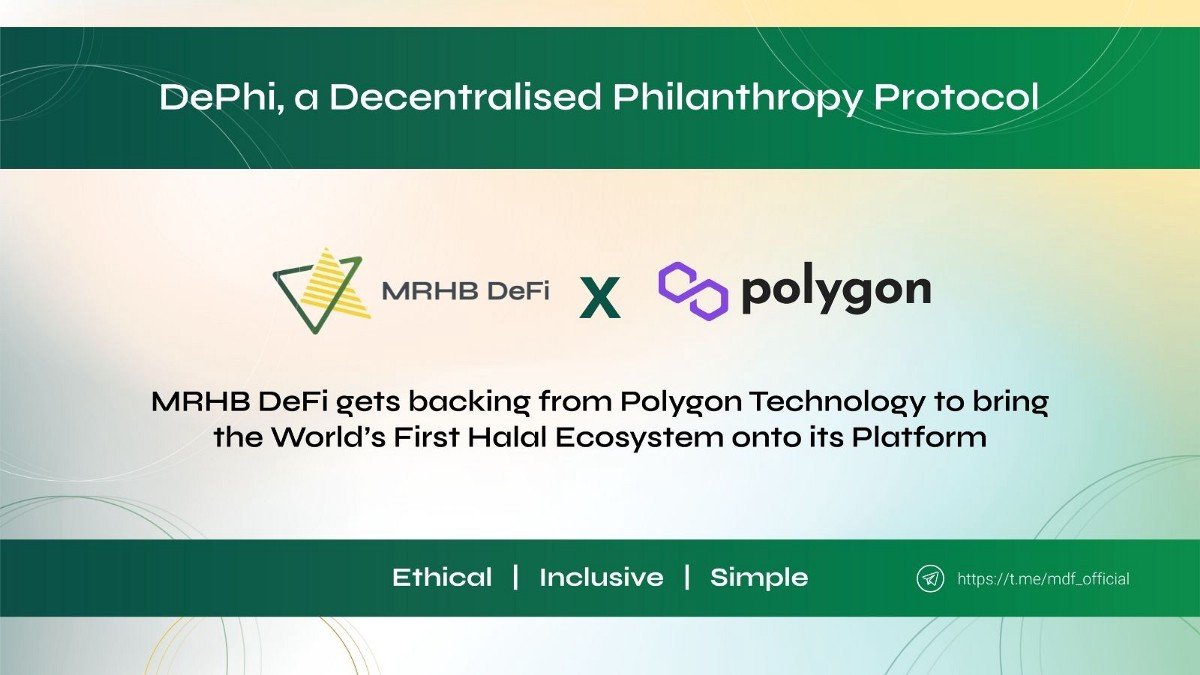
Melbourne, Australia, November 19, 2021— Ethereum’s biggest DeFi chain Polygon and ethical DeFi platform MRHB DeFi are leading the charge on the next big thing in DeFi — decentralized philanthropy — or DePhi for short which is estimated at over USD 300 billion each year in Muslim countries alone with around USD 1.5 trillion in assets held by around 160,000 foundations globally.
“Polygon has become one of the leading full-stack scaling solutions for Ethereum, given its speed and scalability,” says Deniz Dalkilic, MRHB DeFi CTO. “As Marhaba strives to achieve its end goal of building a comprehensive, secure and scalable ecosystem where liquidity is a priority, we are thrilled to announce our integration with Polygon. To expand our presence on Polygon we have received a grant from Polygon to optimise our solutions for their network.”
The Polygon team has been enthusiastic in its support of the ethics-based startup, recognizing that MRHB DeFi is the first Islamic finance d’App. Polygon has agreed to support MRHB DeFi’s plan to develop a sidechain solution that opens up DeFi to millions globally. The two parties have recently signed an agreement which puts into writing their aim to bring philanthropy to the crypto space, stating that:
MRHB DeFi intends to build its DePhi (Decentralised philanthropy) protocol on Polygon technology, which would be a dedicated philanthropy protocol based on funding social initiatives for the benefit of the community, using the quadratic funding model.
With this solution, MRHB intends to catalyse the crypto philanthropy ecosystem, with focus on being the first mover in channelling the annual Zakat contributions of the Islamic World (est. USD 300 billion annually)
Quadratic funding is a technique that applies mathematics to ensure the optimal funding — more democratic, more scalable — of community and social, charitable initiatives.
Bringing Philanthropy — a Key Pillar of the Islamic Faith — to DeFi
DePhi forms a key part of MRHB DeFi’s strategic plans for its protocol. As part of MRHB’s approach to supporting a more ethical and community focused approach to decentralized finance, DePhi seeks to bring a key pillar of the Islamic faith — charity or zakat — to what is still a sector driven by self-interest. Once the DePhi protocol is implemented, MRHB DeFi users will have the option to send a portion of their crypto asset wealth to charities which would be linked to the platform, thus fulfilling their voluntary or faith-driven obligations.
End users who wish to donate will be able to deposit funds and generate rewards via trading fees on liquidity pools created by MRHB DeFi. After depositing the donation, assets would be locked for 60 days before being distributed to one of pre-approved charities nominated by the donor.
In addition, MRHB DeFi will set aside five percent of its DAO treasury to be invested in these pools as a form of crypto endowment, as such, this will generate wealth in perpetuity for charitable causes.
CTO Dalkilic adds: “Decentralized philanthropy represents a significant step forward in sharing the benefits of DeFi globally and allowing for community- and public good- focused initiatives to be supported from the cryptoverse. Polygon is one of the most respected projects in the crypto space, and we’re excited to align our vision of using DeFi for good causes, with theirs.
“Being the first d’App on Islamic finance, we have received strong support from the Polygon team to bring the project to the community. Polygon is the latest in a long line of partnerships we are fostering and developing as we work to grow our vision of an ethics-first platform and project. ”
MRHB DeFi recently partnered with Ethereum scaling and privacy engine zkSync, a leading ZK-Rollup solution for Ethereum. It has also received strategic investments and backing from Blockchain Australia, Mozaic, Contango Digital Assets, NewTribe Capital, Sheesha Finance, Acreditus Partners, EMGS Group, MKD Capital and Sinofy Group.
About MRHB DeFi
MRHB DeFi is a halal, decentralised finance platform built to embody the true spirit of an “Ethical and Inclusive DeFi” by following faith-based financial and business principles, where all excluded communities can benefit from the full empowerment potential of DeFi.
The diverse team is comprised of researchers, technocrats, influencers, Islamic fintech experts & business entrepreneurs, who came together to ensure that MRHB DeFi prevails in a manner that will impact society as a whole, essentially bridging the gap between the faith-conscious communities and the blockchain world.
Polygon is the leading platform for Ethereum scaling and infrastructure development. Its growing suite of products offers developers easy access to all major scaling and infrastructure solutions: L2 solutions (ZK Rollups and Optimistic Rollups), sidechains, hybrid solutions, stand-alone and enterprise chains, data availability solutions, and more. Polygon’s scaling solutions have seen widespread adoption with 3000+ applications hosted, ~600M total transactions processed, ~60M unique user addresses, and $5B+ in assets secured.
If you’re an Ethereum Developer, you’re already a Polygon developer! Leverage Polygon’s fast and secure txns for your Dapp, get started here.
Starting today, Crypto.com Protocol (CRO) and SUKU (SUKU) are available on Coinbase.com and in the Coinbase Android and iOS apps. Coinbase customers can now trade, send, receive, or store CRO and SUKU in most Coinbase-supported regions, with certain exceptions indicated in each asset page here. Trading for these assets is also supported on Coinbase Pro. Please note that Coinbase only supports ERC-20 CRO running on the Ethereum blockchain.
Crypto.com Chain (CRO) is an Ethereum token that powers Crypto.com Pay, a service that aims to allow users to pay for goods and services with cryptocurrency while receiving cashback rewards.
SUKU (SUKU) is an Ethereum token that powers the SUKU Platform, a blockchain-based ecosystem that aims to make supply chains more transparent. SUKU tokens can be used for platform governance and to reward users and SUKU node operators. SUKU Platform is also developing applications for DeFi lending and NFT marketplaces.
One of the most common requests we hear from customers is to be able to buy and sell more cryptocurrencies on Coinbase. We announced a process for listing assets, designed in part to accelerate the addition of more cryptocurrencies. We are also investing in new tools to help people understand and explore cryptocurrencies. We launched informational asset pages (see CRO and SUKU), as well as a new section of the Coinbase website to answer common questions about crypto.
Customers can sign up for a Coinbase account here to buy, sell, convert, send, receive, or store e Coinbase Android and iOS apps. Coinbase customers can now trade, send, receive, or store CRO and SUKU today.
###
Please note: Coinbase Ventures may be an investor in the crypto projects mentioned here, and additionally, Coinbase may hold such tokens on its balance sheet for operational purposes. A list of Coinbase Ventures investments is available at https://ventures.coinbase.com/. Coinbase intends to maintain its investment in these entities for the foreseeable future and maintains internal policies that address the timing of permissible disposition of any related digital assets, if applicable. All assets, regardless of whether Coinbase Ventures holds an investor or Coinbase holds for operational purposes, are subject to the same strict review guidelines and review process.
This website contains links to third-party websites or other content for information purposes only (“Third-Party Sites”). The Third-Party Sites are not under the control of Coinbase, Inc., and its affiliates (“Coinbase”), and Coinbase is not responsible for the content of any Third-Party Site, including without limitation any link contained in a Third-Party Site, or any changes or updates to a Third-Party Site. Coinbase is not responsible for webcasting or any other form of transmission received from any Third-Party Site. Coinbase is providing these links to you only as a convenience, and the inclusion of any link does not imply endorsement, approval or recommendation by Coinbase of the site or any association with its operators.
Crypto is a new type of asset. Besides potential day to day or hour to hour volatility, each crypto asset has unique features. Make sure you research and understand individual assets before you transact.
All images provided herein are by Coinbase.
Crypto.com Protocol (CRO) and SUKU (SUKU) are launching on Coinbase was originally published in The Coinbase Blog on Medium, where people are continuing the conversation by highlighting and responding to this story.
Starting Today, Tuesday November 2, transfer CRO into your Coinbase Pro account ahead of trading. Support for CRO will generally be available in Coinbase’s supported jurisdictions with certain exceptions as indicated in each asset page here. Trading will begin on or after 9AM Pacific Time (PT) Wednesday November 3, if liquidity conditions are met. Please note that Coinbase only supports ERC-20 CRO running on the Ethereum blockchain.
One of the most common requests we receive from customers is to be able to trade more assets on our platform. Per the terms of our listing process, we anticipate supporting more assets that meet our standards over time. Most recently we have added trading support for Kryll (KRL), LCX (LCX) SUKU (SUKU), OriginTrail (TRAC), Assemble Protocol (ASM), ARPA Chain (ARPA), Bounce (AUCTION), Perpetual Protocol (PERP), BadgerDAO (BADGER), Rarible (RARI), Function X (FX), Jasmy (JASMY), Wrapped Centrifuge (WCFG) and Avalanche (AVAX).
Starting Today, Tuesday November 2, we will begin accepting inbound transfers of CRO to Coinbase Pro. Trading will begin on or after 9AM Pacific Time (PT) Thursday October 28, if liquidity conditions are met.
Once sufficient supply of CRO is established on the platform, trading on our CRO-USD CRO-USDT and CRO-EUR order books will launch in three phases, post-only, limit-only and full trading. If at any point one of the new order books does not meet our assessment for a healthy and orderly market, we may keep the book in one state for a longer period of time or suspend trading as per our Trading Rules.
We will publish tweets from our Coinbase Pro Twitter account as each order book moves through the phases.
Crypto.com Chain (CRO) is an Ethereum token that powers Crypto.com Pay, a service that aims to allow users to pay for goods and services with cryptocurrency while receiving cashback rewards.
CRO is not yet available on Coinbase.com or via our Consumer mobile apps. We will make a separate announcement if and when this support is added.
You can sign up for a Coinbase Pro account here to start trading. For more information on trading CRO on Coinbase Pro, visit our support page.
### Please note: Coinbase Ventures may be an investor in the crypto projects mentioned here, and additionally, Coinbase may hold such tokens on its balance sheet for operational purposes. A list of Coinbase Ventures investments is available at https://ventures.coinbase.com/. Coinbase intends to maintain its investment in these entities for the foreseeable future and maintains internal policies that address the timing of permissible disposition of any related digital assets, if applicable. All assets, regardless of whether Coinbase Ventures holds an investor or Coinbase holds for operational purposes, are subject to the same strict review guidelines and review process. This website contains links to third-party websites or other content for information purposes only (“Third-Party Sites”). The Third-Party Sites are not under the control of Coinbase, Inc., and its affiliates (“Coinbase”), and Coinbase is not responsible for the content of any Third-Party Site, including without limitation any link contained in a Third-Party Site, or any changes or updates to a Third-Party Site. Coinbase is not responsible for webcasting or any other form of transmission received from any Third-Party Site. Coinbase is providing these links to you only as a convenience, and the inclusion of any link does not imply endorsement, approval or recommendation by Coinbase of the site or any association with its operators.
Crypto is a new type of asset. Besides potential day to day or hour to hour volatility, each crypto asset has unique features. Make sure you research and understand individual assets before you transact.
All images provided herein are by Coinbase.
Crypto.com Protocol (CRO) is launching on Coinbase Pro was originally published in The Coinbase Blog on Medium, where people are continuing the conversation by highlighting and responding to this story.
Starting today, Assemble Protocol (ASM) is available on Coinbase.com and in the Coinbase Android and iOS apps. Coinbase customers can now trade, send, receive, or store ASM in most Coinbase-supported regions, with certain exceptions indicated in each asset page here. Trading for these assets is also supported on Coinbase Pro.
Assemble Protocol (ASM) is an Ethereum token that powers Assemble, a platform where users and merchants can aggregate, manage, and spend reward points. On Assemble, point providers and retailers can run special events or promotions, providing benefits like discounts for ASM
One of the most common requests we hear from customers is to be able to buy and sell more cryptocurrencies on Coinbase. We announced a process for listing assets, designed in part to accelerate the addition of more cryptocurrencies. We are also investing in new tools to help people understand and explore cryptocurrencies. We launched informational asset pages (see ASM), as well as a new section of the Coinbase website to answer common questions about crypto.
Customers can sign up for a Coinbase account here to buy, sell, convert, send, receive, or store e Coinbase Android and iOS apps. Coinbase customers can now trade, send, receive, or store ASM today.
###
Please note: Coinbase Ventures may be an investor in the crypto projects mentioned here, and additionally, Coinbase may hold such tokens on its balance sheet for operational purposes. A list of Coinbase Ventures investments is available at https://ventures.coinbase.com/. Coinbase intends to maintain its investment in these entities for the foreseeable future and maintains internal policies that address the timing of permissible disposition of any related digital assets, if applicable. All assets, regardless of whether Coinbase Ventures holds an investor or Coinbase holds for operational purposes, are subject to the same strict review guidelines and review process.
This website contains links to third-party websites or other content for information purposes only (“Third-Party Sites”). The Third-Party Sites are not under the control of Coinbase, Inc., and its affiliates (“Coinbase”), and Coinbase is not responsible for the content of any Third-Party Site, including without limitation any link contained in a Third-Party Site, or any changes or updates to a Third-Party Site. Coinbase is not responsible for webcasting or any other form of transmission received from any Third-Party Site. Coinbase is providing these links to you only as a convenience, and the inclusion of any link does not imply endorsement, approval or recommendation by Coinbase of the site or any association with its operators.
Crypto is a new type of asset. Besides potential day to day or hour to hour volatility, each crypto asset has unique features. Make sure you research and understand individual assets before you transact.
All images provided herein are by Coinbase.
Assemble Protocol (ASM) is now available on Coinbase was originally published in The Coinbase Blog on Medium, where people are continuing the conversation by highlighting and responding to this story.