Tag: plunge

  • Bitcoin Slows Plunge Below $40K, What’s the Best Point for a Pullback?

    Bitcoin Slows Plunge Below $40K, What’s the Best Point for a Pullback?

    [ad_1]

    Bitcoin continues to trend lower over the weekend and seems at risk of re-testing previous lows. The first crypto by market cap was rejected at mid-area north of $40,000 and was unable to muster the momentum to hold those levels.

    Related Reading | Did Top Three Bitcoin Addresses Just Call Another Local Bottom?

    As of press time, Bitcoin trades at $39,921 with a 1.2% and 5.2% loss in the last day and 7 days, respectively.

    Bitcoin BTC BTCUSD
    BTC trends to the downside on the daily chart. Source: BTCUSD Tradingview

    Yuya Hasegawa, analyst for Bitbank, attributes BTC’s price recent price action to the Russia-Ukraine situation. In that sense, the analyst expects potential relief as the U.S. Secretary of State Antony Blinken and the Russian Minister of Foreign Affairs Sergey Lavrov scheduled a phone call for next week.

    This could tone down the tensions around the situation at the border. On top of that, the analyst claims Bitcoin is sitting at “ample technical support” which could protect its price from further downside.

    However, is a long weekend in the U.S. which usually leads to potential periods of high volatility driven by low trading volumes across the crypto market. Hasegawa said talking about BTC’s price immediate and medium-term potential headwinds:

    We still have the January U.S. PCE, February jobs report, and CPI until the March FOMC meeting, so it is safe to say that, depending especially on these inflation data, the worst may be still ahead of us, and even if the price rebounds from the current level in the short term, upside is likely quite limited unless the Russian military shows some signs of retreating.

    The macro-situation seems to occupy everyone’s attention. A separate analyst from Material Indicators (MI) claims the Russia-Ukraine situation could see an outcome after the Winter Olympics in Beijing. These events have been linked to similar crises in the past, such as the invasion of Crimea which took place in 2014 during the Olympics hosted by Russia.

    Bitcoin To See Short Squeeze Over Long Weekend?

    Further data provided by Material Indicators claims BTC could have entered a distribution phase. Recommending traders to “avoid knife catching”, especially during periods of low volume, MI presented their Trend Precognition indicator which flashed a bearish arrow on the daily chart as BTC’s price trend below $40,000.

    Bitcoin BTC BTCUSD
    Material Indicator’s Trend Precognition Indicator flashed a bearish signal on the daily chart. Source: Material Indicators via Twitter

    This could suggest the benchmark crypto might re-test its lows which could find good support, as MI claimed, “in areas of prior consolidation”. The levels between $35,000 to $38,000 were relevant during BTC’s price previous sell-off and could operate as support.

    However, MI noted that there are “Liquidity gaps”, levels on the order book with low bids or asks orders, on both sides of the BTC/USDT trading pair. Thus, Bitcoin could see a short squeeze to the upside or downside.

    Related Reading | Comparing Apple’s Growth With Bitcoin, Why This Expert Sets $700K As Long-Term Goal

    Currently, there are around $10 million in bid order around $39,500. Therefore, there seems to be strong support for BTC at that level which could favor the bulls, at least in the short term.
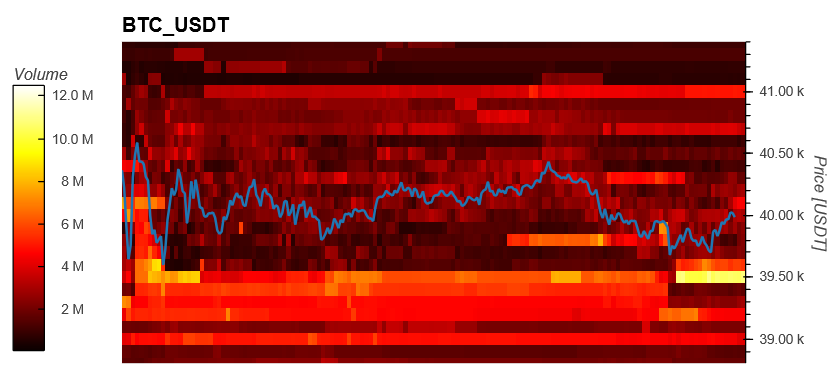
    Bitcoin BTC BTCUSD
    BTC’s price (blue line on the chart) with potential support on $39,500 due to concentration of bid orders (levels below the price). Source Material Indicators


    [ad_2]

    Source link

  • Bitcoin, dollar plunge while S&P 500 rallies after US inflation hits 3-decade high

    Bitcoin, dollar plunge while S&P 500 rallies after US inflation hits 3-decade high

    [ad_1]

    Bitcoin (BTC) and the U.S. dollar fell in tandem while the S&P 500 refreshed its record high at open on Friday as the Federal Reserve’s preferred inflation indicator surged to its highest levels in almost three decades.

    According to data shared by the US Bureau of Economic Analysis, the US Core Personal Consumption Expenditure (PCI) rose 0.5% in May, coming in below the estimation of 0.6%.

    Nevertheless, the expenditure rose 3.4% year-over-year, the highest level since 1991. The Federal Reserve treats core PCI as its benchmark metric to gauge inflation. The U.S. central bank has indicated that it would tolerate inflation above 2% until it ensures a stronger labor-market recovery.

    The prospects of higher inflation fueled volatile bullish rallies across the risk-on markets in 2020, including Bitcoin and the U.S. stock market.

    Bitcoin and the S&P 500 rallied in tandem against Fed’s expansionary policies. Source: TradingView

    Investors considered them as better safe-havens as the Fed elected to hold interest rates near-zero and maintained its $120B monthly asset purchase program to contain the impact of the coronavirus pandemic on the U.S. economy.

    However, the central bank’s policy ended up pushing the U.S. bond yields lower while hurting the dollar’s demand globally, thereby shifting investors to riskier haven alternatives, including Bitcoin.

    But the flagship cryptocurrency dipped after the latest PCI readings, hinting that investors chose to ignore its safe-haven narrative over risks concerning China’s latest crypto ban and amid speculations that the U.S. would impose strict regulations on the cryptocurrency sector, on the whole.

    The BTC/USD exchange rate slipped to an intraday low of $32,350 shorty after the New York opening bell Friday. Meanwhile, Gold, Bitcoin’s top safe-haven rival, recorded early morning gains after higher core CPI readings, with the August Comex Gold Futures trading 0.73% higher at $1,789.70 an ounce in the morning session.

    Bitcoin dips despite higher inflation data. Source: TradingView.com

    Investors also snubbed the so-called safest safe-haven, the U.S. dollar. As a result, the greenback’s index against a basket of foreign currencies fell 0.33% to 91.525 in the early morning trade Friday. It later recovered back to 91.749.

    Alexander Vasiliev, co-founder and CCO of Mercuryo said that demand for the dollar among corporate and retail investors would remain weaker against the prospects of higher inflation. Instead, they would rather hedge in assets with lower depreciation potential. He explained:

    “While Bitcoin has won the argument as a suitable asset in this regard, its currently collapsing price will favor gold much more at such a time as this, and as such, investors may favor the latter more than the former. The price impact of these inflation figures on the asset classes will be more visible in the days and weeks ahead.”

    Bitcoin dipped also as investors’ focus shifted towards the Wall Street equity markets following President Joe Biden’s latest stimulus deal worth $1T. The S&P 500 index surged 0.27% to an all-time high of 4,280.55. The tech-focused Nasdaq Composite went up 0.1%.

    Fed’s mixed signals and Bitcoin

    Francesco Sandrini, senior multi-asset strategist at fund manager Amundi, stated that inflation readings would keep going higher in the months ahead. Meanwhile, markets would struggle to find confidence in terms of how to protect them from higher consumer prices, especially as the Fed officials send mixed signals about whether inflation should result in tighter monetary policy.

    For instance, Fed’s chair Jay Powell has called the recent inflation spikes in the U.S. economy, which could wipe long-term returns from stocks and bonds, as “transient” in nature. But St. Louis Fed president James Bullard said on Thursday that inflation may keep rising in the sessions ahead.

    The Federal Open Market Committee’s latest set of economic projections took a hawkish turn as it suggested dual-rate hikes in 2023. As a result, Bitcoin turned lower on the news.

    Related: 4 reasons why Paul Tudor Jones’ 5% Bitcoin exposure advice is difficult for major funds

    “We remain unsure as to exactly what will happen to inflation over the coming 5 years,” noted CoinShares, a digital asset management firm, in a report published on June 21.

    “But we see adding bitcoin and other real assets as a prudent measure to protect portfolios from the tail-risk of out-of-control inflation,” the firm added.

    Vasiliev noted that strong anti-inflation narrative would keep investors’ interest in Bitcoin in the coming months, adding:

    I believe a recovery to $40,000 is the goal, while investors look toward breaking the previous ATH of $64,000 in the mid to long term.