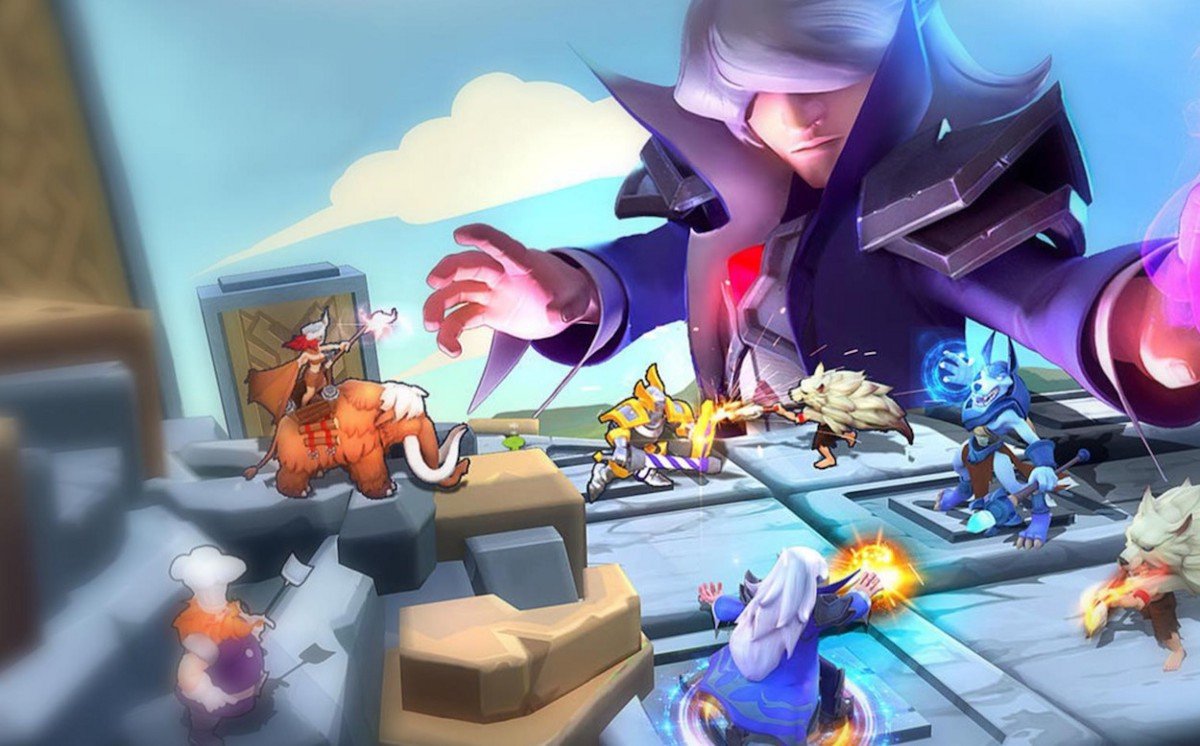
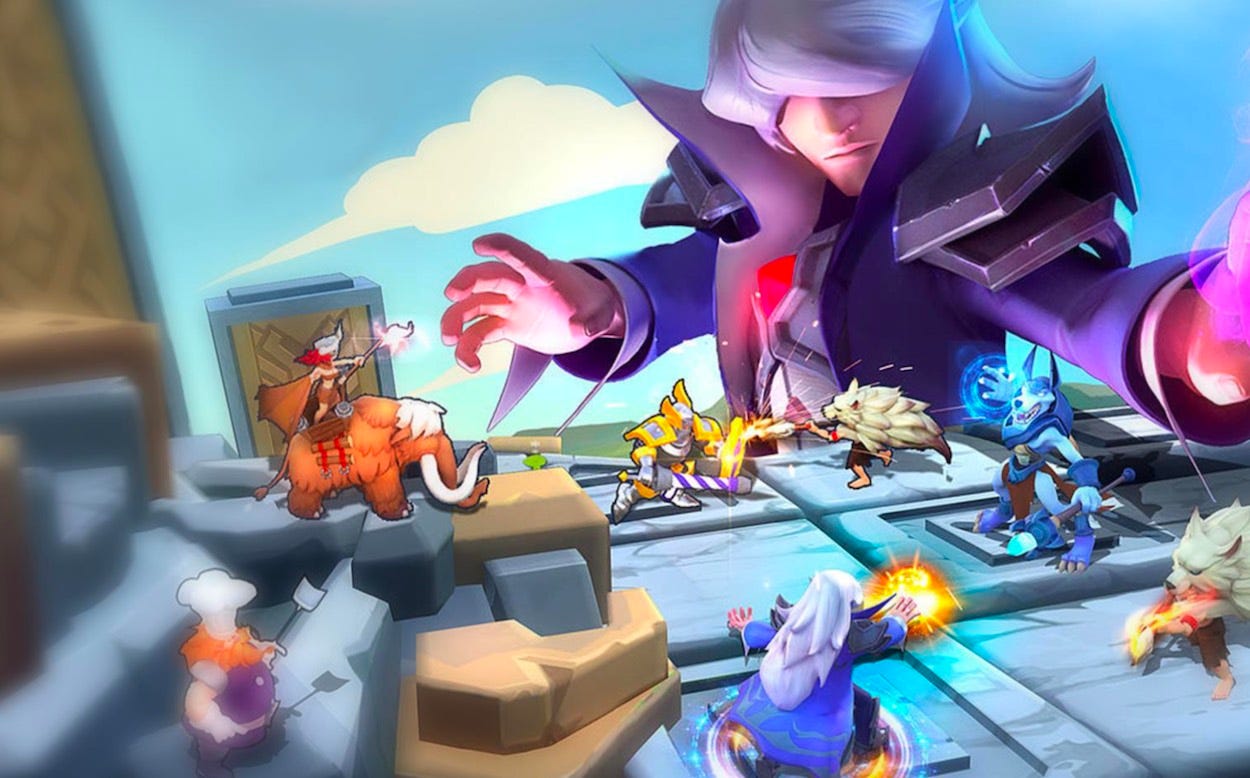
Era7’s ‘Game Of Truth’joins GameFi and offers players mildly competitive entertainment that provides an avenue to earn.
Blockchain technology is quickly redefining the gaming industry by introducing an economic incentive model. Presently, the metaverse is an industry estimated to be valued at a USD 300 bn market cap by 2025. As the industry continues to expand, play-to-earn games like Era7 have taken center stage, bringing new and interesting innovations to the gaming sector.
Era7 is a gaming platform built on the Binance Smart Chain (BSC) that blends TCG (trading card gaming) with fast-paced competitive gameplay while incorporating NFT-themed play-to-earn features.
With GameFi and the NFT-powered economy at the heart of Era7’s product offering, the project intends to push innovation even further, allowing players to experience the euphoria of gameplay and benefit from the economic value that GameFi offers.
Meet the Team and High-Profile Industry Backers
Members of the Era7 core team come from well-known international Korean game companies such as Com2uS, NCsoft, Nexon, and Netmarble, all of which have more than 15 years’ history in the traditional mobile and online video gaming industry.
So far Era7 has received strategic investment and backing from renowned VCs, industry heavyweights, and institutions in the blockchain industry, including Hashkey, Huobi Ventures, Okcoin, Binary Capital, DAG, Waterdrip, Dreamseeker, BTC12, Tembusu, and Mobox. Era7 backers and partners are strategically aligned with the vision and mission of the gaming platform, bringing industry experience and the valuable connections necessary to position Era7 as a cutting-edge NFT-powered trading card gaming platform.
Game of Truth: The Backstory
Era7’s artistic inspiration comes from TCGs like Hearthstone and Magic: The Gathering.
The Game of Truth plot revolves around seven races on the Continent of Truth who compete for the title of “King of Truth.” Amongst the races are groups of specially gifted individuals who are sent to attend Summoner Academy to undergo rigorous training where they graduate to become Summoners. Upon graduation, they travel the world to make Summoning Pacts with the most powerful amongst the seven races, to establish strong allies in order to consolidate their power.
Since ancient times, throughout the year, battles amongst the Summoners have been held in the heart of the Continent. These Summoning Battles attract Summoners from all over the world who battle for the “King of Truth” title. The winner is crowned King of the Continent, and he and his race are awarded the highest honors in the land.
Elaine, Mother of Light, a Game of Truth NFT Master Card
Game of Truth: The Trading Cards
There are 1,000 exquisitely crafted cards in total — Master Cards for summoning and other functionalities and Battle Cards for combat gameplay. The cards all have unique values and attributes, allowing players to create a wide range of card combination strategies.
The fact that there are so many cards with different attributes allows the game to be random, providing endless possibilities for each battle. The large and well-designed card system is underpinned by a well-developed numerical system that supports innovative gameplay.
There is a rating system which categorizes the cards into 4 ranks — Common, Rare, Epic, and Legendary. The unique Master Cards and Battle Cards, which are also NFT collectibles, can be traded. The Battle Cards serve as the foundation for combat gameplay — before they can begin fighting, players must have at least 30 Battle Cards.
Game of Truth: The Gameplay
The Game of Truth is a three-minute battle game designed to utilize strategic thinking to help players increase their competitive advantage, evolve strategically while they play, dive into the adventure of a lifetime and connect with like-minded gamers worldwide.
The NFT-based trading card gaming platform aims to become the gamer’s choice by offering mildly competitive and fast-paced gaming. Using their Master Cards, players can summon Battle Cards to fight within various categories of competitions, such as PVP (player-versus-player), PVE (player-versus-environment), Daily or Weekly Quests, Real-Time Tournaments and fast-paced Championships. Ranking games and World Cup games, as well as other gaming activities like placing bets are being planned. Players will be able to obtain valuable tokens as well as NFT incentives during the game battles.
Game of Truth: an NFT-powered Play-To-Earn Economy
According to Era7, their first NFT sale is planned for December 20th, 2021, with Master Card and Blind Box containing different card highlights. To get the most up-to-date news and developments on this highly anticipated NFT sale, both players and investors should follow Era7 on Twitter and Telegram.
Using the GameFi model, Game of Truth empowers ordinary game players to reap extraordinary economic benefits. Era7 is built around NFT concepts like play-to-earn gamification, rewarding players for winning battles.
Both the Era token and the GOT token power the Era7 gaming economy. GOT tokens can be earned by participating in PVP and PVE and can also be purchased with Era tokens. Era tokens can also be used to purchase Master Cards, Battle Cards and NFT mystery boxes, as well as other in-game functionalities like purchasing land, or to get more community rights when participating in governance voting. It is also the token which will be tradable on exchanges for other cryptocurrencies.
If a player wins a PVP battle game, he will receive GOT tokens and a PVP rank. A higher rating will also allow players to earn more GOT tokens during battle. Rewards will be paid out on a daily/monthly basis.
With an incentivized gaming economic model, blockchain is redefining what we know to be the conventional gaming model, giving gamers the ability to earn passively while getting entertained.
Also, players will have ownership of their in-game digital items and collectibles which in most cases have a real-world monetary value attached to them, unlike in traditional gaming platforms.
More than half of the one billion Era tokens issued will be utilized for in-game rewards. In-game event incentives, participation in daily PVP and other tournaments, land pledges, and marketplace transactions will be some of the many avenues players will be able to accrue Era tokens.
How Era7 Fits into the Contemporary Global Gaming Ecosystem
The global Collectible Card Game market size is fast-growing at break-neck speeds and is expected to reach US$ 27.2 billion by the end of 2026. Despite this astonishing growth, this is only a fraction of the global gaming market, which currently sits at US$175.8 billion. The fast-growing pace of the Collectible Card Game market increases the growth prospect of TCG-based games like Era7 which brings a more innovative approach by leveraging the power of blockchain to provide Play-to-Earn features to gaming.
Even before incorporating NFTs into its gaming structure, Era7 had established a strong presence in the industry, attracting a huge number of Southeast Asian players and amassing a traditional gaming user base of more than 10 million. With an NFT-powered play2earn economy now added into its gaming structure, Era7 has the potential to outgrow and surpass traditional trading card games.
You can learn more about Era7: Game of Truth from its official Website, follow the project on Twitter and join the conversation on Telegram or Discord.
Binance Smart Chain (BSC)-based Era7: Game of Truth combines TCG (trading card gaming) with fast-paced competitive gameplay while incorporating NFT-themed play-to-earn concepts.
Singapore, November 12th, 2021 — Deploying the concepts of GameFi in the exciting combination of DeFi and NFT technologies, upcoming Play-to-Earn trading card game Era7: Game of Truth has successfully closed its first round of fundraising. Investors include some of the most renowned VCs and institutions in blockchain: Hashkey, Huobi, Okcoin, Binary Capital, DAG, Waterdrip, Dreamseeker, BTC12, Tembusu and Mobox.
Era7 will be launched in Q1 of 2022 and is expected to take the global NFT GameFi market by storm. The game has been developed by core team members who hail from well-known international Korean game manufacturers such as Com2uS, NCsoft, Nexon, and Netmarble, companies with more than 15 years of success in the traditional mobile and online video gaming industry.
Game of Truth is an innovative NFT-based competitive game based on TCG (Trading Card Game) concepts, with its creative essence coming from Hearthstone and Magic The Gathering R&D. Standing on the shoulders of giants, the Era7 team aims to bring innovation even further with the development of its GameFi product.
Players collect cards to fight and they win when their opponents are defeated. Given that the learning curve is not steep, the game appeals to all kinds of gamers — from your housewife and granny demographic to your technophile gaming gurus. Players from all levels will be able to find their place in the game. Moreover, Era7 incorporates a complete economic incentive system with the first batch of NFT drops slated for release in December 2021.
Era7 Combines Play-to-Earn & Play-for-Fun!
According to Newzoo, the overall market of the global gaming industry will reach US$175.8 billion in 2021, the total number of players will reach approximately 3 billion, with esports gamers exceeding 474 million. In 2019, the global Collectible Card Game market size was US$ 9,949.63 million and is expected to reach US$ 27,294.79 million by the end of 2026, with a CAGR of 15.89% during 2020–2026. Aware of the growing gaming market, as early as 2018, Era7 had already successfully developed and perfected its game and to date has amassed a user base of more than 10 million players.
The development team has included NFT concepts and technology which greatly benefit players. The income aspect and the value of the NFT assets will naturally attract a large pool of users to join. Furthermore, the game does not require prior knowledge of cryptocurrencies. Getting started is easy, and offers what every gamer wants — strategy and fun gaming.
Standing Out from the GameFi Competition
There are three ways that Game of Truth differs from other GameFi projects on the market. Firstly, the project’s games are rich in depth and content, providing users with long hours of entertainment. The large and well-designed card system is underpinned by a well-developed numerical system that supports innovative gameplay. The combination of a mildly competitive mode with extensive rich gaming content are not usually available in GameFi.
Secondly, the low threshold for players to get started and the extent of gaming content helps attract gamers from the traditional gaming space to join, creating a huge market when combined with the blockchain/crypto gamers.
Lastly, novice or experienced gamers can all have fun and benefit from play2earn — and that is a truth shared by both developers and players in this brave new horizon of GameFi. Both the project and the players work hand in hand to create an ecosystem of gaming that produces value to mutually benefit both parties.
Top Quality Trading Cards to Fight, Trade or Sell
Traditional TCG users will resonate with the exquisitely designed and excellent quality of all the Era7 cards. Card combination strategies are distinctive, and the game has established a market-oriented approach since the beginning of its game development. Presently, strategy gaming and play2earn, all while having fun, are its highlights.
The game contains 1,000 different cards, each having different values and attributes, bringing players a variety of card combination strategies. A lightly competitive 3-minute game can provide gamers with endless imagination and fun, thanks to the unlimited changes in strategy.
What to Expect in Era7’s Premiere NFT Drop this December!
Era7’s debut NFT launch is planned for December 2021, with the Master Card and Blind Box containing different card highlights.
One billion Era tokens will be issued with more than half of which will be used for in-game incentives. Players can obtain Era tokens through the following: in-game event rewards, participation in daily PVP (player versus player) and various tournaments, land pledges and marketplace purchases. The Era tokens held by the player can be exchanged for cryptocurrency that can be traded on exchanges.
Competitive Gameplay Development, Ecosystem Expansion and UE are underway
Era7 currently offers strategic gaming that provides competitive elements, with a focus on PVP gameplay. The game is designed to successively open up different types of competitions between players, such as ranked games and World Cup games, as well as other gaming activities such as watching and betting. While attracting traditional esport stars to participate, it will also groom and train new Era7 stars.
Plans for 2022 to 2028 include building a scalable competitive ecosystem that will encompass a live broadcast platform, esports community, animation series and GameFi IP. In the future, the most advanced UE engine will be deployed, combined with the Era7 platform to launch a competitive product based on the metaverse.
About Era7: Game of Truth
Era7: Game of Truth is a Play-To-Earn NFT-based trading card game (TCG). It offers the perfect combination of traditional gaming and decentralized finance (DeFi) to gamers, bringing an entertaining gaming experience while providing an avenue to earn.
According to Era7 ancient folklore, the seven races on the continent of Truth battle against each other for supremacy all year long, to vy for the title “King of Truth”. The victor from the Game of Truth emerges as the ruler of the continent whereby he and his race then enjoy the highest honors in the land.
Founded by core team members from internationally renowned game developers with over 15 years of valuable experience such as Com2uS, NCsoft, Nexon, and Netmarble, Era7 is backed by heavyweight VCs and blockchain institutions such as Hashkey, Huobi Group, OKcoin, Binary Capital, DAG, Waterdrip, Dreamseeker, BTC12, Tembusu and Mobox.
Era7: Game of Truth Official Links
Website: https://www.era7.io
(desktop browser currently recommended, mobile capability in development)
Sydney, Australia, November 9th, 2021 — With the blockchain gaming metaverse proving to be more than just a buzzword for gamers, Gachyi Land, the first gacha-launchpad ecosystem gears towards its premiere NFT launch, slated to debut on the 22nd of November 2021.
This launch opens up the runway for Gachyi Land as they get the ball rolling for a series of other launches on the Gachyi launchpad. Commenting on the significance of this event, the founding partner of Gachyi Land,Harly Zappino has expressed his excitement:
“Life is too short to slave away on tasks that you despise doing and unfortunately that is how our society is currently structured. The digital world is our future. Let’s make it fun, let’s make it colorful, and let’s provide real-world value to those who want to interact with it!”
Dubbed the Goo Goo series, the first NFT series dropped on Gachyi Land will feature generative artwork with different traits that include body, eyes, mouth, accessories, background, and clouds, among other features. Certain unusual and rare characteristics may entitle their owners to special privileges.
The series finds its footing in folklore inspired by the Gachyi Goddess before she became entirely fossilized. According to Gachyi Land Lore, she created the Goo Goos and ensured that all of her wisdom was handed down to guide them through the RPG (role-playing game).
While the Goo Goo series does not include playable RPG characters, owners will be able to access significant in-game benefits. Slime Tales from Gachyi Land’s second NFT series will implement RPG characters with a Dungeons and Dragons class system that has the ability to breed dual class characters.
Gachyi Land: Introducing the first NFT gacha-launchpad ecosystem
Coming up as a first mover, Gachyi Land will be the first gacha-launchpad to issue NFTs (on its website) as a full-fledged utility across its entire ecosystem. Each NFT issued on the Gachyi NFT Launchpad will serve a purpose within the ecosystem. They will either have in-game functionality such as boosts or exclusive pre-sale access, or their utility can be built into future games.
Besides their own designed NFTs, other projects with similar themes to Gachyi Land, such as those with kawaii and mystical creatures type of themes, will be able to participate in its utility-centric ecosystem. Expanding the entire ecosystem, other projects’ NFTs can be integrated into Gachyi Land’s mini-party games or Play-To-Earn MMORPG.
The NFTs will be deployed on the Polygon blockchain based on the ERC-721 token standard, priced in MATIC. They will be encapsulated and released through interactive Gachapon Machines (a.k.a Gacha-Launchpad). The minting process aims to give the buyers a whole new experience playing with e-Gachapon machines coupled with lo-fi music, great visuals and stunning animation. Each series will feature a maximum of 5 NFTs available on the Launchpad, giving buyers a sneak peak of what could be minted.
Incubating a disruptive NFT gaming ecosystem to empower artists
Gachyi Land is on a mission to empower small artists to use Gachyi Land’s resources to unleash their creativity on the world, to give them the exposure and recognition they deserve. Most artists have yet to take advantage of the unlimited opportunities available in the NFT domain while others may have misconceptions about it. To address this challenge, Gachyi is stepping in to provide artists with the platform, community, technology, and tools they need to exhibit their work and explore the potential within the digital landscape.
“Gachyi Land will be a solution to this and will be a part of a greater movement to fundamentally change the way humanity thinks and interacts with the world. In our virtual world, what defines you are the choices you make and the way you choose to interact. Not labels, not gender, not titles and certainly not the way you look!” states Zappino.
About Gachyi Land
Gachyi Land is building an ecosystem that consists of an NFT Launchpad and Play-To-Earn MMORPG. NFTS issued on their platform will be incorporated within the ecosystem to serve either an in-game functionality such as boosts or exclusive pre-sale access, or their utility can be built into future games.
With its disruptive Play2Earn MMORPG, Gachyi is providing artists with the platform, community, technology, and tools they need to unleash their creativity and gain the exposure they deserve. NFTs will be minted via Gachyi’s interactive gachapon machines on the Polygon blockchain based on the ERC-721 token standard, priced in MATIC.
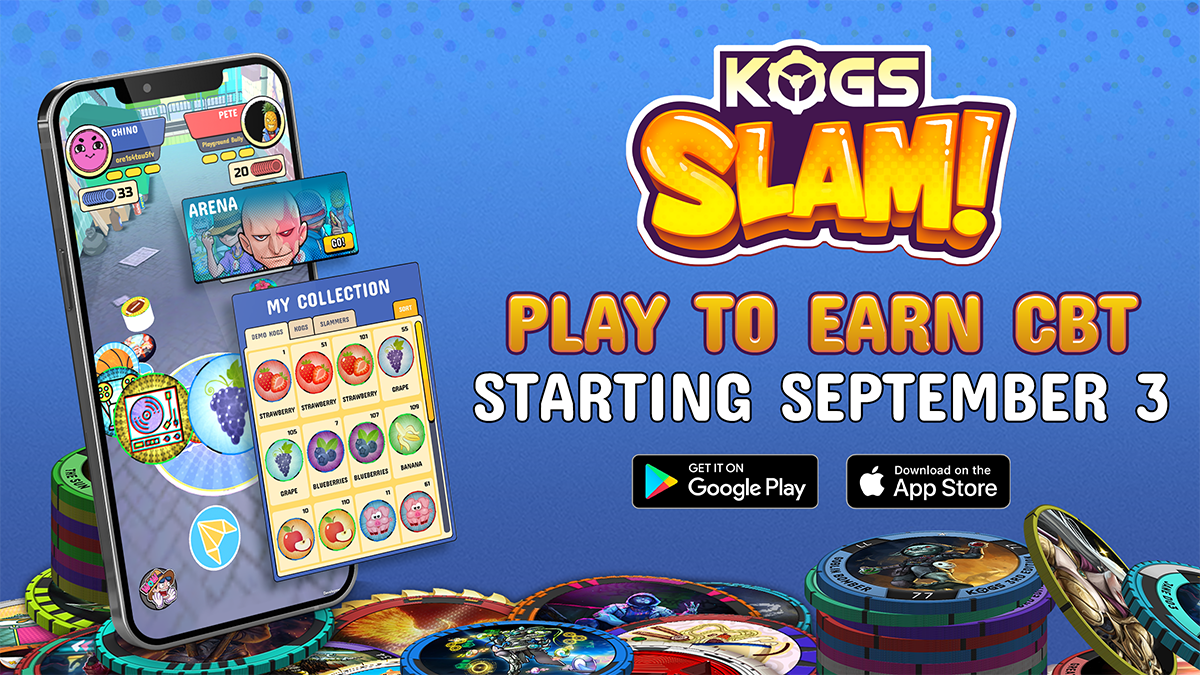
Southeast Asian based RFOX Games (a subsidiary of RedFOX Labs $RFOX) has released its free-to-play game KOGs SLAM! in closed beta. The Bitcoin News finds out more about the KOGs SLAM! digital gaming experience and the collaboration with YGG (Yield Guild Games).
Q. Please introduce yourself and what you do at RFOX Games.
I’m Fadzly Yusof, General Manager of RFOX Games, a subsidiary of Redfox Labs, a crypto and blockchain venture builder based in South East Asia.
Q. Can you tell us more about RFOX Games?
RFOX Games wasset up with the purpose of bringing people into the blockchain era through games. Our team is made up of gaming veterans and artists who want to make digital inclusion into the blockchain space easy, relevant and fun.
Q. You recently released your free-to-play play-to-earn game KOGs SLAM in closed beta. How is that going for you?
We have on-boarded a few thousand gamers to stress testers our system for bugs and issues related to gameplay. There is also an incentive program that awards players with RFOX for leaderboard rankings and an exclusive NFT slammer to be used in the game if they qualify.
Q. Care to comment on your collaboration with Yield Guild Games on this as well as the ‘inclusion’ aspect?
YGG has been very active in managing their community with play to earn opportunities in gaming to help them monetise their time and effort, with Kogs, we hope to give them another opportunity to earn financial rewards through our NFT and token once we go open beta. A lot of their members who are waiting for scholarships or sponsors can consider our content as a viable option for income. We are facilitating cash out options for them to make the experience less tedious for first time users who are not savvy with crypto yet.
Q. Would you say you are leading in this field in the SEA/APAC markets?
We are a young company hoping to expand the play-to-earn ecosystem in as many countries as possible. We are just starting so we have a lot of opportunities to grow. The space is still mostly untapped and will be a huge benefit to economies that have been affected by COVID.
Q. Thanks for your comprehensive answers! We would love to know what’s next for RFOX Games.
We will be announcing more activities and content for our communities, visit our discord channel at https://discord.io/kogs and our Facebook page at https://fb.com/kogs.gg for the latest news and updates!
About RFOX Games
RFOX Games, launched by RedFOX Labs, Southeast Asia’s first blockchain venture builder. RFOX Games is building a series of interoperable games that are PLAY TO EARN and support the KOGs NFT collection. The entire RFOX ecosystem is supported by its native currency $RFOX and users will be able to compete in head-to-head and tournament-based games to win NFT prizes and $RFOX.
Manila, Philippines, September 3, 2021 — Southeast Asian based RFOX Games (a subsidiary of RedFOX Labs $RFOX) will release its free-to-play play-to-earn game KOGs SLAM! in closed beta this Friday the 3rd of September and welcome YGG (Yield Guild Games) to the beta release.
RFOX Games’ maiden release KOGs SLAM! is a digital gaming experience inspired by the 90’s schoolyard phenomenon POGs. RFOX Games will introduce a free play-to-earn model to millions of users in the Southeast Asian region.
RFOX Games, a subsidiary of Southeast Asian venture builder RedFOX Labs, has been working on a game that focuses on digital inclusion and allows people hit hardest by economic challenges an opportunity to earn from their mobile phones.
The closed beta trial for play-to-earn will kick off on September 3 and run for a month before its international public release. The beta release will allow for 5,000 participants to compete for the $RFOX token and prizes and is expected to be heavily oversubscribed.
The easy-to-learn game also has a popular NFT collection called KOGs, which is an acronym for Keys to Other Games. KOGs recently launched its limited Bad Days NFT collection featuring Marvel characters created by Stan Lee. The sale ended last August 28 but you can still buy KOGs here.
Ben Fairbank, CEO, and Co-founder of RedFOX Labs commented:
“It is highly likely that this game could reach millions of users across Southeast Asia and beyond when you consider that a free play-to-earn model would be welcomed with open arms by those most impacted by COVID, with many having lost their jobs.”
“We had an ambitious plan and model, and we are finally ready to go to the closed beta for the play-to-earn. We are thrilled to welcome YGG and Real Deal to the trial who can help us gain exposure to a wider audience of play-to-earn gamers. We are thrilled to have organizations of this caliber join the trial.”
Gabby Dizon, Co-founder of Yield Guild Games commented:
“We’re happy to be working with RFOX GAMES to bring YGG members into the KOGS SLAM closed beta. This gives an opportunity for our underserved members to start earning while they move up our scholarship waitlist. Being able to start playing for free and move earnings directly to GCash will massively increase play-to-earn adoption in the Philippines.”
Register here for the closed beta and early releases.
RedFOX Labs will also feature the KOGs collection and games in its upcoming metaverse the RFOX VALT
About RFOX Games
RFOX Games, launched by RedFOX Labs, Southeast Asia’s first blockchain venture builder. RFOX Games is building a series of interoperable games that are PLAY TO EARN and support the KOGs NFT collection. The entire RFOX ecosystem is supported by its native currency $RFOX and users will be able to compete in head-to-head and tournament-based games to win NFT prizes and $RFOX.
About Yield Guild Games
Yield Guild Games (YGG) is a decentralized autonomous organization (DAO) for investing in non-fungible tokens (NFTs) used in virtual worlds and blockchain-based games. The organization’s mission is to create the biggest virtual world economy, optimizing its community-owned assets for maximum utility and sharing its profits with its token holders.
Around the Block from Coinbase Ventures sheds light on key trends in crypto. In this edition, Justin Mart, Connor Dempsey, and Hassan Ahmed explore the growth of NFT games and the play-to-earn economy. Plus, a look at NFT marketplace activity and the Poly Network exploit.
We’re at an exciting time in crypto: one in which cryptonetworks are blossoming into full-fledged virtual economies. Nowhere is this more on display than with NFT gaming.
At the forefront of NFT gaming sits Axie Infinity and its play-to-earn model: a model that pays people in crypto to play a fun video game. With over one million daily active users, Axie Infinity has exploded in popularity in emerging markets and is showing the potential to be a trojan horse for on-boarding the next generation of crypto users.
On top of that, Axie Infinity and play-to-earn gaming has spawned its own thriving financial services sector.
The rise of Axie Infinity
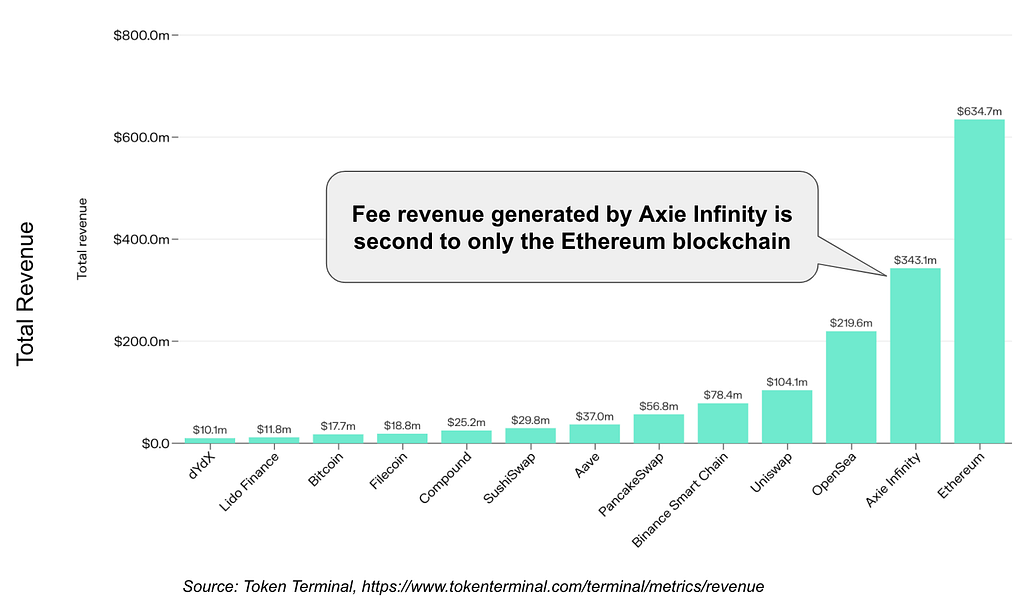
Over the last 30 days, Axie Infinity generated a head turning $343M in fee revenue. This is more than any app or protocol in crypto aside from the Ethereum blockchain, according to Token Terminal.
So where’s that revenue coming from?
How Axie Infinity generates revenue
The Axie Infinity economy consists of a governance token (AXS) and a second token called Smooth Love Potion (SLP) that serves as an in-game currency, along with NFTs that represent both game characters and virtual real estate.
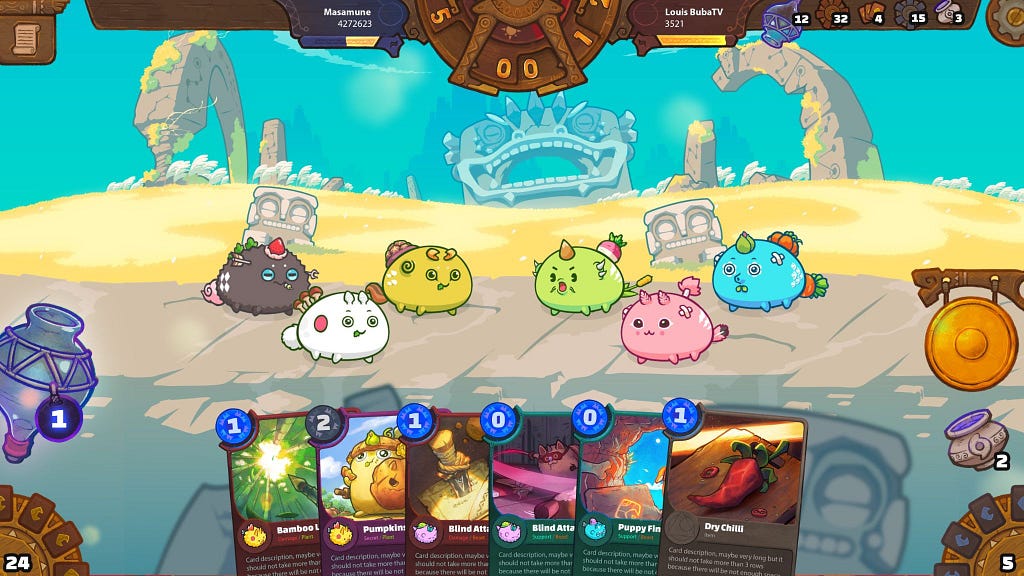
The gameplay itself is often compared to Pokemon, where players battle “Axies” (pictured below) against those of other players. Different Axies have different strengths and weaknesses, and the strategy of the game comes down to playing to your Axies strengths better than your opponent. Players get paid in SLP for defeating opponents. Additionally, players can compete daily quests to earn additional SLP. Axies can also be “bred” together to create new Axies which can in turn be sold to other players for profit.
Every time an Axie is traded, a plot of real estate is sold, or two Axies are bred, the protocol takes a fee priced in a combination of AXS and SLP. Rather than go to the developers, this revenue is placed in the Axie treasury, which has ballooned to nearly $600 million.
While the protocol revenue numbers alone depict the emergence of a new breakout crypto application, what’s more exciting is where Axie Infinity is taking off: in developing nations where players can often earn more playing the game and selling SLP for their native currencies than they can with a typical day job.
With an estimated 50% of daily active users (DAUs) coming from the Philippines, the game is also picking up steam in other emerging markets like Indonesia, Brazil, Venezuela, India, and Vietnam.
Created by game developer Sky Mavis in 2018, Axie started picking up organic traction in the Philippines in early 2020 after a few players realized they could make legitimate incomes by playing. When Covid lockdowns hit and many were put out of work, more were encouraged to give it a try. A documentary on the game’s growth called PLAY-TO-EARN went viral in May 2021 and DAUs went vertical soon after.
Business models of the metaverse
Unlike many mobile games, Axie Infinity is not free to play. To get started, players need to obtain 3 Axie Infinity characters. In the earlier days of the game, the average Axie was selling for under $10. With the game’s rapid growth and the broader NFT rally, the average Axie is now selling for nearly $500 according to CryptoSlam.
Given Axie’s base within the Philippines and other emerging markets, a $1,500 entry tag is a non-starter for most would-be players. To mitigate this barrier to entry, an informal market emerged in which NFT owners began lending players the NFTs needed to play the game in exchange for a cut of their winnings. This is done through QR codes that let players use Axie NFTs in game without the lender having to cede ownership on-chain.
This informal market has blossomed into a formal play-to-earn financial services sector. The largest and most prominent player is a project called Yield Guild Games.
Yield Guild Games (YGG)
Founder Gabby Dizon likes to say that Yield Guild Games is one part Berkshire Hathaway and one part Uber.
Just as Berkshire Hathaway is a holding company for a multitude of businesses, YGG is essentially a holding company for play-to-earn gaming assets. Starting in 2020, they’ve been buying up yield producing NFTs, governance tokens, and ownership stakes in promising gaming projects and protocols.
Similar to how Uber pairs people who want to earn money driving with people who need rides, YGG pairs people who want to make money gaming with the NFTs they need to earn in play-to-earn games. In many parts of the world, people are opting to work with YGG over Uber simply because it pays more.
YGG recently released its July Asset & Treasury Report that offers an interesting glimpse into the new kinds of business models NFTs and play-to-earn games are creating.
YGG by the numbers
Within YGG, there are scholars and community managers. Scholars receive NFTs that they in turn put to work earning crypto. Community managers recruit and train new scholars. 70% of winnings go to scholars, 20% to community managers, and 10% to the Yield Guild Games treasury.
According to the report, 2,058 new scholars joined YGG in July bringing the total to 4,004. In the same month, YGG scholars generated 11.7M SLP by playing Axie Infinity, which equated to over $3.25M in direct revenue. From April through July, scholars and community managers have earned a cumulative of $8.93M.
From its cut of all SLP earned by scholars, YGG earned $329,500 in July and a total of $580,000 since April. YGG’s expenses currently outstrip revenue, as they spent $1.62M in July alone “breeding” new Axie’s to meet scholar demand (breeding can cost anywhere from $200 to $1,200 per Axie).
The YGG Treasury
The YGG treasury consists of tokens and stablecoins held in a wallet, NFTs, and venture investments made in various play-to-earn games. The project has been funded by a $1.325M seed round led by Delphi Digital and another $4.6M round from a16z. They also raised $12.49M from the sale of the YGG governance token, while holding 13.3% of its outstanding supply.
As of the end of July, the YGG wallet’s holdings stood at $415M, with the majority stemming from the YGG token ($373M). The YGG token is part of Yield Guild Game’s plan to transition into a community-governed DAO.
Much of YGG’s capital has been put to work buying NFTs that can earn yield from play-to-earn games. By the end of July, the YGG treasury had amassed 19,460 NFTs valued at over $10M across 12 play-to-earn games. Axie Infinity NFTs comprised close to 90% of that value.
YGG has also made early stage investments across 8 play-to-earn games via SAFT (Simple Agreement for Future Tokens), and locked in ~$1M for yield farming in blue-chip DeFi projects.
A key element of the YGG model is that players are lent NFTs with zero downside risk and without having to put down any upfront capital. In return, they surrender 30% of their winnings but retain the majority — a critical hook to onboarding a new class of crypto users that have historically been priced out.
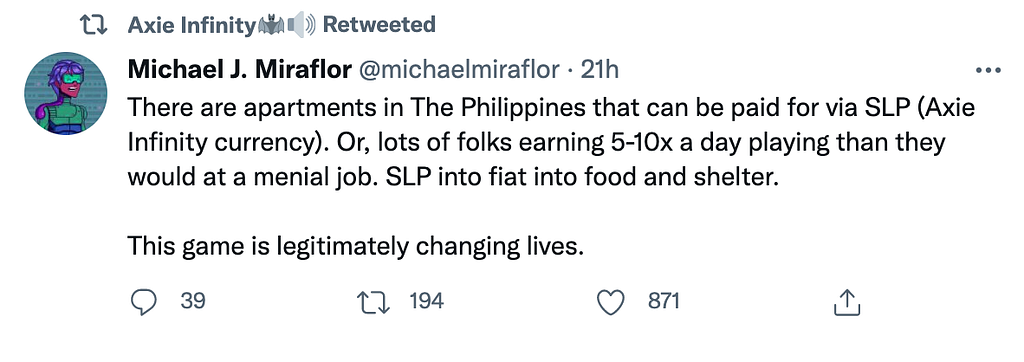
In fact, some players in the Philippines are earning 5–10x what they were making from their previous jobs. New homes have been purchased, charitable acts have been made, and even shops are accepting SLP as payment.
Beyond the wealth Axie Infinity has created, the game’s popularity has served as a means for getting a large new class of users comfortable using crypto applications. As these 1 million users interface with cryptocurrencies, NFTs, digital wallets, and DEXs, it’s not hard to see this new cohort as natural users of other DeFi and Web3 applications.
Play-to-earn sustainability
If Axie Infinity is its own digital nation, game developer Sky Mavis serves as its Federal Reserve. Where the Fed has various tools it uses to influence the economy, Sky Mavis can adjust the SLP issuance rate and breeding fees with the aim of keeping the Axie economy healthy. Just like a real economy, digital economies have to consider the effects of inflation.
ETH has been flowing into the Axie economy due to high demand for Axie NFTs. Increased demand for Axie NFTs has led to rising Axie NFT prices. Higher NFT prices have made breeding more profitable. Breeding requires fees paid in SLP & AXS, leading to a rise in token prices. With rising SLP prices, playing becomes more profitable, encouraging others to join. A powerful positive feedback loop no doubt — but what if market conditions change?
Winning Axie Infinity battles and quests yields SLP, inflating the SLP supply. And since breeding is priced in SLP, additional supply of SLP equates to cheaper breeding fees to create new Axie NFTs, inflating Axie NFT supply. These dynamics could have an impact on NFT market prices, which in turn may have a direct effect on the economics for players — a possible negative feedback loop.
Ultimately, Sky Mavis has to keep the SLP supply in-check while improving overall gameplay to keep its player economy and ETH deposits growing. They must also offset the number of players seeking to extract a profit with players who are pure consumers — i.e. playing for the fun of it.
Playing the Long Game
While Sky Mavis works to keep the Axie economy strong, Yield Guild Games is banking on the continued growth of play-to-earn gaming as a whole. By replicating its model for Axie Infinity across new games, it seeks to build a play-to-earn empire. Over the long run, founder Gabby Dizon sees YGG as the “recruitment agency of the metaverse” that ultimately competes with the Ubers of the world for labor. A future straight out of Ready Player One in which millions of people earn a living in the digital world in order to cover expenses in the physical one.
Final word
With the exploding revenue of Axie Infinity, the emergence of DAOs like Yield Guild Games, and the multitude of play-to-earn games on the horizon, it’s clear that this trend has legs. With DeFi, NFTs, and now crypto gaming, we’re rapidly evolving past the original crypto killer app of speculative trading and into a universe of expressive new apps and models. We’re in fascinating times as crypto’s utility phase marches forward with a full head of steam.
Quick Hits
OpenSea Hits $3B monthly volume
In the month of August, NFT exchange OpenSea hit $3B in monthly volume as over 1.5 million NFTs changed hands. Its August volume alone exceeds that of every other month in its history, combined.
OpenSea’s August volume is on par with $3B in gross sales Etsy put up in all of Q2: another sign of just how big the NFT market has grown relative to other online marketplaces in a very short timespan.
Data from The Block shows how dominant OpenSea’s dominance over the NFT landscape really is.
Notably absent from this exchange landscape are any kind of decentralized venues for trading NFTs. This follows past market cycles in which centralized exchanges found product market fit first, before ultimately paving the way for decentralized alternatives (think Uniswap during the DeFi summer).
The DEX market for NFTs is still nascent but one we’re watching is the recently launched Punks.house which is a permissionless venue for trading CryptoPunks made by Zora. We’re also seeing NFT markets begin to decentralize themselves, with NFT art marketplace Super Rare making the first move with the introduction of its RARE governance token. Many suspect OpenSea will eventually take this route as well.
Lastly, while OpenSea is a centralized for profit entity, its code is open source. It wouldn’t surprise us to see a low-fee competitor forked from OpenSea emerge in the coming months.
$611M whitehat hack?
In the largest DeFi hack to date, an attacker drained over $611M from the Ethereum, Binance Smart Chain, and Polygon blockchains. Then in a surprise move, he returned almost all of it.
The hack was done by exploiting vulnerabilities on the Poly Network, a cross-chain interoperability protocol that connects different blockchains. These types of networks are usually among the most complex, owing to challenges in getting two different blockchains to talk to each other in a secure, safe fashion (it’s hard enough getting one blockchain to be secure!). And complexity is the enemy of security because added complexity increases the surface area for attackers to find exploits.
In this case, the hacker tricked Poly Network’s smart contracts into thinking that the hacker’s address had permission to unlock the $611M+ across chains (detailed technical analysis here, simple explainer here). But in an odd turn of events, the hacker ended up returning nearly all of it to the Poly Network team (sans $33M USDT frozen by Tether).
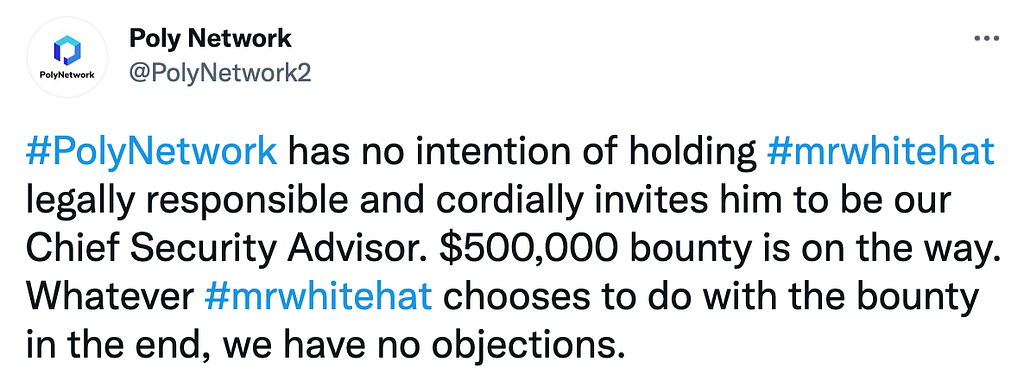
There remains speculation around the hacker’s motives to return the funds. Security firm SlowMist stated that they were able to identify the hacker’s IP and email addresses, so some think the funds were returned because the hacker knew they wouldn’t be able to launder that much money undetected. The hacker, on the other hand, conducted an AMA and stated that they did it, “for fun.” And in a separate twist, the Poly Network team offered the hacker a job as their Chief Security Officer in addition to sending a $500,000 bounty for returning some of the funds.
What’s going on here? We can’t know for sure, but it is rare for a hacker to return funds, especially in such a public fashion. Occam’s razor suggests that the repercussions involved with getting caught (if their info was truly identified) were too great to bear.
While it’s disconcerting to see more hacks happening, we should note that this is simply an evolutionary fitness-function in action. Each hack teaches us how to improve, and we learn, adapt, and improve. While bleeding edge crypto protocols pioneering new use cases will inevitably carry more risk, the space hardens over time.
And Poly Network is not alone. Note the other week when Paradigm’s samczsun discovered and reported a vulnerability in SushiSwap’s MISO platform that would have left $350M ETH at risk. Most recently, Cream Finance was exploited in a flashloan attack for $25M.
But for crypto to really succeed, we need security guarantees. Insurance markets are critical.
Retail news
Binance Tightens KYC Requirements — Leans into Compliance
The 2021 Global Crypto Adoption Index: Worldwide Adoption Jumps Over 880% With P2P Platforms Driving Cryptocurrency Usage in Emerging Markets
Crypto grows from 2% to 41% of Robinhood’s total revenue in past year
Japan’s Liquid Global Exchange Hacked; $90M in Crypto Siphoned Off
‘Novi is ready to come to market,’ says David Marcus as Diem’s future remains uncertain
Facebook Considering NFT Support in Novi Digital Wallet
Austrian crypto unicorn Bitpanda raises another $263 million
Institutional news
US Mortgage Lender UWM Plans to Accept Bitcoin Payments
Galaxy files for ETF that provides indirect exposure to bitcoin
Bloomberg and Galaxy team up on decentralized finance index
Former SEC chair Clayton joins Fireblocks advisory board
Galaxy reports losing $175 million during the last quarter in recent earnings call
Wells Fargo Launches Passive Bitcoin Fund for Wealthy Clients
Ecosystem news
Visa Enters Metaverse With First NFT Purchase
Budweiser buys Beer.ETH domain and a rocket NFT
Twitter taps crypto developer to lead decentralized social media initiative Bluesky
TikTok Picks Streaming Service Audius to Power New ‘Sounds’ Library
DeFi projects could come under SEC’s oversight, says chairman Gensler
a16z announces $4.6 million financing round in Yield Guild Games
Avalanche launches $180 million DeFi incentive scheme with Aave and Curve
Walmart is looking for a crypto product lead
Polygon acquires Hermez in $250 million deal that includes first-ever token ‘merger’
Ethereum 2.0 Staking Contract Now Holds the Most Ether: $21.3B
This website does not disclose material nonpublic information pertaining to Coinbase or Coinbase Venture’s portfolio companies.
Disclaimer: This material is the property of Coinbase, Inc., its parent and affiliates (“Coinbase”). The views and opinions expressed herein are those of the author and do not necessarily reflect the views of Coinbase or its employees and summarizes information and articles with respect to cryptocurrencies or related topics that the author believes may be of interest. This material is for informational purposes only, and is not (i) an offer, or solicitation of an offer, to invest in, or to buy or sell, any interests or shares, or to participate in any investment or trading strategy, (ii) intended to provide accounting, legal, or tax advice, or investment recommendations or (iii) an official statement of Coinbase. No representation or warranty is made, expressed or implied, with respect to the accuracy or completeness of the information or to the future performance of any digital asset, financial instrument or other market or economic measure. The information is believed to be current as of the date indicated on the materials. Recipients should consult their advisors before making any investment decision. Coinbase may have financial interests in, or relationships with, some of the entities and/or publications discussed or otherwise referenced in the materials. Certain links that may be provided in the materials are provided for convenience and do not imply Coinbase’s endorsement, or approval of any third-party websites or their content. Coinbase, Inc. is not registered or licensed in any capacity with the U.S. Securities and Exchange Commission or the U.S. Commodity Futures Trading Commission.
Axie Infinity, Yield Guild Games & the play-to-earn economy was originally published in The Coinbase Blog on Medium, where people are continuing the conversation by highlighting and responding to this story.