Tag: onchain

  • On-chain Data Suggests Bitcoin Miners Were Behind The Selloff

    On-chain Data Suggests Bitcoin Miners Were Behind The Selloff

    [ad_1]

    On-chain shows Bitcoin miner outflows have been elevated recently, suggesting miners were involved in the recent selloff that took the price of the crypto below $42k.

    Bitcoin Miner Outflows Spiked Up Before The Crash Below $42k

    As pointed out by an analyst in a CryptoQuant post, BTC miners seem to have been one of the sellers behind the price drop to $42k.

    The relevant indicator here is the “miner outflow,” which measures the total amount of Bitcoin exiting wallets of all miners.

    When the value of this metric spikes up, it means miners are moving a large number of coins out of their wallets right now. Such a trend can be bearish for the price of the crypto as it may be a sign of dumping from these original whales.

    Related Reading | Ark CEO Cathie Wood Is As Bullish As Ever, Sees Bitcoin Hitting $1 Million By 2030

    On the other hand, low values of these outflows suggest a normal or healthy amount of selling from miners. This trend, when sustained, can prove to be bullish for the BTC price.

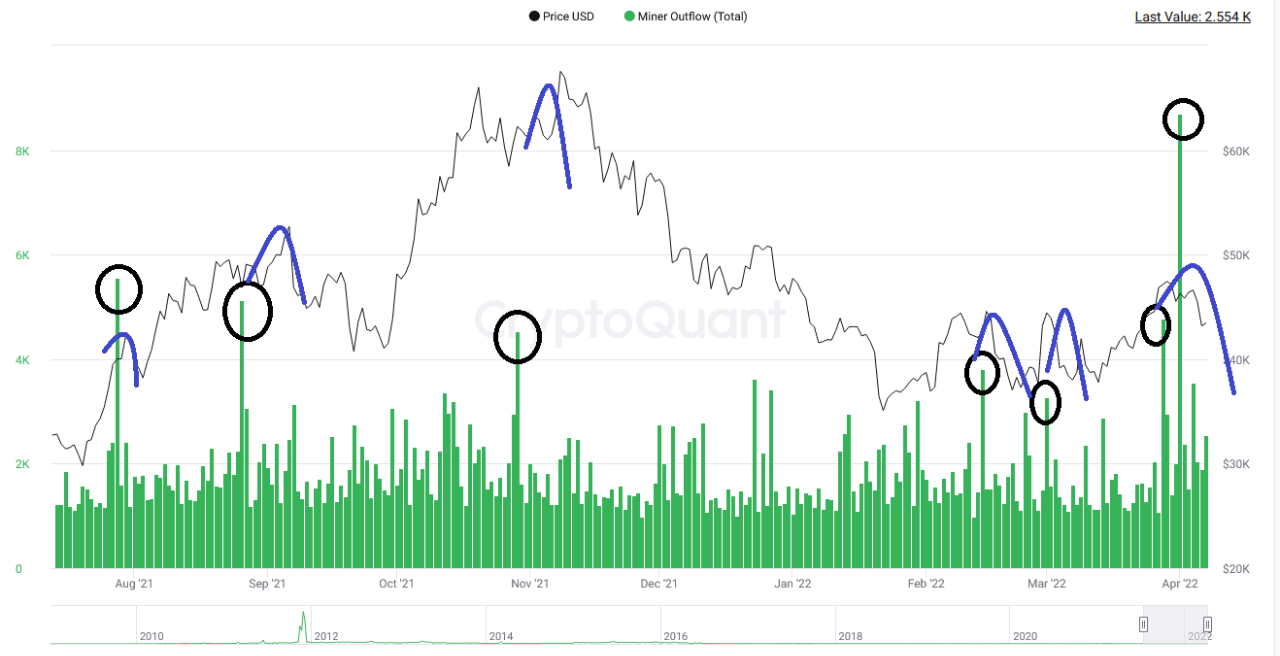
    Now, here is a chart that shows the trend in the Bitcoin miner outflows over the past several months:

    Bitcoin Miner Outflows

    Looks like the value of the indicator has shot up recently | Source: CryptoQuant

    As you can see in the above graph, the Bitcoin miner outflows seem to have shown spikes in recent weeks, just before the selloff.

    This would suggest that miners look to have played a role in the dump recently, sending the price of the coin diving below the $42k level.

    A trend like this has been observed a few times in the past several months already, as the quant has marked in the chart.

    Related Reading | Mexico’s Third Richest Man Says No To Bonds, Yes To Bitcoin

    Currently, it’s unclear whether Bitcoin miners have already calmed down or if more selling is coming in the next few days.

    BTC Price

    After around twenty days of holding strongly above the level, Bitcoin’s price is now once again revisiting the $41k mark.

    At the time of writing, the coin’s price floats around $41.1k, down 11% in the last seven days. Over the past month, the crypto has gained 4% in value.

    The below chart shows the trend in the price of BTC over the last five days.

    Bitcoin Price Chart

    The value of BTC seems to have taken a plunge over the past twenty-four hours | Source: BTCUSD on TradingView

    Due to this sharp downtrend in the price of the coin as well as the wider market, crypto futures has collected a huge amount of liquidations today. In the last 24 hours, liquidations have amounted to more than $322 million, $175 million of which occurred in the past 4 hours alone.

    Featured image from Unsplash.com, charts from TradingView.com, CryptoQuant.com

    [ad_2]

    Source link

  • How A Game-Changing Decentralized Synthetic Exchange Aims to Unlock the True Value of Commodities and Digital Assets On-Chain

    How A Game-Changing Decentralized Synthetic Exchange Aims to Unlock the True Value of Commodities and Digital Assets On-Chain

    [ad_1]

    The barter system, where you trade your cow for someone else’s grains, for instance, is probably older than you think. It has its roots dating back to 6000 BC when Mesopotamian tribes first made exchanges with other groups.

    Those methods of exchange worked well before things like the Internet or decentralized technology existed. Trading was necessary not because commodities have financial value or even industrial utility, but because they were necessary for survival. Back then, societies weren’t as worried about gold or silver as they were about grains, milk, and beans.

    Today, even though society is living in a time where artificial intelligence, automation, blockchain technology and decentralization are going to make means of exchange far more democratic, and private than ever before, commodities still derive their value from the same things.

    Agricultural goods provide us with a means to nourish ourselves and survive. Energy in the form of oil, natural gas etc. allows us to keep the lights on and keep the economy moving, and precious metals provide us with industrial utility and the ability to hedge against inflation.

    Here’s the thing. The above commodities are non-fungible. They are not so easy to trade. That means no matter how valuable they are, some of that value is sucked away by old-world value chains. Thus, it remains out of the hands of the everyday individual.

    That’s why Comdex is launching a decentralized exchange (DEX) for synthetic assets. So that value can be unlocked and participants all around the world can benefit from such an unlocking event.

    What Are Synthetic Assets?

    In blockchain, a synthetic asset is a tokenized version of another asset, whether the latter is tangible or intangible. In the case of commodities, blockchain can be used to tokenize physical assets as well as their financial representations, be it oil, gold or silver. Comdex operates a DEX listing synthetic assets representing all types of commodities.

    The benefits of synthetic assets are enormous, as they allow users to trade the real-world value of a commodity without the complexities inherent in holding the non-fungible good itself.

    Comdex Alleviates the Pain Points Associated with Nonfungible Commodities Exchanges

    The Comdex Decentralized Synthetics Exchange allows participants to act as:

    • Traders (who engage in buying and selling of cAssets against CMDX using cSwap)
    • Minters (who can create and open collateralized debt positions in order to obtain a newly minted cAsset. They must maintain a minimum collateral ratio of 150% to avoid liquidation.)
    • Liquidity Providers who provide equal amounts of cAssets and CMDX so that users can facilitate trades and providers can benefit from rewards and transaction fees.)
    • Stakers (who can earn CMD tokens using Omniflix and Unagii)

    The interface itself is easy to navigate. The team and the project are mission-driven. The whole point of the launch of this product is to alleviate the pain points that come with commodities and digital assets.

    Participants get the real-world benefit of on-chain diversification of assets. The benefit from the security and transparency a decentralized synthetic asset exchange can provide. They also don’t have to worry about the cumbersome nature of the logistics and storage that typically comes with investing in physical goods and commodities.

    Why Trade Synthetic Assets?

    Comdex anticipates that demand on its platform will expand at an accelerated pace given the benefits of synthetics over trading the physical assets themselves. Synthetic assets address multiple risks, including:

    • Confiscation or ban risk – the recent decision of US President Joe Biden to ban oil and gas imports from Russia shows that the commodity market may be unpredictable and struggle with uncertainty. Sometimes governments can go even further by confiscating commodities altogether. Synthetics cannot be confiscated and trading cannot be banned as they reside on a decentralized infrastructure.
    • Theft risk – storing gold coins under your bed can make you happier, but this is not the safest approach for sure. The risk of theft is considerable, and the problem is that your home insurance policy might cover any sizable investment as most insurance packages stipulate clauses preventing cover on high-value items like gold bars. Elsewhere, synthetics can’t be stolen if you keep your private key safely.
    • Third-party risk – even if you give up storing physical items and decide to invest in futures contracts, you will most likely end up storing them with a third-party custodian like a bank or broker. Unfortunately, there is always an insolvency risk associated with any centralized organization, including banks, shipping companies, or brokers. In the case of bankruptcy, you can own your investments partially or entirely. Since synthetics are stored on the blockchain, there is no third-party risk.

    On top of that, synths come with great benefits that can help traders have peace of mind about their commodity investments:

    • Easy access – with synthetics, you can get exposure to any commodity market without any obstacle. All you need to have is an internet connection and an account with Comdex.
    • Costs – if you trade physical commodities or their futures, you have to be ready to pay broker fees, as well as storage, conversion, transportation, withdrawal, and other fees. Trading commodity synthetics reduce the costs to a minimum thanks to the efficient use of resources.
    • No Expiry of futures contracts – trading commodity futures may be problematic for investors, as in theory, they are obligated to take delivery of the physical goods once the contract expires. Synthetics function 24/7 with no expiry.

    Comdex is striving to revolutionize how people engage in commerce with commodities by merging decentralized technologies with real-world assets. The hybrid approach to this new robust decentralized synthetic asset exchange is going to change the game for good.

    The question is, are you ready for it?


    Image: Pixabay


    [ad_2]

    Source link

  • Bitcoin On-Chain Demands Suggests That The Market Has Reached Its Bottom

    Bitcoin On-Chain Demands Suggests That The Market Has Reached Its Bottom

    [ad_1]

    Bitcoin on-chain analysis can be a good way to try to guess where the market is headed. The market tends to repeat itself with metrics looking the same before a bull or a bear rally, thus making this data a pretty good indicator of what’s to come. Analyst Willy Woo uses this same data to demonstrate a pattern that occurs before the bull rally, the criteria which are being met once again.

    Start Of A Bull Run?

    In a recent string of tweets, analyst Willy Woo presents data from on-chain analysis that points to the bitcoin dump having reached its bottom. According to him, “Price in relation to on-chain demand from both speculative and hodl category of investors are now both at peak oversold levels.” Woo points out that the last time that something like this had happened was when bitcoin reached its bottom following the COVID crash.

    The analyst further outlines the times where this has happened in the past. Going as far back as 2012, he points out the same had been the case in February of that year. What followed had been the memorable 2021-2013 bull run that saw bitcoin gain more popularity among investors.

    Related Reading | Bitcoin Halving To Bring The Subsequent Crypto Frenzy

    Fast forward to 2015 and the same had been the case in January of that year. This time, the on-chain metric spelled the bottom of the bear market that had begun previously in 2014, putting an end to the onslaught.

    If Woo is right and the on-chain metric continues the way it has historically, then bitcoin may very well have reached the bottom, suggesting that this is the end of the downtrend. However, there is no telling if this is actually the case given that bitcoin had recorded back-to-back bull rallies in 2021.

    Bitcoin On The Charts

    Bitcoin has lost almost 50% from its all-time high of $69k which it hit in November of last year. This has however not affected the profits of the majority of holders. The digital asset remains one with the highest volume of holders that remain in profit after the market crash.

    Related Reading | El Salvador Chivo Bitcoin Wallet Relaunch To Serve 4 Million Users

    According to data from IntoTheBlock, 60% of all bitcoin holders are still in profit at current prices. It is important to note that the cryptocurrency was subject to massive sell-offs when investors panicked that the downtrend will continue. Most however have still kept their highly profitable status, with only 35% of all holders currently losing at market prices.

    Bitcoin price chart from TradingView.com

    Bulls struggle to pull BTC up as bears take hold | Source: BTCUSD on TradingView.com

    The majority are long-term holders and indicators point to investors still being very bullish on the digital asset despite the downtrend. With its current growth curve, it is expected that the cryptocurrency will see 1 billion holders in the next four years, making it a highly sought-after asset.

    Featured image from Bitcoin News, chart from TradingView.com


    [ad_2]

    Source link

  • DeFi needs more tangible assets on-chain to see a successful future

    DeFi needs more tangible assets on-chain to see a successful future

    [ad_1]

    In a business school lecture hall at the Massachusetts Institute of Technology (MIT), a senior executive for Safaricom gave a prediction of decentralized finance and the future of commerce to a room of keen but confused MBA students. “You will be able to buy your first home on WhatsApp! Smart contracts on the Ethereum blockchain will take care of everything and you won’t need a broker,” he said with conviction, pointing to a slide.

    “How will the house’s title change hands? What about the funds? Can the blockchain do escrow? What role for lawyers? How could we possibly buy something worth a million dollars with the click of a button?” the class wondered.

    Students in April 2017 — who hadn’t yet seen Bitcoin (BTC) crest above $20,000 — had little reason to believe that blockchain would change the world. They were intrigued anyway. Although these conversations took place back in 2017, the same discussions could still sound captivating to many today. That’s because there are still many individuals and businesses who have yet to experience the impact of DeFi and real-world assets (RWAs).

    Looking to our present in 2021, after the excitement of the DeFi summer and the setback of Bitcoin’s recent sell-off, we are at another crossroads. DeFi total value locked is now above $150 billion, MakerDAO has now officially become a DAO, FTX has raised the largest private round in crypto, and a DeFi future seems more plausible than ever.

    This would be a world where credit, payments and investing all take place on-chain in a decentralized system, without as great a role for financial institutions. In the spirit of blockchain, and the broader fintech movement, DeFi projects aim to offer innovative financial products with lower fees, fewer intermediaries and higher transparency.

    While DeFi has made impressive strides and breakthroughs since 2017, the liquidity in the DeFi ecosystem represents only a fraction of what is needed for decentralized finance to go mainstream by bringing more real-world assets on-chain.

    Related: The future of DeFi is spread across multiple blockchains

    The question arises for this entire sector: How do we go from early customer traction to product-market fit? So that when a version of the 2017 conversation between the Safaricom executive and MIT students happens today, it won’t sound like something out of the ordinary and more like part of most people’s everyday life. Here are some key deterministic factors for DeFi to gain mainstream adoption.

    A comprehensive data and analytic infrastructure

    With a declining role for centralized financial institutions, the “guarantors” of the financial system, we are forced to rethink not only how data moves but also how it is controlled and custodied. Without banks, how will a blockchain manage one’s identity? How will we evaluate risk? How will we price assets if we can’t call on centralized datasets for valuations?

    Oracles have successfully played a critical role in bridging the gap between real-world data and smart contracts. But how about the data analysis tools such as FICO and Bloomberg that are powering the financial markets? We haven’t seen any oracles that are providing a viable solution to that. The broader DeFi space needs a crowdsource-enabled solution to price historically opaque and illiquid assets so that we can bring these private assets into DeFi effectively and efficiently.

    Collectively, this will accelerate the movement of real-world assets on-chain, including real estate and collectibles, and has the power to change the world. Still, we raise new questions: What is the right way to govern data in a decentralized universe, and how will laws apply in technological contexts lawmakers never considered? This question has plagued the social media industry and its reputation for the last several years. How can DeFi avoid similar pitfalls?

    A DeFi ecosystem replicates full CeFi functionalities

    China is the global leader in fintech innovation, with nearly 90% digital wallet penetration and 62 billion unique transactions made in 2020. This textbook definition of mass adoption is made possible by providing a complete banking experience for the wallet holders. Through Alibaba Group’s Alipay, China’s leading digital wallet, users can purchase insurance policies, invest in mutual funds, exchange currencies, pay bills and donate to charities. Alipay exemplifies a digital revolution built to allow people to continue the same routines but easier, faster and cheaper.

    Similarly, the cryptographic innovations must be built upon a DeFi ecosystem that provides the same secured insurance, lending services and trusted currencies. While many DeFi veterans have already implemented RWA-based strategies, the lack of sufficient RWA on-chain severely hinders the ecosystem development.

    Related: Decentralized and centralized finance need to collaborate

    After having a proper pricing infrastructure, DeFi needs to offer a solution to onboard real-world assets on-chain at scale. The unique value proposition lies within their financing licenses. The space needs a protocol interfacing with traditional corporate borrowers globally to originate RWA at scale and bridge the funding demand in CeFi with liquidity in DeFi. This can be done by offering a frictionless lending process for real-world borrowers, eliminating the need for “crypto education” by allowing the borrowing and repayment to be made in fiat. On top of that, an RWA-based yield strategy has to be created, allowing DeFi and CeFi lenders to invest in income-generating real-world assets while maintaining exposure in crypto assets.

    RWA lending will undoubtedly unlock numerous opportunities for DeFi innovations to replicate most, if not all, of the CeFi functionalities. With more projects eyeing RWA, the ecosystem will expand quickly.

    An effective and efficient decentralized governance

    When we talk about scaling decentralized finance and bringing more RWA on-chain, decentralized governance is an inevitable part. An effective decentralized governance solution could benefit DeFi in many ways:

    • Easier scaling. Organizations interested in scaling up can facilitate the process easier if they’re decentralized.
    • Faster decision-making. This largely depends on the governance form of that organization. Of course, some can be faster than others, but compared against centralized organizations where there is a wait for decisions to be approved, decentralized organizations have a clear advantage.
    • Transparency. All types of transactions are traceable and auditable by all permitted parties, resulting in much higher transparency and fraud prevention.

    Related: Decentralized parties: The future of on-chain governance

    A global standard for regulatory compliance

    In an unpredictable market for regulatory enforcement actions, DeFi cannot afford to fly blind. Just last month, the U.S. Securities and Exchange Commission chairman Gary Gensler said:

    “These platforms — whether in the decentralized or centralized finance space — are implicated by the securities laws and must work within our securities regime.”

    The DeFi industry needs a strategy for compliance. The views that decentralization makes it difficult to hold any single entity accountable, or worse, that decentralization makes compliance unnecessary, have already and will continue to draw the scorn of regulators.

    Related: FATF draft guidance targets DeFi with compliance

    How can platforms reasonably fit their businesses within existing legal structures of the Bank Secrecy Act and Know Your Customer (KYC)/Anti-Money Laundering, or at least help to change the paradigm? Libra’s misadventures, though hardly DeFi, represent a missed opportunity to innovate without insulting our authorities. In its current state, the DeFi industry risks insulting regulators and advancing the theory put forth by antagonists like Elizabeth Warren that the cryptocurrency industry only truly exists to promote illicit financial practices, such as money laundering and drug and human trafficking. While the answer is not abundantly clear now as to how DeFi will integrate compliance into the technology stack, it seems clear that it must. Mainstream institutions and the general public will require better KYC standards before adopting.

    Conclusion

    There are protocols that have the potential to improve and secure the global financial system by introducing much-needed transparency and neutrality into a stable currency. Some stablecoin platforms have allowed anyone to generate their peer-to-peer cash in a trustless and decentralized environment.

    But if we truly want everyone to realize the dream of accessible financial services for all people, then those of us in the DeFi space must leave our comfort zones. Our goal is for RWA to incorporate billions of dollars in non-digitally native. We must cross the chasm and step outside collateral into the DeFi ecosystem, but we can’t do it alone. We need to work together with a whole set of companies and projects that have a clear goal while encouraging competition from the legacy financial sector to benefit what is most important — the users.

    This article was co-authored by David Lighton, Kevin Tseng and Mariano Di Pietrantonio.

    This article does not contain investment advice or recommendations. Every investment and trading move involves risk, and readers should conduct their own research when making a decision.

    The views, thoughts and opinions expressed here are the authors’ alone and do not necessarily reflect or represent the views and opinions of Cointelegraph.

    David Lighton is the co-founder of Lithium Finance. He’s an entrepreneur passionate about inclusive financial innovation and also the founder of SendFriend, a fintech startup using blockchain for international money transfers. David also served as special assistant on the Haiti desk at the World Bank and co-authored the Haiti National Financial Inclusion Strategy. David holds an MBA from the MIT Sloan School of Management and an M.A. and B.A. with honors from Johns Hopkins University.

    Kevin Tseng is the founder of Naos Finance. Prior to Naos, Kevin was a serial entrepreneur and an investor. Kevin founded and exited three tech startups in China and Southeast Asia and led strategic investment at The Walt Disney Company and Alibaba Group.

    Mariano Di Pietrantonio is the head of strategy for MakerGrowth, a MakerDAO Core Unit. He works primarily on the development and research of new use cases, including education, partnerships and communication activities. Mariano has 15 years of experience in product and marketing in industries such as pharma, banking and gaming, among others.