One of the most important features of the blockchain is the permanence of records stored on-chain. When it comes to securing and documenting human history, there has never before been such an important platform. Preserving human history is an ideal role, among many, for blockchain technologies.
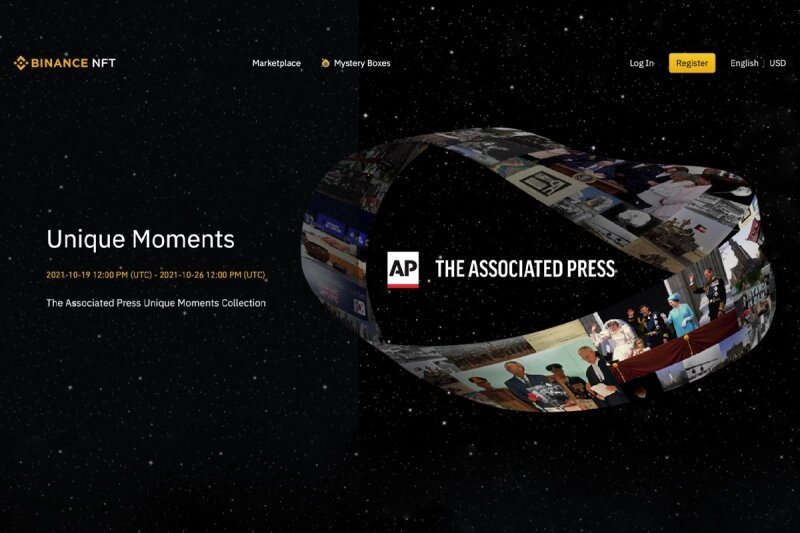
On October 19, MetaList and The Associated Press released The AP UNIQUE Moments Collection. The NFT collection includes 53 significant historical events from 1921–2021. These NFTs were officially auctioned on the Binance NFT market and were also sold in valuable surprise mystery boxes.
“Undoubtedly, what needs to be remembered most by mankind are the achievements of peace, the breakthroughs in science and technology and the catastrophes that touch the hearts and resolve of all people,” said Sharona Lee, the co-founder of MetaList.
One of the NFT works included in the series is the 1944 Normandy landing, the largest and boldest military attack in history and the event that determined the power structure of today’s world. AP’s war correspondents were stationed around the world reporting on the historic battles and AP was the first news agency to report the end of World War II.
In addition, on July 20, 1969, Apollo 11 successfully landed on the moon. The Associated Press dispatched important updates to a waiting world, including the moment that humanity stepped foot on the moon. That historic “news flash” is included in this collection.
“We want these important stories to last forever and for everyone to see them and understand their significance,” said Dwayne Desaulniers, head of blockchain and data licensing at the Associated Press.
“We should remember more than just achievements. Disasters are also mirrors that we should reflect on and thus include in this collection,” Sharona Lee said. “So this auction includes some NFTs of those agonizing moments as well, such as a photo from 911’s ground zero following the attack. It is historically included for the world to remember, that horrific event which marks its 20th anniversary in 2021.”
In addition to these important historical events in the past century, the auction of NFTs also includes historic images of top newsmakers such as Roosevelt, Churchill and JFK. Planet earth and its wonders are also a focus of the collection. Included is the stunning 2018 image of the “Super Blue Blood Moon”, a celestial event occuring once every 150 years.
“There is no doubt that when we collect memories, we are not only just focusing on certain events. The important faces of the individuals involved in the event are also for history and NFTs to document,” said Sharona Lee.
Besides the auctioned NFT works, AP and MetaList released mystery boxes containing some of these valuable NFTs. After the sale started, the mystery boxes were sold out in a short period of time.
Some lucky collectors found surprising and rare NFTs of newsmakers in their boxes, such as Mandela, Che Guevara, Madame Curie and Einstein.
About MetaList Lab
Metalist Lab is based in Australia, and is a world-leading publisher of NFTs. It brings countless outstanding NFT designers together with the top names in encryption technology, and has worked with game companies such as NetEase, news and communications agencies such as the Associated Press, as well as many high-level artists and their IPs. Recently it has been distributing NFTs for NetEase’s globally-popular game Naraka: Bladepoint, as well as the “The AP Unique Moments NFT” series.
Most of us have heard about Beeple’s Everydays: The first 5000 days selling for a whopping $69.3 Million dollars but most of us don’t realize the significance of that astronomical number. To put it into perspective, compared to traditional art, only 100 paintings have sold at a higher price than Everydays. That is all paintings sold ever! The investors in the art world have been around for centuries and NFT investors are just getting started.
There is no doubt that NFTs are changing the way we think about art, but this paradigm shift is not restricted to GIFs and JPEGs as the popular news might suggest. NFTs mark a turning point for digital transformation, as applications and integrations are spilling to various sectors: from music and gaming to energy and supply chains.
Understanding the true applications of NFTs
In essence, NFTs are a unit of data on a blockchain, where each NFT represents a unique digital item such as art, audio, videos, items in video games, and other forms of creative work.
Transactions in which ownership of something changes hands have usually depended on layers of middlemen to establish trust in the transaction, exchange contracts, and ensure that money changes hands. None of this will be necessary for the future. Transactions recorded on blockchains are reliable because the information cannot be changed. Smart contracts can be used in place of lawyers and escrow accounts to automatically ensure that money and assets change hands and both parties honor their agreements. NFTs convert assets into tokens so that they can move around within this ecosystem.
Any NFT is simply a piece of digital memorabilia, nothing more, nothing less. It can work like any other speculative asset, where investors make a purchase in hopes of the value increasing, so they can make a profit.
NFTs outside the art world
Technically, anything digital can be an NFT. They give musicians the potential to provide enhanced media and special perks to their fans. Kings of Leon and Grimes are some of the leading examples in the music industry. With sports memorabilia, between 50% and 80% of items are thought to be fake. Putting these items into NFTs with a clear transaction history back to the creator could overcome the massive counterfeiting problem that exists in the industry.
The potential of NFTs goes much further. For instance, San Marino, the tiny nation surrounded by Italy, has reportedly come up with an NFT-based vaccine passport. While still not in use, many believe NFTs provide the perfect opportunity to secure important documents and help prevent any identity thefts.
Lepasa NFTs
Content creators of all sorts can be one of the biggest beneficiaries of NFTs. It is now possible to escape the centralized control of platforms like Facebook where the platforms monetize content creator’s work. Lepasa is one such platform centered around creators. Lepasa is a mythological virtual life conceptualized by a team of artists and engineered by blockchain enthusiasts with a vision to establish an ecosystem that allows users to create, experience, and monetize their content and applications.
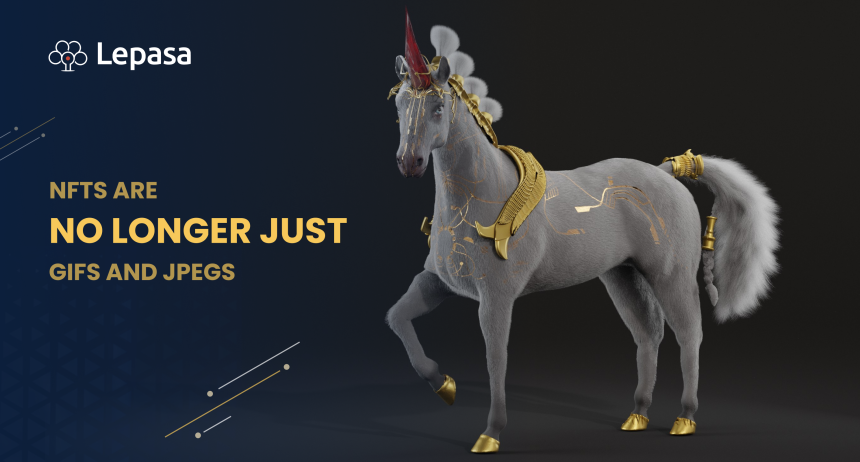
They provide a social experience with an economy driven by layers of land and unique creatures ownership, with content distribution. Even though NFTs are at the heart of this project, these NFTs are not restricted to just GIFss and JPEGs. They have a value proposition to apps and game developers in that they can fully capitalize and monetize on the economic interactions between their applications and users. The NFT scripting language allows for the NFTs to handle a wide range of capabilities, including applications, games, gambling, dynamic 3D scenes, and much more. These NFTs go beyond the realms of gaming, adding something for advertisers, sith elements of social media and E-commerce.
In many ways, Lepasa is at the center of most use cases of NFTs that have currently been developed.
The Apple App Store reportedly blocked a Gnosis Safe crypto wallet app update due to it hosting NFTs that weren’t purchased inside the app.
Lukas Schor —a product developer at Ethereum-based crypto wallet provider Gnosis Safe — revealed the firm ran into trouble when it submitted an updated version of its app to the IOS app store earlier this month.
Schor noted on Sept. 14 that despite the update having nothing to do with non-fungibles, the App Store flagged a sample image that displayed an NFT in the app’s description section, even though it had been up for “many months.”
Apple is blocking a release of our @gnosissafe mobile app because we display NFTs in it. After 2 weeks of back-and-forth, I felt that we need to talk publicly about this to raise awareness.
See the thread for details and why this might affect other wallets and apps as well.
While the app is still listed in the store along with the image displaying the NFT, it appears that Apple is blocking the update due to its guidelines around digital content.
According to screenshots he shared of Gnosis’ correspondence with Apple support over email, the tech giant stated that while “NFTs are not mentioned specifically” in its guidelines, apps are not allowed to provide access to “previously purchased digital content” bought outside of the app store.
This essentially means that apps cannot provide any NFT-related services unless they are integrated with Apple payment methods.
“If you choose not to implement in-app purchase, it would be appropriate to revise your app so that does not access previously purchased digital content,” the email concluded.
⛔️ This shows how access to Web3 still relies heavily on gatekeepers like Apple ❗️ It’s an industry problem, as the same arguments apply to any wallet displaying NFTs or games making use of NFTs We need to find better ways to make Web3 accessible on mobile permissionlessly
Schor stated that Gnosis will submit an appeal over the decision as he called on Apple to clarify its guidelines around NFTs. He also suggested that the firm has no plans to walk back its NFT support in its app:
“Permissionless access to Web3 is core to our values, so we are willing to go the extra mile to clear this up. Simply removing NFTs from our app is definitely not an option for us.”
Apple currently prohibits the inclusion of payment rails beyond those offered by the firm in apps listed in its store. While Gnosis doesn’t sell NFTs in its app, Apple charges a flat 30% commission of in-app purchases of digital goods and services.
This policy may not last for much longer however, as Judge Yvonne Gonzalez Rogers issued a permanent injunction in the Epic Games vs Apple case on Sept.10 that will potentially see a major change to the app store.
Epic Games, the creators of widely popular online game Fortnite built its own in-game payment system last year to circumvent Apple’s in-app payment system, which resulted in the game being delisted from the App-store.
In August 2020, Epic took legal action against Apple and specifically took aim against the firm’s in-app payments policies.
In Judge Rogers’ first ruling on the case on Friday, she issued an order for Apple to allow alternate payment options in apps listed on its store, with the injunction set to go into effect on Dec. 9, 2021 — unless it is enjoined by a higher court.
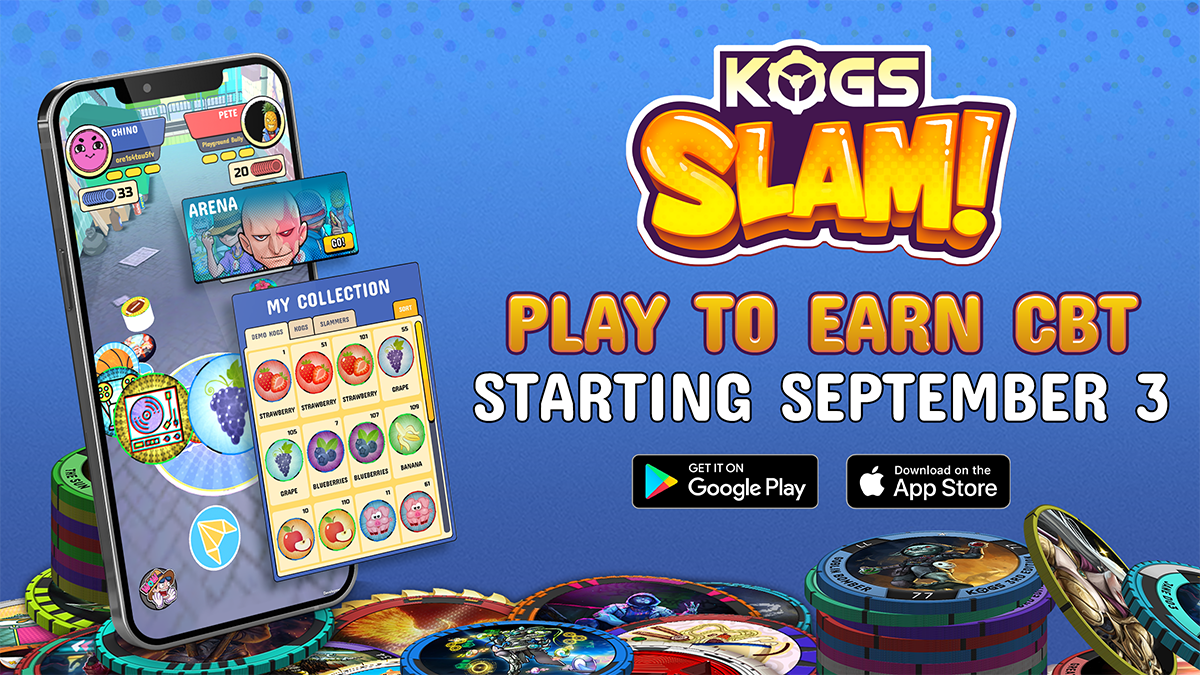
Manila, Philippines, September 3, 2021 — Southeast Asian based RFOX Games (a subsidiary of RedFOX Labs $RFOX) will release its free-to-play play-to-earn game KOGs SLAM! in closed beta this Friday the 3rd of September and welcome YGG (Yield Guild Games) to the beta release.
RFOX Games’ maiden release KOGs SLAM! is a digital gaming experience inspired by the 90’s schoolyard phenomenon POGs. RFOX Games will introduce a free play-to-earn model to millions of users in the Southeast Asian region.
RFOX Games, a subsidiary of Southeast Asian venture builder RedFOX Labs, has been working on a game that focuses on digital inclusion and allows people hit hardest by economic challenges an opportunity to earn from their mobile phones.
The closed beta trial for play-to-earn will kick off on September 3 and run for a month before its international public release. The beta release will allow for 5,000 participants to compete for the $RFOX token and prizes and is expected to be heavily oversubscribed.
The easy-to-learn game also has a popular NFT collection called KOGs, which is an acronym for Keys to Other Games. KOGs recently launched its limited Bad Days NFT collection featuring Marvel characters created by Stan Lee. The sale ended last August 28 but you can still buy KOGs here.
Ben Fairbank, CEO, and Co-founder of RedFOX Labs commented:
“It is highly likely that this game could reach millions of users across Southeast Asia and beyond when you consider that a free play-to-earn model would be welcomed with open arms by those most impacted by COVID, with many having lost their jobs.”
“We had an ambitious plan and model, and we are finally ready to go to the closed beta for the play-to-earn. We are thrilled to welcome YGG and Real Deal to the trial who can help us gain exposure to a wider audience of play-to-earn gamers. We are thrilled to have organizations of this caliber join the trial.”
Gabby Dizon, Co-founder of Yield Guild Games commented:
“We’re happy to be working with RFOX GAMES to bring YGG members into the KOGS SLAM closed beta. This gives an opportunity for our underserved members to start earning while they move up our scholarship waitlist. Being able to start playing for free and move earnings directly to GCash will massively increase play-to-earn adoption in the Philippines.”
Register here for the closed beta and early releases.
RedFOX Labs will also feature the KOGs collection and games in its upcoming metaverse the RFOX VALT
About RFOX Games
RFOX Games, launched by RedFOX Labs, Southeast Asia’s first blockchain venture builder. RFOX Games is building a series of interoperable games that are PLAY TO EARN and support the KOGs NFT collection. The entire RFOX ecosystem is supported by its native currency $RFOX and users will be able to compete in head-to-head and tournament-based games to win NFT prizes and $RFOX.
About Yield Guild Games
Yield Guild Games (YGG) is a decentralized autonomous organization (DAO) for investing in non-fungible tokens (NFTs) used in virtual worlds and blockchain-based games. The organization’s mission is to create the biggest virtual world economy, optimizing its community-owned assets for maximum utility and sharing its profits with its token holders.
According to data from NFT market analyst NonFungible, NFT sales have nearly tripled in value since Q3 2021, rising from a 7-day average of $16.8 million worth of sales, to just over $44.3 million.
The astronomical figure follows a surge in activity in the space that saw sales peak at $176 million per day earlier this year. World-renowned auction houses, Sotheby’s and Christie’s got in on the action, with the latter hosting the now-infamous Beeple Collection sale, raising a record $69 million.
Several of the largest players in the NFT space, including Cryptopunks and Bored Ape Yacht Club, continue to see spectacular sales, with Cryptopunks alone selling just under $15 million worth of NFTs on average over the past 7 days. Despite the market saturation, a new kid on the NFT block, Wicked Craniums is storming into the market, curating a dedicated fanbase. But what are Wicked Craniums and why are they so popular?
Wicked Craniums: The New Kid on the Block
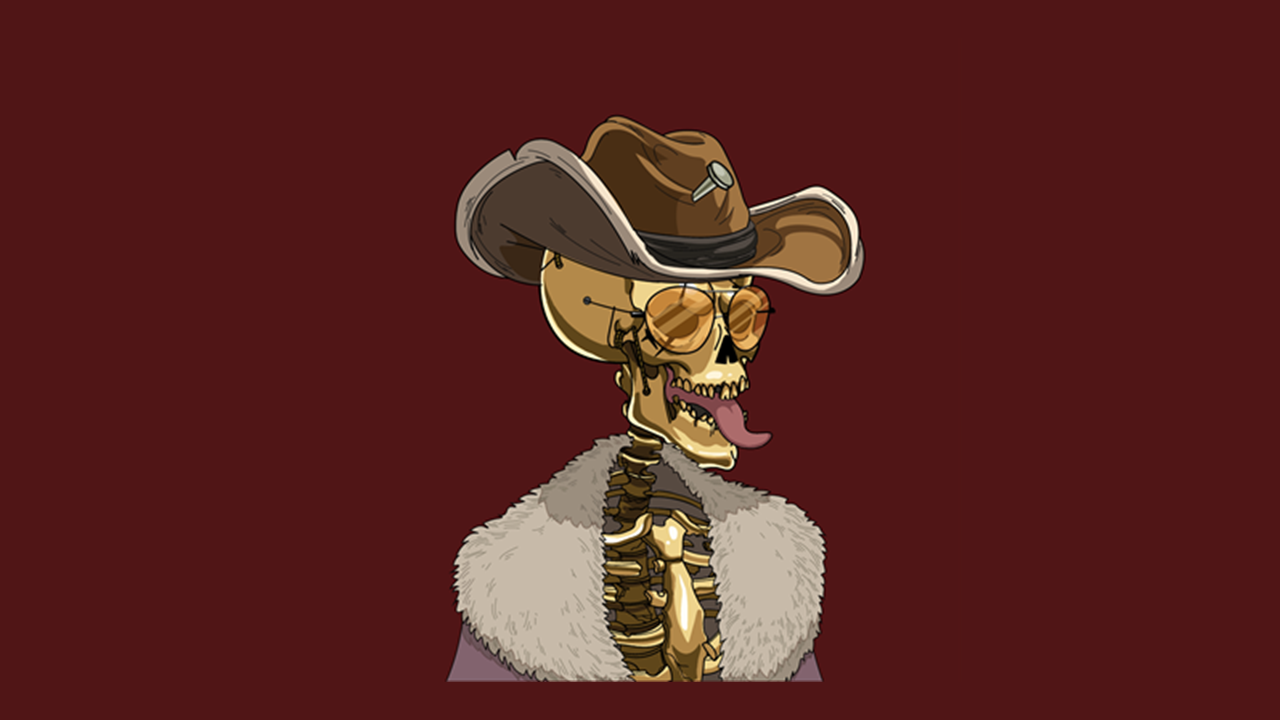
Wicked Craniums are an NFT art collection hosted on OpenSea. Each piece is a skeleton-themed caricature that represents one of 10,762 “Craniums” belonging to a fictional island called Osseous. There are over 180 differentiable features that make each Cranium unique and highly collectible.
Priced at 0.06 ETH (~$113.70 at current market rates), each Cranium affords its owners several features, including access to a members-only social platform called The Cradle, in which Craniums can share introductions, social media handles, and images. There are also a number of members-only projects that kick off as more Craniums are sold and each owner also has full commercial and use rights for each Cranium.
NFTs Roar, Wicked Cranium Sales Soar
The unique theme and combination of features has transformed Wicked Craniums into one of the best-performing NFT projects. Despite being capped at 645.72 ETH, within 48 hours of their release, all Craniums had sold out, and been re-sold, raising 4,311 ETH (~$8.2 million).
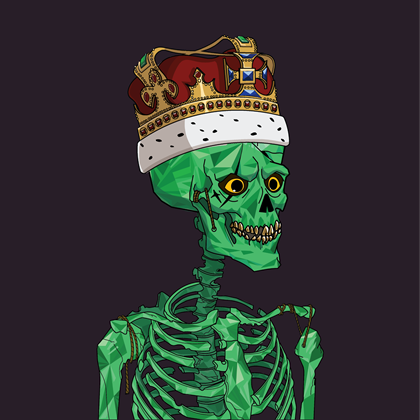
The most expensive Cranium sold, inconspicuously named Wicked Cranium #1875, raised $38,000 (19 ETH) alone, and is now being re-sold on NFT marketplace, OpenSea, for almost $200,000 (100 ETH). The Cranium itself is unique in its character, depicting a yellow-eyed, green skeleton whose joints are weakly held together. Atop its head sits a crown reminiscent of that worn by The Queen at Britain’s State Opening of Parliament.
Many more similarly extravagant Craniums are for sale on OpenSea, including an even more regal skeleton (Wicked Cranium #3622) and a skeleton depicting a member of the clergy crossed with a love-struck sailor. (Wicked Cranium #2664).
Watch This Space
These high resale prices suggest that Wicked Craniums has created something that is undoubtedly desired by a vast quantity of NFT collectors. The attraction has even reached into the celebrity realm, with lead singer of heavy metal group Avenged Sevenfold, M Shadows, trading his signature “The Dark Knight” guitar for a Cranium named Synyster Gates.
Synyster Gates:
I ended up accepting the most insane NFT for physical trade of my career.
These milestones suggest a great future for the franchise and inevitably more record-breaking sales. For now, Wicked Cranium owners can be confident in their art collectibles as digital art based NFTs become more widely adopted by the overall online community.
Join the Wicked Cranium community on Discord and in The Cradle, and follow updates on the latest Craniums on their Website, Twitter and Instagram.
The apocalyptic crash in NFT prices and market activity has caused some doubt over the longevity of non-fungible tokens. Even the art world, where non-fungible tokens have made the biggest splash, seems to be growing wary of NFTs.
Ben Reynolds, the Chief Executive and Founder of Sure Dividend, told Finance Magnates that: “to create a sustainable artist economy long-term, several changes need to occur.”
Bank Account Alternative. Business Account IBAN.
“With the lack of high-end identity and creation verifications, NFTs aren’t really supporting artists long-term. It has potential as a way for artists to earn money and royalties. Still, there’s a lot of issues to overcome to put more protection in place for artists,” he said, specifically pointing to instances of fraud and plagiarism within the NFT space.
Just last week, Coinbase Co-Founder Fred Ehrsam said on Bloomberg TV that: “90% of NFTs produced…probably will have little to no value in three to five years.”
“You could say the same thing about early internet companies in the late ’90s,” he added.
Ben Reynolds, Chief Executive and Founder of investment advisory firm Sure Dividend.
Ehrsam drew a parallel between NFTs and crypto markets at large: “People are going to try all sorts of things. There’ll be millions and millions of cryptocurrencies and crypto-assets, just like there were millions and millions of websites. Most of them won’t work.”
However, even if 90 per cent of NFTs will lose their value in the next several years, some of them will retain it, and as non-fungible token technology continues to develop, some analysts believe that new use cases will bring new verticals value to non-fungible token markets.
“NFTs Will Continue to Adjust Organically into a Wide Variety of Use-Cases.”
So, are NFTs over and done with?
Mango Dogwood, the Community Manager at Charged Particles, told Finance magnates that the answer is “Absolutely not.” Charged Particles is a platform that allows users to Interest-bearing Non-Fungible Tokens (DeFi NFTs).
“What we’re seeing is really just the beginning of what NFTs will be used for,” Dogwood said. “Art turned out to be an incredibly successful vehicle for teaching a huge new group of people about the underlying technology that is the blockchain, and a lot of these people are very creative thinkers who are bringing completely new innovation to the space.”
In other words, the boom-and-bust cycle that NFT markets saw at the beginning of this year may not have a meaningful impact on the future of non-fungible tokens: “I don’t think that NFTs have lost their relevance at all. In fact, I don’t think they’ve even seen the threshold of the relevance that’s coming in the next few years.”
“I think NFTs will continue to adjust organically into a wide variety of use-cases beyond what we’ve seen this year in the art world,” Dogwood said.
Mango Dogwood, the Community Manager at Charged Particles.
“Core NFT Developments Are Happening at a Deeper Level.”
Les Borsai, who is both the Chief Strategy Officer of Waves and a renowned NFT collector, has a different perspective: “I would say the hype has been increasing,” though “I suppose it depends where you are looking,” he told Finance Magnates.
“NFTs can be viewed in many ways. I think the basic understanding was that it was a collectable piece of art sold in a marketplace. The mainstream centralized outlets became interested, and everyone was launching an NFT. Today we have Television Stations, Shoe Brands, Sports Franchises and Gaming companies looking at them,” he said. “But for those outlets, the demand may have gone down.”
Suggested articles
ATFX Connect Appoints Steve Whittet as Institutional Sales DirectorGo to article >>
Borsai pointed out that even in their current iterations, NFTs already have many use cases. “For me, the core NFT developments are happening at a deeper level, not unlike altcoins that launched in 2014 on the back of the Ethereum launch. An NFT, unlike a piece of art that hangs on my wall, can be so many things.”
For example, “It can be a financial instrument that pays out like an annuity; it can be something I borrow and lend money on instantly. It can be used for yield farming based on Rarity. It can be an artefact in augmented reality or an avatar in VR. It can represent my identity the way a CryptoPunk can be a profile pic, which I have.”
“So for me, the hype is far from done,” Borsai said. “You don’t have to look far to find a Bored Ape or Wicked Cranium creating an economy…supported by the [NFT] community.”
“The ‘Metaverse’ Component and Gamification of NFTs Will Continue to Keep Them Relevant.”
However, Borsai, like many others, believes that the non-fungible token space is undergoing a major shift in focus: a move away from collectables and toward tokens that have a wider set of applications.
For example, “the ‘metaverse’ component and gamification of NFTs will continue to keep them relevant,” Borsai said. “If you look at Aavegotchi, Bored Apes and Alien Boys as examples, they have robust offerings where the NFT is part of their structure.”
At the same time, non-fungible token technology has been improving behind the scenes over the past few years. “In 2017, when I bought a CryptoKitty, I had to wait hours (if not days),” he said. “That was a technology problem. Today, we are not seeing that with NFT drops. As a matter of fact, the drops are blowing out in a matter of hours. We also have great new scaling solutions emerging.”
The “Democratization of Art.”
Borsai, Dogwood, and many others believe that the next frontier for non-fungible tokens is decentralized finance.
“I think we’ll start to see more and more intersection between NFTs and DeFi (Decentralized Finance),” Dogwood said, adding that: “this is what we’re exploring at Charged Particles.”
“Bringing together the implicit value from the financial side of crypto and the speculative value from the art side, we start to see some fascinating new doors open in the future of the NFT space.”
Similarly, Borsai added that decentralized finance could enable NFT market-making and “[building] an economy around collectables” in similar ways that DeFi innovators have “created new markets that bring superior returns,” for example, practices like Yield Farming.
But, the principles of decentralized finance can be used to create new use cases for non-fungible tokens, even within the art world.
“[DeFi innovators] look at traditional gallery systems and the approach to valuations in art and have better ideas,” Borsai said. “Ideas that support the community creating art so that a major collector or gallery isn’t the final say on what art deserves to be seen. It’s the democratization of art.”
Furthermore, Borsai pointed out that the intersection between DeFi and art could lead to the creation of new kinds of artistic work: for example, “sharing music is super interesting: taking a song and having many pieces create a different experience as a whole piece. It’s not unlike buying a series of pieces that make up one bigger piece.”
“I am excited to see my NFTs on my Samsung Frame,” he said.”If we have any doubt that we are headed in this direction, take a look at Christie’s and Sotheby’s launches. I could go on and on.”
What do you think about the future of NFTs in art and beyond? Let us know in the comments below.