In Australia, a massive cryptocurrency investment scheme involving approximately US$41 million and over 450 investors has collapsed. The country’s financial market regulator successfully obtained a court order to appoint receivers for the digital currency assets held by a group of three crypto mining companies, collectively known as NGS Companies, and their sole directors.
The court order, issued on Wednesday, was part of the civil proceedings initiated by the Australian Securities and Investments Commission (ASIC) against NGS Crypto Pty Ltd, NGS Digital Pty Ltd, and NGS Group Ltd, along with their respective sole directors Brett Mendham, Ryan Brown, and Mark Ten Caten.
Additionally, the court has restricted Mendham from traveling outside Australia.
NGS Companies offered investment packages supported by their cryptocurrency mining activities. These packages guaranteed fixed-rate returns as high as 16 percent annually, according to the company’s website, with a minimum fixed return promised at 6 percent.
The regulator highlighted that the schemes particularly encouraged investors to transfer funds from regulated superannuation funds to self-managed super funds (SMSFs), which were then converted into cryptocurrency. The promotional material on the company’s website, including “testimonials” and “stories,” seemed to specifically target elderly investors.
“Member stories” on NSG Crypto website
Regulator Gets Wary
ASIC’s action was prompted by concerns that the invested funds in these cryptocurrency schemes were at risk of dissipation. Notably, none of the three implicated companies possessed the necessary financial services licenses to operate legally in Australia. ASIC is now holding them accountable for illegally marketing crypto mining-backed investment products.
“Australians who choose to self-manage their superannuation should carefully consider the risks before using their SMSF to invest in crypto-related investment products such as blockchain mining,” advised Joe Longo, the Chair of ASIC. “These proceedings should also serve as a warning to the crypto industry that ASIC will continue to scrutinize products to ensure compliance with regulatory obligations and to protect consumers.”
Earlier this year, the Australian regulator dismantled similar crypto-backed schemes that promised astronomical profits and banned a director of a crypto fund for dishonest operations.
In Australia, a massive cryptocurrency investment scheme involving approximately US$41 million and over 450 investors has collapsed. The country’s financial market regulator successfully obtained a court order to appoint receivers for the digital currency assets held by a group of three crypto mining companies, collectively known as NGS Companies, and their sole directors.
The court order, issued on Wednesday, was part of the civil proceedings initiated by the Australian Securities and Investments Commission (ASIC) against NGS Crypto Pty Ltd, NGS Digital Pty Ltd, and NGS Group Ltd, along with their respective sole directors Brett Mendham, Ryan Brown, and Mark Ten Caten.
Additionally, the court has restricted Mendham from traveling outside Australia.
NGS Companies offered investment packages supported by their cryptocurrency mining activities. These packages guaranteed fixed-rate returns as high as 16 percent annually, according to the company’s website, with a minimum fixed return promised at 6 percent.
The regulator highlighted that the schemes particularly encouraged investors to transfer funds from regulated superannuation funds to self-managed super funds (SMSFs), which were then converted into cryptocurrency. The promotional material on the company’s website, including “testimonials” and “stories,” seemed to specifically target elderly investors.
“Member stories” on NSG Crypto website
Regulator Gets Wary
ASIC’s action was prompted by concerns that the invested funds in these cryptocurrency schemes were at risk of dissipation. Notably, none of the three implicated companies possessed the necessary financial services licenses to operate legally in Australia. ASIC is now holding them accountable for illegally marketing crypto mining-backed investment products.
“Australians who choose to self-manage their superannuation should carefully consider the risks before using their SMSF to invest in crypto-related investment products such as blockchain mining,” advised Joe Longo, the Chair of ASIC. “These proceedings should also serve as a warning to the crypto industry that ASIC will continue to scrutinize products to ensure compliance with regulatory obligations and to protect consumers.”
Earlier this year, the Australian regulator dismantled similar crypto-backed schemes that promised astronomical profits and banned a director of a crypto fund for dishonest operations.
According to Wells Fargo estimations, U.S.-based retailer Costco runs a $200 million gold business monthly. Consumer trust in the organization and its aggressive pricing have made Costco’s one-ounce bars of 24-karat gold a popular choice for investors, who take advantage of 2% over market spot prices. Costco Might Be Selling $200 Million in Gold Every […]
Ethereum (ETH), the world’s second-largest cryptocurrency by market capitalization, is experiencing a surge in optimism in the cryptocurrency market. The emergence of two new whales, according to crypto tracking platform Spot On Chain, further adds to the bullish sentiment surrounding Ethereum.
These whales have collectively withdrawn a substantial amount of ETH, totaling nearly 11,700 coins, worth approximately $40 million, from leading cryptocurrency exchange Binance.
Their significant purchase, made when ETH was priced around $3,450, indicates their confidence in the potential for further price appreciation.
The $ETH price sharply rebounded by ~4% in the past 2 hours, now beyond $3,500!
During this period, our system detected two more whales, 0x666 and 0x435, that withdrew a total of 11,657 $ETH ($40.28M) from #Binance at ~$3,455!
The cryptocurrency market is experiencing a surge in optimism, fueled by a strong performance from Ethereum (ETH) and the looming Bitcoin halving event.
ETH has seen its price jump nearly 10% in the past 24 hours, reaching $3,679 as of today. This impressive gain is accompanied by a significant rise in trading volume, which has spiked by nearly 70%, surpassing $15 billion.
Source: Coingecko
Meanwhile, Ethereum’s impressive rally is not an isolated event. The broader cryptocurrency market is experiencing a period of bullish momentum. Bitcoin, the undisputed leader, has also witnessed a significant surge, climbing above the $72,000 mark. This upward trend is largely attributed to the anticipation surrounding the upcoming Bitcoin halving, scheduled for approximately 11 days from now.
The Bitcoin halving is a pre-programmed event that occurs roughly every four years. It reduces the number of new Bitcoins awarded to miners for verifying transactions on the network.
Historically, these halving events have been followed by substantial price increases for Bitcoin, as the reduced supply often leads to increased demand and scarcity. Investors are hoping for a similar outcome this time around, contributing to the current marketwide rally.
Renewed Optimism Grips Crypto Investors
The recent surge in prices and trading volumes across the cryptocurrency market suggests renewed optimism and bullish sentiment among investors. Analysts and experts are anticipating further price gains for both Ethereum and Bitcoin in the coming days and weeks.
Featured image from Pexels, chart from TradingView
Disclaimer: The article is provided for educational purposes only. It does not represent the opinions of NewsBTC on whether to buy, sell or hold any investments and naturally investing carries risks. You are advised to conduct your own research before making any investment decisions. Use information provided on this website entirely at your own risk.
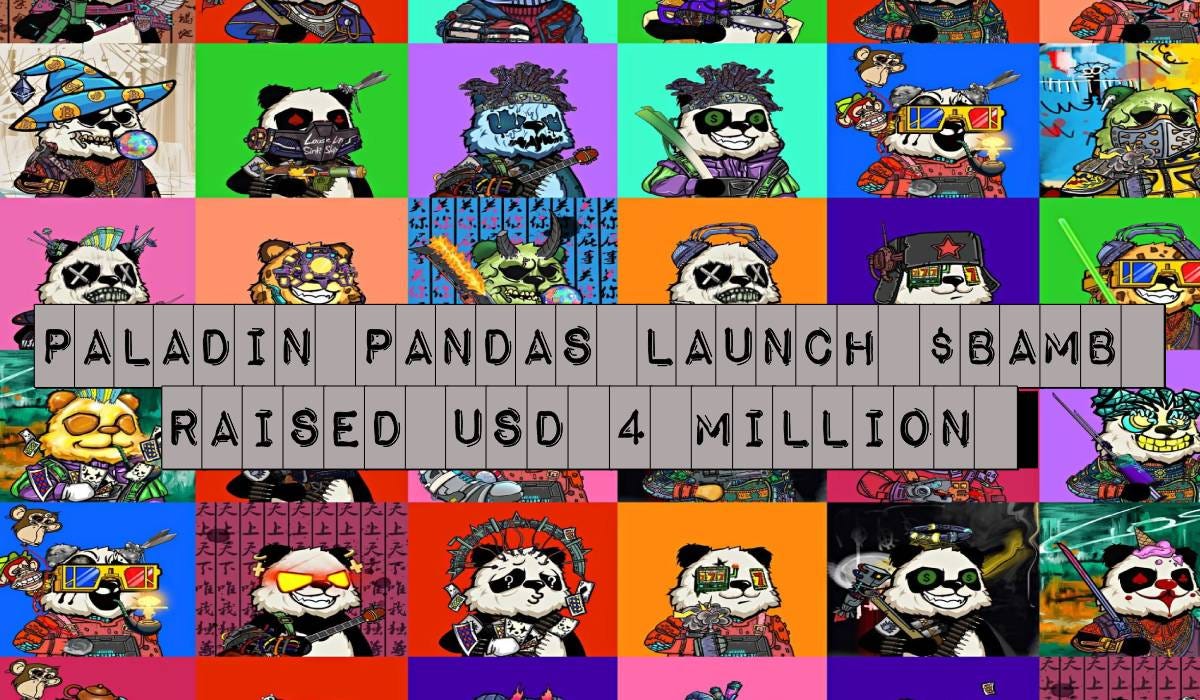
OHDAT-affiliated NFT Game Project Paladin Pandas launched their ERC-20 Token $BAMB on the Ethereum chain on April 6th 2022. This established Paladin Pandas as one of the first NFT projects that has completed both the launch of their play-to-earn game and their token.
A hand-drawn 10K NFT collection launched on Opensea on September 28th 2021, Paladin Pandas sold out in 32 minutes. It was ranked №6 on the daily volume leaderboard, №13 on the weekly volume leaderboard and featured on the OpenSea homepage.
NFT whale owners including influencer and top collector, Zeneca_33, COLE, co-founder of Pudgy Penguins, and NFT influencers Josh Ong and NFT Girl, as well as crypto artist JN Silva, all added Paladin Pandas to their collection.
This led to recognition from established VCs and other institutions and angel investors and OHDAT raised funding totalling US$4M from Future Capital, Hashkey Capital, Innoangel, Y2Z Capital, Vincent Niu, the founder of Sky9 Capital and Mandy Wang, the founder of Odaily. The funds raised were to go towards launching new projects and implementing the Open World social simulation game and MMORPG game, highlighted on their Roadmap 2.0.
On January 25th, Paladin Pandas launched ‘PvE game Space Expedition’, where players send their Pandas to planets on an expedition (with 15 stages each) while strategically putting the Pandas into teams of 3 to retrieve the lost $BAMB (Bamboonium) through battles and mini-games. Since categories like element, class, weapon all matter in the gameplay, players need to select the right pandas to buy and be sent to battle, involving strategy gameplay.
All $BAMB earned from the PvE game is locked in the players’ $BAMB balance, to be unlocked and claimable at a weekly rate of 15%. The lockup can be lifted if players manage to get on the PvP daily/weekly leaderboard.
On March 9th, PvP: ‘Panda v. Panda’ open demo was officially released, a 1V1 3D combat game for true gamers. Players pay $BAMB to enter the arena and loot more $BAMB from other players. With 48 weapons, 7 basic moves and 21 stages, the gameplay is not limited to a ‘Stake-to-Earn’ mechanism; it is an actual ‘Play-to-Earn’ NFT game with delightful strategy gaming, which is a stab at revolutionizing NFT gaming. Up to now, which can be quite monotonous when the focus is only on the earnings. The PvP open demo initiated the “Clean the rugs’ campaign and airdropped 40K $BAMB tokens to the gamefi project holdlers.
Giving perks to all NFT holders was taken into account when devising the Paladin Pandas ecosystem. Mandatory to use a Paladin Panda to enter the game, so as to extend the user base to more NFT gamers, non-holders can also rent Pandas by paying $BAMB. The rental limit for each Panda is 2x for PvE and 3x for PvP.
Besides being an in-game currency, $BAMB has several utilities. First, $BAMB can be staked along with LP tokens to mine 5% of the overall supply, a total of 25M $BAMB. Second, $BAMB can be swapped to Power Raffle tickets, which is a WEB3 raffle machine to win blue chip NFT projects with minimum entry fees. Third, $BAMB holders are able to access exclusive online store merchandise, in-game marketplace boosts, and also the whitelist marketplace to consume their tokens.
To celebrate the $BAMB launch, the OHDAT team will incentivize Panda owners with 2 airdrops. First, 60 Rent Tickets will be dropped to 30K new addresses for mining the game, for their first run. Second, 1.5% of the overall supply, totaling 7.5M $BAMB will be airdropped to all Panda holders. Prioritizing fun gaming features, Paladin Pandas aims for $BAMB to be a “blue chip token” in the NFT market over the long term.
A well-known global multi-asset
Multi-Asset
Composed of varying asset classes, multi-asset is a blanket designation combining different classes such bonds, equities, cash equivalents, fixed income, and alternative investments.When compared to traditional balanced funds, multi-asset solutions differ because they target specific investment outcomes. This includes outcomes such as return above inflation as opposed to gauging performance against standardized benchmarks.Given the composition of multi-asset classes, they need to be dynamically managed so that funds can continue to generate returns while keeping risk within fixed parameters. What Are Advantages or Disadvantages to Multi-Asset Investments?While multi-asset investing may better distribute risk, it should be known that a hindrance may be exerted upon potential returns.Indeed, multi-asset classes do not always perform as well as most stock funds due to containing other assets such as cash, bonds, or real estate investments. As a result, traders generally tend to gravitate towards target-date mutual funds, target allocation mutual funds, and ETFs.Multi-asset funds that fluctuate with an investor’s time scope are target-date mutual funds. Generally, target-date mutual funds run in congruence with an investor’s retirement age and are composed primarily of equities (85% to 90%) while the remaining is distributed to a money market or fixed income. Target allocation mutual funds are centered around an investor’s risk tolerance and are offered by most mutual fund companies. Equities compose between 20% to 85% of multi-asset funds and may also include international equities and bonds.Trading ETFs through contracts-for-difference (CFD) trading provides traders with a more immediate avenue to multi-asset investing with financial instruments such as precious metals, commodities, and currencies. The diversification that stems from the wake of multi-asset investing helps protect traders against unforeseen market pitfalls and volatility. However, these tend not to perform as effectively as the majority of stock funds in common years due to an allocation of assets.
Composed of varying asset classes, multi-asset is a blanket designation combining different classes such bonds, equities, cash equivalents, fixed income, and alternative investments.When compared to traditional balanced funds, multi-asset solutions differ because they target specific investment outcomes. This includes outcomes such as return above inflation as opposed to gauging performance against standardized benchmarks.Given the composition of multi-asset classes, they need to be dynamically managed so that funds can continue to generate returns while keeping risk within fixed parameters. What Are Advantages or Disadvantages to Multi-Asset Investments?While multi-asset investing may better distribute risk, it should be known that a hindrance may be exerted upon potential returns.Indeed, multi-asset classes do not always perform as well as most stock funds due to containing other assets such as cash, bonds, or real estate investments. As a result, traders generally tend to gravitate towards target-date mutual funds, target allocation mutual funds, and ETFs.Multi-asset funds that fluctuate with an investor’s time scope are target-date mutual funds. Generally, target-date mutual funds run in congruence with an investor’s retirement age and are composed primarily of equities (85% to 90%) while the remaining is distributed to a money market or fixed income. Target allocation mutual funds are centered around an investor’s risk tolerance and are offered by most mutual fund companies. Equities compose between 20% to 85% of multi-asset funds and may also include international equities and bonds.Trading ETFs through contracts-for-difference (CFD) trading provides traders with a more immediate avenue to multi-asset investing with financial instruments such as precious metals, commodities, and currencies. The diversification that stems from the wake of multi-asset investing helps protect traders against unforeseen market pitfalls and volatility. However, these tend not to perform as effectively as the majority of stock funds in common years due to an allocation of assets. Read this Term investment platform, eToro, announced that it had launched its own non-fungible token (NFT) fund, eToro.art. According to the press release, the platform seeks to support NFT creators, agencies, and brands within the sphere.
To begin the program, eToro unveiled its NFT collection. This includes blue chip projects such as Bored Ape Yacht Club, CryptoPunks, World of Women, as well as emerging artists’ projects. Upon deployment of its full funds, this collection will make eToro one of the most dominant NFT collectors in the world.
“As a company with one eye constantly on ‘what’s next,’ eToro sees huge potential in the metaverse and a range of new digital assets. eToro has a community of over 27 million registered users who want insight into and access to new and emerging technologies. As one of the first companies to offer crypto alongside more traditional assets, it is only natural for eToro to serve as the bridge
Bridge
The bridge or liquidity bridge is an essential component for brokers that are enabling their clients to trade at interbank rates directly via a Prime Broker or a Prime-of-Prime (PoP). While market makers do not require a bridge in order to service its clients, brokers which are sending through orders to a liquidity provider or an electronic execution venue need a bridge to connect their trading platform to the interbank market.Bridges are used extensively in forex trading, specifically for Metatrader, the world’s most popular trading platform. Bridges can be connecting a broker to a prime of prime or to a prime broker. Connectivity providers are delivering solutions mostly oriented towards the most popular platforms in the market – MetaTrader 4 (MT4) and MT5. The component is another crucial part of proper risk mitigation for the brokerage. The Need for Bridges in Retail TradingGiven the rise of the MT4 and MT5 platforms, there has since arose a need for bridge technology. This is due to the fact that Metaquotes, the company behind MT4, only envisaged their platform being used as a purely an interface client broker trading.This means the broker set the quotes, set the spread, and traded against the client. However, the trader actually had no direct access to the wholesale forex market, yet many brokers were unwilling to let go of MT4 in favor of other platforms which already inherently supported access to the market via Electronic Communications Networks (ECN) due to MT4’s huge popularity and thus potential loss of clients. MetaTrader was not designed to communicate with banks or liquidity providers because Metaquotes didn’t implement the FIX protocol (Financial Information Exchange). The FIX protocol is an electronic communications protocol setup in the early 1990’s to provide worldwide exchange of information in real time with respect to the transactions of financial markets and instruments. As a result, software was developed by third parties to enable MetaTrader to connect traders to the interbank.
The bridge or liquidity bridge is an essential component for brokers that are enabling their clients to trade at interbank rates directly via a Prime Broker or a Prime-of-Prime (PoP). While market makers do not require a bridge in order to service its clients, brokers which are sending through orders to a liquidity provider or an electronic execution venue need a bridge to connect their trading platform to the interbank market.Bridges are used extensively in forex trading, specifically for Metatrader, the world’s most popular trading platform. Bridges can be connecting a broker to a prime of prime or to a prime broker. Connectivity providers are delivering solutions mostly oriented towards the most popular platforms in the market – MetaTrader 4 (MT4) and MT5. The component is another crucial part of proper risk mitigation for the brokerage. The Need for Bridges in Retail TradingGiven the rise of the MT4 and MT5 platforms, there has since arose a need for bridge technology. This is due to the fact that Metaquotes, the company behind MT4, only envisaged their platform being used as a purely an interface client broker trading.This means the broker set the quotes, set the spread, and traded against the client. However, the trader actually had no direct access to the wholesale forex market, yet many brokers were unwilling to let go of MT4 in favor of other platforms which already inherently supported access to the market via Electronic Communications Networks (ECN) due to MT4’s huge popularity and thus potential loss of clients. MetaTrader was not designed to communicate with banks or liquidity providers because Metaquotes didn’t implement the FIX protocol (Financial Information Exchange). The FIX protocol is an electronic communications protocol setup in the early 1990’s to provide worldwide exchange of information in real time with respect to the transactions of financial markets and instruments. As a result, software was developed by third parties to enable MetaTrader to connect traders to the interbank. Read this Term to bring new users into NFTs and the metaverse. We’re incredibly excited to see the developments in this space over the coming months,” Yoni Assia, Co-Founder and CEO at eToro said, commented.
Funds Distribution
eToro will use the $20 million dollar fund to acquire blue chip NFTs, as well as to seed emerging creators and NFT projects. Additionally, eToro plans to support new NFT projects for up-and-coming creators and brands. eToro plans to invest $10 million in emerging projects and act as a strategic partner to bring new emerging projects to market by 2022.
The projects partnering with eToro will receive a range of support and services to help them develop their NFT project from concept to market. Financial support, technical support, marketing support, and community support will all be provided. Creators will have to fill out an intake application on eToro.art to participate in the program.
Recently, eToro released its fourth-quarter of 2021 full-year financial results, noting a significant increase in total commission. According to the report for the quarter ended December 31, 2021, the investment platform netted $304 million, which is up 85% compared with Q4 of 2020.
A well-known global multi-asset
Multi-Asset
Composed of varying asset classes, multi-asset is a blanket designation combining different classes such bonds, equities, cash equivalents, fixed income, and alternative investments.When compared to traditional balanced funds, multi-asset solutions differ because they target specific investment outcomes. This includes outcomes such as return above inflation as opposed to gauging performance against standardized benchmarks.Given the composition of multi-asset classes, they need to be dynamically managed so that funds can continue to generate returns while keeping risk within fixed parameters. What Are Advantages or Disadvantages to Multi-Asset Investments?While multi-asset investing may better distribute risk, it should be known that a hindrance may be exerted upon potential returns.Indeed, multi-asset classes do not always perform as well as most stock funds due to containing other assets such as cash, bonds, or real estate investments. As a result, traders generally tend to gravitate towards target-date mutual funds, target allocation mutual funds, and ETFs.Multi-asset funds that fluctuate with an investor’s time scope are target-date mutual funds. Generally, target-date mutual funds run in congruence with an investor’s retirement age and are composed primarily of equities (85% to 90%) while the remaining is distributed to a money market or fixed income. Target allocation mutual funds are centered around an investor’s risk tolerance and are offered by most mutual fund companies. Equities compose between 20% to 85% of multi-asset funds and may also include international equities and bonds.Trading ETFs through contracts-for-difference (CFD) trading provides traders with a more immediate avenue to multi-asset investing with financial instruments such as precious metals, commodities, and currencies. The diversification that stems from the wake of multi-asset investing helps protect traders against unforeseen market pitfalls and volatility. However, these tend not to perform as effectively as the majority of stock funds in common years due to an allocation of assets.
Composed of varying asset classes, multi-asset is a blanket designation combining different classes such bonds, equities, cash equivalents, fixed income, and alternative investments.When compared to traditional balanced funds, multi-asset solutions differ because they target specific investment outcomes. This includes outcomes such as return above inflation as opposed to gauging performance against standardized benchmarks.Given the composition of multi-asset classes, they need to be dynamically managed so that funds can continue to generate returns while keeping risk within fixed parameters. What Are Advantages or Disadvantages to Multi-Asset Investments?While multi-asset investing may better distribute risk, it should be known that a hindrance may be exerted upon potential returns.Indeed, multi-asset classes do not always perform as well as most stock funds due to containing other assets such as cash, bonds, or real estate investments. As a result, traders generally tend to gravitate towards target-date mutual funds, target allocation mutual funds, and ETFs.Multi-asset funds that fluctuate with an investor’s time scope are target-date mutual funds. Generally, target-date mutual funds run in congruence with an investor’s retirement age and are composed primarily of equities (85% to 90%) while the remaining is distributed to a money market or fixed income. Target allocation mutual funds are centered around an investor’s risk tolerance and are offered by most mutual fund companies. Equities compose between 20% to 85% of multi-asset funds and may also include international equities and bonds.Trading ETFs through contracts-for-difference (CFD) trading provides traders with a more immediate avenue to multi-asset investing with financial instruments such as precious metals, commodities, and currencies. The diversification that stems from the wake of multi-asset investing helps protect traders against unforeseen market pitfalls and volatility. However, these tend not to perform as effectively as the majority of stock funds in common years due to an allocation of assets. Read this Term investment platform, eToro, announced that it had launched its own non-fungible token (NFT) fund, eToro.art. According to the press release, the platform seeks to support NFT creators, agencies, and brands within the sphere.
To begin the program, eToro unveiled its NFT collection. This includes blue chip projects such as Bored Ape Yacht Club, CryptoPunks, World of Women, as well as emerging artists’ projects. Upon deployment of its full funds, this collection will make eToro one of the most dominant NFT collectors in the world.
“As a company with one eye constantly on ‘what’s next,’ eToro sees huge potential in the metaverse and a range of new digital assets. eToro has a community of over 27 million registered users who want insight into and access to new and emerging technologies. As one of the first companies to offer crypto alongside more traditional assets, it is only natural for eToro to serve as the bridge
Bridge
The bridge or liquidity bridge is an essential component for brokers that are enabling their clients to trade at interbank rates directly via a Prime Broker or a Prime-of-Prime (PoP). While market makers do not require a bridge in order to service its clients, brokers which are sending through orders to a liquidity provider or an electronic execution venue need a bridge to connect their trading platform to the interbank market.Bridges are used extensively in forex trading, specifically for Metatrader, the world’s most popular trading platform. Bridges can be connecting a broker to a prime of prime or to a prime broker. Connectivity providers are delivering solutions mostly oriented towards the most popular platforms in the market – MetaTrader 4 (MT4) and MT5. The component is another crucial part of proper risk mitigation for the brokerage. The Need for Bridges in Retail TradingGiven the rise of the MT4 and MT5 platforms, there has since arose a need for bridge technology. This is due to the fact that Metaquotes, the company behind MT4, only envisaged their platform being used as a purely an interface client broker trading.This means the broker set the quotes, set the spread, and traded against the client. However, the trader actually had no direct access to the wholesale forex market, yet many brokers were unwilling to let go of MT4 in favor of other platforms which already inherently supported access to the market via Electronic Communications Networks (ECN) due to MT4’s huge popularity and thus potential loss of clients. MetaTrader was not designed to communicate with banks or liquidity providers because Metaquotes didn’t implement the FIX protocol (Financial Information Exchange). The FIX protocol is an electronic communications protocol setup in the early 1990’s to provide worldwide exchange of information in real time with respect to the transactions of financial markets and instruments. As a result, software was developed by third parties to enable MetaTrader to connect traders to the interbank.
The bridge or liquidity bridge is an essential component for brokers that are enabling their clients to trade at interbank rates directly via a Prime Broker or a Prime-of-Prime (PoP). While market makers do not require a bridge in order to service its clients, brokers which are sending through orders to a liquidity provider or an electronic execution venue need a bridge to connect their trading platform to the interbank market.Bridges are used extensively in forex trading, specifically for Metatrader, the world’s most popular trading platform. Bridges can be connecting a broker to a prime of prime or to a prime broker. Connectivity providers are delivering solutions mostly oriented towards the most popular platforms in the market – MetaTrader 4 (MT4) and MT5. The component is another crucial part of proper risk mitigation for the brokerage. The Need for Bridges in Retail TradingGiven the rise of the MT4 and MT5 platforms, there has since arose a need for bridge technology. This is due to the fact that Metaquotes, the company behind MT4, only envisaged their platform being used as a purely an interface client broker trading.This means the broker set the quotes, set the spread, and traded against the client. However, the trader actually had no direct access to the wholesale forex market, yet many brokers were unwilling to let go of MT4 in favor of other platforms which already inherently supported access to the market via Electronic Communications Networks (ECN) due to MT4’s huge popularity and thus potential loss of clients. MetaTrader was not designed to communicate with banks or liquidity providers because Metaquotes didn’t implement the FIX protocol (Financial Information Exchange). The FIX protocol is an electronic communications protocol setup in the early 1990’s to provide worldwide exchange of information in real time with respect to the transactions of financial markets and instruments. As a result, software was developed by third parties to enable MetaTrader to connect traders to the interbank. Read this Term to bring new users into NFTs and the metaverse. We’re incredibly excited to see the developments in this space over the coming months,” Yoni Assia, Co-Founder and CEO at eToro said, commented.
Funds Distribution
eToro will use the $20 million dollar fund to acquire blue chip NFTs, as well as to seed emerging creators and NFT projects. Additionally, eToro plans to support new NFT projects for up-and-coming creators and brands. eToro plans to invest $10 million in emerging projects and act as a strategic partner to bring new emerging projects to market by 2022.
The projects partnering with eToro will receive a range of support and services to help them develop their NFT project from concept to market. Financial support, technical support, marketing support, and community support will all be provided. Creators will have to fill out an intake application on eToro.art to participate in the program.
Recently, eToro released its fourth-quarter of 2021 full-year financial results, noting a significant increase in total commission. According to the report for the quarter ended December 31, 2021, the investment platform netted $304 million, which is up 85% compared with Q4 of 2020.
MRHB DeFi, the world’s first halal and ethical decentralized finance (DeFi) platform, launched their $MRHB token on the popular PancakeSwap DEX in December 2021. To promote the listing, the company set aside a pool of 5 million MRHB tokens to reward liquidity providers (LPs) with through to the end of March. MRHB has now decided to extend the LP reward period until June 30, and is adding an additional 2 million MRHB tokens to the reward pool.
For anyone unaware of this opportunity, the details are as follows: LPs must supply liquidity to the USDT/MRHB liquidity pool on PancakeSwap to qualify for rewards. A total of 2 million MRHB tokens will be divided between all participating LPs over a three-month period. This reward is provided by MRHB DeFi as a third party offering a conditional gift (‘hibah muallaqah bi al-sharth’), which is permissible according to Islamic Fiqh.
By providing liquidity on PancakeSwap, LP’s help to support the MRHB token, whose mission of bringing ethical finance to faith-based communities and others. It has been years of non-regulation and uncertainty about crypto; it is time to carve out a safe space in the cryptoverse where ethics-conscious people can manage their finances with peace of mind.
Additional Information for LPs
Providing liquidity on a DEX is not without risk. All prospective LPs must first understand about a concept known as ‘impermanent loss’. If you are unfamiliar with the term, please refer to this article to get a firm understanding of the risks involved.
Here are a couple of videos that will be useful for LPs:
Alternatively, check out the MRHB blog post for the step-by-step slideshow walkthrough on how to add liquidity on Pancakeswap: https://mrhbdefi.medium.com/how-mrhb-token-holders-can-earn-passive-income-from-trading-fees-and-5-million-pool-of-mrhb-6848152d51c7
Lastly, the importance of staying vigilant on the internet cannot be stressed enough — scammers abound. Never give your wallet password out to anyone. When sending funds to a liquidity pool, do so on the exchange itself — do not send to addresses given to you by strangers.
MRHB DeFi will never ask you for funds. The only links and information that can be trusted are those shared on their official channels below.
Crypto bulls are back in the race with substantial transactions. On 1 April 2022, a leading XRP wallet transferred 40 million coins worth over $32 million from an unknown wallet to the digital exchange Bitstamp.
While the crypto market cap jumped by more than $100 billion in the past 24 hours, transactions with a value of at least $1 million have also increased significantly. “Both Bitcoin and Ethereum saw transaction spikes at their tops a couple of days ago. We can see whether transactions are taken while a position is in profit or at a loss. For the first time since November, there were 3x as many profitable transactions vs losing transactions,” Santiment noted.
On-chain movements of crypto whales saw an uptick during the recent market rally. In addition to the $32 million XRP transfer, several other $100 million+ crypto transactions were observed during the last 24 hours. A crypto millionaire address moved 3,000 Bitcoin worth over $138 million from Coinbase to an unknown wallet on 1 April at 16:57 UTC.
Ethereum
While the recent large crypto transfers were mainly focused on Bitcoin, USDT, and XRP, the Ethereum network also witnessed a rise in whale movements. On 31 March 2022, someone sent over 35,500 ETH worth more than $119 million from crypto trading platform Bitfinex to an unknown wallet. ETH’s price boom has played an important role in its surging whale movements. As a result of the latest developments, Ethereum’s dominance against Bitcoin is increasing.
“Ethereum has been gaining in price dominance against Bitcoin, and the ETH / BTC price ratio of 0.074762 on Friday came within millimeters of an 8-week high of 0.074878. The top 10 whale addresses remain to hold a significant percentage of supply,” Santiment added.
Yesterday, the deposit contract of Ethereum 2.0 topped 11 million ETH.
Crypto bulls are back in the race with substantial transactions. On 1 April 2022, a leading XRP wallet transferred 40 million coins worth over $32 million from an unknown wallet to the digital exchange Bitstamp.
While the crypto market cap jumped by more than $100 billion in the past 24 hours, transactions with a value of at least $1 million have also increased significantly. “Both Bitcoin and Ethereum saw transaction spikes at their tops a couple of days ago. We can see whether transactions are taken while a position is in profit or at a loss. For the first time since November, there were 3x as many profitable transactions vs losing transactions,” Santiment noted.
On-chain movements of crypto whales saw an uptick during the recent market rally. In addition to the $32 million XRP transfer, several other $100 million+ crypto transactions were observed during the last 24 hours. A crypto millionaire address moved 3,000 Bitcoin worth over $138 million from Coinbase to an unknown wallet on 1 April at 16:57 UTC.
Ethereum
While the recent large crypto transfers were mainly focused on Bitcoin, USDT, and XRP, the Ethereum network also witnessed a rise in whale movements. On 31 March 2022, someone sent over 35,500 ETH worth more than $119 million from crypto trading platform Bitfinex to an unknown wallet. ETH’s price boom has played an important role in its surging whale movements. As a result of the latest developments, Ethereum’s dominance against Bitcoin is increasing.
“Ethereum has been gaining in price dominance against Bitcoin, and the ETH / BTC price ratio of 0.074762 on Friday came within millimeters of an 8-week high of 0.074878. The top 10 whale addresses remain to hold a significant percentage of supply,” Santiment added.
Yesterday, the deposit contract of Ethereum 2.0 topped 11 million ETH.
Singapore, 14th March 2022 — Decentralized cross-chain lending platform Fountain Protocol has launched a liquidity mining program on the Oasis mainnet, attracting over $15 million in TVL (total value locked) within 24 hours.
The strong launch earns Fountain Protocol a third-place ranking as compared to all other protocols on the…
This year, Silvergate Capital paid $182 million for Diem’s technology assets, bringing an end to Facebook’s plan to build a crypto payments network.
The deal underscores how the social network giant, now Meta, has just a limited number of regulatory-approved options for becoming a prominent player in the blockchain space.
These well-known investors participated in a strategic investing round, which was led by investors including Tiger Global, Multicoin Capital, Katie Haun and Coinbase Ventures.
Blockchain System For Aptos
Aptos, a project founded by ex-Facebook employees who just left the firm in December, has already received unicorn money from Andreessen Horowitz and other prominent web3 investors.
Aptos Chief Executive Officer Mo Shaikh said in a recent blog post:
“We are the founders, researchers, designers, and builders of Diem, the first blockchain developed for this purpose… while the rest of the world never saw what we produced, our job is far from done.”
Aptos has disclosed that it has raised $200 million in capital from Tiger Global, Katie Haun, Multicoin Capital, 3 Arrows Capital, FTX Ventures, and Coinbase Ventures to pursue its goal of establishing a blockchain scalability system.
Another prominent first-round investor is Silvergate Capital, while the Aptos team assures that they will not license or use any of Silvergate’s Diem IP as they develop their blockchain.
Related Article | Gloomy Crypto Future? Book Author Warns We’re In The Biggest Bubble In History
Crypto total market cap at $1.78 trillion on the daily chart | Source: TradingView.com
No Direct Link With Facebook
However, some in the crypto industry are skeptical of implementing Facebook’s web3 vision, even though Diem proponents like Andreessen Horowitz may rally behind a group aiming to take up the effort.
“To be clear, we have no official connection with Facebook and no funding from them,” Shaikh said.
As a result, Aptos sees another challenge in recruiting developers. Move, an open-source programming language developed by Meta, is being used to lure new developers to the company.
The Aptos Devnet
Instead of building on top of existing decentralized networks like Ethereum or Solana, Aptos will create its own decentralized network from the ground up.
Additionally, Aptos launched its “devnet,” which will allow developers to explore and build on the Aptos blockchain before its public release, which the company expects to take place in the third quarter this year.
The fundamental objective of Aptos is to develop a blockchain that is more scalable, faster, and has cheaper transaction fees than the current major networks.
Customers that are interested in embracing blockchain technology should expect a more stable and dependable network from the project’s developers.
Related Article | Abra CEO Predicts Ethereum Could Reach $40,000 – But Some Fintech Analysts Don’t Agree
Featured image from SiliconANGLE, chart from TradingView.com
ConsenSys, a blockchain
Blockchain
Blockchain comprises a digital network of blocks with a comprehensive ledger of transactions made in a cryptocurrency such as Bitcoin or other altcoins.One of the signature features of blockchain is that it is maintained across more than one computer. The ledger can be public or private (permissioned.) In this sense, blockchain is immune to the manipulation of data making it not only open but verifiable. Because a blockchain is stored across a network of computers, it is very difficult to tamper with. The Evolution of BlockchainBlockchain was originally invented by an individual or group of people under the name of Satoshi Nakamoto in 2008. The purpose of blockchain was originally to serve as the public transaction ledger of Bitcoin, the world’s first cryptocurrency.In particular, bundles of transaction data, called “blocks”, are added to the ledger in a chronological fashion, forming a “chain.” These blocks include things like date, time, dollar amount, and (in some cases) the public addresses of the sender and the receiver.The computers responsible for upholding a blockchain network are called “nodes.” These nodes carry out the duties necessary to confirm the transactions and add them to the ledger. In exchange for their work, the nodes receive rewards in the form of crypto tokens.By storing data via a peer-to-peer network (P2P), blockchain controls for a wide range of risks that are traditionally inherent with data being held centrally.Of note, P2P blockchain networks lack centralized points of vulnerability. Consequently, hackers cannot exploit these networks via normalized means nor does the network possess a central failure point.In order to hack or alter a blockchain’s ledger, more than half of the nodes must be compromised. Looking ahead, blockchain technology is an area of extensive research across multiple industries, including financial services and payments, among others.
Blockchain comprises a digital network of blocks with a comprehensive ledger of transactions made in a cryptocurrency such as Bitcoin or other altcoins.One of the signature features of blockchain is that it is maintained across more than one computer. The ledger can be public or private (permissioned.) In this sense, blockchain is immune to the manipulation of data making it not only open but verifiable. Because a blockchain is stored across a network of computers, it is very difficult to tamper with. The Evolution of BlockchainBlockchain was originally invented by an individual or group of people under the name of Satoshi Nakamoto in 2008. The purpose of blockchain was originally to serve as the public transaction ledger of Bitcoin, the world’s first cryptocurrency.In particular, bundles of transaction data, called “blocks”, are added to the ledger in a chronological fashion, forming a “chain.” These blocks include things like date, time, dollar amount, and (in some cases) the public addresses of the sender and the receiver.The computers responsible for upholding a blockchain network are called “nodes.” These nodes carry out the duties necessary to confirm the transactions and add them to the ledger. In exchange for their work, the nodes receive rewards in the form of crypto tokens.By storing data via a peer-to-peer network (P2P), blockchain controls for a wide range of risks that are traditionally inherent with data being held centrally.Of note, P2P blockchain networks lack centralized points of vulnerability. Consequently, hackers cannot exploit these networks via normalized means nor does the network possess a central failure point.In order to hack or alter a blockchain’s ledger, more than half of the nodes must be compromised. Looking ahead, blockchain technology is an area of extensive research across multiple industries, including financial services and payments, among others. Read this Term technology solutions provider, announced on Tuesday that it had closed a $450 million financing round, bringing its valuation to over $7 billion. According to the press release, ParaFi Capital led the funding raise.
New investors joined them, including Temasek, SoftBank Vision Fund 2, Microsoft, Anthos Capital, Sound Ventures, and C Ventures. The United Talent Agency’s venture fund, UTA VC, and Third Point also participated in this round of funding. In this transaction, Sullivan & Cromwell LLP acted as ConsenSys’ legal advisor.
“I think of ConsenSys as a broad and deep capabilities machine for the decentralized protocols ecosystem, able to rapidly capitalize at scale on fundamental new constructs that emerge, such as developer tooling, tokenization, token launches, wallets, security audits, DeFi (1.0, 2.0 and beyond), NFTs, bridges, Layer-2 scaling, DAOs, and more. This view has resonated with our crypto native and growth investors in a Series D that will enable us to execute powerful growth strategies,” Joseph Lubin, Founder and CEO of ConsenSys, commented.
According to ConsenSys’ treasury strategy, the proceeds from this round will be converted to ETH in order to rebalance the ratio of ETH to USD equivalents. They added to ConsenSys’ “ultra sound money” position in advance of Ethereum’s merger to Proof of Stake.
A significant amount of Ethereum, stablecoins, and other crypto assets have been accumulated by ConsenSys over the years, which is actively investing them in DeFi protocols and via staking
Staking
Staking is defined as the process of holding funds in a cryptocurrency wallet to support the operations of a blockchain network. In particular, staking represents a bid to secure a volume of crypto to receive rewards. In most case however, this process relies on users participating in blockchain-related activities via a personal crypto wallet.The concept of staking is also closely tied to the Proof-of-Stake (PoS). PoS is a type of consensus algorithm in which a blockchain network aims to achieve distributed consensus.This notably differs from Proof-of-Work (PoW) blockchains that instead rely on mining to verify and validate new blocks.Conversely, PoS chains produce and validate new blocks through staking. This allows for blocks to be produced without relying on mining hardware. As such, instead of competing for the next block with heavy computation work, PoS validators are selected based on the number of coins they are committing to stake.Users that stake larger amounts of coins have a higher chance of being chosen as the next block validator. Staking ExplainedStaking requires a direct investment in the cryptocurrency, while each PoS blockchain has its particular staking currency.The production of blocks via staking enables a higher degree of scalability. Moreover, some chains have also moved to adopt the Delegated Proof of Staking (DPoS) model. DPoS allows users to simply signal their support through other participants of the network. In other words, a trusted participant works on behalf of users during decision-making events.The delegated validators or nodes are the ones that handle the major operations and overall governance of a blockchain network. These participate in the processes of reaching consensus and defining key governance parameters.
Staking is defined as the process of holding funds in a cryptocurrency wallet to support the operations of a blockchain network. In particular, staking represents a bid to secure a volume of crypto to receive rewards. In most case however, this process relies on users participating in blockchain-related activities via a personal crypto wallet.The concept of staking is also closely tied to the Proof-of-Stake (PoS). PoS is a type of consensus algorithm in which a blockchain network aims to achieve distributed consensus.This notably differs from Proof-of-Work (PoW) blockchains that instead rely on mining to verify and validate new blocks.Conversely, PoS chains produce and validate new blocks through staking. This allows for blocks to be produced without relying on mining hardware. As such, instead of competing for the next block with heavy computation work, PoS validators are selected based on the number of coins they are committing to stake.Users that stake larger amounts of coins have a higher chance of being chosen as the next block validator. Staking ExplainedStaking requires a direct investment in the cryptocurrency, while each PoS blockchain has its particular staking currency.The production of blocks via staking enables a higher degree of scalability. Moreover, some chains have also moved to adopt the Delegated Proof of Staking (DPoS) model. DPoS allows users to simply signal their support through other participants of the network. In other words, a trusted participant works on behalf of users during decision-making events.The delegated validators or nodes are the ones that handle the major operations and overall governance of a blockchain network. These participate in the processes of reaching consensus and defining key governance parameters. Read this Term using its own financial infrastructures, such as MetaMask Institutional and Codefi Staking.
MyCrypto Acquisition
Recently, ConsenSys announced the acquisition of MyCrypto, a market-leading Web3 wallet. Following the acquisition, ConsenSys will combine MyCrypto with its popular MetaMask wallet.
MetaMask and MyCrypto will integrate their efforts under a shared brand to enhance the security of all their products and build a cohesive user experience across browser, extension, mobile and desktop wallets.
ConsenSys, a blockchain
Blockchain
Blockchain comprises a digital network of blocks with a comprehensive ledger of transactions made in a cryptocurrency such as Bitcoin or other altcoins.One of the signature features of blockchain is that it is maintained across more than one computer. The ledger can be public or private (permissioned.) In this sense, blockchain is immune to the manipulation of data making it not only open but verifiable. Because a blockchain is stored across a network of computers, it is very difficult to tamper with. The Evolution of BlockchainBlockchain was originally invented by an individual or group of people under the name of Satoshi Nakamoto in 2008. The purpose of blockchain was originally to serve as the public transaction ledger of Bitcoin, the world’s first cryptocurrency.In particular, bundles of transaction data, called “blocks”, are added to the ledger in a chronological fashion, forming a “chain.” These blocks include things like date, time, dollar amount, and (in some cases) the public addresses of the sender and the receiver.The computers responsible for upholding a blockchain network are called “nodes.” These nodes carry out the duties necessary to confirm the transactions and add them to the ledger. In exchange for their work, the nodes receive rewards in the form of crypto tokens.By storing data via a peer-to-peer network (P2P), blockchain controls for a wide range of risks that are traditionally inherent with data being held centrally.Of note, P2P blockchain networks lack centralized points of vulnerability. Consequently, hackers cannot exploit these networks via normalized means nor does the network possess a central failure point.In order to hack or alter a blockchain’s ledger, more than half of the nodes must be compromised. Looking ahead, blockchain technology is an area of extensive research across multiple industries, including financial services and payments, among others.
Blockchain comprises a digital network of blocks with a comprehensive ledger of transactions made in a cryptocurrency such as Bitcoin or other altcoins.One of the signature features of blockchain is that it is maintained across more than one computer. The ledger can be public or private (permissioned.) In this sense, blockchain is immune to the manipulation of data making it not only open but verifiable. Because a blockchain is stored across a network of computers, it is very difficult to tamper with. The Evolution of BlockchainBlockchain was originally invented by an individual or group of people under the name of Satoshi Nakamoto in 2008. The purpose of blockchain was originally to serve as the public transaction ledger of Bitcoin, the world’s first cryptocurrency.In particular, bundles of transaction data, called “blocks”, are added to the ledger in a chronological fashion, forming a “chain.” These blocks include things like date, time, dollar amount, and (in some cases) the public addresses of the sender and the receiver.The computers responsible for upholding a blockchain network are called “nodes.” These nodes carry out the duties necessary to confirm the transactions and add them to the ledger. In exchange for their work, the nodes receive rewards in the form of crypto tokens.By storing data via a peer-to-peer network (P2P), blockchain controls for a wide range of risks that are traditionally inherent with data being held centrally.Of note, P2P blockchain networks lack centralized points of vulnerability. Consequently, hackers cannot exploit these networks via normalized means nor does the network possess a central failure point.In order to hack or alter a blockchain’s ledger, more than half of the nodes must be compromised. Looking ahead, blockchain technology is an area of extensive research across multiple industries, including financial services and payments, among others. Read this Term technology solutions provider, announced on Tuesday that it had closed a $450 million financing round, bringing its valuation to over $7 billion. According to the press release, ParaFi Capital led the funding raise.
New investors joined them, including Temasek, SoftBank Vision Fund 2, Microsoft, Anthos Capital, Sound Ventures, and C Ventures. The United Talent Agency’s venture fund, UTA VC, and Third Point also participated in this round of funding. In this transaction, Sullivan & Cromwell LLP acted as ConsenSys’ legal advisor.
“I think of ConsenSys as a broad and deep capabilities machine for the decentralized protocols ecosystem, able to rapidly capitalize at scale on fundamental new constructs that emerge, such as developer tooling, tokenization, token launches, wallets, security audits, DeFi (1.0, 2.0 and beyond), NFTs, bridges, Layer-2 scaling, DAOs, and more. This view has resonated with our crypto native and growth investors in a Series D that will enable us to execute powerful growth strategies,” Joseph Lubin, Founder and CEO of ConsenSys, commented.
According to ConsenSys’ treasury strategy, the proceeds from this round will be converted to ETH in order to rebalance the ratio of ETH to USD equivalents. They added to ConsenSys’ “ultra sound money” position in advance of Ethereum’s merger to Proof of Stake.
A significant amount of Ethereum, stablecoins, and other crypto assets have been accumulated by ConsenSys over the years, which is actively investing them in DeFi protocols and via staking
Staking
Staking is defined as the process of holding funds in a cryptocurrency wallet to support the operations of a blockchain network. In particular, staking represents a bid to secure a volume of crypto to receive rewards. In most case however, this process relies on users participating in blockchain-related activities via a personal crypto wallet.The concept of staking is also closely tied to the Proof-of-Stake (PoS). PoS is a type of consensus algorithm in which a blockchain network aims to achieve distributed consensus.This notably differs from Proof-of-Work (PoW) blockchains that instead rely on mining to verify and validate new blocks.Conversely, PoS chains produce and validate new blocks through staking. This allows for blocks to be produced without relying on mining hardware. As such, instead of competing for the next block with heavy computation work, PoS validators are selected based on the number of coins they are committing to stake.Users that stake larger amounts of coins have a higher chance of being chosen as the next block validator. Staking ExplainedStaking requires a direct investment in the cryptocurrency, while each PoS blockchain has its particular staking currency.The production of blocks via staking enables a higher degree of scalability. Moreover, some chains have also moved to adopt the Delegated Proof of Staking (DPoS) model. DPoS allows users to simply signal their support through other participants of the network. In other words, a trusted participant works on behalf of users during decision-making events.The delegated validators or nodes are the ones that handle the major operations and overall governance of a blockchain network. These participate in the processes of reaching consensus and defining key governance parameters.
Staking is defined as the process of holding funds in a cryptocurrency wallet to support the operations of a blockchain network. In particular, staking represents a bid to secure a volume of crypto to receive rewards. In most case however, this process relies on users participating in blockchain-related activities via a personal crypto wallet.The concept of staking is also closely tied to the Proof-of-Stake (PoS). PoS is a type of consensus algorithm in which a blockchain network aims to achieve distributed consensus.This notably differs from Proof-of-Work (PoW) blockchains that instead rely on mining to verify and validate new blocks.Conversely, PoS chains produce and validate new blocks through staking. This allows for blocks to be produced without relying on mining hardware. As such, instead of competing for the next block with heavy computation work, PoS validators are selected based on the number of coins they are committing to stake.Users that stake larger amounts of coins have a higher chance of being chosen as the next block validator. Staking ExplainedStaking requires a direct investment in the cryptocurrency, while each PoS blockchain has its particular staking currency.The production of blocks via staking enables a higher degree of scalability. Moreover, some chains have also moved to adopt the Delegated Proof of Staking (DPoS) model. DPoS allows users to simply signal their support through other participants of the network. In other words, a trusted participant works on behalf of users during decision-making events.The delegated validators or nodes are the ones that handle the major operations and overall governance of a blockchain network. These participate in the processes of reaching consensus and defining key governance parameters. Read this Term using its own financial infrastructures, such as MetaMask Institutional and Codefi Staking.
MyCrypto Acquisition
Recently, ConsenSys announced the acquisition of MyCrypto, a market-leading Web3 wallet. Following the acquisition, ConsenSys will combine MyCrypto with its popular MetaMask wallet.
MetaMask and MyCrypto will integrate their efforts under a shared brand to enhance the security of all their products and build a cohesive user experience across browser, extension, mobile and desktop wallets.


 According to Wells Fargo estimations, U.S.-based retailer Costco runs a $200 million gold business monthly. Consumer trust in the organization and its aggressive pricing have made Costco’s one-ounce bars of 24-karat gold a popular choice for investors, who take advantage of 2% over market spot prices. Costco Might Be Selling $200 Million in Gold Every […]
 Source: Coingecko