Facebook whistleblower Frances Haugen has taken aim at Meta in a new interview, suggesting that its version of the Metaverse will simply repeat all of its past mistakes.
In an interview with Politico, Haugen said:
“They’ve made very grandiose promises about how there’s safety-by-design in the Metaverse. But if they don’t commit to transparency and access and other accountability measures, I can imagine just seeing a repeat of all the harms you currently see on Facebook.”
In 2021 Huagen leaked thousands of internal documents from Facebook to the Securities and Exchange Commission and The Wall Street Journal. Her experience working for the company has left her with concerns about privacy issues and about letting the corporation amass data about every aspect of user’s interactions in the Metaverse.
“I’m super concerned about how many sensors are involved. When we do the Metaverse, we have to put lots more microphones from Facebook; lots more other kinds of sensors into our homes,” she said.
“You don’t really have a choice now on whether or not you want Facebook spying on you at home. We just have to trust the company to do the right thing.”
Haugen isn’t the only one concerned. According to a recent survey, 70% of people don’t trust Meta to handle privacy properly.
Andy Yen, CEO of encrypted email service ProtonMail is also concerned with the unilateral powers of Big Tech giants like Meta. Last week, he said in an interview, that his own company, Proton, will only be able to survive based on the goodwill of tech giants.
“Tech giants could today remove us from the Internet with zero legal or financial repercussions,” he said.
Yen has also raised concerns about Big Tech controlling the Metaverse in the past, telling Newsweek last year that Meta was “building a new infrastructure where they control everything. They control the device, they have the VR headsets, you’re now in their world, on their devices, on their platform.”
Yen said that given their track record, he doesn’t believe we should trust Meta with power like that and that promises around privacy in the Metaverse are useless unless its business model changes.
“At the end of the day, their business model revolves on taking your data and monetizing it. So, there is fundamentally always going to be a conflict between what they say and what they actually have to do to make money.”
Data collection
The Electronic Frontier Foundation (EFF) is a nonprofit organization defending civil liberties in the digital world. Like Yen, it believes that VR headsets and AR glasses, and other wearables, will make data collection and surveillance easier than ever before. In December they stated:
“This data harvesting, sometimes done by companies with a history of putting profit before protections, sets the stage for unprecedented invasions into our lives, our homes, and even our thoughts.”
The EFF is concerned that data collected and used for targeted advertising will generate “biometric psychography” and that our deepest desires and inclinations will be up for sale. Once the information has been collated, the data could be monetized by third parties, even without our knowledge or agreement.
The China syndrome
While the Metaverse may seem like an issue for the distant future, in China, citizens are living it every day, in a different way.
WeChat is the social media platform of choice in China. It has a mind-boggling user base of over one billion. Of those, 850 million are active users. The app is amassing data about users in China on a scale never seen before. And, the Chinese government can monitor every word, picture and video on it.
WeChat came under heavy criticism from Reporters Without Borders (RSF) before the Winter Olympic Games earlier this year. RSF urged journalists to protect themselves against Chinese surveillance while reporting in-situ. They said, “RSF recommends journalists who travel to China to avoid downloading applications that could allow the Chinese authorities to monitor them.” These included WeChat and TikTok.
Content constitutes the essence of the internet and comes in many different forms that the current Web2 internet iteration supports — text, audio, video or a mix of all three. However, content is scarcely a free resource. It is content creators who are now becoming opinion leaders, influencers and the cornerstones of so many of the critical services businesses rely on, such as advertising, marketing and public relations management.
The need for content and its strive for independence — embodied by thousands of bloggers and indie performers — has spawned an immense online economy that trades talent and often rakes in sales volumes many a top-level artist would salivate to earn. This economy has been dubbed the creator economy: a financial framework that allows independent individuals to earn on their self-expression by feeding audiences the type of content they are willing to pay to consume.
A rising force
The creator economy is a tremendous force: a unique, online phenomenon that overstepped the $104-billion market size threshold at the end of 2021. Given the snowballing demand for new content on popular platforms, such as TikTok, that empower independent artists and performers, experts are hesitant to make forecasts about the potential market size of the creator economy in the near future.
The reason for the lack of tangible predictions is that the creator economy is an extremely young phenomenon that started with the COVID-19 pandemic. The lockdowns evoked a wave of talent among people confined indoors, resulting in a release of creativity that others sharing confinement were eager to consume as much-needed entertainment.
Related: The best is yet to come: What’s next for blockchain and the creator economy
Considering that micro-entrepreneur creators are closely related to influencer marketing, which spots around $13.8 billion in market size, it is possible to understand the prospects that further expansion of the phenomenon can yield. More importantly, experts believe the transition to a new technological medium will allow content creators to overwhelm markets and industries with new opportunities for product and service promotion.
Decentralizing talent
More than 50 million creators are driving their own economy of talent, attracting in excess of $800 million in venture capital. Such figures are but a shadow of what they can become later, as new venues are rapidly becoming available.
The development of blockchain technologies has resulted in a sweeping revolution across financial markets, empowering individuals instead of institutions and channeling ownership of data and funds to their holders. The qualities of the blockchain — immutability, full transparency and the trustless nature of operations — have permeated many industries, swooning the balance of business orientation from centralized corporate reliance to decentralization. This shift in the basic concepts that govern relations between participants to transactions, facilitated by smart contracts, has not gone unnoticed in the creator economy.
With the decentralized finance and GameFi sectors marshaling across their respective industries and detracting droves of users from conventional approaches to banking and gaming, it was only a matter of time before influencers and content creators decided to shift the paradigm in their operating environments. The content creation model has been altered forever with the incorporation of blockchain technologies that allow users to incentivize content creators, while creators can actually monetize their talent without having to share the proceeds with centralized, often-unfair hosting platforms.
Related: DAOs are the foundation of Web3, the creator economy and the future of work
Going metaverse
The development of metaverses — fully digital environments powered by the blockchain on Web3 and virtual reality — will herald a new era in content creation. Never before has talent had access to such an advanced set of tools to embellish even the bravest of ideas on the threshold of the real and digital worlds.
Metaverses allow creators to visualize in stunning graphical detail anything from an opera concert in the void of space against a backdrop of nebulae to a blog stream on a deserted island. Anything creativity can fathom can be implemented in the metaverse for the benefit of all parties involved. By relying on the unlimited opportunities of the metaverse in its incorporation of virtual reality, content creators will be able to unleash their creativity and allow it to roam wild. Such promises of unseen quality of content can only be described as honeysuckle for an eager audience of viewers longing for more variety in types of content consumed — and, more importantly, new experiences.
The blockchain basis of the metaverse offers even more benefits for content creators, as it allows them to employ various mechanisms for monetizing their content through the versatile nature of internal cryptocurrencies. Users can stake their digital assets on specific creators, encouraging them to release more content of a certain type. Others can pay to access special content, while others can simply reward their favorite creators with donations. The monetization avenues are numerous, and content creators can always be sure that their talent will be paid for and no hosting platform can strip them of their earnings.
Even more lucrative are the prospects for businesses in terms of content-creator economy permeation in the metaverse. Marketing, advertising and promotion in general gain a new lease on evolution with content that can be tailored in an endless variety of ways and seamlessly integrated into the channels of select creators. The metaverse provides businesses with an entirely new frontier for deployment and audience reach, and the creators are the takeoff ramps that can showcase products and services before their followers — for a price.
In digital hindsight
The metaverse is the next iteration of the internet we know today: a fully user-centric environment serving the purpose of elevating creativity to a new level. However, audiences will not be the only sources of revenue for content creators, as businesses are eager to tap into this lucrative niche and leverage the possibilities offered by native, organic and highly versatile ad integrations in virtual reality content.
This article does not contain investment advice or recommendations. Every investment and trading move involves risk, and readers should conduct their own research when making a decision.
The views, thoughts and opinions expressed here are the author’s alone and do not necessarily reflect or represent the views and opinions of Cointelegraph.
Johnny Lyu is the CEO of KuCoin, one of the largest cryptocurrency exchanges, which was launched in 2017. Before joining KuCoin, he had accumulated abundant experience in the e-commerce, auto and luxury industries.
While the interest in metaverse seems to slow down, a pioneer in the space is still hard at work, advocating the open metaverse, a decentralized and interoperable multiverse.
In an interview with Cointelegraph Brazil, Sebastien Borget, the founder of the open-world blockchain game The Sandbox, shared some of his thoughts and expertise when it comes to Web3 and the state of the metaverse.
According to Borget, the metaverse is a gateway to new experiences limited only by what users can think of. He explained that:
“Web 3.0 and the metaverse are enabling each of us to become an explorer of our human imagination, inventing new parallel universes where we can choose the experiences we want to live.”
The Sandbox founder also mentions that the metaverse has already started to influence the way people “socialize, form economic relationships, and gather in communities.” He believes that within a decade, there will be more developments in the space.
“We envision that within the next 10 years, the metaverse will have transformed profoundly how we’re thinking about the way we’ll be working, socializing, playing, and earning through the economic opportunities and jobs it is creating.”
Borget believes that the role of platforms must be to ensure that the process of creation is fun and rewarding and that listening to what users want should be the priority. “We’ve brought this ecosystem into being, but experiences and assets that players make and share are what drives it,” says Borget.
Apart from these, the governance of the metaverse must be transferred over to the users according to Borget. This will be done through a decentralized autonomous organization (DAO) launch with voting mechanisms.
Related: The Sandbox metaverse hits 2M users, begins K-pop partnership
The Sandbox is offering a decentralized metaverse. Borget explains that this means that its users are not locked within its platform. “It’s important to us that the content you own or create in The Sandbox can be transferred to other open metaverses, and vice versa,” he said. Borget also stresses that decentralization is the way forward, rather than being stuck in a Web2 “microverse,” where content ownership is trapped by big tech.
“We’re strongly advocating for the core of the open metaverse to be decentralization, interoperability and creator-generated content.”
When asked what’s next for The Sandbox, the founder explained that the team is building the platform step by step. “Our vision of a decentralized entertainment metaverse where everyone can play, create, and be rewarded for their time through play-to-earn is resonating strongly. Step by step, we’re building out the ecosystem to realize the potential The Sandbox offers to players, creators, and partners,” says Borget.
Sebastien Borget, Founder and COO of The Sandbox. Source: borget.net
Apart from this, the founder explains that up next is enabling creators to build and share experiences within their lands. Borget says that people can expect more original content generated by the community going forward.
The Sandbox executive also underscored that despite nations like the United States, China and Turkey announcing metaverse strategies, these parties would be unable to control the metaverse. “This diversity of ownership means that no single party can control the metaverse,” he said.
Borget also mentions that the Sandbox also aims to make gaming more equitable. The founder says that they “especially want to make The Sandbox a welcoming place for women as creators and players.” This can potentially also bring more women to Web3.
“We support creator efforts to build inclusive worlds that can inspire players to see beyond the external differences while still appreciating them.”
Please introduce yourself, tell us about your background and what you do at Pokemine.
My name is Sato, co-founder of PokeMine and DEME. I was in the online dating industry back in 2015. A big issue of that industry was that there were lots of scammers. So, we thought of a way of building up a shared blacklist database with other dating apps to identify whether this newly registered user has any digital footprint that matches the data in this database. This way, we can identify the scammers at the early stages before they can harm other users. But we encountered huge difficulties in persuading all the dating apps to be part of this project. They wanted to use it, but they didn’t like to share their data. And blockchain is the natural way to deal with this problem. Ethereum just came out back then. We did some research and realized no mainnet back then could handle this database. We recognized this as an opportunity for us, so I led my team to get into Blockchain, starting with public chain development. We gained lots of technical experience, worked closely with some pretty famous projects in the market, then Join Games studio found us and we formed a new studio called DEME games, a metaverse GameFi studio. So yeah, this is my brief story.
2. Congratulations on your launch, PokeMine is ticking all the right buzzwords like NFTs, GameFi and Pokemon. Describe your gaming model so our readers can understand more how PokeMine works.
Thanks, let’s talk about the economic model of PokeMine first. In PokeMine, there are several different assets. They are Pokemon NFTs, PokeMine Diamond as $PMD tokens, stamina, and gold coins. For users in the early stages, we have not made stamina and gold coins as independent circulating tokens, so that the game is easier to adapt to at the beginning. As more and more users are familiar with the game, stamina and gold coins will be traded and circulated in the market. All stamina, gold coins, and 75% of PMD can only be mined or earned in-game. 15% of PMD is reserved by early investors and development teams with a lock-up period of 24 months. 10% will be sold to the market with a lock-up period of 6 months.
Secondly, PokeMine has created a unique NFT mechanism so that the user’s NFT is no longer a work of art but a way to build characters in the game. PokeMine has 4 different colors of PokeMine NFTs, which are red, orange, purple, and blue (URSSR SR R N) in descending order of quality and Pokemon combat power. More powerful sprites are rarer. Users need to upgrade NFTs through PVE, or use equipment to upgrade Pokemons to improve combat power, endurance, attributes, etc., in order to deal with the Evil BOSS battle recently announced by PokeMine. To know more about the setting of Evil BOSS, you can follow PokeMine official Twitter to check the related content. In the official game, the PokeMine dispatch is the entry to participate in the challenge of the Evil BOSS. You can participate in the dispatch with the high-quality Pokemons you have or the limited Pokemons from the voting event. You can also use the water of time props dropped from the explore level to extend the dispatch time for a higher return.
What can you tell us about the actual game itself, how is it played?
PokeMine is an action card mobile game with Pokémon as its theme. It is the first Pokémon mobile game where players can independently evolve elves and change their appearance! The overall game restores the Pokémon world in depth. The game adds a variety of rich gameplay methods such as the classic Pokémon gacha system, Pokémon cultivation system, Checkpoint battles, Z move, Pokémon dispatch (mining), etc.
There are two different assets in PokeMine, NFT and PokeMine Diamond ($PMD). Currently, users can purchase PMD on MDEX, ButterSwap, and PancakeSwap, and can also use PMD to obtain Pokemon NFTs from the in-game Pokemon Center, as well as Treasureland. In addition, PokeMine is developing its own trading platform in NFT Market, which will be launched soon.
Players can register on the official website of deme.games and bind their wallet to download the game or visit the official website of DEME in the mobile wallet to download the PokeMine game. The wallets supported by the official website of DEME are: ONTO, Bitkeep, Coin98, Coinhub, Huobi, Metamask.
For specific operation details, players can refer to tutorial for PokeMine official version: 1.0.07
Interpretation of gameplay
Players will get 3 initial Pokemons when they enter the game (note that these 3 Pokemons cannot be extracted). By consuming physical strength to pass the adventure level, the team EXP and PokeMine EXP obtained are used to level up. Players who reach a certain level can unlock other functions in the system, such as explore levels, Pokemon dispatch, and other functions of Pokemon training, etc. At present, the main way to obtain PMD is through the explore levels and Pokemon dispatch. Players can consume PMD to gacha NFT or Pokemon fragments from Gacha system, and they can participate in gold-making if they meet the conditions of elf dispatch. The Pokemon dispatch function adds a limited Pokemon mechanism, and the limited Pokemons are selected by voting and replaced regularly. The output mechanism of PMD in this level has also been optimized, and the output will be calculated based on the total combat power of the entire server. Players can get more rewards by using limited Pokemons or Pokemons with high combat power during the dispatch process.
Pokémon Social Interaction
Built-in scenes can also be used for real-time interaction. Efficient data interaction and processing capabilities can display all user data in time. Also, players can exchange ideas and experiences with other players in the “world” at any time, provided with an immersive experience. The in-game friend function has been opened in version 1.0.07. At present, the equipment function has not been opened yet. We look forward to giving players a brand new gold-making experience and promise to optimize the user experience and continue to work towards a better PokeMine GameFi!!!
[Trading Platform Link]
Treasureland: https://treasureland.market/
ButterSwap: https://www.butterswap.me/
MDEX: https://mdex.com/#/
PancakeSwap: https://pancakeswap.finance/
Gaming and investing has now become two sides of the same coin with NFTs. How do you see GameFi and NFTs impacting the real world?
In the past, there was no direct connection between games and finance to the connection between players and investors. But now, GameFi facilitates the interconnection between players and investors, allowing players to earn to play, which provides a new market model. In addition, GameFi endows NFT with more practical value through gamification settings. NFT items in the game are no longer just items sold on the NFT trading platform, but can also be directly traded in the market from the game, making the transaction process easier than traditional Game.
GameFi is an intuitive way for users to understand the metaverse. It started in the game industry, but in the future, it will further affect all aspects of human social life, such as social and financial. The global gaming market is expected to generate $175.8 billion of revenue in 2021 and exceed $200 billion in 2023. GameFi is in a relatively early stage of development and has huge potential.
The integration of NFTs with GameFi has paid off. It will continue to have a profound impact on the business model of the gaming industry and the ownership of in-game virtual assets at both the macro and micro levels. So what kind of magical chemistry will the combination of Pokémon and GameFi produce? No doubt, PokeMine is the right answer as the perfect restoration of the Pokemon world!!!
2. What other trends do you see developing in this industry?
At present, GameFi projects on various public chains are very popular, and they are becoming more and more mature from an economic model to game play design. The huge game player base and overall market provide unprecedented opportunities for the development of GameFi. GameFi has become unstoppable with the vigorous development and another breakthrough in blockchain applications, or it can be said that they have become the final form of game development and the entrance to the metaverse. In-depth analysis, looking at GameFi from the three perspectives of GameFi’s economic model, autonomy and decentralization, we will find that GameFi is a transitional stage in the development of the metaverse and plays a very important role in connecting the past and the future. We all know that there are infinite possibilities and hopes behind GameFi, which is also the original intention of DEME studio to build a real decentralized metaverse platform by supporting different stable commercial blockchain infrastructures. PokeMine is our first answer sheet.
3. Thanks for the interview, any last words or exciting news to share?
Currently, the PokeMine project has only launched part of functions in the game version 1.0.08. And it is worth paying attention to the announcement of the card pool released before the 1.0.07 version goes live. The amount of NFT to be produced is enough to make players excited. In addition, the official weekly project report is also a focus. To stabilize the operation of the PokeMine ecological, economic system, the setting of the PMD burn mechanism includes that the output of PMD in the whole server will increase the difficulty of production according to the increase in the total combat power of the whole server, and the PMD not produced by the Pokemon dispatched prize pool, consumed in gacha system and explore levels all will be destroyed. The specific content will be announced every week.
The dispatch level of PokeMine ushered in new gameplay — challenging the Evil Boss. In this mechanism, the Pokemon dispatch is the bridge to enter the time and space of the DEME metaverse. The Pokemons of justice in the Pokemon world are sent to fight against the evil bosses in the cave of time and space. When the total combat power of the whole server reaches a certain level, the corresponding PMD output can be unlocked. Currently, 7 levels of evil bosses have been officially announced, and the number of diamonds unlocked by the largest evil boss π·Mewtwo is X million (X>1.1 million).
This gameplay combines PokeMine’s currency sales mechanism in the elf dispatch level, the announcement of the PokeMine pool, and the real-time proposal, voting, and system parameter changes of the multiplier Pokemons in the Pokemon dispatch. The overall token mechanism in a deflationary state, the longer-term and more stable dual-deflation token economy, the complete destruction of the blind box for drawing cards, and the automatic adjustment of production and sales ratios to the game system, all contribute to the virtuous circle of the game economic system. As a leading chain game distribution platform in the industry, DEME’s first GameFi PokeMine is only the prototype of the DEME metaverse space. Players can also earn a lot of platform governance coins by playing in the game. Players own the platform and share development dividends.
In the future, PokeMine will explore a wider, deeper metaverse with all the PokeMiners together!!!
Billion-dollar companies are taking the Metaverse by storm as consumers have shown heightened interest in virtual, interactive, three-dimensional experiences that take place online.
While the “Metaverse” is still a new concept, research firm Strategy Analytics found that the global Metaverse market is forecasted to hit nearly $42 billion by 2026. This very well may be the case, as a handful of businesses including Nike and Walmart have begun exploring consumer experiences in metaverse environments.
NFT utility for brands launching in the Metaverse
To understand how and why brands are leveraging the Metaverse, it’s key to point out the role that NFTs, or nonfungible tokens, play within these ecosystems. While the year 2021 saw an influx of NFTs, the rise of the Metaverse is predicted to highlight the importance of utility behind NFTs.
Adrian Baschuk, founding partner at Ethernity Chain — an authenticated and licensed NFT platform — told Cointelegraph that every brand, company and notable figure will eventually have a metaverse and NFT integration:
“This is the “Myspace days” of the NFT-metaverse interactivity layer. Just as every company and individual has adopted some form of social media, this will also be the case for NFTs and the Metaverse.”
Given this, Baschuk shared that Ethernity recently brought its IP to The Sandbox, a blockchain-based metaverse ecosystem. Specifically speaking, Ethernity has acquired a desirable plot of land in The Sandbox to host a gallery and fully licensed NFT store. Baschuk explained that this will allow The Sandbox users to purchase Ethernity NFT wearables and collectibles.
According to Baschuk, these wearable NFTs include athlete jerseys, which will be used to dress and provide special powers to The Sandbox avatars. “Dallas Cowboys’ Zeke and Dak will kick this off, as the players’ wearable jerseys and shoulder pads will boost a user’s avatars’ skills and powers,” he said.
While this specific example may appeal to The Sandbox gaming community, the concept behind it is universal for brands entering the Metaverse. For instance, Baschuk explained that NFTs within virtual ecosystems allow for companies to monetize assets across a blockchain network, enhancing interactivity for consumers and fans.
To put this in perspective, consumer electronics giant Samsung recently announced that it will have a virtual replica of its New York physical store located within Decentraland, another leading metaverse ecosystem. The store, known as the “Samsung 837X shop,” will be accessible in Decentraland for a limited time.
Samsung 837X shop in Decentraland. Source: Samsung
A Samsung spokesperson told Cointelegraph that establishing Samsung 837X as a metaverse brand will provide limitless possibility for consumers to connect with Samsung and its products in an immersive way:
“In our metaverse, the brand pillars of sustainability, customization and connectivity will come to life in experiences that showcase the cutting-edge technology embedded in the Samsung family of products. This virtual hub will become a place for our community to celebrate the convergence of technology, art, culture, fashion and music.”
Samsung’s spokesperson further mentioned that Decentraland specifically gave the company a platform to enable a true Web3 metaverse experience. They noted that the Samsung community wanted a metaverse store to feature interactive quests that would allow participants to earn wearables like NFT badges or opportunities to win exclusive Samsung branded clothing for avatars.
Samsung 837X wearables in Decentraland. Source: Samsung
Overall, Samsung explained that its 837X store will serve as a foundation for the future, which will offer significant utility to its visitors. In turn, the company is looking at ways in which badges earned at 837X will offer access and utility for future events and experiences in its virtual space. “In the future, it’s our hope that everyone who visits our world will be able to enhance their online experience in the metaverse and their real-world experience with Samsung products,” commented Samsung’s spokesperson.
While Samsung was one of the first major brands to launch a virtual store in Decentraland this year, other organizations are following suit. Most recently Tennis Australia, the organizer of the Australian Open (AO), partnered with Decentraland to host the AO in the metaverse. This virtual environment contains key areas in Melbourne Park, including the Rod Laver Arena and Grand Slam Park. AO Decentraland 2022 will take place Jan. 17–30, mirroring the in-real-life tournament schedule.
An avatar watching the Welcome Address at the AO in Decentraland. Source: Decentraland
Ridley Plummer, Tennis Australia NFT and metaverse project lead, told Cointelegraph that it was a natural progression for the event to expand into the metaverse. Plummer shared that this was also the case due to border closures brought about by the COVID-19 pandemic, which has made it more difficult for fans to attend the event in person:
“We can only have a certain number of people in the area and the arenas, so we are bringing the AO to the world by allowing fans to partake in a virtual, interactive experience on Decentraland. This will enhance our fans’ viewing experience at home from their television by providing users with a more voyeuristic look at what’s happening at Melbourne Park.”
Plummer elaborated that AO’s metaverse environment features entertainment hubs where fans can watch replays of tennis matches, along with historical footage of past tournaments. He noted that during the final weekend of the event, fans will have access to behind-the-scenes footage that will show players during practice sessions and more.
Ariel image of the AO arena in Decentraland. Source: Decentraland
Plummer added that users on Decentraland can walk around Melbourne Park with their avatars to collect wearables and play virtual games to earn NFTs. “There are items and branding we can add within Decentraland that enhance experiences for our partners as well from a play-to-earn perspective. We have a series of gamification within Decentraland.”
Blockchain-based metaverse offers more, but will the mainstream catch on?
Given the unique experiences NFTs can bring to consumers and fans, it’s equally important to highlight the benefits offered by a blockchain-based metaverse ecosystem. For instance, while many brands have started to engage users through connected environments, blockchain networks enable digital asset ownership while demonstrating the true power of Web3.
Elaborating on this, Adam De Cata, head of partnerships at Decentraland, told Cointelegraph that the difference between a blockchain-based metaverse and a non-blockchain metaverse is interoperability:
“When it comes to interoperability and what this means to users in blockchain, it can provide countless utilities and benefits. You can buy your digital garments, trade and sell them and receive these funds via crypto (that can be transferred into fiat if need be). As a creator, you can receive a trailing commission on wearable sales too.”
De Cata added that open source platforms like Decentraland further allow users to connect their digital wallets to the platform to access particular builds and scenes that might be exclusive to a particular NFT they already hold: “We are still in the infancy of exploration, and it’s exciting to think of the possibilities moving forward with Web3.”
In regards to interoperability, Sebastien Borget, co-founder of The Sandbox, told Cointelegraph that the Metaverse enables a digital economy, noting that a true virtual ecosystem should allow for an avatar to be used across a variety of platforms: “The Metaverse means that your avatar can function across a myriad of virtual worlds, with the same identity. This is only possible through blockchain technology, which puts the users in control of their identity, data and currency.”
Borget further remarked that virtual worlds have existed for over 20 years, adding that many current metaverses are just centralized platforms:
“The value centralized platforms bring by creating or being present is locked into the platform, and even worse, captured mostly by the platform rather than going back to the users. For me, the Metaverse’ true potential can only happen if there is a technology that supports this digital economy and users’ sovereignty.”
Yet while blockchain-based metaverse environments are capable of offering more to both companies and their users, the question as to whether this concept will catch on with the mainstream remains. De Cata remarked that he is optimistic about mainstream adoption, noting that Decentraland has seen an almost equal number of guest wallets and users with existing digital wallets utilize the platform. He shared that he is looking forward to the feedback from the AO event. “I’m keen to see what happens during the course of the AO on Decentraland. There is just enough market research to find out the retention rate and user experience for events like the AO, and if these users are crypto native or not.”
It’s also notable to point out that Samsung shared that the company has had an overwhelmingly positive response from visitors coming to Samsung 837X. “Based on the response we’ve received, we’ve seen attendance to Samsung 837X from both experienced users and new explorers alike. For us, that’s very exciting.”
Will metaverse experiences replace real life?
Metaverse experiences may be the next big innovation for brands and users, but some may be wondering if virtual environments will replace real-life experiences entirely. After all, this could very well be the case due to the advanced capabilities provided within blockchain-based metaverse environments.
For instance, while NFT utility has been brought to life through the Metaverse, the trillion-dollar e-commerce sector is being disrupted overall. To understand the scope of this, Justin Banon, co-founder of Boson Protocol — a decentralized commerce protocol — told Cointelegraph that brands are ultimately seeking commerce opportunities. “The whole point of the Metaverse is that it’s programmable and gameable, therefore offering full capabilities for a new wave of commerce.”
In turn, Banon explained that Boson Protocol has purchased one of the largest plots of land in Decentraland to host virtual shops that allow for NFT wearables to be purchased and then redeemed for physical items either online or at store locations. For example, Boson Protocol recently launched a virtual store with DressX, a retailer for digital fashion clothing, allowing the company to sell items to users in the metaverse that can be redeemed for physical versions. “We are getting more demand for Web3 features, like “digiphysical” offerings. There is no longer the demand for vanilla e-commerce,” he remarked.
Boson Protocol’s DressX shop in Decentraland. Source: Boson Protocol
While this may be, De Cata commented that time spent in the Metaverse depends on individual users:
“Metaverse events will be complementary to real-life events and experiences. We are already seeing a blended mix of both. Social content is key in the digital age we live in. I draw from the tech adoptions curves — the early adopters may spend increasingly more time in the Metaverse whereas the late majority less time.”
Although it’s hard to predict the future traction of the Metaverse, industry experts remain confident that all brands will eventually adopt a metaverse model. Borget commented that he expects this trend to accelerate because brands are looking for new ways to engage with users digitally. “It makes sense for brands to give more value back to the users directly, rather than spending on advertising,” he remarked. And De Cata added that although “the Metaverse” is trending as a topic, he believes that these virtual worlds are just an extension of social media platforms:
“The Metaverse allows us to connect with like minded individuals in a way that we don’t currently get from swiping up and down in a mobile app. For the crypto community, interoperability is key. For non-crypto users entering these environments, it’s clear that they are enjoying them now more than YouTube.”
Singapore, December 20th 2021 — For most of history, games have had no direct link with finance, and players had nothing to do with investors. GameFi has now enabled the connections between them with mechanisms such as playtoearn, which opens up a brand new sector in the market.
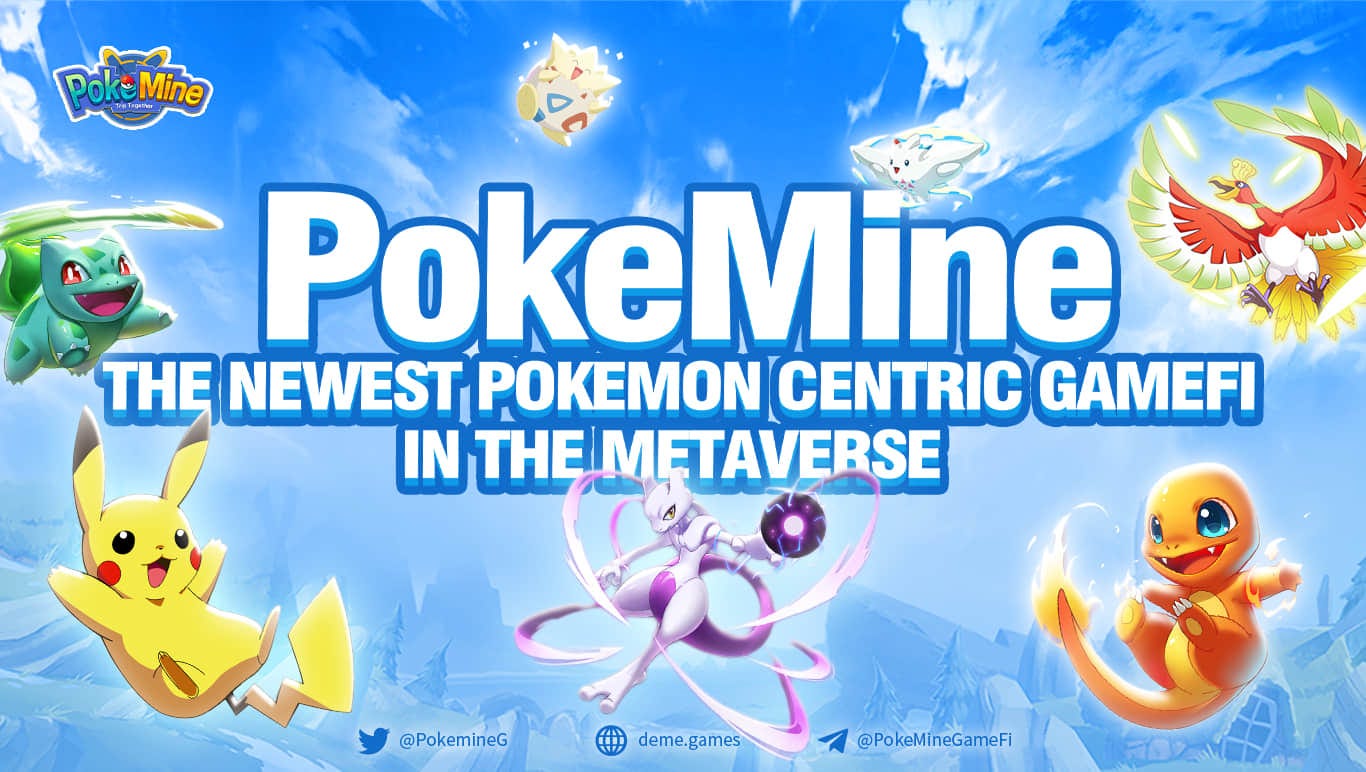
PokeMine is a new action card mobile game with Pokémon as its theme. It is the first Pokémon mobile game where players can independently evolve elves and change their appearance. The overall game restores the Pokémon world in depth, adding a variety of rich gameplay such as the classic Pokémon gacha system, Pokémon cultivation system, checkpoint battles, Z move, Pokémon dispatch (mining), and many others. There are also Budokan, Invasion of Mythical Beasts, Daily Trail, Team Hunting, Battle Tower, Champions Road, Budokan Battle, Quartz Assembly, Alliance War, Cross-server PK and many other gameplay varieties available.
Pokemon has created a unique NFT mechanism that enables a user’s NFT to no longer just be a work of art but a way to build characters in a game. PokeMine has 4 different colors of Pokemon NFTs, red being the most powerful, followed by orange, then purple, then blue. More powerful Pokemons are relatively rare. Users can upgrade NFTs through PVE, or upgrade Pokemon with equipment. Equipment in the game can increase the Pokemon’s combat power, dispatch time, etc. PokeMine has many features to explore, and more detailed tutorials will be released when the official version is released.
Pokemon Exploration: Users can explore the levels to obtain rewards and reach higher levels for their Pokemon. Higher levels, better attributes, and stronger skills make the user’s Pokemon more valuable.
Pokemon Dispatch: Players can get rich rewards by dispatching. The longer the dispatch period, the better the quality of the Pokemon, the more lucrative the rewards, such as diamonds. Using the ‘limit Pokemon Dispatch’ will also double the revenue, depending on the actual profit. Each dispatch line accounts for the dispatch time independently, and each dispatch queue has 4 hours of free dispatch time every day. You can increase any dispatch queue’s available time on the same day by using the “Time aquatic” item produced by [Exploration Level].
In addition, the “limited Pokemon” mechanism and sending “limited Pokemon” can provide a certain percentage of dispatch value bonus for this dispatch queue. The higher the quality of the qualified Pokemon, the greater the increase.
Exploring level and Adventure level: Adventure points and exploration points both require stamina, so it is best to use the stamina of adventure levels in the early stages to level up your team, unlock new features, and then improve your Pokemon overall with appropriate experience gains. Players upgrade Pikachu to unlock to multi-adventure levels. Diamonds are consumed at each level. The amount consumed increases with the progress of the level.
Changeable Combat Strategies: Pokemon types are divided into attack, heal, skill, and defense, and each Pokemon can play according to its positioning characteristics, making the entire gaming experience a battle of wit and courage, and full of strategization.
Cultivate Pokemons: There are more skills that players can use in the game to make you invincible, as well as to increase the level of Pokemons, stars, skill levels, and more so that the Pokemons can continue to grow, allowing players to cultivate a unique and powerful Pokemon from scratch.
Equipment: Elf armor can be upgraded to increase stats. Armor attributes are given to corresponding Pokemons, which is the player’s goal.
Pokemon Center (Gacha Center): Pokemon center’s Gacha System is the main way for players to obtain Pokemon and Pokemon shards. The Pokemon are randomly selected, by consuming diamonds or props. And there are rare Pokemon hidden in it, which can make for surprises.
Pokemon Social Interaction: The built-in gaming environment can also be used for real-time interaction, efficient data interaction, and processing capabilities, so that all users’ data can be displayed in real time. Players can exchange ideas and experiences with other players in the “world” at any time, offering users an immersive experience.
How to start playing Pokemon:
1. Players need to register an account onhttps://deme.games, then connect their wallets and e-mails.
2. To download the game, sign in on the official website.
The Real World Impact of NFTs in Gaming
Besides gameplay, NFTs have more real-world value. NFT items in games are not just items sold on NFT platforms, but they can deal directly on the markets, making the dealing process much easier than in traditional games.
GameFi is one of the ways that can help users understand Metaverse with more clarity. While its beginnings are in the game industry, in the future, it will have a strong impact on more aspects of human civilization, for instance in finance and socialization. It is estimated that in 2021 the global game market will reach profits of $175.8 billion. It is expected that during 2023, the gains will exceed $200 billion. GameFi is at a relatively early stage of development, and it still has enormous growth potential.
The integration of NFT and GameFi has produced a huge impact on gaming and will continue to have both micro and macro effects on business models as well as virtual assets ownership rights.
With the combination of Pokemon and GameFi, PokeMine is without a doubt, the rebirth of the Pokemon world in the real world.
PokeMine was officially launched on December 16th, 2021. After completing its first round of $5 million funding on November 16 2021, more functions have been increasingly launched one after another in stages. The first funding round was financed by GMC, Blockchain Ventures, Hayek Capital, YIBI Exchange, YSL Capital, HKD.COM, NKCCapital, and others. The funds are being used for Pokemon’s technology development and team building so as to fund international growth.
Currently, PokeMine NFTs have been deployed on the Heco-chain and Binance Smart Chain based on the ERC-721 token standard. There are two different types of assets in PokeMine: NFTs and PokeMine Diamonds ($PMD). Users can purchase PokeMine NFTs on Treasureland and purchase $PMD from MDEX and ButterSwap and use PMD to get Pokemon NFTs from the Pokemon center in the game.
The project has also made an official announcement to attract influencers for PokeMine. The influencer initiative purports to give influencers the opportunity to join and share in a large portion of the bonuses. Influencers need to promote across Pokemine social platforms, which include: Telegram, Discord and Twitter.
Diverse game scenarios and unique gameplay have made Pokemon a high-profile GameFi project. There are plenty of strategies and methods to explore, both in the PvE scenario and future PVP. Better strategization will not only be more fun for the player, it will lead to a higher return on investment. In the aspects of game quality and tokenomics, PokeMine is one of the leading offerings in this market.
No Deme games will be deployed on centralized service clients like Amazon in the future. All Deme games will be deployed on the DEME mainnet node, a system which is completely decentralized. Technically, that is the biggest advantage of Deme.
In the future, Deme will access Metaverse and empower more Web 3.0 applications. Meanwhile, Deme will support Cross-chain bridge, Multi-chain wallet, NFT trading markets, and Defi assembly kits. It also sorts the utilities of Metaverse, helps users create decentralized identities, and makes it convenient for users to manage Token and NFT assets easily. What’s more, Deme will let users enjoy all kinds of encrypted applications, and build SocialDAO blocks, open up encrypted application communities, and decentralized governance. Deme will build a highly-decentralized Metaverse platform, inspiring the unlimited vision of every gaming and crypto enthusiast to the encrypted world.
By Brian Armstrong, CEO and Cofounder, & Alex Reeve, Identity Product Lead
These days, everyone is talking about the Metaverse.
Primitive Metaverse platforms are selling virtual land for millions of dollars. Billions more are being invested in Metaverse startups. And Mark Zuckerberg recently renamed his entire company to reflect a focus on building the Metaverse.
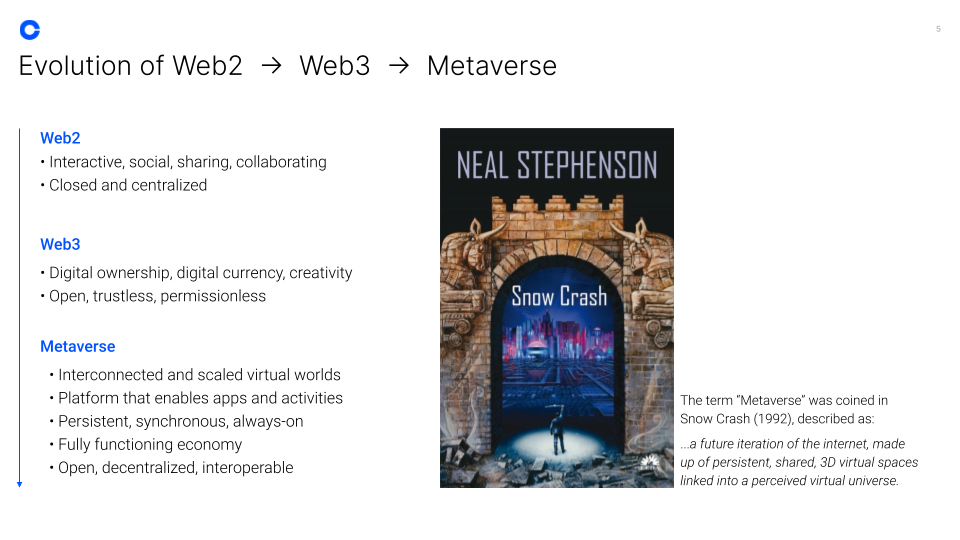
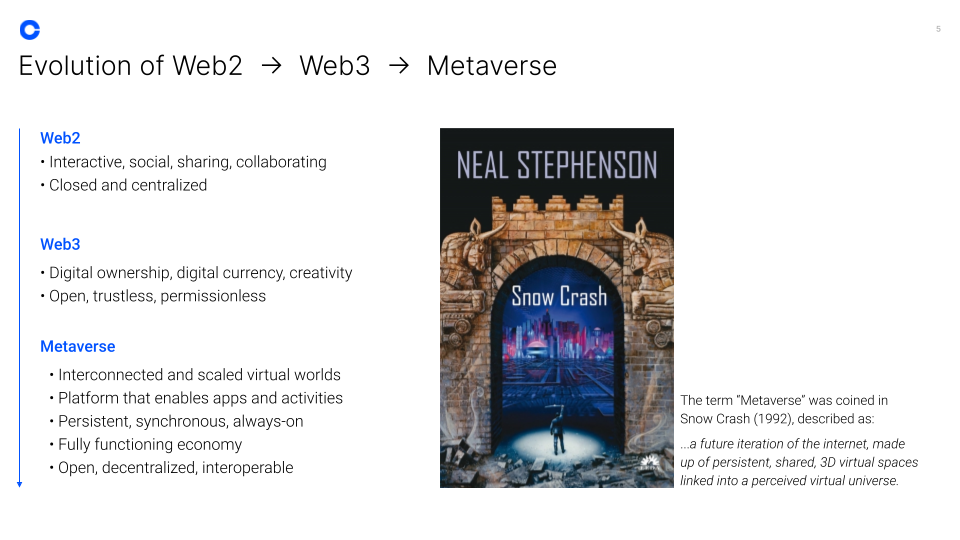
The term “Metaverse” is not new. It was first used by author Neal Stephenson in his 1992 novel “Snow Crash.” But as technology improves, and we spend more of our lives online, more people are starting to think about what’s next — and how the future might revolutionize both the digital and the physical world.
Recently, our team put together an internal presentation about the Metaverse, who’s working on it, and how crypto will help make it real. I thought the presentation was well done, so I’m sharing most of the slides here.
Defining the Metaverse
At Coinbase, our thinking about the Metaverse has been heavily influenced by venture capitalist and writer Matthew Ball (you can find his work here). Like Matt, we define the Metaverse as:
The future of the internet: A massively-scaled, persistent, interactive, and interoperable real-time platform comprised of interconnected virtual worlds where people can socialize, work, transact, play, and create.
The earliest version of the internet, Web1, was about accessing static web pages. Web2 is about interactive, social experiences within closed ecosystems. And Web3 will be about digital ownership within an open, decentralized environment.
The Metaverse is the distant evolution of Web3. In its most complete form, it will be a series of decentralized, interconnected virtual worlds with a fully functioning economy where people can do just about anything they can do in the physical world.
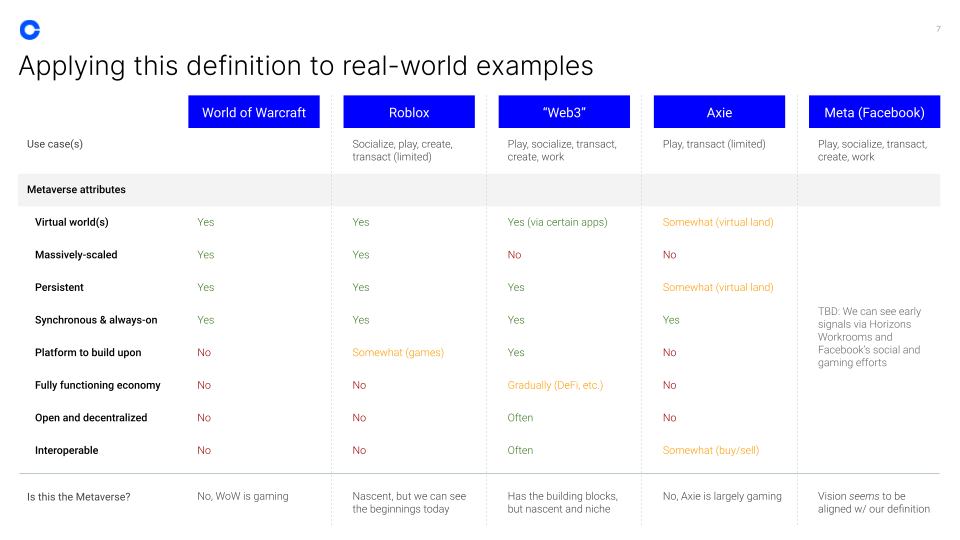
Importantly, the Metaverse is not the same thing as gaming (an activity you can do within the Metaverse), or virtual reality (a way of interfacing with the Metaverse). It’s also not the same as Web3 (a distant ancestor of the Metaverse).
To illustrate this, here’s how some current platforms stack up against our definition of the Metaverse:
Elements of the Metaverse
While the full Metaverse is years away, it will rest on a foundation that’s being built right now.
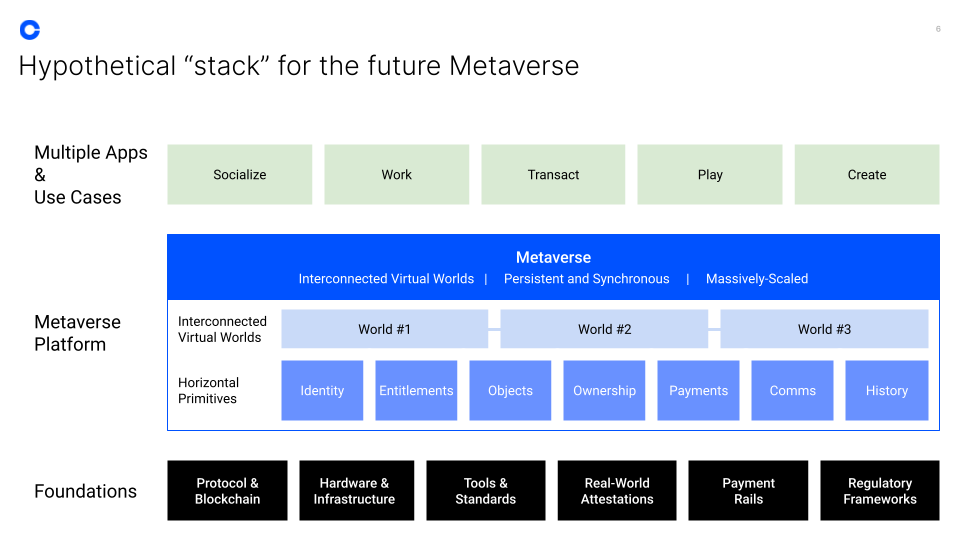
Like the internet today, the Metaverse will rely on hardware and infrastructure, tools and standards, and regulatory frameworks — most of which haven’t been fully developed yet.
But unlike today’s internet, there won’t just be one Metaverse. There will be many Metaverses, and they’ll be interconnected. That’s why it will be important for any Metaverse to be trustless — meaning people can interact directly without going through an intermediary — and permissionless — meaning anyone can participate without authorization from a governing body.
To achieve this, the Metaverse will rely on blockchain to transfer identity and ownership across virtual worlds, attestation to verify them, and payment rails that allow people buy, sell, and earn income within a decentralized economy.
Who’s building the Metaverse today?
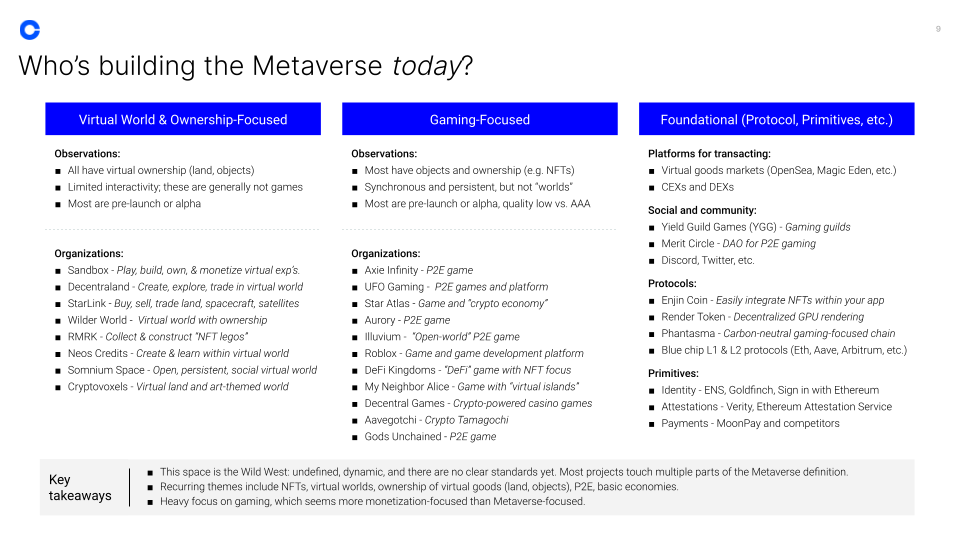
While we can’t build anything close to the full Metaverse yet, different companies and organizations are experimenting with different elements of it. Most fall into three categories:
The Metaverse ecosystem is still very much in its infancy: emergent and yet to be defined. That’s its beauty too. There’s a heavy focus on gaming, mostly because it’s easy to monetize. But we’re beginning to see glimpses of what the future might look like.
Identity
Identity determines who you are, what you can access and do, and how you’re represented across the worlds of the Metaverse.
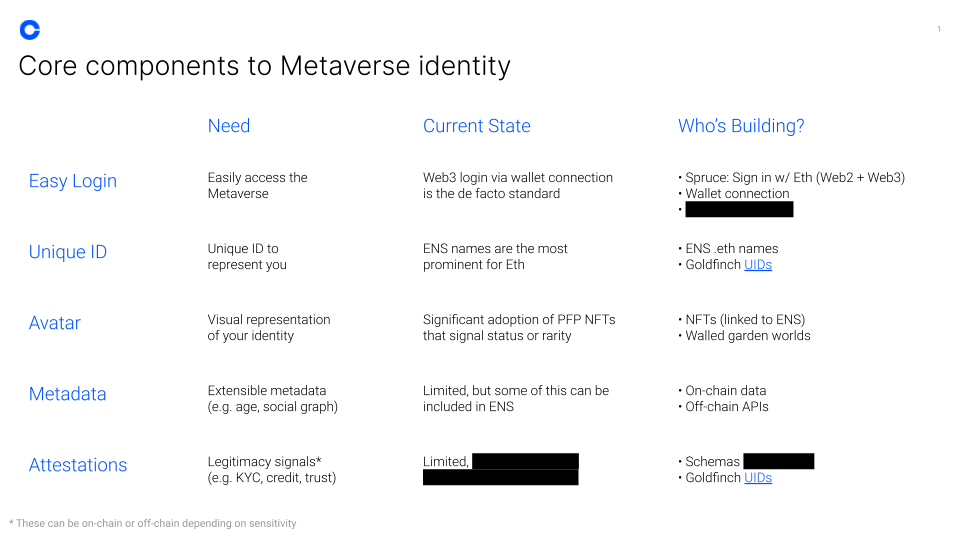
In the Metaverse, our identities will have to include an easy login, a unique ID, an avatar that represents us, metadata that follows us, and attestation so we can prove who we are. Here’s where each of those pieces stands today:
Where Coinbase comes in
At Coinbase, we want to help pull all the pieces of identity together — essentially creating an identity on-ramp into the Metaverse.
That’s the idea behind our work with ENS, which makes it possible to create a unique username NFT that resolves to a wallet. Eventually, this will allow users to carry a unique ID across different worlds in the Metaverse.
We’re also working on technology that will allow you to purchase your avatar, define and maintain your public profile, and establish trust. And we’re working on features like Sign in with [Eth/Coinbase], which could allow users to sign into every app in the Metaverse.
Conclusion
At the end of the day, this isn’t about expanding our business or making money. It’s about building a critical piece of the Metaverse ecosystem, and helping crypto grow in the right way.
We know that the Metaverse will exist, and we know it will be a series of interconnected virtual worlds. Our goal is to make it easy for anyone to establish their identity and gain access to those worlds in a way that’s simple, trusted, and decentralized.
If we succeed, it will allow the Metaverse to reach its full potential — and keep it free and open to everyone.
How Coinbase thinks about the Metaverse was originally published in The Coinbase Blog on Medium, where people are continuing the conversation by highlighting and responding to this story.
Further to a recent announcement, Rikkei Finance launched its dual IDO and IEO for its native governance token today, quickly selling out. Currently, Rikkei’s native token, $RIFI, is live trading on both Huobi and PancakeSwap.
Rikkei Finance is a metaverse DeFi protocol, built on Binance Smart Chain, that enables safe and secure open lending offering cross-chain support, NFT collateralization, and peer-to-peer insurance cover. The long-awaited IDO started alongside Rikkei Finance’s IEO, having previously been postponed since August.
It follows a successful $5.6 million fundraising round with investors including Signum Capital, X21 Digital, and Kyber Network, as well as the $RU token NFT project IDO for its RiFi United play-to-earn soccer manager simulator.
$RIFI IDO on RedKite Launchpad
RedKite is a cutting-edge launchpad powered by PolkaFoundry as part of the growing $PKF ecosystem. Projects are chosen carefully through a vetting procedure that analyzes the team and implementation capabilities.
Pool Details
Token ticker: $RIFI
Token type: BEP20
Price per token: $0.10
Vesting schedule: 20% released at launch, three months cliff, then unlock 20% quarterly
Network for IDO: BSC
Accepted currency for IDO: BUSD
Participants were able to register between December 3-6, with the IDO pool launching today, December 7. Phase 1 buying (guaranteed allocation) ran from 11:00 AM UTC to 12:00 PM UTC. Phase 2 (first come, first served) ran from 12:00 PM UTC to 12:15 PM UTC, and the community pool from 12:15 PM UTC to 12:30 PM UTC.
As previously mentioned, $RIFI is not live trading.
$RIFI IEO on Huobi Primelist
Regarded as a leading global digital asset exchange dedicated to providing secure and reliable digital asset trading, Huobi is listing $RIFI today on its brand new token listing platform, Primelist. The sale period runs from 10:00 AM UTC to 12:20 PM UTC, with trading time beginning at 1:00 PM UTC. Participants were offered two methods for registering for the sale: Queue or HT Holding.
Queue
To register via Queue, participants had to sign up on Huobi Global and complete the advanced verification process before 10:00 AM UTC on December 7, holding at least 50 USDT in their exchange account.
From 10:00 AM UTC to 11:00 AM UTC, eligible users register to participate in the event, with 5,000 lucky users randomly selected to qualify for the purchase and allocation of 50 USDT worth of $RIFI each.
HT Holding
To register via HT Holding, participants also had to sign up on Huobi Global and complete the advanced verification process before 10:00 AM UTC on December 7, having had 3-day minimum average holdings of 300 HT between December 3-6.
From 10:00 AM UTC to 11:00 AM UTC, eligible users register to participate in the event with the system automatically executing purchase orders for the maximum amount of USDT they could use for the order placement, allocating new tokens for each participant on a pro-rata basis.
Interested parties can now purchase $RIFI tokens on Huobi or PancakeSwap.
Facebook has been planning its foray into the metaverse for some time now — possibly even several years. But it’s only recently that its ambitious expansion plans have catapulted the concept into mainstream headlines across the globe. Renaming the parent company to Meta was perhaps the biggest, boldest statement of intent the firm could make. Suddenly, major news outlets were awash with explainer articles, while finance websites have been bubbling with excitement about the investment opportunities in this newly emerging sector.
However, within the crypto sphere, the response has been understandably more muted. After all, decentralized versions of the metaverse have been in development around these parts for several years now. Even worse, the tech giants’ cavalier attitude to user privacy and data harvesting has informed many of the most cherished principles in the blockchain and crypto sector.
Nevertheless, metaverse tokens such as Decentraland (MANA) and Sandbox (SAND), enjoyed extensive rallies on the back of the news, and within a few days of Facebook’s announcement, decentralized metaverse project The Sandbox received $93 million in funding from investors, including Softbank.
But now that the dust has settled, do the company-formerly-known-as-Facebook’s plans represent good news for nonfungible token (NFT) and metaverse projects in crypto? Or does Meta have the potential to sink this still-nascent sector?
What is known so far?
Facebook hasn’t released many details about what can be expected from its version of the metaverse. A promotional video featuring the company co-founder and CEO Mark Zuckerberg, himself, along with his metaverse avatar, looked suitably glossy. Even so, it was scant with information about how things will actually work under the hood. However, based on precedent and what is known, some distinctions can be made between what Facebook is likely to be planning and the established decentralized metaverse projects.
Facebook has some form when it comes to questions over whether it will adopt decentralized infrastructure based on its efforts to launch a cryptocurrency. Diem, formerly Libra, is a currency run by a permissioned network of centralized companies. David Marcus, who heads up Diem, has also confirmed that the project, and by extension Facebook, is also considering NFTs integrated with Novi, the Diem-compatible wallet.
Based on all this, it’s fair to say that the Facebook metaverse would have an economy centered around the Diem currency, with NFT-based assets issued on the permissioned Diem network.
Announcing @Meta — the Facebook company’s new name. Meta is helping to build the metaverse, a place where we’ll play and connect in 3D. Welcome to the next chapter of social connection. pic.twitter.com/ywSJPLsCoD
The biggest difference between Facebook’s metaverse, and crypto’s metaverse projects, is that the latter operates on open, permissionless, blockchain architecture. Any developer can come and build a metaverse application on an open blockchain, and any user can acquire their own virtual real estate and engage with virtual assets.
Critically, one of the biggest benefits of a decentralized, open architecture is that users can join and move around barrier-free between different metaverses. Interoperability protocols reduce friction between blockchains, allowing assets, including cryptocurrencies, stablecoins, utility tokens, NFTs, loyalty points, or anything else to be transferable across chains.
So the most crucial question regarding Facebook’s plans is around the extent to which the company plans for its metaverse to be interoperable, and metaverse assets to be fungible with other, non-Facebook issued assets.
From the standpoint of the decentralized metaverse, it doesn’t necessarily sound like great news. After all, Meta’s global user base dwarfs crypto’s. But there’s another way of looking at it, according to Robbie Ferguson, co-founder of Immutable, a layer two platform for NFTs:
“Even if [Meta] decides to pursue a closed ecosystem, it is still a fundamental core admission of the value that digital ownership provides — and the fact that the most valuable battleground of the future will be who owns the infrastructure of digital universes.”
Centralization could be the most limiting factor
Based on the fact that Diem is already a closed system, it seems likely that the Facebook metaverse will also be a closed ecosystem that won’t necessarily allow direct or easy interaction with decentralized metaverses. Such a “walled garden” approach would suit the company’s monopolistic tendencies but limit the potential for growth or Facebook-issued NFTs to attain any real-world value.
Furthermore, as Nick Rose Ntertsas CEO and founder of an NFT marketplace Ethernity Chain pointed out, users are becoming weary of Facebook’s centralized dominance. He added in a conversation with Cointelegraph:
“Amidst [the pandemic-fuelled digital] transition, crypto adoption rose five-fold. At the same time, public opinion polling worldwide shows growing distrust of centralized tech platforms, and more favorable ratings of the very nature of what crypto and blockchain offer in protecting privacy, enabling peer-to-peer transactions, and championing transparency and immutability.”
This point is even more pertinent when considering that the utility of Diem has been preemptively limited by regulators before it has even launched. Regardless of how Diem could eventually be used in a Facebook metaverse, regulators have made it clear that Diem isn’t welcome in the established financial system.
So it seems evident that a closed Facebook metaverse will be limited to the point that it will be a completely different value proposition to what the decentralized metaverse projects are trying to achieve.
Meanwhile, decentralized digital platforms are already building and thriving. Does that mean there’s a risk that blockchain-based platforms could fall prey to the same fate as Instagram and WhatsApp, and get swallowed up as part of a Meta acquisition spree? Sebastien Borget, co-founder and chief operating officer of the Sandbox, believes that decentralized projects can take a different approach:
“Typically, big tech sits on the sidelines while new entrants fight for relevance and market share — and then swoops in to buy one of the strongest players. But that strategy only works if startups sell. So there has to be a different economic incentive, which is exactly why Web 3.0 is so powerful. It aligns the platform and the users to build a platform that stands on its own, where users have ownership over its governance — and ultimate success.”
A metaverse operated by tech giants?
Rather than attempting to dominate, Facebook may decide to integrate with established metaverses, games and crypto financial protocols — a potentially far more disruptive scenario. It could be seriously transformative for the crypto space, given the scale of Facebook’s user base.
Therefore, could there be a scenario where someone can move NFT assets between a Facebook metaverse and a decentralized network of metaverses? Sell Facebook-issued NFT assets on a DEX? Import a $69 billion Beeple to the Facebook metaverse to exhibit in a virtual gallery?
This seems to be an unlikely scenario as it would entail substantial changes in mindset from Facebook. While it would create exponentially more economic opportunity, regulatory concerns, risk assessments, and Facebook’s historical attitude to consuming competitors rather than playing alongside them are likely to be significant blockers.
Related: As Patreon tests the waters, can crypto open doors for content creators?
The most likely outcome seems to be that Facebook will attempt to play with established centralized tech and finance firms to bring value into its metaverse. Microsoft has already announced its own foray into the metaverse, but perhaps not as a direct competitor to what Facebook is attempting to achieve. Microsoft’s metaverse is focused on enhancing the “Teams” experience in comparison to Facebook’s VR-centric approach.
But it seems more plausible that the two firms would offer some kind of integration between their metaverse platforms than either of them would rush to partner with decentralized, open-source competitors. After all, Facebook’s original attempt to launch Libra involved other big tech and finance firms.
Make hay while the sun shines
Just as Libra created a lot of hype, which ultimately became muted by regulators, it seems likely that the development of a Facebook metaverse can play out in the same way with regards to its impact on the cryptocurrency sector.
Regulators will limit Facebook’s ability to get involved with money or finance, and the company isn’t likely to develop a sudden desire for open-source, decentralized, solutions.
However, the one positive boost that Libra brought to crypto was publicity. Ntertsas believes that this, alone, is enough to provide a boost to the decentralized NFT sector, explaining:
“Meta’s plans will enable a surge in utility for NFT issuers and minters. NFTs can then be used as metaverse goods — from wearables to art, to collectibles, and even status symbols — there is an infinite use case and utility to NFTs and what they can become in the ever-growing NFT ecosystem.”
In this respect, there are plenty of opportunities for decentralized metaverse projects to muscle into the limelight with their own offerings and showcase how decentralized solutions are already delivering what Facebook is still developing. Borget urges the community to seize the moment:
“Now is the time for us to double down on building our vision of the open, decentralized and user-driven metaverse. We also have to invest time and money in explaining the benefits of our vision over what the Facebooks of the world have offered thus far.”
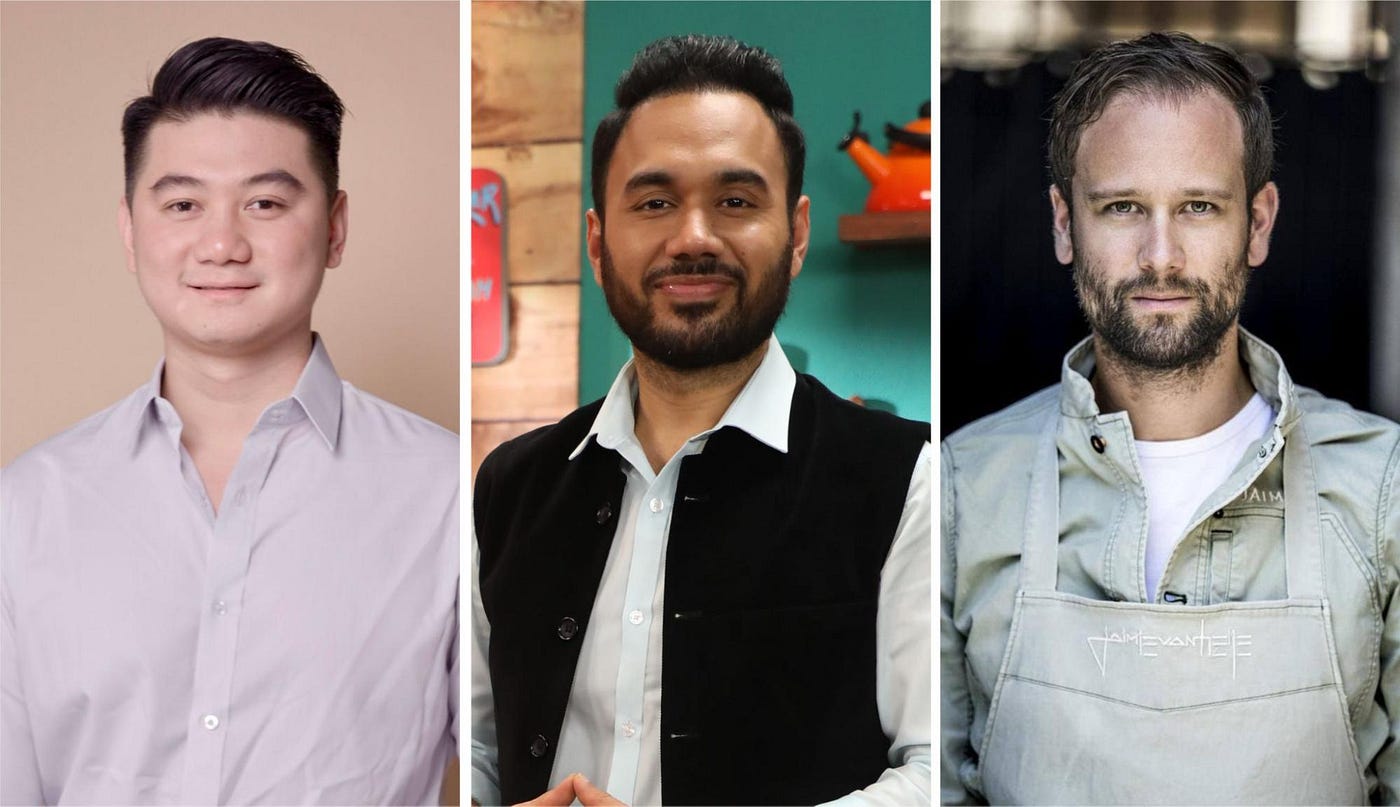
(L to R) Andrew Poernomo, Saransh Goila & Jaimie Van Heije are joining the Foodverse
Every facet of blockchain technology including the emerging metaverse is growing rapidly as the world turns to an era of revolutionary technologies. Novel blockchain innovations are redefining the entire ecosystem. OneRare is a groundbreaking gaming project that looks to impact the cryptosphere with its unique take on Food. In an exclusive interview, the project revealed it is ready to spearhead an exciting journey to foodify the blockchain.
OneRare is poised to bring into the blockchain ecosystem, a new wave of the metaverse, with food as its core. It is the very first of its kind and will be a major turning point for the global Food & Beverage industry that gets access to the blockchain for the first time.
The foodverse is significantly growing and in an exclusive interview, the OneRare team has revealed its latest collaboration with celebrity chefs to promote the project. Arnold Poernomo (Celebrity chef and judge on cooking reality series Masterchef Indonesia), Saransh Goila (Indian chef and winner of India’s youngest Super Chef title), and Jaimie Van Heije (A renowned Dutch Chef and owner of several high cuisine restaurants in The Netherlands), are joining the OneRare Foodverse to celebrate their culinary journey.
Establishing An Ever-Growing Community Of Food Lovers On The Foodverse
OneRare is keen on building an ever-growing community of food lovers on its unique food metaverse to promote the ecosystem, and creating the first opportunity for Celebrity chefs & their special signature dishes to reach global markets.
“OneRare celebrates global cuisines, and it’s a natural fit to celebrate the best culinary artists from around the world. We are very excited to be joined by Arnold Poernomo, Saransh Goila & Jaimie Van Heije as we celebrate their iconic dishes and introduce them to Web3 audiences”, said Supreet Raju, CEO & Co-founder of OneRare.
Saransh Golia, the popular Indian Super Chef expressed his excitement on the collaboration saying,
“From being a chef in my home kitchen to teaching and creating recipes virtually I’ve learnt that food really has no boundaries. Super excited to explore this new chapter of food in the metaverse by OneRare. The fact that you can create your favourite recipes in the metaverse and own dish NFTs is fascinating for me. I’m really looking forward to showcasing my favourite dishes on OneRare, and hoping to make the metaverse a delicious space!”
With the Chefs in the Foodverse, the OneRare community gets an exciting chance to explore the best of culinary talent from all across the world, while exploring the exciting new world of NFTs and Gaming. The Chefs will also get a chance to meet new audiences from across the world, and create a future opportunity for being able to swap these NFTs for real life meals at the Chefs’ restaurants.
An Authentic Food Experience
As the first food metaverse, OneRare is exclusively dedicated to providing an authentic food experience for foodies all around the world. The project offers lots of creative opportunities on its platform for artists, game buffs, foodies, and food industry mavens to explore. It’s even more exciting with top partners onboard.
The project recently concluded a $2.35 million fundraise with leading investment funds and is all set for its public launch on Trustpad and Enjnstarter. OneRare is ready to create an experience that will be inclusive to everyone and foodify the blockchain.