Generally, the cryptocurrency market is bearish at the moment, with coins like Avalanche (AVAX), Ethereum, Litecoin, XRP, Solana, and others all caught in this trend. Currently, the price of AVAX is on a strong bearish move below the 100-day Moving Average (MA) and could continue in that direction for a while before retracing.
Technical Indicators Suggest A Bearish Trend For Avalanche
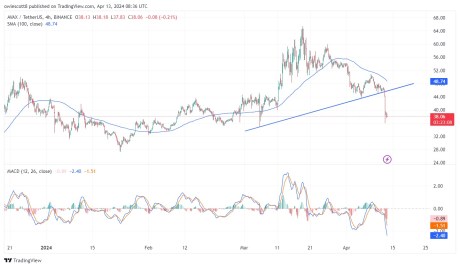
Observing the chart from the 4-hour timeframe, AVAX has crossed below both the 100-day moving average and the trend line. This could mean that the price is on a downward trend. The MACD indicator on the 4-hour timeframe suggests a very strong bearish movement as the MACD histograms are trending below the MACD zero line.
Also, both the MACD line and MACD signal line are trending below the zero line. Given the formation of the MACD indicator, it shows that there is a possibility that the price will still move further downward.
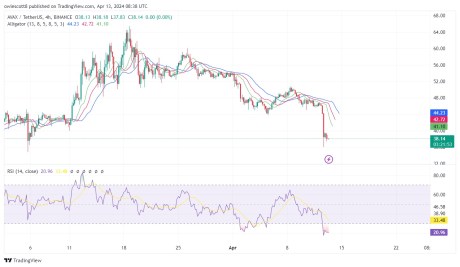
Furthermore, the Relative Strength Index (RSI) also on the 4-hour timeframe suggests a bearish trend as the RSI signal line is trending around the oversold zone. Despite the potential of a retracement at this point, the price will drop more following this.
The alligator indicator is another powerful tool used to determine the trend of an asset. A look at the above image shows that both the alligator’s lip and teeth have crossed over the alligator’s jaw facing the downward direction. This formation suggests that the trend is bearish and that the price could witness a deeper decline.
What Could Happen Next
Based on the price’s previous movement, there are two major resistance levels of $50 and $59.99 and a support level of $39.95. As Avalanche is on a negative trajectory, if prices manage to break below the support level of $39.95, it could trigger a move further toward the next low of $27.53.
On the other hand, if the price fails to break below its previous low, it might start an upward correction movement toward the resistance level of $50.80. However, if it manages to break past this level, AVAX might move even further toward the $59.99 resistance level.
As of the time of writing, the Avalanche was trading around $38, indicating a decline of 1.75% in the last 24 hours. Its market cap is down by over 16%, while its trading volume has increased significantly by nearly 250% in the past day.
AVAX trading at $38 on the 1D chart | Source: AVAXUSDT on Tradingview.com
Featured image from Shutterstock, chart from Tradingview
Disclaimer: The article is provided for educational purposes only. It does not represent the opinions of NewsBTC on whether to buy, sell or hold any investments and naturally investing carries risks. You are advised to conduct your own research before making any investment decisions. Use information provided on this website entirely at your own risk.
Crypto.com, a global cryptocurrency exchange, unveiled plans
today (Tuesday) to introduce a specialized trading platform application
designed exclusively for the Korean market. The application, tailored to cater
to the preferences and needs of Korean users, is set to be launched on April
29, 2024, offering trading between various cryptocurrencies.
With this development, Crypto.com becomes the first
international cryptocurrency exchange to venture into the Korean market,
signaling its focus on expanding its global footprint. The Chief Operating
Officer of Crypto.com, Eric Anziani, highlighted Korea’s tech-savvy populace
and its inclination towards embracing innovative technologies as key factors
driving the decision to focus on the Korean market. Moreover, he emphasized
Korea’s influence as a cultural powerhouse, indicating the exchange
Exchange
An exchange is known as a marketplace that supports the trading of derivatives, commodities, securities, and other financial instruments.Generally, an exchange is accessible through a digital platform or sometimes at a tangible address where investors organize to perform trading. Among the chief responsibilities of an exchange would be to uphold honest and fair-trading practices. These are instrumental in making sure that the distribution of supported security rates on that exchange are effectiv
An exchange is known as a marketplace that supports the trading of derivatives, commodities, securities, and other financial instruments.Generally, an exchange is accessible through a digital platform or sometimes at a tangible address where investors organize to perform trading. Among the chief responsibilities of an exchange would be to uphold honest and fair-trading practices. These are instrumental in making sure that the distribution of supported security rates on that exchange are effectiv Read this Term‘s intention
to support Korean creators and artists through strategic partnerships.
Eric Anziani, Chief Operating Officer of Crypto.com, Source: LinkedIn
“The first product we will be launching in Korea is the
crypto.com app, which is our most popular product globally. It’s a fully mobile
product offering a convenient and safe way to buy, sell and store digital
assets, including non-fungible tokens, enabling Korean customers to access
global prices in a regulated manner,” he commented.
Patrick Yoon, the General Manager of Crypto.com’s Korean
operations, emphasized the company’s dedication to catering to the unique
demands of the Korean market. He stated that Crypto.com has been prioritizing
localization efforts for the past two and a half years, ensuring that its
services align with the preferences and regulatory requirements of Korean
users.
“Once our coin trading service is stabilized in the
Korean market, we plan to ultimately advance into the Korean won-based trading
market in the future,” Yoon added.
📰 Just IN: https://t.co/MVDkYuc3ge plans to launch https://t.co/MVDkYuc3ge Korea exchange utilizing subsidiary OKBit’s VASP rights, valid until this year, as exclusively reported by News 1. With OKBit’s VASP authority obtained in 2021, https://t.co/MVDkYuc3ge aims to enter…
— BitcoinWorld Media (@ItsBitcoinWorld) April 1, 2024
Navigating Regulatory Landscape for Korean Market Entry
Patrick Yoon, General Manager of Crypto.com, Korea, Source: LinkedIn
One such regulatory requirement in Korea mandates
cryptocurrency exchanges to establish partnerships with commercial banks to
verify the real-name accounts of their customers. Yoon revealed ongoing
discussions with local banks to secure potential partnerships for real-name
account authentication.
Presently, there are five won-based cryptocurrency exchanges
authorized by Korean financial authorities, including UpBit, Bithumb, Coinone,
Korbit, and GOPAX. By entering the Korean market, Crypto.com aims to provide
users with an alternative trading platform
Trading Platform
In the FX space, a currency trading platform is a software provided by brokers to their respective client base, garnering access as traders in the broader market. Most commonly, this reflects an online interface or mobile app, complete with tools for order processing.Every broker needs one or more trading platforms to accommodate the needs of different clients. Being the backbone of the company’s offering, a trading platform provides clients with quotes, a selection of instruments to trade, real
In the FX space, a currency trading platform is a software provided by brokers to their respective client base, garnering access as traders in the broader market. Most commonly, this reflects an online interface or mobile app, complete with tools for order processing.Every broker needs one or more trading platforms to accommodate the needs of different clients. Being the backbone of the company’s offering, a trading platform provides clients with quotes, a selection of instruments to trade, real Read this Term while fostering healthy competition
and innovation in the local cryptocurrency ecosystem.
Crypto.com, a global cryptocurrency exchange, unveiled plans
today (Tuesday) to introduce a specialized trading platform application
designed exclusively for the Korean market. The application, tailored to cater
to the preferences and needs of Korean users, is set to be launched on April
29, 2024, offering trading between various cryptocurrencies.
With this development, Crypto.com becomes the first
international cryptocurrency exchange to venture into the Korean market,
signaling its focus on expanding its global footprint. The Chief Operating
Officer of Crypto.com, Eric Anziani, highlighted Korea’s tech-savvy populace
and its inclination towards embracing innovative technologies as key factors
driving the decision to focus on the Korean market. Moreover, he emphasized
Korea’s influence as a cultural powerhouse, indicating the exchange
Exchange
An exchange is known as a marketplace that supports the trading of derivatives, commodities, securities, and other financial instruments.Generally, an exchange is accessible through a digital platform or sometimes at a tangible address where investors organize to perform trading. Among the chief responsibilities of an exchange would be to uphold honest and fair-trading practices. These are instrumental in making sure that the distribution of supported security rates on that exchange are effectiv
An exchange is known as a marketplace that supports the trading of derivatives, commodities, securities, and other financial instruments.Generally, an exchange is accessible through a digital platform or sometimes at a tangible address where investors organize to perform trading. Among the chief responsibilities of an exchange would be to uphold honest and fair-trading practices. These are instrumental in making sure that the distribution of supported security rates on that exchange are effectiv Read this Term‘s intention
to support Korean creators and artists through strategic partnerships.
Eric Anziani, Chief Operating Officer of Crypto.com, Source: LinkedIn
“The first product we will be launching in Korea is the
crypto.com app, which is our most popular product globally. It’s a fully mobile
product offering a convenient and safe way to buy, sell and store digital
assets, including non-fungible tokens, enabling Korean customers to access
global prices in a regulated manner,” he commented.
Patrick Yoon, the General Manager of Crypto.com’s Korean
operations, emphasized the company’s dedication to catering to the unique
demands of the Korean market. He stated that Crypto.com has been prioritizing
localization efforts for the past two and a half years, ensuring that its
services align with the preferences and regulatory requirements of Korean
users.
“Once our coin trading service is stabilized in the
Korean market, we plan to ultimately advance into the Korean won-based trading
market in the future,” Yoon added.
📰 Just IN: https://t.co/MVDkYuc3ge plans to launch https://t.co/MVDkYuc3ge Korea exchange utilizing subsidiary OKBit’s VASP rights, valid until this year, as exclusively reported by News 1. With OKBit’s VASP authority obtained in 2021, https://t.co/MVDkYuc3ge aims to enter…
— BitcoinWorld Media (@ItsBitcoinWorld) April 1, 2024
Navigating Regulatory Landscape for Korean Market Entry
Patrick Yoon, General Manager of Crypto.com, Korea, Source: LinkedIn
One such regulatory requirement in Korea mandates
cryptocurrency exchanges to establish partnerships with commercial banks to
verify the real-name accounts of their customers. Yoon revealed ongoing
discussions with local banks to secure potential partnerships for real-name
account authentication.
Presently, there are five won-based cryptocurrency exchanges
authorized by Korean financial authorities, including UpBit, Bithumb, Coinone,
Korbit, and GOPAX. By entering the Korean market, Crypto.com aims to provide
users with an alternative trading platform
Trading Platform
In the FX space, a currency trading platform is a software provided by brokers to their respective client base, garnering access as traders in the broader market. Most commonly, this reflects an online interface or mobile app, complete with tools for order processing.Every broker needs one or more trading platforms to accommodate the needs of different clients. Being the backbone of the company’s offering, a trading platform provides clients with quotes, a selection of instruments to trade, real
In the FX space, a currency trading platform is a software provided by brokers to their respective client base, garnering access as traders in the broader market. Most commonly, this reflects an online interface or mobile app, complete with tools for order processing.Every broker needs one or more trading platforms to accommodate the needs of different clients. Being the backbone of the company’s offering, a trading platform provides clients with quotes, a selection of instruments to trade, real Read this Term while fostering healthy competition
and innovation in the local cryptocurrency ecosystem.
The PlayMining GameFi platform’s DEAPcoin ($DEP) token is performing very bullishly following the announcement of an NFT collaboration with the popular Devilman manga and anime series. At the time of this writing, DEP is currently a top-5 gaming token on Coinmarketcap by 7 day % change, with a 13% seven-day price increase and over 20% growth in market cap.
DEP’s bullish market performance comes at a time when other top-tier gaming tokens are experiencing a bearish slump — Guild of Guardians ($GOG), Oasys ($OAS), Immutable ($IMX) and Axie Infinity ($AXS) are all now dipping on the market charts. Meanwhile, DEP is still going strong, boasting one-month price and market cap increases of 41% and 49%, and respective three-month increases of 120% and 168%.
Major Brand Collab Driving Traction
Devilman is a well-known top-60 manga and anime franchise, having sold over 50 million manga copies since it first launched in 1972. Most serious fans of Japanese manga and anime will be familiar with the title, and PlayMining has a significant user base in Japan — making this new partnership a particularly prominent one in the Japanese GameFi space.
For PlayMining’s collaboration with the Devilman franchise, a new limited edition Devilman NFT collection is being integrated with the popular PlayMining card battle game JobTribes. Collectors can purchase limited quantities of six different Devilman NFT styles on the PlayMining NFT market until Jan. 31, after which the remaining cards will be raffled off over the following two weeks (or until supplies last). ‘Premium Recruitment’ raffle tickets can be purchased from within JobTribes from Jan. 31 until Valentine’s Day.
As a special bonus, whoever draws the very last Devilman NFT during the Premium Recruitment raffle period will receive a special one-of-a-kind Legendary “Rage of Fire Devilman” NFT as a prize.
JobTribes also has a “Devilman’s Invasion!” event prepared, which will run during the Premium Recruitment period. During this event, players will be able to win another kind of Legendary NFT depicting Devilman’s amulet, as well as other useful game items.
High-Profile #GamifyingWork Partnerships Bolstering DEP Token Rally
DEP’s rebound began three months ago, directly following an official PlayMining announcement of multiple high-level partnerships and a new business model that PlayMining calls #GamifyingWork. Under this new initiative, PlayMining is helping real-world companies from any industry outsource various work tasks to gamers, who can perform the tasks remotely as in-game quests and be rewarded with DEP for their ‘work’.
Kozo Yamada, co-CEO of PlayMining owner Digital Entertainment Asset, said that the new Gamifying Work solution is addressing a severe labor shortage crisis that is affecting many industries across the world. In fact, as many as four out of five companies may be affected globally, according to research by ManpowerGroup. But under PlayMining’s new initiative, companies that are not even traditionally part of the digital space, such as heavy industries, can remotely fill this labor demand in innovative ways.
PlayMining has a pilot project launching this spring in collaboration with the world’s fourth-largest electric power company, TEPCO Power Grid. The new PlayMining game will send teams of players out into their communities to photograph aging utility poles, with DEP tokens allocated to the teams that connect the most power lines in their game. As a result, TEPCO, which has been suffering from a lack of power pole inspectors, can now more efficiently maintain their aging power infrastructure.
A similar project is also underway to fill labor demands at waste processing facilities — this time via a highly innovative game in which players can remotely operate real-life waste-sorting robots. Japan’s second-largest telecom operator, KDDI, invested in DEA last summer to promote more such Gamifying Work projects. PlayMining went on to announce a slew of new collaboration partnerships in October, addressing numerous industries and social good goals including CO2 reduction, disaster prevention, animal welfare, local revitalization, inheritance, elderly quality-of-life and employment for people with disabilities.
For more information about PlayMining, visit their official website and follow them on social media.
Japan-based banking giant Nomura, announced today that its digital assets subsidiary, Laser Digital, has made a strategic investment in Infinity, a non-custodial interest rate protocol built on Ethereum.
Infinity’s wholesale exchange, the first of several planned infrastructures, provides inter-exchange clearing, fixed and floating rate markets, as well as enterprise-grade risk management utilizing hybrid on-chain/off-chain infrastructures that deliver transaction efficiency, security, and scalability.
Infinity is a pioneering interest rate protocol that forms the basis for benchmark rates, institutional-grade lending, borrowing, and risk management in DeFi. The money market exchange protocol was founded by ex-Morgan Stanley Head of Structuring, Kevin Lepsoe.
“Infinity is building critical infrastructure for DeFi, and its protocol enabling price discovery and management of risk within DeFi is transformative for institutions, Infinity’s groundwork paves the way for institutional flows on-chain, new levels of rates, and risk innovation, and we are keen to support their advances in the hybrid finance space.” – Olivier Dang, Head of Ventures at Laser Digital
Laser Digital was recently unveiled by Nomura to spearhead its digital asset ambitions and is chaired by Steve Ashley, who previously led Nomura’s wholesale division, with Dr. Jez Mohideen as its CEO. Headquartered in Switzerland, Laser Digital’s investments are focused on DeFi, centralized finance (CeFi), web3, and blockchain infrastructure.
The investment comes as the Bank of International Settlements (BIS) published guidelines for crypto exposures in December 2022, with bank-prescribed risk weightings for tokenized assets to be treated on par 1:1 with their analog counterparts. The guidelines for banks come into effect on 1 January 2025.
With USD $300 trillion of credit securities outstanding and multiples of that in the loan, derivative, and equity markets, the new guidelines portend a major wave of tokenization across financial and real assets.
Presently in Beta, the Inifinity mainnet is scheduled to launch by the end of Q2 2023.
Yesterday, Twitter confirmed its acquisition by Elon Musk in a deal worth nearly $44 billion. The announcement had a positive impact on the crypto market and specifically on Dogecoin (DOGE). The world’s largest meme coin jumped by approximately 25% within 24 hours.
Today, Dogecoin reached a high of almost $0.167, according to the data published by Coinmarketcap. With that, DOGE crossed the market cap of $20 billion for the first time in almost three weeks. The meme coin is now the 10th most valuable cryptocurrency in the world, just behind Cardano (ADA) and Terra (LUNA).
“Potentially related to the news of ElonMusk’s nearly formalized purchase of Twitter today, Dogecoin has pumped +19% over the past six hours. We have historically seen that meme coins benefit from Musk developments, & we’ll monitor this situation,” crypto analysis platform Santiment recently highlighted in a Twitter post.
Elon Musk has been one of the biggest supporters of Dogecoin. In March 2022, the CEO of Tesla confirmed that he is holding different crypto assets including Bitcoin, Ethereum and DOGE. In a Tweet last year, Elon Musk called Dogecoin “the people’s crypto.”
Meme Coins
Amid the retail frenzy in digital assets during 2021, meme coins gained significant popularity among users. DOGE and Shiba Inu witnessed monumental gains throughout last year. However, DOGE and SHIB saw consistent dips in the past 5 months. Despite the latest jump of approximately 25%, Dogecoin is still down by almost 50% compared to October 2021. A similar trend was witnessed across the Shiba Inu network. SHIB is now down by more than 60% from its all-time high in November 2021.
Despite price volatility, the adoption of DOGE and SHIB has increased in the past 12 months. Earlier this month, AMC mobile app started accepting Shiba Inu and Dogecoin for online payments.
Yesterday, Twitter confirmed its acquisition by Elon Musk in a deal worth nearly $44 billion. The announcement had a positive impact on the crypto market and specifically on Dogecoin (DOGE). The world’s largest meme coin jumped by approximately 25% within 24 hours.
Today, Dogecoin reached a high of almost $0.167, according to the data published by Coinmarketcap. With that, DOGE crossed the market cap of $20 billion for the first time in almost three weeks. The meme coin is now the 10th most valuable cryptocurrency in the world, just behind Cardano (ADA) and Terra (LUNA).
“Potentially related to the news of ElonMusk’s nearly formalized purchase of Twitter today, Dogecoin has pumped +19% over the past six hours. We have historically seen that meme coins benefit from Musk developments, & we’ll monitor this situation,” crypto analysis platform Santiment recently highlighted in a Twitter post.
Elon Musk has been one of the biggest supporters of Dogecoin. In March 2022, the CEO of Tesla confirmed that he is holding different crypto assets including Bitcoin, Ethereum and DOGE. In a Tweet last year, Elon Musk called Dogecoin “the people’s crypto.”
Meme Coins
Amid the retail frenzy in digital assets during 2021, meme coins gained significant popularity among users. DOGE and Shiba Inu witnessed monumental gains throughout last year. However, DOGE and SHIB saw consistent dips in the past 5 months. Despite the latest jump of approximately 25%, Dogecoin is still down by almost 50% compared to October 2021. A similar trend was witnessed across the Shiba Inu network. SHIB is now down by more than 60% from its all-time high in November 2021.
Despite price volatility, the adoption of DOGE and SHIB has increased in the past 12 months. Earlier this month, AMC mobile app started accepting Shiba Inu and Dogecoin for online payments.
With the recent crypto market decline, investors have become more fearful of the market. Recorded on the Fear & Greed Index, it shows that this remains an incredibly frightening time for users of cryptocurrencies. In times like these when the prices of digital assets continue to slide down, it is expected that investors become warier. However, this time around, the market had quickly gone into “Extreme Fear” territory with no sign of emerging anytime soon.
Scared Of Investing?
At the start of the month, top cryptocurrencies such as Bitcoin and Ethereum had begun a recovery trend that would eventually wash over the rest of the market. As prices rose, so did positive sentiment among investors who had flooded back into the market. Not long after though, the market had started one of its signature correction trends that comes with the bull rally and now investors have chosen to retreat instead of risk further downside.
Related Reading | CeFi Platform Celsius Restricts Yield Rewards To Only Accredited Investors In U.S.
The Fear & Greed Index shows that the market had been on a downward sliding scale since coming out of last week which had ended with a neutral sentiment from both sides of the market. By Monday however, this had quickly turned into fear with bitcoin finally falling to the $43K territory. Tuesday in itself proved to be worse as the market had indeed fallen into extreme fear, leading to a low score of 20.
Now, while Wednesday is starting out better than what Tuesday ended with at a score of 25, it still does not spell good news for the short term. When investors are scared of the market, they tend to not put any money into it for fear of losing more. This also triggers people taking profits from the market due to fear of their coins dropping further in value. With such low momentum, prices can suffer more instead of staging another recovery.
Is Fear Good For Crypto?
When it comes to how the market is feeling towards cryptocurrencies, it can often be a matter of personal perspective. There are those who believe that steering clear of the market while it is fearful is the best bet and to only invest once the prices start recovering. However, there are those who believe the opposite.
Related Reading | The Ronin Hack Aftermatch: Axie Infinity’s $1M Bug Bounty
Those who subscribe to the “buy the blood” school of thought often welcome downtrends like these since it gives them the opportunity to purchase coins at a “discount.” This mainly comes down to the risk appetite of the investor.
Nevertheless, it still stands to reason that some of the largest rallies have come after the market has consolidated from a price drop. This was the case in late February/early March which had seen the market in extreme fear turn greedy very fast as prices began to recover.
Total market cap falls to $1.8 trillion | Source: Crypto Total Market Cap on TradingView.com
Featured image from Psychology Today, chart from TradingView.com
Ethereum has mostly mirrored bitcoin’s run in the recent rally. This has seen the digital asset break as high as $3,000 once again for the year. This point which has proved elusive for the cryptocurrency has continued to give it a hard time. In previous times, Ethereum has had a had time staying above this level. Such has been the case this time around as it fails to secure its spot above e$3K.
Ethereum On The Decline
Like all other cryptocurrencies, Ethereum is a highly volatile asset and as such is subject to wild fluctuations in its price. For the last few months, it has fluctuated but remained mostly around the $2,600 to $ 2,800=0 level. With the recent rally, it was finally able to break out of this trend and begin a whole new one, one which saw it rise above the coveted $3K level.
Related Reading | TA: Ethereum Prints Bearish Pattern, Why It Could Correct To $2.8K
Nevertheless, this recovery would prove to be short-lived given that ETH could not maintain this position. Meeting fierce resistance from the bears at the $3,000 point, the digital asset was unable to form any meaningful support above it. This meant that the price crumbled below it but it would prove to be a continuous downward trend given the current indicators.
The fall below $3k saw the digital asset trading below its 50-day moving average. Now, this is an incredibly important point for cryptocurrencies in general given their high volatility. Since buyers are unwilling to purchase the digital asset at prices they did over the past few weeks, it indicates that Ethereum is still a seller’s market. Thus, it is expected that there will be a continuous downtrend as more coins are dumped on the market.
ETH falls below $3k | Source: ETHUSD on TradingView.com
This however does not spell bad news all around though. A market like ETH’s can quickly switch up and turn into a buyer’s market, especially when prices are as low as they are right now. If this happens, then Ethereum could very well see another 10% bounce that will cement its position above the $3k resistance point.
Market Sentiments Falls To Fear
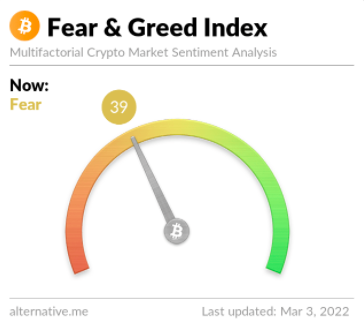
The Fear & Greed Index had moved out of the fear territory back into a neutral point at the start of the week but this new wave of positive sentiment did not hold. The index has now moved back into fear at a current score of 39 as at the time of this writing, showing that despite recent rallies, investor sentiments are still more negative than anything.
Related Reading | Terra (LUNA) Outperforms Popular Cryptos Ether, Dogecoin In The Past 24 Hours
Ethereum and the crypto market are directly affected by investor sentiment as they show when investors are likely to put money in the market. Currently, with the index in fear, it shows that investors are very wary of putting money in the market. However, this does not necessarily spell bad news for ETH.
Market sentiments drop to fear | Source: Alternative.me
Usually, when most investors are fearful, it can present a good buying opportunity. In the past, whales have been known to take advantage of moments like these to fill their bags. If so, then ETH can kickstart another rally. But only a large absorption of current supply can start the digital asset on this path.
Featured image from CNBC, chart from TradingView.com
Decentralized finance (DeFi) has the opportunity to democratize access to financial markets that have typically only been open to the rich and powerful. But, DeFi will only survive and continue to grow if we take steps to ensure things are safe, private and fair for both retail and institutional investors. When faced with predatory market behaviors such as miner extractable value (MEV) and front-running attacks it opens up old wounds to a “Flash Boys” era of traditional finance.
DeFi can and should do better by not allowing the failures of the past to come creeping back into the future. Fortunately, by implementing cryptographic mechanisms that integrate transactional privacy into public blockchains, information can be proven with things such as an order book without being revealed. This seemingly magical mathematical tactic not only shields transactions from the aforementioned behavior but also allows for auditability, all while still preserving the privacy of individual or institutional accounts. This approach will foster a more accessible DeFi industry and provide a more equitable and liquid market for all.
The boys are back in town
The phrase Flash Boys entered the lexicon after Michael Lewis wrote a very influential book detailing the phenomenon. When we transitioned from the open-outcry trading floor of old Wall Street into a fully electronic trading world, traders immediately started working out new ways to game the system. In short, the earliest tech-savvy brokers used the ultra-fast processing power of modern computer systems to monitor and facilitate high-frequency trades undercutting, or front-running, legitimate incoming trades posted by slower systems. The crypto DeFi equivalent of the Flash Boys is Flash Bots.
Related: Bitcoin’s last security challenge: Simplicity
In crypto, these specialized arbitrage bots will usurp human traders on exchanges by algorithmically predicting their moves and squeezing in their trades before a person can modify their position. These bots also often get priority in the upcoming block validation by paying higher fees that are calculated against the return on the trade. These bots will know in a fraction of a second what trades to make to optimize their profit.
Another phenomenon that enables scenarios like front-running is miner extractable value. MEV is just a fancy new way to describe how miners can extract value by deliberately prioritizing or ordering transactions to their benefit. When the miners are working against the best interests of the blockchain, their ability to use MEV undermines one of the key value propositions of decentralization and that is censorship resistance.
This malicious behavior incentivizes bad actors to come up with and implement numerous predatory actions that can undermine the security of an entire network. Further, most consensus mechanisms fail to punish MEV attacks which, in turn, gives miners the freedom to exploit them.
Related: Is the rise of derivatives trading a risk to retail crypto investors?
On a blockchain native decentralized exchange (DEX), when you combine the presence of Flash Bots together with MEV, the threat and resulting costs for the average human user compounds. If there is ever going to be mainstream adoption of crypto and DeFi, then the market environment needs to become less hostile to retail consumers. Working on cryptographic methods to protect against these types of malicious behaviors is something the industry needs to prioritize.
Rage against the machine
Fortunately, Flash Bot front-running and MEV attacks can be minimized on blockchains and their native DEXs with privacy-centric designs that utilize zero-knowledge proofs (ZKP) to mask transactions without compromising network security. ZKP technology is quickly becoming scalable enough to support such use cases as blind bidding, where the trade transaction is submitted, proven and verified on a DEX without revealing details such as trade size and time. This mechanism prevents a Flash Bot from being able to look up the trade on an order book and instantly front-run it with a better bid or ask.
A similar mechanism can be implemented to prevent MEV as well, but instead, the transaction is submitted, proven and verified on a blockchain without having to reveal its details to miners. This is the magic of ZKP that can be used to allow protocol rules to be implemented that see what (and how) transactions take place through cryptographic proofs. All of this is without revealing more information than is needed to verify the transaction under any existing protocol rules that said transactions must meet.
No quarter
The ability to share (and prove) information without showing it through the use of ZKP can unlock more mainstream adoption by policing crypto markets from bad actors and safely paving the way for more users. This approach will help the DeFi market grow to unprecedented levels through more safety, security and fairness, without compromising the decentralized nature of the industry.
This article does not contain investment advice or recommendations. Every investment and trading move involves risk, and readers should conduct their own research when making a decision.
The views, thoughts and opinions expressed here are the author’s alone and do not necessarily reflect or represent the views and opinions of Cointelegraph.
Warren Paul Anderson is vice president of product at Discreet Labs, which is developing Findora, a public blockchain with programmable privacy. Previously, Warren led product at Ripple for four and a half years, working on the XRP Ledger, Interledger and PayString protocols, the RippleX platform and RippleNet’s On-Demand Liquidity enterprise product. Prior to Ripple, in 2014 Warren co-founded Hedgy, one of the first DeFi platforms for derivatives using programmable escrowed smart contracts on the Bitcoin blockchain. Warren has two bachelor’s degrees from Northwestern University and did graduate studies at Harvard University.
Bitcoin on-chain analysis can be a good way to try to guess where the market is headed. The market tends to repeat itself with metrics looking the same before a bull or a bear rally, thus making this data a pretty good indicator of what’s to come. Analyst Willy Woo uses this same data to demonstrate a pattern that occurs before the bull rally, the criteria which are being met once again.
Start Of A Bull Run?
In a recent string of tweets, analyst Willy Woo presents data from on-chain analysis that points to the bitcoin dump having reached its bottom. According to him, “Price in relation to on-chain demand from both speculative and hodl category of investors are now both at peak oversold levels.” Woo points out that the last time that something like this had happened was when bitcoin reached its bottom following the COVID crash.
Price in relation to on-chain demand from both speculative and hodl category of investors are now both at peak oversold levels.
The last time this happened was October 2020. The time before that was at the bottom of the COVID crash.
The analyst further outlines the times where this has happened in the past. Going as far back as 2012, he points out the same had been the case in February of that year. What followed had been the memorable 2021-2013 bull run that saw bitcoin gain more popularity among investors.
Related Reading | Bitcoin Halving To Bring The Subsequent Crypto Frenzy
Fast forward to 2015 and the same had been the case in January of that year. This time, the on-chain metric spelled the bottom of the bear market that had begun previously in 2014, putting an end to the onslaught.
If Woo is right and the on-chain metric continues the way it has historically, then bitcoin may very well have reached the bottom, suggesting that this is the end of the downtrend. However, there is no telling if this is actually the case given that bitcoin had recorded back-to-back bull rallies in 2021.
Bitcoin On The Charts
Bitcoin has lost almost 50% from its all-time high of $69k which it hit in November of last year. This has however not affected the profits of the majority of holders. The digital asset remains one with the highest volume of holders that remain in profit after the market crash.
Related Reading | El Salvador Chivo Bitcoin Wallet Relaunch To Serve 4 Million Users
According to data from IntoTheBlock, 60% of all bitcoin holders are still in profit at current prices. It is important to note that the cryptocurrency was subject to massive sell-offs when investors panicked that the downtrend will continue. Most however have still kept their highly profitable status, with only 35% of all holders currently losing at market prices.
Bulls struggle to pull BTC up as bears take hold | Source: BTCUSD on TradingView.com
The majority are long-term holders and indicators point to investors still being very bullish on the digital asset despite the downtrend. With its current growth curve, it is expected that the cryptocurrency will see 1 billion holders in the next four years, making it a highly sought-after asset.
Featured image from Bitcoin News, chart from TradingView.com
In the latest crypto sell-off, BTC holders suffered huge losses. However, there was one bright spot for the holders of Bitcoin. The overall market dominance of the most valuable digital currency spiked by more than 4% in the last 8 weeks and crossed 42% on Friday.
In a jittery season for crypto bulls, the overall value of digital currencies plunged by approximately $1.4 trillion since 10 November 2021. The latest surge in BTC’s market dominance indicates that other digital currencies dropped more than Bitcoin in the recent market sell-off.
To put things into perspective, Ethereum has lost nearly 20% of its value just in the last 7 days. The correction in Solana was even worst as SOL dipped by 30% during the same period. Bitcoin performed relatively better with a drop of just 6% during the recent week.
In terms of drawdown from its all-time high levels, BTC is currently trading nearly 48% down from its all-time high level in November 2021. Cryptocurrency assets like Solana and Dogecoin are down 65% and 75%, respectively from their all-time highs.
Bitcoin Transfer Volume and Whales
With weak sentiment among retail traders, BTC whales are dominating the current market. Large transactions currently account for most of the trading volume. “Bitcoin transfer volumes continue to be dominated by institutional size flows, with more than 65% of all transactions being larger than $1M in value. The uptrend in institutional dominance in on-chain volumes started around Oct 2020 when prices were around $10k to $11k,” Glassnode noted.
“BTC whale addresses with 100+ Bitcoin continue their long-term pattern of accumulation during this volatility in the 34k to 38k range. In the past 5 years, 1.7M BTC has been added to these large addresses, including 60k more in the past 2 months,” Santiment highlighted in a Tweet.
In the latest crypto sell-off, BTC holders suffered huge losses. However, there was one bright spot for the holders of Bitcoin. The overall market dominance of the most valuable digital currency spiked by more than 4% in the last 8 weeks and crossed 42% on Friday.
In a jittery season for crypto bulls, the overall value of digital currencies plunged by approximately $1.4 trillion since 10 November 2021. The latest surge in BTC’s market dominance indicates that other digital currencies dropped more than Bitcoin in the recent market sell-off.
To put things into perspective, Ethereum has lost nearly 20% of its value just in the last 7 days. The correction in Solana was even worst as SOL dipped by 30% during the same period. Bitcoin performed relatively better with a drop of just 6% during the recent week.
In terms of drawdown from its all-time high levels, BTC is currently trading nearly 48% down from its all-time high level in November 2021. Cryptocurrency assets like Solana and Dogecoin are down 65% and 75%, respectively from their all-time highs.
Bitcoin Transfer Volume and Whales
With weak sentiment among retail traders, BTC whales are dominating the current market. Large transactions currently account for most of the trading volume. “Bitcoin transfer volumes continue to be dominated by institutional size flows, with more than 65% of all transactions being larger than $1M in value. The uptrend in institutional dominance in on-chain volumes started around Oct 2020 when prices were around $10k to $11k,” Glassnode noted.
“BTC whale addresses with 100+ Bitcoin continue their long-term pattern of accumulation during this volatility in the 34k to 38k range. In the past 5 years, 1.7M BTC has been added to these large addresses, including 60k more in the past 2 months,” Santiment highlighted in a Tweet.