[ad_1]
 In March, bitcoin miners amassed an unprecedented level of revenue not seen in the previous 12 months, hitting a high of $2.01 billion from rewards and transfer fees. Of this total, $85.81 million was earned from transaction fees over the past month. Historic Month for Bitcoin Miners — Income Peaks at $2 Billion As we […]
[ad_2]
Source link
Tag: March
-

Bitcoin Miners’ Earnings Hit Record $2 Billion in March Ahead of Halving Event
-

March Sees Nearly $1 Billion In Ethereum Netflow To Centralized Exchanges
[ad_1]
The price of Ethereum has not exactly lived up to its promise as the month has gone on, despite a stellar start to the month. While this bearish pressure has been widespread in the general cryptocurrency market, regulation uncertainty has been an additional concern for ETH, igniting a negative sentiment around the “king of altcoins.”
Interestingly, the latest on-chain revelation shows a substantial amount of Ethereum has made its way to exchanges so far in March, suggesting that investors might be losing confidence in the long-term promise of the cryptocurrency.
Are Investors Losing Confidence In Ethereum?
According to data from CryptoQuant, more than $913 million has been recorded in net ETH transfers to centralized exchanges so far in March. This on-chain information was revealed via a quicktake post on the data analytics platform.
This net fund movement represents the largest volume of Ethereum transferred to centralized exchanges in a single month since June 2022. Even though March is still a week from being over, this exchange inflow appears to be a complete deviation from the pattern observed over the past few months.
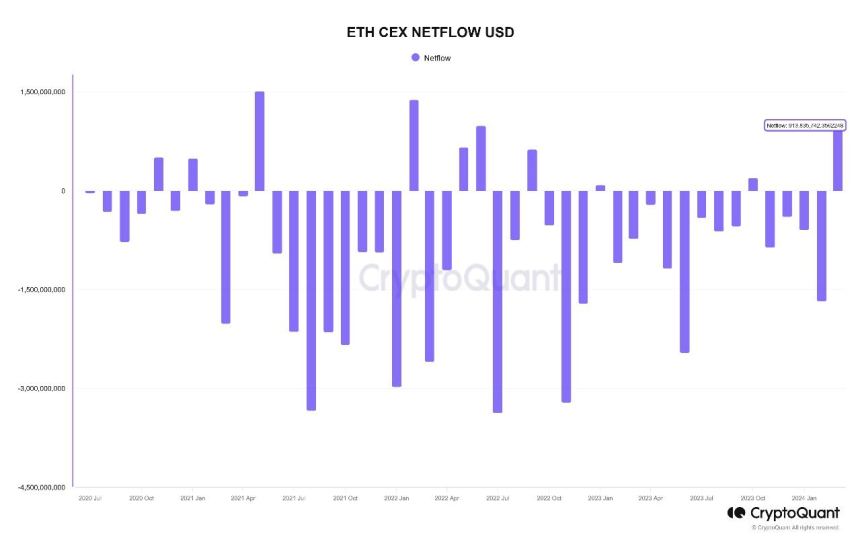
Chart showing total monthly netflow of ETH on centralized exchanges | Sources: CryptoQuant
As shown in the chart above, October 2023 was the last time cryptocurrency exchanges witnessed a positive net flow. It is worth noting that there was significant movement of Ethereum tokens out of the centralized platforms in subsequent months up until this month.
Meanwhile, a separate data point that supports the massive exodus of ETH to centralized exchanges has come to light. Popular crypto analyst Ali Martinez revealed on X nearly 420,000 Ethereum tokens (equivalent to $1.47 billion) have been transferred to cryptocurrency exchanges in the past three weeks.
The flow of large amounts of cryptocurrency to centralized exchanges is often considered a bearish sign, as it can be an indication that investors may be willing to sell their assets. Ultimately, this can put downward pressure on the cryptocurrency’s price.
Substantial fund movements to trading platforms could also represent a shift in investor sentiment. It could be a sign that investors are losing faith in a particular asset (ETH, in this case).
Moreover, the recent regulatory headwind surrounding Ethereum specifically accentuates this hypothesis. According to the latest report, the United States Securities and Exchange Commission is considering a probe to classify the ETH token as a security.
ETH Price
As of this writing, the Ethereum token is valued at $3,343, reflecting a 4% price decline over the past /4 hours. According to data from CoinGecko, ETH is down by 11% in the past week.
Ethereum loses the $3,400 level again on the daily timeframe | Source: ETHUSDT chart on TradingView
Featured image from Unsplash, chart from TradingView
Disclaimer: The article is provided for educational purposes only. It does not represent the opinions of NewsBTC on whether to buy, sell or hold any investments and naturally investing carries risks. You are advised to conduct your own research before making any investment decisions. Use information provided on this website entirely at your own risk.
[ad_2]
Source link -

3 reasons why XRP price could drop 25%-30% in March
[ad_1]
XRP price risks dropping by more than 25% in the coming weeks due to a multi-month bearish setup and fears surrounding excessive XRP supply.
XRP descending triangle
XRP has been consolidating inside a descending triangle pattern since topping out at its second-highest level to date — near $1.98 — in April 2021.
In doing so, the XRP/USD pair has left behind a sequence of lower highs on its upper trendline while finding a solid support level around $0.55, as shown in the chart below.

XRP/USD weekly candle price chart. Source: TradingView In the week ending March 13, XRP’s price again tested the triangle’s upper trendline as resistance, raising alarms that the coin could undergo another pullback move to the pattern’s support trendline near $0.55, amounting to a drop between 25% and 30%.
The downside outlook also takes cues from other bearish catalysts that has emerged around the triangle resistance.
For instance, XRP formed a bearish hammer on March 12, a single candlestick pattern with a small body and a long upside wick, suggesting lower buying pressure near the coin’s week-to-date top of around $0.85.

XRP/USD daily price chart featuring bearish hammer. Source: TradingView Additionally, the price turned lower after testing a confluence of resistances defined by its 20-week exponential moving average (20-week EMA; the green wave) and its 50-week EMA (the red wave), as shown in the attached image below.

XRP/USD weekly candle price chart with moving average resistances. Source: TradingView Excessive supply FUD
More downside cues for XRP come after Ripple Labs locked 800 million XRP in escrow as a part of its programmed schedule for withdrawals.
The blockchain payment company moved around 100 million XRP worth nearly $40 million to exchange wallets on March 3. Meanwhile, it kept the other 700 million XRP (worth around $550 million) in an escrow account, raising anticipations that at least 200 million XRP would be flooded into the market to generate funds for Ripple’s operational expenses, as well as to distribute XRP among Ripple’s global clientele.
Meanwhile, it kept the other 700 million XRP (worth around $550 million) in an escrow account, raising anticipations that at least 200 million XRP would enter the market to generate funds for Ripple’s operational expenses, as well as to distribute XRP among Ripple’s global clientele.
I understood there are some 800 million $XRP that are locked up and ready to be sold…someone should check the increase in circulating supply to verify this
— Shyan (@tayshyan) March 12, 2022
The selloff fears originated from the XRP price’s earlier response to unexpected supply hikes. For instance, XRP/USD fell by more than 50% to near $0.60 four months after its net supply in circulation increased from 40.46 billion to over 47 billion in just two days.

XRP circulating supply. Source: Messari Nonetheless, Ripple’s withdrawal of 800 million XRP has not yet been reflected in its net circulating supply.
Profit-taking risks mount
Another catalyst that hints XRP’s price could fall 25-30% to reach its descending triangle target is a Santiment indicator that tracks social media trends and their impact on market trends.

XRP price versus $XRPNetwork trend. Source: Santiment XRP’s price rose by over 15% week-to-date on March 12, notes Santiment, alongside a large spike in social media searches for the hashtag #XRPNetwork, suggesting that it could follow up with a potential selloff ahead. Excerpts:
“Historically, our social trends indicate that profit-taking is justified whenever the crowd makes the #XRPNetwork a top topic.”
The views and opinions expressed here are solely those of the author and do not necessarily reflect the views of Cointelegraph.com. Every investment and trading move involves risk, you should conduct your own research when making a decision.
[ad_2]
Source link -

DeFi proved resilient during the March 2020 and May 2021 market crises
[ad_1]

As if 2020 didn’t provide enough nail-biting moments, 2021 is shaping up to be quite an interesting year for cryptocurrency. With the price of Bitcoin (BTC) floating around the $35,000 mark, skeptics and pundits are flocking to the streets of social media to celebrate the long-awaited demise of the decentralized economy. Of course, they quite conveniently forgot that the price of Bitcoin has experienced a 533% increase since the third halving happened in May 2020.
Given the number of people claiming the crypto bubble has burst — including former U.S. President Donald Trump — it is almost hard to remember that the price of Bitcoin was hovering between $9,000 and $10,000 a mere 12 months ago.
Since the halving, in fact, decentralized finance (DeFi) has emerged as the most promising sector of the cryptocurrency economy, fueling the adoption of the crypto space. A quick glance at the growth statistics clearly indicates just how much momentum DeFi has generated over the past year. In June 2020, the total value locked (TVL) in DeFi was around $1.05 billion. Today, DeFi boasts more than $104 billion locked-in protocols.
Related: Was 2020 a ‘DeFi year,’ and what is expected from the sector in 2021? Experts answer
Although DeFi is set to lead the crypto space into the mainstream, DeFi has been challenged to its core over the past two years. While some onlookers may point to the hurdles in March 2020 and May 2021, the fact remains that DeFi is quite resilient and is poised for further growth moving ahead.
Calm in the storm
Despite the frenetic growth of DeFi, the space has experienced two substantial stress tests over the past two years: March 2020 and May 2021. To be clear, these instances challenged the DeFi space in ways it had not previously been challenged. The spread of the global COVID-19 pandemic and the Elon Musk-provoked panic selloff, coupled with the crackdown on China’s Bitcoin miners, culminated in the loss of $1 trillion across the entire crypto market.
If the Twitter account of Musk is partially responsible for summoning the storm, DeFi provided a calming presence within the storm.
Following the massive panic selloff ignited by Musk, a far more telling and impressive thing occurred: nothing. DeFi protocols continued to operate exactly as designed: no crashes, no glitches. In fact, the DeFi sector would grow to surpass $100 billion in value — passing its stress test with flying colors.
This feat is especially impressive when juxtaposed against the stress test administered in March 2020. The combined capitalization of the DeFi sector took a hard nosedive — crashing below $1 billion. Worse, the frenzy culminated in a crisis within MakerDAO’s liquidations system, where the protocol became under-capitalized, and roughly $8 million worth of Ether (ETH) was bid on and purchased for free over a 40-minute time period.
Like the rest of the DeFi space, however, MakerDAO survived. Although its survival required it to auction off native MKR tokens to fill the bad debt, it was also able to weather the storm of March 2020’s “Black Thursday.”
Just 12 months later, DeFi would once again carry the mantle for the acceleration of the crypto space. Even famed mainstream investor Mark Cuban would go on to claim that with DeFi, cryptocurrency’s “utility has changed. There are so many things that you can do now. If I’ve got my Bitcoin, whether it goes up or down in value, I can take a percentage of that and borrow and lend and earn income, and be my own personal banker.”
CEX and DEX performance
The impact of the two aforementioned crises was vastly different across centralized and decentralized exchanges (DEXs), as well. While DEXs navigated the situations relatively effectively, their centralized counterparts experienced outages and significant liquidation chaos.
The May 2021 crisis was extremely difficult for centralized exchanges (CEXs), with more than $7 billion in futures positions being liquidated in a single day, marking the second-highest single-day liquidation ever. Additionally, CEX users experienced functionality issues, including prevention from adding collateral, closing loans or completing trades.
Related: Decentralization vs. centralization: Where does the future lie? Experts answer
Decentralized exchanges, on the other hand, were not only able to avoid outages or downtime, but DEXs also experienced unprecedented trade volume, according to Dune Analytics. Though, that is not to say there were no hiccups along the way. A record $700 million was liquidated in DeFi protocols over a two-day span, and users suffered from egregious gas prices. However, the protocols operated as designed, and did not present compounding issues to users at any point.
This alone highlighted the robustness of DeFi when compared with centralized platforms.
DeFi is the new secure asset fund for users
Perhaps the most important factor in the resilience of DeFi has been the ability of crypto traders to generate significant returns on tokens, regardless of the market volatility. DeFi protocols have become increasingly popular over the past year, as they reward traders with yield for their collateral and their farming. More broadly, yield farming helps traders generate maximum returns on their crypto assets by borrowing, lending and staking across different DeFi protocols. The trading technique is quite similar to dividend payments in the traditional banking system, where the yield paid out to traders helps them generate compounded returns.
Related: Yield farming is a fad, but DeFi promises to change the way we interact with money
This method was instrumental in helping DeFi weather the storms of 2020 and 2021, as traders continued to operate within DeFi protocols to earn annual percentage yield, or APY, while simultaneously circumventing the turbulence within the market.
The volatility we’ve witnessed over the past 18 months was largely unable to dissuade traders from investing in DeFi. In fact, the statistics argue the contrary. While some speculators were dusting off their snow coats in preparation for crypto winter, DeFi protocols experienced monthly all-time high revenues — pushing the TLV in DeFi protocols to nearly $8 billion.
The massive economic stress tests of 2020 and 2021 had the potential to dismantle previous iterations of the decentralized economy. This evolved, matured version of the cryptosphere, however, was much more prepared to weather the storm. Akin to influencer Logan Paul squaring off against lightweight champion Floyd Mayweather, simply surviving is a huge victory. And, similar to Paul, the DeFi space fared far better than most assumed.
Not only did DeFi protocols survive, they thrived. The volatility within the free market must not be the takeaway from the previous two years. The more telling occurrence is that DeFi passed these tests — tests that centralized protocols struggled with.
DeFi’s resilience alone speaks volumes about its potential and its staying power.
This article does not contain investment advice or recommendations. Every investment and trading move involves risk, and readers should conduct their own research when making a decision.
The views, thoughts and opinions expressed here are the author’s alone and do not necessarily reflect or represent the views and opinions of Cointelegraph.
Doug Leonard is the CEO of Hifi, a fixed-rate, fixed-term lending protocol built on the Ethereum blockchain. Doug holds a BS in information systems from Brigham Young University and a master’s degree in management information systems from Brigham Young University. Before being named CEO of Hifi Finance, Doug spent a year as a senior software architect at Mainframe.
[ad_2]
Source link