The U.S. Commodity Futures Trading Commission (CFTC) has filed a lawsuit against Kucoin, emphasizing the classification of bitcoin, ethereum, and litecoin as commodities. The enforcement action, launched in the U.S. District Court for the Southern District of New York, accuses Kucoin of multiple regulatory breaches involving these digital assets. Kucoin’s Legal Battles Shine a Bright […]
According to the unconfirmed sources, Honduras may officially adopt Bitcoin by giving it a legal tender status. Honduras President, Xiomara Castro may make the announcement within several hours.
Honduras may follow the steps of El Salvador in adopting Bitcoin
Bitcoin
Bitcoin is the world’s first digital currency that was created in 2009 by a mysterious entity named Satoshi Nakamoto. As a digital currency or cryptocurrency, Bitcoin operates without a central bank or single administrator. Instead, Bitcoin can be sent via a Peer-to-Peer (P2P) networking, devoid of intermediaries.Bitcoins are not issued or backed by any governments or banks, and Bitcoin is not considered to be legal tender, although they do have status as an acknowledged transfer of value in some jurisdictions. Rather than composing a physical currency, Bitcoins are pieces of code that can be sent and received across a kind of distributed ledger network called a blockchain. Transactions on the Bitcoin network are confirmed by a network of computers (or nodes) that solve a series of complex equations. This process is called mining. In exchange for mining, the computers receive rewards in the form of new Bitcoins. Mining grows increasingly difficult over time, and the rewards get smaller and smaller. There is a total of 21 million Bitcoins. As of May 2020, there are 18.3 million Bitcoins in circulation. This number changes approximately every 10 minutes when new blocks are mined. Presently, each new block adds 12.5 bitcoins into circulation.Since its inception, Bitcoin has remained the most popular and largest cryptocurrency in terms of market cap in the world. Bitcoin’s popularity has contributed significantly to the release of thousands of other cryptocurrencies, called “altcoins.” While the crypto market was originally hegemonic, today’s landscape features countless altcoins.Bitcoin ControversyBitcoin has been extremely controversial since its original launch. Given its mercurial nature, Bitcoin has been criticized for its use in illegal transactions and money laundering.As its impossible to trace, these attributes make Bitcoin the ideal vehicle for illicit behavior. Moreover, critics point to its high electricity consumption for mining, rampant price volatility, and thefts from exchanges. Bitcoin has been seen as a speculative bubble given its lack of oversight. The crypto has weathered multiple collapses and survived over a decade so far. Unlike its launch back in 2009, Bitcoin today is viewed far differently and is much more accepted by merchants and other entities.
Bitcoin is the world’s first digital currency that was created in 2009 by a mysterious entity named Satoshi Nakamoto. As a digital currency or cryptocurrency, Bitcoin operates without a central bank or single administrator. Instead, Bitcoin can be sent via a Peer-to-Peer (P2P) networking, devoid of intermediaries.Bitcoins are not issued or backed by any governments or banks, and Bitcoin is not considered to be legal tender, although they do have status as an acknowledged transfer of value in some jurisdictions. Rather than composing a physical currency, Bitcoins are pieces of code that can be sent and received across a kind of distributed ledger network called a blockchain. Transactions on the Bitcoin network are confirmed by a network of computers (or nodes) that solve a series of complex equations. This process is called mining. In exchange for mining, the computers receive rewards in the form of new Bitcoins. Mining grows increasingly difficult over time, and the rewards get smaller and smaller. There is a total of 21 million Bitcoins. As of May 2020, there are 18.3 million Bitcoins in circulation. This number changes approximately every 10 minutes when new blocks are mined. Presently, each new block adds 12.5 bitcoins into circulation.Since its inception, Bitcoin has remained the most popular and largest cryptocurrency in terms of market cap in the world. Bitcoin’s popularity has contributed significantly to the release of thousands of other cryptocurrencies, called “altcoins.” While the crypto market was originally hegemonic, today’s landscape features countless altcoins.Bitcoin ControversyBitcoin has been extremely controversial since its original launch. Given its mercurial nature, Bitcoin has been criticized for its use in illegal transactions and money laundering.As its impossible to trace, these attributes make Bitcoin the ideal vehicle for illicit behavior. Moreover, critics point to its high electricity consumption for mining, rampant price volatility, and thefts from exchanges. Bitcoin has been seen as a speculative bubble given its lack of oversight. The crypto has weathered multiple collapses and survived over a decade so far. Unlike its launch back in 2009, Bitcoin today is viewed far differently and is much more accepted by merchants and other entities. Read this Term. The impact of such news may have on BTCUSD is unclear at this stage. The focus of the crypto markets is on the upcoming regulations, which includes NFTs and possibly the metaverse.
India 30% tax on cryptocurrencies
Cryptocurrencies
By using cryptography, virtual currencies, known as cryptocurrencies, are nearly counterfeit-proof digital currencies that are built on blockchain technology. Comprised of decentralized networks, blockchain technology is not overseen by a central authority.Therefore, cryptocurrencies function in a decentralized nature which theoretically makes them immune to government interference. The term, cryptocurrency derives from the origin of the encryption techniques that are employed to secure the networks which are used to authenticate blockchain technology. Cryptocurrencies can be thought of as systems that accept online payments which are denoted as “tokens.” Tokens are represented as internal ledger entries in blockchain technology while the term crypto is used to depict cryptographic methods and encryption algorithms such as public-private key pairs, various hashing functions, and an elliptical curve. Every cryptocurrency transaction that occurs is logged in a web-based ledger with blockchain technology.These then must be approved by a disparate network of individual nodes (computers that maintain a copy of the ledger). For every new block generated, the block must first be authenticated and confirmed ‘approved’ by each node, which makes forging the transactional history of cryptocurrencies nearly impossible. The World’s First CryptoBitcoin became the first blockchain-based cryptocurrency and to this day is still the most demanded cryptocurrency and the most valued. Bitcoin still contributes the majority of the overall cryptocurrency market volume, though several other cryptos have grown in popularity in recent years.Indeed, out of the wake of Bitcoin, iterations of Bitcoin became prevalent which resulted in a multitude of newly created or cloned cryptocurrencies. Contending cryptocurrencies that emerged after Bitcoin’s success is referred to as ‘altcoins’ and they refer to cryptocurrencies such as Bitcoin, Peercoin, Namecoin, Ethereum, Ripple, Stellar, and Dash. Cryptocurrencies promise a wide range of technological innovations that have yet to be structured into being. Simplified payments between two parties without the need for a middle man is one aspect while leveraging blockchain technology to minimize transaction and processing fees for banks is another. Of course, cryptocurrencies have their disadvantages too. This includes issues of tax evasion, money laundering, and other illicit online activities where anonymity is a dire ingredient in solicitous and fraudulent activities.
By using cryptography, virtual currencies, known as cryptocurrencies, are nearly counterfeit-proof digital currencies that are built on blockchain technology. Comprised of decentralized networks, blockchain technology is not overseen by a central authority.Therefore, cryptocurrencies function in a decentralized nature which theoretically makes them immune to government interference. The term, cryptocurrency derives from the origin of the encryption techniques that are employed to secure the networks which are used to authenticate blockchain technology. Cryptocurrencies can be thought of as systems that accept online payments which are denoted as “tokens.” Tokens are represented as internal ledger entries in blockchain technology while the term crypto is used to depict cryptographic methods and encryption algorithms such as public-private key pairs, various hashing functions, and an elliptical curve. Every cryptocurrency transaction that occurs is logged in a web-based ledger with blockchain technology.These then must be approved by a disparate network of individual nodes (computers that maintain a copy of the ledger). For every new block generated, the block must first be authenticated and confirmed ‘approved’ by each node, which makes forging the transactional history of cryptocurrencies nearly impossible. The World’s First CryptoBitcoin became the first blockchain-based cryptocurrency and to this day is still the most demanded cryptocurrency and the most valued. Bitcoin still contributes the majority of the overall cryptocurrency market volume, though several other cryptos have grown in popularity in recent years.Indeed, out of the wake of Bitcoin, iterations of Bitcoin became prevalent which resulted in a multitude of newly created or cloned cryptocurrencies. Contending cryptocurrencies that emerged after Bitcoin’s success is referred to as ‘altcoins’ and they refer to cryptocurrencies such as Bitcoin, Peercoin, Namecoin, Ethereum, Ripple, Stellar, and Dash. Cryptocurrencies promise a wide range of technological innovations that have yet to be structured into being. Simplified payments between two parties without the need for a middle man is one aspect while leveraging blockchain technology to minimize transaction and processing fees for banks is another. Of course, cryptocurrencies have their disadvantages too. This includes issues of tax evasion, money laundering, and other illicit online activities where anonymity is a dire ingredient in solicitous and fraudulent activities. Read this Term profits will commence in April. This is on top of the 1% tax deduction at source (TDS). India will tax 1% TDS on all transactions in cryptocurrencies.
Bitcoin is still looking for a direction, BTCUSD weekly chart will be shortly presented.
How will Honduras Affect Bitcoin?
In August 2021 Honduras opened the first Bitcoin ATM in the the capital of Tegucigalpa by Honduran firm TGU Consulting Group. The ATM, nicknamed by the locals as ‘la bitcoinera’ allowed to purchase ETH and BTC using the local currency.
When El Salvador only considered adopting Bitcoin a positive reaction was seen in the markets. By paying attention to BTCUSD a tight price range is noted.
source: btcusd weekly chart, tradingview
The war between Russia and Ukraine is also weighing on BTC. Based on current market conditions, Honduras intentions to provide Bitcoin a legal tender status may not have a significant impact on market price.
However, in an event other countries announce this week they are may follow suit, a more substantial reaction may take place. A break above $45,535 may be required based on the weekly chart.
source: btcusd 60min chart, tradingview
BTCUSD hourly chart shows the price is ‘compressed’ between the support and resistance levels. As an intraday breakout materializes, BTC may choose its hourly trend.
A bearish breakout (below the blue line) may drive significantly lower than a bullish breakout (above the purple line).
According to the unconfirmed sources, Honduras may officially adopt Bitcoin by giving it a legal tender status. Honduras President, Xiomara Castro may make the announcement within several hours.
Honduras may follow the steps of El Salvador in adopting Bitcoin
Bitcoin
Bitcoin is the world’s first digital currency that was created in 2009 by a mysterious entity named Satoshi Nakamoto. As a digital currency or cryptocurrency, Bitcoin operates without a central bank or single administrator. Instead, Bitcoin can be sent via a Peer-to-Peer (P2P) networking, devoid of intermediaries.Bitcoins are not issued or backed by any governments or banks, and Bitcoin is not considered to be legal tender, although they do have status as an acknowledged transfer of value in some jurisdictions. Rather than composing a physical currency, Bitcoins are pieces of code that can be sent and received across a kind of distributed ledger network called a blockchain. Transactions on the Bitcoin network are confirmed by a network of computers (or nodes) that solve a series of complex equations. This process is called mining. In exchange for mining, the computers receive rewards in the form of new Bitcoins. Mining grows increasingly difficult over time, and the rewards get smaller and smaller. There is a total of 21 million Bitcoins. As of May 2020, there are 18.3 million Bitcoins in circulation. This number changes approximately every 10 minutes when new blocks are mined. Presently, each new block adds 12.5 bitcoins into circulation.Since its inception, Bitcoin has remained the most popular and largest cryptocurrency in terms of market cap in the world. Bitcoin’s popularity has contributed significantly to the release of thousands of other cryptocurrencies, called “altcoins.” While the crypto market was originally hegemonic, today’s landscape features countless altcoins.Bitcoin ControversyBitcoin has been extremely controversial since its original launch. Given its mercurial nature, Bitcoin has been criticized for its use in illegal transactions and money laundering.As its impossible to trace, these attributes make Bitcoin the ideal vehicle for illicit behavior. Moreover, critics point to its high electricity consumption for mining, rampant price volatility, and thefts from exchanges. Bitcoin has been seen as a speculative bubble given its lack of oversight. The crypto has weathered multiple collapses and survived over a decade so far. Unlike its launch back in 2009, Bitcoin today is viewed far differently and is much more accepted by merchants and other entities.
Bitcoin is the world’s first digital currency that was created in 2009 by a mysterious entity named Satoshi Nakamoto. As a digital currency or cryptocurrency, Bitcoin operates without a central bank or single administrator. Instead, Bitcoin can be sent via a Peer-to-Peer (P2P) networking, devoid of intermediaries.Bitcoins are not issued or backed by any governments or banks, and Bitcoin is not considered to be legal tender, although they do have status as an acknowledged transfer of value in some jurisdictions. Rather than composing a physical currency, Bitcoins are pieces of code that can be sent and received across a kind of distributed ledger network called a blockchain. Transactions on the Bitcoin network are confirmed by a network of computers (or nodes) that solve a series of complex equations. This process is called mining. In exchange for mining, the computers receive rewards in the form of new Bitcoins. Mining grows increasingly difficult over time, and the rewards get smaller and smaller. There is a total of 21 million Bitcoins. As of May 2020, there are 18.3 million Bitcoins in circulation. This number changes approximately every 10 minutes when new blocks are mined. Presently, each new block adds 12.5 bitcoins into circulation.Since its inception, Bitcoin has remained the most popular and largest cryptocurrency in terms of market cap in the world. Bitcoin’s popularity has contributed significantly to the release of thousands of other cryptocurrencies, called “altcoins.” While the crypto market was originally hegemonic, today’s landscape features countless altcoins.Bitcoin ControversyBitcoin has been extremely controversial since its original launch. Given its mercurial nature, Bitcoin has been criticized for its use in illegal transactions and money laundering.As its impossible to trace, these attributes make Bitcoin the ideal vehicle for illicit behavior. Moreover, critics point to its high electricity consumption for mining, rampant price volatility, and thefts from exchanges. Bitcoin has been seen as a speculative bubble given its lack of oversight. The crypto has weathered multiple collapses and survived over a decade so far. Unlike its launch back in 2009, Bitcoin today is viewed far differently and is much more accepted by merchants and other entities. Read this Term. The impact of such news may have on BTCUSD is unclear at this stage. The focus of the crypto markets is on the upcoming regulations, which includes NFTs and possibly the metaverse.
India 30% tax on cryptocurrencies
Cryptocurrencies
By using cryptography, virtual currencies, known as cryptocurrencies, are nearly counterfeit-proof digital currencies that are built on blockchain technology. Comprised of decentralized networks, blockchain technology is not overseen by a central authority.Therefore, cryptocurrencies function in a decentralized nature which theoretically makes them immune to government interference. The term, cryptocurrency derives from the origin of the encryption techniques that are employed to secure the networks which are used to authenticate blockchain technology. Cryptocurrencies can be thought of as systems that accept online payments which are denoted as “tokens.” Tokens are represented as internal ledger entries in blockchain technology while the term crypto is used to depict cryptographic methods and encryption algorithms such as public-private key pairs, various hashing functions, and an elliptical curve. Every cryptocurrency transaction that occurs is logged in a web-based ledger with blockchain technology.These then must be approved by a disparate network of individual nodes (computers that maintain a copy of the ledger). For every new block generated, the block must first be authenticated and confirmed ‘approved’ by each node, which makes forging the transactional history of cryptocurrencies nearly impossible. The World’s First CryptoBitcoin became the first blockchain-based cryptocurrency and to this day is still the most demanded cryptocurrency and the most valued. Bitcoin still contributes the majority of the overall cryptocurrency market volume, though several other cryptos have grown in popularity in recent years.Indeed, out of the wake of Bitcoin, iterations of Bitcoin became prevalent which resulted in a multitude of newly created or cloned cryptocurrencies. Contending cryptocurrencies that emerged after Bitcoin’s success is referred to as ‘altcoins’ and they refer to cryptocurrencies such as Bitcoin, Peercoin, Namecoin, Ethereum, Ripple, Stellar, and Dash. Cryptocurrencies promise a wide range of technological innovations that have yet to be structured into being. Simplified payments between two parties without the need for a middle man is one aspect while leveraging blockchain technology to minimize transaction and processing fees for banks is another. Of course, cryptocurrencies have their disadvantages too. This includes issues of tax evasion, money laundering, and other illicit online activities where anonymity is a dire ingredient in solicitous and fraudulent activities.
By using cryptography, virtual currencies, known as cryptocurrencies, are nearly counterfeit-proof digital currencies that are built on blockchain technology. Comprised of decentralized networks, blockchain technology is not overseen by a central authority.Therefore, cryptocurrencies function in a decentralized nature which theoretically makes them immune to government interference. The term, cryptocurrency derives from the origin of the encryption techniques that are employed to secure the networks which are used to authenticate blockchain technology. Cryptocurrencies can be thought of as systems that accept online payments which are denoted as “tokens.” Tokens are represented as internal ledger entries in blockchain technology while the term crypto is used to depict cryptographic methods and encryption algorithms such as public-private key pairs, various hashing functions, and an elliptical curve. Every cryptocurrency transaction that occurs is logged in a web-based ledger with blockchain technology.These then must be approved by a disparate network of individual nodes (computers that maintain a copy of the ledger). For every new block generated, the block must first be authenticated and confirmed ‘approved’ by each node, which makes forging the transactional history of cryptocurrencies nearly impossible. The World’s First CryptoBitcoin became the first blockchain-based cryptocurrency and to this day is still the most demanded cryptocurrency and the most valued. Bitcoin still contributes the majority of the overall cryptocurrency market volume, though several other cryptos have grown in popularity in recent years.Indeed, out of the wake of Bitcoin, iterations of Bitcoin became prevalent which resulted in a multitude of newly created or cloned cryptocurrencies. Contending cryptocurrencies that emerged after Bitcoin’s success is referred to as ‘altcoins’ and they refer to cryptocurrencies such as Bitcoin, Peercoin, Namecoin, Ethereum, Ripple, Stellar, and Dash. Cryptocurrencies promise a wide range of technological innovations that have yet to be structured into being. Simplified payments between two parties without the need for a middle man is one aspect while leveraging blockchain technology to minimize transaction and processing fees for banks is another. Of course, cryptocurrencies have their disadvantages too. This includes issues of tax evasion, money laundering, and other illicit online activities where anonymity is a dire ingredient in solicitous and fraudulent activities. Read this Term profits will commence in April. This is on top of the 1% tax deduction at source (TDS). India will tax 1% TDS on all transactions in cryptocurrencies.
Bitcoin is still looking for a direction, BTCUSD weekly chart will be shortly presented.
How will Honduras Affect Bitcoin?
In August 2021 Honduras opened the first Bitcoin ATM in the the capital of Tegucigalpa by Honduran firm TGU Consulting Group. The ATM, nicknamed by the locals as ‘la bitcoinera’ allowed to purchase ETH and BTC using the local currency.
When El Salvador only considered adopting Bitcoin a positive reaction was seen in the markets. By paying attention to BTCUSD a tight price range is noted.
source: btcusd weekly chart, tradingview
The war between Russia and Ukraine is also weighing on BTC. Based on current market conditions, Honduras intentions to provide Bitcoin a legal tender status may not have a significant impact on market price.
However, in an event other countries announce this week they are may follow suit, a more substantial reaction may take place. A break above $45,535 may be required based on the weekly chart.
source: btcusd 60min chart, tradingview
BTCUSD hourly chart shows the price is ‘compressed’ between the support and resistance levels. As an intraday breakout materializes, BTC may choose its hourly trend.
A bearish breakout (below the blue line) may drive significantly lower than a bullish breakout (above the purple line).
XRP as a cryptocurrency keeps catching the attention of global companies, as the firm behind the blockchain, Ripple, is broadening its business fronts within the sphere. As a digital asset, it remains in sixth place in the ranking of the largest cryptos by market capitalization, with a figure of $44.46 billion as of press time, according to Coinmarketcap.
Although it has not brought too many gains so far from a yearly perspective, XRP has managed to overcome the hurdles amid the legal issues faced by Ripple Inc. in the United States. The San Francisco-based blockchain firm recently launched a fund worth $250 million to support the creation of non-fungible tokens (NFTs) on the XRP Ledger.
Ripple and the NFT Market
Such a manoeuvre will allow the company to incentivize brands, marketplaces and creators to explore new use cases for the NFT market amid the current hype this sector has been undergoing nowadays.
“Since day one, we’ve viewed crypto and blockchain as powerful levelers, unlocking access and equity for everyone. The growth of NFTs is an important part of that vision, helping build a tokenized future that will allow new business models to prosper and people to engage more deeply with the communities and things they care most about,” Ripple noted in a blog post. This announcement propelled XRP price to test fresh highs and skyrocketed by 7.5%.
Current Status of the US SEC vs. Ripple Legal Battle
But, what had happened with the legal battle against the US Securities and Exchange Commission? It was recently revealed that the US watchdog did not always consider XRP a security, which is the hot potato of the legal tussle. Only until 2018 XRP was included within the list of securities of the SEC.
Suggested articles
BrokerTested.com Deposited Over $150K with 33 Brokers to Test ThemGo to article >>
When the news crossed the wires, XRP price skyrocketed by 10% in September because it contradicted the initial statement from the regulators that XRP cryptocurrency was a security from the beginning. Thus, the US SEC used such assertion to argue that Ripple was allegedly engaged in illicit securities sales from the early days.
Former US Treasurer Talks about XRP’s Purpose
The strain of positive news did not stop during September for Ripple and XRP, as Rosie Rios, the 43rd Treasurer of the United States from 2009 to 2016 under President Barack Obama, issued her definition of XRP, which does not align with the SEC’s assertions: “XRP’s primary purpose is facilitating cross-border payments while other #Cryptos find their value in speculation. China’s latest move brings this point home.”
XRP Price Analysis
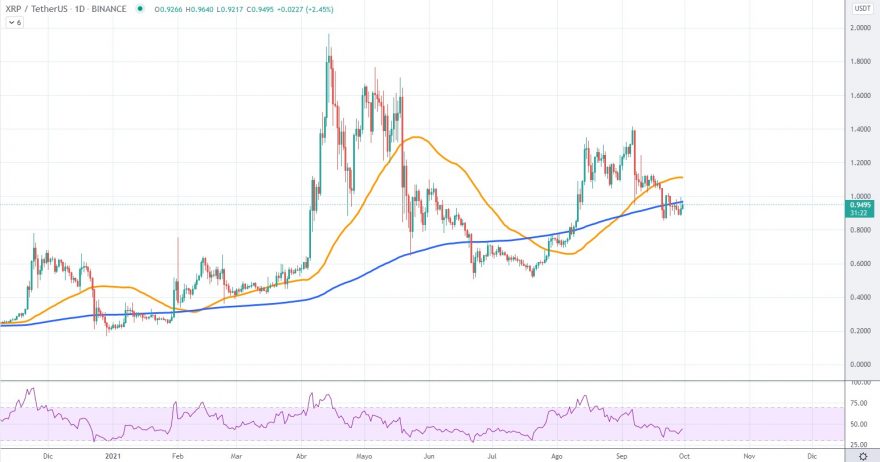
So far, from a broad perspective based on the daily chart, XRP keeps its yearly gains at the end of September above the $0.9000 critical level. This is because XRP was hit hard by the sell-off seen at the start of September, combined with China’s tussles on the regulatory crackdown towards the crypto industry. However, losses were capped by such a psychological area.
XRP Daily Chart
As a result, the 200-day simple moving average has provided dynamic support across the board, and the RSI indicator keeps trending upwards. The next critical resistance levels lie at $1.018 and $1.123. Should the lows from September give up in order to open the doors for further declines toward a critical resistance, now support, placed at around $0.7643.
 The U.S. Commodity Futures Trading Commission (CFTC) has filed a lawsuit against Kucoin, emphasizing the classification of bitcoin, ethereum, and litecoin as commodities. The enforcement action, launched in the U.S. District Court for the Southern District of New York, accuses Kucoin of multiple regulatory breaches involving these digital assets. Kucoin’s Legal Battles Shine a Bright […]