Coming up onWednesday is the first instalment of the Invest Shariah Dialogue Series 2022, an annual four-part series organized by Bursa Malaysia that provides a platform for industry experts to discuss the Islamic capital market and Shariah investing-related topics.
Dubai-based Khalid Howladar will speak on the topic of Millenials and Gen Z: Embracing the Future of Investing. Howladar is Chairman of the Advisory Board at MRHB.Network, a landmark DeFi project in Islamic Finance, offering halal and ethical decentralized finance solutions.
Talking points include:
The debate on whether crypto is halal vs haram and whether the next generation should participate or avoid this space, Millennials and Gen Z being the biggest adopters of crypto, a sector now worth about US$2 trillion
The opportunities and use cases of decentralized finance (DeFi) and its role — if any — in Islamic finance and supporting sustainability goals.
Clarity on these terms — blockchain and cryptocurrencies. Is there a misconception on these digital innovations — do they have any value or are they just pure speculation.
How MRHB is raising the bar on safe investing amongst Millenials and Gen Z and how the platform is envisaged to create future investment opportunities.
About MRHB DeFi
MRHB (pronounced ‘Marhaba’) DeFi is a decentralised finance platform built to bring ethics to the DeFi space with an approach that supports the inclusion of faith-based and other excluded communities in addition to existing crypto-natives so that everyone can benefit from the full empowerment potential of DeFi to help build a true peer-to-peer financial and economic value system.
Based on the tenets of blockchain such as trust, transparency, and security, MRHB DeFi has encapsulated universally applicable principles of Islamic Finance into those tenets of blockchain to render a suite of offerings that are also ESG compliant.
The project is backed by a diverse and strong team with backgrounds spanning crypto, technology, faith-compliant investing, finance and seasoned institutional veterans of industry.
MRHB DeFi Official Channels
Website | Twitter | Telegram Chat | Telegram Announcements | Medium | Documents | Facebook | LinkedIn | Telegram Arabic Community | Russian Community | Turkish Community |Persian Community | Urdu/Hindi Community
YouGov’s latest survey released on Monday indicates that digital banking has become increasingly popular in Saudi Arabia. According to the survey, nine out of ten respondents (91%) say that they prefer online banking. Furthermore, 86% of respondents have even shown intention to switch to digital-only banking methods in the future.
The data from YouGov’s latest survey indicates that in Saudi Arabia, crypto coins have generated a significant amount of awareness. More than three-quarters of residents (77%) claim to be aware of the new asset class.
Although awareness about cryptocurrency is high, only 18% currently trade in such assets. Young adults between 25-34 years is the main group dealing in cryptocurrencies
Cryptocurrencies
By using cryptography, virtual currencies, known as cryptocurrencies, are nearly counterfeit-proof digital currencies that are built on blockchain technology. Comprised of decentralized networks, blockchain technology is not overseen by a central authority.Therefore, cryptocurrencies function in a decentralized nature which theoretically makes them immune to government interference. The term, cryptocurrency derives from the origin of the encryption techniques that are employed to secure the networks which are used to authenticate blockchain technology. Cryptocurrencies can be thought of as systems that accept online payments which are denoted as “tokens.” Tokens are represented as internal ledger entries in blockchain technology while the term crypto is used to depict cryptographic methods and encryption algorithms such as public-private key pairs, various hashing functions, and an elliptical curve. Every cryptocurrency transaction that occurs is logged in a web-based ledger with blockchain technology.These then must be approved by a disparate network of individual nodes (computers that maintain a copy of the ledger). For every new block generated, the block must first be authenticated and confirmed ‘approved’ by each node, which makes forging the transactional history of cryptocurrencies nearly impossible. The World’s First CryptoBitcoin became the first blockchain-based cryptocurrency and to this day is still the most demanded cryptocurrency and the most valued. Bitcoin still contributes the majority of the overall cryptocurrency market volume, though several other cryptos have grown in popularity in recent years.Indeed, out of the wake of Bitcoin, iterations of Bitcoin became prevalent which resulted in a multitude of newly created or cloned cryptocurrencies. Contending cryptocurrencies that emerged after Bitcoin’s success is referred to as ‘altcoins’ and they refer to cryptocurrencies such as Bitcoin, Peercoin, Namecoin, Ethereum, Ripple, Stellar, and Dash. Cryptocurrencies promise a wide range of technological innovations that have yet to be structured into being. Simplified payments between two parties without the need for a middle man is one aspect while leveraging blockchain technology to minimize transaction and processing fees for banks is another. Of course, cryptocurrencies have their disadvantages too. This includes issues of tax evasion, money laundering, and other illicit online activities where anonymity is a dire ingredient in solicitous and fraudulent activities.
By using cryptography, virtual currencies, known as cryptocurrencies, are nearly counterfeit-proof digital currencies that are built on blockchain technology. Comprised of decentralized networks, blockchain technology is not overseen by a central authority.Therefore, cryptocurrencies function in a decentralized nature which theoretically makes them immune to government interference. The term, cryptocurrency derives from the origin of the encryption techniques that are employed to secure the networks which are used to authenticate blockchain technology. Cryptocurrencies can be thought of as systems that accept online payments which are denoted as “tokens.” Tokens are represented as internal ledger entries in blockchain technology while the term crypto is used to depict cryptographic methods and encryption algorithms such as public-private key pairs, various hashing functions, and an elliptical curve. Every cryptocurrency transaction that occurs is logged in a web-based ledger with blockchain technology.These then must be approved by a disparate network of individual nodes (computers that maintain a copy of the ledger). For every new block generated, the block must first be authenticated and confirmed ‘approved’ by each node, which makes forging the transactional history of cryptocurrencies nearly impossible. The World’s First CryptoBitcoin became the first blockchain-based cryptocurrency and to this day is still the most demanded cryptocurrency and the most valued. Bitcoin still contributes the majority of the overall cryptocurrency market volume, though several other cryptos have grown in popularity in recent years.Indeed, out of the wake of Bitcoin, iterations of Bitcoin became prevalent which resulted in a multitude of newly created or cloned cryptocurrencies. Contending cryptocurrencies that emerged after Bitcoin’s success is referred to as ‘altcoins’ and they refer to cryptocurrencies such as Bitcoin, Peercoin, Namecoin, Ethereum, Ripple, Stellar, and Dash. Cryptocurrencies promise a wide range of technological innovations that have yet to be structured into being. Simplified payments between two parties without the need for a middle man is one aspect while leveraging blockchain technology to minimize transaction and processing fees for banks is another. Of course, cryptocurrencies have their disadvantages too. This includes issues of tax evasion, money laundering, and other illicit online activities where anonymity is a dire ingredient in solicitous and fraudulent activities. Read this Term. The survey shows that 25% of young adults are investing in such virtual assets. However, 37% of older adults aged 45+ appears hesitant and don’t intend to deal with such an asset class.
Additionally, the poll shows that the popularity of crypto is among high-income households (earning SAR 30,000+). High-income earners are more likely than others to invest in crypto assets.
Despite the small number of active crypto investors in the country, the future of such digital assets looks promising. More than a third (34%) of the surveyed respondents who are aware of crypto said they intend to invest in them. The idea of investing in the new asset class appears more appealing to men than women (36% vs 30%).
As per the survey, the key motivation for most Saudi Arabian residents, who either invest or intend to invest in crypto, is the easy accessibility of such assets for trading (49%). High returns compared to other investments are the second motivator among these residents (43%). The study shows that 45+ adults have a higher interest in investing in crypto to get higher returns.
Many residents invest in crypto to diversify their portfolio (38%) because they regard it as a secure transparent long-term investment option.
Although people are motivated to invest in cryptos, many others are discouraged from investing in such virtual assets. Almost 2 in 5 Saudi Arabia residents (37%) consider the volatility and instability of the crypto market as the major reason that discourages them from investing. Religious beliefs (15%) and cybersecurity threats (13%) are among other reasons that deter them from investing in such assets.
Ambitions to Become a Fintech Hub
Saudi citizens are ranked third in the Arab world in terms of individuals owning cryptos. There is a total of 453,000 Saudi residents who own this type of digital asset. Egypt ranked first in the Arab world with its population investing in cryptos standing at 1.8 million. Morocco comes in second with 878,000 residents investing in cryptocurrencies.
The fintech sector in Saudi Arabia is booming. In the last few years, Saudi Arabia has expanded its efforts to attract crypto firms. The Saudi Central Bank and Central Bank of the United Arab Emirates have been collaborating together to learn how they can adopt blockchain and digital payments.
Saudi Arabia intends to become an international financial center. Authorities are positioning cryptocurrency to be part of that. Saudi Arabia is positioning itself as a safe harbour for crypto companies. The official stamp of approval is beginning to show results. As a result, big pools of capital are becoming interested in crypto. The nation has witnessed a significant increase in fintech
Fintech
Financial Technology (fintech) is defined as ay technology that is geared towards automating and enhancing the delivery and application of financial services. The origin of the term fintechs can be traced back to the 1990s where it was primarily used as a back-end system technology for renowned financial institutions. However, it has since grown outside the business sector with an increased focus upon consumer services.What Purpose Do Fintechs Serve?The main purpose of fintechs would be to supply a technological service that not only simplifies but also aids consumers, business operators, and networks.This is done by optimizing business processes and financial operations through the implementation of specialized software, algorithms, and automated computing processes. Transitioning from the roots of the financial sector, fintech providers can be found through a multitude of industries such as retail banking, education, cryptocurrencies, insurance, nonprofit, and more. While fintechs cover a vast array of business sectors, it can be broken down into four classifications which are as followed: Business-to-business for banks, Business-to-business for banking business clients, business-to-consumers for small businesses, and consumers. More recently, fintechs presence has become increasingly apparent within the trading sector, primarily for cryptocurrencies and blockchain technology.The creation and use of Bitcoin can also be contributed to innovations brought upon by fintechs while smart contracts through blockchain technology have simplified and automated contracts between buyers and sellers. As a whole, fintechs applications are growing more diverse with a consumer-centric focus while its applications continue to innovate the trading and cryptocurrency sectors through automated technologies and business practices.
Financial Technology (fintech) is defined as ay technology that is geared towards automating and enhancing the delivery and application of financial services. The origin of the term fintechs can be traced back to the 1990s where it was primarily used as a back-end system technology for renowned financial institutions. However, it has since grown outside the business sector with an increased focus upon consumer services.What Purpose Do Fintechs Serve?The main purpose of fintechs would be to supply a technological service that not only simplifies but also aids consumers, business operators, and networks.This is done by optimizing business processes and financial operations through the implementation of specialized software, algorithms, and automated computing processes. Transitioning from the roots of the financial sector, fintech providers can be found through a multitude of industries such as retail banking, education, cryptocurrencies, insurance, nonprofit, and more. While fintechs cover a vast array of business sectors, it can be broken down into four classifications which are as followed: Business-to-business for banks, Business-to-business for banking business clients, business-to-consumers for small businesses, and consumers. More recently, fintechs presence has become increasingly apparent within the trading sector, primarily for cryptocurrencies and blockchain technology.The creation and use of Bitcoin can also be contributed to innovations brought upon by fintechs while smart contracts through blockchain technology have simplified and automated contracts between buyers and sellers. As a whole, fintechs applications are growing more diverse with a consumer-centric focus while its applications continue to innovate the trading and cryptocurrency sectors through automated technologies and business practices. Read this Term-related activities in the last 12 months.
In Saudi Arabia, the emphasis on cryptocurrency is part of the nation’s Saudi Vision 2030, which aims to diversify the economy and make the nation a hub of innovation.
YouGov’s latest survey released on Monday indicates that digital banking has become increasingly popular in Saudi Arabia. According to the survey, nine out of ten respondents (91%) say that they prefer online banking. Furthermore, 86% of respondents have even shown intention to switch to digital-only banking methods in the future.
The data from YouGov’s latest survey indicates that in Saudi Arabia, crypto coins have generated a significant amount of awareness. More than three-quarters of residents (77%) claim to be aware of the new asset class.
Although awareness about cryptocurrency is high, only 18% currently trade in such assets. Young adults between 25-34 years is the main group dealing in cryptocurrencies
Cryptocurrencies
By using cryptography, virtual currencies, known as cryptocurrencies, are nearly counterfeit-proof digital currencies that are built on blockchain technology. Comprised of decentralized networks, blockchain technology is not overseen by a central authority.Therefore, cryptocurrencies function in a decentralized nature which theoretically makes them immune to government interference. The term, cryptocurrency derives from the origin of the encryption techniques that are employed to secure the networks which are used to authenticate blockchain technology. Cryptocurrencies can be thought of as systems that accept online payments which are denoted as “tokens.” Tokens are represented as internal ledger entries in blockchain technology while the term crypto is used to depict cryptographic methods and encryption algorithms such as public-private key pairs, various hashing functions, and an elliptical curve. Every cryptocurrency transaction that occurs is logged in a web-based ledger with blockchain technology.These then must be approved by a disparate network of individual nodes (computers that maintain a copy of the ledger). For every new block generated, the block must first be authenticated and confirmed ‘approved’ by each node, which makes forging the transactional history of cryptocurrencies nearly impossible. The World’s First CryptoBitcoin became the first blockchain-based cryptocurrency and to this day is still the most demanded cryptocurrency and the most valued. Bitcoin still contributes the majority of the overall cryptocurrency market volume, though several other cryptos have grown in popularity in recent years.Indeed, out of the wake of Bitcoin, iterations of Bitcoin became prevalent which resulted in a multitude of newly created or cloned cryptocurrencies. Contending cryptocurrencies that emerged after Bitcoin’s success is referred to as ‘altcoins’ and they refer to cryptocurrencies such as Bitcoin, Peercoin, Namecoin, Ethereum, Ripple, Stellar, and Dash. Cryptocurrencies promise a wide range of technological innovations that have yet to be structured into being. Simplified payments between two parties without the need for a middle man is one aspect while leveraging blockchain technology to minimize transaction and processing fees for banks is another. Of course, cryptocurrencies have their disadvantages too. This includes issues of tax evasion, money laundering, and other illicit online activities where anonymity is a dire ingredient in solicitous and fraudulent activities.
By using cryptography, virtual currencies, known as cryptocurrencies, are nearly counterfeit-proof digital currencies that are built on blockchain technology. Comprised of decentralized networks, blockchain technology is not overseen by a central authority.Therefore, cryptocurrencies function in a decentralized nature which theoretically makes them immune to government interference. The term, cryptocurrency derives from the origin of the encryption techniques that are employed to secure the networks which are used to authenticate blockchain technology. Cryptocurrencies can be thought of as systems that accept online payments which are denoted as “tokens.” Tokens are represented as internal ledger entries in blockchain technology while the term crypto is used to depict cryptographic methods and encryption algorithms such as public-private key pairs, various hashing functions, and an elliptical curve. Every cryptocurrency transaction that occurs is logged in a web-based ledger with blockchain technology.These then must be approved by a disparate network of individual nodes (computers that maintain a copy of the ledger). For every new block generated, the block must first be authenticated and confirmed ‘approved’ by each node, which makes forging the transactional history of cryptocurrencies nearly impossible. The World’s First CryptoBitcoin became the first blockchain-based cryptocurrency and to this day is still the most demanded cryptocurrency and the most valued. Bitcoin still contributes the majority of the overall cryptocurrency market volume, though several other cryptos have grown in popularity in recent years.Indeed, out of the wake of Bitcoin, iterations of Bitcoin became prevalent which resulted in a multitude of newly created or cloned cryptocurrencies. Contending cryptocurrencies that emerged after Bitcoin’s success is referred to as ‘altcoins’ and they refer to cryptocurrencies such as Bitcoin, Peercoin, Namecoin, Ethereum, Ripple, Stellar, and Dash. Cryptocurrencies promise a wide range of technological innovations that have yet to be structured into being. Simplified payments between two parties without the need for a middle man is one aspect while leveraging blockchain technology to minimize transaction and processing fees for banks is another. Of course, cryptocurrencies have their disadvantages too. This includes issues of tax evasion, money laundering, and other illicit online activities where anonymity is a dire ingredient in solicitous and fraudulent activities. Read this Term. The survey shows that 25% of young adults are investing in such virtual assets. However, 37% of older adults aged 45+ appears hesitant and don’t intend to deal with such an asset class.
Additionally, the poll shows that the popularity of crypto is among high-income households (earning SAR 30,000+). High-income earners are more likely than others to invest in crypto assets.
Despite the small number of active crypto investors in the country, the future of such digital assets looks promising. More than a third (34%) of the surveyed respondents who are aware of crypto said they intend to invest in them. The idea of investing in the new asset class appears more appealing to men than women (36% vs 30%).
As per the survey, the key motivation for most Saudi Arabian residents, who either invest or intend to invest in crypto, is the easy accessibility of such assets for trading (49%). High returns compared to other investments are the second motivator among these residents (43%). The study shows that 45+ adults have a higher interest in investing in crypto to get higher returns.
Many residents invest in crypto to diversify their portfolio (38%) because they regard it as a secure transparent long-term investment option.
Although people are motivated to invest in cryptos, many others are discouraged from investing in such virtual assets. Almost 2 in 5 Saudi Arabia residents (37%) consider the volatility and instability of the crypto market as the major reason that discourages them from investing. Religious beliefs (15%) and cybersecurity threats (13%) are among other reasons that deter them from investing in such assets.
Ambitions to Become a Fintech Hub
Saudi citizens are ranked third in the Arab world in terms of individuals owning cryptos. There is a total of 453,000 Saudi residents who own this type of digital asset. Egypt ranked first in the Arab world with its population investing in cryptos standing at 1.8 million. Morocco comes in second with 878,000 residents investing in cryptocurrencies.
The fintech sector in Saudi Arabia is booming. In the last few years, Saudi Arabia has expanded its efforts to attract crypto firms. The Saudi Central Bank and Central Bank of the United Arab Emirates have been collaborating together to learn how they can adopt blockchain and digital payments.
Saudi Arabia intends to become an international financial center. Authorities are positioning cryptocurrency to be part of that. Saudi Arabia is positioning itself as a safe harbour for crypto companies. The official stamp of approval is beginning to show results. As a result, big pools of capital are becoming interested in crypto. The nation has witnessed a significant increase in fintech
Fintech
Financial Technology (fintech) is defined as ay technology that is geared towards automating and enhancing the delivery and application of financial services. The origin of the term fintechs can be traced back to the 1990s where it was primarily used as a back-end system technology for renowned financial institutions. However, it has since grown outside the business sector with an increased focus upon consumer services.What Purpose Do Fintechs Serve?The main purpose of fintechs would be to supply a technological service that not only simplifies but also aids consumers, business operators, and networks.This is done by optimizing business processes and financial operations through the implementation of specialized software, algorithms, and automated computing processes. Transitioning from the roots of the financial sector, fintech providers can be found through a multitude of industries such as retail banking, education, cryptocurrencies, insurance, nonprofit, and more. While fintechs cover a vast array of business sectors, it can be broken down into four classifications which are as followed: Business-to-business for banks, Business-to-business for banking business clients, business-to-consumers for small businesses, and consumers. More recently, fintechs presence has become increasingly apparent within the trading sector, primarily for cryptocurrencies and blockchain technology.The creation and use of Bitcoin can also be contributed to innovations brought upon by fintechs while smart contracts through blockchain technology have simplified and automated contracts between buyers and sellers. As a whole, fintechs applications are growing more diverse with a consumer-centric focus while its applications continue to innovate the trading and cryptocurrency sectors through automated technologies and business practices.
Financial Technology (fintech) is defined as ay technology that is geared towards automating and enhancing the delivery and application of financial services. The origin of the term fintechs can be traced back to the 1990s where it was primarily used as a back-end system technology for renowned financial institutions. However, it has since grown outside the business sector with an increased focus upon consumer services.What Purpose Do Fintechs Serve?The main purpose of fintechs would be to supply a technological service that not only simplifies but also aids consumers, business operators, and networks.This is done by optimizing business processes and financial operations through the implementation of specialized software, algorithms, and automated computing processes. Transitioning from the roots of the financial sector, fintech providers can be found through a multitude of industries such as retail banking, education, cryptocurrencies, insurance, nonprofit, and more. While fintechs cover a vast array of business sectors, it can be broken down into four classifications which are as followed: Business-to-business for banks, Business-to-business for banking business clients, business-to-consumers for small businesses, and consumers. More recently, fintechs presence has become increasingly apparent within the trading sector, primarily for cryptocurrencies and blockchain technology.The creation and use of Bitcoin can also be contributed to innovations brought upon by fintechs while smart contracts through blockchain technology have simplified and automated contracts between buyers and sellers. As a whole, fintechs applications are growing more diverse with a consumer-centric focus while its applications continue to innovate the trading and cryptocurrency sectors through automated technologies and business practices. Read this Term-related activities in the last 12 months.
In Saudi Arabia, the emphasis on cryptocurrency is part of the nation’s Saudi Vision 2030, which aims to diversify the economy and make the nation a hub of innovation.
cryptocurrency exchange
Cryptocurrency Exchange
A cryptocurrency exchange is an online platform that supports the exchange of various currencies for a cryptocurrency or digital asset.Comparable to a generalized financial exchange, a crypto exchange’s core function is to permit and encourage the buying and selling of cryptos.This is accomplished by producing a stable trading environment suitable for traders nested through different locations around the world. Sometimes a crypto exchange may be referred to as a digital currency exchange (DCE) for short.How Does Trading Take Place on a Crypto Exchange?Cryptocurrency trading occurs over a centralized exchange, although these crypto exchanges should be used with caution given the implications that surround the custody of new assets. Similar to the banking industry, when a crypto exchange holds cryptocurrencies of users they accrue interest and are no longer classified as client money.These provide an accessible platform for not only companies, hedge funds, and retail traders for exchanging digital currencies.Additionally, crypto exchanges serve a critical role in producing stability within the cryptocurrency sector given how the sourcing and pricing of these assets are innately volatile. One could think of a crypto exchange as an intermediary who provides a service by connecting buyers and sellers from various markets under one roof. In exchange for facilitating trades and for services rendered, a digital currency exchange generally collects a fee of an outgoing transaction that averages between 0.20% to 0.25% or will request a deposit fee that has been known to be as high as 11% for credit card deposits. Crypto exchanges may also support the exchange of crypto tokens, such as the Binance Token, which is ranked as the 9th most valuable cryptocurrency in the world.
A cryptocurrency exchange is an online platform that supports the exchange of various currencies for a cryptocurrency or digital asset.Comparable to a generalized financial exchange, a crypto exchange’s core function is to permit and encourage the buying and selling of cryptos.This is accomplished by producing a stable trading environment suitable for traders nested through different locations around the world. Sometimes a crypto exchange may be referred to as a digital currency exchange (DCE) for short.How Does Trading Take Place on a Crypto Exchange?Cryptocurrency trading occurs over a centralized exchange, although these crypto exchanges should be used with caution given the implications that surround the custody of new assets. Similar to the banking industry, when a crypto exchange holds cryptocurrencies of users they accrue interest and are no longer classified as client money.These provide an accessible platform for not only companies, hedge funds, and retail traders for exchanging digital currencies.Additionally, crypto exchanges serve a critical role in producing stability within the cryptocurrency sector given how the sourcing and pricing of these assets are innately volatile. One could think of a crypto exchange as an intermediary who provides a service by connecting buyers and sellers from various markets under one roof. In exchange for facilitating trades and for services rendered, a digital currency exchange generally collects a fee of an outgoing transaction that averages between 0.20% to 0.25% or will request a deposit fee that has been known to be as high as 11% for credit card deposits. Crypto exchanges may also support the exchange of crypto tokens, such as the Binance Token, which is ranked as the 9th most valuable cryptocurrency in the world. Read this Term led by Sam Bankman-Fried, announced a launch of a new venture capital business unit called FTX Ventures. According to the Wall Street Journal media outlets, the exchange has pumped $2 billion fund into the new capital unit to focus on investing in crypto-industry startups. The allocation makes the FTX Ventures’ fund as one of the largest venture capitals in the crypto industry. FTX exchange disclosed that the $2 billion venture fund will be led by Amy Wu, a former General Partner at $10 billion venture capital firm Lightspeed.
As per FTX exchange, the FTX Ventures will majorly focus on
blockchain
Blockchain
Blockchain comprises a digital network of blocks with a comprehensive ledger of transactions made in a cryptocurrency such as Bitcoin or other altcoins.One of the signature features of blockchain is that it is maintained across more than one computer. The ledger can be public or private (permissioned.) In this sense, blockchain is immune to the manipulation of data making it not only open but verifiable. Because a blockchain is stored across a network of computers, it is very difficult to tamper with. The Evolution of BlockchainBlockchain was originally invented by an individual or group of people under the name of Satoshi Nakamoto in 2008. The purpose of blockchain was originally to serve as the public transaction ledger of Bitcoin, the world’s first cryptocurrency.In particular, bundles of transaction data, called “blocks”, are added to the ledger in a chronological fashion, forming a “chain.” These blocks include things like date, time, dollar amount, and (in some cases) the public addresses of the sender and the receiver.The computers responsible for upholding a blockchain network are called “nodes.” These nodes carry out the duties necessary to confirm the transactions and add them to the ledger. In exchange for their work, the nodes receive rewards in the form of crypto tokens.By storing data via a peer-to-peer network (P2P), blockchain controls for a wide range of risks that are traditionally inherent with data being held centrally.Of note, P2P blockchain networks lack centralized points of vulnerability. Consequently, hackers cannot exploit these networks via normalized means nor does the network possess a central failure point.In order to hack or alter a blockchain’s ledger, more than half of the nodes must be compromised. Looking ahead, blockchain technology is an area of extensive research across multiple industries, including financial services and payments, among others.
Blockchain comprises a digital network of blocks with a comprehensive ledger of transactions made in a cryptocurrency such as Bitcoin or other altcoins.One of the signature features of blockchain is that it is maintained across more than one computer. The ledger can be public or private (permissioned.) In this sense, blockchain is immune to the manipulation of data making it not only open but verifiable. Because a blockchain is stored across a network of computers, it is very difficult to tamper with. The Evolution of BlockchainBlockchain was originally invented by an individual or group of people under the name of Satoshi Nakamoto in 2008. The purpose of blockchain was originally to serve as the public transaction ledger of Bitcoin, the world’s first cryptocurrency.In particular, bundles of transaction data, called “blocks”, are added to the ledger in a chronological fashion, forming a “chain.” These blocks include things like date, time, dollar amount, and (in some cases) the public addresses of the sender and the receiver.The computers responsible for upholding a blockchain network are called “nodes.” These nodes carry out the duties necessary to confirm the transactions and add them to the ledger. In exchange for their work, the nodes receive rewards in the form of crypto tokens.By storing data via a peer-to-peer network (P2P), blockchain controls for a wide range of risks that are traditionally inherent with data being held centrally.Of note, P2P blockchain networks lack centralized points of vulnerability. Consequently, hackers cannot exploit these networks via normalized means nor does the network possess a central failure point.In order to hack or alter a blockchain’s ledger, more than half of the nodes must be compromised. Looking ahead, blockchain technology is an area of extensive research across multiple industries, including financial services and payments, among others. Read this Term and cryptocurrency investments. Wu talked about the development and stated that the fund will make strategic concentrated bets into companies in the crypto market, from Latin America, Africa, and beyond. She said that FTX Ventures is especially excited about consumer and social web3 as well as Web3 gaming applications. She further mentioned that the venture firm also targets layer-1 and layer-2 blockchain platforms, blockchain infrastructure, cross-chain protocols, crypto-fueled and NFT-powered video games, and wallet payment applications.
“It’s not necessarily tied to the strategy of FTX. The objective is more to accelerate the adoption of blockchain technology. We want to be known for the value add that we bring, leveraging the resources, the expertise and the global network of FTX,” Wu elaborated.
Why Crypto Startups Are Attracting Venture Capital Money
The development by FTX cryptocurrency exchange to have launched its FTX Ventures’ fund comes at a time when the crypto and blockchain space sees a lot of interest from venture capital companies. Such interests translated into a significant amount of investments made in the space during the year 2021. Startups in the crypto and blockchain sector have become winners in the category of record-breaking fundraising. Venture capitalists bet big in cryptocurrency in the previous year, investing more cash than ever into emerging companies in the sector. Startups in the blockchain and crypto space were powered by a record $33 billion in ventral capital funding last year. That can be compared with the year 2020, which saw venture funding of about $3.1 billion.
In 2021, about 43% of crypto funding went into firms involved in lending, investing, exchange services, and trading of cryptocurrencies. Meanwhile, 17% was channeled towards startups in Metaverse (a network of 3D virtual worlds), Web3 (a decentralized online ecosystem based on the blockchain), DAOs (decentralized autonomous organizations), and FTs (non-fungible tokens). Other categories that also attracted significant venture capital interest include decentralized finance, infrastructure, and custody.
Crypto startups have become so profitable that they have begun attracting growth-stage capital. In the previous year, major crypto funds such as Hivemind, a16z, and Paradigm managed to raise billions of dollars to bet in crypto and blockchain startups.
On January 14, FTX, a popular Bahamian-based
cryptocurrency exchange
Cryptocurrency Exchange
A cryptocurrency exchange is an online platform that supports the exchange of various currencies for a cryptocurrency or digital asset.Comparable to a generalized financial exchange, a crypto exchange’s core function is to permit and encourage the buying and selling of cryptos.This is accomplished by producing a stable trading environment suitable for traders nested through different locations around the world. Sometimes a crypto exchange may be referred to as a digital currency exchange (DCE) for short.How Does Trading Take Place on a Crypto Exchange?Cryptocurrency trading occurs over a centralized exchange, although these crypto exchanges should be used with caution given the implications that surround the custody of new assets. Similar to the banking industry, when a crypto exchange holds cryptocurrencies of users they accrue interest and are no longer classified as client money.These provide an accessible platform for not only companies, hedge funds, and retail traders for exchanging digital currencies.Additionally, crypto exchanges serve a critical role in producing stability within the cryptocurrency sector given how the sourcing and pricing of these assets are innately volatile. One could think of a crypto exchange as an intermediary who provides a service by connecting buyers and sellers from various markets under one roof. In exchange for facilitating trades and for services rendered, a digital currency exchange generally collects a fee of an outgoing transaction that averages between 0.20% to 0.25% or will request a deposit fee that has been known to be as high as 11% for credit card deposits. Crypto exchanges may also support the exchange of crypto tokens, such as the Binance Token, which is ranked as the 9th most valuable cryptocurrency in the world.
A cryptocurrency exchange is an online platform that supports the exchange of various currencies for a cryptocurrency or digital asset.Comparable to a generalized financial exchange, a crypto exchange’s core function is to permit and encourage the buying and selling of cryptos.This is accomplished by producing a stable trading environment suitable for traders nested through different locations around the world. Sometimes a crypto exchange may be referred to as a digital currency exchange (DCE) for short.How Does Trading Take Place on a Crypto Exchange?Cryptocurrency trading occurs over a centralized exchange, although these crypto exchanges should be used with caution given the implications that surround the custody of new assets. Similar to the banking industry, when a crypto exchange holds cryptocurrencies of users they accrue interest and are no longer classified as client money.These provide an accessible platform for not only companies, hedge funds, and retail traders for exchanging digital currencies.Additionally, crypto exchanges serve a critical role in producing stability within the cryptocurrency sector given how the sourcing and pricing of these assets are innately volatile. One could think of a crypto exchange as an intermediary who provides a service by connecting buyers and sellers from various markets under one roof. In exchange for facilitating trades and for services rendered, a digital currency exchange generally collects a fee of an outgoing transaction that averages between 0.20% to 0.25% or will request a deposit fee that has been known to be as high as 11% for credit card deposits. Crypto exchanges may also support the exchange of crypto tokens, such as the Binance Token, which is ranked as the 9th most valuable cryptocurrency in the world. Read this Term led by Sam Bankman-Fried, announced a launch of a new venture capital business unit called FTX Ventures. According to the Wall Street Journal media outlets, the exchange has pumped $2 billion fund into the new capital unit to focus on investing in crypto-industry startups. The allocation makes the FTX Ventures’ fund as one of the largest venture capitals in the crypto industry. FTX exchange disclosed that the $2 billion venture fund will be led by Amy Wu, a former General Partner at $10 billion venture capital firm Lightspeed.
As per FTX exchange, the FTX Ventures will majorly focus on
blockchain
Blockchain
Blockchain comprises a digital network of blocks with a comprehensive ledger of transactions made in a cryptocurrency such as Bitcoin or other altcoins.One of the signature features of blockchain is that it is maintained across more than one computer. The ledger can be public or private (permissioned.) In this sense, blockchain is immune to the manipulation of data making it not only open but verifiable. Because a blockchain is stored across a network of computers, it is very difficult to tamper with. The Evolution of BlockchainBlockchain was originally invented by an individual or group of people under the name of Satoshi Nakamoto in 2008. The purpose of blockchain was originally to serve as the public transaction ledger of Bitcoin, the world’s first cryptocurrency.In particular, bundles of transaction data, called “blocks”, are added to the ledger in a chronological fashion, forming a “chain.” These blocks include things like date, time, dollar amount, and (in some cases) the public addresses of the sender and the receiver.The computers responsible for upholding a blockchain network are called “nodes.” These nodes carry out the duties necessary to confirm the transactions and add them to the ledger. In exchange for their work, the nodes receive rewards in the form of crypto tokens.By storing data via a peer-to-peer network (P2P), blockchain controls for a wide range of risks that are traditionally inherent with data being held centrally.Of note, P2P blockchain networks lack centralized points of vulnerability. Consequently, hackers cannot exploit these networks via normalized means nor does the network possess a central failure point.In order to hack or alter a blockchain’s ledger, more than half of the nodes must be compromised. Looking ahead, blockchain technology is an area of extensive research across multiple industries, including financial services and payments, among others.
Blockchain comprises a digital network of blocks with a comprehensive ledger of transactions made in a cryptocurrency such as Bitcoin or other altcoins.One of the signature features of blockchain is that it is maintained across more than one computer. The ledger can be public or private (permissioned.) In this sense, blockchain is immune to the manipulation of data making it not only open but verifiable. Because a blockchain is stored across a network of computers, it is very difficult to tamper with. The Evolution of BlockchainBlockchain was originally invented by an individual or group of people under the name of Satoshi Nakamoto in 2008. The purpose of blockchain was originally to serve as the public transaction ledger of Bitcoin, the world’s first cryptocurrency.In particular, bundles of transaction data, called “blocks”, are added to the ledger in a chronological fashion, forming a “chain.” These blocks include things like date, time, dollar amount, and (in some cases) the public addresses of the sender and the receiver.The computers responsible for upholding a blockchain network are called “nodes.” These nodes carry out the duties necessary to confirm the transactions and add them to the ledger. In exchange for their work, the nodes receive rewards in the form of crypto tokens.By storing data via a peer-to-peer network (P2P), blockchain controls for a wide range of risks that are traditionally inherent with data being held centrally.Of note, P2P blockchain networks lack centralized points of vulnerability. Consequently, hackers cannot exploit these networks via normalized means nor does the network possess a central failure point.In order to hack or alter a blockchain’s ledger, more than half of the nodes must be compromised. Looking ahead, blockchain technology is an area of extensive research across multiple industries, including financial services and payments, among others. Read this Term and cryptocurrency investments. Wu talked about the development and stated that the fund will make strategic concentrated bets into companies in the crypto market, from Latin America, Africa, and beyond. She said that FTX Ventures is especially excited about consumer and social web3 as well as Web3 gaming applications. She further mentioned that the venture firm also targets layer-1 and layer-2 blockchain platforms, blockchain infrastructure, cross-chain protocols, crypto-fueled and NFT-powered video games, and wallet payment applications.
“It’s not necessarily tied to the strategy of FTX. The objective is more to accelerate the adoption of blockchain technology. We want to be known for the value add that we bring, leveraging the resources, the expertise and the global network of FTX,” Wu elaborated.
Why Crypto Startups Are Attracting Venture Capital Money
The development by FTX cryptocurrency exchange to have launched its FTX Ventures’ fund comes at a time when the crypto and blockchain space sees a lot of interest from venture capital companies. Such interests translated into a significant amount of investments made in the space during the year 2021. Startups in the crypto and blockchain sector have become winners in the category of record-breaking fundraising. Venture capitalists bet big in cryptocurrency in the previous year, investing more cash than ever into emerging companies in the sector. Startups in the blockchain and crypto space were powered by a record $33 billion in ventral capital funding last year. That can be compared with the year 2020, which saw venture funding of about $3.1 billion.
In 2021, about 43% of crypto funding went into firms involved in lending, investing, exchange services, and trading of cryptocurrencies. Meanwhile, 17% was channeled towards startups in Metaverse (a network of 3D virtual worlds), Web3 (a decentralized online ecosystem based on the blockchain), DAOs (decentralized autonomous organizations), and FTs (non-fungible tokens). Other categories that also attracted significant venture capital interest include decentralized finance, infrastructure, and custody.
Crypto startups have become so profitable that they have begun attracting growth-stage capital. In the previous year, major crypto funds such as Hivemind, a16z, and Paradigm managed to raise billions of dollars to bet in crypto and blockchain startups.
Decentralized finance (DeFi) has become an increasingly important addition to the Cardano network following the launch of smart contracts capability. Developers have been working since the Alonzo hard fork to bring their DeFi solutions to the ecosystem. But with decentralized finance already underway on blockchains such as Ethereum and Solana, Cardano has had to play catch-up with these other networks.
This is why the recent announcement from EMURGO carries significant connotations for the future of DeFi on the network. EMURGO, which is the commercial arm of the Cardano Foundation, has made moves to help further the growth of decentralized finance solutions on the ecosystem. A $100 million investment is set to be made into the DeFi ecosystem in a big to promote the development and growth of the platform.
Related Reading | Billionaire Mike Novogratz Says He’s “Not Nervous” About Crypto Sell-Off
The $100 million investment in the ecosystem is meant to go towards promoting the network’s capabilities to developers and uses. Although NFTs are now live on the blockchain, decentralized finance is taking a long time as developers need to build and test their protocols before rolling them out to users. Thus making sure that users’ funds in said protocols are safe.
Related Reading | Cardano Summit Sees Launch Of Exciting New Partnerships
DeFi on the network will bring things such as lending and borrowing, yield farming, and more to the ecosystem users, which are built on the smart contracts deployed on the Cardano network. The investment will hopefully help the blockchain carve out a niche for itself in the growing decentralized finance market. Also enabling it to compete with the big dogs such as Ethereum, Solana, and Algorand.
EMURGO Bolsters Cardano-Focused Projects
During the recently concluded Cardano Summit, EMURGO unveiled a number of investments made into Cardano-focused projects around the world. CEO Ken Kodama shared that the company had made strategic investments into projects being developed on the ecosystem. EMURGO participated in seed investments rounds on these projects. To bolster development on the blockchain.
ADA trends low at $2.04 | Source: ADAUSD on TradingView.com
These include Adanian, a tech incubator based in Africa that is focused on startups building on Cardano. Milkomeda, a dcSpark side chain project that bridges Cardano and other Layer 1 blockchain protocols benefitted from EMURGO’s investments. And last but not least, ADAVERSE, also focused on incurring African startups developing their offerings on the ecosystem.
Featured image from The Coin Republic, chart from TradingView.com
Flirt invest is a platform developed by Brandon West to attract investments in cryptocurrency from anyone who wants to invest their funds in the development of Brandon’s webcam studios network.
Due to the niche specifics, the company cannot enter an IPO and become public by placing its shares, so the company chose cryptocurrency so anyone could invest in it. In addition, Brandon West himself is a crypto enthusiast and a fan of bitcoin.
Let’s figure out how to work with it, how much you can earn and answer the most frequent questions about the platform from our readers.
Registration and work on the platform
1) First, you need to register. For that, you should go to the ‘registration’ tab and create an account.
2) After registration, you will be able to log in to your account. Go to the account settings to put your crypto wallets for receiving payments. You don’t have to put every single one, you can put only the wallet, whose blockchain coins you will be investing.
IMPORTANT: the platform pays out funds exactly in those coins in which you made a deposit. For example: If you have invested BTC, you will receive payments in BTC and will be able to withdraw them to a BTC wallet.
3) Go to the ‘make a deposit’ tab, select the payment system, select the tariff of interest and specify the desired investment amount. Click on the ‘make a deposit’ button.
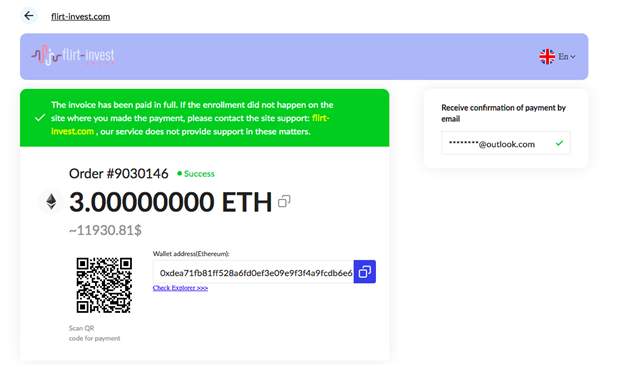
4) After that, you will be redirected to the payment page in the PayKassa merchant. The amount of funds that you’ll need to pay and the wallet for sending the funds will be indicated there. Make sure to send the exact amount that is indicated in the invoice!
5) After receiving 3 confirmations online, you will see that on the invoice payment page. Immediately after that on the Flirt Invest platform, you will see that your deposit has been successfully created. After that, you will be receiving payments every day.
How much will you receive and how much can you earn?
It is important to understand that the initial deposit that you make will be locked for 1 year, but you will be receiving a certain amount every day and will be able to immediately withdraw it or reinvest it back.
It all depends on the amount you are investing. Now the conditions are very favorable, since the company has just started raising funds. Later, the company is planning to reduce the profit for investors. However, the conditions for those who invest now will remain for the whole year.
Let’s figure out how much you can get. The company offers 4 tariffs, with a net profit of 0.5% to 3% per day.
If you invest:
From $100 to $1,000, you will be receiving 0.5% of the invested amount every day. From $1,000 to $10,000, you will be receiving 1% of the invested amount every day. From $10,000 to $50,000, you will be receiving 2% of the invested amount every day. From $50,000 to $250,000, you will be receiving 3% of the invested amount every day.
For example: You invest $12,000 in USDT, that is, 12,000 USDT. That means, that you will be receiving 2% of profit from the initial deposit every day, that is, 240 USDT per day. In 2 months you will earn as much as 14.400 USDT!
You will be able to withdraw a daily payment of 240 USDT immediately or make another deposit and reinvest your profit.
In order to withdraw funds, go to the ‘withdraw funds’ tab, select the payment system, the needed amount and click the ‘withdraw funds’ button. Within a few hours, you will receive a payment to the wallet specified in the account settings.
As you can see, everything is very simple.
In addition to payments from your deposits, you can also participate in the affiliate program and invite your friends or colleagues and receive a bonus of 5% of their deposits. For example: if an invited friend makes a deposit of 1000 USDT, you will receive 50 USDT to your account, which you will also be able to withdraw immediately.
To invite a friend, just send your referral link for registration on the platform to your friend. The link can be found in your personal account.
And now let’s answer the most popular questions:
1) Will the initial deposit be returned after 1 year of freezing? – Yes, after 365 days you will be able to withdraw your initial deposit.
2) Is it possible to exchange coins inside the platform? – No, you strictly get the same coins that you used for the deposit.
3) Are there any restrictions on the amount of deposit? – Yes, one deposit can be made for a maximum amount of $250,000. If you want to invest more, you should make another deposit.
4) Is it possible to make several deposits with different rates? – Yes, the number of deposits is not limited
5) If I invested $500 in the first tariff, and I get 0.5% per day, can I add another $500 and so get 1% from $ 1000? – No, to have 1%, you need to open 1 deposit for $1000 or more. It is not possible to add funds to the current deposit.
6) What are the guarantees that my funds will not be lost? – The rules of the site indicate that the company is fully responsible for the safety of investors’ funds. Flirt Invest also has an authorized capital of 1,000,000 pounds to insure the deposits of its customers.
7) Are there any restrictions on the number of invited friends? – No, the more you invite, the more you will earn. For bloggers, website owners and people with a large audience, the company offers even more favorable terms of the affiliate program.
8) If I have any tech problems with the platform, whom should I contact? – You can write us via the ‘support’ window on the website or send us an email on [email protected]
Conclusions
We hope that after reading this article, you don’t have any questions about the work of the platform. We also hope that you will not miss the chance to take advantage of the current profit percentage that the company offers. As Brandon West mentioned in his recent interview, after receiving the necessary amount, the platform will reduce payments for new investors. After that, the company, according to West, will stop accepting new investors altogether, since it already can develop further due to its own capital.