The Dogecoin open interest has been on the rise over the past few weeks, breaking and setting new all-time highs twice this March. Unsurprisingly, the price of the meme coin has been reflecting the growth seen by its open interest.
This recent bullish momentum pushed the price of DOGE to break the $0.22 mark, its highest point in three years. However, the question is – how far can this rally go for the foremost meme token?
Dogecoin Open Interest Breaks Above $2 Billion
According to data from CoinGlass, the Dogecoin open interest broke through the $2 billion mark on Friday, March 29. Although DOGE’s open interest stands at around 1.96 billion at press time, it rose as high as $2.21 billion on Friday, a new record for the meme coin.
Open interest is a metric that measures the total number of futures or options contracts of a particular cryptocurrency (Dogecoin, in this case) in the market at a given time. It provides insight into the amount of money investors are pouring into DOGE derivatives at this time.
The meme token’s open interest has had quite a performance since the start of March. DOGE’s open interest rose to $1.6 billion (an all-time high at the time) earlier in the month before retracing to below $1 billion by March 20.
It is worth noting that there has been a high correlation between open interest and Dogecoin’s price, with both climbing at the same time and at almost the same pace. Typically, a rising open interest can suggest a continuation of the trend around the asset’s price at the moment.
Ultimately, the current high open interest for DOGE could mean a rapid price movement for the meme coin in the near future. However, it would be difficult to tell the direction in which this spurt of volatility would take the price of Dogecoin, especially as open interest is not the most optimal indicator of trends or price action.
DOGE Price Overview
As of this writing, the Dogecoin price stands at $0.204, reflecting a 4.6% decline in the last 24 hours. While the meme token’s price has somewhat struggled since hitting the three-year high, it has managed to retain most of its profit from the past week.
According to CoinGecko data, the Dogecoin price is up by a whopping 18% in the past seven days. This positive performance has strengthened DOGE’s position as the largest meme coin in the market, with a market capitalization of $29 billion.
Dogecoin price sees slight correction on the daily timeframe | Source: DOGEUSDT chart on TradingView
Featured image from Pexels, chart from TradingView
Disclaimer: The article is provided for educational purposes only. It does not represent the opinions of NewsBTC on whether to buy, sell or hold any investments and naturally investing carries risks. You are advised to conduct your own research before making any investment decisions. Use information provided on this website entirely at your own risk.
Aparna Chennapragada, Chief Product Officer at Robinhood, made some statements about the interest of the trading platform
Trading Platform
In the FX space, a currency trading platform is a software provided by brokers to their respective client base, garnering access as traders in the broader market. Most commonly, this reflects an online interface or mobile app, complete with tools for order processing.Every broker needs one or more trading platforms to accommodate the needs of different clients. Being the backbone of the company’s offering, a trading platform provides clients with quotes, a selection of instruments to trade, real-time updates on quotes, charts and is the main frontend which customers are facing.Brokers either use existing trading platforms and sometimes customize them, or develop their own platform from scratch. Since the beginning of the retail FX trading business MetaQuotes and its platforms MetaTrader 4 (MT4) and MetaTrader 5 (MT5) have been the industry standard, especially when it comes to automated trading.MT4 Shows Resiliency While MT4 has long been seen as ubiquitous amongst brokers’ offerings, a targeted push by MetaQuotes themselves has led to broader adoption of MT5 in recent years. Advanced trading platforms such as MT4 or MT5 also allow access to a wide range of asset classes available for trading.The development of trading platforms over the past decade has failed to successfully dethrone MT4 or MT5, notably in the retail market. However, in institutional markets, brokerage companies and banking entities also construct and utilize proprietary currency trading platforms to help satisfy internal needs with trades executed through institutional trading channels.By far the most important parameter for many retail clients is the optionality and pairs available on trading platforms. Additionally, demand by traders has led to a greater emphasis on newer features such as advanced charting and other tools.
In the FX space, a currency trading platform is a software provided by brokers to their respective client base, garnering access as traders in the broader market. Most commonly, this reflects an online interface or mobile app, complete with tools for order processing.Every broker needs one or more trading platforms to accommodate the needs of different clients. Being the backbone of the company’s offering, a trading platform provides clients with quotes, a selection of instruments to trade, real-time updates on quotes, charts and is the main frontend which customers are facing.Brokers either use existing trading platforms and sometimes customize them, or develop their own platform from scratch. Since the beginning of the retail FX trading business MetaQuotes and its platforms MetaTrader 4 (MT4) and MetaTrader 5 (MT5) have been the industry standard, especially when it comes to automated trading.MT4 Shows Resiliency While MT4 has long been seen as ubiquitous amongst brokers’ offerings, a targeted push by MetaQuotes themselves has led to broader adoption of MT5 in recent years. Advanced trading platforms such as MT4 or MT5 also allow access to a wide range of asset classes available for trading.The development of trading platforms over the past decade has failed to successfully dethrone MT4 or MT5, notably in the retail market. However, in institutional markets, brokerage companies and banking entities also construct and utilize proprietary currency trading platforms to help satisfy internal needs with trades executed through institutional trading channels.By far the most important parameter for many retail clients is the optionality and pairs available on trading platforms. Additionally, demand by traders has led to a greater emphasis on newer features such as advanced charting and other tools. Read this Term towards the non-fungible tokens (NFTs) industry, saying that they’re ‘fascinated.’
In fact, Chennapragada stated that there is ‘a lot of potential’ in using NFTs nowadays that Robinhood spotted. “We absolutely think about NFTs. I have been fascinated by them, and I think that the crypto team is excited. We are always looking at what makes sense here, in terms of products to offer through Robinhood,” she commented in an interview with The Verge.
Robinhood’s CPO, in particular, talked about what Axie has been doing in the NFT industry with the in-game sphere. “The reason I ask about NFTs, in particular, is that when you think about products on smartphones that allow you to transact — where you push a button and spend some money, and then digital goods move around — Robinhood is actually very unique. It does not pay a 30% commission to either of the smartphone platforms, even if you are buying Bitcoin
Bitcoin
Bitcoin is the world’s first digital currency that was created in 2009 by a mysterious entity named Satoshi Nakamoto. As a digital currency or cryptocurrency, Bitcoin operates without a central bank or single administrator. Instead, Bitcoin can be sent via a Peer-to-Peer (P2P) networking, devoid of intermediaries.Bitcoins are not issued or backed by any governments or banks, and Bitcoin is not considered to be legal tender, although they do have status as an acknowledged transfer of value in some jurisdictions. Rather than composing a physical currency, Bitcoins are pieces of code that can be sent and received across a kind of distributed ledger network called a blockchain. Transactions on the Bitcoin network are confirmed by a network of computers (or nodes) that solve a series of complex equations. This process is called mining. In exchange for mining, the computers receive rewards in the form of new Bitcoins. Mining grows increasingly difficult over time, and the rewards get smaller and smaller. There is a total of 21 million Bitcoins. As of May 2020, there are 18.3 million Bitcoins in circulation. This number changes approximately every 10 minutes when new blocks are mined. Presently, each new block adds 12.5 bitcoins into circulation.Since its inception, Bitcoin has remained the most popular and largest cryptocurrency in terms of market cap in the world. Bitcoin’s popularity has contributed significantly to the release of thousands of other cryptocurrencies, called “altcoins.” While the crypto market was originally hegemonic, today’s landscape features countless altcoins.Bitcoin ControversyBitcoin has been extremely controversial since its original launch. Given its mercurial nature, Bitcoin has been criticized for its use in illegal transactions and money laundering.As its impossible to trace, these attributes make Bitcoin the ideal vehicle for illicit behavior. Moreover, critics point to its high electricity consumption for mining, rampant price volatility, and thefts from exchanges. Bitcoin has been seen as a speculative bubble given its lack of oversight. The crypto has weathered multiple collapses and survived over a decade so far. Unlike its launch back in 2009, Bitcoin today is viewed far differently and is much more accepted by merchants and other entities.
Bitcoin is the world’s first digital currency that was created in 2009 by a mysterious entity named Satoshi Nakamoto. As a digital currency or cryptocurrency, Bitcoin operates without a central bank or single administrator. Instead, Bitcoin can be sent via a Peer-to-Peer (P2P) networking, devoid of intermediaries.Bitcoins are not issued or backed by any governments or banks, and Bitcoin is not considered to be legal tender, although they do have status as an acknowledged transfer of value in some jurisdictions. Rather than composing a physical currency, Bitcoins are pieces of code that can be sent and received across a kind of distributed ledger network called a blockchain. Transactions on the Bitcoin network are confirmed by a network of computers (or nodes) that solve a series of complex equations. This process is called mining. In exchange for mining, the computers receive rewards in the form of new Bitcoins. Mining grows increasingly difficult over time, and the rewards get smaller and smaller. There is a total of 21 million Bitcoins. As of May 2020, there are 18.3 million Bitcoins in circulation. This number changes approximately every 10 minutes when new blocks are mined. Presently, each new block adds 12.5 bitcoins into circulation.Since its inception, Bitcoin has remained the most popular and largest cryptocurrency in terms of market cap in the world. Bitcoin’s popularity has contributed significantly to the release of thousands of other cryptocurrencies, called “altcoins.” While the crypto market was originally hegemonic, today’s landscape features countless altcoins.Bitcoin ControversyBitcoin has been extremely controversial since its original launch. Given its mercurial nature, Bitcoin has been criticized for its use in illegal transactions and money laundering.As its impossible to trace, these attributes make Bitcoin the ideal vehicle for illicit behavior. Moreover, critics point to its high electricity consumption for mining, rampant price volatility, and thefts from exchanges. Bitcoin has been seen as a speculative bubble given its lack of oversight. The crypto has weathered multiple collapses and survived over a decade so far. Unlike its launch back in 2009, Bitcoin today is viewed far differently and is much more accepted by merchants and other entities. Read this Term, which is a digital good. Because it’s money. Which is a very philosophical, like you’re dancing on the head of a pin there, that Apple has not said, ‘I want 30%’,” Chennapragada noted.
Moreover, she highlighted that NFTs could be an end in itself in some cases, making them a ‘really fascinating opportunity.’ However, she didn’t specify whether the company plans to launch or not any NFT offerings in the future, but she pointed out the following: “I think, as a team, and a company, we are looking at the space and saying, ‘How can we best participate? What are the customer problems that we can solve?’”
Settlement with Vermont Regulators
Recently, Robinhood reached an agreement to settle $640,000 with Vermont’s financial regulator, DFR, over the platform’s outages and account supervision issues.
Aparna Chennapragada, Chief Product Officer at Robinhood, made some statements about the interest of the trading platform
Trading Platform
In the FX space, a currency trading platform is a software provided by brokers to their respective client base, garnering access as traders in the broader market. Most commonly, this reflects an online interface or mobile app, complete with tools for order processing.Every broker needs one or more trading platforms to accommodate the needs of different clients. Being the backbone of the company’s offering, a trading platform provides clients with quotes, a selection of instruments to trade, real-time updates on quotes, charts and is the main frontend which customers are facing.Brokers either use existing trading platforms and sometimes customize them, or develop their own platform from scratch. Since the beginning of the retail FX trading business MetaQuotes and its platforms MetaTrader 4 (MT4) and MetaTrader 5 (MT5) have been the industry standard, especially when it comes to automated trading.MT4 Shows Resiliency While MT4 has long been seen as ubiquitous amongst brokers’ offerings, a targeted push by MetaQuotes themselves has led to broader adoption of MT5 in recent years. Advanced trading platforms such as MT4 or MT5 also allow access to a wide range of asset classes available for trading.The development of trading platforms over the past decade has failed to successfully dethrone MT4 or MT5, notably in the retail market. However, in institutional markets, brokerage companies and banking entities also construct and utilize proprietary currency trading platforms to help satisfy internal needs with trades executed through institutional trading channels.By far the most important parameter for many retail clients is the optionality and pairs available on trading platforms. Additionally, demand by traders has led to a greater emphasis on newer features such as advanced charting and other tools.
In the FX space, a currency trading platform is a software provided by brokers to their respective client base, garnering access as traders in the broader market. Most commonly, this reflects an online interface or mobile app, complete with tools for order processing.Every broker needs one or more trading platforms to accommodate the needs of different clients. Being the backbone of the company’s offering, a trading platform provides clients with quotes, a selection of instruments to trade, real-time updates on quotes, charts and is the main frontend which customers are facing.Brokers either use existing trading platforms and sometimes customize them, or develop their own platform from scratch. Since the beginning of the retail FX trading business MetaQuotes and its platforms MetaTrader 4 (MT4) and MetaTrader 5 (MT5) have been the industry standard, especially when it comes to automated trading.MT4 Shows Resiliency While MT4 has long been seen as ubiquitous amongst brokers’ offerings, a targeted push by MetaQuotes themselves has led to broader adoption of MT5 in recent years. Advanced trading platforms such as MT4 or MT5 also allow access to a wide range of asset classes available for trading.The development of trading platforms over the past decade has failed to successfully dethrone MT4 or MT5, notably in the retail market. However, in institutional markets, brokerage companies and banking entities also construct and utilize proprietary currency trading platforms to help satisfy internal needs with trades executed through institutional trading channels.By far the most important parameter for many retail clients is the optionality and pairs available on trading platforms. Additionally, demand by traders has led to a greater emphasis on newer features such as advanced charting and other tools. Read this Term towards the non-fungible tokens (NFTs) industry, saying that they’re ‘fascinated.’
In fact, Chennapragada stated that there is ‘a lot of potential’ in using NFTs nowadays that Robinhood spotted. “We absolutely think about NFTs. I have been fascinated by them, and I think that the crypto team is excited. We are always looking at what makes sense here, in terms of products to offer through Robinhood,” she commented in an interview with The Verge.
Robinhood’s CPO, in particular, talked about what Axie has been doing in the NFT industry with the in-game sphere. “The reason I ask about NFTs, in particular, is that when you think about products on smartphones that allow you to transact — where you push a button and spend some money, and then digital goods move around — Robinhood is actually very unique. It does not pay a 30% commission to either of the smartphone platforms, even if you are buying Bitcoin
Bitcoin
Bitcoin is the world’s first digital currency that was created in 2009 by a mysterious entity named Satoshi Nakamoto. As a digital currency or cryptocurrency, Bitcoin operates without a central bank or single administrator. Instead, Bitcoin can be sent via a Peer-to-Peer (P2P) networking, devoid of intermediaries.Bitcoins are not issued or backed by any governments or banks, and Bitcoin is not considered to be legal tender, although they do have status as an acknowledged transfer of value in some jurisdictions. Rather than composing a physical currency, Bitcoins are pieces of code that can be sent and received across a kind of distributed ledger network called a blockchain. Transactions on the Bitcoin network are confirmed by a network of computers (or nodes) that solve a series of complex equations. This process is called mining. In exchange for mining, the computers receive rewards in the form of new Bitcoins. Mining grows increasingly difficult over time, and the rewards get smaller and smaller. There is a total of 21 million Bitcoins. As of May 2020, there are 18.3 million Bitcoins in circulation. This number changes approximately every 10 minutes when new blocks are mined. Presently, each new block adds 12.5 bitcoins into circulation.Since its inception, Bitcoin has remained the most popular and largest cryptocurrency in terms of market cap in the world. Bitcoin’s popularity has contributed significantly to the release of thousands of other cryptocurrencies, called “altcoins.” While the crypto market was originally hegemonic, today’s landscape features countless altcoins.Bitcoin ControversyBitcoin has been extremely controversial since its original launch. Given its mercurial nature, Bitcoin has been criticized for its use in illegal transactions and money laundering.As its impossible to trace, these attributes make Bitcoin the ideal vehicle for illicit behavior. Moreover, critics point to its high electricity consumption for mining, rampant price volatility, and thefts from exchanges. Bitcoin has been seen as a speculative bubble given its lack of oversight. The crypto has weathered multiple collapses and survived over a decade so far. Unlike its launch back in 2009, Bitcoin today is viewed far differently and is much more accepted by merchants and other entities.
Bitcoin is the world’s first digital currency that was created in 2009 by a mysterious entity named Satoshi Nakamoto. As a digital currency or cryptocurrency, Bitcoin operates without a central bank or single administrator. Instead, Bitcoin can be sent via a Peer-to-Peer (P2P) networking, devoid of intermediaries.Bitcoins are not issued or backed by any governments or banks, and Bitcoin is not considered to be legal tender, although they do have status as an acknowledged transfer of value in some jurisdictions. Rather than composing a physical currency, Bitcoins are pieces of code that can be sent and received across a kind of distributed ledger network called a blockchain. Transactions on the Bitcoin network are confirmed by a network of computers (or nodes) that solve a series of complex equations. This process is called mining. In exchange for mining, the computers receive rewards in the form of new Bitcoins. Mining grows increasingly difficult over time, and the rewards get smaller and smaller. There is a total of 21 million Bitcoins. As of May 2020, there are 18.3 million Bitcoins in circulation. This number changes approximately every 10 minutes when new blocks are mined. Presently, each new block adds 12.5 bitcoins into circulation.Since its inception, Bitcoin has remained the most popular and largest cryptocurrency in terms of market cap in the world. Bitcoin’s popularity has contributed significantly to the release of thousands of other cryptocurrencies, called “altcoins.” While the crypto market was originally hegemonic, today’s landscape features countless altcoins.Bitcoin ControversyBitcoin has been extremely controversial since its original launch. Given its mercurial nature, Bitcoin has been criticized for its use in illegal transactions and money laundering.As its impossible to trace, these attributes make Bitcoin the ideal vehicle for illicit behavior. Moreover, critics point to its high electricity consumption for mining, rampant price volatility, and thefts from exchanges. Bitcoin has been seen as a speculative bubble given its lack of oversight. The crypto has weathered multiple collapses and survived over a decade so far. Unlike its launch back in 2009, Bitcoin today is viewed far differently and is much more accepted by merchants and other entities. Read this Term, which is a digital good. Because it’s money. Which is a very philosophical, like you’re dancing on the head of a pin there, that Apple has not said, ‘I want 30%’,” Chennapragada noted.
Moreover, she highlighted that NFTs could be an end in itself in some cases, making them a ‘really fascinating opportunity.’ However, she didn’t specify whether the company plans to launch or not any NFT offerings in the future, but she pointed out the following: “I think, as a team, and a company, we are looking at the space and saying, ‘How can we best participate? What are the customer problems that we can solve?’”
Settlement with Vermont Regulators
Recently, Robinhood reached an agreement to settle $640,000 with Vermont’s financial regulator, DFR, over the platform’s outages and account supervision issues.
With native cross-chain trading and very attractive Bitcoin APYs, Thorwallet offers a user-friendly UI with all the trimmings this Christmas
As we near the end of a spectacularly explosive year for the growth of DeFi and blockchain technology in general, both interest and investment in the industry are at an all-time high. Institutions continue to explore the likes of Bitcoin and Ethereum as major investment assets, but decentralized finance solutions have also becoming major forces to be reckoned with; offering financial inclusion to millions of unbanked people around the world, DeFi products are enabling people everywhere to unlock new and independent sources of income as the global economy continues to struggle with the fallout from COVID-19.
Taking a look into blockchain infrastructure, several popular blockchains have grown both in terms of capabilities and ecosystem size in recent months; THORchain is one such example and, having steadily expanded its reach within the industry, the Cosmos-based blockchain protocol is today the home for an array of exciting projects offering a multitude of crypto and DeFi services.
THORWallet Pushes the Envelope for DeFi 2.0 Products
Amongst many innovative solutions being built on THORchain is THORWallet, a non-custodial wallet that looks to pander to both DeFi power users and mainstream consumers with 2 separate mobile applications available to the public. Both THORWallet products offer feature-rich user experiences and exposure to DeFi, with multi-chain savings accounts, liquidity provision capabilities and synthetic asset trading just some of the many things on offer; the retail targeted app strips away some of the more complex attributes of the THORWallet application but continues to extend access to a large majority of the benefits on offer.
THORWallet has been built to complement THORchain’s cross-chain functionality and users of the THORWallet app are able to swap Layer 1 tokens such as Bitcoin and Ethereum in a completely decentralized manner with no middlemen. This improves massively on swapping options available on many other popular blockchain platforms which offer only wrapped assets, keeping custody of the native assets. By doing this, THORWallet is also able to offer users a way to earn yield on their Bitcoin whilst keeping complete custody of their assets at all times.
Previous Funding and the Upcoming MISO IDO
The THORWallet team successfully raised over $3.4 million during private rounds led by THORchain, Fomocraft, Nine Realms, 0x Ventures and several other leading funds in the blockchain investment space. THORWallet’s native TGT multi-utility token serves a variety of purposes within the THORWallet ecosystem such as node operation and as a tool for gamification and community incentives such as airdrops, as well as unlocking premium features for holders.
Having already concluded the first phase of their public token sale on THORStarter, which sold out in just over one minute, phase 2 of the public token sale will take place on Sushi MISO on December 20th 2021. Token holders are currently able to stake their TGT, with rates for single-sided staking sitting at 800% and 1200% for eth-tgt pooling respectively.
“We are thankful to have received considerable interest and support from both reputable funds and the public and we are excited to open the doors to future THORWallet users with the upcoming MISO IDO. The THORchain ecosystem continues to grow rapidly and we’re proud to be one of the projects driving that growth.” – Marcel Harmann, THORWallet Co-Founder and CEO.
Ethereum has been slowing down on its bullish momentum. The second cryptocurrency by market cap trades at $3,066 with a 4.2% loss in the daily chart.
ETH moving sideways in the daily chart. Source: ETHUSD Tradingview
After two weeks of profits and an incredible rally from the low at $2,000, mostly driven by the implementation of EIP-1559, Ethereum could see some downside in the short term.
The In/Out of the Money Around Price (IOMAP) metric, used to measure the average purchase price of a crypto asset and compared it to its current price, from IntoTheBlock suggests Ethereum sits at “stable support”.
Analyst Ali Martinez shared the chart below and indicated that over 230,000 addresses bought 7,33 million ETH between $2,970 and $3,080. Thus, ETH’s price must hold above these levels to prevent a bearish trend in the short term. Martinez added:
Any downswing below this price range could encourage investors to book profits quickly before their investments go “Out of the Money.”
ETH’s price IOMAP. Source: IntotheBlock via Ali Martinez
One of the key drivers for Ethereum has been institutional adoption that sees great potential in its ecosystem. Additional data provided by Arcane Research suggests adoption is still on the rise with ETH-based derivatives on the rise.
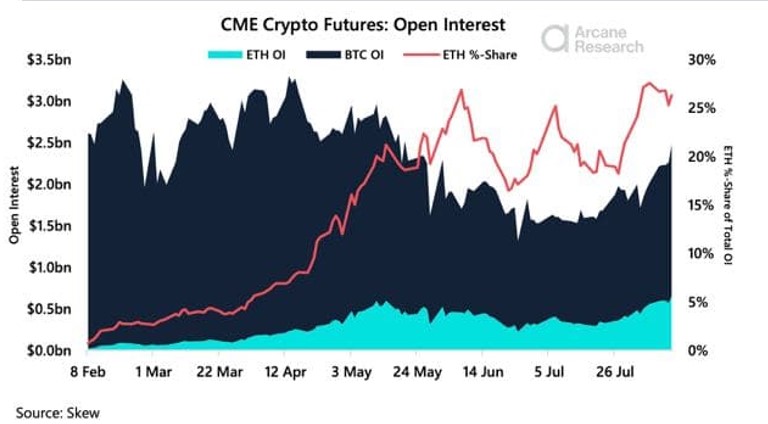
The research firm has recorded an increase in open interest (OI) for Ethereum futures on the Chicago Mercantile Exchange (CME). The ETH trading volumes have been gaining dominance and stand at around 30% of Bitcoin (BTC) and the open interest at 27%.
The OI of CME’s EH futures currently sits at an all-time high of $650 million. The OI of the bitcoin futures sits at $1.8 bn but is down substantially from its Feb 18th peak of $3.3 billion. Ether futures now account for 26.5% of the total OI in CME’s crypto futures.
Source: Arcane Research
Ethereum Takes Market Share Away From Bitcoin
The OI also suggests that institutions are “eagerly” building up their Ethereum (ETH) positions at the moment, Arcane Research said. Most likely, a consequence of the EIP-1559 and the expectations of future appreciation due to the network’s new fee model.
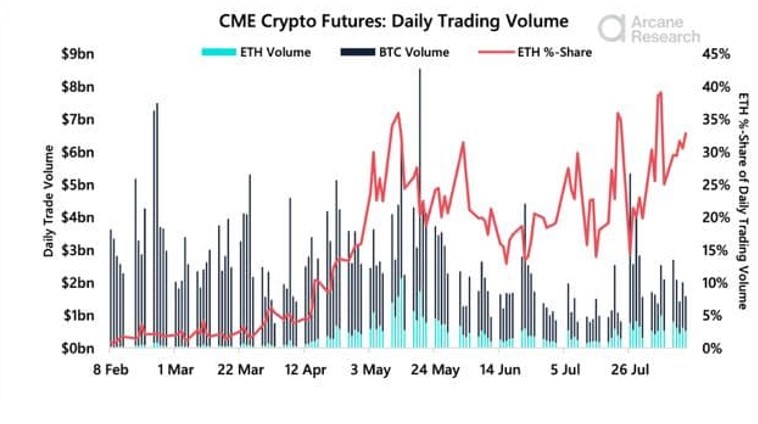
Source: Arcane Research
As the chart shows, ETH futures trading volume has been on a rise since mid-April 12 and only slow down during May and July’s crypto market crash. During this time Ethereum went as low as $1,650 but was able to quickly recover both in price and in the aforementioned metric.
The daily trading volume of the CME ETH futures has also seen a significant uptick in market share recently. On Friday, Aug 13th, the trading volume of the ETH futures accounted for 33% of the total trading volume in CME’s crypto futures. With the increased dominance of the ETH futures and the growing contango, a bullish sentiment around ETH among institutional investors seems to be brewing.