Tag: institutional

  • Crypto.com’s Dubai Entity Cleared for Full Operations in Institutional Trading

    Crypto.com’s Dubai Entity Cleared for Full Operations in Institutional Trading

    [ad_1]

    Crypto.com has received full operational approval from
    the Virtual Assets Regulatory Authority (VARA) for its Dubai entity, CRO
    DAX Middle East FZE. This approval paves the way for the launch of the
    Crypto.com Exchange, a platform targeting institutional investors in the region.

    The VARA’s approval signifies Crypto.com’s
    compliance with the pre-operational conditions outlined in the Virtual Asset
    Service Provider license granted to CRO DAX Middle East FZE in November
    2023. The license allows the crypto exchange to operate in the region with fiat
    capabilities.

    Stuart Isted, the General Manager for Middle East and
    Africa at Crypto.com, mentioned: “We are incredibly supportive of the
    steps Dubai is taking to progress the crypto industry, both in-market and
    abroad. But this is still just the beginning, and we
    look forward to continuing to work closely with VARA in our collective efforts
    to effectively and responsibly advance the sector.”

    Crypto.com Exchange is
    designed for institutions and qualified retail investors. It
    offers a range of services, including spot trading, staking brokerage, and
    over-the-counter offerings in settlements for selected markets.

    According to the press release, the crypto firm plans
    to expand its offerings in the region in the coming months. The expansion
    includes a rollout of the Crypto.com app and other products for retail investors. Last year, Crypto.com secured a Minimal Viable Product
    (MVP) Preparatory license from the VARA. This license followed a provisional
    approval previously obtained by the crypto exchange.

    Dubai’s Crypto Regulatory Landscape

    Established under the Dubai Virtual Asset Regulation
    Law, VARA has been instrumental in positioning Dubai as a burgeoning global
    crypto hub. The authority aims to foster a robust ecosystem for virtual assets,
    attracting key players into the region.

    With the issuance of the MVP Preparatory license,
    Crypto.com joins the ranks of prominent crypto exchanges with the capability to
    offer a spectrum of crypto products and services, including spot and
    derivatives instruments for virtual assets. Besides that, Crypto.com has obtained licenses in
    major markets, including the United Kingdom, France, Italy, and Brazil.

    Meanwhile, Crypto.com recently unveiled plans to launch a specialized trading platform exclusively for Korean users. Scheduled for release on April 29, 2024, the platform aims to cater to the unique preferences and needs of Korean investors. The firm emphasized Korea’s cultural influence and the adoption of new technologies as key factors driving this initiative.

    Crypto.com has received full operational approval from
    the Virtual Assets Regulatory Authority (VARA) for its Dubai entity, CRO
    DAX Middle East FZE. This approval paves the way for the launch of the
    Crypto.com Exchange, a platform targeting institutional investors in the region.

    The VARA’s approval signifies Crypto.com’s
    compliance with the pre-operational conditions outlined in the Virtual Asset
    Service Provider license granted to CRO DAX Middle East FZE in November
    2023. The license allows the crypto exchange to operate in the region with fiat
    capabilities.

    Stuart Isted, the General Manager for Middle East and
    Africa at Crypto.com, mentioned: “We are incredibly supportive of the
    steps Dubai is taking to progress the crypto industry, both in-market and
    abroad. But this is still just the beginning, and we
    look forward to continuing to work closely with VARA in our collective efforts
    to effectively and responsibly advance the sector.”

    Crypto.com Exchange is
    designed for institutions and qualified retail investors. It
    offers a range of services, including spot trading, staking brokerage, and
    over-the-counter offerings in settlements for selected markets.

    According to the press release, the crypto firm plans
    to expand its offerings in the region in the coming months. The expansion
    includes a rollout of the Crypto.com app and other products for retail investors. Last year, Crypto.com secured a Minimal Viable Product
    (MVP) Preparatory license from the VARA. This license followed a provisional
    approval previously obtained by the crypto exchange.

    Dubai’s Crypto Regulatory Landscape

    Established under the Dubai Virtual Asset Regulation
    Law, VARA has been instrumental in positioning Dubai as a burgeoning global
    crypto hub. The authority aims to foster a robust ecosystem for virtual assets,
    attracting key players into the region.

    With the issuance of the MVP Preparatory license,
    Crypto.com joins the ranks of prominent crypto exchanges with the capability to
    offer a spectrum of crypto products and services, including spot and
    derivatives instruments for virtual assets. Besides that, Crypto.com has obtained licenses in
    major markets, including the United Kingdom, France, Italy, and Brazil.

    Meanwhile, Crypto.com recently unveiled plans to launch a specialized trading platform exclusively for Korean users. Scheduled for release on April 29, 2024, the platform aims to cater to the unique preferences and needs of Korean investors. The firm emphasized Korea’s cultural influence and the adoption of new technologies as key factors driving this initiative.


    [ad_2]

    Source link

  • Coinbase Prime Partners with Enfusion, Targets Institutional Investors

    Coinbase Prime Partners with Enfusion, Targets Institutional Investors

    [ad_1]

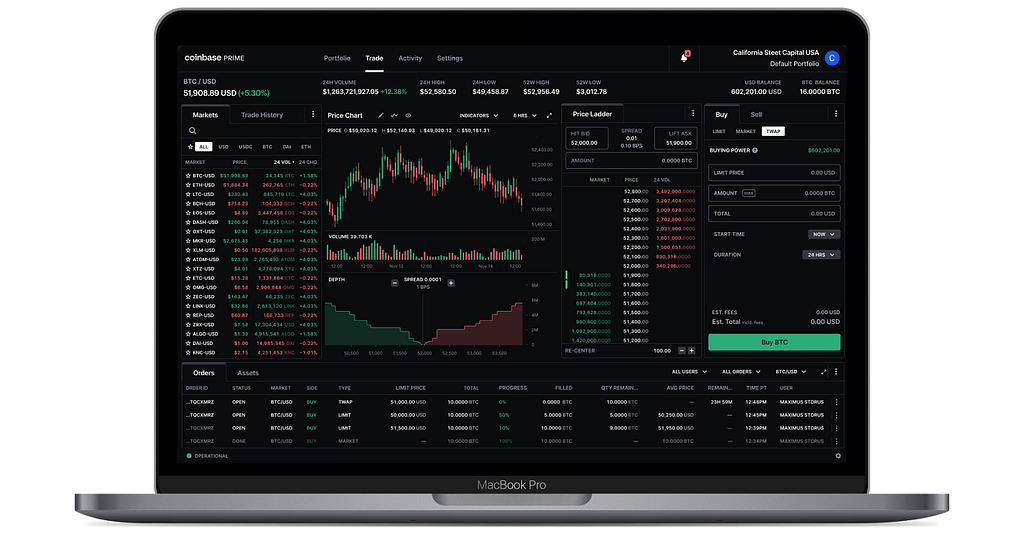
    Coinbase Prime announced yesterday that the company has established a collaboration with Enfusion to offer seamless crypto trading to institutional investors. The integration, which is expected to be completed during the second quarter of 2022 (Q2 2022), will give institutions easy access to the growing market of digital assets.

    Coinbase Prime expects leading financial institutions to increase their crypto exposure in the future. The company aims to provide efficient institutional-level crypto services to its clients through the integration of innovative technologies.

    “Enfusion’s connectivity with Coinbase Prime will allow us to seamlessly manage our crypto positions alongside other assets from a single interface, streamlining our trading operations. We’re very excited to see two platforms. We rely on the everyday team up to continue improving how institutions access the crypto markets,” said Eric Peters, the CEO and CIO of One River, a leading asset management firm.

    In September 2021, Coinbase Prime announced the launch of innovative features to help clients in the management of their portfolios. Earlier this year, Coinbase acquired Routefire to expand Prime Brokerage execution.

    OEMS Enfusion

    According to Brett Tejpaul, the Head of Institutional Sales, Trading and Prime at Coinbase, the institutional interest in digital assets has increased substantially in the last 12 months.

    “By providing straight-through processing to Coinbase Prime via APIs, Enfusion is providing its clients institutional access to digital asset custody and algorithmic trading, with the potential to further our relationship in the future,” he said in a recent post.

    “We’re excited to connect to our first OEMS Enfusion, as their native multi-asset management system is a natural first choice to collaborate with on a joint institutional offering. We expect financial institutions to continue to increase their portfolio exposure to crypto, and we’re committed to offering the best tools to enable them to manage it efficiently,” Tejpaul added.

    Coinbase Prime announced yesterday that the company has established a collaboration with Enfusion to offer seamless crypto trading to institutional investors. The integration, which is expected to be completed during the second quarter of 2022 (Q2 2022), will give institutions easy access to the growing market of digital assets.

    Coinbase Prime expects leading financial institutions to increase their crypto exposure in the future. The company aims to provide efficient institutional-level crypto services to its clients through the integration of innovative technologies.

    “Enfusion’s connectivity with Coinbase Prime will allow us to seamlessly manage our crypto positions alongside other assets from a single interface, streamlining our trading operations. We’re very excited to see two platforms. We rely on the everyday team up to continue improving how institutions access the crypto markets,” said Eric Peters, the CEO and CIO of One River, a leading asset management firm.

    In September 2021, Coinbase Prime announced the launch of innovative features to help clients in the management of their portfolios. Earlier this year, Coinbase acquired Routefire to expand Prime Brokerage execution.

    OEMS Enfusion

    According to Brett Tejpaul, the Head of Institutional Sales, Trading and Prime at Coinbase, the institutional interest in digital assets has increased substantially in the last 12 months.

    “By providing straight-through processing to Coinbase Prime via APIs, Enfusion is providing its clients institutional access to digital asset custody and algorithmic trading, with the potential to further our relationship in the future,” he said in a recent post.

    “We’re excited to connect to our first OEMS Enfusion, as their native multi-asset management system is a natural first choice to collaborate with on a joint institutional offering. We expect financial institutions to continue to increase their portfolio exposure to crypto, and we’re committed to offering the best tools to enable them to manage it efficiently,” Tejpaul added.

    [ad_2]

    Source link

  • Coinbase Prime and Enfusion team up to bring seamless crypto trading to institutional investors

    Coinbase Prime and Enfusion team up to bring seamless crypto trading to institutional investors

    [ad_1]

    By Brett Tejpaul, Head of Institutional Sales, Trading and Prime

    Our goal is to be the trusted bridge to the cryptoeconomy for all institutions, to fuel widespread adoption of crypto, and ultimately to increase global economic freedom. Coinbase Prime, an integrated solution that provides secure custody, an advanced trading platform, prime services and market data, has become a first choice for sophisticated investors and institutions that want to start investing in digital assets.

    Coinbase Prime and Enfusion are connecting to offer cryptocurrency trading to financial institutions and investment managers. By providing straight-through processing to Coinbase Prime via APIs Enfusion is providing its clients institutional access to digital asset custody and algorithmic trading, with the potential to further our relationship in the future.

    “Enfusion’s connectivity with Coinbase Prime will allow us to seamlessly manage our crypto positions alongside other assets from a single interface, streamlining our trading operations. We’re very excited to see two platforms we rely on every day team up to continue improving how institutions access the crypto markets,’ said Eric Peters, CEO and CIO of One River, a leading asset management firm.

    We’re excited to connect to our first OEMS Enfusion, as their native multi-asset management system is a natural first choice to collaborate with on a joint institutional offering. We expect financial institutions to continue to increase their portfolio exposure to crypto, and we’re committed to offering the best tools to enable them to manage it efficiently.

    The integrations between both platforms are expected to be completed in Q2 2022. To learn more about Coinbase Prime click here.


    Coinbase Prime and Enfusion team up to bring seamless crypto trading to institutional investors was originally published in The Coinbase Blog on Medium, where people are continuing the conversation by highlighting and responding to this story.

    [ad_2]

    Source link

  • MRHB DeFi Partners With Masary Capital to Launch Halal Retail and Institutional Crypto in the UAE | by Bit Media Buzz | Dec, 2021

    MRHB DeFi Partners With Masary Capital to Launch Halal Retail and Institutional Crypto in the UAE | by Bit Media Buzz | Dec, 2021

    [ad_1]

    Bit Media Buzz

    Dubai, UAE, December 14th, 2021 — MRHB (Marhaba) DeFi, the world’s first halal and ethical Decentralized Finance (DeFi) platform, is proud to announce their partnership with UAE-based crypto pioneer Masary Capital to bring DeFi opportunities to both retail and institutional clients in the United Arab Emirates and beyond, for the first time in the Islamic Finance space — a market estimated at around USD 3 trillion globally.

    The agreement was signed between Masary CEO, Mr. Khalil Abdullah, and MRHB CEO & Founder, Mr. Naquib Mohammed, in Dubai, UAE, a fast emerging global crypto hub for the sector.

    MRHB DeFi will be providing an entire ecosystem of eight innovative and shariah-compliant DeFi products for distribution through Masary Capital’s retail platform that provides easy access to crypto payments, investments, services and global remittance facilities. Together, they will encourage maximum UAE participation in the crypto space for those consumers who are focussed on halal services and opportunities.

    “Our pioneering crypto platform will provide a seamless path for our businesses, institutions and consumers to participate. Our partnership with MRHB DeFi is aimed at giving access to the full potential of DeFi to our Islamic customers,” said Masary Capital CEO, Mr. Khalil Abdullah.

    Masary Islamic is one of the key product suites of Masary Capital that will be “Powered by MRHB”. Under the leadership of Mr. Khalil, Masary Capital aims to unlock transactional efficiencies of blockchain technology to shape a new financial system that is both highly efficient and productive.

    “We are proud that Masary Capital has chosen us to be their preferred DeFi partner,” said MRHB DeFi CEO Naquib Mohammed. “This partnership will drive both retail and crucial institutional growth in the region and support our vision of providing DeFi to over 1 Billion people who find themselves excluded from the cryptosphere due to faith, lack of access and complexity.”


    [ad_2]

    Source link

  • DeFi’s potential means more institutional demand for next-gen tokens | by Bit Media Buzz | Sep, 2021

    DeFi’s potential means more institutional demand for next-gen tokens | by Bit Media Buzz | Sep, 2021

    [ad_1]

    Bit Media Buzz

    Ether’s impressive YTD gains have largely been overshadowed by the profits accrued by other smart contract-enabled projects.

    There’s no denying that the last couple of years have seen the altcoin sector blossom and have a major impact on the crypto market at large. In fact, a quick look at data available on Google Trends shows us that searches related to the term “Ethereum killer” have been soaring over the past 90-days, signaling a growing interest among investors in various altcoins.

    In this regard, a few cryptocurrencies — such as Cardano (ADA), Solana (SOL), Polkadot’s DOT and Terra (LUNA) — have made a major market push recently. SOL, in particular, has been turning a lot of heads among investors, thanks in large part to its most recent rally, which saw the cryptocurrency surge despite the market experiencing a massive selloff.

    In addition, there are several other networks that have shown a lot of promise. For example, following the completion of its much-hyped Alonzo hard fork, Cardano, too, has been able to record substantial profits, posting numbers of +70% and +1,200% over the last 90 and 180 days, respectively.

    To gain a better idea of what the aforementioned developments mean for the market at large, Cointelegraph reached out to Antoni Trenchev, managing partner and co-founder of lending platform Nexo. In his view, there is growing institutional demand for coins such as Solana’s SOL and Terra’s LUNA, something that is made evident by the fact that both assets have been able to make their way into the list of top 15 cryptocurrencies by total market capitalization. Trenchev told Cointelegraph:

    “This is a reflection of companies going deeper into crypto. Over the first two months of 2021, major institutions like BlackRock, Square and MicroStrategy were only just dipping their toes into Bitcoin. Now they’ve tasted its benefits and are looking to harness the untapped potential of up-and-coming blockchains and DeFi coins that could yield higher returns.”

    Trenchev highlighted that such developments suggest that the crypto market may currently be in the midst of an alt-season; however, what’s different this time around is that established coins such as ETH and Bitcoin (BTC) are showing a higher level of stability in comparison to some of these newer assets. “Think of the current situation as alt season meets institutional interest, and yes, I think we will see more and more trends like this in the future,” he said.

    The stability these institutions bring became fairly evident on Sept. 16 when Solana experienced a major outage wherein instead of going into a panic-induced sell frenzy, SOL barely lost any of its value, dropping less than 10%.

    Earlier this month, institutional traders flocked to Solana as demand for Ether and Bitcoin (BTC) exposure seemed to plateau. In this regard, over the first week of September, SOL-centric investment products represented a whopping 86.6% of the total weekly inflows into the crypto investment market.

    More specifically, per data made available by digital asset management firm CoinShares recently, SOL’s combined investment products witnessed inflows in excess of $49.4 million between Sept. 6 and 10. Not only that, for the week, SOL saw a 275% week-over-week increase in its value, representing 86.6% of total capital inflow into the crypto investment sector.

    Lastly, other digital asset products have also continued to see major cash inflows for the fourth consecutive week, with demand for different altcoins quite easily exceeding that of BTC products, with the latter only witnessing minimal inflows of $200,000. For example, it is worth highlighting that during the first half of September, multi-asset products, XRP, Polkadot’s DOT and Bitcoin Cash (BCH) were able to register sizable financial inflows of fa$3.2 million, $3.1 million, $1.7 million and $600,000, respectively.

    Kadan Stadelmann, chief technical officer of end-to-end blockchain infrastructure solutions provider Komodo, told Cointelegraph that rising demand for undiscovered projects is nothing new for the crypto market. However, what separates this time from previous cycles is the sheer amount of capital flowing in from institutions. He said:

    “The risk is that this will lead to faster market cycles for specific cryptocurrencies that are outliers from overall market movements. We see extreme FOMO and price increases, followed by a large sell-off and price declines. With SOL, in particular, prices are down 20% this week. That doesn’t mean it won’t quickly return back to its all-time high. It’s just that people who are new to crypto should be aware that volatility is par for the course.”

    Lastly, echoing Trenchev’s view, Stadelmann believes that as we move into an increasingly decentralized future, it will become more common to see a sharp increase in the price of different altcoins. “Hundreds of DeFi projects are flying under the radar. Many of these projects have solid technology and can gain upward price momentum once institutions recognize their potential,” he said.

    One of the core reasons underlying the rise of many of the above-stated altcoins has been the lack of scalability offered by the Ethereum network. In this regard, despite all of its recent highly touted functional updates, the platform is only able to process around 15–25 transactions per second in its current state — all while offering an extremely low throughput capacity.

    Not only that, even though the recently concluded London hard fork was designed to help regulate Ether’s rising gas fees — after rates rose as high as $40 and $70 earlier this year during Q1 and Q2, respectively — the figure still seems to be hovering around the $15–$20 range, which is quite high for the average Ethereum customer.

    Furthermore, during peak traffic hours, minting a nonfungible token (NFT) on the Ethereum network can cost up to 3 ETH, which, in many cases, may actually work out to a price point that is more than the actual NFT itself. On the other hand, Solana, as well as many other projects, not only offer faster transaction speeds but far lower gas prices, allowing for the more economical issuance of NFTs.

    With Ethereum gearing up to make its transition to a proof-of-stake framework, it is expected that once the move is finally done, the platform will be able to process up to 100,000 transactions per second. However, until that day comes, it looks as though a growing list of smart contract-enabled platforms may continue to eat into Ethereum’s mammoth market share.

    Ethereum’s most recent overhaul, the all-important London hard fork — which incidentally contained crucial updates such as the Ethereum Improvement Proposal 1559 — was supposed to deploy a new transaction pricing mechanism for the network, resulting in the ecosystem becoming deflationary in nature.

    Available data suggests that over 336,000 ETH tokens have already been burned, with the current burn rate currently sitting at 4.9 ETH per second or about 2.7 million ETH tokens per year, which would basically take the project’s yearly supply growth rate to 2.3% while taking its issuance to around 5.3 million tokens per annum.

    Moreover, Ethereum is not the only project to make use of such a deflationary setup, since Solana is also known to burn 50% of its transaction fees to regulate the supply of its native SOL token. Khalid Howladar, chairman of MRHB DeFi — a Shariah-compliant decentralized finance (DeFi) platform — told Cointelegraph:

    “While it’s clear that Ethereum is the current smart contract backbone of the DeFi ecosystem, Solana is emerging as a solid competitor with potentially more upside to come. Key factors such as cost and speed mean that Solana has become a solid challenger to Ethereum’s position both within the realm of programmable money (DeFi) and programmable media (NFTs).”

    In Howladar’s view, institutions are only just getting their toes wet when it comes to DeFi, and therefore, the next few months could be extremely interesting in terms of how they become further involved. “If DeFi platforms can somehow ensure basic things like consumer protection using decentralized KYC and AML, they will take vast chunks out of banks’ market share, especially as peer-to-peer economic systems take hold,” he said.

    Moving forward, it will be interesting to see whether Ethereum is able to maintain its current dominance levels, especially as a growing list of smart contract-enabled alternatives continues to garner mainstream market traction.

    Source

    [ad_2]

    Source link

  • Institutional Investors Could Soon Enter DeFi through “Aave Pro”

    Institutional Investors Could Soon Enter DeFi through “Aave Pro”

    [ad_1]

    Decentralized lending protocol Aave is planning to launch “Aave Pro,” a permissioned platform for institutional investors later this month, according to a new report from Cointelegraph. The platform, which will provide the same kinds of services as Aave’s current platform, will be launched in partnership with the digital asset custody and settlement platform Fireblocks.

    The new platform was reportedly announced in a webinar entitled ‘Next Steps in Institutional DeFi’ that featured Stani Kulechov, Michael Shaulov and Mike Novogratz, who are respectively the CEOs of Aave, Fireblocks and Galaxy Digital.

    Bank Account Alternative. Business Account IBAN.

    Stani Kulechov, CEO of Aave.

    According to a screenshot of an email that is said to recap the contents of the webinar, Aave is launching Aave Pro in response to ‘extensive demand from various institutions’. The platform will only support four crypto assets in the beginning: BTC, ETH, AAVE and USDC. Additionally, Aave Pro’s pools will be kept separate from its main platform. Further, the email said that there are plans to eventually decentralized the governance of Aave Pro.


    In addition, Aave Pro will add a whitelisting layer onto Aave’s V2 smart contracts to ensure that only ‘institutions, corporates, and fintechs’ approved by Fireblocks’ Know-Your-Customer verification process can access the platform. Moreover, Fireblocks is responsible for Aave Pro’s anti-money laundering and anti-fraud controls.

    Aave Pro is slated to vastly expand the total value locked in the Aave ecosystem, which currently sits at around $17 billion.

    DeFi “Rails” for Institutional Investors

    According to CoinTelegraph, the announcement of the new platform received ‘mixed reactions’ on Twitter. Some enthusiastic users pointed out that the platform will act as a rail for institutions entering the DeFi world in a meaningful way for the first time.

    However, others pointed to an ongoing lawsuit against Fireblocks by staking provider StakeHound. The lawsuit was filed over the alleged deletion of private keys to a wallet that contained $72 million in ETH.

    Aave first announced that it was entering the institutional world in May, when Kulechov said that Aave had created a “private pool” for institutions to “practice” with before jumping headfirst into DeFi. Furthermore, Aave partnered with Compound in early 2020 to launch DeFi services for institutional investors.


    [ad_2]

    Source link

  • Coinbase expands international payments options for institutional customers

    Coinbase expands international payments options for institutional customers

    [ad_1]

    One of our top priorities at Coinbase is to be the most trusted and easy-to-use platform for accessing the broader cryptoeconomy. Coinbase currently offers our institutional clients easy access to the crypto markets through advanced trading and custody technology. But being easy-to-use also means providing a strong set of global fiat payment rails. Starting today institutional customers can access additional trading pairs and payments options through an expansion of supported fiat currencies on Coinbase Exchange.

    Until now, many of our global clients have been limited to purchasing crypto in their local currency only. We now offer the fiat rails to enable deposits and withdrawals in USD, EUR, or GBP and access to the related trading pairs. This expansion of supported currencies has been a top request from international clients and has the potential to unlock billions of dollars in trading volume through improved access to major pools of liquidity. Institutional customers will now be able to trade in and out of various currencies regardless of where they are based. This is an important step in Coinbase’s journey towards creating a global trading platform.

    “Access to SEN on Coinbase provides us with the flexibility to move USD quickly, keep providing liquidity in fast markets, and take advantage of opportunities” says Morgan Vincent, Head of Trading at Wintermute.

    To learn more about Coinbase Prime, Exchange, Custody, our execution services, or Coinbase’s white label brokerage services click here.


    Coinbase expands international payments options for institutional customers was originally published in The Coinbase Blog on Medium, where people are continuing the conversation by highlighting and responding to this story.

    [ad_2]

    Source link

  • CME Micro Bitcoin futures surpass 1M contracts as institutional speculation grows

    CME Micro Bitcoin futures surpass 1M contracts as institutional speculation grows

    [ad_1]

    Institutional exposure to cryptocurrencies via derivatives continued to grow in the second quarter, as CME Group’s newly launched Bitcoin (BTC) micro contract received considerable uptick in its first two months of trading. 

    Since launching on May 3, CME’s Micro Bitcoin futures contract has already surpassed 1 million contracts traded, the Chicago-based derivatives market announced earlier this week. CME executive Tim McCourt said the new product has been popular among institutions and day traders seeking to hedge their spot Bitcoin price risk. 

    Denominated at 0.1 BTC, the micro contract is one-tenth the size of one Bitcoin. By comparison, CME’s main Bitcoin futures contract unit is 5 BTC.

    “We’ve seen more institutional volume than we anticipated, which shows that the timing was right for a smaller bitcoin contract,” said Brooks Dudley, the global head of digital assets at ED&F Man Capital Markets.

    Related: ‘Bitcoin will go all the way to $160,000 this year,’ says Celsius CEO

    Institutions have reduced their long-term exposure to Bitcoin and other cryptocurrencies during the latest correction, with outflows totaling $79 million last week, according to CoinShares data. In the case of BTC, newly liquidated coins are being scooped up by long-term holders who remain convinced in the long-term prospects of their investment.

    More activity in the derivatives market suggests traders are hedging their positions, speculating on the short-term directional movement of Bitcoin or both. Although derivatives trading has increased institutional exposure to Bitcoin, it has also become a source of stress for spot holders. As Cointelegraph reported, Friday’s $6 billion in Bitcoin and Ether (ETH) expiries created considerable friction in the market, with some traders expecting extreme volatility.

    The Bitcoin price mostly traded between $30,000 and $35,000 last week. Source: Cointelegraph

    High volatility was reported in the latter half of the week, with the BTC price falling 13.6% peak-to-trough between June 24-26.