Tag: inflation

  • Bitcoin Steadies Above $45k, US Inflation Comes In At 7.5% Year Over Year

    Bitcoin Steadies Above $45k, US Inflation Comes In At 7.5% Year Over Year

    [ad_1]

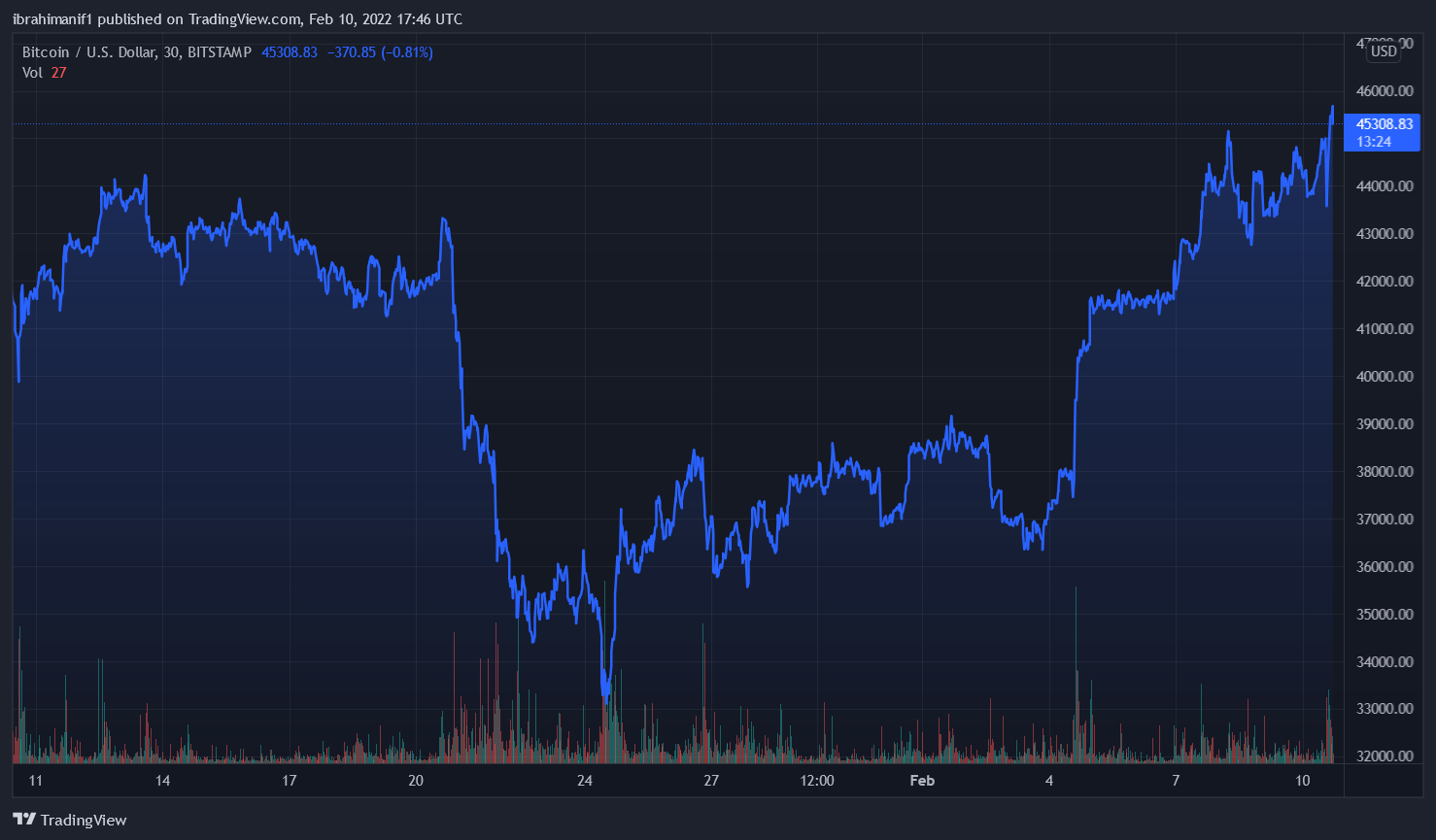
    Bitcoin price recovered to within $45k after sliding below $44k as analysts indicated probable swings for the flagship cryptocurrency. The release of US inflation rates seems to have had no effect on the king cryptocurrency.

    Bitcoin’s price rose past a crucial barrier overnight Wednesday, reaching $45,300, before falling as the broader market dipped in early trades after US markets opened.

    Bitcoin Unaffected By Inflation Rates

    Over the last 24 hours, BTC/USD has moved in a range of $43,402.81 – $45,398.91, exhibiting high volatility. Trading volume has climbed by 16.21% to $28.8 billion, while the overall market cap is around $860.47 billion dollars, leading in a 42% market dominance.

    As investors analyzed new US inflation data, which came in at 7.5% year-over-year vs an expected 7.3%, the earlier decline took shape. Risky assets like crypto and equities have reacted negatively, with all eyes on the Federal Reserve’s upcoming rate hike in March.
    Bitcoin

    BTC/USD steadies above $45k. Source: TradingView

    Despite being 0.2% higher than predicted, rising inflation did not have the same favorable impact on risk assets like Bitcoin as it had in recent months.

    The S&P 500 fell 0.23%, the Nasdaq composite fell 0.18%, and the Dow Jones Industrial Average remained barely above the flat line.

    According to analysts, the Federal Reserve may now have additional motivation to begin raising interest rates sooner due to the speed of year-over-year price increases.

    Crypto trader and analyst Michael van de Poppe observed:

    The Consumer Price Index (CPI) results for the U.S.A. are coming in at 7.5% year-over-year, the expectations were 7.3% year-over-year.$DXY is shooting up and risk-on assets are dropping down like Bitcoin & equities.Likelihood that the FED will start rate hikes in March.”

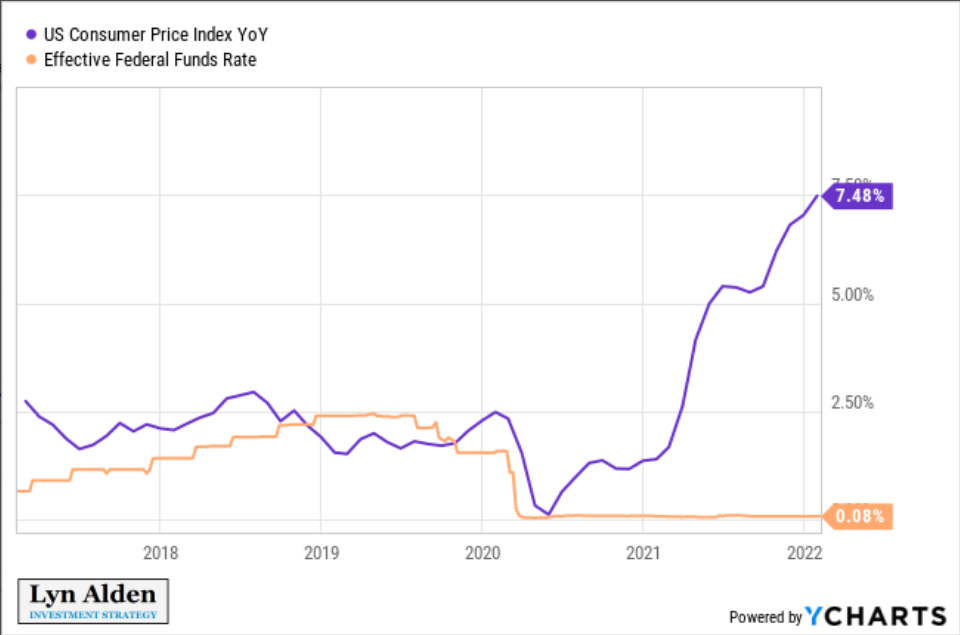
    However, for economist Lyn Alden, it was cash savers who had been losing the most from inflation. she noted alongside a chart:
    bitcoin and inflation rates

    U.S. CPI vs. effective federal funds rate chart. Source: Lyn Alden/ Twitter

    “Official inflation currently has its biggest gap over short-term interest rates since 1951. People holding cash in a bank or T-bills over the past year lost over 7% of their purchasing power.”

    Related article | Investors Take Refuge In Bitcoin As Inflation Rises

    BTC Will Hit $50k In Short term

    The Fed will be put to the test here, as they had hoped for a steady tightening cycle rather than a hasty tightening that would appear to be a policy blunder. The political pressure on the Biden administration and Democrats will increase as core inflation rises over the Fed’s objective and real average hourly earnings fall. Although November is still a long way off, this inflation report shows that price hikes are everywhere, and there is rising opposition to new fiscal stimulus measures that would exacerbate pricing pressures.

    As investors predict that pricing pressures may be peaking just before the Fed’s March policy meeting, US stocks have regained most of their inflation-related losses.

    Given the rise in global bond yields, Bitcoin prices are holding up well. Bitcoin’s optimal future environment is risk appetite, which may be tough to achieve until after the Fed’s first couple of rate hikes. Institutional investors in Bitcoin are focusing on Treasuries because the momentum trade appears to be quite simple. For the short term, Bitcoin appears to be settling in between $40,000 and $50,000.

    Cameron Winklevoss, co-founder of Gemini, feels Bitcoin is still the best inflation hedge, corroborating thoughts from the crypto community and even mainstream investors.

    Related article | Bitcoin Aims For $48K? BTC Reacts Upward To U.S. Inflation Report

    Featured image from iStockPhoto, Charts from TradingView.com


    [ad_2]

    Source link

  • Bitcoin, dollar plunge while S&P 500 rallies after US inflation hits 3-decade high

    Bitcoin, dollar plunge while S&P 500 rallies after US inflation hits 3-decade high

    [ad_1]

    Bitcoin (BTC) and the U.S. dollar fell in tandem while the S&P 500 refreshed its record high at open on Friday as the Federal Reserve’s preferred inflation indicator surged to its highest levels in almost three decades.

    According to data shared by the US Bureau of Economic Analysis, the US Core Personal Consumption Expenditure (PCI) rose 0.5% in May, coming in below the estimation of 0.6%.

    Nevertheless, the expenditure rose 3.4% year-over-year, the highest level since 1991. The Federal Reserve treats core PCI as its benchmark metric to gauge inflation. The U.S. central bank has indicated that it would tolerate inflation above 2% until it ensures a stronger labor-market recovery.

    The prospects of higher inflation fueled volatile bullish rallies across the risk-on markets in 2020, including Bitcoin and the U.S. stock market.

    Bitcoin and the S&P 500 rallied in tandem against Fed’s expansionary policies. Source: TradingView

    Investors considered them as better safe-havens as the Fed elected to hold interest rates near-zero and maintained its $120B monthly asset purchase program to contain the impact of the coronavirus pandemic on the U.S. economy.

    However, the central bank’s policy ended up pushing the U.S. bond yields lower while hurting the dollar’s demand globally, thereby shifting investors to riskier haven alternatives, including Bitcoin.

    But the flagship cryptocurrency dipped after the latest PCI readings, hinting that investors chose to ignore its safe-haven narrative over risks concerning China’s latest crypto ban and amid speculations that the U.S. would impose strict regulations on the cryptocurrency sector, on the whole.

    The BTC/USD exchange rate slipped to an intraday low of $32,350 shorty after the New York opening bell Friday. Meanwhile, Gold, Bitcoin’s top safe-haven rival, recorded early morning gains after higher core CPI readings, with the August Comex Gold Futures trading 0.73% higher at $1,789.70 an ounce in the morning session.

    Bitcoin dips despite higher inflation data. Source: TradingView.com

    Investors also snubbed the so-called safest safe-haven, the U.S. dollar. As a result, the greenback’s index against a basket of foreign currencies fell 0.33% to 91.525 in the early morning trade Friday. It later recovered back to 91.749.

    Alexander Vasiliev, co-founder and CCO of Mercuryo said that demand for the dollar among corporate and retail investors would remain weaker against the prospects of higher inflation. Instead, they would rather hedge in assets with lower depreciation potential. He explained:

    “While Bitcoin has won the argument as a suitable asset in this regard, its currently collapsing price will favor gold much more at such a time as this, and as such, investors may favor the latter more than the former. The price impact of these inflation figures on the asset classes will be more visible in the days and weeks ahead.”

    Bitcoin dipped also as investors’ focus shifted towards the Wall Street equity markets following President Joe Biden’s latest stimulus deal worth $1T. The S&P 500 index surged 0.27% to an all-time high of 4,280.55. The tech-focused Nasdaq Composite went up 0.1%.

    Fed’s mixed signals and Bitcoin

    Francesco Sandrini, senior multi-asset strategist at fund manager Amundi, stated that inflation readings would keep going higher in the months ahead. Meanwhile, markets would struggle to find confidence in terms of how to protect them from higher consumer prices, especially as the Fed officials send mixed signals about whether inflation should result in tighter monetary policy.

    For instance, Fed’s chair Jay Powell has called the recent inflation spikes in the U.S. economy, which could wipe long-term returns from stocks and bonds, as “transient” in nature. But St. Louis Fed president James Bullard said on Thursday that inflation may keep rising in the sessions ahead.

    The Federal Open Market Committee’s latest set of economic projections took a hawkish turn as it suggested dual-rate hikes in 2023. As a result, Bitcoin turned lower on the news.

    Related: 4 reasons why Paul Tudor Jones’ 5% Bitcoin exposure advice is difficult for major funds

    “We remain unsure as to exactly what will happen to inflation over the coming 5 years,” noted CoinShares, a digital asset management firm, in a report published on June 21.

    “But we see adding bitcoin and other real assets as a prudent measure to protect portfolios from the tail-risk of out-of-control inflation,” the firm added.

    Vasiliev noted that strong anti-inflation narrative would keep investors’ interest in Bitcoin in the coming months, adding:

    I believe a recovery to $40,000 is the goal, while investors look toward breaking the previous ATH of $64,000 in the mid to long term.