
Tag: inches

  • Bitcoin Halving Inches Closer With Less Than 2,900 Blocks Left

    Bitcoin Halving Inches Closer With Less Than 2,900 Blocks Left

    [ad_1]

    The Bitcoin Halving is fast approaching, with less than 2,900 blocks left before miners’ rewards are cut in half. This event, projected to take place sometime in April, is significant as Bitcoin’s price could enjoy a parabolic move to the upside after it takes place. 

    Bitcoin Halving Set For April 19

    Data from Coinwarz shows that the Bitcoin Halving is set to take place on April 19 at Block 840,000. This projection is based on Bitcoin’s current block time average, which means the Halving can come a little earlier or sometime after April 19. However, the main focus remains that miners’ supply will be cut in half. 

    The Halving event is a deflationary measure that Bitcoin’s founder, Satoshi Nakamoto, encoded in the flagship crypto and takes place after every 210,000 blocks. Three halving events have occurred since the Genesis block in 2009, when Bitcoin’s first block was mined. The first was on November 28, 2012, when miners’ rewards were cut from 50 BTC to 25 BTC.

    The next Halving event took place on July 9, 2016, cutting miners’ rewards to 12.5 BTC. The third one happened on May 11, 2020, reducing the reward to 6.25 BTC. Now, Miners’ rewards are set to be cut in half again, reducing them to 3.125 BTC.

    This reward is the amount of BTC miners receive for validating each block of new transactions on the blockchain. Although this event mainly affects miners, the crypto community closely monitors it due to the ripple effects it could have on the market. Bitcoin’s supply comes through these miners’ rewards, and a reduction in them usually drives Bitcoin’s value higher. 

    Bitcoin’s Performance After Each Halving

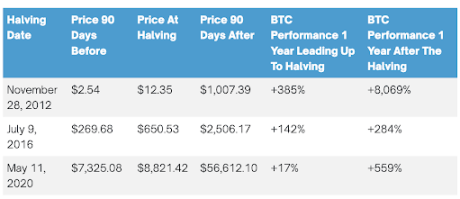
    The Halving has historically always led to a price appreciation for Bitcoin. Ninety days after the first Halving on November 28, 2012, Bitcoin’s price increased to $1,000 from $12 at the time of Halving. Subsequently, Bitcoin’s price saw a gain of over 8,000% one year after that Halving. 
    Bitcoin halving

    Source: MilkRoad

    This parabolic price surge also occurred after the second and third Halving events, with Bitcoin’s price rising from $650 and $8,821 (at the time of the Halving) to $2,506 and $56,612 (90 days after the Halving) in 2016 and 2020 respectively. Bitcoin also gained 284% and 559% one year after the event. 

    This time isn’t expected to be different as Bitcoin is again predicted to experience a massive move to the upside after April. This bullish sentiment is further strengthened by Bitcoin’s demand, which has continued to skyrocket in the face of a dwindling supply. 

    At the time of writing, Bitcoin is trading at around $70,400, up in the last 24 hours according to data from CoinMarketCap. 

    Bitcoin price chart from Tradingview.com

    BTC price struggles ahead of halving | Source: BTCUSD on Tradingview.com

    Featured image from 99Bitcoins, chart from Tradingview.com

    Disclaimer: The article is provided for educational purposes only. It does not represent the opinions of NewsBTC on whether to buy, sell or hold any investments and naturally investing carries risks. You are advised to conduct your own research before making any investment decisions. Use information provided on this website entirely at your own risk.

    [ad_2]

    Source link

  • Bitcoin inches past $38K as Wall Street opens to strange calm on Russia sanctions

    Bitcoin inches past $38K as Wall Street opens to strange calm on Russia sanctions

    [ad_1]

    Bitcoin (BTC) recovered to $38,000 as Wall Street opened on Feb. 22 amid a tense atmosphere over geopolitical instability. 

    BTC/USD 1-hour candle chart (Bitstamp). Source: TradingView

    Bitcoin tiptoes around macro cues

    Data from Cointelegraph Markets Pro and TradingView showed an eerily calm start to the first Wall Street session of the week for both stocks and crypto.

    Fears of a dramatic bout of volatility accompanying the open thanks to Feb. 21’s announcement by Russian President Vladimir Putin that he would recognize two breakaway republics in eastern Ukraine had been high.

    Sanctions, still being announced at the time of writing, were likewise assumed to be about to fuel the fire but on the day, there was little movement.

    The S&P 500 was all but flat thirty minutes after trading began, leaving Russian markets as the main losers and gold as the standout winner.

    “I think that we’re going to open in the red and then, immediately bounce up on the risk-on assets and have a slight correction on gold,” Cointelegraph contributor Michaël van de Poppe previously forecast.

    Fellow trader and analyst Scott Melker meanwhile focused attention on the potential for the Russia-Ukraine debacle to influence policy at the United States Federal Reserve.

    According to banking giant JPMorgan, the effect of a potential conflict could be to make the Fed abandon the veracity of its planned interest rate hikes this year.

    According to a note published Feb. 22 quoted by various media outlets, analysts at JPMorgan believe that the trigger for a Fed rethink would come in the form of commodity price increases.

    “Russia-Ukraine tension is a low earnings risk for U.S. corporates, but an energy price shock amid an aggressive central bank pivot focused on inflation could further dampen investor sentiment and growth outlook,” they wrote.

    The sanctions meanwhile held off on all-out economic retaliation, with Russia’s two largest state-owned banks, Sberbank and VTB, left untouched.

    Traders take Bitcoin’s recovery one step at a time

    Looking ahead on Bitcoin, popular trader Anbessa meanwhile eschewed calm as BTC/USD conformed to expectations without a significant trend violation.

    Related: Bitcoin Mayer Multiple returns to July 2021 levels in fresh sign $37K BTC is a long-term buy

    A potential support/resistance flip near $37,700 was on the cards, he said, this hopefully becoming an important feature for the higher timeframe chart going forward.

    As Cointelegraph reported, however, Bitcoin and altcoins remain off the radar for the majority of mainstream consumers, with mostly large-volume institutional players and whales maintaining meaningful participation.

    “If we are bleeding new users but still have heavy dilution and retail outflows. There is no recovery. Maybe for BTC. But not alts far out on the risk curve,” fellow trader Pentoshi added in his own discussion of the macro environment.