Republican Congressman Pete Sessions from Texas has come out with a bold statement about the impact Bitcoin mining will have not just on his state but on the United States as a whole.
The Texan representative, a proponent of Bitcoin (BTC) mining, tweeted on March 22 that “Bitcoin Mining will play a critical role in rebuilding energy independence in the USA.” His statement drew a mixed bag of reactions from both supporters and critics. Wyoming’s Republican Senator Cynthia Lummis was among the supporters who responded to his tweet with a succinct “Indeed.”
#Bitcoin Mining will play a critical role in rebuilding energy independence in the USA
Both lawmakers have been vocal advocates for policies that support innovation in the crypto industry, not just for miners. As U.S. consumers suffer from a spike in gas prices due to global tensions, the debate has ramped up about how the country can reduce its dependence on external energy sources.
Sessions’ view highlights a growing compilation of research that suggests the innovations from the BTC mining industry could have global applications in industrial energy consumption and production.
As Texas has come to contribute over 14% of the country’s total Bitcoin hash rate, the stability of the state’s electrical grid and the environmental impact of miners have come to the forefront of growing criticism, as it has in other mining hubs around the world.
Despite those concerns, various researchers have suggested that the growing mining market in Texas could reduce its net environmental impact and energy demands on the public energy grid.
A March 2021 research paper detailed how flexible data centers could promote renewable energy resources. A flexible data center generates its own energy either from a small dedicated renewable power plant or draws power from the grid depending on the grid’s current state.
According to the U.S. Energy Information Administration (EIA), Texas is already the country’s leading wind power generator. Therefore, miners may already have access to renewable energy when needed. Promoting miners to utilize a flexible data center model could stimulate greater growth in renewable energy accessibility and reliability. The paper stated:
“Hence, the (integrated energy system) may contribute to grid stability by locally using generated electricity instead of feeding it into the grid.”
Software solutions firm Lancium published similar research last October. It concluded that as the mining industry grows and more operations implement a flexible data center model, it will likely prevent energy grid shortages while promoting the growth of renewable energy resources. Researcher Joshua D. Rhodes, Ph.D. said in the paper.
“As grids move towards incorporating higher levels of intermittent resources, such as wind and solar, flexible demand will play an ever more important role in keeping the electrical grid system stable.”
Related: New York Bitcoin mining moratorium bill garners more support
Texas is a significant hub of Bitcoin mining in the United States as Hive Blockchain, Riot Blockchain, Argo Blockchain, and others have operations in the Lone Star State.
Some believe that 2021 will be the year of ‘dogs’ for cryptocurrency. Dogecoin (DOGE) and Shiba Inu (SHIB), the canine combo, lead the meme currency pack in terms of price and market value. DOGE has increased almost 8,000 percent since the beginning of the year and is ranked #9 by market value on CoinMarketCap as of November 2021. SHIB, its opponent, has pumped more than 60,000,000% since January.
Things move quickly in the meme coin world, as they do in most internet jokes because nobody cares about anything they read on social media for more than a few minutes. This means that coins must be generated quickly in order to be classified as a meme currency rather than simply another random coin. In this article, we will discuss Meme tokens, their good side, bad side and their future.
What Are Meme Coins?
Meme coins are cryptocurrencies that have garnered a lot of attention in a short period of time, mainly due to influencers and retail investors pushing them online. People are doing a debate on several meme coins like Safemoon vs Shiba Inu or Shib vs Doge etc.
Dogecoin is the first meme coin, having been developed in 2013 as a joke based on a meme. It gained popularity once Elon Musk began tweeting about it, and regular investors began purchasing it in droves.
Developers have launched a spate of joke currencies after Dogecoin since anybody can build a new cryptocurrency. Many of these currencies are Dogecoin spinoffs, such as Shiba Inu, but there are dozens of additional meme coins to choose from.
Dogecoin Overview
Dogecoin is crypto similar to Bitcoin and Ethereum, but it’s not the same as either of these prominent coins. Dogecoin was named after a once-popular meme and was founded, at least in part, as a lighthearted joke for
Meggie Nahatakyan
cryptocurrency aficionados. Despite its strange genesis story, Dogecoin has skyrocketed in popularity in 2021, becoming the sixth-largest cryptocurrency by market valuation as of writing.
Billy Marcus and Jackson Palmer, two software programmers, invented Dogecoin in late 2013. Palmer created the cryptocurrency’s logo by mistyping the term “doge” to represent a Shiba Inu dog, a popular joke at the time.
Shiba Inu Overview
Shiba Inu is an Ethereum-based altcoin (an alternative cryptocurrency to Bitcoin) using the Shiba Inu, a Japanese breed of hunting dog, as its symbol. Shiba Inu is widely regarded as a viable alternative to Dogecoin; in fact, Shiba Inu supporters refer to it as “the Dogecoin killer.”
Shiba Inu and Dogecoin are meme coins, which are cryptocurrencies connected with a theme, in the instance of Shiba Inu and Dogecoin, the Shiba Inu dog, but they’re more often made as a prank or inside joke than as a legitimate digital product. While Dogecoin was established in December 2013, Ryoshi, an unidentified individual or group, invented Shiba Inu in August 2020.
Cryptocurrency vs Meme Coins
Meme coins are a sort of cryptocurrency, however, there is one significant distinction between cryptocurrencies and meme coins, and that difference is mostly the aim.
Bitcoin and Ethereum, two major cryptocurrencies, were created to answer real-world issues. The ultimate objective is for it to be widely accepted by merchants, resulting in the creation of a new kind of decentralized currency that will revolutionize a range of sectors.
Meme coins, on the other hand, currently serve no real-world use, and the majority of them were established for profit. Many investors sell quickly once their prices rise in order to earn a rapid profit. Because meme coins now have no practical utility.
Meme Coins Good Sides
When Dogecoin originally appeared in 2013, it was thought to be a prank. No one imagined this coin could be anything other than a meme, even in their wildest imaginations. Doge is now worth $100,000 if you purchased it for $1,000 last year. Consider those who bought Dogecoin in 2013 because they thought it was a joke (or simply for fun).
Suggested articles
How Blockchain is Helping Half A Billion Africans Solve the Identity ProblemGo to article >>
If you put more than $1,000 into it, you’ll get a better return. Doge has proven to be one of the most profitable cryptocurrencies in history, and it is still bringing money to individuals. This is not a coincidence. Nowadays, investors are pouring money into Meme currencies, with Shiba Inu being the most recent example, reaching an all-time high in November 2021.
Meme Coins Bad Ugly Sides
Meme coins may have experienced exponential growth in 2021, but trading and investing in meme coins, like other cryptocurrencies, entails significant financial risk.
Meme coin tokenomics might be worrisome. Bitcoin has a deflationary tendency, a blockchain, a well-written whitepaper, and an established ecosystem. In comparison to Bitcoin, most meme currencies are inflationary and have no limit on supply. The community’s collective humour frequently determines its ecology, use cases, and basics. Only a handful of meme coins have been created using major cryptocurrency technologies. DOGE, for example, got its technology from Litecoin (LTC), whereas SHIB was constructed on the Ethereum network.
As the meme coin market grows, you should be cautious that certain projects may try to take advantage of the enthusiasm to defraud traders. For example, in only one week, Squid Game (SQUID), a meme currency based on the famous Netflix program of the same name, increased by almost 86,000%. The development team, on the other hand, immediately rug-pulled, causing the price to collapse by 99%. Worse, holders have been barred from selling their SQUID tokens.
Meme Coin Future
It might be difficult to predict if a meme coin will be bullish or bearish. Meme currencies often lack a market value and a high circulating quantity, making them very inexpensive and easy to get. Because meme currencies are frequently inexpensive and easy to obtain, there are several other aspects to consider while predicting the future of any meme currency.
The growing popularity of meme tokens and dogecoins is being fueled in part by social media. Elon Musk is one of the market factors that has frequently been indirectly impacting the price fluctuations of DOGE and Floki Inu (FLOKI) via erratic Twitter updates.
Such an attitude might be immensely destructive to cryptocurrencies in the long term. This might reverse the industry’s overall trajectory toward pushing the financial world towards an even more gloomy future.
Nonetheless, new meme tokens and dog coins join the market on a daily basis, and regular investors tend to purchase them with the aim of replicating the profits made by DODGE and SHIB in the past. In fact, the excitement around dogecoins has developed to the point that it is apparently driving demand for genuine dogs.
Are They Worth the Investment?
Even the most experienced investors face ups and downs while investing in meme coins. However, by finding out and implementing the proper knowledge, one may limit the dangers while maximizing profits. There are thousands of meme currencies to choose from, and the vast majority of them are frauds. As a result, in order to compete in this market, you must be at your best.
The reality is that diamonds may be found amid stones; you simply have to know where to look and how to look. These particular meme coins have the potential to create 1000 for early investors.
Before investing in any meme currency, spend some time researching the token’s community to learn about the creators’ priorities. Do they have a long-term plan for community building and long-term growth? Are they more interested in raising the price and pressuring consumers to buy? The former is a positive thing, whilst the latter is a warning sign. Additionally, it would be helpful if you could find out whether the initiative has a whitepaper outlining its true goal and objective.
Final Thoughts
With new meme currencies hitting the market every day and traders seeking to emulate DOGE and SHIB’s earnings, it is crucial to DYOR before investing in any meme currency. Remember that meme coins are quite volatile compared to other digital currencies. Trading or investing in cryptocurrency is fraught with danger. Meme coins are heavily community-driven and may fall abruptly, so never invest money you can’t afford to lose.
Meggie Nahatakyan, Crypto Analyst at the Top Coins.
Charity fundraising risks being left behind in the shift to online activity. But taking inspiration from the COVID-19 pandemic trends, and new payment technology, could open doors.
Change comes whether you’re ready or not, but being ready means you can seize the opportunity. The past year has accelerated the pace of digital transformation dramatically — sure, personal contact was already moving online, and contactless payments were slowly replacing cash, but the pandemic did not so much push as shove the world faster and farther than anyone expected. This creates specific challenges for the nonprofit sector — and with those, some exciting possibilities.
Related: Philanthropy: A missing catalyst of blockchain adoption
Bring the message home
Charity events and street fundraising — two major traditional revenue streams — have been sharply curtailed by the pandemic. However, lockdown has unlocked some inspirational creative thinking, such as the 2.6 Challenge, in which sports and fundraising agencies asked the public to come up with their own private challenges to fill the gap left by the London Marathon. The brilliance of such personal fundraising efforts is that, well, they’re personal.
Consider how Captain Tom Moore raised over 32 million euros ($44 million) by walking around his garden! This shows rather dramatically how an individual effort can drive far stronger engagement than might be achieved by, say, a marathon team: When supporters can see the motivation behind each challenge, they are inspired. It’s all about storytelling and authenticity. To stand out among a host of issues vying for public attention, and to restore the path to the positive feelings of giving, it’s important to reinforce the “why” — keep it personal, keep it relatable.
But while big moments like this capture the imagination and attract a flood of impulse contributions, charities need repeat donations and peer-to-peer fundraising for their financial health. It is crucial that organizations convert one-time donors into engaged supporters who are committed to sharing their message.
Related: The future of philanthropy lies in blockchain technology
Online fundraising can be particularly effective at this task, thanks to the power of storytelling. According to research, 57% of the people who watch a fundraising video go on to make a donation, but think about how much more could be done. A charity or activist website can become a place for helpers and the helped alike to share their experiences, their motivations and the impact of their actions. How can individual online actions translate into greater change? How can online social tools build community? And how can we mobilize a demographic that no longer trusts established groups to do the right thing once the donations have been made, or accepts that the agenda should be set only by the biggest donors?
Transparency and accountability are in increasing demand in all aspects of life. So it is with social causes: Young people want to know they make a difference. Show them a track record of effective action coupled with responsible stewardship, and they will spread the word for you. Explain what resources are needed, and how they will and have been put to use. Groups who make use of social networks and universal tools that are easy to access and understand will be best placed to win the trust and loyalty of the generations that are coming of age now.
Embedded payments open new doors
Let’s talk about the nuts and bolts of payments. The actual process of making a donation online can be a significant hurdle. Donors usually need to complete a detailed form, providing their name and several methods of contact, even before going into the details of payment. A moment of generosity and a true desire to participate might sour as more and more demands are made of people who imagine that their personal details are being stockpiled in a database.
Blockchain technology could simplify this step dramatically. If a charity website implemented a micropayment layer that allowed donors to give any amount with the click of a button — no forms to fill, no personal data to give up — wouldn’t you expect that to unlock goodwill, not to mention giving? This is a real possibility. Once the tech has gained widespread acceptance, it won’t just make online donations easier, it will pave the way for exciting new forms of fundraising.
Remember the Ice Bucket Challenge? Donations from that social media phenomenon reached $115 million, enabling the beneficiary, the ALS Association, to nearly double its funding for research into the disease. During lockdown, TikTok and Instagram challenges spread like wildfire, although few were linked to a cause. Imagine what might be achieved if you could craft a viral social media challenge that harnessed that energy, tied it to an action that held meaning — and embedded the donation mechanism directly in the posts created. If viewers were asked to donate a few pennies to watch the video, and a few pennies more to upload their own, viral campaigns could achieve more than just spreading awareness.
The trivia game Freerice has raised around $1.4 million (through advertising) for the United Nations World Food Program — it works because players are motivated partly by the addictiveness of the simple game but also by the sense of doing good. Making giving easy through an embedded, decentralized micropayment system could be deployed to combine small donations to fund any manner of positive, transparent, effective efforts. One could even imagine a free marketplace of information that drives funds toward the most valued causes.
Related: Your crypto taxes can be donated to charity instead
What can you offer?
Fundraisers need to employ some sharp marketing thinking to broaden their revenue base. Asking for donations, in many ways across multiple platforms, is a must. But apply the bake sale principle: What can you give, in order to get?
Any nonprofit is likely to have specialist knowledge. If it can leverage that to create an online course or e-book, or offer expert lectures, that’s a valuable product. Online donors typically give less, so fundraisers need to work harder on cultivating them and providing different channels for donation. Online or hybrid events are another option, less risky than traditional fundraising events (which are vulnerable to weather and other unpredictable factors) and with greater reach. Embedded payments make it possible to offer this extra value in a frictionless way, without compromising data protection or investing any overhead in payment processing contracts.
Target the next generation
Remember that, above all, younger donors are likely to engage with online content and offerings — and younger donors can deliver a full lifetime of support. So, fundraisers need to pay attention to young people’s online behavior. We know that Generation Z is active online, especially on mobile devices, and is turned off by out-of-date websites. Social media is a big part of their lives, so online community building is crucial. And they rarely use cash.
As cash payments become a rarity, small change donations have gone the way of the dinosaur, arguably leaving more than just a financial gap. Dropping a few coins in the charity jar by the till, or in the “take a penny, leave a penny” plate familiar in some United States regions, generated a sense of solidarity. Could micropayments offer a way to recapture the social and economic benefits that came from the anonymous circulation of small amounts of money? And could they help to engage young people at a level that works for them, opening the door to increasing levels of support in the future?
The leap forward in remote networking in 2020 could combine with emerging payment technologies to bring transformative possibilities for charities. We can see now that far from being a poor substitute for in-person activities, online engagement can be hugely powerful in its own right. New digital payments could prove to be a similarly great step-up on cash. Now, it’s over to fundraisers to apply the lessons learned and build new models for the future.
The views, thoughts and opinions expressed here are the author’s alone and do not necessarily reflect or represent the views and opinions of Cointelegraph.
Stephanie So is an economist, policy analyst and co-founder of Geeq, a blockchain security company. Throughout her career, she has applied technology within her specialist disciplines. In 2001, she was the first to use machine learning on social science data at the National Center for Supercomputing Applications. More recently, she researched the use of distributed networking processes in healthcare and patient safety in her role as a senior lecturer at Vanderbilt University. Stephanie is a graduate of Princeton University and the University of Rochester.
XRP is trading at an attractive price level following its correction from April’s peak. Though the cryptocurrency is still one of the largest in terms of market capitalization, is it a good time to buy it?
XRP was issued by San Francisco-headquartered Ripple and the token is RippleNet’s native digital currency, meaning it has major real-world usage. Ripple’s partnership with big banks all around the world for blockchain-based cross-border payments boosts the future usage of XRP.
But, XRP remains one of the most controversial cryptocurrencies. Many crypto enthusiasts were critical of the token from early days due to its centralization structure and Ripple having control on XRP’s supply. However, the biggest blow to XRP came when the US Securities and Commission Exchange (SEC) filed a lawsuit against the company alleging that XRP is an unregistered security, and Ripple illegally raised it with its sale.
XRP Bulls
That followed the delisting of the cryptocurrency from several US-based crypto exchanges, and the XRP token went down to around $0.13.
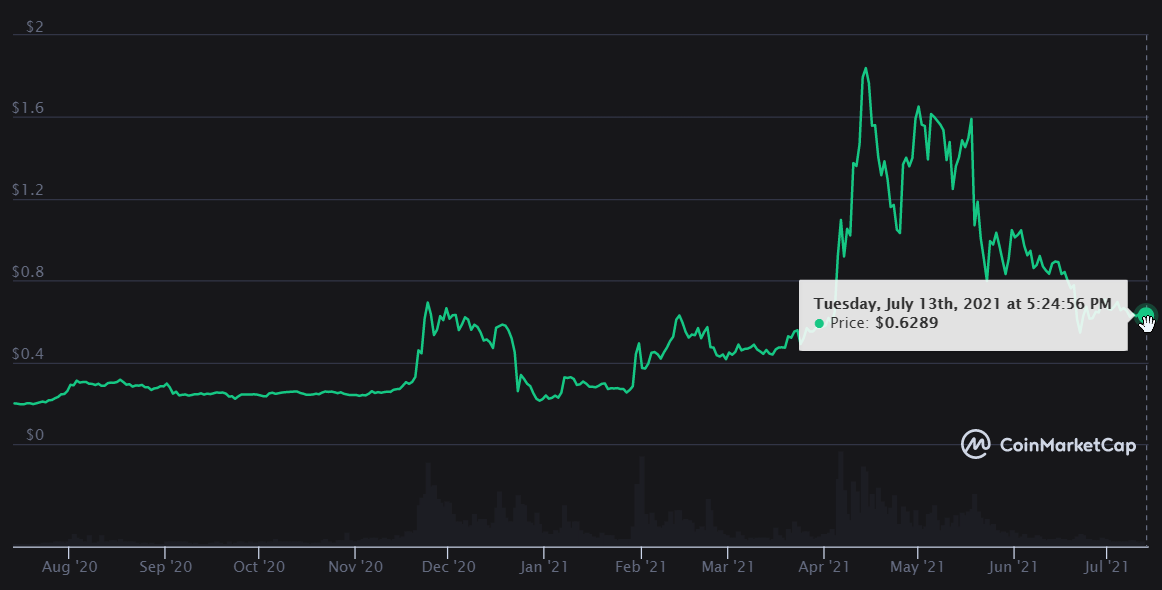
But, things pivoted as Ripple found support in Asia. Crypto whales jumped in to buy the dip and pumped the prices aggressively, and along with the positive sentiments around the overall crypto market, XRP prices breached the $1.83 mark within a month.
“The SEC suing Ripple simply delays the inevitable that XRP gets regulatory clarity and is deemed: NOT a security. What this headline does do, however, is scare retail investors into selling and scare the new investors from buying XRP,” CryptoClear Founder, Johnny McCamley earlier told Finance Magnates.
Suggested articles
PayRetailers Continues its Strong Growth in 2021Go to article >>
What’s Going On?
However, the ongoing correction of the cryptocurrency market pushed down the XRP prices again. The token is trading at $0.62, as of press time, which is more than 66 percent lower than its peak achieved in April.
From a technical standpoint, demand for XRP remains better than other cryptocurrencies. Ripple earlier reported that the demand for XRP surged in the first quarter of 2021. The company’s total XRP sales reached $150.34 million in the first quarter of 2021, which is a jump of approximately 97% compared to Q4 of 2020.
“XRP is currently trending horizontally around $0.62, which is a sharp drop for April 15 when it almost reached $2. As things stand, things look pretty glum for Ripple having met continuous resistance at the 20-day SMA. Further rejection could potentially take XRP to the $0.55 support wall,” said Gate.io CMO, Marie Tatibouet. “My suggestion would be to wait to see if XRP opens a candlestick above the 20-day SMA or not.”
XRP Price Levels, Source: Coinmarketcap.com
In addition, whales have accelerated their activities with XRP. Finance Magnates recently reported that multiple crypto whales are transferring millions of dollars in XRP out of cryptocurrency exchanges.
Currently, XRP has a total market cap of over $28.6 billion and is the sixth-largest digital currency, according to Coinmarketcap.com.
Meanwhile, the ongoing litigations against Ripple can make or break XRP prices. “In the short term, I expect XRP to keep trending around the levels that it is at right now,” Tatibouet added. “In the long-term, assuming a favorable result in the SEC lawsuit, XRP could go back up to $2 at the very least, and then it could jump to $5 and reach new all-time high levels.”