Tag: fraud

  • Liti Capital Launches ScamBusters to tackle Crypto Fraud | by Bit Media Buzz | Sep, 2021

    Liti Capital Launches ScamBusters to tackle Crypto Fraud | by Bit Media Buzz | Sep, 2021

    [ad_1]

    Bit Media Buzz

    Devoted to fighting fraud

    Fraud within cryptocurrency and blockchain is rife. This year will be a record for investment fraud: 14,079 investment scams were reported to the FTC in the first quarter of 2021, and victims lost $215 million in this quarter alone. Liti Capital is bringing its expertise in picking, funding and winning court cases and inviting consumers to vote on which scams it should pursue in court next.

    “The idea that scammers can freely operate in the crypto sphere without facing the consequences of their actions must end to bring trust and change the perception blockchain and crypto projects have in our society”, says Andy Christen, CVO/COO at Liti Capital.

    Liti Capital commits to allocating between 5% and 10% of its yearly investment budget to finance cases that have affected its community members. Any LITI or wLITI token holder can report a purported fraud to the company.

    How ScamBusters works

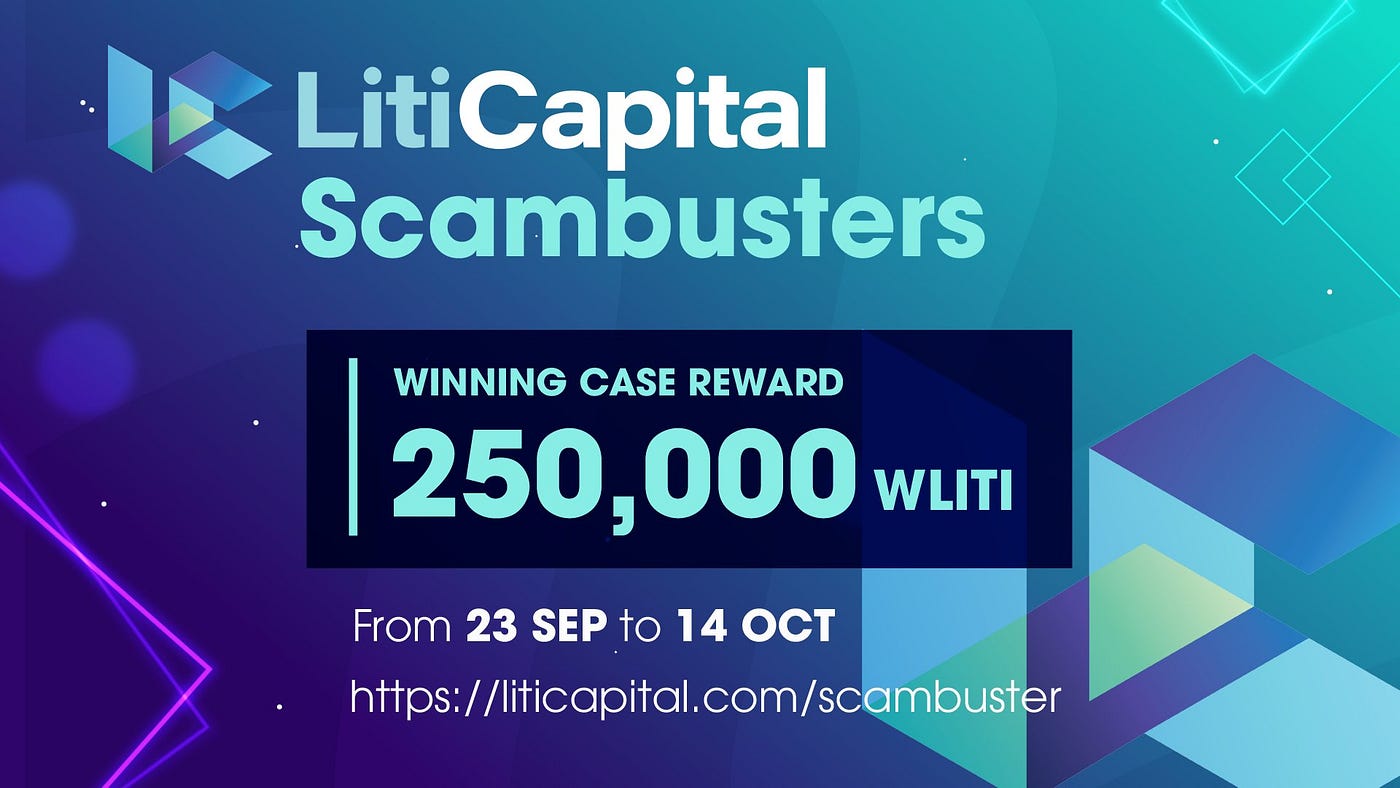
    ScamBusters is a community voting event to select which crypto scam cases Liti Capital will sue. LITI and wLITI token holders can use their tokens without spending them to vote for the case(s) they think have the most merit. The more tokens they have, the more voting power they can exercise. Voters of the winning case will share an award up to 250,000 wLITI, distributed pro-rata to their votes.

    Once members of the community have submitted cases on the ScamBusters website, Liti Capital instructs its team of legal experts based in 140 countries across the world to explore details of the case.

    A selection of cases are then presented back to community members, with the case collecting the highest number of votes being added to Liti Capital’s portfolio. Community voting begins on September 23, 2021, with the first winning case announced on October 15, 2021.

    “If cryptocurrency is going to become the de facto way people take part in the Web3 world, trust, regulation and a robust legal system are all parts of that puzzle,” says Jonas Rey, CEO at Liti Capital.

    About Liti Capital

    Liti Capital is bringing the litigation asset class to everyone through Blockchain technology with LITI tokens, an equity token that is a share of stock in Liti Capital SA. The launch of LITI and wLITI tokens allows any investor to engage in the high-performing litigation finance market previously only available to elite investors.

    For project information, please read the Whitepaper.

    For token distribution, please read Tokenomics.

    Liti Capital Official Channels

    Liti Capital Website: https://liticapital.com

    Liti Capital Telegram: https://t.me/Liti_Capital_Official

    Liti Capital Telegram Announcements: https://t.me/Liti_Capital_Official_ANN

    Liti Capital LinkedIn: https://www.linkedin.com/company/liti-capital

    Liti Capital Twitter: https://twitter.com/liticapital

    Liti Capital Medium: https://medium.com/@liticapital

    Liti Capital Reddit: https://www.reddit.com/r/liticapital

    Binance Claim: https://binanceclaim.com


    [ad_2]

    Source link
  • Stronger crypto regulations in US won’t necessarily help prevent fraud, says Okcoin CCO

    Stronger crypto regulations in US won’t necessarily help prevent fraud, says Okcoin CCO

    [ad_1]

    Though Okcoin chief compliance officer Megan Monroe said that there are still certain grey areas over cryptocurrencies in the United States, further regulation may not be the best solution.

    In a statement to Cointelegraph, Monroe said current U.S. regulations are sufficient to police cryptocurrency exchanges, token issuers and custody wallet providers, but “jurisdictional boundaries of these federal financial regulators are neither clear nor collaborative.” Rather, she advocated for a framework with greater clarity to determine which crypto firms should be subject to regulation and let investors know which protections are available.

    “A clear regulatory framework with established jurisdictional boundaries, flexible compliance standards and open communication channels with registrants (as well as with state regulators) would be a good way to initiate an evolving framework for market participants to grow their businesses,” said the Okcoin chief compliance officer. “[This] would provide retail customers that seek to work with regulated entities a clearer understanding of the investor protections that would be available to them.”

    She added:

    “We do not believe that further regulation will necessarily prevent fraud and platform abuse […] Fraud should not be limited to focusing on retail customer regulatory compliance issues in the securities markets.”

    Two of the major government agencies handling digital asset regulation in the United States, the Securities and Exchange Commission, or SEC, and the Commodity Futures Trading Commission, or CFTC, have different jurisdictional claims regarding crypto.

    The SEC often determines whether tokens are securities using the Howey Test, with Chairperson Gary Gensler arguing the crypto industry, including decentralized exchanges, falls within the regulatory purview of the federal agency. However, former CFTC Chair Christopher Giancarlo has claimed that cryptocurrencies are commodities and thus would be subject to regulation by the CFTC.

    The apparent lack of clarity can be seemingly confusing to crypto firms that are considering relocating to the U.S., or local ones making the transition to the digital space. David Schwartz, chief technology officer of Ripple Labs, told Cointelegraph earlier this year that it was “difficult to figure out which laws apply and how they apply to something new,” like cryptocurrencies or blockchain technology.

    “Over time, the regulators have educated themselves about the industry and expanded their scope to incorporate new blockchain technology, such as decentralized exchanges and DApps,” said Monroe. “But, the regulations still lag behind the industry innovation, which is why the regulators have yet to provide comprehensive regulatory guidance on decentralized finance technology.”

    Related: Will regulation adapt to crypto, or crypto to regulation? Experts answer

    The Okcoin chief compliance officer said that an “incubator” approach might be one possible solution to this “patchwork of financial regulations,” wherein crypto traders and businesses could operate without fear of legal action for a set period of time. She also encouraged projects to clearly identify the risks to both investors and users, and for greater communication and collaboration between agencies like the CFTC, SEC and Financial Crimes Enforcement Network.