MRHB DeFi follows the successful DEX (decentralized exchange) listing on Pancakeswap with its first CEX (centralized exchange) listing on LBank as it continues to bring DeFi opportunities to communities previously discouraged or excluded from the cryptoverse.
Shakepay, a Canadian-based exchange platform for bitcoin (BTC) and ether (ETH), announced it closed $44 million in Series A funding. The round was led by QED Investors, a US-based venture capital firm.
“We love our devoted community of shakers, and this funding is going right to work to bring you more products and services to help you earn, access, and build wealth in bitcoin. In 2021, we grew 381% to more than 900,000 shakers with $6B in total volume and grew our team from around 20 people to 75 across Canada. Just imagine what this funding could mean for 2022 and the future beyond.” – The Shakepay Team
As part of the capital raise, Matt Burton, Partner at QED Investors, will join Shakepay’s board of directors, alongside founders, Jean Amiouny, CEO, and Roy Breidi, CTO.
Ongoing participation also came from Boost VC and BoxOne Ventures, while Series A newly included participation from Golden Ventures, Broadhaven, Henri Machalani, Mike Murchison, Jevon MacDonald, Mark MacLeod, Dan Debow, Farhan Thawar, and several product leaders from Shopify.
One of the fastest-growing crypto exchanges in Australia, BTC Markets recently announced a partnership with Ajla Tomljanovic, a prominent tennis player in the country. According to the latest female tennis player rankings, Ajla currently stands at 45th position worldwide. In Australia, Ajla holds the second position.
BTC Markets is the only female-led digital exchange in Australia. Due to the rising interest of retail and institutional Australian clients in digital currencies, BTC Markets experienced a strong surge in demand for its crypto trading products during 2021.
“We’re excited to announce our sponsorship of rising tennis star and 2021 Wimbledon Quarter-Finalist, Ajla Tomljanović. Crypto moves fast on our exchange, just like Ajla on the court, & she encapsulates the promise and potential of Australia,” BTC Markets highlighted in a recent announcement.
In addition, the tennis star expressed her happiness on the latest collaboration and mentioned that the clients of BTC Markets will have an opportunity to meet her in person. “I’m really excited to be partnering with BTC Markets, Australia’s largest crypto exchange. To celebrate, we’re giving away some prizes including the chance to meet me in person,” Ajla said.
Crypto in Australia
Crypto adoption in Australia is on the rise. In November last year, Perth Heat, one of the most successful baseball teams in Australia, announced that the club has decided to pay its players in Bitcoin. Furthermore, Perth Heat is holding BTC on its balance sheet. The Commonwealth Bank of Australia is planning to expand its presence in the global crypto market.
“We are so proud to support the next wave of Australian talent with Ajla,” said the Chief Executive of BTC Markets, Caroline Bowler. “Cryptocurrency on BTC Markets is fast-moving, just like Ajla on the tennis court. We know our clients will be proud to cheer her on this summer.”
One of the fastest-growing crypto exchanges in Australia, BTC Markets recently announced a partnership with Ajla Tomljanovic, a prominent tennis player in the country. According to the latest female tennis player rankings, Ajla currently stands at 45th position worldwide. In Australia, Ajla holds the second position.
BTC Markets is the only female-led digital exchange in Australia. Due to the rising interest of retail and institutional Australian clients in digital currencies, BTC Markets experienced a strong surge in demand for its crypto trading products during 2021.
“We’re excited to announce our sponsorship of rising tennis star and 2021 Wimbledon Quarter-Finalist, Ajla Tomljanović. Crypto moves fast on our exchange, just like Ajla on the court, & she encapsulates the promise and potential of Australia,” BTC Markets highlighted in a recent announcement.
In addition, the tennis star expressed her happiness on the latest collaboration and mentioned that the clients of BTC Markets will have an opportunity to meet her in person. “I’m really excited to be partnering with BTC Markets, Australia’s largest crypto exchange. To celebrate, we’re giving away some prizes including the chance to meet me in person,” Ajla said.
Crypto in Australia
Crypto adoption in Australia is on the rise. In November last year, Perth Heat, one of the most successful baseball teams in Australia, announced that the club has decided to pay its players in Bitcoin. Furthermore, Perth Heat is holding BTC on its balance sheet. The Commonwealth Bank of Australia is planning to expand its presence in the global crypto market.
“We are so proud to support the next wave of Australian talent with Ajla,” said the Chief Executive of BTC Markets, Caroline Bowler. “Cryptocurrency on BTC Markets is fast-moving, just like Ajla on the tennis court. We know our clients will be proud to cheer her on this summer.”
Crypto partnerships are on the rise. With surging global adoption, leading companies in the crypto ecosystem are announcing collaborations to make digital assets more accessible. Ledger, one of the most popular hardware wallets, today announced a partnership with crypto exchange FTX.
As a result of the latest collaboration, the liquidity, leverage, and trading options of FTX will be available via Ledger Live, the company’s secure self-custody application. The collaboration between FTX and Ledger has enabled global users of Ledger Live to trade a broad range of digital currency pairs.
Ledger outlined a few challenges related to the accessibility of digital assets in the global crypto ecosystem and mentioned that the recent partnership will provide quick access to trading in a secure environment.
“This is an important innovation in cryptocurrency trading,” said FTX Founder and CEO Sam Bankman-Fried. “Investors are looking for increased security and self-custody solutions without sacrificing liquidity, leverage, and trading options. The partnership between FTX and Ledger addresses this pain point for the marketplace, by providing quick access to trading while assets remain fully secure.”
With a valuation of more than $25 billion, FTX is one of the fastest-growing crypto firms in the world. In October 2021, the digital exchange secured $420 million in funding.
Partnership
The press release shared by Ledger states that the users can take advantage of innovative services in a smooth manner. With access to over 300 cryptocurrency trading pairs, the collaboration provides an important opportunity for portfolio diversification.
“Ledger is the number 1 choice for serious crypto investors. More than 15% of all crypto assets are secured by the more than 4 million Ledger Nanos sold since 2014,” added Ledger CEO Pascal Gauthier. “In the past, they would need to move their assets to an exchange, trade, and move back again. Now serious traders and investors can do everything right from the security of their Ledger Nano.”
Crypto partnerships are on the rise. With surging global adoption, leading companies in the crypto ecosystem are announcing collaborations to make digital assets more accessible. Ledger, one of the most popular hardware wallets, today announced a partnership with crypto exchange FTX.
As a result of the latest collaboration, the liquidity, leverage, and trading options of FTX will be available via Ledger Live, the company’s secure self-custody application. The collaboration between FTX and Ledger has enabled global users of Ledger Live to trade a broad range of digital currency pairs.
Ledger outlined a few challenges related to the accessibility of digital assets in the global crypto ecosystem and mentioned that the recent partnership will provide quick access to trading in a secure environment.
“This is an important innovation in cryptocurrency trading,” said FTX Founder and CEO Sam Bankman-Fried. “Investors are looking for increased security and self-custody solutions without sacrificing liquidity, leverage, and trading options. The partnership between FTX and Ledger addresses this pain point for the marketplace, by providing quick access to trading while assets remain fully secure.”
With a valuation of more than $25 billion, FTX is one of the fastest-growing crypto firms in the world. In October 2021, the digital exchange secured $420 million in funding.
Partnership
The press release shared by Ledger states that the users can take advantage of innovative services in a smooth manner. With access to over 300 cryptocurrency trading pairs, the collaboration provides an important opportunity for portfolio diversification.
“Ledger is the number 1 choice for serious crypto investors. More than 15% of all crypto assets are secured by the more than 4 million Ledger Nanos sold since 2014,” added Ledger CEO Pascal Gauthier. “In the past, they would need to move their assets to an exchange, trade, and move back again. Now serious traders and investors can do everything right from the security of their Ledger Nano.”
Coinhako, an Asia-based cryptocurrency exchange, announced today the launch of its platform for institutional and high-net-worth customers, Coinhako Privé.
With the launch, all Coinhako Privé clients enjoy access to the following suite of services:
Institutional grade liquidity and digital asset management tools
Round-the-clock white-glove services provided by a dedicated personal relationship manager
Zero percent trading fees and competitive pricing
“After years of consultations, experiments and research, we are pleased to officially unveil Coinhako Privé. Created to suit the growing demands for Coinhako services from institutional and High-Networth Individual (HNWI) customers. In order to better serve this growing customer segment, our team set out to craft this bespoke solution to better suit their needs. Coinhako Privé offers specially tailored bespoke services for an esteemed class of clients to manage their digital assets like Bitcoin, Ethereum, and more. Think of it as visiting a bespoke tailor where every detail of your custom-made suit is crafted to perfection, except that with Coinhako Privé, our team of dedicated experts assists you with managing your digital asset portfolio.” – The Coinhako Team
Offer for opening an account at Coinhako Privé
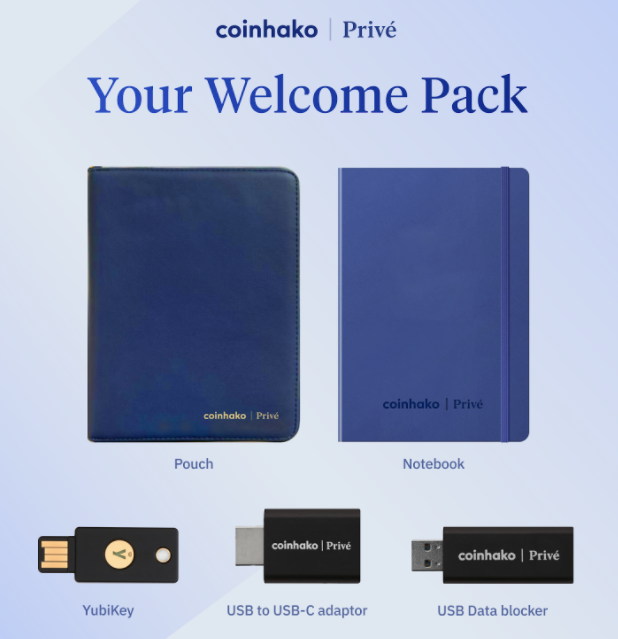
Upon the creation of a new Coinhako Privé account, clients will be gifted a welcome pack (shown below) to make the onboarding experience a special one. Moreover, those who are among the first 25 to register their interest for Coinhako Privé until November 12th will receive a $200 sign-up bonus.
MDEX is a multi-chain decentralized exchange operating across the HEXO, BSC, and Ethereum blockchains.
It employs an innovative dual liquidity and transaction mining incentive mechanism that rewards users with MDX tokens for trading.
MDEX is currently the largest decentralized exchange on HECO and the second largest on BSC
Dubbed the “DeFi Golden Shovel” in cryptocurrency circles, MDEX is a leading multi-chain decentralized exchange built on the Huobi Eco-chain (HECO), Binance Smart Chain (BSC), and Ethereum. It employs an innovative dual mechanism of liquidity and transaction mining, the latter of which effectively rewards users in MDX tokens to trade on the platform.
MDEX Unpacked
Decentralized exchanges have risen to become one of DeFi’s most popular kinds of platforms, both in actual usage and in generating revenues on the protocol level. In less than two years, the total value locked (TVL) in DeFi protocols has skyrocketed by a factor of 240, from $1 billion in June 2020 to the current staggering $240 billion. According to data from DeFiLlama, a significant portion of this value is locked in various decentralized exchanges operating across more than a dozen blockchains, sidechains, and Layer 2 protocols.
Based on statistics from DeBank and dapp.com, one of the top-performing decentralized exchanges by TVL and trading volume this year is MDEX — an AMM-based DEX functioning across the Huobi Eco-chain (HECO), Binance Smart Chain (BSC), and Ethereum blockchains. In terms of active users, trading volumes, and TVL, MDEX ranks second only after Pancakeswap on the BSC and is the undisputed leading exchange on HECO. The cumulative number of wallet addresses that have interacted with MDEX is 1,038,840, the current TVL is approximately $2.2 billion, and the current average weekly trading volume is around $1.25 billion.
The innovative dual mechanism of liquidity and transaction mining is a huge part of its success and what sets MDEX apart from other decentralized exchanges in DeFi. In order to attract and secure sufficient liquidity, DEXes typically incentivize liquidity provisioning by rewarding LPs with their native governance tokens. While MDEX does that too, it is unique in that it also rewards users with its native token, MDX, on every trade. Thanks to this reward mechanism, and by leveraging low-cost and high throughput blockchains like HECO and BSC, MDEX has captured roughly 80% of the entire TVL on HECO.
Another contributing factor to MDEX’s success was integrating its proprietary project incubator, or a token launchpad for Initial MDEX Offerings (IMO), and the launch of its DAO. The IMO capability allows the platform to incubate new projects on HECO and BSC by providing liquidity as a service and standardizing the fundraising process. Thus far, MDEX has facilitated two massively successful IMOs, one for Coinwind and another for Demeter, allowing these projects to raise more than $385 million and $350 million, respectively.
Honoring its roadmap goals promptly, on Sep. 2, MDEX initiated its DAO. Again, the team implemented an innovative twist to governance by establishing monthly “director elections,” in which MDX stakers vote and elect nine members of the community to the so-called “board of directors.” Instead of voting on protocol improvement proposals directly, which is how governance in most DAOs works, the MDEX DAO members elect directors with a month-long mandate to select, vote, and implement community proposals.
MDEX users need to stake their MDX tokens in the Boardroom for 30, 90, 180, or 365 days to participate in governance. In return for staking, the users obtain transferable xMDX “lock-in vouchers” that allow them to participate in IMOs, director elections, voting, making community proposals, and deciding on the allocation ratio and use of the platform’s revenue.
Speaking of revenue, MDEX implements a revenue-share model more similar to that of centralized exchanges like Binance or FTX than that of decentralized AMMs like Sushi or PancakeSwap. Specifically, the protocol charges a 0.3% fee on token swaps and then splits the income into three parts: 0.1% of the profit it uses to subsidize the development and growth of the ecosystem, 0.14% to buy Huobi Tokens (HT) from the secondary market and reward MDX stakers, and 0.06% to buy back and burn MDX tokens, thus reducing the circulating supply and increasing their value.
What is Next for MDEX?
Next on MDEX’s roadmap is growing the platform by adding even more pools or token trading pairs and expanding the ecosystem to new blockchains such as OKExChain, Polkadot, NEAR, and Ethereum sidechain Polygon.
Besides that, MDEX further wants to expand its product landscape by adding an order book that users can use in combination with its AMM liquidity pools. The idea here is to solve trading limitations caused by insufficient depth in liquidity pools and significantly enhance the user’s trading experience. While the platform currently supports only liquidity, transaction mining, and simple token swaps, in the future, MDEX is expected to launch other services such as lending, insurance, support for options and futures trading, and other DeFi primitives.
MDEX’s unique approach to DeFi has made it one of the leading decentralized exchanges in the multi-chain world in less than a year since its launch. As one of very few DeFi protocols that cater to the non-English speaking audience, MDEX has managed to establish a strong foothold in the Chinese, Turkish, Korean, Russian, and Japanese crypto communities and has built a loyal audience of users and contributors.
Data from Cointelegraph Markets Pro and TradingView showed BTC/USD losing $43,000 following the news after hitting local highs above $43,800 on Bitstamp.
With the source of the issue unknown at the time of writing, traders were left in the dark as an already sensitive crypto market fell back towards es
“We are investigating issues with the platform and have to temporarily halt trading,” Bitfinex wrote as part of its latest service update.
We are investigating issues with the platform and have to temporarily halt trading. We will keep everyone updated on here and our status page https://t.co/u3pYCVVGQq as we know more. We apologise for the inconvenience.
Tuesday had seen fellow exchange Binance, the largest by volume in the world, suspend trading for two hours as part of scheduled maintenance, this having no significant impact on BTC price action.
With Thursday already set to be a charged day, however, Bitcoin looked set to close out September almost exactly at its predicted “worst case scenario” price of $43,000.
In so doing, the largest cryptocurrency would once again validate predictions made by stock-to-flow model creator PlanB, who also correctly estimated the August close of $47,000.
Fellow trader and analyst Rekt Capital meanwhile reiterated the need for BTC/USD to reclaim its 21-week exponential moving average level (EMA) by the end of Sunday to preserve overall bullish momentum.
Market mimics $10,000 BTC from September 2020
Meanwhile, the overall character of the Bitcoin market was still far from bearish for most.
Related: Bitcoin breaking new highs in Q4 will ‘temporarily turn alts to dust’ — Analyst
Despite lackluster price action, the odds remain for a dramatic return to form in the coming weeks and months, with comparisons to the same period in 2020.
The latest was from Cole Garner, who noted that the large block of buyer support just below $40,000 was reminiscent of the order book setups when BTC/USD was at $10,000 in September last year.
This week also saw long-time pundit Bobby Lee predict not only $100,000 in the mid term, but as much as $200,000 or more for Bitcoin in a new “FOMO rally.”
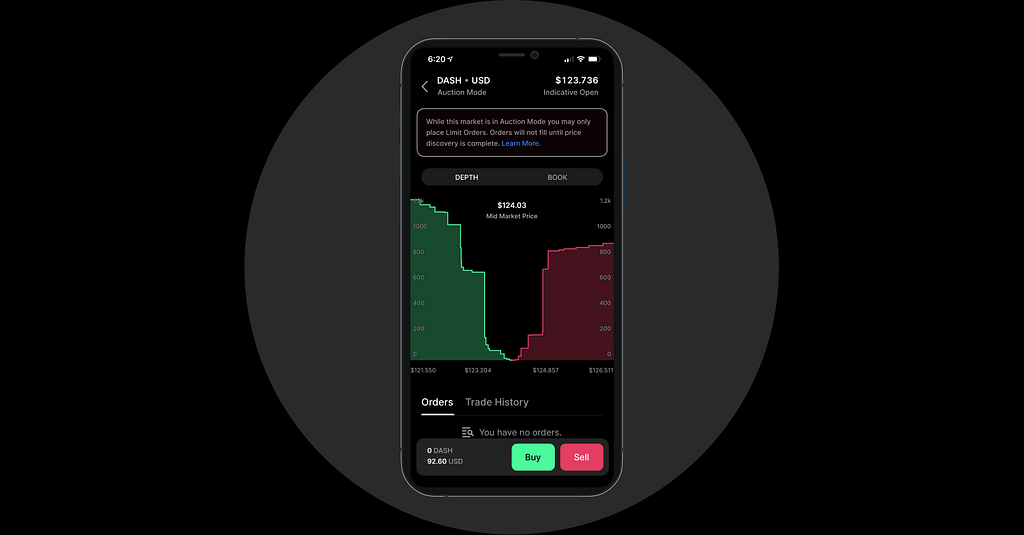
As a trusted crypto exchange our priority is to build features that enhance transparency and help us create the best markets. Starting today, when we launch new assets on the Coinbase Exchange we will be using a price auction to help price discovery and create a healthier market when trading starts.
How price auctions work
In our price auctions, limit orders are collected over a minimum of 10 minutes for price discovery. While orders are placed on the book, the Pro and Exchange applications along with the API and data feeds will show an indicative price — a price that may be used to match orders when the auction is opened. Using this indicative price as a signal of the eventual open price, users can cancel and resubmit orders while the auction takes place. Upon completion of the auction, orders crossing the final opening price will be matched and the book will move to full trading or limit only.
For orders matched on completion of the auction, both sides are charged taker fees. Orders that remain on the book during full trading are charged standard rates. For more information about price auctions and how to get a data feed containing the indicative price, please refer to our API docs.
Coinbase Exchange will now use price auctions when we launch a new order book or when we restart an order book that was previously paused. These auctions can be canceled without matching any orders.
About Coinbase Exchange
Coinbase Exchange helps a wide variety of clients access one of the deepest pools of liquidity of any regulated crypto spot exchange using high throughput APIs and an advanced trading interface.
While Coinbase intends to use the price auction for every listing possible, there may be some instances where, for operational or market health reasons, we may use other methods of launching a new book including using Limit and Post Only modes to start new markets.
Coinbase Exchange is launching price auction was originally published in The Coinbase Blog on Medium, where people are continuing the conversation by highlighting and responding to this story.
On-chain data shows Bitcoin exchange reserves have hit the lowest value in 3 years, here’s what it might mean for BTC’s price.
Bitcoin Exchange Reserves Lowest In 3 Years As Negative Netflows Continue
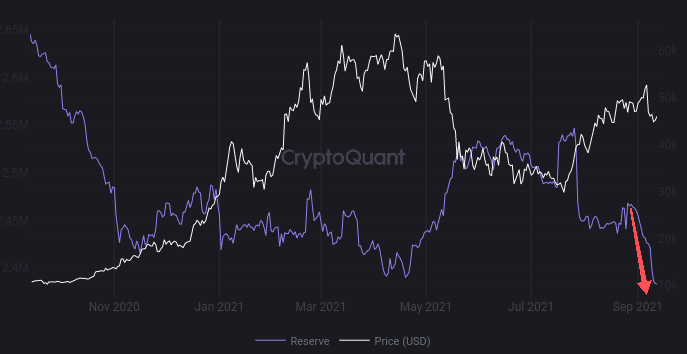
As pointed out by a CryptoQuant post, exchange reserves have been continuing their downtrend, and have now reached lows not seen since 3 years ago.
The all exchanges reserve is an indicator that shows the total amount of Bitcoin held in wallets of all centralized exchanges.
An increase in the metric’s value suggests more investors are depositing their coins for withdrawing to fiat or altcoin purchasing. On the other hand, a decrease means more buyers are moving their BTC to personal wallets for hodling or OTC deals.
Here is the latest chart for the Bitcoin all exchanges reserve:
The BTC all exchanges reserve plunges down
As the above graph shows, the value of the indicator has sharply gone down recently. The current level of the metric is the lowest it has been in the last three years.
As already mentioned before, a downtrend like this one means investors are withdrawing their coins from exchanges possibly to hodl or sell through OTC deals.
Related Reading | Indicators Show Bitcoin Might Be Gearing Up For One Last Push Up
Such values are typically bullish in the long-term as they may mean that there are more long-term holders in the market who are hodling out of exchanges.
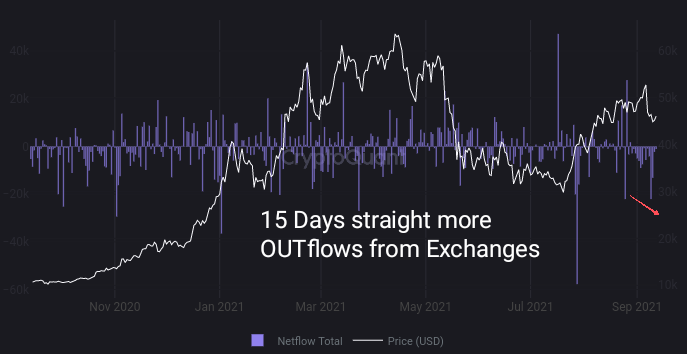
There is another relevant indicator here, called the Bitcoin netflow, which shows the net amount of BTC entering or exiting exchanges.
A positive spike in the chart for the exchange netflows means exchanges are observing more inflows compared to the outflows. A negative value implies just the opposite.
Big spikes or a prolonged period of smaller spikes in one direction can affect the value of the exchange reserves. Naturally, positive values can increase the reserve while negative ones can decrease it.
Related Reading | Ukraine Adopts New Law To Legalize Bitcoin And Other Cryptocurrencies
The below chart shows the current trend for the exchange netflows:
The BTC netflows show big negative spikes
As expected, the netflows have been negative recently, leading to the low values of the Bitcoin exchange reserves.
What Could It Mean for BTC’s Price?
As mentioned earlier, a downtrend in the exchange reserves can be bullish for the price in the long-term as it may imply a greater amount of long-term holdings. This has also been usually true historically, but there can be certain exceptions.
However, looking at the current Bitcoin price movement, it looks like selling has been going on. But as the exchange reserves haven’t shot up (unlike the crash from the May ATH), sales are being done likely through OTC deals.
Now, depending on if most of the outflows are being done to sell through OTC deals, a bearish picture can be there instead.
BTC's price continues to decline | Source: BTCUSD on TradingView
Featured image from Unsplash.com, charts from TradingView.com, CryptoQuant
Bears pressed harder on the market on Aug. 26 after Bitcoin (BTC) continued its pullback to an intra-day low at $46,250 and altcoins nursed near double-digit losses.
While most of the market is seeing red, a few altcoins managed to notch notable gains due to exchange listings and new staking opportunities.
Top seven coins with the highest 24-hour price change. Source: Cointelegraph Markets Pro
Data from Cointelegraph Markets Pro and TradingView shows that the biggest gainers over the past 24 hours were COTI, XYO Network (XYO) and Conflux Network (CFX).
COTI rallies after listing on Coinbase
The top-performing coin over the past 24 hours was COTI, an enterprise-grade fintech platform focused on decentralized payments.
VORTECS™ data from Cointelegraph Markets Pro began to detect a bullish outlook for COTI on Aug. 22, prior to the recent price rise.
The VORTECS™ Score, exclusive to Cointelegraph, is an algorithmic comparison of historic and current market conditions derived from a combination of data points including market sentiment, trading volume, recent price movements and Twitter activity.
VORTECS™ Score (green) vs. COTI price. Source: Cointelegraph Markets Pro
As seen in the chart above, the VORTECS™ Score for COTI turned solidly green on Aug. 22 and proceeded to climb to a high of 79 on Aug. 25, around two hours before the price increased 81% over the next day.
The burst of momentum for COTI came after it was announced that the token would be listed on Coinbase Pro and Huobi, two of the largest cryptocurrency exchanges by daily trading volume.
XYO volume surges
The XYO Network is comprised of a network of devices that anonymously collect and validate data with a geographic component (geospatial). All data obtained from the tracking devices on the network are stored on the XYO blockchain.
VORTECS™ data from Cointelegraph Markets Pro began to detect a bullish outlook for XYO on Aug. 21, prior to the recent price rise.
VORTECS™ Score (green) vs. XYO price. Source: Cointelegraph Markets Pro
As seen in the chart above, the VORTECS™ Score for XYO climbed into the green zone on Aug. 21 and reached a high of 72, around 67 hours before its price increased 36% over the next two days.
Related: Forget Lambos, NFTs are the new crypto status symbol
Conflux Network expands its NFT ecosystem
The Conflux Network is a public, permissionless blockchain network that has the goal of bridging the communities and economies of Asian and Western societies in order to facilitate the secure and interoperable flow of assets and data.
Data from Cointelegraph Markets Pro and TradingView shows that after hitting a low of $0.269 on Aug. 25, the price of CFX rallied 40% to an intraday high at $0.377 on Aug. 26 as its 24-hour trading volume surged by 242% to $66 million.
CFX/USDT 4-hour chart. Source: TradingView
The sudden price surge comes as the CFX ecosystem works on building out its NFT ecosystem, and the token appears to have also benefited from recently being listed on the Mexo and Tokocrypto exchanges.
The overall cryptocurrency market capitalization now stands at $1.993 trillion, and Bitcoin’s dominance rate is 41.2%.
The views and opinions expressed here are solely those of the author and do not necessarily reflect the views of Cointelegraph. Every investment and trading move involves risk, and you should conduct your own research when making a decision.