Liechtenstein-based crypto exchange LCX has confirmed the compromise of one of its hot wallets after temporarily suspending all deposits and withdrawals on the platform.
The hack was first identified by PeckShield, a blockchain security company, based on the suspicious transfer of ERC-20 tokens from LXC to an unknown Ethereum (ETH) wallet.
hot wallet compromised? @lcx https://t.co/uL5a7oCFfM
The probable hot wallet compromise was soon confirmed by the exchange as it announced the loss of numerous tokens including ETH, USD Coin (USDC) and other tokens including its in-house LCX token.
Ethereum blockchain based assets such as ETH, USDC, EURe, LCX and other assets have been moved to the
Hacker ETH Wallet: 0x165402279F2C081C54B00f0E08812F3fd4560A05
Based on PeckShield’s investigation, LCX lost a cumulative of $6.8 million after the hacker successfully transferred eight types of tokens that included Sandbox (SAND), Quant (QNT), Chainlink (LINK), Enjin Coin (ENJ) and Maker (MKR).
Details of the stolen funds on LCX. Source: PeckShield.
At the time of writing, LCX has not shared any plans to help return the stolen funds. However, the company has confirmed to take security measures to protect other wallets and assets:
“During this difficult period, we greatly appreciate the support from our customers, other exchanges, security experts, and the broader crypto community.”
LCX has not yet responded to Cointelegraph’s request for comment.
Related: ImmuneFi report $10B in DeFi hacks and losses across 2021
A recent report from security platform ImmuneFi found that crypto companies incurred losses of over $10.2 billion in 2021 due to hacks, scams and other malicious activities.
As Cointelegraph reported, ImmuneFi identified 120 instances of crypto exploits and rug-pulls, the highest-valued hack being Poly Network at $613 million, followed by Venus and BitMart with $200 million and $150 million, respectively.
Polygon (MATIC), a layer-two network designed for scaling and application infrastructure development on Ethereum (ETH), has been making the rounds among blockchain enthusiasts as of late. From its $1 billion investment into zero-knowledge technology to co-launching a $200 million Web 3.0 social media initiative up to integrating with Opera’s web browser to make its decentralized apps accessible to 80 million Android mobile users, the network’s momentum is going strong.
But partnerships and business aside, the technological capacities of the network, especially when compared to Ethereum, are also attracting the attention of many blockchain developers. In an exclusive interview with Cointelegraph, Polygon co-founder Sandeep Nailwal talked about the extent of the network’s adoption.
Cointelegraph: What are the current gas prices and transaction speeds for Polygon? And how does that compare to Ethereum?
Sandeep Nailwal (SN): From the Polygon Scan Explorer, you can see that the average block time is around 2.3 seconds. As for Ethereum, that is 15 seconds. And then the gas fees, you can see 0.001 MATIC tokens; this is a point fraction of a penny.
CT: Have there been any notable nonfungible token (NFT) drops on the Polygon network recently?
SN: None of them have become like CryptoPunks or anything, but I think Polygon’s biggest kind of support is from the gaming companies […] They all added to NFT. If you go to market, talk to any random 10 different gaming teams, they will tell you six to seven are building on Polygon.
But the notable drops on NFT, the biggest, have been Dolce and Gabbana, the brand. They made a $7 million sale recently. There are other big luxury premium watch brands, and these guys are coming in. Apart from that […] Elon Musk minted an NFT. Jack Dorsey minted NFT of his first-ever tweet, and […] Mark Cuban — all those were on Polygon networks only.
#NFT sales have seen astronomical growth since 2020.
2020 total sales: $340 million 2021 total sales: $9 billion (so far)
Let’s see what happens in 2022, with NFTs in sports, gaming, and #metaverses now gaining traction. https://t.co/VDD8v2YwVo via @cointelegraph
CT: What are some popular decentralized apps built on the Polygon blockchain? And what does their total value locked (TVL) look like?
SN: Polygon is now used by all the decentralized finance applications in Ethereum. The only one remaining was Uniswap. And the community signaled a week back that they are also launching on Polygon now. So as for the popular DApps, I would say Uniswap, Aave, Decentraland, etc. I think the TVL across the bridges is around $5 billion or $6 billion.
CT: What is your objective for investing in zero-knowledge technology?
SN: We had committed $1 billion for zero-knowledge technology, which we believe is the holy grail of blockchain scaling. And privacy is the second element — that’s one thing where everybody gets confused. So you use ZK to verify computations back on Ethereum without sending back the entire data. Instead, you simply provide proof that everything was correctly computed on layer two and put a […] succinct proof back to Ethereum.
CT: In your opinion, would further Ethereum upgrades empower the network’s capacity to match that of layer-two solutions?
SN: Even if 2.0 comes in here, that will not provide enough scalability. Next year, the proof-of-stake [PoS] upgrade will keep everything the same; like Ethereum has 13 transactions per second [TPS] right now, maybe it will go to 20 TPS [after PoS], but not more than that. So that does not add anything to scalability. And let’s say in three to five years, even if the sharding comes, we’ll have a projection of 64 shards. And with each acting at 20 transactions per second, but that’s still 1,280 transactions per second overall, right? That’s still not enough for the entire world.
Related: Uniswap v3 contracts deployment on Polygon approved with 99.3% consensus
CT: What does Polygon’s adoption currently look like?
SN: There are 3,000 plus active development teams on it. This was posted by Alchemy some time back. It should actually be up to 5,000. The daily active users on Polygon have become 50% more than Ethereum, and with gaming NFTs, we are seeing so much happening on Polygon.
BBVA Switzerland, the Swiss division of the Spanish multinational financial services provider BBVA, announced the addition of Ethereum (ETH) to its crypto custody and trading service today. The private banking clients of BBVA Switzerland will be able to manage Bitcoin and Ethereum on its platform.
Moreover, customers with a New Gen account will be able to access BTC and ETH. Ethereum and Bitcoin are available on the BBVA app along with other traditional investments. According to BBVA Switzerland, it is the first traditional bank in Europe to incorporate Ethereum into its services.
In June 2021, BBVA Switzerland opened Bitcoin trading services for all private banking clients. Since then, the company has seen a substantial increase in interest from its clients. With the addition of Ethereum, the financial services provider aims to meet the growing demand for diversified crypto offerings.
“This gradual roll-out has allowed BBVA Switzerland to test the service’s operations, strengthen security and, above all, detect that there is a significant desire among investors for crypto-assets or digital assets as a way of diversifying their portfolios, despite their volatility and high risk,” explains Alfonso Gómez, the CEO of BBVA Switzerland.
Diversified Crypto Portfolio
The market cap of digital currencies increased by almost 200% in 2021. In addition to Bitcoin, the popularity of altcoins has jumped substantially. As a result, investors are now more inclined towards a diversified crypto portfolio.
“One of the most important attractions of BBVA Switzerland’s offer is that the bitcoin management system is fully integrated into its app, where its performance can be viewed alongside that of the rest of the customers’ assets, funds or investments. This service thus represents a novel offering, as it allows investing and combining traditional and digital financial assets in the same investment portfolio. This integration also offers a great advantage in terms of simplicity when it comes to trading, account statements, tax returns, etc,” BBVA added.
BBVA Switzerland, the Swiss division of the Spanish multinational financial services provider BBVA, announced the addition of Ethereum (ETH) to its crypto custody and trading service today. The private banking clients of BBVA Switzerland will be able to manage Bitcoin and Ethereum on its platform.
Moreover, customers with a New Gen account will be able to access BTC and ETH. Ethereum and Bitcoin are available on the BBVA app along with other traditional investments. According to BBVA Switzerland, it is the first traditional bank in Europe to incorporate Ethereum into its services.
In June 2021, BBVA Switzerland opened Bitcoin trading services for all private banking clients. Since then, the company has seen a substantial increase in interest from its clients. With the addition of Ethereum, the financial services provider aims to meet the growing demand for diversified crypto offerings.
“This gradual roll-out has allowed BBVA Switzerland to test the service’s operations, strengthen security and, above all, detect that there is a significant desire among investors for crypto-assets or digital assets as a way of diversifying their portfolios, despite their volatility and high risk,” explains Alfonso Gómez, the CEO of BBVA Switzerland.
Diversified Crypto Portfolio
The market cap of digital currencies increased by almost 200% in 2021. In addition to Bitcoin, the popularity of altcoins has jumped substantially. As a result, investors are now more inclined towards a diversified crypto portfolio.
“One of the most important attractions of BBVA Switzerland’s offer is that the bitcoin management system is fully integrated into its app, where its performance can be viewed alongside that of the rest of the customers’ assets, funds or investments. This service thus represents a novel offering, as it allows investing and combining traditional and digital financial assets in the same investment portfolio. This integration also offers a great advantage in terms of simplicity when it comes to trading, account statements, tax returns, etc,” BBVA added.
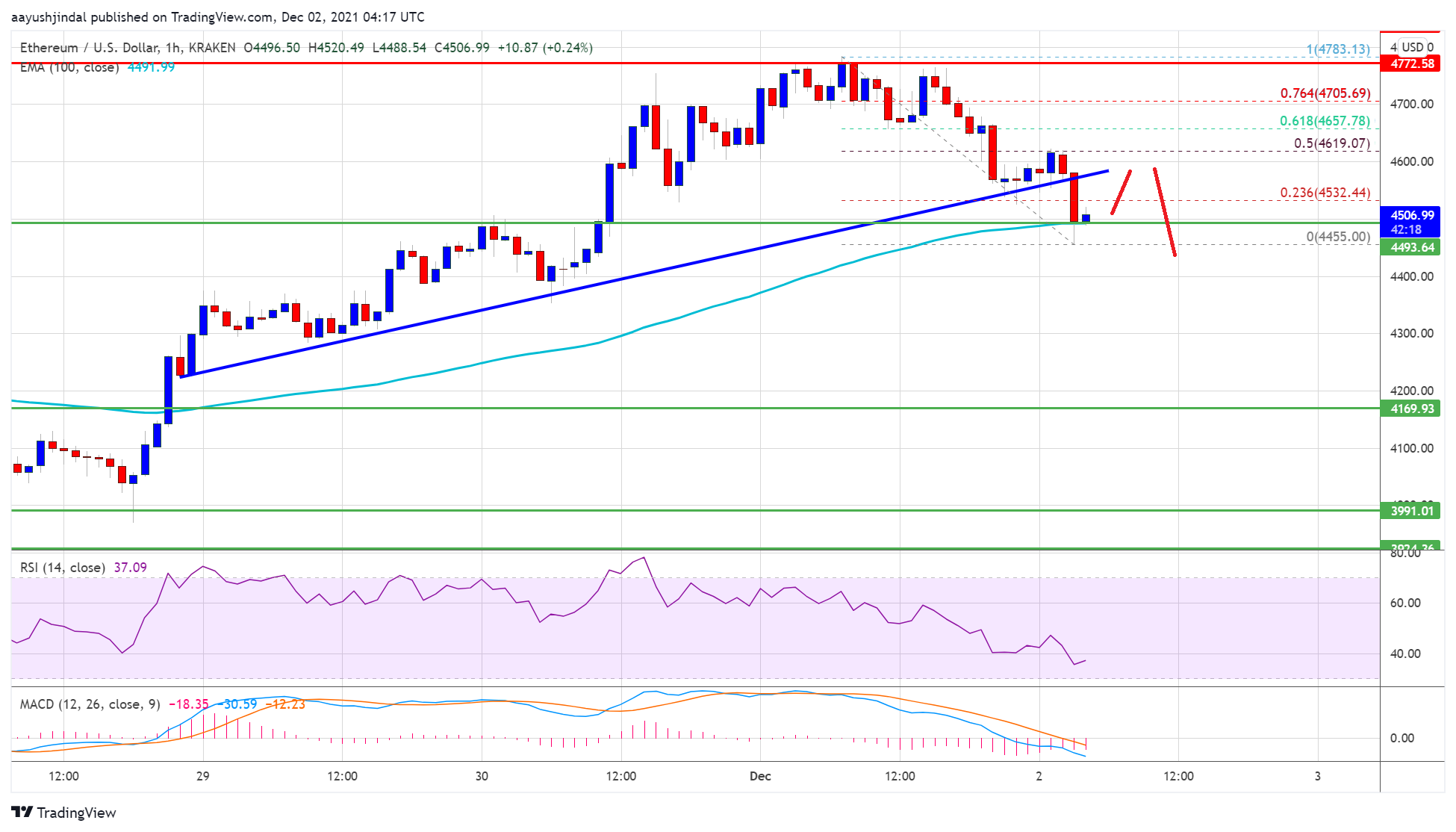
Ethereum trimmed gains from the $4,800 resistance against the US Dollar. ETH is down 5% and it might decline further if there is a break below $4,350.
Ethereum failed to clear the $4,800 resistance and started a fresh decline.
The price is now trading near $4,500 and the 100 hourly simple moving average.
There was a break below a key bullish trend line with support near $4,600 on the hourly chart of ETH/USD (data feed via Kraken).
The pair could decline further below $4,500 if there is a close below the 100 hourly SMA.
Ethereum Price Trims Gains
Ethereum struggled to clear the $4,800 resistance zone and started a fresh decline. ETH broke the key $4,650 support to enter a bearish zone.
Besides, there was a break below a key bullish trend line with support near $4,600 on the hourly chart of ETH/USD. The pair even traded below the $4,550 support zone. It is now trading near $4,500 and the 100 hourly simple moving average.
A low is formed near $4,455 and is currently consolidating losses. An initial resistance on the upside is near the $4,540 level. It is near the 23.6% Fib retracement level of the recent decline from the $4,783 high to $4,455 low.
The first major resistance is near the $4,580 level. The next major resistance is near the $4,620 level. It coincides with the 50% Fib retracement level of the recent decline from the $4,783 high to $4,455 low.
Source: ETHUSD on TradingView.com
A close above the $4,600 and $4,620 levels could start a fresh increase in the near term. In the stated case, the price might rise towards the $4,750 level. Any more gains could lift the price towards the $4,800 zone in the near term.
More Losses in ETH?
If ethereum fails to start a fresh increase above the $4,600 level, it could start a downside correction. An initial support on the downside is near the $4,500 level.
The first key support is now forming near the $4,450 level. A downside break below the $4,450 support zone could push the price further lower. The main breakdown support is $4,350, below which the price could decline heavily.
Technical Indicators
Hourly MACD – The MACD for ETH/USD is gaining pace in the bearish zone.
Hourly RSI – The RSI for ETH/USD is now well below the 50 level.
“It was Ethereum, in Metamask, with the gas fees.”
There is often talk of Solana being an Ethereum killer, but what if the culprit is not the latest trendy smart contract platform; what if the wounds are self-inflicted and Ethereum will ultimately be done in by Ethereum itself, which is to say, by its own shortcomings?
Or alternatively, is this all melodramatic FUD from people who put their money on the wrong horse and are bitter about it? Is it actually the case that ETH, like Gloria Gaynor, will not crumble, nor lay down and die, because it knows how to love, and how to stay alive?
What’s the Problem?
The major sticking point with Ethereum is the transaction costs, known as gas fees. Anytime you want to do anything at all on the Ethereum blockchain, you have to pay for computational power on the network. These fees used to seem reasonable, but as the price of ETH has risen and the network gets busier, the costs become, in fiat terms, ludicrously high.
On top of that, the network is frequently congested, leading to long delays, battles to get transactions through first, failed transactions and, on the whole, a user experience that would, in a more orthodox and established industry, be considered a full-on disaster.
What this all boils down to is scalability.
What’s the Solution?
Sidechains and Layer 2
Sidechains and layer 2 solutions, such as Immutable X, Polygon, Optimism, and Arbitrum, comprise of other networks building compatible protocols alongside or on top of Ethereum. All being well, these allow you to work within the Ethereum ecosystem but with reduced transaction fees, improved speeds and on the whole, scalability.
Sounds good, but these solutions come with their own set of issues. There is no direct on-ramp to these protocols, so you have to buy ETH, move it from an ETH wallet to a sidechain/layer 2 wallet, and then all the way back again in reverse if you want to cash out. Though you are still paying some gas fees along the way, and there is an additional level of friction.
Bearing in mind that getting started with ETH and, say, buying NFTs, is already a slightly weird and complicated process. This seems like fixing one problem (the fees) while exacerbating others (friction and complexity).
Eth 2.0
Ethereum 2.0 is Ethereum, but better. To get very marginally more technical, it switches Ethereum from a Proof of Work consensus mechanism to a Proof of Stake consensus mechanism, and it introduces a technique
Sam White
known as sharding.
From a user or investor perspective, the upshot of these changes should be to drastically ease congestion on the network, reduce transaction costs and times, and allow Ethereum to scale up and meet demand.
Suggested articles
ATFX as One of the Brand Sponsors of Finance Magnates London Summit 2021Go to article >>
The problem is that it is unknown when Ethereum 2.0 will be fully operational. It could be relatively soon, possibly sometime in early 2022, but no one seems certain. In the meantime, we can simply hold on and wait, but that risks losing some of the momentum and public interest that is building up around decentralization, blockchain technology, and digital assets.
What’s the Alternative?
There are several competitors, not layer 2 solutions for Ethereum, but entirely separate blockchains and ecosystems, that are attracting the development and users and have tremendous potential.
Cardano
Cardano is a meticulous and well-thought-out protocol. The main criticism of Cardano is that it’s a little too meticulous, progressing slowly and with not enough actual working products. However, that has changed as smart contracts are now operational, a host of DeFi platforms are gearing up for action, and a buoyant NFT community continues to grow.
Solana
As with Ethereum, Solana has gained attention through its NFTs, which are achieving high trade volumes without the gas fees. There is plenty of development going on, and the coin price has made huge gains. A criticism of Solana is that, unlike Ethereum, it is not adequately decentralized.
Avalanche
Rapidly becoming known for its speed and utility, Avalanche’s price has soared as it offers a powerful alternative to Ethereum for the deployment of smart contract-based dApps (decentralized applications) that avoid excessive transaction fees. It is a relatively new platform, but Avalanche is looking extremely well positioned.
For more alternatives, you might want to look into Tezos and Binance Smart Chain, and there are other less well-known competitors too.
All that said, it’s worth noting that this doesn’t have to be a zero-sum game in which one ultimate victor devours the others in a brutal crypto blood-frenzy, although that might be entertaining. A key concept for the future is multi-chain functionality. The idea is that blockchains will become interoperable, and rather than facing off tribally on Twitter, we can all get along nicely.
Ethereum Has the Advantage, but Where Next?
Let’s be realistic here. Ethereum is not about to keel over just yet. What it has on its side is first-mover advantage and user adoption, meaning that it is heavily insulated by the network effects it has earned over several years.
If anyone says that Ethereum does not function, then the question you can fire back in its defence is, “then why are so many people using it?” And it is true, for something that supposedly does not work, it sure is doing a lot of work.
And yet. What is also true is that if you’re hoping to onboard a lot of new people into the worlds of NFTs, DeFi, metaverses, or just Web 3.0 in general, then with those gas fees? Forget it. The wonders of Ethereum will remain a niche interest for the crypto rich who got on board early. And, in terms of developer activity, don’t be fooled into thinking that other networks are not gaining momentum now.
What is more, Ethereum’s issues come at a moment (inevitably, being scalability issues) when interest in things like NFTs, the metaverse and blockchain gaming are sky-high. Plus, we can realistically expect a growing influx of newcomers.
Timing is everything, and it would be an interesting history that got written if Ethereum dominated while the space was in its obscure nascent phase, making a few people very rich in the process, only to be superseded by alternative protocols when crypto went mainstream.
Ethereum remained stable above $4,050 against the US Dollar. ETH could gain bullish momentum once it clears the $4,325 and $4,350 resistance levels.
Ethereum is showing a few positive signs above the $4,200 level.
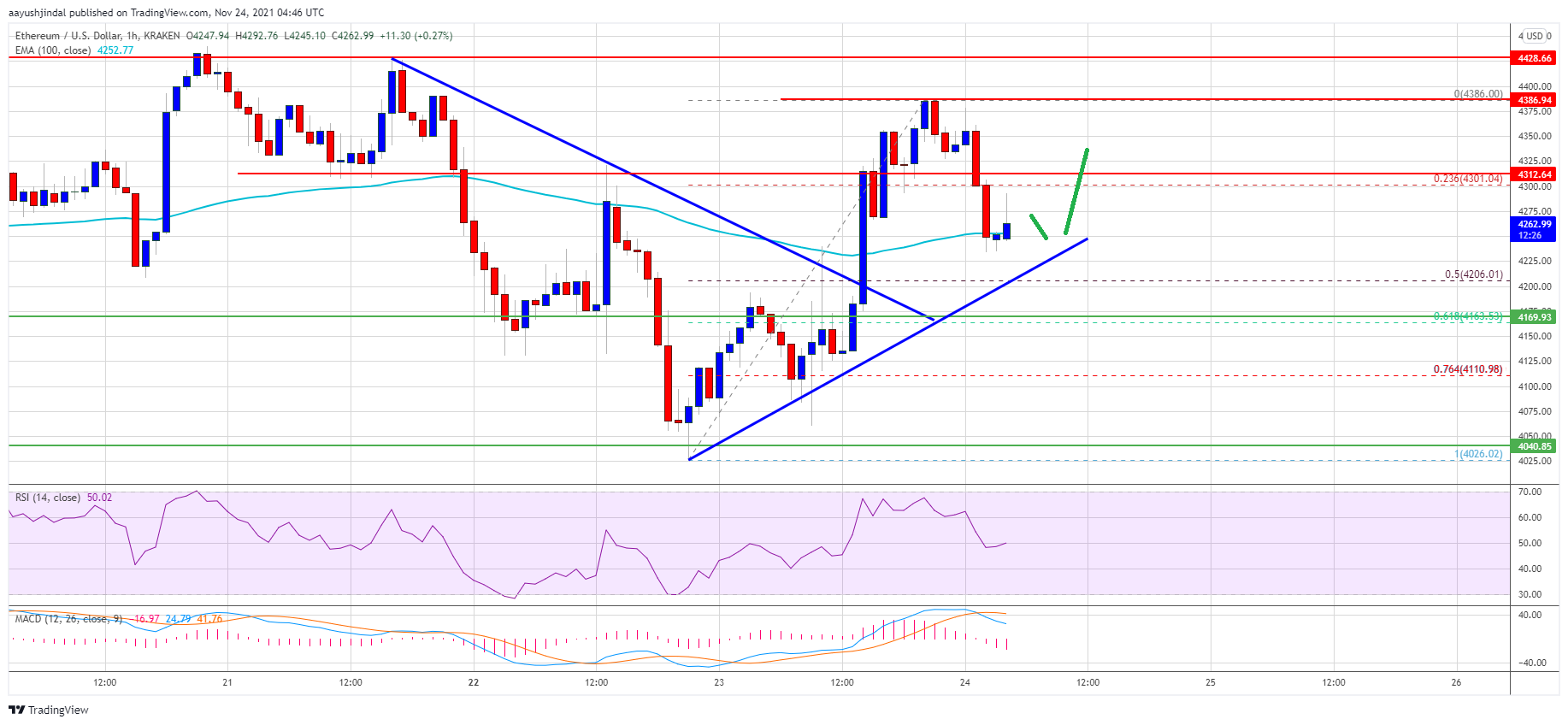
The price is now trading above $4,200 and the 100 hourly simple moving average.
There was a break above a major bearish trend line with resistance near $4,205 on the hourly chart of ETH/USD (data feed via Kraken).
The pair could extend gains if there is a clear break above the $4,350 resistance zone.
Ethereum Price Is Recovering
Ethereum remained strong above the $4,050 support level, unlike bitcoin. ETH price formed a base and started a steady recovery wave above the $4,120 resistance zone.
There was a clear break above the $4,200 resistance zone and the 100 hourly simple moving average. Besides, there was a break above a major bearish trend line with resistance near $4,205 on the hourly chart of ETH/USD.
The pair climbed higher above the $4,300 resistance zone and formed a high near $4,386. It is now correcting gains below the $4,300 level. There was a break below the 23.6% Fib retracement level of the upward move from the $4,026 swing low to $4,386 high.
Source: ETHUSD on TradingView.com
Ether price is now trading above $4,200 and the 100 hourly simple moving average. An initial resistance on the upside is near the $4,300 level.
The first major resistance is near the $4,350 level. A close above the $4,300 and $4,350 levels could start a fresh increase in the near term. In the stated case, the price might rise towards the $4,450 level. Any more gains could lift the price towards the $4,500 barrier in the near term.
Fresh Drop in ETH?
If ethereum fails to start a fresh increase above the $4,350 level, it could start a fresh decline. An initial support on the downside is near the $4,220 level. There is also a connecting bullish trend line near $4,220 on the same chart.
The first key support is now forming near the $4,200 level. It is close to the 50% Fib retracement level of the upward move from the $4,026 swing low to $4,386 high. A downside break below the $4,200 support might push the price further lower.
Technical Indicators
Hourly MACD – The MACD for ETH/USD is losing pace in the bullish zone.
Hourly RSI – The RSI for ETH/USD is now near the 50 level.
A guide to the multi-chain future, sidechains, and layer-2 solutions
Around the Block from Coinbase Ventures sheds light on key trends in crypto. Written by Justin Mart & Connor Dempsey.
As of late 2021, Ethereum has grown to support thousands of applications from decentralized finance, NFTs, gaming and more. The entire network settles trillions of dollars in transactions annually, with over $170 billion locked on the platform.
But as the saying goes, more money, more problems. Ethereum’s decentralized design ends up limiting the amount of transactions it can process to just 15 per second. Since Ethereum’s popularity far exceeds 15 transactions per second, the result is long waits and fees as high as $200 per transaction. Ultimately, thisprices out many users and limits the types of applications Ethereum can handle today.
If smart-contract based blockchains are to ever grow to support finance and Web 3 applications for billions of users, scaling solutions are needed. Thankfully, the cavalry is beginning to arrive, with many proposed solutions coming online recently.
In this edition of Around The Block, we explore the crypto world’s collective quest to scale.*
To compete or to complement?
The goal is to increase the number of transactions that openly accessible smart contract platforms can handle, while retaining sufficient decentralization. Remember, it would be trivial to scale smart contract platforms through a centralized solution managed by a single entity (Visa can handle 45,000 transactions per second), but then we’d be right back to where we started: a world owned by a handful of powerful centralized actors.
The approaches being taken to fix this problem come twofold: (1) build brand new networks competitive to Ethereum that can handle more activity, or (2) build complementary networks that can handle Ethereum’s excess capacity.
Broadly, they break out across a few categories:
Layer 1 blockchains (competitive to Ethereum)
Sidechains (somewhat complementary to Ethereum)
Layer 2 networks (complementary to Ethereum)
While each differs in architecture and approach, the goal is the same: let users actually use the networks (eg, interact with DeFi, NFTs, etc) without paying exorbitant fees or experiencing long wait times.
Layer 1s
Ethereum is considered a layer 1 blockchain — an independent network that secures user funds and executes transactions all in one place. Want to swap 100 USDC for DAI using a DeFi application like Uniswap? Ethereum is where it all happens.
Competing layer 1s do everything Ethereum does, but in a brand new network, soup to nuts. They’re differentiated by new system designs that enable higher throughput, leading to lower transaction fees, but usually at the cost of increased centralization.
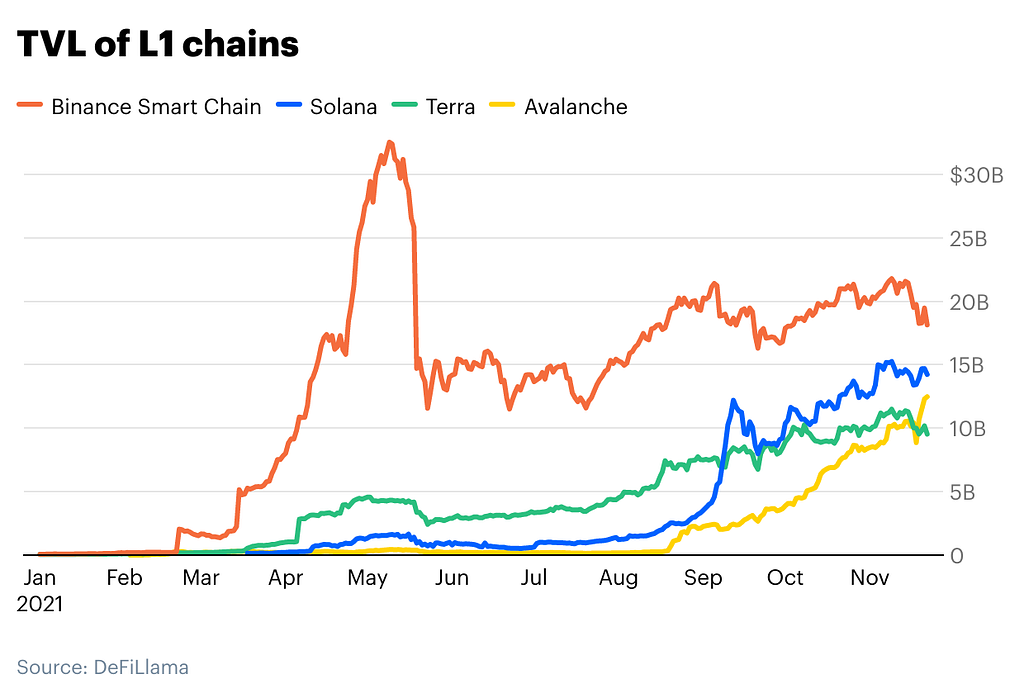
New layer 1s have come online in droves over the last 10 months, with the aggregate value on these networks rocketing from $0 to ~$75B over the same time period. This field is currently led by Solana, Avalanche, Terra, and Binance Smart Chain, each with growing ecosystems that have reached over $10 billion in value.
Leading non-ETH L1s by TVL
All layer 1s are in competition to attract both developers and users. Doing so without any of Ethereum’s tooling and infrastructure that make it easy to build and use applications, is difficult. To bridge this gap, many layer 1s employ a tactic called EVM compatibility.
EVM stands for the Ethereum Virtual Machine, and it’s essentially the brain that performs computation to make transactions happen. By making their networks compatible with the EVM, Ethereum developers can easily deploy their existing Ethereum applications to a new layer 1 by essentially copying and pasting their code. Users can also easily access EVM compatible layer 1s with their existing wallets, making it simple for them to migrate.
Take Binance Smart Chain (BSC) as an example. By launching an EVM compatible network and tweaking the consensus design to enable higher throughput and cheaper transactions, BSC saw usage explode last summer across dozens of DeFi applications all resembling popular Ethereum apps like Uniswap and Curve. Avalanche, Fantom, Tron, and Celo have also taken the same approach.
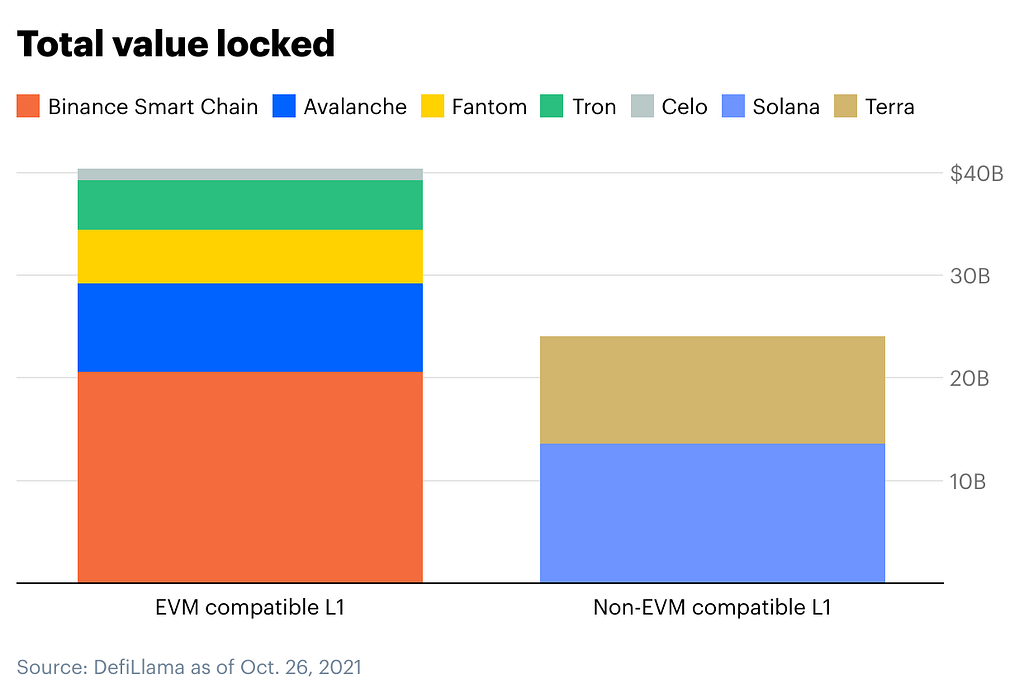
Conversely, Terra and Solana do not currently support EVM compatibility.
TVL of EVM compatible vs non-EVM compatible L1s
Interoperable Chains
In a slightly different layer 1 bucket are blockchain ecosystems like Cosmos and Polkadot. Rather than build new stand-alone blockchains, these projects built standards that let developers create application specific blockchains capable of talking to each other. This can allow, for example, tokens from a gaming blockchain to be used within applications built on a separate blockchain for social networking.
There is currently over $100B+ sitting on chains built using Cosmos’ standard that can eventually interoperate. Meanwhile, Polkadot recently reached a milestone that will similarly unite its ecosystem of blockchains.
In short, there’s now a diverse landscape of direct Ethereum competitors, with more on the way.
Sidechains
The distinction between sidechains and new layer 1s is admittedly a fuzzy one. Sidechains are very similar to EVM-compatible layer 1s, except that they’ve been purpose built to handle Ethereum’s excess capacity, rather than compete with Ethereum as a whole. These ecosystems are closely aligned with the Ethereum community and host Ethereum apps in a complementary fashion.
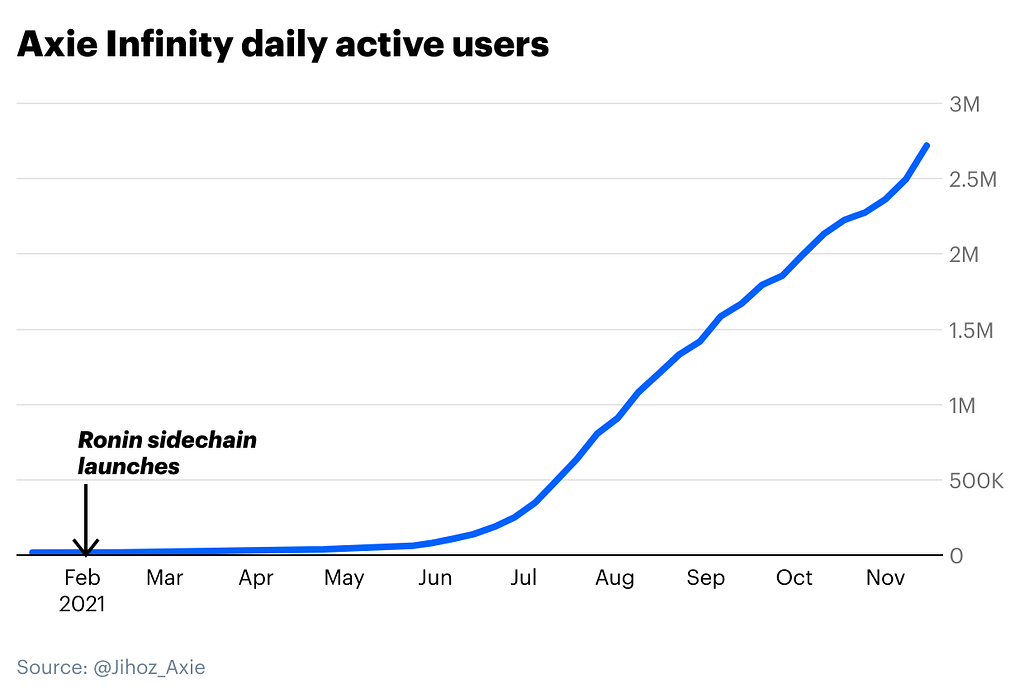
Axie Infinity’s Ronin sidechain is a prime example. Axie Infinity is an NFT game originally built on Ethereum. Since Ethereum fees made playing the game prohibitively expensive, the Ronin sidechain was built to allow users to move their NFTs and tokens from Ethereum to a low fee environment. This made the game affordable to more users, and preceded an explosion in the game’s popularity.
As of this writing, users have moved over $7.5B from Ethereum to Ronin to play Axie Infinity.
Polygon POS
Where sidechains like Ronin are application specific, others are suited for more general purpose applications. Right now, Polygon’s proof-of-stake (POS) sidechain is the industry leader with nearly $5B in value deployed over 100 DeFi and gaming applications including familiar names like Aave and Sushiswap, as well as a Uniswap clone called Quickswap.
Again, Polygon POS really doesn’t look that different from an EVM compatible layer-1. However, it’s been built as part of a framework to scale Ethereum rather than compete with it. The Polygon team sees a future where Ethereum remains the dominant blockchain for high value transactions and value storage, while everyday transactions move to Polygon’s lower-cost blockchains. (Polygon POS also maintains a special relationship with Ethereum through a process known as checkpointing).
With transaction fees of less than a penny, Polygon’s vision of the future looks plausible. And with the help of incentive programs, users have flocked to Polygon POS with daily transactions surpassing Ethereum (though spam transactions inflate this number).
Layer 2s (Rollups)
Layer 1s and sidechains both have a distinct challenge: securing their blockchains. To do so, they must pay a new cohort of miners or proof of stake validators to verify and secure transactions, usually in the form of inflation from a base token (e.g. Polygon’s $MATIC, Avalanche’s $AVAX).
However, this brings notable downsides:
Having a base token naturally makes your ecosystem more competitive rather than complementary to Ethereum
Validating and securing transactions is a complex and challenging task that your network is responsible for indefinitely
Wouldn’t it be nice if we could create scalable ecosystems that borrowed from Ethereum’s security? Enter layer 2 networks, and “rollups” in particular. In a nutshell, layer 2s are independent ecosystems that sit on top of Ethereum in such a way that relies on Ethereum for security.
Critically, this means that layer 2s do not need to have a native token — so not only are they more complementary to Ethereum, they are essentially part of Ethereum. The Ethereum roadmap even pays homage to this idea by signaling that Ethereum 2.0 will be “rollup centric.”
How rollups work
Layer 2s are commonly called rollups because they “rollup” or bundle transactions together and execute them in a new environment, before sending the updated transaction data back to Ethereum. Rather than have the Ethereum network process 1,000 Uniswap transactions individually (expensive!), the computation is offloaded on a layer 2 rollup before submitting the results back to Ethereum (cheap!).
However, when results are posted back to Ethereum, how does Ethereum know that the data is correct and valid? And how can Ethereum prevent anyone from posting incorrect information? These are critical questions that differentiate the two types of rollups: Optimistic rollups, and Zero Knowledge rollups (ZK rollups).
Optimistic Rollups
When submitting results back to Ethereum, optimistic rollups “optimistically” assume that they’re valid. In other words, they let the operators of the rollup post any data they want (including potentially incorrect / fraudulent data), and just assume it’s correct — an optimistic outlook no doubt! But there are ways to fight fraud. As a check and balance, there is a window of time after any withdrawal where anyone watching can call out fraud (remember blockchains are transparent, anyone can watch what’s happening). In the event that one of these watchers can mathematically prove that fraud occurred (by submitting a fraud proof), the rollup reverts any fraudulent transactions and penalizes the bad actor and rewards the watcher (a clever incentive system!).
The drawback is a brief delay when you move funds between the rollup and Ethereum, waiting to see if any watchers catch any fraud. In some cases this can be up to a week, but we expect these delays to come down over time.
The key point is that optimistic rollups are intrinsically tied to Ethereum and ready to help Ethereum scale today. Accordingly, we’ve seen strong nascent growth with many leading DeFi projects moving to the leading optimistic rollups — Arbitrum and Optimistic Ethereum.
Arbitrum & Optimistic Ethereum
Arbitrum (by Off-chain Labs) and Optimistic Ethereum (by Optimism) are the two main projects implementing optimistic rollups today. Notably, both are still in their early stages, with both companies maintaining levels of centralized control but with plans to decentralize over time.
It’s estimated that once mature, optimistic roll ups can offer anywhere from a 10–100x improvement in scalability. Even in their early days, DeFi applications on Arbitrum and Optimism have already accrued billions in network value.
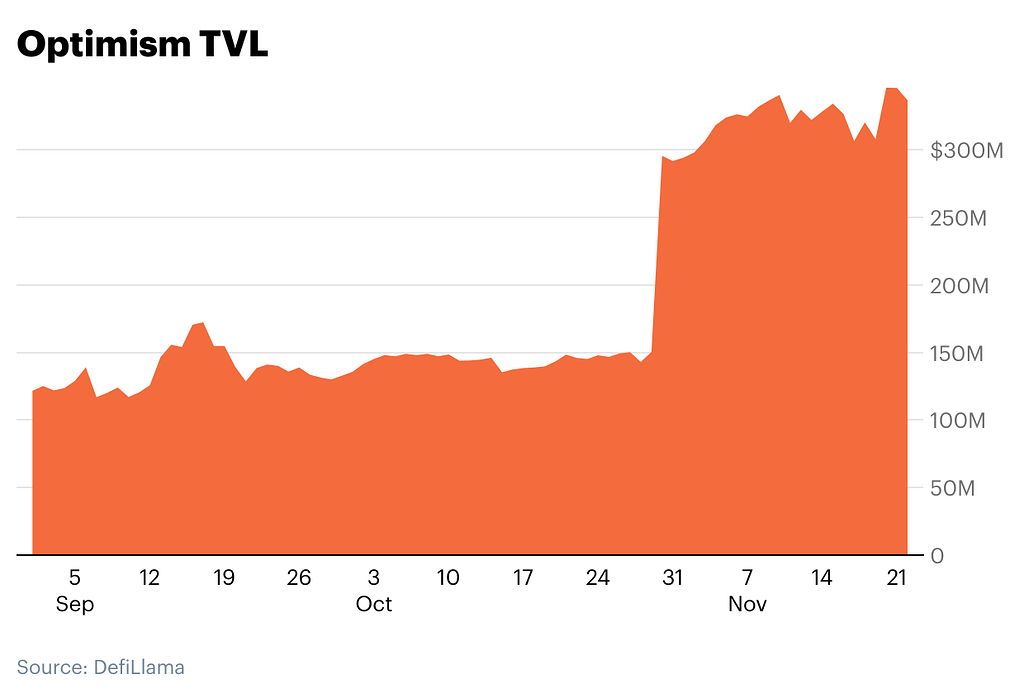
Optimism is earlier in its adoption curve with over $300M in TVL deployed across 7 DeFi applications, most notably Uniswap, Synthetix, and 1inch.
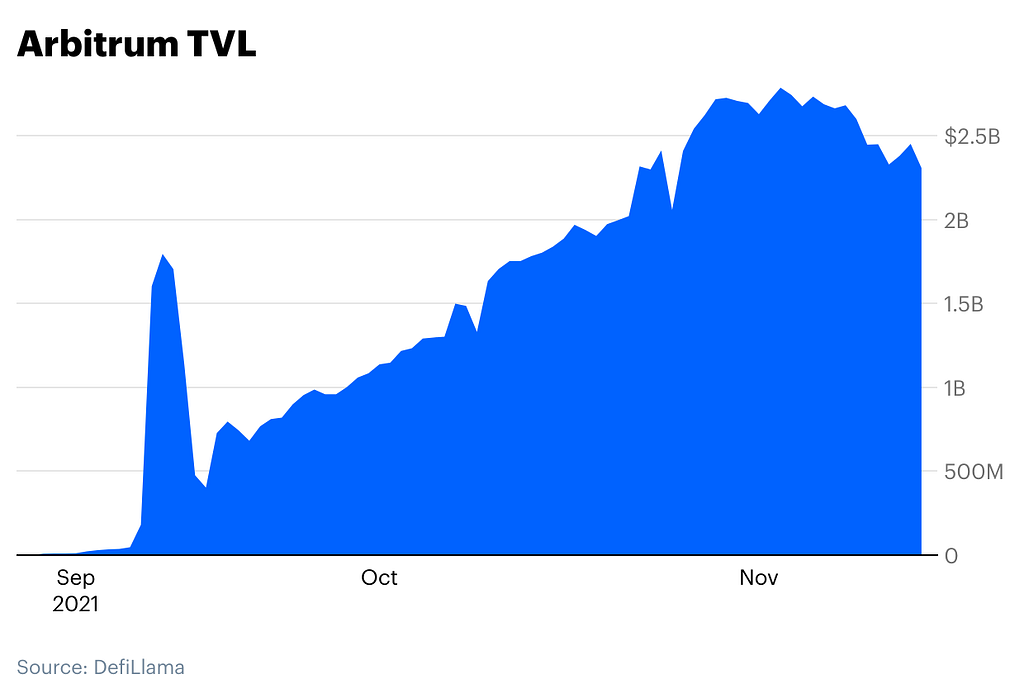
Arbitrum is further along, with around $2.5B in TVL across 60+ applications including familiar DeFi protocols like Curve, Sushiswap, and Balancer.
Aribtrum has also been selected as Reddit’s scaling solution of choice for their long awaited efforts to tokenize community points for the social media platform’s 500 million monthly active users.
ZK Rollups
Where optimistic rollups assume the transactions are valid and leave room for others to prove fraud, ZK rollups do the work of actually proving to the Ethereum network that transactions are valid.
Along with the results of the bundled transactions, they submit what’s called a validity proof to an Ethereum smart contract. As the name suggests, validity proofs let the Ethereum network verify that the transactions are valid, making it impossible for the relayer to cheat the system. This eliminates the need for a fraud proof window, so moving funds between Ethereum and ZK-rollups is effectively instant.
While instant settlement and no withdrawal times sound great, ZK rollups are not without tradeoffs. First, generating validity proofs is computationally intensive, so you need high powered machines to make them work. Second, the complexity surrounding validity proofs makes it more difficult to support EVM compatibility, limiting the types of smart contracts that can be deployed to ZK-rollups. As such, optimistic rollups have been first to market and are more capable of addressing Ethereum’s scaling woes today, but ZK-rollups may become a better technical solution in the long run.
ZK Rollup Adoption
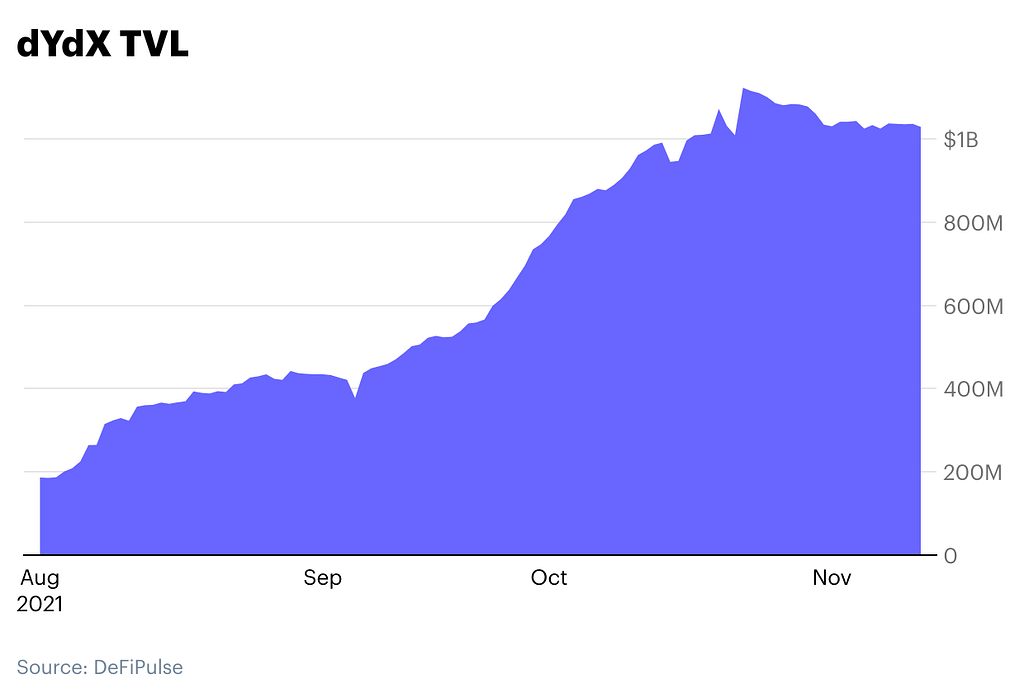
The ZK rollup landscape runs deep, with multiple teams and implementations in the works and in production. Some prominent players include Starkware, Matter Labs, Hermez, and Aztec. Today, ZK-rollups mainly support relatively simple applications such as payments or exchanges (owing to limitations on what types of applications ZK-rollups can support today). For example, derivatives exchange dYdX employs a ZK rollup solution from Starkware (StarkEx) to support nearly 5 million weekly transactions and $1B+ in TVL.
The real prize however, is ZK rollup solutions that are fully EVM compatible and thus capable of supporting popular general applications (like the full suite of DeFi apps) without the withdrawal delays of optimistic rollups. The main players in this realm are MatterLab’s zkSync 2.0, Starkware’s Starknet, Polygon Hermez’s zkEVM, and Polygon Miden, which are all currently working towards mainnet launch. (Aztec, meanwhile, is focused on applying zk proofs to privacy).
Many in the industry (Vitalik included) are looking at ZK rollups in conjunction with Ethereum 2.0 as the long term solution to scaling Ethereum, mainly stemming from their ability to fundamentally handle hundreds of thousands of transactions per second without compromising on security or decentralization.The upcoming rollouts of fully EVM compatible ZK rollups will be one of the key things to watch as the quest to scale Ethereum progresses.
A fragmenting world
In the long run, these scaling solutions are necessary if smart contract platforms are to scale to billions of users. In the near term, these solutions, however, may present significant challenges for users and crypto operators alike. Navigating from Ethereum to these networks requires using cross-chain bridges, which is complex for users and carries latent risk. For example, several cross-chain bridges have already been the target of $100+ million dollar exploits.
More importantly, the multi-chain world fragments composability and liquidity. Consider that Sushiswap is currently implemented on Ethereum, Binance Smart Chain, Avalanche, Polygon, and Arbitrum. Where Sushiswap’s liquidity was once concentrated on one network (Ethereum), it’s now spread across five different networks.
Ethereum applications have long benefited from composability — i.e. Sushiswap on Ethereum is plug-and-play with other Ethereum apps like Aave or Compound. As applications spread out to new networks, an application implemented on one layer 1/sidechain/layer 2 is no longer composable with apps implemented on another, limiting usability and creating challenges for users and developers.
An uncertain future
Will new layer 1s like Avalanche or Solana continue to grow to compete with Ethereum? Will blockchain ecosystems like Cosmos or Polkadot proliferate? Will sidechains continue to run in harmony with Ethereum, taking on its excess capacity? Or will rollups in conjunction with Ethereum 2.0 win out? No one can say for sure.
While the future is uncertain, everyone can take solace in the knowledge that there are so many smart teams dedicated to tackling the most challenging problems that open, permissionless networks face. Just as broadband ultimately helped the internet support a host of revolutionary applications like YouTube and Uber, we believe that we’ll eventually look at the winning scaling solutions in the same light.
* This post focuses on scaling smart-contract based blockchains. Bitcoin scaling is best saved for a future post.
Scaling Ethereum & crypto for a billion users was originally published in The Coinbase Blog on Medium, where people are continuing the conversation by highlighting and responding to this story.
Ethereum started a fresh increase from the $4,500 zone against the US Dollar. ETH could extend upsides towards $4,850 unless it fails to stay above the 100 hourly SMA.
Ethereum started a fresh increase above the $4,600 and $4,700 levels.
The price is now trading above $4,650 and the 100 hourly simple moving average.
There was a break above a major bearish trend line with resistance near $4,630 on the hourly chart of ETH/USD (data feed via Kraken).
The pair could extend gains above the $4,800 resistance zone in the near term.
Ethereum Price Eyes More Upsides
Ethereum formed a decent support base above the $4,500 level. As a result, ETH price started a fresh increase above the $4,600 resistance zone and the 100 hourly simple moving average.
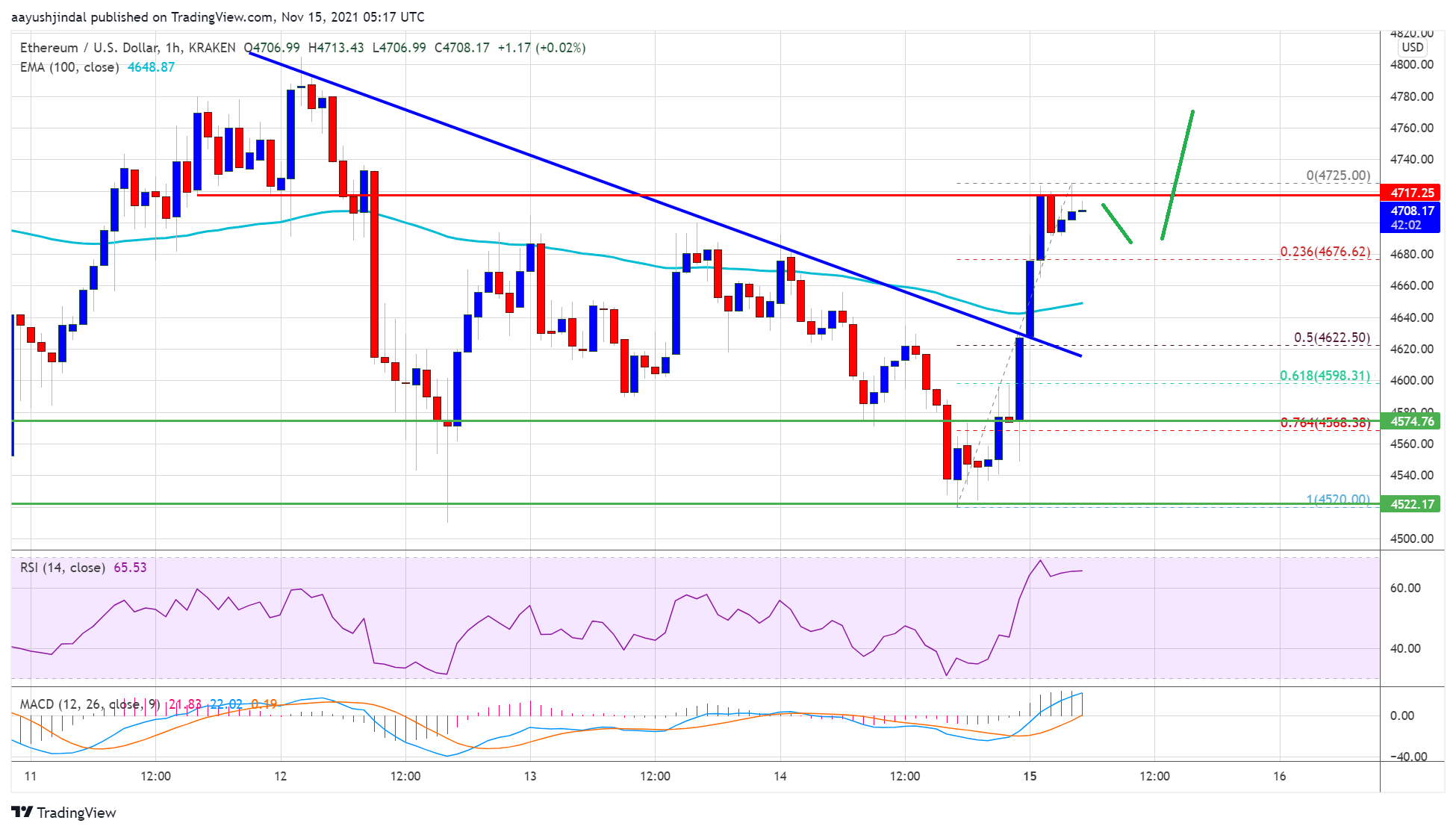
There was a break above a major bearish trend line with resistance near $4,630 on the hourly chart of ETH/USD. The pair climbed above the $4,700 level, but it is now facing resistance near the $4,725 level.
Ether is now consolidating gains and trading near $4,700. It is also well above the 23.6% Fib retracement level of the upward move from the $4,520 swing low to $4,725 high. An immediate resistance on the upside is near the $4,725 level.
Source: ETHUSD on TradingView.com
The next major resistance is near the $4,750 level. A break above the $4,750 level may possibly spark a fresh rally. The next key resistance is near the $4,850 level. Any more gains could lead the price towards the $5,000 level in the near term.
Dips Supported in ETH?
If ethereum fails to climb above the $4,725 and $4,750 resistance levels, it could extend its downside correction. An initial support on the downside is near the $4,675 level.
The first major support is near the $4,650 level and the 100 hourly SMA. The next major support is near the $4,620 level. It is near the 50% Fib retracement level of the upward move from the $4,520 swing low to $4,725 high. Any more downsides could lead the price towards the $4,550 support. The next major support for the bulls is near the $4,500 level.
Technical Indicators
Hourly MACD – The MACD for ETH/USD is slowly losing pace in the bullish zone.
Hourly RSI – The RSI for ETH/USD is now well above the 50 level.
Did Steve Hanke find a way out of the hole he’s been digging himself into for all these years? The economist holds the world record for the person with the highest number of terrible Bitcoin takes, with almost 13 years of failed predictions. And now, out of nowhere, he seems to like the world’s second cryptocurrency by market capitalization. What does he like about Ethereum, though? The “560% price surge this year,” of course. But there’s more…
Ethereum is giving Bitcoin a run for its money. Ethereum has become increasingly popular amongst DeFi and NFTs, resulting in a 560% price surge this year. Has the look of a bubble. But, is it?https://t.co/2fkvuNoRWz
Wait… is Steve Hanke into NFTs? The man said, “Ethereum has become increasingly popular amongst DeFi and NFTs” without a hint of irony. He also said, “Ethereum is giving Bitcoin a run for its money,” which is the most positive thing Steve Hanke has said about Bitcoin in over a decade. And, in the end there, he leaves space for possible deniability, “Has the look of a bubble. But, is it?”
The economist also links to an extremely basic and clumsy CNN article. Is Steve Hanke warming up to cryptocurrencies? Or is there some other dynamic at play here?
The Article Steve Hanke Linked To
This run-of-the-mill article doesn’t really say much. Its main message is the price action anyone reading NewsBTC is probably already familiar with.
“Ethereum, or ether for short, is also trading at record levels. It’s now hovering around $4,850, having soared more than 560% this year, compared to the “mere” 135% pop for bitcoin. Crypto investors are betting that ether will continue to be used as the backbone for even more non-fungible tokens, or NFTs, as well as so-called smart contracts.”
Ok, what else do you got for us? Not much. It’s all over the place. It breaks down the total cryptocurrency market capitalization, introduces the concept of the mythical “flippening,” and tries to keep people away from meme coins. To accomplish this, CNN quotes Paxfull’s Ray Youssef saying, “Ether and bitcoin versus meme coins are like the difference between blue chips and penny stocks you get a call about from a guy in a boiler room.” The article also talks about inflation, how could it not?, and introduces ETFs into the picture.
“The rise of bitcoin ETFs also could be good news for ethereum, because experts predict that similar ether ETFs could soon launch. That will make it even easier for average investors and big money management firms to buy into the crypto.”
So, all in all, it doesn’t say much and the only clear fact it presents is that Ethereum had a better year than Bitcoin. Why did Steve Hanke link to it, then?
ETH price chart for 11/13/2021 on Bitfinex | Source: ETH/USD on TradingView.com
Is Hanke Trying To Find A Lifeboat?
Here at NewsBTC, we constantly argue with Steve Hanke. Just in the last year, we responded to him calling Bitcoin not legitimate, not a currency, and the concept of it being legal tender “stupid.” And now, Hanke seems to like Ethereum. Why? Is it because Ethereum’s internal policies are more akin to the traditional banking system he’s accustomed to? Or did Hanke realize that cryptocurrencies are here to stay and is too afraid to admit he was wrong about Bitcoin for all these years?
In any case, the main reaction in his replies so far is mockery. Even notorious Ethereum defender Udi Wertheimer said, “this is the most bearish ethereum signal i’ve seen in my entire life.” Let’s keep an eye on Hanke’s Twitter feed and see what the economist says about Ethereum in the next few days. This is going to be interesting.
Featured Image: RobinHiggins at Pixabay | Charts by TradingView
Sam Trabucco, co-CEO of Alameda Research, discusses the different price drivers that led to BTC, ETH, SOL, and LUNA reaching new all-time highs in the past week. Show highlights:
why Sam believes no bad news from regulators is good news
what effect leverage has on the crypto markets
the significance of Bitcoin hitting a new all-time high and the crypto market cap reaching $3 trillion
how the approval of a bitcoin futures ETF affected the crypto market
what Sam thinks about the actions of US crypto regulators (hint: it’s probably not what you would think)
why Sam thinks ETH’s price hit a new all-time this week
what Sam thinks about the changes to ETH monetary policy and the upcoming merge to Ethereum 2.0
how Sam views the competition among layer 1 blockchains and why he is not a fan of maximalism
what factors he believes are driving the price of SOL
what sort of projects are being built on Solana, and why people are excited about the ecosystem
what Sam thinks about Terra passing a proposal to burn LUNA