After two years and many COVID-19 restrictions finally subsiding, the world is welcoming the return of in-person theater, movies, comedy, music and sports. This has left some wondering what will happen to the legions of digital creatives who occupied and entertained us while normal life was at a standstill — and to the multibillion-dollar economy they inhabit.
Will the world forget the platforms and artists they discovered during the pandemic now the doors of festivals, fashion shows and concerts are open to them again? Is the creator economy, which recent estimates suggest will exceed $100 billion this year, strong enough to withstand a stampede back to real-life experiences?
I strongly believe it is. Government-imposed restrictions may have accelerated the pace of change, but the transformative trends in video streaming we witnessed during the pandemic were nascent before and would have caught hold regardless.
And, while I claim no deep training in macroeconomics, I am a technologist who has spent the past several years working in and around one of the most transformative new technologies to arise in decades: the blockchain. This is the technology that will completely reshape digital life, supercharging the creator economy in the process.
Related: Decentralization revolutionizes the creator’s economy, but what will it bring?
Playing on a digital stage
The enforced slowdown has given many artists the time — and the push — needed to experiment in the digital sphere, find new audiences and explore new ways to showcase their talents.
Even musicians who might never have given serious thought to live streaming a concert have taken to the digital stage. And, there’s evidence this will continue. Take singer Dua Lipa, who broke paid livestreaming records with 2020’s Studio 2054 concert. Initially said to be reluctant, Dua Lipa decided to go the livestream route after being forced to postpone an album tour. This turned out to be a good call: Her digital appearance drew more than five million views globally.
A survey from Middlesex University and funded by the UK Economic and Social Research Council showed that some 90% of musicians and 92% of fans believe livestreaming would remain an effective way to reach fans unwilling or unable to travel to venues in the post-pandemic world. Providers should take note: The study also found that audiences do not expect free access to live music and are not particularly discouraged by paywalls.
The rise in creative energy has inspired the developer community as well. New niche streaming platforms have grown up, helped by the emergence of low-cost decentralized infrastructure that allows application builders to encode video, store data and handle identity without having to pay expensive centralized cloud providers for such services.
Related: Music in the Metaverse creates social and immersive experiences for users
These centralized providers will increasingly find themselves on the defensive. Two attention-grabbing incidents in 2021 are illustrative: Hackers attacked Twitch and released private information about its code and its users to the world. And, Facebook suffered colossal reputational damage from a lengthy outage and whistleblower claims that its management has repeatedly chosen to prioritize profit over safety.
What comes next?
Big Tech’s woes and pandemic-related restrictions have sped up fundamental changes already underway in how the world produces, consumes and uses video content — changes likely to propel growth in the creator economy well into the future. And, given the increasing availability of low-cost decentralized blockchain infrastructure, these emerging players have a shot at mounting a serious challenge to the FAANG-run streaming providers.
There are five ways that blockchain will hasten growth in the creator economy, and help cement it as a central force in worldwide culture and entertainment:
Exclusivity: Nonfungible token- (NFT-) gated access and NFT ticketing are only two of the decentralized tools that improve the digital experience for event-goers: NFT tickets curb scalping while giving attendees a unique souvenir, all while token gating supports unique experiences for fans such as access to private groups and direct messaging with creators.
Fan ownership: The Web3 era is defined by the shift from extracting value from renters to accreting value to owners. Just as the blockchain enables fans to engage directly with their favorite creators, it offers a pathway to asset ownership in individual creator economies outside of traditional centralized platforms.
Low-cost streaming: Video streaming accounts for more than 80% of Web2 internet traffic and counting. Developers, eager to seize a piece of this market without being crushed by high costs, are increasingly seeking blockchain-based affordable infrastructure to support creator streams. With their new ability to draw global audiences through on-demand access-anywhere streams, creators are turning to uniquely Web3 features such as tipping, paid entry and live shopping to monetize their content.
Immersive interactivity: The one-way nature of Web2 publishing is already giving way to immersive interactivity that rewards users for participation. With the ability to record immutably and securely on the blockchain, creators can incentivize interactions without sacrificing privacy.
Niche down: While Web2 was built to scale up, Web3 is built to niche down. With its lower cost, increased security and resistance to censorship, the blockchain makes it possible to build micro-communities serving smaller niches than would be economically viable in Web2. That’s a fundamental shift that not only puts creators in control but also makes communities less appealing to attention-seeking trolls.
The stage has been set for a blossoming of creative activity, and those poised to take it will be assisted by decentralized infrastructure.
Related: The Metaverse will change the live music experience, but will it be decentralized?
Digital creatives have always recognized that they must be nimble to succeed. Now, there is a technology that will empower them and their analog peers to reach new audiences on their own terms without having to cede power or profit to tech behemoths like Google and Amazon.
My faith in the ability of musicians, gamers, influencers and creators to adapt to the new realities to come — and to thrive in them — has never been stronger.
The creator economy? The clue’s in the name.
This article does not contain investment advice or recommendations. Every investment and trading move involves risk, and readers should conduct their own research when making a decision.
The views, thoughts and opinions expressed here are the author’s alone and do not necessarily reflect or represent the views and opinions of Cointelegraph.
Doug Petkanics is a co-founder at Livepeer, where the team is building a decentralized live video broadcast platform to enable the next generation of video streaming. Prior to Livepeer, Doug was co-founder and CEO of Wildcard, a mobile browser. He also co-founded Hyperpublic, which was acquired by Groupon. He was the VP of Engineering at both.
From video game enthusiasts monetizing their passions as shout casters to fashion influencers supercharging their careers into livestreamers on e-commerce platforms, the creator economy flourished, evolved and matured in the past year. Largely catalyzed by the ongoing COVID-19 pandemic, contemporary creators benefited from the gradual shift in consumer behaviors as more people came online across the globe. Now valued at over $100 billion, the creator economy is witnessing staggering growth as the worlds of e-commerce, social media and online communities converge.
With opportunities mounting in social tokens and corresponding virtual playgrounds such as the Metaverse, the year ahead seems to be filled with a great deal of promise. What lies ahead for creators in an increasingly digital and decentralized 2022?
A more equitable dynamic
From OnlyFans to TikTok, social networks may give creators access to communities but these creators are what drive traffic to these platforms due to the strength of their content. Whether they are an artist, musician, writer, photographer or all-around influencer, they are the true revenue drivers on these platforms. However, the relationship between a creator and their community is ultimately intermediated by a third party — the platform — which can impact the extent to which a creator is fully rewarded and compensated for their work. Sometimes this manifests itself as a cut in revenue and can even impact the type of content created and what it can include.
Related: Twitter and TikTok embrace NFTs: Mainstream adoption incoming?
Imagine if you could create without limits. This is the benefit that social tokens stand to offer. Blockchain-powered fan tokens can fulfill several functions: For one, they can be used to reward fans for their engagement, further encouraging them to engage with a universe of content. Not only does this help in growing one’s community, but social tokens can also be used as a medium of exchange — fans can directly compensate creators for work that they like, powering a mini economy that effectively cuts out the middleman from the equation. By essentially tokenizing themselves, creators invite their fans to take a stake in all they do — consider the example of 23-year-old entrepreneur Alex Masmej who launched ALEX to raise enough funds for a flight to San Francisco to launch his startup.
Social tokens essentially represent the ethos of Web3, connecting creators and consumers of content directly and enabling them to benefit from a value exchange. However, there are philosophical questions that merit some thought. What does it mean to tokenize yourself? Do you risk raising the bar and the pressure to perform? After all, incidents of social media influencers struggling to meet the demands of their followers have been well-chronicled. But as the creator economy continues to evolve, social tokens are still a valuable step forward that looks to level the financial playing field for what’s fast becoming a legitimate career path.
Revitalizing the meaning of engagement
Much like social tokens, nonfungible tokens (NFTs) are another innovation shaping the creator economy. Consider that the NFT-based crypto art market is now worth over $2.3 billion (as of mid-February 2022), pointing to the lucrative opportunity that artists have in accessing new monetization streams for their work.
Meanwhile, NFTs can also be leveraged to engineer a new model of fan engagement as they reconcile virtual assets with real-world experiences. Enter the phygital experience — a mix of physical and digital. NFTs can be tied to real-world perks — if you’re a musician, that could mean a lifetime supply of concert tickets or VIP meet and greets and as an artist, a select number of prints in a collection — all while ensuring that these assets verifiably belong to a fan, attesting to their ownership and authenticity. As economies gradually reopen and we continue to see the eventual normalization of social activities, experiential NFTs as a tool for long-term fan engagement are likely to grow in popularity.
Let’s not stop there, though: Enter interactive NFTs. These assets can change over time based on a fan’s modification to the content. Consider a digital collectible like a player card issued by an athlete — a fan can request for a digital autograph to be emblazoned onto the item, effectively adding to and altering the NFT, adding to its scarcity. For artists, this could mean creating collaborating digital artworks that their fans can add to, allowing for a more active two-way fan-creator relationship.
Related: Bull or bear market, creators are diving headfirst into crypto
Celebrating the rise of Asia
Much has been said about the age of Asia and that phenomenon certainly extends to the continent’s creator economy. In 2021, the number of influencers across the region grew by 66 percent, particularly in markets such as Indonesia, Japan, the Philippines, Taiwan and Thailand. While the influence of Western social networks is certainly widespread across the continent — with the likes of Indonesia’s growing population of digital natives ranking fourth in the world for Instagram usage — localized homegrown alternatives continue to proliferate. From China’s Sina Weibo to Japan’s LINE, creators need to master strategies to best navigate the cultural and communal nuances unique to each market.
Though the majority of Asian nations are still on the rise, China has arguably solidified its position as a leader in the creator economy, backed by a mature, professionalized network of e-commerce platforms that have helped to popularize live streaming as a career — a market that is estimated to rake in $60 billion each year. The model is fast replicating itself in other Asian markets, especially across Southeast Asia by e-commerce marketplaces such as Lazada and Shopee.
Related: All eyes on Asia: Crypto’s new chapter post-China
Meanwhile, a digital-savvy approach to tackling the physical restrictions posed by the coronavirus has been actively employed by Asian creators — to see this, one doesn’t need to look further than K-pop musicians who’ve seamlessly transitioned to offering virtual experiences to their fans and has entered the world of NFTs to mint audio-visual digital collectibles that their fans can buy, sell and trade.
Asia is primed to play host to this development given the legitimization and formalization of its continental creator economy. Whether it’s a traditional celebrity or an entrepreneur turned livestreamer, the opportunities for them to rally a community of loyal fans and shoppers rests firmly in their hands. But in light of the unique nuances to navigate across each culture, local firms should be taking a distinctly localized approach to celebrating the very differences that add to the challenge of mastering Asia’s creator landscape. A decentralized community strives to put the power back in the hands of creators with a model that’s uniquely made in Asia for Asia. As the continent’s creator economy continues to flourish, only time will tell how both fans and creators will adapt to the incoming wave of decentralization.
The value of alternatives
Contemporary creators are burdened by choice — forced to reckon with the growing number of platforms and access points to cultivate new and existing communities of fans. With the era of Web3 upon us, it’s truly an exciting time to be a creator. What we can hope to see is a creator economy that no longer rests on a disparate landscape of channels, but a distributed, interoperable network that maximizes all the touchpoints and opportunities to meaningfully engage. Meanwhile, the staggering rise of Asia and its influential position in generating cultural products and developing new platforms that have the potential to shape multiple industries is set to redefine the creator economy and its participants as we know it.
As we look to 2022, creators are now, more than ever, armed with innovations to set apart their offerings — from virtual worlds to collectibles growing in sophistication. Beyond that, they now have new pathways to explore, ones that can ultimately promise a more equitable, leveled playing field as they transform their passions into careers. The opportunities on the horizon are clear: The dawn of decentralization is the next step in bringing the creator economy to new heights.
This article does not contain investment advice or recommendations. Every investment and trading move involves risk, and readers should conduct their own research when making a decision.
The views, thoughts and opinions expressed here are the author’s alone and do not necessarily reflect or represent the views and opinions of Cointelegraph.
Weiwei Geng is the CEO of Unite, a creator ecosystem built in Asia for Asia that looks to put power into the hands of the continent’s creative communities. In addition to his role at Unite, Weiwei is also the co-founder of Rally and serves as an executive board member of the RLY Network Association. Previously, Weiwei served as managing director of China at Gen.G, a leading esports organization with top teams in China, South Korea and the United States.
Around the Block from Coinbase Ventures sheds light on key trends in crypto. In this edition, Justin Mart, Connor Dempsey, and Hassan Ahmed explore the growth of NFT games and the play-to-earn economy. Plus, a look at NFT marketplace activity and the Poly Network exploit.
We’re at an exciting time in crypto: one in which cryptonetworks are blossoming into full-fledged virtual economies. Nowhere is this more on display than with NFT gaming.
At the forefront of NFT gaming sits Axie Infinity and its play-to-earn model: a model that pays people in crypto to play a fun video game. With over one million daily active users, Axie Infinity has exploded in popularity in emerging markets and is showing the potential to be a trojan horse for on-boarding the next generation of crypto users.
On top of that, Axie Infinity and play-to-earn gaming has spawned its own thriving financial services sector.
The rise of Axie Infinity
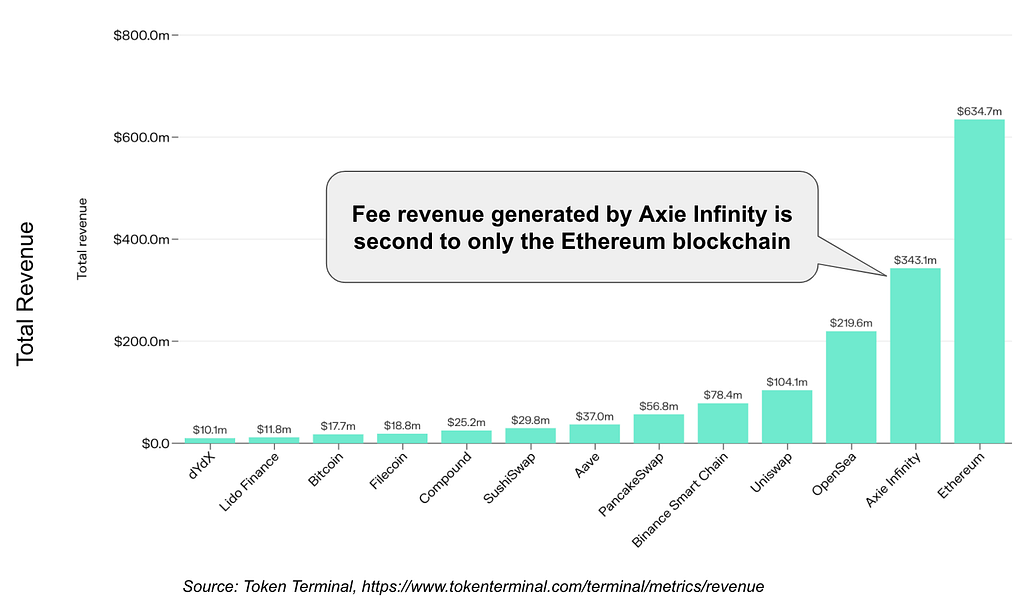
Over the last 30 days, Axie Infinity generated a head turning $343M in fee revenue. This is more than any app or protocol in crypto aside from the Ethereum blockchain, according to Token Terminal.
So where’s that revenue coming from?
How Axie Infinity generates revenue
The Axie Infinity economy consists of a governance token (AXS) and a second token called Smooth Love Potion (SLP) that serves as an in-game currency, along with NFTs that represent both game characters and virtual real estate.
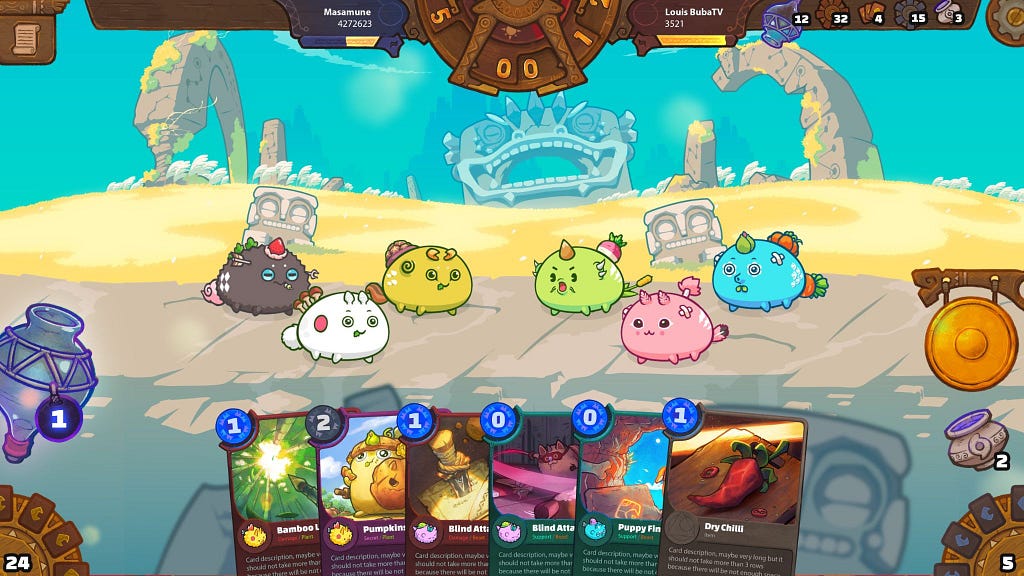
The gameplay itself is often compared to Pokemon, where players battle “Axies” (pictured below) against those of other players. Different Axies have different strengths and weaknesses, and the strategy of the game comes down to playing to your Axies strengths better than your opponent. Players get paid in SLP for defeating opponents. Additionally, players can compete daily quests to earn additional SLP. Axies can also be “bred” together to create new Axies which can in turn be sold to other players for profit.
Every time an Axie is traded, a plot of real estate is sold, or two Axies are bred, the protocol takes a fee priced in a combination of AXS and SLP. Rather than go to the developers, this revenue is placed in the Axie treasury, which has ballooned to nearly $600 million.
While the protocol revenue numbers alone depict the emergence of a new breakout crypto application, what’s more exciting is where Axie Infinity is taking off: in developing nations where players can often earn more playing the game and selling SLP for their native currencies than they can with a typical day job.
With an estimated 50% of daily active users (DAUs) coming from the Philippines, the game is also picking up steam in other emerging markets like Indonesia, Brazil, Venezuela, India, and Vietnam.
Created by game developer Sky Mavis in 2018, Axie started picking up organic traction in the Philippines in early 2020 after a few players realized they could make legitimate incomes by playing. When Covid lockdowns hit and many were put out of work, more were encouraged to give it a try. A documentary on the game’s growth called PLAY-TO-EARN went viral in May 2021 and DAUs went vertical soon after.
Business models of the metaverse
Unlike many mobile games, Axie Infinity is not free to play. To get started, players need to obtain 3 Axie Infinity characters. In the earlier days of the game, the average Axie was selling for under $10. With the game’s rapid growth and the broader NFT rally, the average Axie is now selling for nearly $500 according to CryptoSlam.
Given Axie’s base within the Philippines and other emerging markets, a $1,500 entry tag is a non-starter for most would-be players. To mitigate this barrier to entry, an informal market emerged in which NFT owners began lending players the NFTs needed to play the game in exchange for a cut of their winnings. This is done through QR codes that let players use Axie NFTs in game without the lender having to cede ownership on-chain.
This informal market has blossomed into a formal play-to-earn financial services sector. The largest and most prominent player is a project called Yield Guild Games.
Yield Guild Games (YGG)
Founder Gabby Dizon likes to say that Yield Guild Games is one part Berkshire Hathaway and one part Uber.
Just as Berkshire Hathaway is a holding company for a multitude of businesses, YGG is essentially a holding company for play-to-earn gaming assets. Starting in 2020, they’ve been buying up yield producing NFTs, governance tokens, and ownership stakes in promising gaming projects and protocols.
Similar to how Uber pairs people who want to earn money driving with people who need rides, YGG pairs people who want to make money gaming with the NFTs they need to earn in play-to-earn games. In many parts of the world, people are opting to work with YGG over Uber simply because it pays more.
YGG recently released its July Asset & Treasury Report that offers an interesting glimpse into the new kinds of business models NFTs and play-to-earn games are creating.
YGG by the numbers
Within YGG, there are scholars and community managers. Scholars receive NFTs that they in turn put to work earning crypto. Community managers recruit and train new scholars. 70% of winnings go to scholars, 20% to community managers, and 10% to the Yield Guild Games treasury.
According to the report, 2,058 new scholars joined YGG in July bringing the total to 4,004. In the same month, YGG scholars generated 11.7M SLP by playing Axie Infinity, which equated to over $3.25M in direct revenue. From April through July, scholars and community managers have earned a cumulative of $8.93M.
From its cut of all SLP earned by scholars, YGG earned $329,500 in July and a total of $580,000 since April. YGG’s expenses currently outstrip revenue, as they spent $1.62M in July alone “breeding” new Axie’s to meet scholar demand (breeding can cost anywhere from $200 to $1,200 per Axie).
The YGG Treasury
The YGG treasury consists of tokens and stablecoins held in a wallet, NFTs, and venture investments made in various play-to-earn games. The project has been funded by a $1.325M seed round led by Delphi Digital and another $4.6M round from a16z. They also raised $12.49M from the sale of the YGG governance token, while holding 13.3% of its outstanding supply.
As of the end of July, the YGG wallet’s holdings stood at $415M, with the majority stemming from the YGG token ($373M). The YGG token is part of Yield Guild Game’s plan to transition into a community-governed DAO.
Much of YGG’s capital has been put to work buying NFTs that can earn yield from play-to-earn games. By the end of July, the YGG treasury had amassed 19,460 NFTs valued at over $10M across 12 play-to-earn games. Axie Infinity NFTs comprised close to 90% of that value.
YGG has also made early stage investments across 8 play-to-earn games via SAFT (Simple Agreement for Future Tokens), and locked in ~$1M for yield farming in blue-chip DeFi projects.
A key element of the YGG model is that players are lent NFTs with zero downside risk and without having to put down any upfront capital. In return, they surrender 30% of their winnings but retain the majority — a critical hook to onboarding a new class of crypto users that have historically been priced out.
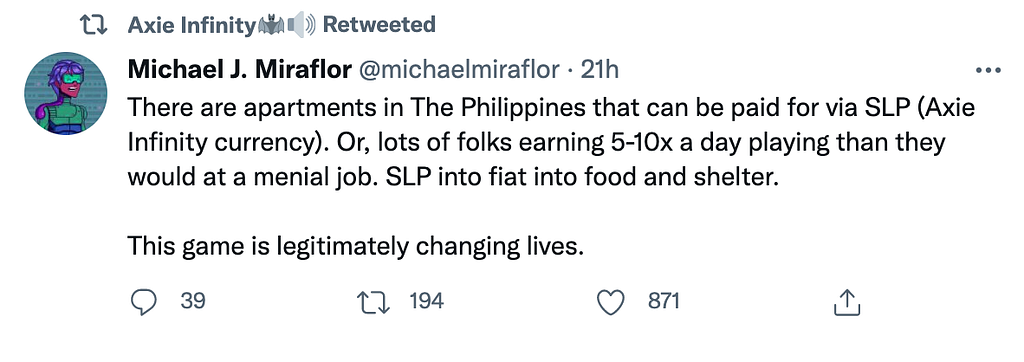
In fact, some players in the Philippines are earning 5–10x what they were making from their previous jobs. New homes have been purchased, charitable acts have been made, and even shops are accepting SLP as payment.
Beyond the wealth Axie Infinity has created, the game’s popularity has served as a means for getting a large new class of users comfortable using crypto applications. As these 1 million users interface with cryptocurrencies, NFTs, digital wallets, and DEXs, it’s not hard to see this new cohort as natural users of other DeFi and Web3 applications.
Play-to-earn sustainability
If Axie Infinity is its own digital nation, game developer Sky Mavis serves as its Federal Reserve. Where the Fed has various tools it uses to influence the economy, Sky Mavis can adjust the SLP issuance rate and breeding fees with the aim of keeping the Axie economy healthy. Just like a real economy, digital economies have to consider the effects of inflation.
ETH has been flowing into the Axie economy due to high demand for Axie NFTs. Increased demand for Axie NFTs has led to rising Axie NFT prices. Higher NFT prices have made breeding more profitable. Breeding requires fees paid in SLP & AXS, leading to a rise in token prices. With rising SLP prices, playing becomes more profitable, encouraging others to join. A powerful positive feedback loop no doubt — but what if market conditions change?
Winning Axie Infinity battles and quests yields SLP, inflating the SLP supply. And since breeding is priced in SLP, additional supply of SLP equates to cheaper breeding fees to create new Axie NFTs, inflating Axie NFT supply. These dynamics could have an impact on NFT market prices, which in turn may have a direct effect on the economics for players — a possible negative feedback loop.
Ultimately, Sky Mavis has to keep the SLP supply in-check while improving overall gameplay to keep its player economy and ETH deposits growing. They must also offset the number of players seeking to extract a profit with players who are pure consumers — i.e. playing for the fun of it.
Playing the Long Game
While Sky Mavis works to keep the Axie economy strong, Yield Guild Games is banking on the continued growth of play-to-earn gaming as a whole. By replicating its model for Axie Infinity across new games, it seeks to build a play-to-earn empire. Over the long run, founder Gabby Dizon sees YGG as the “recruitment agency of the metaverse” that ultimately competes with the Ubers of the world for labor. A future straight out of Ready Player One in which millions of people earn a living in the digital world in order to cover expenses in the physical one.
Final word
With the exploding revenue of Axie Infinity, the emergence of DAOs like Yield Guild Games, and the multitude of play-to-earn games on the horizon, it’s clear that this trend has legs. With DeFi, NFTs, and now crypto gaming, we’re rapidly evolving past the original crypto killer app of speculative trading and into a universe of expressive new apps and models. We’re in fascinating times as crypto’s utility phase marches forward with a full head of steam.
Quick Hits
OpenSea Hits $3B monthly volume
In the month of August, NFT exchange OpenSea hit $3B in monthly volume as over 1.5 million NFTs changed hands. Its August volume alone exceeds that of every other month in its history, combined.
OpenSea’s August volume is on par with $3B in gross sales Etsy put up in all of Q2: another sign of just how big the NFT market has grown relative to other online marketplaces in a very short timespan.
Data from The Block shows how dominant OpenSea’s dominance over the NFT landscape really is.
Notably absent from this exchange landscape are any kind of decentralized venues for trading NFTs. This follows past market cycles in which centralized exchanges found product market fit first, before ultimately paving the way for decentralized alternatives (think Uniswap during the DeFi summer).
The DEX market for NFTs is still nascent but one we’re watching is the recently launched Punks.house which is a permissionless venue for trading CryptoPunks made by Zora. We’re also seeing NFT markets begin to decentralize themselves, with NFT art marketplace Super Rare making the first move with the introduction of its RARE governance token. Many suspect OpenSea will eventually take this route as well.
Lastly, while OpenSea is a centralized for profit entity, its code is open source. It wouldn’t surprise us to see a low-fee competitor forked from OpenSea emerge in the coming months.
$611M whitehat hack?
In the largest DeFi hack to date, an attacker drained over $611M from the Ethereum, Binance Smart Chain, and Polygon blockchains. Then in a surprise move, he returned almost all of it.
The hack was done by exploiting vulnerabilities on the Poly Network, a cross-chain interoperability protocol that connects different blockchains. These types of networks are usually among the most complex, owing to challenges in getting two different blockchains to talk to each other in a secure, safe fashion (it’s hard enough getting one blockchain to be secure!). And complexity is the enemy of security because added complexity increases the surface area for attackers to find exploits.
In this case, the hacker tricked Poly Network’s smart contracts into thinking that the hacker’s address had permission to unlock the $611M+ across chains (detailed technical analysis here, simple explainer here). But in an odd turn of events, the hacker ended up returning nearly all of it to the Poly Network team (sans $33M USDT frozen by Tether).
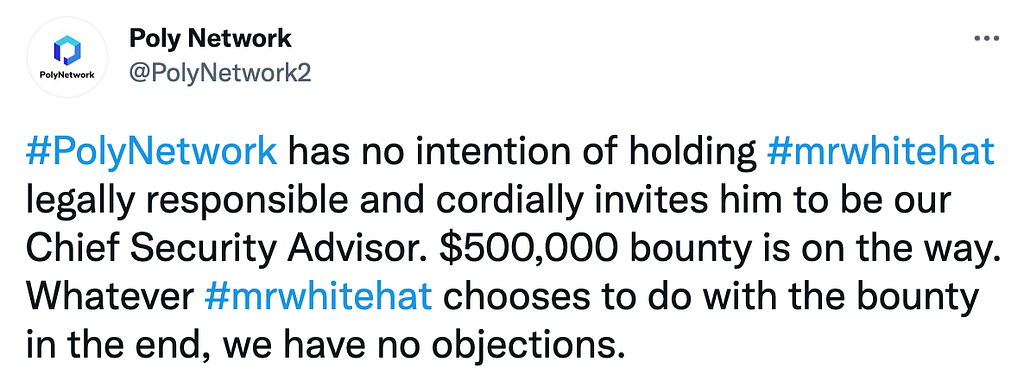
There remains speculation around the hacker’s motives to return the funds. Security firm SlowMist stated that they were able to identify the hacker’s IP and email addresses, so some think the funds were returned because the hacker knew they wouldn’t be able to launder that much money undetected. The hacker, on the other hand, conducted an AMA and stated that they did it, “for fun.” And in a separate twist, the Poly Network team offered the hacker a job as their Chief Security Officer in addition to sending a $500,000 bounty for returning some of the funds.
What’s going on here? We can’t know for sure, but it is rare for a hacker to return funds, especially in such a public fashion. Occam’s razor suggests that the repercussions involved with getting caught (if their info was truly identified) were too great to bear.
While it’s disconcerting to see more hacks happening, we should note that this is simply an evolutionary fitness-function in action. Each hack teaches us how to improve, and we learn, adapt, and improve. While bleeding edge crypto protocols pioneering new use cases will inevitably carry more risk, the space hardens over time.
And Poly Network is not alone. Note the other week when Paradigm’s samczsun discovered and reported a vulnerability in SushiSwap’s MISO platform that would have left $350M ETH at risk. Most recently, Cream Finance was exploited in a flashloan attack for $25M.
But for crypto to really succeed, we need security guarantees. Insurance markets are critical.
Retail news
Binance Tightens KYC Requirements — Leans into Compliance
The 2021 Global Crypto Adoption Index: Worldwide Adoption Jumps Over 880% With P2P Platforms Driving Cryptocurrency Usage in Emerging Markets
Crypto grows from 2% to 41% of Robinhood’s total revenue in past year
Japan’s Liquid Global Exchange Hacked; $90M in Crypto Siphoned Off
‘Novi is ready to come to market,’ says David Marcus as Diem’s future remains uncertain
Facebook Considering NFT Support in Novi Digital Wallet
Austrian crypto unicorn Bitpanda raises another $263 million
Institutional news
US Mortgage Lender UWM Plans to Accept Bitcoin Payments
Galaxy files for ETF that provides indirect exposure to bitcoin
Bloomberg and Galaxy team up on decentralized finance index
Former SEC chair Clayton joins Fireblocks advisory board
Galaxy reports losing $175 million during the last quarter in recent earnings call
Wells Fargo Launches Passive Bitcoin Fund for Wealthy Clients
Ecosystem news
Visa Enters Metaverse With First NFT Purchase
Budweiser buys Beer.ETH domain and a rocket NFT
Twitter taps crypto developer to lead decentralized social media initiative Bluesky
TikTok Picks Streaming Service Audius to Power New ‘Sounds’ Library
DeFi projects could come under SEC’s oversight, says chairman Gensler
a16z announces $4.6 million financing round in Yield Guild Games
Avalanche launches $180 million DeFi incentive scheme with Aave and Curve
Walmart is looking for a crypto product lead
Polygon acquires Hermez in $250 million deal that includes first-ever token ‘merger’
Ethereum 2.0 Staking Contract Now Holds the Most Ether: $21.3B
This website does not disclose material nonpublic information pertaining to Coinbase or Coinbase Venture’s portfolio companies.
Disclaimer: This material is the property of Coinbase, Inc., its parent and affiliates (“Coinbase”). The views and opinions expressed herein are those of the author and do not necessarily reflect the views of Coinbase or its employees and summarizes information and articles with respect to cryptocurrencies or related topics that the author believes may be of interest. This material is for informational purposes only, and is not (i) an offer, or solicitation of an offer, to invest in, or to buy or sell, any interests or shares, or to participate in any investment or trading strategy, (ii) intended to provide accounting, legal, or tax advice, or investment recommendations or (iii) an official statement of Coinbase. No representation or warranty is made, expressed or implied, with respect to the accuracy or completeness of the information or to the future performance of any digital asset, financial instrument or other market or economic measure. The information is believed to be current as of the date indicated on the materials. Recipients should consult their advisors before making any investment decision. Coinbase may have financial interests in, or relationships with, some of the entities and/or publications discussed or otherwise referenced in the materials. Certain links that may be provided in the materials are provided for convenience and do not imply Coinbase’s endorsement, or approval of any third-party websites or their content. Coinbase, Inc. is not registered or licensed in any capacity with the U.S. Securities and Exchange Commission or the U.S. Commodity Futures Trading Commission.
Axie Infinity, Yield Guild Games & the play-to-earn economy was originally published in The Coinbase Blog on Medium, where people are continuing the conversation by highlighting and responding to this story.