Major developer platform Github has reportedly blocked more than a dozen accounts of Russian developer’s associated with organizations sanctioned by the United States government.
The sanctioned accounts include some of the largest banks in Russia: Sberbank and Alfa-Bank, as well as individual developers with links to the sanctioned firms. However, many individual accounts with no links or ties to sanctioned firms were also blocked in the process, Researcher Sergey Bobrov, who reportedly has no links to any such firm, reported that his account was suspended on April 15 and then immediately restored.
My github account is unlocked, thanks everyone. The ban was related to the sanctions imposed on my previous employer.
Another individual developer, Vadim Yanitskiy, wrote:
“My Github account has been suspended without prior notification. Perhaps because I am ethnically Russian. ‘GitHub’s vision is to be the home for all developers, no matter where they reside,’ they said.”
Github is a popular software development platform used for storing, tracking and collaborating on software projects. It enables developers to upload their own code files and to collaborate with fellow developers on open-source projects. It has become a core part of the crypto ecosystem because of its open-source nature.
As per early reports, most of the firms and developers facing suspension belong to private Russian banks and no crypto firm or developer was impacted. Github didn’t respond to Cointelegraph’s request for comment at publishing time.
Related: North Korea-obsessed Ethereum dev gets 5 years for breaking sanctions
After a few Russian developers contacted Github regarding the suspension, they received a response, explaining the reasons behind their suspension with an added link through which they could appeal.
Github Reponse to Developers
The blocking of individual developers’ accounts has raised many questions, especially when the open-source platform has promised “ to ensure free open source services are available to all, including developers in Russia,”
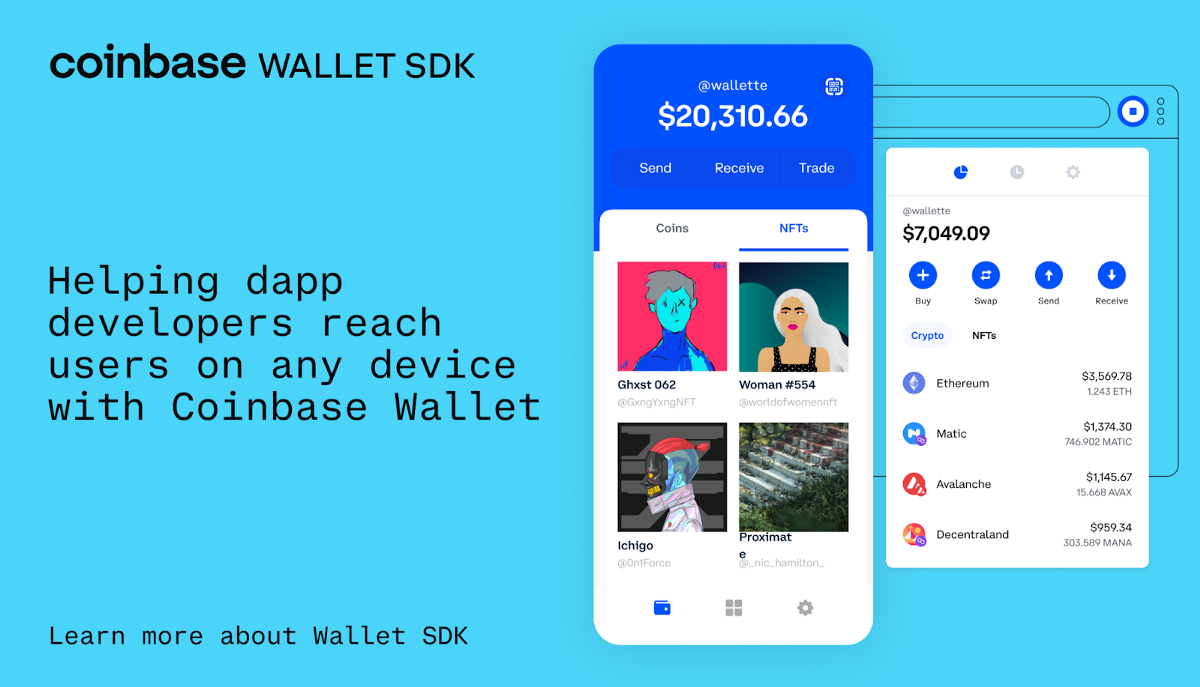
Expand your dapp’s reach with just a few lines of code
By Sid Coelho-Prabhu, Product Management Director, Wallet
Millions of people choose Coinbase Wallet to use dapps, earn yield with DeFi, trade more than hundreds of thousands of assets, and hold their NFTs. In just minutes you can integrate Coinbase Wallet in your dapp, expanding your reach to users on all of their devices — and open your dapp up to the multichain Coinbase ecosystem of over 89M users across 85 countries, on whatever device they prefer.
With just a few lines of code, you can open up access to your dapp to Coinbase Wallet users across the iOS and Android mobile apps as well as the Wallet browser extension on Chrome.
Coinbase Wallet SDK takes just 5 minutes to integrate and doesn’t require you to deploy any additional infrastructure. You can learn how to integrate with Coinbase Wallet in our technical documentation, read our post on using web3-react to connect, or watch the Coinbase Wallet SDK demo.
We are dedicated to making the benefits of crypto and the entire web3 ecosystem accessible to all — regardless of network or blockchain, country or currency, crypto savvy or crypto skeptical. We’re building Coinbase Wallet to reflect that commitment. With support for all EVM-compatible chains, including Avalanche, BNB Chain, Polygon, and many more, you can access millions of users for your dapp across the most popular ecosystems.
We also know that security is top-of-mind for anyone building in the web3 ecosystem. By offering integration with the most trusted and secure name in crypto, you can help put your users at ease while they explore your dapp, confident that their crypto and data are safe.
The built-in trust offered by Coinbase Wallet shows: As of February 2022 it’s the most downloaded mobile dapp wallet in the United States. Integrating your dapp with Coinbase Wallet can immediately unlock access to 12M Wallet users, with the potential to reach the full Coinbase ecosystem of over 89M users in 85 countries.
We see Coinbase Wallet SDK as a critical way to expand access to dapps, which is why we want this experience to be available to everyone in the crypto community. To make that possible, Coinbase Wallet SDK is open-source, making it available for any dapp developer that wants to integrate it into their product.
Crypto is just getting started, and Coinbase Wallet is your key to what’s next. For developers, Coinbase Wallet is the best self-custody wallet to integrate with, as it’s the most trusted name in crypto and offers unparalleled reach to 89M users across the entire Coinbase ecosystem. Coinbase Wallet also offers the most user-friendly self-custody experience, unlocking the entire world of crypto, including collecting NFTs, earning yield on your crypto, accessing play-to-earn games, engaging in DeFi, participating in DAOs, and more. To learn more, visit our website.
Disclaimer:
Coinbase Wallet is a self-custody wallet providing software services subject to Coinbase Wallet Terms of Service and Privacy Policy. Coinbase Wallet is distinct from Coinbase.com, and private keys for Coinbase Wallet are stored directly by the user and not by Coinbase. Fees may apply. You do not need a Coinbase.com account to use Coinbase Wallet.
Paris, France, January 13th, 2022 — Archethic, the world’s fastest and most secure blockchain network, has launched the Archethic Lab web portal, featuring a series of tools that make it easier for users and developers to join the project’s growing ecosystem.
The website contains links to Archethic’s testnet and mainnet beta, regular video tech updates, as well as all the tools and documentation a newcomer will need to get started.
“We’re embracing the spirit ofcommunity-led scalable initiatives with an open invitation to developers looking for an exciting blockchain project to get involved with from an early stage,” said Sebastien Dupont, Chairman, Archethic Foundation. “This initiative is led by Web3 builders for Web3 builders. With Archethic’s highly scalable blockchain being perfectly primed for real-world use in high-traffic use-cases such as content publication (or website hosting), mailing solutions, we’re very excited to watch this project evolve as crypto and blockchain are finally being adopted into the mainstream.”
Test how to safely store $UCO in the Archethic Mobile Wallet
One of the tools that will be of use for anybody interested in supporting the project (not just developers) is the Archethic Mobile Wallet. The wallet supports transactions of Archethic’s $UCO tokens and is also compatible with NFT transfers on the Archethic testnet.
A GitHub page is available with APKs for downloading a mobile wallet on Android devices. The page also includes a repo for developers to build their own wallets and a beta version of a web app wallet.
The wallet is highly secure, with no funds being lost should the wallet be deleted from a device. A 24-word mnemonic recovery password is all that’s needed to re-access the wallet on any compatible device. Users must make sure to keep their recovery password safely recorded in an offline or analog format for the highest security.
Build a one-page website (any website), explore the network and more
The other three tools are aimed at developers looking to get started building on the Archethic blockchain. In all cases, complete documentation has been provided — usually in both written and video form — to make it easy to learn the ropes.
AEWeb is a tool that helps web developers deploy websites on the blockchain. Boasting a decentralized security layer that is on par with aviation security standards, Archethic is a top choice for deploying a website that is as secure as can be from hacking and all other possible security failures.
A lot of websites get created globally every day where 99% of them are very small, and medium-sized websites, its maintenance, security risks & costs are very high.
AEWeb provides a single solution to all these problems within a fraction of the total cost.
Plus it’s simple to use and saves a lot of time and is secure.
Beacon Chains
The Beacon Explorer is a blockchain explorer that makes it possible to examine the “beacon chains” used to coordinate and synchronize the Archethic network. Archethic uses a unique consensus protocol called ARCH that runs multiple grouped beacon chains in parallel, with each chain being composed of blocks containing a single validated transaction each. The ARCH consensus protocol is what allows Archethic to operate so blazingly fast, capable of processing up to 1 million transactions per second.
Testnet Faucet
Lastly, developers looking to build DApps that interface with UCO will need a way to test their projects. The Archethic testnet comes equipped with a UCO faucet that supplies 100 UCO at a time, strictly for testing purposes. This allows developers to build projects without burning their own funds to validate code. Being a naturally eco-friendly blockchain, Archethic is also cost-efficient, and the UCO faucet is yet another step toward saving resources of all kinds.
The Archethic mainnet beta launched in June of 2021 after four years of research and development aimed at solving limitations and challenges faced by other blockchains. The project aims to disrupt mainstream industries such as retail and finance, giving interested developers ample opportunity to build innovative new technologies with the potential to make a real impact.
About Archethic Public Blockchain
Archethic is a highly scalable, tamper-proof Blockchain with scalability greater than 1 Million TPS, and a validation time of fewer than 5 seconds. The blockchain has the capacity to handle up to 90% maliciousness, 3.6 billion times less energy consumption than Bitcoin, and 0.1% of the transaction fees.
The platform aims to replace and improve all current applications with a comprehensive and open ecosystem, allowing people to move from the trust imposed by centralized to decentralized systems while keeping identity and privacy under the control of the user.
With Archethic, you can access your identity but no one owns it. The security and threat issues that centralized systems pose helped us realize that self-sovereign identity is needed now more than ever. An Open Source autonomous & Decentralized network in the hands of the world population created by the people, for the people.