Tag: crypto

  • Adoption of Crypto & Blockchain Goes Way Beyond Financial Markets

    Adoption of Crypto & Blockchain Goes Way Beyond Financial Markets

    [ad_1]

    Analysts believe that a ‘wave of decentralization’ is approaching, thanks to exponential growth in blockchain adoption across the globe. Multiple sectors, particularly the financial ones, are converging to adapt the underlying technology behind cryptocurrency, aka ‘blockchain.’ Interestingly, the federal authorities are certain about blockchain adoption, but they are wary of crypto as an investment class.

    While digital assets have become a global phenomenon, they have received brutal scrutiny from global watchdogs. Regions such as China and the United States, including several others, take a tough stance on crypto. They do not consider crypto as any financial instrument or investment opportunity but deem it illegal and fraudulent. However, Commonwealth Bank (CBA.AX), one of Australia’s leading Main Street banks, has offered a very different outlook on the ongoing situation.

    A CBA research found that the craze for digital assets is reaching new heights. The majority of its customers prefer to access crypto as an investment class and are already involved in crypto trading via various exchanges. Upon assessing this, the bank decided to introduce cryptocurrency trading and services on its platform. The bank believes that crypto is a good investment opportunity and is more concerned about the risks of missing out on crypto rather than those associated with its adoption.

    In a statement with Bloomberg TV, Commonwealth bank CEO Matt Comyn noted, “We see risks in participating, but we see greater risks in not participating. It’s important to admit that we don’t have a view of the asset price itself. We see it as a very volatile and speculative asset, but we also don’t think that the sector and the technology are going away anytime soon.” To be noted, CBA is one of Australia’s four largest banks. While the bank’s move could spark a tremendous bullishness in cryptocurrency affinity among 25.7 million Australians, it will also create many income opportunities for them.

    Despite continued regulatory clampdowns, cryptocurrency has become a global phenomenon

    The world is undergoing a significant shift towards the next stage of Internet evolution – ‘​​the Web 3.0.’ Web 3.0 strives for decentralization, openness, and transparency. Therefore, blockchain-based products – decentralized finance (DeFi), decentralized applications (DApps), non-fungible tokens (NFTs), including others will grow rapidly and undergo mass adoption. It is worth stating that Defi is already a $155 billion industry, and games like Axie Infinity are ruling the metaverse.

    From the financial sector to Hollywood,  the global bias shift is so significant that nearly every industry is getting on the path of decentralization. Here are some top projects that have driven blockchain adoption in different industries.

    Given the global bias shift travel industry adopts cryptocurrency

    Not long back, booking travel tickets was a dull experience. It involved numerous middlemen, and the payment currency was only fiat.  However, Travala.com is striving to enhance a customers’ experience by disrupting the traditional travel market. To be noted, Travala has emerged as a leading blockchain-based travel platform that enables users to make payments in over 50 virtual currencies, including its native token $AVA.

    As per the U.S. Travel Association, the domestic travel industry lost over $492 billion in revenue compared to 2019, “an unprecedented 42% decline.” While the industry suffered a significant loss, Travala reported an “explosive growth” during Q3 2021, with over $1 million gains every week. CEO Juan Otero attributed this growth to cryptocurrencies and noted, “With more people holding cryptocurrencies and more businesses accepting them for real-world things, travel is naturally a desirable experience to use crypto.”

    Besides this, Travala offers 3,000,000+ travel products, including accommodations, flights, and activities in 90,124 destinations in 230 countries around the world. While $AVA – the platform’s native token is a good long-term investment, it offers an unmatched loyalty program with real value token rewards that can be saved or spent for all types of travel.

    Crypto.com rewards visa debit cards holders

    With over 10 million users and 3,000 employees, Crypto.com is another leading player in the cryptosphere. The Singapore-based cryptocurrency exchange gained critical acclaim from enthusiasts after it signed a 20-year contract deal worth $700 million with the Anschutz Entertainment Group (AEG) to buy the naming rights to the Staples Center in Los Angeles. On November 16, when the deal was announced, $CRO, the platform’s native token, rallied 24% within 24 hours. Worth noting is that the coin has been up 2500% since its launch in November 2018 and is trading at $0.738 at the time of writing.

    “We are community-building the future of the internet: Web3.” Per Crypto.com’s website. The platform seeks to take cryptocurrency adoption to new heights. In keeping with the motive and Web3 wave, the exchange allows users to trade digital assets, store them in an online account and access them with a Visa Rewards debit card. The platform also has an NFT wing and several other products in the works.

    Rewards Visa Card allows cardholders to earn cashback in the form of CRO tokens. CRO rewards can be exchanged on Crypto.com’s platform with other crypto or fiat currency. These visa debit cards are a series of cards. Each level of card is dependent on how much you stake – the higher the stake, the more the profit. Interestingly, the highest card, Obsidian, claims to give back 8% CRO on most purchases.

    Brave Browser, the eldest kid of Web3.0

    Another project that is disrupting Web 2.0 and providing additional income opportunities is the Brave browser. The browser embodies Web 3.0 as it is a decentralized, interoperable, optimized, secure, seamless, and innovation-fueled version of the Internet. Gone are the days when multiple ads popped up on every website a user visited, making their online experience a miserable one.

    With Brave, a user can choose the ads they want to see and get paid for their attention with the Basic Attention Token, $BAT. Interestingly, this speedy privacy-focused browser rewards users for browsing. According to the browser team, participating users can earn up to 100 $BAT tokens per year. At the current price of around $1.46 per BAT, users can earn up to $146 a year.

    Being one of a kind, the Brave browser gained severe traction after its inception. It has more than 40 million active monthly users and more than a million content creators. Recently, Brave browser announced its partnership with Solana. The merger aims to bring wallet features for the Solana blockchain into Brave’s Web3 desktop and mobile browsers in the first half of 2022.

    The food traceability market may strike the $9.75 Billion mark till 2028

    As food safety problems become serious for many countries, the demand for food traceability systems reaches new heights. According to a recent Emergen report, the global food traceability market has already achieved a capitalization of $4.54 billion in 2020 but is expected to reach $9.75 billion by 2028.

    Launched in 2016, TE-FOOD, the blockchain-based farm-to-table food traceability ecosystem, has proven to be a great solution against problems like counterfeiting. Being an end-to-end solution, TE-FOOD provides multiple components for the entire supply chain. While the system keeps a track of items and records their data, it stores it on the blockchain for further processing and delivering it to the consumers.

    TE-Food’s Blockchain (FoodChain) is a public permissioned blockchain, which facilitates both supply chain participants and consumers to maintain masternodes for decentralized traceability information. Besides this, the company currently serves approximately 6,000 business customers and conducts 400,000 business operations per day. The team also claims that food products tracked with TE-Food are available to more than 150 million consumers worldwide.

    Bistroo leads the decentralized food takeaway industry

    According to Bistroo’s whitepaper, it aims to be a “facilitator, never a dictator” between restaurants and their customers. Simply put, Bistro has emerged as one of the best-decentralized solutions that are revamping the game for the online food ordering and takeaway industry. It is an end-to-end marketplace where users can order food from restaurants, cafes, and other similar merchants at a low cost with cryptocurrency as a payment mode other than fiat.

    Unlike other ‘supply food chains,’ Bistroo is a food takeaway startup that not only encourages the use of cryptocurrency but also pulls non-crypto users into the crypto market. To be noted, Bistroo employs its blockchain token, $BIST, to facilitate payments, gain liquidity, create loan structures for businesses, offer $BIST as a reward, and much more. At the time of writing, $BIST is trading at $0.157.

    Like the Brave browser reward mechanism, the BIST token will be used as a reward for many different community actions,  including  – customers sharing data (enabling optimization and smart advertising). Providing ratings and reviews (blockchain transparency ensures these are not sponsored). Affiliate and ambassador perks (bringing other customers or restaurants to the platform).

    According to analysts, a significant problem with other takeaway platforms is that they charge high fees for restaurants and seek overbearing controls. However, Bistroo allows restaurants to quickly onboard the system, offer the menu items and prices they desire. It currently offers much lower transaction fees than competitors (5% vs.>13%) and promises to keep fees low for restaurants in this razor-margin industry.

    Given the unique features of the platform and its motto of encouraging cryptocurrency adoption, the platform has seen incredible growth in the Netherlands, their home market. Moreover, on witnessing the growing demand for blockchain in the food industry, Bistroo also plans expansion into Belgium, France, Hungary, Croatia, and eventually the global market.

    The cryptocurrency market has registered incredible growth over the years. According to blockchain data analytics firm, Chainalysis, global cryptocurrency adoption has increased by over 2300% since the third quarter of 2019 and by over 881% during the last year. The above-mentioned leaders are driving the growth of the crypto market significantly. In particular, the food sector that did not use blockchain for a long time is revolutionizing and attracting new users with the help of Bistroo.


    Canva.com

    [ad_2]

    Source link

  • This Crypto Collaboration Aided Health Staff Beaten By Venezuelan Regime

    This Crypto Collaboration Aided Health Staff Beaten By Venezuelan Regime

    [ad_1]

    As Venezuelans have struggled to survive the pandemic during times of dictatorship, the crypto company Circle collaborated last year with the countries’ opposition to financially aid healthcare workers who were abandoned to a broken-down system with almost no proper medical equipment and a discouraging $15 a month salary.

    Today $1 equals 45,000,000,000,000,000 bolivars –although it has been devalued to look like 4,5 VES–, a cipher too large to comprehend, much like the general panorama. The basic food basket is calculated over $300 a month, but the minimum wage is roughly $7, and last year many doctors were making as much a $15 a month.

    Financial Times published a report where they describe the methods used by the interim president to bypass the Maduro regime’s tight grip that would not allow citizens to receive any type of external aid.

    As Gideon Long’s report remembers, the U.S. sanctions on Venezuela had made the situation worse for its citizens with the state funds frozen in U.S bank accounts, but the politicians who oppose the government –with Guaidó recognized by Washington as Venezuela’s legitimate president– found leverage in that by managing to access the accounts after convincing the US Treasury of doing so.

    But how would they get the money to the health carers’ hands if the government was extremely against it? Legitimized or not, Venezuela is still under Maduro’s control, so the banks were not a possibility, but stablecoins were. During the bumpy road, the crypto era opened a pathway that wouldn’t have been there a decade ago.

    Circle, U.S.–based fintech innovator Airtm and Juan Guaido’s team collaborated in what they claim to be the first “use of stablecoins for foreign aid“, the “only viable option available”.

    Circle says on its website: “we were able to put in place an aid disbursement pipeline that leveraged the power of USDC — dollar-backed, open, internet-based digital currency payments — to bypass the controls imposed by Maduro over the domestic financial system and put millions of dollars of funds into the hands of people fighting for the health and safety of the people of Venezuela.”

    Maduro’s regime did its best to block the Airtm platform, where healthcare workers would receive the aid, but Guaidó’s team published a guide on how to use the Canadian company TunnelBear’s VPN, which provided free services for a while.

    Many countrymen have said that not much changed for Venezuelans either way but at the same, the landmark that collaborations like this ones create show the possibilities that the crypto era we are entering can offer in situations of despair. It’s not all about the market, it’s also about freedom.

    Related Reading | Venezuelan Airport To Accept Payment In Bitcoin

    Inside The Effects Of Crypto

    As the countrymen were already in a heartbreaking situation, the times of Covid came around and Venezuela entered deeper despair. Numbers on deaths cannot be officially traced because the regime covers them up to make itself look better, and all we are left is with the abandoned voices of its victims.

    A New York Times report on childbirth in Venezuela amidst a shattered system.

    Guillermo Herrera Gallo, a Venezuelan doctor that currently works for the Red Cross in the country, was one of the health workers to receive the bonus. He made comments to newsBTC about his personal experience regarding the financial aid through the decay of Venezuela’s health system.

    Herrera said that the aid didn’t make much of a difference for the lives of doctors, but he did see relief in the eyes of nurses who could finally afford a better meal and supplies for their children. He thinks that the method and platform used were strongly beneficial when facing a national currency devaluation that has become useless and was pleased with how secure using AirTM feels like.

    Circle adds that this event remarks “the freedom of people to transact, even in the face of brutal dictatorships. It also marks a historic moment where in order to execute on foreign aid objectives, economic and political leaders have turned to stablecoins. ”

    Related Reading | How Bitcoin is The Answer To Venezuela’s Stuck-At-Sea Oil Supply

    Crypto
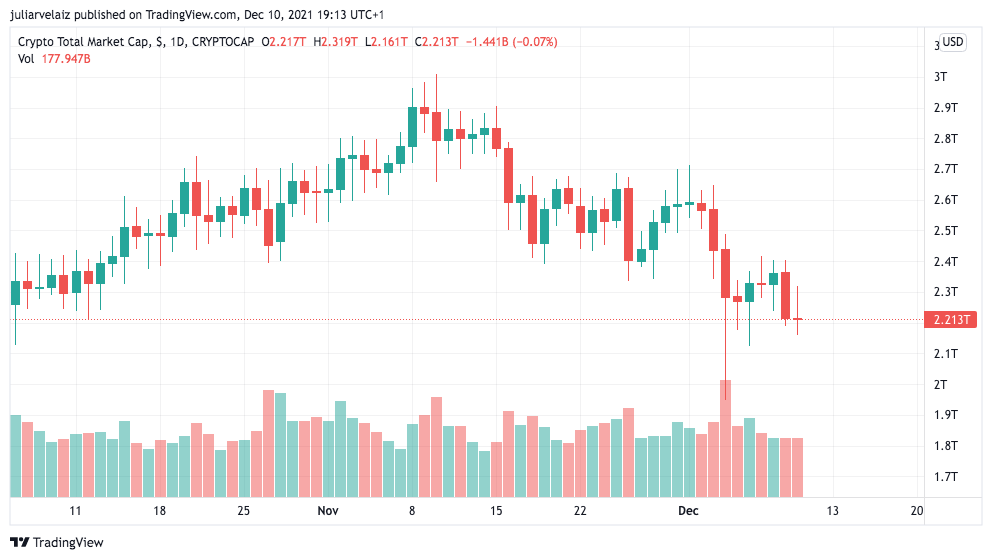
    Crypto total market cap down to $2,2 trillion in the daily chart | Source: TradingView


    [ad_2]

    Source link

  • Crypto Regulations Should Be Comprehensive, Says IMF

    Crypto Regulations Should Be Comprehensive, Says IMF

    [ad_1]

    International Monetary Fund (IMF) recently published a post about crypto-assets and their regulations. The fund asked for a comprehensive global approach to regulate digital assets.

    The crypto market witnessed significant growth in the last 11 months. The market capitalization of digital assets jumped by more than 200% this year and touched a record high of $3 trillion in November 2021. With rising adoption, the use of crypto assets in illegal financial activities has also increased. IMF highlighted some key issues related to Bitcoin and other digital assets.

    According to the fund, several digital currencies are overvalued, and the protection of crypto investors is still a major problem due to the lack of clear regulations. IMF believes that an uncoordinated global approach to cryptocurrency regulations will destabilize the financial system.

    “In emerging markets and developing economies, the advent of cryptocurrencies can accelerate what we have called “cryptoization”—when these assets replace domestic currency and circumvent exchange restrictions and capital account management measures. Such risks underscore why we now need comprehensive international standards that more fully address risks to the financial system from crypto assets, their associated ecosystem, and their related transactions while allowing for an enabling environment for useful crypto asset products and applications,” the post noted.

    During a recent event hosted by Bocconi University in Italy, Kristalina Georgieva, International Monetary Fund (IMF) Managing Director, stated that it is difficult to treat Bitcoin and other cryptocurrencies as money.

    Crypto Regulatory Framework

    IMF outlined the urgent need for international collaborations to solve the technical, supervisory, and regulatory challenges related to cryptocurrencies. The financial institution believes that digital currencies are changing the international monetary and financial system.

    “The IMF has developed a strategy in order to continue to deliver on its mandate in the digital age. The Fund will work closely with the Financial Stability Board and other members of the international regulatory community to develop an effective regulatory approach to crypto-assets,” IMF added in the post.

    International Monetary Fund (IMF) recently published a post about crypto-assets and their regulations. The fund asked for a comprehensive global approach to regulate digital assets.

    The crypto market witnessed significant growth in the last 11 months. The market capitalization of digital assets jumped by more than 200% this year and touched a record high of $3 trillion in November 2021. With rising adoption, the use of crypto assets in illegal financial activities has also increased. IMF highlighted some key issues related to Bitcoin and other digital assets.

    According to the fund, several digital currencies are overvalued, and the protection of crypto investors is still a major problem due to the lack of clear regulations. IMF believes that an uncoordinated global approach to cryptocurrency regulations will destabilize the financial system.

    “In emerging markets and developing economies, the advent of cryptocurrencies can accelerate what we have called “cryptoization”—when these assets replace domestic currency and circumvent exchange restrictions and capital account management measures. Such risks underscore why we now need comprehensive international standards that more fully address risks to the financial system from crypto assets, their associated ecosystem, and their related transactions while allowing for an enabling environment for useful crypto asset products and applications,” the post noted.

    During a recent event hosted by Bocconi University in Italy, Kristalina Georgieva, International Monetary Fund (IMF) Managing Director, stated that it is difficult to treat Bitcoin and other cryptocurrencies as money.

    Crypto Regulatory Framework

    IMF outlined the urgent need for international collaborations to solve the technical, supervisory, and regulatory challenges related to cryptocurrencies. The financial institution believes that digital currencies are changing the international monetary and financial system.

    “The IMF has developed a strategy in order to continue to deliver on its mandate in the digital age. The Fund will work closely with the Financial Stability Board and other members of the international regulatory community to develop an effective regulatory approach to crypto-assets,” IMF added in the post.

    [ad_2]

    Source link
  • Ledger Partners with Crypto Exchange FTX

    Ledger Partners with Crypto Exchange FTX

    [ad_1]

    Crypto partnerships are on the rise. With surging global adoption, leading companies in the crypto ecosystem are announcing collaborations to make digital assets more accessible. Ledger, one of the most popular hardware wallets, today announced a partnership with crypto exchange FTX.

    As a result of the latest collaboration, the liquidity, leverage, and trading options of FTX will be available via Ledger Live, the company’s secure self-custody application. The collaboration between FTX and Ledger has enabled global users of Ledger Live to trade a broad range of digital currency pairs.

    Ledger outlined a few challenges related to the accessibility of digital assets in the global crypto ecosystem and mentioned that the recent partnership will provide quick access to trading in a secure environment.

    “This is an important innovation in cryptocurrency trading,” said FTX Founder and CEO Sam Bankman-Fried. “Investors are looking for increased security and self-custody solutions without sacrificing liquidity, leverage, and trading options. The partnership between FTX and Ledger addresses this pain point for the marketplace, by providing quick access to trading while assets remain fully secure.”

    With a valuation of more than $25 billion, FTX is one of the fastest-growing crypto firms in the world. In October 2021, the digital exchange secured $420 million in funding.

    Partnership

    The press release shared by Ledger states that the users can take advantage of innovative services in a smooth manner. With access to over 300 cryptocurrency trading pairs, the collaboration provides an important opportunity for portfolio diversification.

    “Ledger is the number 1 choice for serious crypto investors. More than 15% of all crypto assets are secured by the more than 4 million Ledger Nanos sold since 2014,” added Ledger CEO Pascal Gauthier. “In the past, they would need to move their assets to an exchange, trade, and move back again. Now serious traders and investors can do everything right from the security of their Ledger Nano.”

    Crypto partnerships are on the rise. With surging global adoption, leading companies in the crypto ecosystem are announcing collaborations to make digital assets more accessible. Ledger, one of the most popular hardware wallets, today announced a partnership with crypto exchange FTX.

    As a result of the latest collaboration, the liquidity, leverage, and trading options of FTX will be available via Ledger Live, the company’s secure self-custody application. The collaboration between FTX and Ledger has enabled global users of Ledger Live to trade a broad range of digital currency pairs.

    Ledger outlined a few challenges related to the accessibility of digital assets in the global crypto ecosystem and mentioned that the recent partnership will provide quick access to trading in a secure environment.

    “This is an important innovation in cryptocurrency trading,” said FTX Founder and CEO Sam Bankman-Fried. “Investors are looking for increased security and self-custody solutions without sacrificing liquidity, leverage, and trading options. The partnership between FTX and Ledger addresses this pain point for the marketplace, by providing quick access to trading while assets remain fully secure.”

    With a valuation of more than $25 billion, FTX is one of the fastest-growing crypto firms in the world. In October 2021, the digital exchange secured $420 million in funding.

    Partnership

    The press release shared by Ledger states that the users can take advantage of innovative services in a smooth manner. With access to over 300 cryptocurrency trading pairs, the collaboration provides an important opportunity for portfolio diversification.

    “Ledger is the number 1 choice for serious crypto investors. More than 15% of all crypto assets are secured by the more than 4 million Ledger Nanos sold since 2014,” added Ledger CEO Pascal Gauthier. “In the past, they would need to move their assets to an exchange, trade, and move back again. Now serious traders and investors can do everything right from the security of their Ledger Nano.”

    [ad_2]

    Source link
  • Massive jump in number of Australians who own crypto: Survey

    Massive jump in number of Australians who own crypto: Survey

    [ad_1]

    The 2021 Independent Reserve’s Cryptocurrency Index (IRCI) survey of more than 2,000 people found that the percentage of Australians surveyed who own or have owned crypto has reached 28.8%, up from 18.4% in 2020.

    The results suggest that growth in the sector is being driven by the positive experience of those who own crypto, with 89% of those surveyed saying they have made money or broken even, up from 78% in 2020.

    Independent Reserve CEO Adrian Przelozny told Cointelegraph that these results didn’t come as a surprise to him, due to an environment in which it has become “very difficult to get returns on investments.”

    He stated that “cryptocurrencies have easily outperformed any other assets over the last 12 months,” before adding:

    “I think it’s quite natural that more and more people get interested in an asset class that’s clearly outperforming the rest of the market.”

    In October, Cointelegraph reported that Bitcoin (BTC) is the official best-performing asset class of 2021.

    Przelozny said that he expects the trend to continue as crypto matures and becomes less volatile. He said that the “biggest ally” of cryptocurrency is that “the longer it’s around, the more accepted it becomes.”

    “With time, I think you’ll see volatility and the perceived risk of this investment reduce.”

    28.6% of those surveyed by the IRCI who don’t currently own crypto said they would invest if there were better consumer protections in place. Another 26.6% said they’d buy crypto if industry regulation was improved.

    Regulation is needed for continued growth

    Przelozny said that “the sector still desperately needs regulation to catch up and provide greater security for both investors and cryptocurrency businesses.”

    “I do think that once regulation comes on board, we’ll see a whole new class of investors into this space. And I think that’s what we’ve seen in other jurisdictions, like over in Singapore.”

    Przelozny told Cointelegraph that he anticipates that older Aussies over 65 will make up the next big wave of investors as these regulatory issues are addressed.

    “They’re looking for consumer protections from the government before they’re willing to take the plunge and enter the cryptocurrency market.”

    Unsurprisingly, the 24 to 34-year-old age group was the most trusting of crypto with 27.6% saying they bought in to get rich, while disbelievers in the system are most likely to be found in the over 65 age group.

    Related: Australian women owning crypto has doubled in 2021: Survey

    According to the IRCI, Bitcoin remains the most well-known and popular cryptocurrency, with 89.1% of Australians surveyed saying they’ve heard of it and 21.1% actually owning Bitcoin. The second most popular crypto asset is Ethereum, at 11% reported ownership, up from just 5% in 2020.

    The IRCI is an annual cross-sectional survey of more than 2,000 Australians conducted by PureProfile. Independent Reserve says its sample was reflective of the country’s gender, age, and geographic distribution.

    [ad_2]

    Source link
  • Give the gift of crypto this holiday season

    Give the gift of crypto this holiday season

    [ad_1]

    By Catherine Shyu Sullivan, Senior Product Manager, Coinbase

    The month of December normally consists of a scramble to find the perfect gifts for coworkers, hosts, friends, and family. You either brave the long lines in stores or navigate supply chain delays online, and frequently end up settling on another generic candle.

    This holiday season, we’re introducing a new crypto gifting experience that allows you to send family and friends crypto assets like Bitcoin and Ethereum along with a personalized digital card. The season of (crypto) giving is here.

    The gift that keeps gifting

    Crypto gifts educate, excite, and have the potential to increase in value (there’s also risk that they decrease in value). Plus, all crypto gifts come in a personalized digital card featuring up-and-coming, crypto-forward artwork.

    Give a crypto gift right from the app or coinbase.com/gifting. Simply tap Send a gift from the menu on the left hand side — all you’ll need is the lucky recipient’s email address. You can gift 100+ crypto assets to recipients who already have a Coinbase account and can gift 5 assets (including Bitcoin and Ethereum) to recipients who are new to Coinbase. There is no fee to send a crypto gift.

    Perfectly packaged with a digital card

    Your gift is delivered in a digital card featuring a piece of unique artwork by an up-and-coming artist. Pick a piece, write a personalized note, and give the lucky recipient a taste of crypto culture.

    “Andrius”-008 by Magdiel Lopez

    Born in Havana Cuba, Magdiel Lopez spent his childhood inspired by the colorful culture. Lopez’s upbringing played an integral part in forming his sense of style, art and design, which can be seen in his works today.

    “Andrius”-008 by Magdiel Lopez

    Robot Invasion by David Krovblit

    David Krovblit is a Canadian visual artist who now lives in California. He curates images that he considers lost in time — layering them to form whimsical collages rooted in pop culture.

    Robot Invasion by David Krovblit

    #1644 by Bored Ape Yacht Club

    An iconic collection of NFTs. Each Bored Ape is unique and programmatically generated from over 170 possible traits, including expression, fashion accessories, clothing, and more. Note: your recipient will not receive a NFT, just a digital replica of the Bored Ape! Sign up for the waitlist of Coinbase NFT if you’d like to explore NFTs.

    #1644 by Bored Ape Yacht Club

    Snow Days by Rob Flowers

    Rob Flowers is a UK based artist with humor at the heart of his work. It has been described as “trippy…. as if you ate too much candy floss and went on the waltzers at your town’s local fair.”

    Snow Days by Rob Flowers

    The future of gifting just got brighter. Try it this holiday season in the Coinbase app on iOS or Android or at coinbase.com/gifting.

    *Excludes Japan


    Give the gift of crypto this holiday season was originally published in The Coinbase Blog on Medium, where people are continuing the conversation by highlighting and responding to this story.

    [ad_2]

    Source link

  • India misinterpreted private crypto ban, says crypto bill creator

    India misinterpreted private crypto ban, says crypto bill creator

    [ad_1]

    The creator of India’s crypto bill, former Finance Secretary Subhash Garg, dismissed the notion of banning “private cryptocurrencies” as a misinterpretation while highlighting the enormous potential of cryptocurrencies and blockchain technology.

    The Parliamentary discussions around a controversial crypto bill sparked fears around the ban on cryptocurrencies, with no clear indication about the ban’s scope. As Cointelegraph reported, an episode of panic selling among Indian investors followed the announcement. In an interview with local news channel News 18, Garg clarified:

    “[The description of the crypto bill] was perhaps a mistake. It is misleading to say that private cryptocurrencies will be banned and to intimate the government about the same.”

    He believes that the Indian government should formulate a bill after discussing it with stakeholders and crypto investors. Furthermore, the bill suggests banning private cryptocurrencies without clarifying what the word “private” stands for.

    As a result, the crypto community in India self-interpreted two different versions of the bill’s agenda — one that considers banning all non-government issued cryptocurrencies and the other that excludes cryptocurrencies running on the public blockchains such as Bitcoin (BTC) and Ethereum (ETH).

    Garg also pointed out a flaw in classifying cryptocurrencies as assets after underscoring the vast ecosystem powered by disruptive technology. He also said that crypto exchanges have limited interests and do not represent the entire community:

    “You don’t classify the wheat that you produce, you don’t classify the clothes you produce, as assets. That is too much of oversimplification to treat this as an asset.”

    On an end note, Garg added that the central bank digital currency (CBDC) initiatives, especially in countries like India, are complex. According to him, the government first needs to address challenges, including the unavailability of smartphones and digital wallet issuance.

    Related: Singaporean crypto exchange enters India amid regulatory uncertainty

    The Indian crypto market continues to attract international firms with the latest being Coinstore, a Singaporean crypto exchange. As Cointelegraph reported, Coinstore has allocated a $20-million fund to set up three new offices in the region.

    Speaking to Cointelegraph, Coinstore spokesperson was hopeful for the development of a positive crypto regulatory framework:

    “Strict KYC process, security requirement for exchanges, as well as gradual regulation of certain cryptocurrencies naturally protects the Indian users and would clarify the legality of certain cryptocurrencies.”