hacklink hack forum hacklink film izle hacklink mamibet loginmamibetmamibet loginqqmamibetjojobet

Tag: crypto

  • Norway to Regulate Energy-Intensive Crypto Mining Activities

    Norway to Regulate Energy-Intensive Crypto Mining Activities

    [ad_1]

    Norway plans to regulate cryptocurrency
    mining activities in the country by restricting data centers. Two government officials
    intend to propose a new law that will bring the data center industry under
    regulatory oversight for the first time in Norway.

    According to the media outlet VG, Norway’s
    Digitalization Minister Karianne Tung and Energy Minister Terje Aasland
    mentioned that this initiative is driven by the government’s desire to control
    and limit projects deemed undesirable, such as cryptocurrency mining, which is
    associated with significant greenhouse gas emissions.

    Norway will become the first country in Europe to
    implement comprehensive regulations for data centers, focusing on
    controlling energy-intensive activities like cryptocurrency mining. The
    expected regulation requires crypto mining operators to register with local
    authorities and disclose the services offered.

    Tung mentioned: “The government requires a
    registration obligation for who is behind the data center, who is the manager
    of the center, and an obligation to state which services are offered at the
    center. The purpose is to regulate the industry in such a way
    that we can close the door on the projects we do not want.”

    By mandating data center operators to disclose their
    activities, the Norwegian government aims to empower the relevant authorities
    to approve or reject projects based on their social and environmental impact.

    Greenhouse Gas Emission Concerns

    Aasland emphasized the importance of promoting
    socially beneficial data centers. In Norway, crypto mining is viewed as
    incompatible with the country’s environmental goals. Aasland highlighted
    concerns about the industry’s significant greenhouse gas emissions.

    He said: “This is incredibly important. It is very important to get a good overview of which services are offered in these
    data centers. It is the socially useful data center that we want. They are
    important for infrastructure.”

    Meanwhile, there are approximately four days until the much anticipated Bitcoin halving event occurs. Due to current high profits in the mining sector, analysts expect a slight drop of 5% to 10% in Bitcoin mining hashrate post-halving, according to a report by Finance Magnates. Some miners are reportedly planning to acquire more efficient equipment or diversify into other sectors after the halving.

    Meanwhile, Norway licensed the Vienna-based crypto exchange BitPanda last year, marking a significant milestone in the exchange’s European expansion efforts. BitPanda has already obtained licenses in Austria, Germany, Czechia, France, and Sweden. Besides that, the company obtained approval in Spain and entered the UK market by acquiring Trustology.

    Norway plans to regulate cryptocurrency
    mining activities in the country by restricting data centers. Two government officials
    intend to propose a new law that will bring the data center industry under
    regulatory oversight for the first time in Norway.

    According to the media outlet VG, Norway’s
    Digitalization Minister Karianne Tung and Energy Minister Terje Aasland
    mentioned that this initiative is driven by the government’s desire to control
    and limit projects deemed undesirable, such as cryptocurrency mining, which is
    associated with significant greenhouse gas emissions.

    Norway will become the first country in Europe to
    implement comprehensive regulations for data centers, focusing on
    controlling energy-intensive activities like cryptocurrency mining. The
    expected regulation requires crypto mining operators to register with local
    authorities and disclose the services offered.

    Tung mentioned: “The government requires a
    registration obligation for who is behind the data center, who is the manager
    of the center, and an obligation to state which services are offered at the
    center. The purpose is to regulate the industry in such a way
    that we can close the door on the projects we do not want.”

    By mandating data center operators to disclose their
    activities, the Norwegian government aims to empower the relevant authorities
    to approve or reject projects based on their social and environmental impact.

    Greenhouse Gas Emission Concerns

    Aasland emphasized the importance of promoting
    socially beneficial data centers. In Norway, crypto mining is viewed as
    incompatible with the country’s environmental goals. Aasland highlighted
    concerns about the industry’s significant greenhouse gas emissions.

    He said: “This is incredibly important. It is very important to get a good overview of which services are offered in these
    data centers. It is the socially useful data center that we want. They are
    important for infrastructure.”

    Meanwhile, there are approximately four days until the much anticipated Bitcoin halving event occurs. Due to current high profits in the mining sector, analysts expect a slight drop of 5% to 10% in Bitcoin mining hashrate post-halving, according to a report by Finance Magnates. Some miners are reportedly planning to acquire more efficient equipment or diversify into other sectors after the halving.

    Meanwhile, Norway licensed the Vienna-based crypto exchange BitPanda last year, marking a significant milestone in the exchange’s European expansion efforts. BitPanda has already obtained licenses in Austria, Germany, Czechia, France, and Sweden. Besides that, the company obtained approval in Spain and entered the UK market by acquiring Trustology.


    [ad_2]

    Source link
  • Coinbase Challenges SEC’s Definition of ‘Investment Contracts’ in Crypto Transactions

    Coinbase Challenges SEC’s Definition of ‘Investment Contracts’ in Crypto Transactions

    [ad_1]

    Coinbase Challenges SEC’s Definition of 'Investment Contracts' in Crypto TransactionsIn a recent legal challenge, Coinbase has filed a brief with the Southern District of New York, seeking permission for an interlocutory appeal against the U.S. Securities and Exchange Commission’s expansive interpretation of what constitutes an “investment contract” in digital asset transactions. This pivotal case could set significant precedents for the cryptocurrency industry in the […]


    [ad_2]

    Source link

  • $41 Million Crypto Investment Scheme Collapses in Australia

    $41 Million Crypto Investment Scheme Collapses in Australia

    [ad_1]

    In Australia, a massive cryptocurrency investment scheme involving approximately US$41 million and over 450 investors has collapsed. The country’s financial market regulator successfully obtained a court order to appoint receivers for the digital currency assets held by a group of three crypto mining companies, collectively known as NGS Companies, and their sole directors.

    The court order, issued on Wednesday, was part of the civil proceedings initiated by the Australian Securities and Investments Commission (ASIC) against NGS Crypto Pty Ltd, NGS Digital Pty Ltd, and NGS Group Ltd, along with their respective sole directors Brett Mendham, Ryan Brown, and Mark Ten Caten.

    Additionally, the court has restricted Mendham from traveling outside Australia.

    NGS Companies offered investment packages supported by their cryptocurrency mining activities. These packages guaranteed fixed-rate returns as high as 16 percent annually, according to the company’s website, with a minimum fixed return promised at 6 percent.

    The regulator highlighted that the schemes particularly encouraged investors to transfer funds from regulated superannuation funds to self-managed super funds (SMSFs), which were then converted into cryptocurrency. The promotional material on the company’s website, including “testimonials” and “stories,” seemed to specifically target elderly investors.

    “Member stories” on NSG Crypto website

    Regulator Gets Wary

    ASIC’s action was prompted by concerns that the invested funds in these cryptocurrency schemes were at risk of dissipation. Notably, none of the three implicated companies possessed the necessary financial services licenses to operate legally in Australia. ASIC is now holding them accountable for illegally marketing crypto mining-backed investment products.

    “Australians who choose to self-manage their superannuation should carefully consider the risks before using their SMSF to invest in crypto-related investment products such as blockchain mining,” advised Joe Longo, the Chair of ASIC. “These proceedings should also serve as a warning to the crypto industry that ASIC will continue to scrutinize products to ensure compliance with regulatory obligations and to protect consumers.”

    Earlier this year, the Australian regulator dismantled similar crypto-backed schemes that promised astronomical profits and banned a director of a crypto fund for dishonest operations.

    In Australia, a massive cryptocurrency investment scheme involving approximately US$41 million and over 450 investors has collapsed. The country’s financial market regulator successfully obtained a court order to appoint receivers for the digital currency assets held by a group of three crypto mining companies, collectively known as NGS Companies, and their sole directors.

    The court order, issued on Wednesday, was part of the civil proceedings initiated by the Australian Securities and Investments Commission (ASIC) against NGS Crypto Pty Ltd, NGS Digital Pty Ltd, and NGS Group Ltd, along with their respective sole directors Brett Mendham, Ryan Brown, and Mark Ten Caten.

    Additionally, the court has restricted Mendham from traveling outside Australia.

    NGS Companies offered investment packages supported by their cryptocurrency mining activities. These packages guaranteed fixed-rate returns as high as 16 percent annually, according to the company’s website, with a minimum fixed return promised at 6 percent.

    The regulator highlighted that the schemes particularly encouraged investors to transfer funds from regulated superannuation funds to self-managed super funds (SMSFs), which were then converted into cryptocurrency. The promotional material on the company’s website, including “testimonials” and “stories,” seemed to specifically target elderly investors.

    “Member stories” on NSG Crypto website

    Regulator Gets Wary

    ASIC’s action was prompted by concerns that the invested funds in these cryptocurrency schemes were at risk of dissipation. Notably, none of the three implicated companies possessed the necessary financial services licenses to operate legally in Australia. ASIC is now holding them accountable for illegally marketing crypto mining-backed investment products.

    “Australians who choose to self-manage their superannuation should carefully consider the risks before using their SMSF to invest in crypto-related investment products such as blockchain mining,” advised Joe Longo, the Chair of ASIC. “These proceedings should also serve as a warning to the crypto industry that ASIC will continue to scrutinize products to ensure compliance with regulatory obligations and to protect consumers.”

    Earlier this year, the Australian regulator dismantled similar crypto-backed schemes that promised astronomical profits and banned a director of a crypto fund for dishonest operations.

    [ad_2]

    Source link

  • Bitget’s Crypto Trading Volume Surges over 100% in Q1 2024

    Bitget’s Crypto Trading Volume Surges over 100% in Q1 2024

    [ad_1]

    Bitget, one of the biggest cryptocurrency exchanges by volume, has released its Q1 2024 Transparency Report, revealing visible growth across various metrics. The
    report highlighted a 100% increase in both spot and futures trading volumes
    compared to previous quarters, along with a significant rise in the value of
    its platform native token, BGB.

    According
    to the report, Bitget’s futures trading volume reached approximately $1.4
    trillion, an escalation of 146% from the previous quarter. The exchange witnessed the
    highest increase in derivatives market share, with a growth of 2.4% in March
    alone. The spot trading volume also saw a substantial uplift of 113%, surpassing
    $60 billion in Q1 2024.

    According to an independent report by Finance Magnates Intelligence, these figures coincide with the overall boost in volumes across the cryptocurrency industry.
    In March, spot volumes for the largest cryptocurrency exchanges grew 119%
    compared to the previous year and over 100% compared to February.

    Bitget’s
    user base has expanded significantly, now serving over 25 million users
    across 100+ countries and regions.

    “This
    year, Bitget is doubling down on its commitment to enhance our spot market
    offerings,” Gracy Chen, the Managing Director of Bitget, commented. “We aim not
    only to bolster our market position but also to contribute tremendously to the
    broader crypto ecosystem, supporting startups with high potential to
    grow.”

    Bitget Bets on Its Crypto
    Token

    The
    platform’s native token, BGB, had a really good run last quarter, breaking its
    all-time high and surpassing the $1 mark in February. Since the beginning of
    2023, BGB has delivered gains of 434%, outperforming Bitcoin and establishing
    itself as a top performer among centralized exchange tokens.

    Currently,
    it is one of the 70 largest cryptocurrencies, with a market capitalization of
    over $1.8 billion and a daily trading volume of $81 million. Binance exchange’s BNB token has a market capitalization of $89 billion.

    Bitget’s listing
    strategy led to the introduction of 186 new tokens in the first quarter,
    expanding its offerings to over 750 tokens and 820 spot trading pairs. Several
    tokens, such as XAI, GPT, and PIXEL, experienced extraordinary growth, surging
    over 3000%.

    According
    to the latest exchange report, more people are trading
    cryptocurrencies in Europe. In Germany alone, the number of traders has
    escalated 69% over the year.

    In the meantime,
    Bitget Wallet hired a new Chief Operating Officer, Alvin Kan, to accelerate its global
    expansion.

    Bitget, one of the biggest cryptocurrency exchanges by volume, has released its Q1 2024 Transparency Report, revealing visible growth across various metrics. The
    report highlighted a 100% increase in both spot and futures trading volumes
    compared to previous quarters, along with a significant rise in the value of
    its platform native token, BGB.

    According
    to the report, Bitget’s futures trading volume reached approximately $1.4
    trillion, an escalation of 146% from the previous quarter. The exchange witnessed the
    highest increase in derivatives market share, with a growth of 2.4% in March
    alone. The spot trading volume also saw a substantial uplift of 113%, surpassing
    $60 billion in Q1 2024.

    According to an independent report by Finance Magnates Intelligence, these figures coincide with the overall boost in volumes across the cryptocurrency industry.
    In March, spot volumes for the largest cryptocurrency exchanges grew 119%
    compared to the previous year and over 100% compared to February.

    Bitget’s
    user base has expanded significantly, now serving over 25 million users
    across 100+ countries and regions.

    “This
    year, Bitget is doubling down on its commitment to enhance our spot market
    offerings,” Gracy Chen, the Managing Director of Bitget, commented. “We aim not
    only to bolster our market position but also to contribute tremendously to the
    broader crypto ecosystem, supporting startups with high potential to
    grow.”

    Bitget Bets on Its Crypto
    Token

    The
    platform’s native token, BGB, had a really good run last quarter, breaking its
    all-time high and surpassing the $1 mark in February. Since the beginning of
    2023, BGB has delivered gains of 434%, outperforming Bitcoin and establishing
    itself as a top performer among centralized exchange tokens.

    Currently,
    it is one of the 70 largest cryptocurrencies, with a market capitalization of
    over $1.8 billion and a daily trading volume of $81 million. Binance exchange’s BNB token has a market capitalization of $89 billion.

    Bitget’s listing
    strategy led to the introduction of 186 new tokens in the first quarter,
    expanding its offerings to over 750 tokens and 820 spot trading pairs. Several
    tokens, such as XAI, GPT, and PIXEL, experienced extraordinary growth, surging
    over 3000%.

    According
    to the latest exchange report, more people are trading
    cryptocurrencies in Europe. In Germany alone, the number of traders has
    escalated 69% over the year.

    In the meantime,
    Bitget Wallet hired a new Chief Operating Officer, Alvin Kan, to accelerate its global
    expansion.


    [ad_2]

    Source link

  • Crypto Expert Predicts Massive Shiba Inu Run As Price Mirrors 2021

    Crypto Expert Predicts Massive Shiba Inu Run As Price Mirrors 2021

    [ad_1]

    Crypto expert Rekt Capital has suggested that Shiba Inu (SHIB) could follow a similar trajectory to its move back in 2021. If so, this sets up the crypto token for a parabolic move that could see it hit its all-time high (ATH) and even surpass it. 

    2024 Shiba Inu To Mirror 2021 Action

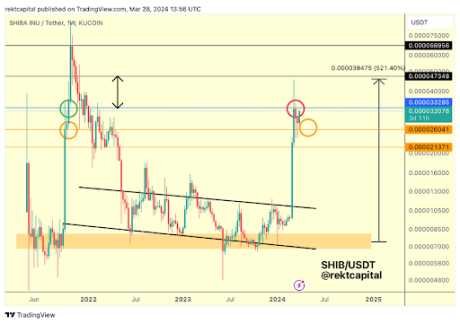
    Rekt Capital mentioned in an X (formerly Twitter) post that SHIB’s retest was successful and that history was repeating itself. According to him, SHIB needs to break above the $0.000033285 price range to begin its uptrend continuation. In a previous post, the crypto analyst raised the possibility of SHIB’s price action mirroring the one from 2021. 

    He noted how SHIB came close to that price range but couldn’t break this resistance level. This was the same thing in late 2021, as Shiba Inu didn’t break that resistance level on the first attempt. That forced the meme coin to retest the $0.000026041 price level as a new support before confirming further upside. 

    Shiba Inu

    Source: X

    This time, Shiba Inu also retested that $0.000026041 price level during its recent price dip, which was partly caused by a wave of profit-taking. The meme coin showed great resolve and somehow managed to hold above that level, and it has since made a good recovery. 

    Now, it needs to break above the $0.000033285 price range to confirm that history is repeating itself and that a price surge to the one in 2021 is on the horizon. 2021 was SHIB’s breakout year when it enjoyed a mouth-watering gain of 46,000,000% on its way to an ATH of $0.00008845 in October 2021. 

    Analysts Optimistic About Shiba Inu’s Future Trajectory

    Rekt Capital isn’t the only one optimistic about SHIB’s future trajectory. Crypto analyst and trader Xanrox recently predicted that SHIB could rise to $0.00008854 by July, representing a new ATH for the meme coin. Interestingly, that looks to be only the starting point for the meme coin, as other analysts have predicted that SHIB could shed another zero. 

    One of them is crypto investor and analyst Oscar Ramos, who expressed his bullish sentiment about the meme coin when he predicted it could rise to $0.0001. Technical analyst Javon Marks also echoed similar sentiments when he suggested that SHIB could rise to as high as $0.0001553. 

    Meanwhile, crypto analyst Ali Martinez once suggested that SHIB’s price gain in 2021 could be nothing compared to what lies ahead for the meme coin. Specifically, Martinez predicted that Shiba Inu could see a historic 122,000% price surge to $0.011.

    At the time of writing, SHIB is trading around $0.00003116, up over 3% in the last 24 hours according to data from CoinMarketCap. 

    Shiba Inu price chart from Tradingview.com

    SHIB price at $0.00003 | Source: SHIBUSDT on Tradingview.com

    Featured image from Coinpedia, chart from Tradingview.com

    Disclaimer: The article is provided for educational purposes only. It does not represent the opinions of NewsBTC on whether to buy, sell or hold any investments and naturally investing carries risks. You are advised to conduct your own research before making any investment decisions. Use information provided on this website entirely at your own risk.

    [ad_2]

    Source link

  • US, UK Probe $20B Crypto Transfers Linked to Russian Exchange

    US, UK Probe $20B Crypto Transfers Linked to Russian Exchange

    [ad_1]

    Authorities from the US and the UK are investigating
    cryptocurrency transactions traversing Russian exchanges. Recent revelations
    suggest that over $20 billion in crypto transfers have been flagged for
    investigation.

    According to a report by Bloomberg, the suspicions
    revolve around Moscow-based Garantex and its use of the Tether cryptocurrency.
    At the center of the scrutiny is Tether, a dollar-pegged stablecoin. The sizable volume of transactions sent through
    Garantex using Tether has raised red flags, prompting regulatory bodies to
    delve deeper into potential sanctions evasion and illicit financial activities.

    Tether Holdings, the issuer of the eponymous
    stablecoin, finds itself entangled in the investigation. Authorities caution
    that unraveling the intricacies of these transactions requires time and
    resources, with no immediate conclusions drawn.

    Garantex, founded in Estonia but operating primarily
    out of Moscow, finds itself in the regulatory crosshairs. Stripped of its
    license in Estonia and sanctioned by Western powers, the exchange denies
    allegations of complicity in illicit activities.

    However, evidence suggests a pattern of facilitating
    transactions involving sanctioned entities and criminal groups. As the
    investigation unfolds, the spotlight on cryptocurrency exchanges intensifies. While asserting cooperation with law enforcement, the
    company faces scrutiny over the role of Tether in facilitating criminal
    activities, including investment scams and money laundering schemes.

    Challenges and Complexity

    Despite concerted efforts to clamp down on illicit
    financial flows, the task remains daunting. Cryptocurrency transactions present
    a myriad of challenges, from their decentralized nature to the cloak of
    anonymity they afford.

    Regulatory bodies are poised to implement stricter
    oversight measures to curb abuse and safeguard the integrity of the financial
    system. Yet, the evolving landscape of digital currencies underscores the
    ongoing challenges in combating financial crime in the digital age.

    As geopolitical tensions escalate due to Russia’s
    invasion of Ukraine, Western powers are tightening their grip on financial
    networks to stem the flow of funds that could support Vladimir Putin’s regime.

    Authorities from the US and the UK are investigating
    cryptocurrency transactions traversing Russian exchanges. Recent revelations
    suggest that over $20 billion in crypto transfers have been flagged for
    investigation.

    According to a report by Bloomberg, the suspicions
    revolve around Moscow-based Garantex and its use of the Tether cryptocurrency.
    At the center of the scrutiny is Tether, a dollar-pegged stablecoin. The sizable volume of transactions sent through
    Garantex using Tether has raised red flags, prompting regulatory bodies to
    delve deeper into potential sanctions evasion and illicit financial activities.

    Tether Holdings, the issuer of the eponymous
    stablecoin, finds itself entangled in the investigation. Authorities caution
    that unraveling the intricacies of these transactions requires time and
    resources, with no immediate conclusions drawn.

    Garantex, founded in Estonia but operating primarily
    out of Moscow, finds itself in the regulatory crosshairs. Stripped of its
    license in Estonia and sanctioned by Western powers, the exchange denies
    allegations of complicity in illicit activities.

    However, evidence suggests a pattern of facilitating
    transactions involving sanctioned entities and criminal groups. As the
    investigation unfolds, the spotlight on cryptocurrency exchanges intensifies. While asserting cooperation with law enforcement, the
    company faces scrutiny over the role of Tether in facilitating criminal
    activities, including investment scams and money laundering schemes.

    Challenges and Complexity

    Despite concerted efforts to clamp down on illicit
    financial flows, the task remains daunting. Cryptocurrency transactions present
    a myriad of challenges, from their decentralized nature to the cloak of
    anonymity they afford.

    Regulatory bodies are poised to implement stricter
    oversight measures to curb abuse and safeguard the integrity of the financial
    system. Yet, the evolving landscape of digital currencies underscores the
    ongoing challenges in combating financial crime in the digital age.

    As geopolitical tensions escalate due to Russia’s
    invasion of Ukraine, Western powers are tightening their grip on financial
    networks to stem the flow of funds that could support Vladimir Putin’s regime.

    [ad_2]

    Source link

  • Crypto traders can mitigate risk with PODS’ FUD Vault

    Crypto traders can mitigate risk with PODS’ FUD Vault

    [ad_1]

    The team of Pods recently announced the mainnet launch of its 3rd strategy on Pods Yield: FUD Vault, which now complements ETHphoria and stETHvv.

    FUD Vault provides a way for users to benefit from market downturns by offering a mechanism to hedge against significant price drops in ETH while preserving the deposited principal.

    Who is this product for?

    The FUD Vault is designed for individuals who have uncertainties about the future performance of ETH and want to find a way to potentially profit even when the market is experiencing a downward trend.

    By depositing funds into the FUD Vault, users can take advantage of a specific strategy that aims to mitigate the risks associated with a falling market.

    Therefore, if you feel uncertain or skeptical about the future performance of ETH and desire a strategy that allows for potential profit-making during market declines, the FUD Vault could be a suitable option.

    Product Values

    The FUD Vault offers several key values to its users:

    • Simplified Strategy: By consolidating a single strategy into one token, the FUD Vault enhances both DeFi composability and user convenience. Users can easily manage their deposits by transferring them between addresses, utilizing them as collateral on other protocols, and effortlessly verifying their holdings within a specific strategy. The aim is to streamline the user experience and provide a seamless interface for interacting with the vault.
    • Access to Intricate Strategies: With just a single click, users gain access to intricate strategies within the FUD Vault. These strategies are designed to optimize returns and navigate the complexities of the market. By offering these strategies in a user-friendly manner, the vault allows users to benefit from sophisticated investment approaches without needing in-depth knowledge or expertise.
    • Flexible Withdrawal: Users can withdraw their funds from the FUD Vault at any point after the deposit has been processed. This feature ensures that users maintain control over their assets and can access their funds whenever they need them.
    • Transparent Historical Returns: The FUD Vault provides users with a clear display of actual historical returns. This transparency allows users to assess the performance of the vault and make informed decisions about their investments. By presenting accurate and up-to-date information, the vault aims to build trust and confidence among its users.

    How FUD Vault Operates

    When you deposit USDC the vault immediately invests in Aave. Then, it utilizes the entire lending yield generated by Aave for purchasing ETH put options. These put options have a delta ranging from 0,03-0,12 and a maturity period of one week.

    In simple terms, the put options act as a form of insurance against a significant drop in the price of ETH. If the price of ETH decreases by more than 10% within the one-week timeframe, the put options are exercised and the resulting profits are distributed to the depositors of the FUD Vault.

    Summary

    The FUD Vault offers a user-friendly experience, providing convenient deposit management, access to intricate strategies, flexible withdrawal options, and transparent historical return information.

    These values ensure that users can easily navigate the vault, make informed decisions, and enjoy the benefits of the platform’s offerings.

    About Pods:

    Pods make structured products for crypto assets that are easy to use and seamless. Co-founded by Rafaella Baraldo, Robson Silva, and Guilherme Guimarães, the team has developed some of the most innovative and secure tools in DeFi. The success of the products, security audits, and brand efforts, have set a new standard for building DeFi methods in this rapidly expanding sector. Security audits conducted by OpenZeppelin further demonstrate the commitment to safety and reliability. Pods continue to focus on infrastructure and serving professional clients and investors looking to diversify their portfolios.

    Contracts

    The vault has undergone four audits by leading audit firms, including OpenZeppelin and ABDK. Audit reports are available at https://github.com/pods-finance/yield-contracts/tree/main/audits

    The open-source contracts can be reviewed at https://github.com/pods-finance/yield-contracts 

    Join the Pods community on Twitter


    [ad_2]

    Source link

  • Crypto derivatives exchange Deribit launching zero-fee spot trading

    Crypto derivatives exchange Deribit launching zero-fee spot trading

    [ad_1]

    Deribit, a popular cryptocurrency derivatives platform, has announced the launch of zero-fee spot trading, allowing clients to buy and sell crypto while simultaneously managing risk using other derivatives.

    Spot trading will start on April, 24th 2023 at 1 PM UTC with three pairs (BTC/USDC, ETH/USDC, and ETH/BTC), providing clients with a simple and free solution for exchanging collateral and eliminating the need for external asset conversion. Clients will enjoy a zero-fee structure for trading these pairs.

    Aiming to foster liquid markets, Deribit will offer 0% fees for makers and takers on spot. Note, due to this structure, there will not be any volume discounts, or affiliate/partner sharing offered on this model.

    “Our goal has always been to provide our users with a complete exchange platform that meets all their trading needs. After years of being the leading crypto derivatives trading platform and ensuring that our exchange has the highest level of security and transparency, we have decided to apply our expertise to spot trading. By adding spot trading to our existing futures and options products, we are now able to provide a fulsome exchange offering that caters to all types of traders.”
    – Luuk Strijers, COO at Deribit

    Currently, Deribit offers options, inverse & linear perpetuals, and futures (incl volatility futures) for three bases currencies (Bitcoin and Ethereum, and USDC), which allows investors to efficiently manage risk and hedge their investments. With the addition of spot trading, Deribit now serves a wider range of traders who seek to swap directly between assets with immediate delivery and ownership.

    The introduction of free spot trading capabilities comes shortly after Deribit’s launch of BTC DVOL futures, a contract built on DVOL (the Deribit Bitcoin Volatility Index) that facilitates bitcoin volatility trading. Deribit has also experienced a continued increase in investor activity, seeing open interest on the platform hit an all-time high of over $20 billion on March 30th, 2023.

    [ad_2]

    Source link

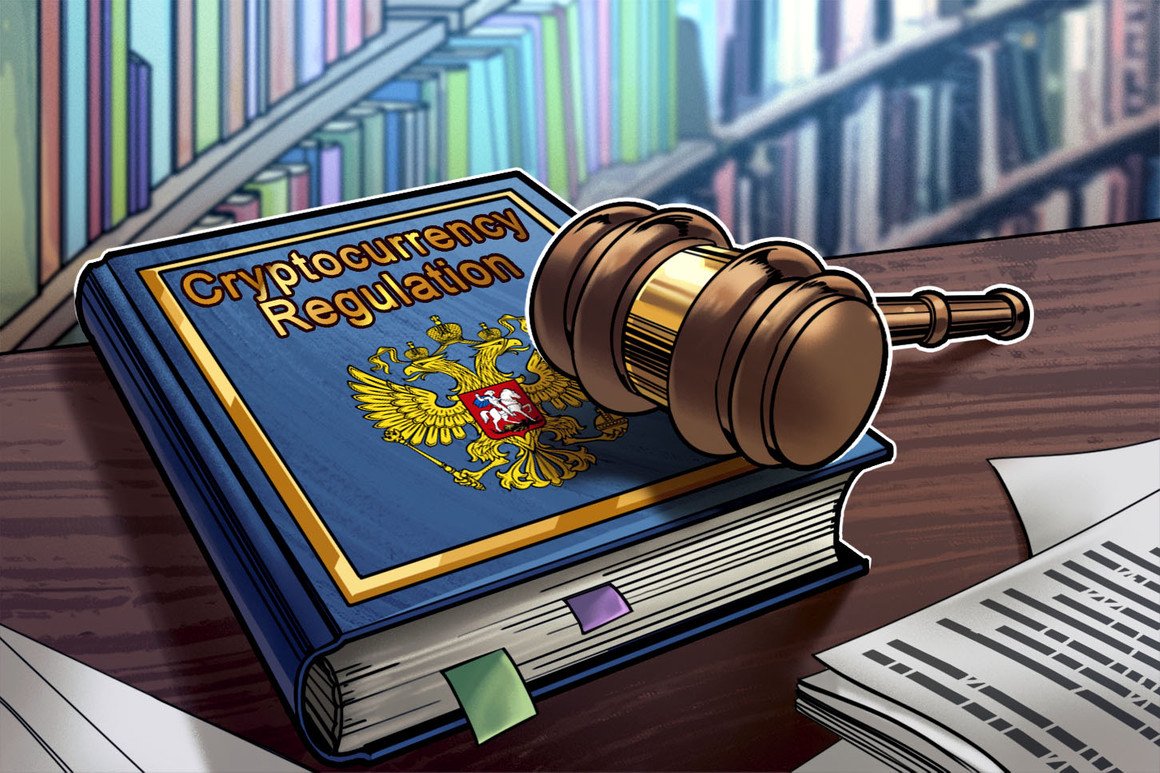
  • Crypto Twitter reacts as Russian gov’t reviews finalized crypto bill

    Crypto Twitter reacts as Russian gov’t reviews finalized crypto bill

    [ad_1]

    The Ministry of Finance (MinFin) of Russia finalized a draft bill named “On Digital Currency” and has sent it to the Russian government for approval to be passed as law. The draft of the federal law clarifies regulations related to the trading and mining of cryptocurrencies. 

    On Apr. 8, Russia’s finance ministry announced the amendment and finalization of an impending crypto bill, which provides regulatory clarity related to the circulation, issuance, trading, mining and other activities within the crypto market. 

    While unconfirmed reports of Russia legalizing cryptocurrency surfaced early Apr 16, the thriving crypto community on Twitter welcomed the announcement with arms wide open. 

    Binance CEO Changpeng Zhao was also one of the first to acknowledge the move, given the numerous sanctions currently levied against the nation. 

    As the dust settled, Crypto Twitter soon realized that they’ve been celebrating just a little too early and soon, CZ and others deleted the tweets cheering for crypto’s legal status in Russia.

    The buzz around Russia legalizing crypto was sparked by a report from local Russian daily newspaper Kommersant, who reportedly got their hands on the authentic final version of the draft law. According to the local media, the bill recommended accepting digital currency “as a means of payment that is not the monetary unit of the Russian Federation,” which is yet to be passed as law by the Russian government.

    While MinFin finalized and shared the draft bill with the Russian government, an official announcement regarding its approval as the law is still awaited with no known timeline. 

    Kommersant’s report also highlighted that the bill recommends building a regulatory framework for crypto-related activities while sharing the groundwork for registered operators.

    On Apr. 14, Sergei Katyrin, President of Russia’s Chamber of Commerce and Industry, recommended collaborating with African countries for conducting cross-border settlements in crypto and central bank digital currencies (CBDCs). In the announcement related to the finalized bill, the ministry disclosed to have clarified crypto regulations while considering the viewpoint of all other departments of the Russian government.

    Related: Russia‘s energy chief says it would accept Bitcoin for oil and gas

    In an ongoing to counter the international sanctions and the resultant inflation, president of the Russian Gas Society Pavel Zavalny hinted at the possibility of accepting Bitcoin (BTC) as payment for exporting oil and gas. 

    As Cointelegraph reported, Zavalny recommended taking payments in Russian rubles, Chinese yuan, Turkish lira, or even Bitcoin (BTC) from “friendly countries.” However, “unfriendly countries” could pay for their oil in rubles or gold.


    [ad_2]

    Source link

  • Optimism and Urgency Lie at the Heart of UK’s Global Crypto Potential | by Coinbase | Apr, 2022

    Optimism and Urgency Lie at the Heart of UK’s Global Crypto Potential | by Coinbase | Apr, 2022

    [ad_1]

    By Faryar Shirzad, Chief Policy Officer

    The digital economy is permanently changing the nature of financial services globally and digital assets are at the center of much of this rapid change. This is something clearly understood by the UK Government. John Glen, Economic Secretary to the Treasury, used his recent keynote speech at Fintech Week to highlight the opportunities crypto presents to the UK economy — and that the country is keen to embrace them. Noting that the UK is second only to the US in the global league table of fintech hubs, Mr Glen was clear in his message that “the UK is open for business, open for crypto companies… we want this country to be a global hub, the very best place to start and scale crypto companies.”

    Coinbase welcomes Economic Secretary Glen’s statement and commends the vision of the UK Government that stands behind it. The UK’s depth and strength in capital markets, fintech leadership, its globally respected regulators, its deep talent pool, and the innovative dynamism of the country’s economy combine to present an opportunity for the UK to be a leader in the next technology revolution and to become a global powerhouse for web3.

    There is no question that fintech in the UK is growing rapidly and that the broader financial industry will increasingly be built on crypto rails. Mr Glen himself referenced the 200% year-on-year rise in fintech investment. He’s not a lone voice seeing the potential. Some of finance’s most influential voices are waking up to crypto’s economic and transformational power. From funds and VCs to the real economy investor, the UK is increasingly embracing crypto and recognizing its social, cultural, and economic utility.

    This is a continuation of a global trend. Larry Fink, chairman of BlackRock, the world’s largest asset manager, for example, revealed in his latest letter to CEOs that BlackRock is investigating how digital currencies, stablecoins and underlying technologies “can help serve” clients of the $10 trillion firm. At the retail level, Coinbase’s own research reveals that about a third of people in the UK who are aware of crypto own or have owned digital currency, and twice that amount intend to increase their holdings. We’re at an inflection point in the adoption curve.

    But increased adoption is only the tip of the iceberg. As the possibilities of how crypto can revolutionize traditional finance reveal themselves, there will be so much more innovation at the core of this movement. Whether that’s existing payment systems being streamlined through digitalization or complex contracts being hosted on the blockchain, whole new economic frontiers will open up, bringing new employment with them.

    As Mr Glen himself said, these developments create an opportunity for the UK to leverage its existing and formidable advantages to be a leader in digital innovation. He says that if crypto is going to be a “big part of the future, then the UK wants in, and in on the ground floor.” We believe the country can do this by taking steps to build a more free and open financial system, bridging the gap between traditional financial services and the crypto industry, and supporting economic growth and jobs.

    Get it wrong and there’s a risk the UK cedes a critical dimension of its financial and technological leadership, and signals to the next generation of entrepreneurs to look elsewhere to build, hire, and grow. Coinbase believes and has advocated for thoughtful regulation for digital assets around the world. We applaud the work and deep thinking that the UK Government is doing to address consumer risk, market integrity, and competition in the financial sector — these are critical issues and require careful analysis.

    But what is also critical now is continuing this positive reframing of the debate to focus on the opportunities from digital assets, as opposed to just the perceived risks. Without such clarity, there is a danger the UK is left behind, particularly as more and more entrepreneurs and businesses seek to use crypto rails to build their new ventures. For example, we are concerned that the proposed changes to the existing Financial Promotions Regime to cover crypto will, unless carefully recalibrated, render a de facto ban on the marketing of crypto services in the UK.

    Looking ahead, we want to highlight some key principles for consideration by the Government as it considers how to best put the UK on the path to be a web3 leader:

    Creation of a tailored framework for digital assets

    Digital assets — and in particular blockchain technology — allow for increased efficiency in the financial sector and offer a transformational level of financial empowerment for everyday people. That is why the UK Government’s decision to bring the cryptoeconomy into a central focus of its policymaking is so important. The cryptoeconomy, however, is rapidly evolving, and policy should adapt with it through a regulatory regime that is flexible enough to cope with current and future needs as they emerge — all informed by input by stakeholders and the public.

    This is a point the UK authorities clearly appreciate and understand. Mr Glen said that crypto will bring dynamism to finance and that regulation must therefore be dynamic too, “rather than a static, rigid thing.” His analogy of envisioning regulation as “computer code, which can be refined and rewritten when needed” is well-stated and absolutely correct. Marrying this vision of dynamism with the work of regulators who have achieved their international status by being reliable and predictable is clearly something that will require some effort.

    For example, industry eagerly awaited the publication of the UK Government’s Stablecoin Consultation response and broadly supported the proposal to bring stablecoins — where used as a means of payment — under a clear regulatory framework. However, success will be determined by how well and quickly this is implemented. The UK Government’s planned consultation and implementation of tailored digital asset regulation will need to be a fast follow to ensure that the UK does not fall behind.

    Oversight by a dedicated policy & supervisory unit

    Creating a dedicated policy unit and an equivalent supervisory unit with the resources to oversee digital assets would be a worthwhile investment, potentially with a cross-regulatory function much like the Digital Economy Taskforce as proposed by the Kalifa Review. It would need to be staffed by those with specialist knowledge of the sector and could also act as a single point of contact for the industry and present clarity for new and emerging businesses who are considering the UK as their home.

    Again the UK Government shows its foresight, with Mr Glen sketching out a new world for both the “newly regulated and the regulators,” with a Government Minister driving the process, including the establishment of the Crypto Engagement Group. For him to imagine a policy of industry and authorities “working together and learning from each other” while maintaining high standards, yet being flexible and working at the pace that the speed of innovation needs” sets the UK as an inviting home for web3 entrepreneurs Mr Glen’s challenge is to make sure that he delivers on his promise to create “robust and effective innovation that won’t hinder innovation, but will boost it.”

    International harmonization & Industry coordination

    With digital assets rapidly becoming a worldwide phenomenon, countries around the world are competing to establish themselves as leaders and to embrace the potential of the new, decentralized web. As the UK emerges as a leader in crypto and digital assets, it has a unique opportunity to work with other like-minded countries to create a workable international framework for regulation. All this needs to be done together with the industry and other stakeholders in a consultative and transparent manner. True innovation means engaging with the people working with those who have important perspectives on how the best policy outcomes are achieved. A fresh focus on digital assets does not mean leaving established institutions behind — they will unquestionably play an important role in the future and in many cases, will adopt blockchain technology as a critical component of their infrastructure.

    To conclude, we must recognize that digital assets are a technological breakthrough that allows us to increase economic freedom for everyone. The UK Government certainly recognizes this, though Mr Glen rightly says that “no one knows for sure what the future of crypto looks like in the UK.” But what he has shown is that the UK clearly sees that the future can only be embraced by not focusing exclusively on perceived risks, but instead also seeing the opportunities.

    Mr Glen finished his address by saying “we’re on the cusp of something important, we have the opportunity to shape and lead it.” By following through on this vision and by implementing consistent, proportionate and appropriate regulation as soon as possible, the UK can not only help bring about a better, safer, more resilient and fairer system for everyone, but also help unlock broader innovation. The UK government — and Mr. Glen specifically — deserve enormous credit for setting the stage for the UK to play an important role in the future of innovation.

    [ad_2]

    Source link