[ad_1]
 In a recent legal challenge, Coinbase has filed a brief with the Southern District of New York, seeking permission for an interlocutory appeal against the U.S. Securities and Exchange Commission’s expansive interpretation of what constitutes an “investment contract” in digital asset transactions. This pivotal case could set significant precedents for the cryptocurrency industry in the […]
[ad_2]
Source link
Tag: contracts
-
Coinbase Challenges SEC’s Definition of ‘Investment Contracts’ in Crypto Transactions
-

Algorand upgrade adds quantum-secure keys, enhanced smart contracts
[ad_1]
Algorand, a next-gen blockchain application network, today announced a major release that will empower the creation of more sophisticated apps while marking a milestone for its cross-chain interoperability.
Developers are now able to build complex dapps for the Algorand ecosystem with smart contract-to-contract calling, and network participants can take their first step towards trustless cross-chain interoperability with quantum-secure keys for the upcoming State Proof technology.
These upgrades come on the heels of a $20 million incentive program from the Algorand Foundation focused on developer tooling and EVM compatibility, putting Algorand at the forefront of blockchain interoperability and post-quantum security while providing features advanced decentralized applications.
“With this latest upgrade, Algorand continues its leadership position when it comes to ongoing delivery of highly sophisticated blockchain technology. We’ve received overwhelmingly positive feedback from developers during the beta testing and are excited to roll out these enhancements to the broader blockchain developer ecosystem.”
– Paul Riegle, Chief Product Officer at AlgorandCore elements of this release include:
- Smart contract compatibility with contract-to-contract calls: Allows complex dApps that can efficiently and trustlessly interact with other smart contract-based dApps to extend functionality and usability.
- Post-quantum secure Falcon Keys: These keys will, in the near future, be used to generate State Proofs, a new blockchain infrastructure that will allow Algorand to be trustlessly accessed in low-power environments like mobile phones, smartwatches, and on other blockchains.
These features add to Algorand’s already advanced tech, high performance, and rich developer resources. Accessible to all types of developers, smart contracts on Algorand can be written in Python or Reach.
Since its launch, Algorand has experienced zero downtime, the highly scalable blockchain supports the creation of DeFi protocols, NFTs, payment solutions, regulated digital assets, and more.
Source:
developer.algorand.org[ad_2]
Source link -

How smart contracts are shifting the crypto sector’s balance of power
[ad_1]
One of the familiar themes seen in previous crypto market cycles is the shifting market caps, popularity and ranking of the top 10 projects that see significant gains during bull phases, only to fade into obscurity during the bear markets. For many of these projects, they follow a recognizable boom-to-bust cycle and never return to their previous glory.
During the 2017–2018 bull market and initial coin offering (ICO) boom, which was driven by Ethereum network-based projects, all manner of small smart contract-oriented projects rallied thousands of percentage to unexpected highs.
During this time, projects like Bitcoin Cash (BCH), Litecoin (LTC), Monero (XMR) and ZCash (ZEC) also rotated in and out of the top 10 ranking, but to this day, investors still argue about which project actually presents a “useful” use case.
While all of these tokens are still unicorn-level projects with billion-dollar valuations, these large-cap megaliths have fallen far from their previous glory and now struggle to stay relevant in the current ecosystem.
Let’s take a look at a few of the current projects that threaten to unseat these dinosaur tokens from their perch.
Dollar-pegged stablecoins take the stage as the most “transactable” currency
Bitcoin’s (BTC) original use case stipulated that it would simplify the process of conducting transactions, but the network’s “slow” transaction time and the cost associated with sending funds makes it a better store of value than a medium of exchange when the other blockchain networks are considered as options.
Terra (LUNA), a protocol focused on creating a global payment structure through the use of fiat-pegged stablecoins, has emerged as a possible solution to the issues faced when trying to use the top proof-of-work (PoW) projects as payment currencies.
The main token used for transacting value on Terra aside from LUNA is TerraUSD (UST), a U.S. dollar-pegged algorithmic stablecoin that forms the basis of Terra’s decentralized finance (DeFi) ecosystem. The market cap of UST has steadily been increasing throughout 2021 as activity and the number of users in the ecosystem increased.

UST supply changes. Source: SmartStake The recent addition of Ether (ETH) as a collateral choice for minting UST on Anchor protocol has given token holders a way of accessing the value in their Ether without having to sell and create a taxable event.
This opens the possibility for other tokens such as BTC to be utilized as collateral to mint UST that can be used in everyday purchases.
As it stands, the borrowing APR for UST on Anchor stands at 25.85%, while the distribution APR is at 40.67%, meaning users who borrow UST against their LUNA or Ether actually earn a yield while borrowing against their tokens.
From privacy coins to privacy protocols
Privacy is also a cornerstone characteristic of the cryptocurrency sector and privacy-focused projects like XMR and ZEC offer obfuscation technologies that support covert or what, for a time, were thought to be untraceable transactions.
Unfortunately, regulatory concerns have made it more challenging for users to access these tokens, as many exchanges have delisted them for fear of drawing the ire of regulators and the overall demand among crypto users has declined alongside their availability.
Their lack of smart contract capabilities has also limited what these protocols are capable of and, so far, users do not appear to be too excited about utilizing Wrapped Monero (WXMR) for use in DeFi, as the token loses its privacy capabilities in the process.
These limitations have led to the development of privacy-focused protocols such as the Secret Network, which allows users to create and use decentralized applications (DApps) in a privacy-preserving environment.
Privacy features are not common among smart contract capable platforms in the crypto ecosystem, which makes Secret something of an experimental case in the ever-evolving Web 3.0 landscape.

Decentralized applications on the Secret Network. Source: Secret Secret is also part of the Cosmos ecosystem which means it can utilize the Inter-blockchain Communication (IBC) protocol to seamlessly interact with other protocols in the ecosystem.
The network’s native SCRT can be used as the value transfer medium on the platform as well as to interact with protocols that operate on the network, including Secret DeFi applications and the network’s NFT offering, Secret Heroes.
New enterprise solutions aren’t better but they come without controversy
One of the ways cryptocurrency projects sought to differentiate themselves from the “medium of exchange” label was to offer enterprise solutions as a way to help corporations navigate the transition to a blockchain-based infrastructure.
XRP and Stellar (XLM) are two of the veteran protocols that fit this bill, but continual controversy and slow development has resulted in these early movers now playing catch up with newer networks that also don’t have the legal controversy that has followed Ripple for years.
Hedera Hashgraph has emerged as a competitor in this field and data shows that the network is capable of processing more than 10,000 transactions per second (TPS), with an average transaction fee of $0.0001 and a time to finality of 3-5 seconds.
These statistics are comparable to both XRP and XLM, which have indicated that their ledgers reach consensus on all outstanding transactions every 3-5 seconds with an average transaction cost of 0.00001 XRP/XLM.
Hedera is also smart contract capable, meaning users can create both fungible and nonfungible tokens, and developers can build decentralized applications to accompany the network’s decentralized file storage services.
For each sector (stablecoins, privacy and enterprise solutions), the main difference between the old-school and next-generation projects has been the introduction of smart contract capabilities and plans to develop within the side-chain and DeFi sectors where the top protocols exist. This gives newer projects additional utility, allowing them to meet the demand of investors and developers, thus increasing their token values and market caps as a result.
With smart contracts, the ability to interact with the growing DeFi landscape comes built-in, whereas the legacy tokens like LTC, XMR and BCH require special wrapping services which insert middlemen and thus insert additional fees, rigor and risk into the process.
Newer protocols have also embraced the more eco-friendly proof-of-stake consensus model that aligns with the larger global shift toward environmental awareness and sustainability. A plus is that holders can also stake their tokens directly on the network for a yield.
It remains to be seen if the slow march of time will eventually lead to a capital migration from older large cap projects to the newer generation protocols or if these legacy blue-chips will find a way to evolve and survive into the future.
Want more information about trading and investing in crypto markets?
The views and opinions expressed here are solely those of the author and do not necessarily reflect the views of Cointelegraph.com. Every investment and trading move involves risk, you should conduct your own research when making a decision.
[ad_2]
Source link -
Cardano Confirms Launch Date For Smart Contracts Mainnet Upgrade
[ad_1]
Cardano’s developer IOHK has now confirmed smart contracts capability is set to launch on the network on September 12th. The long-awaited upgrade to the Cardano Mainnet will see the addition of smart contracts capability to the network, which would open the door to both developers and investors alike on the network. The launch is scheduled for Sunday, only four days away.
LAUNCH CONFIRMED: Today, around 17:26 UTC we successfully submitted an update proposal to the #Cardano mainnet, to trigger a hard fork combinator event on Sunday 💪🙌 #Cardano $ADA 1/6 pic.twitter.com/rEtjrdGiBV
— Input Output (@InputOutputHK) September 7, 2021
Related Reading | Analyst Lays Out Theory That Suggests A 290% Move In Cardano (ADA) Before Rally Is Over
Taking to Twitter, the developer shared with the wider community that they had successfully submitted an upgrade proposal to the Cardano Mainnet. This would trigger the hard fork combinator (HFC) event that would take place on Sunday. “The Alonzo HFC event will be the most significant upgrade yet, laying the firmest of foundations for an exciting new era of smart contracts on Cardano,” said the developer.
Using the HFC technology will enable the deployment of smart contracts capability with the core Plutus, which will come will all compatibility upgrades across the entire software stack. Testing has already been underway for the smart contracts capability with trusted testers from previous upgrade iterations. So far, the smart contracts are processing transactions accordingly and developers have taken to building their DApps on the platform.
Gearing Up To Compete
The final deployment will see Cardano competing with other networks successfully operating in the space. Going up against well-known smart contracts platforms like Ethereum, and a new contender that has taken the market by storm, Solana.
Alonzo Hard Fork will bring decentralized finance (DeFi) and decentralized exchanges (DEX) to the ecosystem, as well as capabilities like being able to mint NFTs on the Cardano blockchain. Effectively expanding the scope of use cases of the network.
Related Reading | New To Bitcoin? Learn To Trade Crypto With The NewsBTC Trading Course
The network ran into some problems earlier when rumors started making the rounds on social media that the smart contracts could only handle one transaction at a time. But this was soon after cleared up by the developers, who showed that the problem was not with the network, but rather with the DApp Minswap. IOHK further encouraged developers to keep testing on the network, adding that “this is what a testnet is for.”
Cardano (ADA) Price Reaction
Cardano, like the rest of the market, is still reeling from the flash crash which it experienced yesterday. Although it has recovered from the lows of the flash crash, the digital asset continues to struggle to find footing back to positions before the crash. The announcement from Cardano’s developer did not do much to push the price upwards, which has left the asset trading around the $2.3 range. Putting it back down below highs from May.
ADA price struggles as market reels from crash | Source: ADAUSD on TradingView.com
At the time of writing, the asset is trading at $2.38, down more than 9% in the last 24 hours. The crash in its value has brought the total market cap of the asset down to $76 billion. Although remaining the third-largest cryptocurrency by market cap.
Featured image from Ethereum World News, chart from TradingView.com
[ad_2]
Source link -
CME Micro Bitcoin futures surpass 1M contracts as institutional speculation grows
[ad_1]
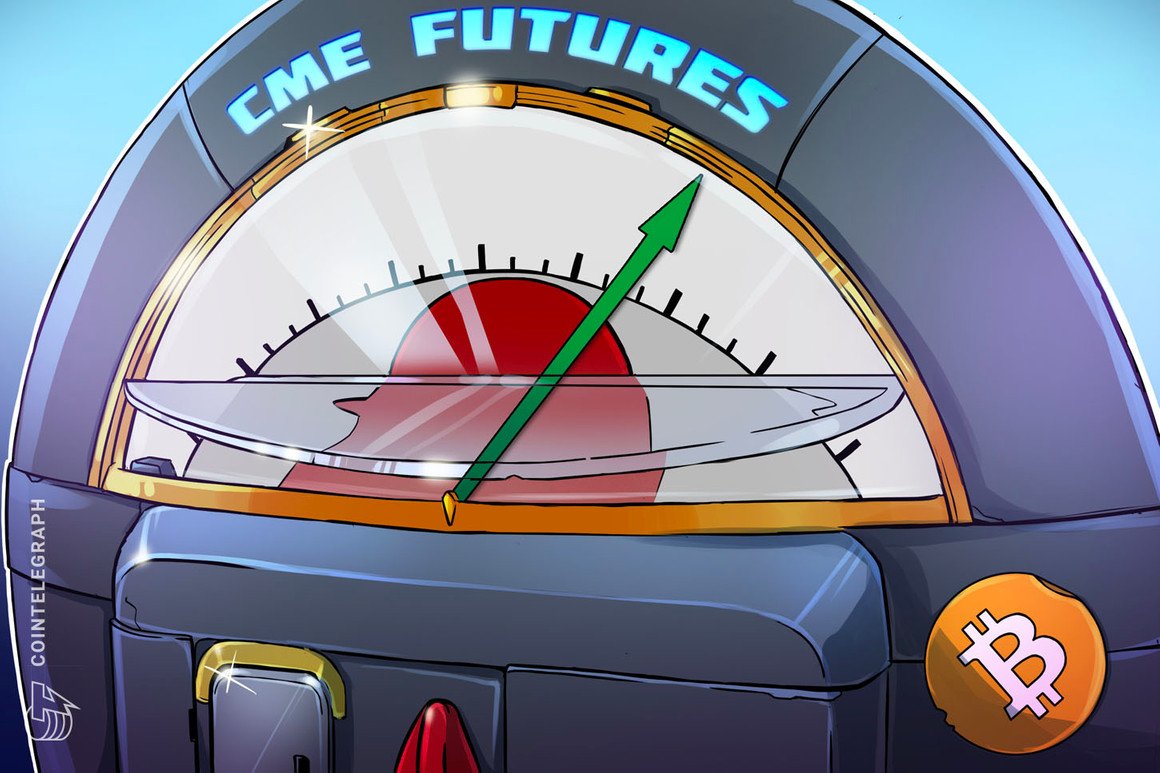
Institutional exposure to cryptocurrencies via derivatives continued to grow in the second quarter, as CME Group’s newly launched Bitcoin (BTC) micro contract received considerable uptick in its first two months of trading.
Since launching on May 3, CME’s Micro Bitcoin futures contract has already surpassed 1 million contracts traded, the Chicago-based derivatives market announced earlier this week. CME executive Tim McCourt said the new product has been popular among institutions and day traders seeking to hedge their spot Bitcoin price risk.
Denominated at 0.1 BTC, the micro contract is one-tenth the size of one Bitcoin. By comparison, CME’s main Bitcoin futures contract unit is 5 BTC.
“We’ve seen more institutional volume than we anticipated, which shows that the timing was right for a smaller bitcoin contract,” said Brooks Dudley, the global head of digital assets at ED&F Man Capital Markets.
Related: ‘Bitcoin will go all the way to $160,000 this year,’ says Celsius CEO
Institutions have reduced their long-term exposure to Bitcoin and other cryptocurrencies during the latest correction, with outflows totaling $79 million last week, according to CoinShares data. In the case of BTC, newly liquidated coins are being scooped up by long-term holders who remain convinced in the long-term prospects of their investment.
More activity in the derivatives market suggests traders are hedging their positions, speculating on the short-term directional movement of Bitcoin or both. Although derivatives trading has increased institutional exposure to Bitcoin, it has also become a source of stress for spot holders. As Cointelegraph reported, Friday’s $6 billion in Bitcoin and Ether (ETH) expiries created considerable friction in the market, with some traders expecting extreme volatility.

The Bitcoin price mostly traded between $30,000 and $35,000 last week. Source: Cointelegraph High volatility was reported in the latter half of the week, with the BTC price falling 13.6% peak-to-trough between June 24-26.
[ad_2]
Source link