Tag: Coinbase

  • Reflecting on Coinbase Ventures’ record year in 2021 | by Coinbase | Jan, 2022

    Reflecting on Coinbase Ventures’ record year in 2021 | by Coinbase | Jan, 2022

    [ad_1]

    Coinbase

    Around the Block from Coinbase Ventures sheds light on key trends in crypto. Written by Connor Dempsey, Ryan Yi & Justin Mart.

    2021 was a historic year for both crypto markets and venture capital funding. Driven in part by institutional inflows, Bitcoin soared to new highs to start the year, the entire market followed suit nearing a record $3T market cap in November. Meanwhile, $30B in venture funding poured into the space: more than all prior years of crypto’s history combined.

    2021 was also a record year for Coinbase Ventures, with just under 150 deals, averaging a new deal every 2.5 days. On a cumulative basis, more than 90% of the capital Coinbase Ventures has deployed since inception was deployed in 2021, reflecting an accelerated pace of activity in our fourth year of operation.

    Coinbase Ventures is among the most active corporate venture funds in operation, with the mandate of increasing economic freedom around the world by supporting the leading entrepreneurs and projects in the ecosystem. Ultimately, we see crypto and Web3 as a rising tide that lifts all boats, Coinbase included, and Coinbase Ventures is dedicated to making investments that are crucial to the space’s overall growth.

    In this edition of Around The Block, we’ll peer into the future through the lens of Coinbase Ventures’ 2021 activity. (Learn how Ventures aligns with Coinbase and its customers here).

    Coinbase Venture’s portfolio now consists of over 250 companies, and broadly breaks down across the following verticals.

    Let’s break down the pie, slice by slice.

    Protocols & Web3 infrastructure

    2021 saw crypto reach new heights in terms of utility, particularly in the nascent “Web3” space, which we generally think of as a trustless, permissionless, and decentralized internet that leverages blockchain technology: essentially, the plumbing that underpins everything from DeFi, NFTs, metaverses, and DAOs. At the bottom of the Web3 stack sit Layer 1 protocols, led by Ethereum, but 2021 saw Web3 begin to expand to other Layer 1s like Solana, Polygon, Avalanche, Terra, Flow, among dozens of others.

    To help scale existing Layer 1s and enable higher throughput, we supported Layer 2 solutions including Matter Labs, Optimism, and Arbitrum. As multiple Layer 1s have proliferated, so has the demand to safely and easily move funds across blockchains. As such, Ventures’ was active in investing in projects working to facilitate this cross-chain movement, including Biconomy, Movr, LayerZero, Chainflip, and more. We also observed and funded new protocols working to bring better privacy to Web3 through various zero-knowledge solutions (Aleo, MobileCoin, and a third TBA).

    We were also active across the infrastructure layer of the Web3 stack: primitives that form the backbone of user applications. Specifically, technologies that introduce standards to Web3 for data storage (Arweave), messaging (XMTP), and identity (Spruce). Given that 2021 was a great year for DAOs, we were active across infrastructure projects focused on enabling DAO creation/incorporation (Syndicate, Utopia), discovery/participation (Snapshot/Consensys’ Metamask), payroll/operations (Diagonal), and coordination (Orca).

    Given investments made over the year, in 2022 we expect to see Web3 mature across multiple Layer 1 and Layer 2 ecosystems with UX that more closely resembles Web2 applications. Additionally, we expect to see the continued flourishing of DAOs in the year ahead, as well as better privacy features for Web3 applications.

    DeFi

    While 2021 hinted at a future where Web3 activity takes place across multiple Layer 1 and Layer 2 platforms, DeFi activity already began its migration over the course of the year. Much of this activity took place within EVM compatible chains (Avalanche, Polygon, BSC etc.) and Layer 2 environments (Arbitrum, Optimism). Meanwhile, non-EVM chains (Solana, Terra, Cosmos, Polkadot etc.) also saw impressive growth.

    We’re believers in the multichain future, and although we remained most active within Ethereum’s DeFi ecosystem, we also invested across Solana (Orca, Solend), Cosmos (Umee), Algorand (Folks), Polkadot (Acala, Moonbeam), NEAR, Polygon and Bitcoin. The multichain future of France appears bright, with just about every financial primitive one could imagine in development.

    While DeFi made great strides in 2021, exploits of these nascent financial protocols hampered the ecosystem, amounting to over $10B. Better user protection remains paramount, which is why Coinbase Ventures supported DeFi insurance financial protocols including Neptune Mutual, Risk Harbor, Cozy Finance, and Nayms.

    In 2022, the smart contract wars will rage on as Layer 1s and Layer 2s fight for user and developer mindshare. Hacking risks will persist but we’ll see increased maturity in DeFi insurance solutions. Lastly, it’s shaping up to be the year we see institutions enter the fray via “permissioned DeFi”, complete with KYC’d user pools and on-chain attestations.

    NFT / Metaverse

    2021 was also a year that saw the rapid rise of NFTs and renewed interest in “the metaverse.” Projects like CryptoPunks and Bored Ape Yacht Club took NFT sales from $200M in 2020 to a staggering $25B in 2021. Meanwhile, NFT based game Axie Infinity put play-to-earn gaming on the map as people in the Philippines were able to turn the game into a full time job. And elsewhere, Facebook’s rebrand to “Meta” catalyzed excitement around the metaverse.

    In large part, NFTs spent 2021 in their “V0” phase, with most activity centered around simple buying and selling on marketplaces like OpenSea and Rarible. 2021 also saw NFTs emerge across L1/L2 ecosystems such as Flow (MomentRanks, Eternal GG) and Solana (Magic Eden, Solanalysis).

    Ventures has now invested heavily in the NFT “utility” phase — one in which NFT assets expand to new types of mediums such as audio (Royal, Mint Songs, Sturdy), avatars (Genies, OFF), AR (Anima, Jambo), and gaming/GameFi (Ancient8, GuildFi). This will allow interesting social features to be layered on top of the programmatic recognition of NFTs (Gallery).

    These NFT and gaming investments can broadly be bucketed with the metaverse, as they inch us closer to a possible future where we have a series of decentralized, interconnected virtual worlds with fully functioning economies. In 2022, look for a host of new gaming titles and applications, including those launched by traditional gaming studios. Also expect metaverse applications to expand from both decentralized initiatives like Decentraland and the Sandbox and incumbent Web2 companies like Microsoft/Activision and Meta.

    Platform & Developer Tools

    Without developers, there would be no crypto or Web3 applications for anyone to use. As such, support for the tooling that developers need to make crypto and Web3 thrive is a critical part of advancing the ecosystem.

    Over the year, we followed the “developer journey” from staging (Tenderly), collaboration (Radicle), query (Covalent), audit (Certik, OpenZeppelin, Certora) and real-time simulation/monitoring (Chaos Labs, Gauntlet). We also invested in developer toolkits like API providers (Alchemy, Consensys’ Infura).

    We expect the industry’s collective investment made in dev tooling to pay dividends in the years to come. With all of the developers pouring into Web3 from Web2, they’re sorely needed.

    CeFi

    Much of the value that finds its way into crypto initially does so through centralized platforms, and as such, centralized finance (CeFi) remains an active category. We believe that crypto is inherently global and there is a need for localized platforms that serve as onramps across distinct regulatory, banking, and infrastructure regimes. This is why in 2021, we were active investors in crypto financial service providers everywhere from LatAm, Pan-Africa, MENA, South Asia, Europe, and North America.

    The year also saw a move towards traditional vehicles for crypto exposure — IRAs, IAs, ETFs, Trusts, etc. — punctuated by the approval of the BTC Futures ETF in the US. Coinbase Ventures actively invested in asset managers and brokers including AltoIRA, Onramp, Valkyrie, ForUsAll, Ledn, and One River Digital. We were also investors in various CeFi “picks and shovels”, with follow-on investments in TaxBit and CoinTracker, which automate crypto tax reporting across platforms. In addition, we supported projects helping startups integrate crypto with traditional fintech offerings, including Paxos, Tribal Credit, and Meow.

    2021 set the stage for more regulated and compliant ways for institutional and individual investor capital to gain crypto exposure through centralized exchanges and traditional investment vehicles and fintech platforms in both the US and abroad. We expect this to be an ongoing theme in 2022.

    2022 & beyond

    Macro uncertainty has prices falling sharply into the new year, but one thing is certain: this is not the crypto ecosystem of 2018. Between the best performing asset class of the last decade being much more accessible to investors around the world, the maturation of the Web3 stack, and an explosion of exciting new use cases across DeFi, NFTs, DAOs, gaming, and the metaverse, this industry appears to be hitting escape velocity.

    Just as the boom of 2017 fueled investments that laid the groundwork for the applications that are thriving today, what do you think the record $30B funneled into crypto and Web3 in 2021 will yield? The market appears uncertain in the near term, but the future appears brighter then it’s ever been.


    [ad_2]

    Source link

  • Coinbase is now your personalized guide to crypto taxes | by Coinbase | Jan, 2022

    Coinbase is now your personalized guide to crypto taxes | by Coinbase | Jan, 2022

    [ad_1]

    Coinbase

    By Lucy Aziz, Product Manager, Coinbase

    Crypto taxes can be complicated. Last tax season, many customers told us they didn’t know if they owed taxes on their crypto activity, and those who did know found it manual and difficult to file.

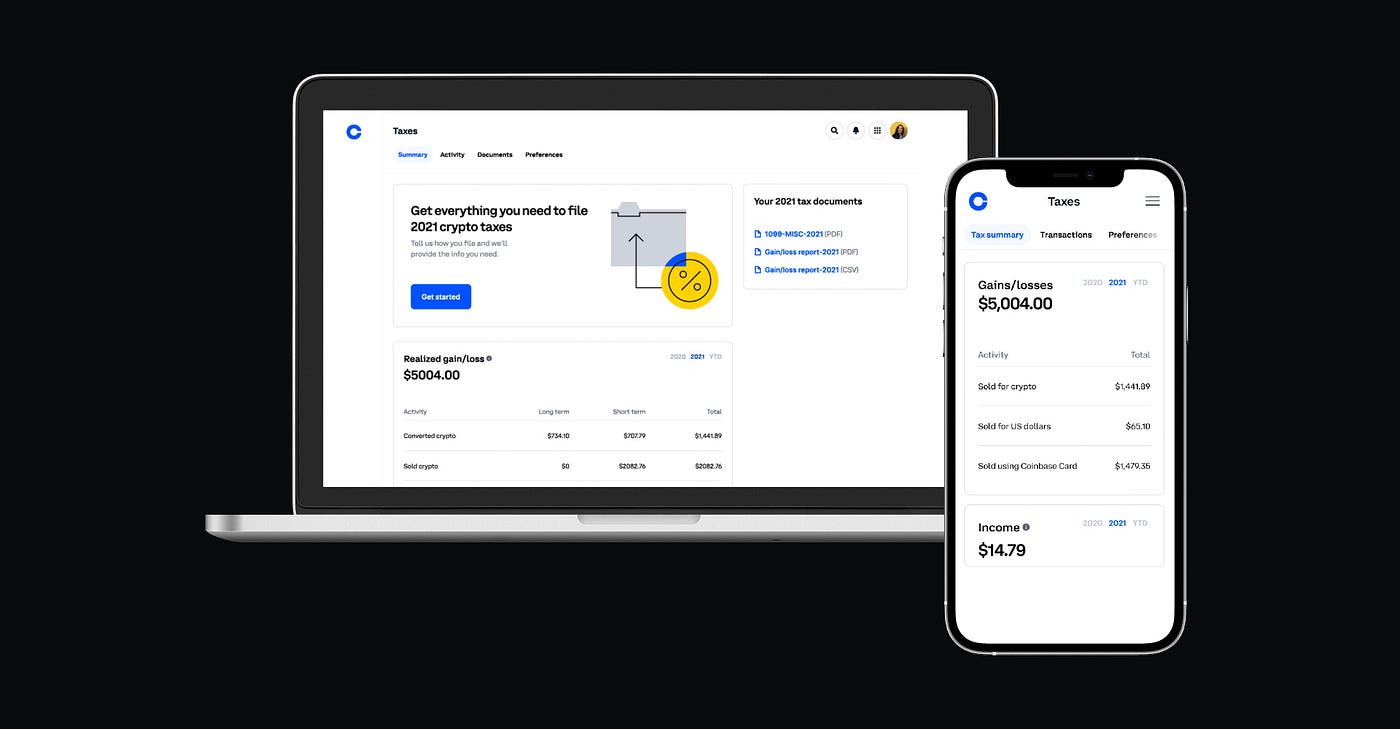
    This tax season, we’re introducing a tax center so customers can understand and file their crypto taxes with more ease and confidence. Customers will see all of their taxable activity in one place to determine if they owe taxes, and how much. If they’ve taken more advanced steps like sending or receiving crypto from Coinbase Pro or external wallets, they can receive free tax reports for up to 3,000 transactions from our crypto tax partner CoinTracker. The most complicated time of the year just became more clear.

    See a simple summary of taxable amounts

    U.S. taxpayers are required to report crypto sales, conversions, payments, and income to the IRS, and these transactions may be taxed as either capital gains/ losses or as regular income. Last year, customers had to research which transactions were considered taxable, and then manually track and sort them to calculate their gains/losses. It was tedious and time-consuming.

    Now, we’re simplifying the process by showing each customer a personalized summary of their taxable activity on Coinbase, broken out over time by realized gains/losses and miscellaneous income. Customers can use these amounts to prepare and file their taxes either with their personal accountants or directly with tax prep software like TurboTax®, where all Coinbase customers get up to $20 off TurboTax products.

    Get help with all crypto taxes, even transactions off Coinbase

    U.S. taxpayers may owe taxes on the amount they gained from crypto, or may be able to use losses against their other income. In order to calculate gains/losses, we need to know the initial value of a customer’s crypto. There are some cases where Coinbase is missing this information (e.g. the customer received it from an external wallet). Customers with these cases can use our crypto tax partner CoinTracker to aggregate their transactions across Coinbase and other exchanges, wallets, and DeFi services. Coinbase and Coinbase Pro customers have free access to tax reports for up to 3,000 transactions made on these platforms and get 10% off CoinTracker plans that support the syncing of any other Wallet or exchange.

    Learn about the latest crypto tax tips

    To access tax tools on coinbase.com, customers can tap their profile in the upper right hand corner and will see Taxes as a new item in the drop down menu. To access from the mobile app, customers will tap the menu on the upper left hand side, tap Profile & Settings, and will see Taxes. Over the next few weeks, customers will also find written guides on topics like finding the right tax professional and filing taxes on NFTs plus explainer videos on capital gains/losses and income.

    Coinbase is committed to making it as easy as possible to understand and file crypto taxes. We’ll continue improving tax tools and creating new content throughout tax season as we all navigate the evolving world of web3.

    [ad_2]

    Source link

  • Coinbase Partners with Mastercard to Revolutionize NFT Purchase Experience

    Coinbase Partners with Mastercard to Revolutionize NFT Purchase Experience

    [ad_1]

    On January 18, Coinbase, the US largest
     
     cryptocurrency exchange 
    , announced a partnership with Mastercard, a global payment giant, to classify NFTs as digital goods in order to allow a wider group of consumers to buy non-fungible tokens. With the announcement, coming soon Coinbase will transform a new way to pay using Mastercard cards.

    Coinbase recently announced ‘Coinbase NFT,’ a peer-to-peer marketplace, which enables minting, buying, showcasing, and discovering NFTs easier. The partnership with Mastercard will therefore enable Coinbase to offer a better customer experience on the Coinbase NFT marketplace. The exchange is working to find ways to bring such opportunities to the wider ecosystem through Mastercard’s global network. Coinbase applauds Mastercard’s leadership on this matter to make it as easy as possible to purchase and sell NFTs.

    Prakash Hariramani, the head of
     
     Payments 
    and Financial Hub at Coinbase, talked about the development and said that Coinbase’s mission is to increase economic freedom in the globe. He stated that by enabling more users to join the creator economy and profit from their work, NFTs have a vital role to play in this mission. He, however, identified that buying an NFT remains a complex experience for many users. He disclosed that Coinbase is working on simplifying the user experience to allow more people to join the NFTs community. Hariramani elaborated that just the way the exchange helped millions of people access Bitcoin in an easy and trusted manner, it is working on doing the same for NFTs.

    Coinbase Is Doubling Down on NFTs Efforts

    The development by Coinbase to embrace partnership with Mastercard comes at a time when NFT trading activity has been increasing substantially. Last year, NFTs demand skyrocketed significantly with around 280,000 unique sellers and buyers trending by the end of August. In October last year, Coinbase announced the launch of its Coinbase NFT marketplace to allow users to mint, buy, and showcase NFTs. The initial launch supports Ethereum-based ERC-721 and ERC-1155 standards, but the exchange has plans to enable multi-chain support in the near future.

    NFT artists have revolutionized the traditional art world. Industries like music, gaming, and fashion are recognizing the power of NFTs to unlock new forms of creativity and ownership. Coinbase is therefore making NFTs more accessible by developing user-friendly interfaces that put the complexity behind the scenes. The crypto exchange added social features that open new avenues for discovery and conversation. Coinbase remains dedicated to growing the creator community exponentially, which is a win-win for artists and fans. In this way, the Coinbase NFT is positioning itself as a peer-to-peer marketplace whose filters are based on the users’ interests.

    On January 18, Coinbase, the US largest
     
     cryptocurrency exchange 
    , announced a partnership with Mastercard, a global payment giant, to classify NFTs as digital goods in order to allow a wider group of consumers to buy non-fungible tokens. With the announcement, coming soon Coinbase will transform a new way to pay using Mastercard cards.

    Coinbase recently announced ‘Coinbase NFT,’ a peer-to-peer marketplace, which enables minting, buying, showcasing, and discovering NFTs easier. The partnership with Mastercard will therefore enable Coinbase to offer a better customer experience on the Coinbase NFT marketplace. The exchange is working to find ways to bring such opportunities to the wider ecosystem through Mastercard’s global network. Coinbase applauds Mastercard’s leadership on this matter to make it as easy as possible to purchase and sell NFTs.

    Prakash Hariramani, the head of
     
     Payments 
    and Financial Hub at Coinbase, talked about the development and said that Coinbase’s mission is to increase economic freedom in the globe. He stated that by enabling more users to join the creator economy and profit from their work, NFTs have a vital role to play in this mission. He, however, identified that buying an NFT remains a complex experience for many users. He disclosed that Coinbase is working on simplifying the user experience to allow more people to join the NFTs community. Hariramani elaborated that just the way the exchange helped millions of people access Bitcoin in an easy and trusted manner, it is working on doing the same for NFTs.

    Coinbase Is Doubling Down on NFTs Efforts

    The development by Coinbase to embrace partnership with Mastercard comes at a time when NFT trading activity has been increasing substantially. Last year, NFTs demand skyrocketed significantly with around 280,000 unique sellers and buyers trending by the end of August. In October last year, Coinbase announced the launch of its Coinbase NFT marketplace to allow users to mint, buy, and showcase NFTs. The initial launch supports Ethereum-based ERC-721 and ERC-1155 standards, but the exchange has plans to enable multi-chain support in the near future.

    NFT artists have revolutionized the traditional art world. Industries like music, gaming, and fashion are recognizing the power of NFTs to unlock new forms of creativity and ownership. Coinbase is therefore making NFTs more accessible by developing user-friendly interfaces that put the complexity behind the scenes. The crypto exchange added social features that open new avenues for discovery and conversation. Coinbase remains dedicated to growing the creator community exponentially, which is a win-win for artists and fans. In this way, the Coinbase NFT is positioning itself as a peer-to-peer marketplace whose filters are based on the users’ interests.

    [ad_2]

    Source link

  • Coinbase and Mastercard partner to revolutionize NFT purchase experience | by Coinbase | Jan, 2022

    Coinbase and Mastercard partner to revolutionize NFT purchase experience | by Coinbase | Jan, 2022

    [ad_1]

    Coinbase

    By Prakash Hariramani, Senior Director, Product

    Our mission at Coinbase is to increase economic freedom in the world. By enabling more people to join the creator economy and profit from their work, NFTs (Non-Fungible Tokens) have an important role to play in this mission. However, the experience of purchasing an NFT remains complex for many users.

    Coinbase wants to simplify the user experience to allow more people to join the NFTs community. Just as we helped millions of people access Bitcoin for the first time in an easy and trusted way, we want to do the same for NFTs.

    That’s why we’re working with Mastercard to classify NFTs as “digital goods”, allowing a broader group of consumers to purchase NFTs. And, coming soon we’ll “unlock” a new way to pay using Mastercard cards.

    Coinbase recently announced Coinbase NFT, a peer-to-peer marketplace that will make minting, purchasing, showcasing, and discovering NFTs easier. Thanks to our work with Mastercard, we’ll be able to provide a better customer experience on Coinbase NFT, and plan on working to find ways to bring this opportunity to the broader ecosystem through Mastercard’s scale and global network.

    We applaud Mastercard’s leadership on this issue to make it as easy as possible to buy an NFT and make sure it’s the best consumer experience. The NFT revolution is just beginning.

    To learn more, please visit Mastercard’s Newsroom for a blog post and Q&A on our NFT strategy.

    [ad_2]

    Source link

  • Coinbase Expands Live Customer Support

    Coinbase Expands Live Customer Support

    [ad_1]

    By Casper Sorensen, Vice President, Customer Experience

    The following is the latest update in our series of blog posts describing our commitment to continuously improving our customer experience.

    In past blog posts we highlighted our ongoing journey to create more value for customers with our support experience. In 2021, we invested in providing improved support experiences by increasing our staffing, accelerating our response times, as well as adding dozens of educational resources to our help pages so customers can get the most accurate information on our products and services.

    In our pursuit to provide customers with the most trusted customer service experience in crypto we are excited to highlight new live support options for our customers.

    In Q4 we began offering localized phone support for retail customers in the US, UK, Ireland, Germany, and Japan. Whether the question is simple or complex, our trained professionals are ready to help. These new phone support options expand on the Coinbase One support which launched in October 2021 and is available to customers in the United States 24/7 from a dedicated team, and the fastest answer times in crypto.

    In December 2021, we began providing US retail customers with live messaging via our new Help Center platform. Live messaging offers customers the flexibility to connect with us when the time is right and continue the conversation seamlessly if they have to step away. Our team of customer service experts are available via messaging 24/7 with the speed our customers expect.

    The journey continues in 2022, we will provide more localized phone and messaging options for our customers globally as well as bring further enhancements to our in-app support experience for iOS and Android.

    We remain deeply focused on providing our customers with intuitive support technology and appreciate patience as we continue to grow. We look forward to continuous enhancements so please stay tuned to this blog for updates on the status of our journey.


    Coinbase Expands Live Customer Support was originally published in The Coinbase Blog on Medium, where people are continuing the conversation by highlighting and responding to this story.

    [ad_2]

    Source link

  • Coinbase Voices: Why I decided on a career in crypto | by Coinbase | Jan, 2022

    Coinbase Voices: Why I decided on a career in crypto | by Coinbase | Jan, 2022

    [ad_1]

    Coinbase

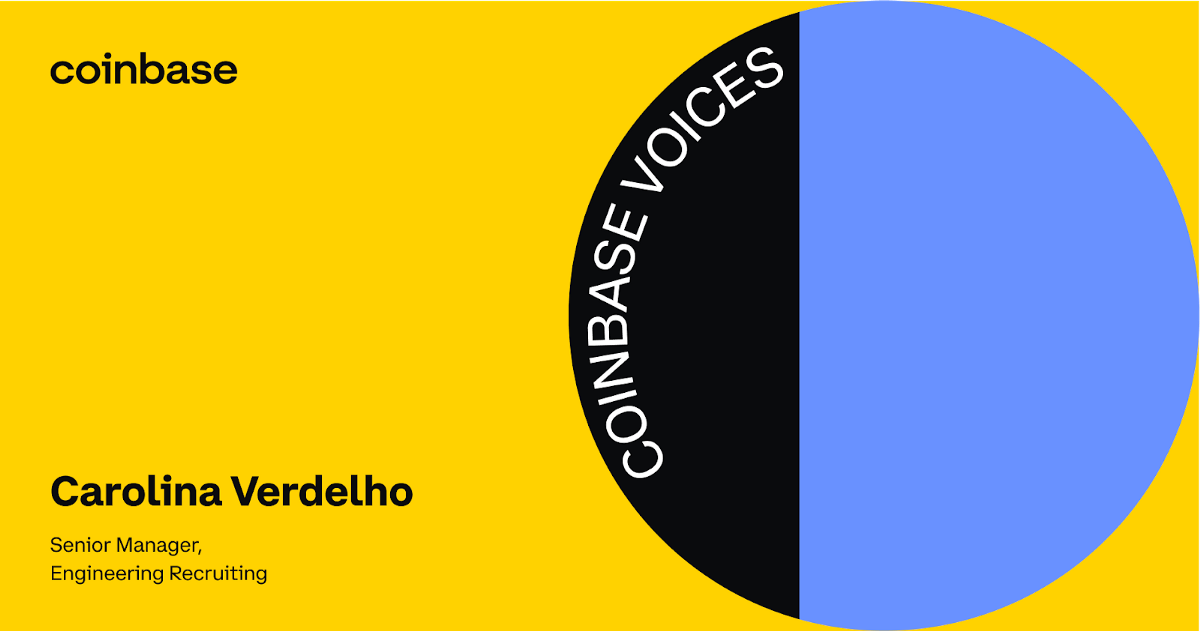
    Coinbase Voices is a collection of employee stories that highlight the expertise of our Coinbase team and share their journeys to crypto. In this post, Carolina Verdelho, Senior Recruiting Manager, discusses her experience as an international recruiter and how she’s using it to help shape the future of Coinbase.

    Tell us about your journey to becoming a Sr. Recruiting Manager. What does your job entail?

    I’ve been in Recruiting for more than 15 years now, and have always worked with tech companies. I started my career in Brazil, working in traditional tech like Dell and Oracle, hiring people across all of Latin America in technical, sales and business positions.

    My first language is Portuguese, but because I had exposure to other countries from the start, I also learned to speak Spanish and English. I didn’t expect to get into Recruiting at first — in fact, it was my last choice of careers. Now, don’t even think about taking me away from it! It’s what I love.

    What made you want to work at Coinbase?

    I had worked for almost nine years at Facebook when I decided I needed something new. One day, I was talking with a friend and shared that I wanted to do something different, but didn’t know what that was. He pointed out that when I joined Dell, the company was going to Retail, and when I joined Oracle, it was launching software as a service. When I joined Facebook, no one knew what social media would turn out to be. I joined at a pivotal time in those companies’ journeys. He said, “I think you should do that again.” He works for a blockchain company and suggested that I try the crypto environment. I wasn’t sure, but I started doing some homework and changed my status to Open on LinkedIn. To my surprise, someone from Coinbase reached out to me, along with five other crypto companies. I thought, maybe my friend is right — maybe it is for me. From there, I started talking to people at Coinbase and learning more about what the company had to offer.

    Candidates often ask me during interviews: Why did you decide to leave Facebook and join Coinbase? I find myself giving the same answer that I gave when I joined Facebook nine years ago. At that time, it was a company of 4,000 global employees. I remember the VP of Engineering asked me why I wanted to join, and what I thought the company would be in five years. I told her, “I don’t know what this company is going to be in the next five years — and that’s exactly why I want to join. I want to help build it.” It’s the same for Coinbase — I don’t know where we’ll be in five years, but I want to help us get there.

    What project are you working on over the next 60 days?

    My role has changed quite a bit since I joined Coinbase in May of this year. I wear three different hats: I manage a Recruiting team hiring engineering managers in the United States; I’m helping to stand up recruiting efforts in Latin America, including Brazil and others; and, I’m doing the same for EMEA, in the UK, Ireland, Israel and more.

    Internationally, we are starting everything from scratch — hiring recruiters, finding agencies who will help us, and establishing a system for how to hire in each country. We’re in hyper-growth mode, and it’s an exciting time to be here — especially on the Recruiting team.

    What’s it like working for a remote-first company? What advice would you give to someone considering it?

    I was at Facebook when the pandemic hit and everyone went remote, and was later offered the opportunity to work from home full-time. When I was looking to join another company, that was one of the mandatory requirements for me.

    Remote work allows me to balance managing a family — a husband, kids and a dog — while also working and being as available as I can be. It doesn’t make sense for me to commute 30–40 minutes in the car when I could be doing something productive, like supporting my team or finding a solution to a problem. Working remotely is the best use of my time.

    I also love that we have a lot of tools that help us interact with each other. We use Slack and Google Meet to connect, so I don’t miss out on meeting people. I think I know people better now in this virtual environment than I did face-to-face. I get to know more about them and really talk to them instead of just seeing each other in passing.

    The one piece of advice I would give to people is to set boundaries. I make sure I have a dedicated workspace where I can be 100% focused on what I’m doing. When I’m there, my brain recognizes that I’m working. Then, when I’m done and it’s time to be with my family, I can close the door and detach from work.

    Finally, just because I can be at the computer at any time doesn’t mean I’m available at any time. If you don’t set boundaries upfront, things will be difficult. Use your ‘me’ time to be with your family, take care of yourself, exercise, read a book, go for a walk — get fresh air. It’s important to set aside time in your day to recharge, then hit the ground running when it’s time to work.

    What’s it like onboarding remotely?

    I really had a hard time the first two days at Coinbase — it was difficult for me to understand what was going on. I told my husband, “What have I done?” He reminded me that I was at a company for nine years and things would be different now. In the days following, people were very open to supporting me, explaining things, and helping me understand why we do things the way we do here.

    I think onboarding remotely is a bit of a challenge because you’re essentially opening a different computer in the same place you were working the day before, for a different company. After a few days, I started to catch on — I think giving time to acclimate to the culture and providing access to resources makes a huge difference. I had an amazing buddy who helped me onboard and was always available and checking on me. That was a total game-changer.

    What do you value most about Coinbase’s culture? What do you think sets it apart?

    I took a leadership course a few years back, where the teacher said that we should hire people not only by their skills or experience, but by their values, and that the values of the person should match the values of the company. Before I interviewed with Coinbase, I read the values and asked myself if I could work and operate following them. The answer is a huge yes.

    There’s a cultural value here that’s very important to me: Act Like an Owner. It might be because I’m driving a lot of things for international expansion, but I strongly believe that I shouldn’t expect or wait around for others to take care of something for me. I should own it and ensure its successful completion.

    I think what sets Coinbase apart for me is the winning combination of a solid business foundation, a very strong leadership team, and the excitement of hyper-growth. You don’t find this often. Being able to join this company and put your fingerprint on this growth and say, “Hey, I was the one who did this, who moved this needle or helped jumpstart that initiative,” that’s such a rare and exciting opportunity. Coinbase also gives people the responsibility and accountability to push the company forward — everyone feels like they’re a part of something bigger than themselves, and that’s something that I love.

    Tell us something about you that we wouldn’t know from your LinkedIn profile.

    Something not many people know is that my first job was working at the video rental store, Blockbuster. I was watching a documentary about the company a few weeks ago and thinking back on all that I learned in that experience: How to listen to people, how to approach people that I don’t know, how to offer my help and manage expectations. I learned a lot from that experience, and I’m very thankful.

    I can also say that I learned a lot from my recruiting experience there. I walked away thinking, how can I do better for people? How can I be respectful of their time and feelings? Maybe being a part of that process helped shape the Recruiting professional I am today.

    [ad_2]

    Source link

  • Goldfinch Protocol (GFI) is launching on Coinbase Pro

    Goldfinch Protocol (GFI) is launching on Coinbase Pro

    [ad_1]

    Starting Today, January 11, transfer GFI into your Coinbase Pro account ahead of trading. Support for GFI will generally be available in Coinbase’s supported jurisdictions with certain exceptions as indicated in each asset page here. Trading will begin later today if liquidity conditions are met.

    One of the most common requests we receive from customers is to be able to trade more assets on our platform. Per the terms of our listing process, we anticipate supporting more assets that meet our standards over time. Most recently we have added trading support for DESO, API3 (API3), Bluezelle (BLZ), Gods Unchained (GODS), Immutable X (IMX), Measurable Data Token (MDT), Ribbon Finance (RBN), Circuits of Value (COVAL), IDEX (IDEX), Moss Carbon Credit (MCO2), Polkastarter (POLS), ShapeShift FOX Token (FOX), Spell Token (SPELL) and SuperFarm (SUPER)

    Once sufficient supply of GFI is established on the platform, trading on our GFI-USD order book will launch in phases, auction mode then limit-only or full trading mode. If at any point one of the new order books does not meet our assessment for a healthy and orderly market, we may keep the book in one state for a longer period of time or suspend trading as per our Trading Rules.

    We will publish tweets from our Coinbase Exchange Twitter account as each order book moves through the phases.

    Goldfinch Protocol (GFI) is an Ethereum token that governs Goldfinch, a decentralized credit protocol for extending business loans without collateral. The token can be used to vote on the future of the protocol and protocol auditors can stake GFI to receive rewards.

    GFI is not yet available on Coinbase.com or via our Consumer mobile apps. We will make a separate announcement if and when this support is added.

    You can sign up for a Coinbase Pro account here to start trading. For more information on trading GFI on Coinbase Pro, visit our support page.

    ###
    Please note: Coinbase Ventures may be an investor in the crypto projects mentioned here, and additionally, Coinbase may hold such tokens on its balance sheet for operational purposes. A list of Coinbase Ventures investments is available at https://ventures.coinbase.com/. Coinbase intends to maintain its investment in these entities for the foreseeable future and maintains internal policies that address the timing of permissible disposition of any related digital assets, if applicable. All assets, regardless of whether Coinbase Ventures holds an investor or Coinbase holds for operational purposes, are subject to the same strict review guidelines and review process.
    This website contains links to third-party websites or other content for information purposes only (“Third-Party Sites”). The Third-Party Sites are not under the control of Coinbase, Inc., and its affiliates (“Coinbase”), and Coinbase is not responsible for the content of any Third-Party Site, including without limitation any link contained in a Third-Party Site, or any changes or updates to a Third-Party Site. Coinbase is not responsible for webcasting or any other form of transmission received from any Third-Party Site. Coinbase is providing these links to you only as a convenience, and the inclusion of any link does not imply endorsement, approval or recommendation by Coinbase of the site or any association with its operators.

    Crypto is a new type of asset. Besides potential day to day or hour to hour volatility, each crypto asset has unique features. Make sure you research and understand individual assets before you transact.

    All images provided herein are by Coinbase.


    Goldfinch Protocol (GFI) is launching on Coinbase Pro was originally published in The Coinbase Blog on Medium, where people are continuing the conversation by highlighting and responding to this story.


    [ad_2]

    Source link

  • Working at Coinbase: Intense and demanding, balanced by deliberate recharge time

    Working at Coinbase: Intense and demanding, balanced by deliberate recharge time

    [ad_1]

    By L.J. Brock, Chief People Officer

    We’re often asked a version of this question: “What’s it really like to work at Coinbase?”

    Our culture doc provides a great overall perspective on working here, but I think it’s important to address this question head-on, too.

    The bottom line: We work incredibly hard at Coinbase — for most of us, Coinbase is the most intense place we’ve ever worked. That intensity is only magnified by the current moment in crypto, and it often results in long days and long weeks.

    However, because of that intensity, we’re also deliberate about finding time to recover between sprints. How deliberate? This year, we’re experimenting with four recharge weeks (roughly one per quarter), when nearly the entire company will shut down so we can all enjoy downtime without work piling up.

    Four weeks of coordinated recharge time might sound like a lot of time off for a company in hypergrowth, but given the intensity of our work throughout the year, we think this is the best way to ensure our pace is sustainable for the long term.

    We know this approach wouldn’t work for every company, and we also know Coinbase isn’t for everyone. But if you want to work at the cutting edge of crypto and tech — and if you’re excited about pushing your skills to the limit while knowing you’ll have regular opportunities to recharge — there’s no better place to be.

    An all-in environment

    Why is Coinbase so intense? Because the massive opportunity in front of us demands the best from each of us, every day.

    We’re upfront about this in our culture doc, but it’s worth emphasizing: “We are a winning team, not a family, and have high expectations for performance and delivering results…. We have an intense work culture, and are regularly pushed out of our comfort zones.”

    What’s this mean in practice?

    It means we don’t promise 9 a.m. — 5 p.m. hours or 40-hour work weeks — many days and weeks are long, because that’s what it takes to get the job done.

    It means we can’t simply do more in some areas by doing less in others — the risk of missing out on a huge opportunity is too great.

    It means we aren’t wedded to long-term plans — yes, we thoughtfully map out quarterly and annual plans, but we’re prepared to pivot at a moment’s notice if we see a better opportunity to serve our customers.

    We’re laser-focused on achieving our mission of increasing economic freedom in the world, and we encourage our teams to set “uncomfortably ambitious” goals. That’s the only way we can stay ahead.

    An ‘act like an owner’ mentality

    One of our cultural tenets is “act like an owner.” We expect our employees to take 100% responsibility for achieving our mission, but we also empower them to work in the way that’s best for them, and to rest and recharge between their sprints.

    We do this in part through our remote-first stance, which enables almost all employees to choose whether to work from an office, from home, or through a hybrid approach — whatever works best for them and their families. This policy has been hugely successful, enabling us to hire top talent from around the world and earning positive reviews from our employees.

    We also empower employees to take charge of their well-being through our flexible time off (FTO) policy (in eligible countries), which means most employees don’t need to accrue time off before using it or worry about hitting an annual limit.

    Despite our FTO policy for most employees, we realized in 2020 that many employees weren’t taking enough time off to recharge, either because they didn’t want to force their teammates to cover for them or because they didn’t want to fall behind on their work.

    We knew this was unsustainable, so we scheduled a recharge week at the end of 2020 and two recharge weeks in 2021, when nearly the entire company would shut down. (Teams with critical 24/7 responsibilities, such as customer service and security, scheduled alternate recharge weeks.)

    Subsequent employee surveys made it clear: recharge weeks work. In fact, 52% of employees said recharge days and weeks were the primary tool that helped them rest and recover in 2021.

    That feedback — and our expectation that this year will be just as intense as last year — prompted us to schedule four recharge weeks for 2022, roughly one per quarter. We have no expectation we’ll continue with four recharge weeks beyond 2022 — we’ll evaluate as we go — but we’re confident this is the right approach for us this year.

    Even though we’ve scheduled four recharge weeks for 2022, we didn’t make any changes to our FTO policy — we’ve encouraged employees to schedule vacations during our recharge weeks when they can, but we know that’s not always possible, and that’s OK.

    We also know that, despite our best intentions, there are times when some employees need to work through a recharge week. When this happens, we do our best to make it up to them so they have dedicated time to recharge, too. We’re OK with this tradeoff — we prefer to implement a solution that regularly works for 90% of employees than to endlessly search for an elusive “perfect” solution.

    Acting like an owner truly is key to success at Coinbase — our top performers take recharge seriously, but they also don’t hesitate to jump in and deliver for the company whenever and however is needed.

    A once-in-a-career opportunity — and we’re hiring

    There’s no denying that Coinbase is one of the most exciting places to work right now.

    In just the last 12 months, we’ve tripled our headcount, expanded into new markets, brought new crypto innovations to our customers and become a publicly traded company — and we still feel we’re just getting started.

    As we say in our culture doc, “We are optimistic about the future and determined to get there.”

    If you share that optimism, and if my description of working at Coinbase resonates with you, take a look at our Careers page — we’re hiring for hundreds of roles in dozens of fields, and we want exceptional people in every seat, working together towards our mission.


    Working at Coinbase: Intense and demanding, balanced by deliberate recharge time was originally published in The Coinbase Blog on Medium, where people are continuing the conversation by highlighting and responding to this story.

    [ad_2]

    Source link

  • Coinbase Giving: Half Year in Review

    Coinbase Giving: Half Year in Review

    [ad_1]

    In May 2021, we announced the launch of Coinbase Giving. Coinbase Giving is the operational embodiment of our commitment to Pledge 1%: our promise to dedicate 1% of Coinbase profits, equity, and employee time toward charitable activities that leverage the power of crypto to increase economic freedom in the world.

    Where we are

    In the past 7 months we’re proud of what we’ve accomplished:

    • Coinbase Giving is the largest charitable organization focused on Crypto (>$500M endowed at the time of post)
    • GiveCrypto, founded in 2018, has been brought officially under the umbrella of Coinbase Giving to enable scale and maximize social impact
    • We have launched 7 programs, supported 410 organizations, deployed ~$2M, and are impacting 2K+ lives

    We are only at the beginning of this journey. 2021 has been a test and iteration year — our impact is still modest. The purpose of this post is to share progress and lessons learned.

    Areas of focus

    In 2021 our focus has been to support endeavors that align to three broad categories:

    1. Increasing education around, and access to, crypto
    2. Accelerating the development of crypto protocols that underpin the cryptoeconomy
    3. Fostering the next generation of crypto talent, no matter where they are located

    Highlights from 2021

    GiveCrypto is our nonprofit that enables crypto based direct giving to some of the most needy people in the world. In doing so we also educate them about crypto and give them an alternative to their broken financial systems.

    GiveCrypto has been one of Coinbase Giving’s largest investment areas in-house. GiveCrypto is a two-sided market. First, donations are driven by donors who are inspired to give charitably. Second, from these donations, crypto is put directly in the hands of people in need through our on-the-ground Ambassador program.

    Bringing GiveCrypto directly within Coinbase has accelerated our ability to integrate donation collection within the consumer experience. As such, 2021 has been a critical year of rebuilding and integration. As the #1 crypto exchange in the US, we see this connection as a huge step forward in enabling public donations using crypto and Coinbase products. We have taken this chance to revamp our Ambassador program — our system to distribute funds directly into the hands of the most needy. In 2021, we were purely testing our distribution system and only reached 246 recipients. However, with those tests now under our belts, we feel ready to scale distributions dramatically in 2022.

    Already we are seeing how crypto possesses unique characteristics that make it suitable as a cross-border donations mechanism. For example, it allows donors to avoid disintermediation by bad actors, who often take a cut at the expense of the recipient. Crypto adoption is growing, particularly in Latin American countries where hyperinflation can be devastating. Our independently validated randomized control test shows that direct giving continues to demonstrate high real-life impact, whether in enabling individuals to pay for food, education, or other day-to-day needs.

    Developer Grants 2.0 to accelerate the development of crypto protocols.

    In August, we launched the second iteration of our Crypto Community Fund whose goal is to make the cryptoeconomy safer and easier to access for everyone. We selected 6 developers to fund across 3 thematic areas: (1) Scalability; (2) Privacy, identity and zero knowledge research; and (3) Protocol security and other foundational infrastructure.

    Grant terms are typically 1-year and we will share progress on their journeys throughout 2022.

    Base 11 partnership to foster the next generation of global and diverse crypto talent.

    Earlier this year Coinbase announced our three-year partnership with Base 11. Together, our goal is to develop the next generation of diverse crypto talent. In early October, Base11 hosted the Next Frontier Conference & Expo, which featured a fireside chat with Alesia Haas, CFO at Coinbase and Landon Taylor, Founder & Chairman, Base 11.

    At the conclusion of the conference, the Coinbase Giving team launched our first ever Open Innovation Challenge, giving away over $10,000 in prizes and an exclusive NFT. The Open Innovation Challenge called for participants to focus on four key pillars: environmental sustainability, healthcare, education, and financial inclusion. The call to action has drawn hundreds of participants from all over the world and dozens of quality submissions that address the key pillars described above. We’re excited to enter the judging phase and will announce the winner in Q1 2022.

    Learnings

    1. The crypto-forward charitable ecosystem — like the crypto ecosystem — is still nascent. That said, there are a growing number of novel partnerships between established non-profits (who deeply understand the social sector) and technical partners (who get crypto/blockchain) trying to better solve old problems with new solutions. We’ve learned this is Coinbase Giving’s sweet spot for grant-making.
    2. As more people hold crypto, more people want to give in crypto. “45% of crypto holders donated $1,000 or more to charities in 2020 compared to 33% of all investors”, according to a new report by Fidelity. We have engaged in many conversations with potential partners exploring the role Coinbase Giving could play in connecting nonprofits and endowments with the infrastructure they need to accept and hold crypto as an endowment (only ~2% have the ability to do so currently).
    3. Without education, there is no access. As the crypto market has heated up in 2021, so has the call for Coinbase Giving to provide more educational resources and support. Non-profits, NGOs and education leaders increasingly see crypto literacy as a next-generation skill required for the future success of their communities and constituencies. Coinbase’s investment in Crypto Learn and other initiatives distinctly well position Coinbase Giving to address this educational need. We look forward to exploring more in 2022.
    4. Accelerating and building infrastructure is more than open source code. There are many barriers to the simple and secure use of crypto and blockchain that are just as much about infrastructure development as having the right protocols. There are also many more applications for blockchain to solve social problems than have yet been envisioned or realized. This is all infrastructure. We can do better to support a flourishing ecosystem.

    Next Up

    With 2021 as a foundation-building (half) year, we are looking forward to incorporating what we’ve learned and to drive the social impact of crypto in 2022. We’ll keep the community up to date on what’s happening with a quarterly blog. Stay tuned!


    Coinbase Giving: Half Year in Review was originally published in The Coinbase Blog on Medium, where people are continuing the conversation by highlighting and responding to this story.


    [ad_2]

    Source link

  • Coinbase Prime Partners with Enfusion, Targets Institutional Investors

    Coinbase Prime Partners with Enfusion, Targets Institutional Investors

    [ad_1]

    Coinbase Prime announced yesterday that the company has established a collaboration with Enfusion to offer seamless crypto trading to institutional investors. The integration, which is expected to be completed during the second quarter of 2022 (Q2 2022), will give institutions easy access to the growing market of digital assets.

    Coinbase Prime expects leading financial institutions to increase their crypto exposure in the future. The company aims to provide efficient institutional-level crypto services to its clients through the integration of innovative technologies.

    “Enfusion’s connectivity with Coinbase Prime will allow us to seamlessly manage our crypto positions alongside other assets from a single interface, streamlining our trading operations. We’re very excited to see two platforms. We rely on the everyday team up to continue improving how institutions access the crypto markets,” said Eric Peters, the CEO and CIO of One River, a leading asset management firm.

    In September 2021, Coinbase Prime announced the launch of innovative features to help clients in the management of their portfolios. Earlier this year, Coinbase acquired Routefire to expand Prime Brokerage execution.

    OEMS Enfusion

    According to Brett Tejpaul, the Head of Institutional Sales, Trading and Prime at Coinbase, the institutional interest in digital assets has increased substantially in the last 12 months.

    “By providing straight-through processing to Coinbase Prime via APIs, Enfusion is providing its clients institutional access to digital asset custody and algorithmic trading, with the potential to further our relationship in the future,” he said in a recent post.

    “We’re excited to connect to our first OEMS Enfusion, as their native multi-asset management system is a natural first choice to collaborate with on a joint institutional offering. We expect financial institutions to continue to increase their portfolio exposure to crypto, and we’re committed to offering the best tools to enable them to manage it efficiently,” Tejpaul added.

    Coinbase Prime announced yesterday that the company has established a collaboration with Enfusion to offer seamless crypto trading to institutional investors. The integration, which is expected to be completed during the second quarter of 2022 (Q2 2022), will give institutions easy access to the growing market of digital assets.

    Coinbase Prime expects leading financial institutions to increase their crypto exposure in the future. The company aims to provide efficient institutional-level crypto services to its clients through the integration of innovative technologies.

    “Enfusion’s connectivity with Coinbase Prime will allow us to seamlessly manage our crypto positions alongside other assets from a single interface, streamlining our trading operations. We’re very excited to see two platforms. We rely on the everyday team up to continue improving how institutions access the crypto markets,” said Eric Peters, the CEO and CIO of One River, a leading asset management firm.

    In September 2021, Coinbase Prime announced the launch of innovative features to help clients in the management of their portfolios. Earlier this year, Coinbase acquired Routefire to expand Prime Brokerage execution.

    OEMS Enfusion

    According to Brett Tejpaul, the Head of Institutional Sales, Trading and Prime at Coinbase, the institutional interest in digital assets has increased substantially in the last 12 months.

    “By providing straight-through processing to Coinbase Prime via APIs, Enfusion is providing its clients institutional access to digital asset custody and algorithmic trading, with the potential to further our relationship in the future,” he said in a recent post.

    “We’re excited to connect to our first OEMS Enfusion, as their native multi-asset management system is a natural first choice to collaborate with on a joint institutional offering. We expect financial institutions to continue to increase their portfolio exposure to crypto, and we’re committed to offering the best tools to enable them to manage it efficiently,” Tejpaul added.

    [ad_2]

    Source link