By Shilpa Dhar, VP of Product, and Moheeth Alvi, Lead Product Manager, Payments
Introducing an instant, convenient way for your friends and family in Mexico to cash out the crypto you send them.
Initially, recipients in Mexico will be able to cash out crypto in local currency at over 37,000 locations across the country, or save the crypto they’ve received in their Coinbase account.
In 2020, immigrants and expats from around the world sent approximately $700 billion from the US to their family and friends back in their home countries, according to the World Bank. But many challenges exist with today’s traditional cross border payment offerings: sender fees can reach up to 6–7%, and recipients can only receive funds as cash in their local currency so they don’t have an option to save, grow, or protect their funds from losing purchasing power due to currency depreciation.
Coinbase has long presented a way to instantly send crypto (including stablecoins such as USDC) to family and friends anywhere in the world for free, and to allow recipients to invest in any of the 100+ cryptocurrencies that we support. Today, we’re introducing the ability for recipients in Mexico to cash out their crypto holdings in their local currency. The lower price of sending and cashing out crypto and flexibility in how to store funds will allow recipients to keep even more of their money.
Instantly Send Funds And Cash Out
Here’s how it works: customers today can already instantly send crypto to recipients in Mexico directly from their Coinbase app. Once sent, the recipient will receive a notification and can immediately view the crypto balance in their Coinbase account. From there, the recipient can choose to cash out or save the funds in their Coinbase account. If they choose to cash out any part of their balance, they can generate a redemption code from their Coinbase app that can be used to receive cash at 37,000 physical retail outlets and convenience stores located across Mexico. If they choose to keep their funds on Coinbase, they can simply hold the crypto asset they received or convert and invest their balance in any of the 100+ cryptocurrencies that Coinbase supports. That includes USDC, a stablecoin pegged to the US Dollar, which will help the recipient hedge against any devaluation of their local currency.
Free through March 31st
Coinbase customers in Mexico will be able to cash out their crypto using this new service free of charge through March 31, 2022. After that date, customers will be charged a nominal fee that’s still 25–50% cheaper than traditional cross border payment solutions.
We recognize this is a global issue. And while we’re starting in Mexico, over time we’ll consider other regions where customers face similar challenges.
Coinbase’s mission is to increase economic freedom around the world, and this new product is core to enabling that mission. We want to make it fast and easy for users to send crypto to anyone in the world, and allow recipients to participate in the cryptoeconomy. We’re just getting started.
By Nana Murugesan, VP, International and Business Development
Coinbase will adopt a go broad and go deep approach to scale globally in order to further its mission of bringing more economic freedom to each and every individual and business around the world. Leadership roles are now open across the globe to build our international presence.
Go Broad: launch foundational products that are a gateway to Web3 and crypto in every country*
Go Deep: launch localized infrastructure and public facing products with a full suite of services
I joined Coinbase around a month ago to lead business development and international operations teams to further our mission, strategy, and culture around the world. In this blog, I wanted to share our international strategy, how we are thinking about building our international operations, and the exciting leadership roles we just opened up around the world for those interested to join us!
By its very nature, crypto is global and decentralized, and as stated in our blog yesterday, we have an ambitious mission to increase economic freedom in the world that will rely on our ability to bring our products to customers globally. Crypto can have a seismic impact in driving toward a more equitable global economy. This is for a number of reasons, including, but not limited to, the fact that in new high growth markets, the barriers to entry into the traditional financial system may be beyond the reach of many citizens. For instance, traditional financial systems may require official identification or a credit history to access financial services and the security it provides. In larger, more diversified economies, we take these things for granted, but in many parts of the world, they’re unavailable to a majority of the population.
There are billions of people around the world who are underbanked or unbanked. According to the World Bank’s Global Financial Inclusion database, 1.7 billion adults are unbanked, and while the number of underbanked is harder to identify, it’s an issue that impacts almost every country. Yet two-thirds of those identified as unbanked own a mobile phone that could help them access financial services. These numbers are even worse for women, who are roughly 10 percent less likely than men to have access to financial services. Where women are not financially empowered, the trend lines are also more profoundly negative, correlated to a less established civil society and the seeds of undemocratic norms. These are precisely the types of challenges that crypto is uniquely equipped to solve.
Economic freedom is unevenly distributed around the world. Crypto enables economic freedom. At Coinbase, we believe everyone deserves access to financial services that can empower them to create a better life for themselves and their families, regardless of their location, gender or socioeconomic status.
Going global is complicated and this is compounded by rapidly evolving regulatory international frameworks for crypto. Our approach globally will be consistent with our approach in the United States: we will work with governments and regulators in different markets, and will always aim to be the most trusted and compliant crypto company in any market. As our co-founder & CEO Brian Armstrong has said, “clear rules of the road allow for technological innovation and investment and give the public and policy makers confidence that these markets are fair.” That is why, in Brian’s words, “we see [regulation] as a business enabler.” We will take that perspective in our global expansion.
A key first step of our strategy is to hire experienced regional and country leaders across the globe. We are now kicking off an extensive global expansion strategy, with hiring and investment plans to enter these markets which will ultimately allow Coinbase to serve customers more locally:
Americas — Latin America, Canada
EMEA — Europe, Middle East and North Africa, Sub-Saharan Africa
APAC — South Asia, Southeast Asia and Oceania, North and East Asia
[Link to newly opened Regional Managing Directors, Country Directors, and other Global & Regional Leadership roles. And, keep an eye out for more roles opening in the coming months]
With these leaders in place, we will develop and execute on in-market plans to (1) launch our products, (2) establish our presence with top local talent, (3) grow our customer base, (4) build our business, and (5) collaborate closely with our external constituents [including regulators, financial institutions and partners]. In parallel, we will explore new market entry through acquisitions.
To accelerate the growth of the cryptoeconomy globally, Coinbase Ventures will double down on regional investments, adding to our portfolio of platforms such as CoinSwitch Kuber and CoinDCX in India, Bitso in Latin America, and Rain in the Middle East.
We understand that a one-size-fits-all approach won’t work as each market is unique, with its own set of opportunities, challenges, political dynamics, and cultural norms. To address this, we plan to take a go broad and go deep approach.
Coinbase’s mission is to increase economic freedom in the world, and we take this commitment seriously. The first tenet of our global strategy is to get crypto into the hands of any person who wants it, regardless of their financial status. This means we may enter international markets at scale with our decentralized and non-custodial products such as Coinbase Wallet. This allows us to offer local communities a light-weight, user-controlled, simple and secure interaction with the crypto economy and to enable fun experiences such as NFT drops from local creators. As regulatory frameworks and markets develop, we will look to go deep, as elaborated below.
In those countries that have clearly defined crypto regulation and there is a clear path for us to offer services in a way that is fully compliant with local laws and with a reasonable content moderation philosophy, we will plan to provide access to a full suite tailored to the local market. For our retail customers, this includes our custodial, full-fiat trading products, such as our main Coinbase App, and products that host user generated content (or include social features) such as our upcoming Coinbase NFT marketplace. For our institutional customers, we will plan to offer a full suite of advanced prime brokerage services, including custody and private client support.
I am excited to embark on this journey, and I look forward to providing updates along the way. At Coinbase we’re building an open financial system for the world and we’re always looking for top talent ready to do the best work of their careers to help us get there. If you think this could be you, we’re hiring!
At Coinbase we have an ambitious mission to increase economic freedom in the world. If we’re going to execute against the opportunity in front of us, we’re going to need more help to scale our existing products, and build new ones. In 2022, we plan to add up to 2,000 employees across our Product, Engineering, and Design teams.
We see enormous product opportunities ahead for the future of Web3. We believe our industry is in its infancy and that building onramps for individuals to participate is critical to driving the next generation use case of crypto. We’re also expanding to include products that host user generated content like NFTs, and we’re excited about our ambitious plans for the future of Coinbase Wallet, enhancing security, ease of use, and accessibility.
We are unwavering in our focus to build for the long-term, through every crypto cycle. It’s been one of the greatest drivers of our success to date. Through the highs, we get to focus on scaling and many new people get introduced to crypto. During the lows, we get to focus on product innovation. Whether the market is up or down, we see a clear opportunity, making Coinbase one of the most exciting places to work right now.
Who we’re looking for
There are a few things we look for across all hires we make at Coinbase, regardless of role or team. First, we look for signals that a candidate will thrive in a culture like ours, where we prioritize clear communication, efficient execution, and continuous learning, among other qualities. We look for people that choose to take a mission-focused approach to their work. And we seek people with the desire and capacity to #LiveCrypto, actively building and sharing their expertise in crypto with those around them.
In return, we offer a once-in-a-career opportunity, with competitive, transparent compensation; unique benefits like multiple company-wide recharge weeks; and a remote-first environment where you’ll work on a championship team with some of the most talented people in our industry.
Crypto is at a critical juncture — public adoption is at an all-time high, crypto companies are more visible than ever before, and the explosion of Web3 applications is uncovering new possibilities every day. So if you’re excited by this opportunity and want to join us on our mission to increase economic freedom in the world, check out our Careers Page. We’re hiring.
This communication contains “forward-looking statements” including, among other things, statements relating to our anticipated hiring in 2022. Statements containing words such as “could,” “believe,” “expect,” “intend,” “will,” “anticipate,” “plan,” or similar expressions constitute forward-looking statements. These forward-looking statements are made pursuant to the safe harbor provisions of the Private Securities Litigation Reform Act of 1995. These statements involve risks and uncertainties that could cause actual results to differ materially, including, but not limited to, risks and uncertainties related to our ability to successfully execute our business and growth strategy and maintain future profitability, market acceptance of our products and services, our ability to further penetrate our existing customer base and expand our customer base, our ability to develop new products and services, our ability to expand internationally, the effects of increased competition in our markets, and market conditions across the cryptoeconomy. The foregoing list of risks and uncertainties is illustrative, but is not exhaustive. Further information on risks that could cause actual results to differ materially from forecasted results are, or will be included in our filings with the Securities and Exchange Commission including our Quarterly Report on Form 10-Q for the quarterly period ended September 30, 2021. Except as may be required by law, we undertake no obligation, and do not intend, to update these forward-looking statements after the date of this communication.
Investors are increasingly demanding high-quality, diversified exposure to digital investment strategies. And to meet those expectations, institutions must quickly move along the adoption curve, armed with sophisticated tools and trading capabilities. Coinbase Prime continues to meet the unique goals of institutional investors in navigating this complex market now and in the future, iterating on and enhancing our products and solutions.
That’s why we empowered OneRiver Digital Assessment Management to offer wealth managers direct access to ONE Digital SMA,a suite of digital investment strategies and indexes in an easy-to-use separately managed account (SMA) platform.
ONE Digital SMA is a solution for wealth managers that want to give clients access to crypto through direct ownership of assets, complete transparency and the ability to optimize future returns through value-added services, like staking.
Behind ONE Digital SMA’s strategies is the power of Coinbase Prime, an institutional-grade execution engine, advanced trading platform and secure custody solution trusted by industry-leading corporations, hedge funds, wealth managers, asset managers, family offices, university endowments and other multi-strategy allocators.
Coinbase Prime worked with OneRiver Digital to map investment processes, operational workflows, security requirements, and permissions — all to create a best-in-class, comprehensive solution for institutions and, ultimately, wealth managers.
To learn more about Coinbase Prime or explore an SMA solution for your institution’s clients, click here.
Coinbase Global, a major cryptocurrency exchange in the US, announced on Wednesday that it has removed ‘how to buy’ instructions for at least three crypto tokens which have been identified as ‘rug pulls’ that could make investors lose their money.
The three said tokens include ‘DeFi100’, ‘Mercenary’, and the ‘SQUID token’. Last week, Reuters media outlets brought attention to the tokens on Coinbase sales pages that were suspected to be rug pulls.
Jaclyn Sales, a spokesperson at Coinbase, stated yesterday that the links associated with such tokens were removed from the crypto exchange’s website after they were brought into the limelight by Reuters.
CoinMarketCap was identified to have automatically created the sales pages. Since its establishment, CoinMarketCap has had the goal of collecting all of the data about the crypto space and putting them in one, online location, so that anyone, anywhere can find out more about any particular crypto coin they are interested in.
However, Shaun Heng, the Vice-President of Growth and Operations at CoinMarketCap, talked about the ‘crypto tokens’ in question, and stated that CoinMarket did not create the pages as there was no partnership with Coinbase.
So, Coinbase pulled down the pages that featured ‘DeFi100’ ‘Mercenary’, and ‘Squid Game’ crypto tokens on its website.
In addition, the Coinbase spokesperson said that the
exchange
Exchange
An exchange is known as a marketplace that supports the trading of derivatives, commodities, securities, and other financial instruments.Generally, an exchange is accessible through a digital platform or sometimes at a tangible address where investors organize to perform trading. Among the chief responsibilities of an exchange would be to uphold honest and fair-trading practices. These are instrumental in making sure that the distribution of supported security rates on that exchange are effectively relevant with real-time pricing.Depending upon where you reside, an exchange may be referred to as a bourse or a share exchange while, as a whole, exchanges are present within the majority of countries. Who is Listed on an Exchange?As trading continues to transition more to electronic exchanges, transactions become more dispersed through varying exchanges. This in turn has caused a surge in the implementation of trading algorithms and high-frequency trading applications. In order for a company to be listed on a stock exchange for example, a company must divulge information such as minimum capital requirements, audited earnings reports, and financial reports.Not all exchanges are created equally, with some outperforming other exchanges significantly. The most high-profile exchanges to date include the New York Stock Exchange (NYSE), the Tokyo Stock Exchange (TSE), the London Stock Exchange (LSE), and the Nasdaq. Outside of trading, a stock exchange may be used by companies aiming to raise capital, this is most commonly seen in the form of initial public offerings (IPOs).Exchanges can now handle other asset classes, given the rise of cryptocurrencies as a more popularized form of trading.
An exchange is known as a marketplace that supports the trading of derivatives, commodities, securities, and other financial instruments.Generally, an exchange is accessible through a digital platform or sometimes at a tangible address where investors organize to perform trading. Among the chief responsibilities of an exchange would be to uphold honest and fair-trading practices. These are instrumental in making sure that the distribution of supported security rates on that exchange are effectively relevant with real-time pricing.Depending upon where you reside, an exchange may be referred to as a bourse or a share exchange while, as a whole, exchanges are present within the majority of countries. Who is Listed on an Exchange?As trading continues to transition more to electronic exchanges, transactions become more dispersed through varying exchanges. This in turn has caused a surge in the implementation of trading algorithms and high-frequency trading applications. In order for a company to be listed on a stock exchange for example, a company must divulge information such as minimum capital requirements, audited earnings reports, and financial reports.Not all exchanges are created equally, with some outperforming other exchanges significantly. The most high-profile exchanges to date include the New York Stock Exchange (NYSE), the Tokyo Stock Exchange (TSE), the London Stock Exchange (LSE), and the Nasdaq. Outside of trading, a stock exchange may be used by companies aiming to raise capital, this is most commonly seen in the form of initial public offerings (IPOs).Exchanges can now handle other asset classes, given the rise of cryptocurrencies as a more popularized form of trading. Read this Term plans to conduct an upgrade to safeguard its auto-created webpages.
Crypto Funds Go Missing
Coinbase is the most popular consumer-facing cryptocurrency exchange in the US. Formed in 2012, the firm allows users to hold, purchase and sell crypto coins like
Bitcoin
Bitcoin
Bitcoin is the world’s first digital currency that was created in 2009 by a mysterious entity named Satoshi Nakamoto. As a digital currency or cryptocurrency, Bitcoin operates without a central bank or single administrator. Instead, Bitcoin can be sent via a Peer-to-Peer (P2P) networking, devoid of intermediaries.Bitcoins are not issued or backed by any governments or banks, and Bitcoin is not considered to be legal tender, although they do have status as an acknowledged transfer of value in some jurisdictions. Rather than composing a physical currency, Bitcoins are pieces of code that can be sent and received across a kind of distributed ledger network called a blockchain. Transactions on the Bitcoin network are confirmed by a network of computers (or nodes) that solve a series of complex equations. This process is called mining. In exchange for mining, the computers receive rewards in the form of new Bitcoins. Mining grows increasingly difficult over time, and the rewards get smaller and smaller. There is a total of 21 million Bitcoins. As of May 2020, there are 18.3 million Bitcoins in circulation. This number changes approximately every 10 minutes when new blocks are mined. Presently, each new block adds 12.5 bitcoins into circulation.Since its inception, Bitcoin has remained the most popular and largest cryptocurrency in terms of market cap in the world. Bitcoin’s popularity has contributed significantly to the release of thousands of other cryptocurrencies, called “altcoins.” While the crypto market was originally hegemonic, today’s landscape features countless altcoins.Bitcoin ControversyBitcoin has been extremely controversial since its original launch. Given its mercurial nature, Bitcoin has been criticized for its use in illegal transactions and money laundering.As its impossible to trace, these attributes make Bitcoin the ideal vehicle for illicit behavior. Moreover, critics point to its high electricity consumption for mining, rampant price volatility, and thefts from exchanges. Bitcoin has been seen as a speculative bubble given its lack of oversight. The crypto has weathered multiple collapses and survived over a decade so far. Unlike its launch back in 2009, Bitcoin today is viewed far differently and is much more accepted by merchants and other entities.
Bitcoin is the world’s first digital currency that was created in 2009 by a mysterious entity named Satoshi Nakamoto. As a digital currency or cryptocurrency, Bitcoin operates without a central bank or single administrator. Instead, Bitcoin can be sent via a Peer-to-Peer (P2P) networking, devoid of intermediaries.Bitcoins are not issued or backed by any governments or banks, and Bitcoin is not considered to be legal tender, although they do have status as an acknowledged transfer of value in some jurisdictions. Rather than composing a physical currency, Bitcoins are pieces of code that can be sent and received across a kind of distributed ledger network called a blockchain. Transactions on the Bitcoin network are confirmed by a network of computers (or nodes) that solve a series of complex equations. This process is called mining. In exchange for mining, the computers receive rewards in the form of new Bitcoins. Mining grows increasingly difficult over time, and the rewards get smaller and smaller. There is a total of 21 million Bitcoins. As of May 2020, there are 18.3 million Bitcoins in circulation. This number changes approximately every 10 minutes when new blocks are mined. Presently, each new block adds 12.5 bitcoins into circulation.Since its inception, Bitcoin has remained the most popular and largest cryptocurrency in terms of market cap in the world. Bitcoin’s popularity has contributed significantly to the release of thousands of other cryptocurrencies, called “altcoins.” While the crypto market was originally hegemonic, today’s landscape features countless altcoins.Bitcoin ControversyBitcoin has been extremely controversial since its original launch. Given its mercurial nature, Bitcoin has been criticized for its use in illegal transactions and money laundering.As its impossible to trace, these attributes make Bitcoin the ideal vehicle for illicit behavior. Moreover, critics point to its high electricity consumption for mining, rampant price volatility, and thefts from exchanges. Bitcoin has been seen as a speculative bubble given its lack of oversight. The crypto has weathered multiple collapses and survived over a decade so far. Unlike its launch back in 2009, Bitcoin today is viewed far differently and is much more accepted by merchants and other entities. Read this Term. The online platform has gained much popularity and turned itself into a reliable exchange for mainstream crypto investors. However, Coinbase said, as a disclaimer, that its online pages offering tips on investing in tokens are informational rather than investment advice and that the exchange is not liable for ‘errors and delays’.
While the popularity of crypto adoption has significantly grown, scams in the industry have continued to make headlines. Chainalysis research company revealed that scams scooped over $7.7 billion from investors last year. The most common form of scam was the ‘rug pull’, where developers launch a scam project, attract investors and then abandon the project, escaping with the investors’ funds. Last year, Squid Game crypto token crashed to zero after the developers did a rug pull that robbed over $3.38 million from investors.
Coinbase Global, a major cryptocurrency exchange in the US, announced on Wednesday that it has removed ‘how to buy’ instructions for at least three crypto tokens which have been identified as ‘rug pulls’ that could make investors lose their money.
The three said tokens include ‘DeFi100’, ‘Mercenary’, and the ‘SQUID token’. Last week, Reuters media outlets brought attention to the tokens on Coinbase sales pages that were suspected to be rug pulls.
Jaclyn Sales, a spokesperson at Coinbase, stated yesterday that the links associated with such tokens were removed from the crypto exchange’s website after they were brought into the limelight by Reuters.
CoinMarketCap was identified to have automatically created the sales pages. Since its establishment, CoinMarketCap has had the goal of collecting all of the data about the crypto space and putting them in one, online location, so that anyone, anywhere can find out more about any particular crypto coin they are interested in.
However, Shaun Heng, the Vice-President of Growth and Operations at CoinMarketCap, talked about the ‘crypto tokens’ in question, and stated that CoinMarket did not create the pages as there was no partnership with Coinbase.
So, Coinbase pulled down the pages that featured ‘DeFi100’ ‘Mercenary’, and ‘Squid Game’ crypto tokens on its website.
In addition, the Coinbase spokesperson said that the
exchange
Exchange
An exchange is known as a marketplace that supports the trading of derivatives, commodities, securities, and other financial instruments.Generally, an exchange is accessible through a digital platform or sometimes at a tangible address where investors organize to perform trading. Among the chief responsibilities of an exchange would be to uphold honest and fair-trading practices. These are instrumental in making sure that the distribution of supported security rates on that exchange are effectively relevant with real-time pricing.Depending upon where you reside, an exchange may be referred to as a bourse or a share exchange while, as a whole, exchanges are present within the majority of countries. Who is Listed on an Exchange?As trading continues to transition more to electronic exchanges, transactions become more dispersed through varying exchanges. This in turn has caused a surge in the implementation of trading algorithms and high-frequency trading applications. In order for a company to be listed on a stock exchange for example, a company must divulge information such as minimum capital requirements, audited earnings reports, and financial reports.Not all exchanges are created equally, with some outperforming other exchanges significantly. The most high-profile exchanges to date include the New York Stock Exchange (NYSE), the Tokyo Stock Exchange (TSE), the London Stock Exchange (LSE), and the Nasdaq. Outside of trading, a stock exchange may be used by companies aiming to raise capital, this is most commonly seen in the form of initial public offerings (IPOs).Exchanges can now handle other asset classes, given the rise of cryptocurrencies as a more popularized form of trading.
An exchange is known as a marketplace that supports the trading of derivatives, commodities, securities, and other financial instruments.Generally, an exchange is accessible through a digital platform or sometimes at a tangible address where investors organize to perform trading. Among the chief responsibilities of an exchange would be to uphold honest and fair-trading practices. These are instrumental in making sure that the distribution of supported security rates on that exchange are effectively relevant with real-time pricing.Depending upon where you reside, an exchange may be referred to as a bourse or a share exchange while, as a whole, exchanges are present within the majority of countries. Who is Listed on an Exchange?As trading continues to transition more to electronic exchanges, transactions become more dispersed through varying exchanges. This in turn has caused a surge in the implementation of trading algorithms and high-frequency trading applications. In order for a company to be listed on a stock exchange for example, a company must divulge information such as minimum capital requirements, audited earnings reports, and financial reports.Not all exchanges are created equally, with some outperforming other exchanges significantly. The most high-profile exchanges to date include the New York Stock Exchange (NYSE), the Tokyo Stock Exchange (TSE), the London Stock Exchange (LSE), and the Nasdaq. Outside of trading, a stock exchange may be used by companies aiming to raise capital, this is most commonly seen in the form of initial public offerings (IPOs).Exchanges can now handle other asset classes, given the rise of cryptocurrencies as a more popularized form of trading. Read this Term plans to conduct an upgrade to safeguard its auto-created webpages.
Crypto Funds Go Missing
Coinbase is the most popular consumer-facing cryptocurrency exchange in the US. Formed in 2012, the firm allows users to hold, purchase and sell crypto coins like
Bitcoin
Bitcoin
Bitcoin is the world’s first digital currency that was created in 2009 by a mysterious entity named Satoshi Nakamoto. As a digital currency or cryptocurrency, Bitcoin operates without a central bank or single administrator. Instead, Bitcoin can be sent via a Peer-to-Peer (P2P) networking, devoid of intermediaries.Bitcoins are not issued or backed by any governments or banks, and Bitcoin is not considered to be legal tender, although they do have status as an acknowledged transfer of value in some jurisdictions. Rather than composing a physical currency, Bitcoins are pieces of code that can be sent and received across a kind of distributed ledger network called a blockchain. Transactions on the Bitcoin network are confirmed by a network of computers (or nodes) that solve a series of complex equations. This process is called mining. In exchange for mining, the computers receive rewards in the form of new Bitcoins. Mining grows increasingly difficult over time, and the rewards get smaller and smaller. There is a total of 21 million Bitcoins. As of May 2020, there are 18.3 million Bitcoins in circulation. This number changes approximately every 10 minutes when new blocks are mined. Presently, each new block adds 12.5 bitcoins into circulation.Since its inception, Bitcoin has remained the most popular and largest cryptocurrency in terms of market cap in the world. Bitcoin’s popularity has contributed significantly to the release of thousands of other cryptocurrencies, called “altcoins.” While the crypto market was originally hegemonic, today’s landscape features countless altcoins.Bitcoin ControversyBitcoin has been extremely controversial since its original launch. Given its mercurial nature, Bitcoin has been criticized for its use in illegal transactions and money laundering.As its impossible to trace, these attributes make Bitcoin the ideal vehicle for illicit behavior. Moreover, critics point to its high electricity consumption for mining, rampant price volatility, and thefts from exchanges. Bitcoin has been seen as a speculative bubble given its lack of oversight. The crypto has weathered multiple collapses and survived over a decade so far. Unlike its launch back in 2009, Bitcoin today is viewed far differently and is much more accepted by merchants and other entities.
Bitcoin is the world’s first digital currency that was created in 2009 by a mysterious entity named Satoshi Nakamoto. As a digital currency or cryptocurrency, Bitcoin operates without a central bank or single administrator. Instead, Bitcoin can be sent via a Peer-to-Peer (P2P) networking, devoid of intermediaries.Bitcoins are not issued or backed by any governments or banks, and Bitcoin is not considered to be legal tender, although they do have status as an acknowledged transfer of value in some jurisdictions. Rather than composing a physical currency, Bitcoins are pieces of code that can be sent and received across a kind of distributed ledger network called a blockchain. Transactions on the Bitcoin network are confirmed by a network of computers (or nodes) that solve a series of complex equations. This process is called mining. In exchange for mining, the computers receive rewards in the form of new Bitcoins. Mining grows increasingly difficult over time, and the rewards get smaller and smaller. There is a total of 21 million Bitcoins. As of May 2020, there are 18.3 million Bitcoins in circulation. This number changes approximately every 10 minutes when new blocks are mined. Presently, each new block adds 12.5 bitcoins into circulation.Since its inception, Bitcoin has remained the most popular and largest cryptocurrency in terms of market cap in the world. Bitcoin’s popularity has contributed significantly to the release of thousands of other cryptocurrencies, called “altcoins.” While the crypto market was originally hegemonic, today’s landscape features countless altcoins.Bitcoin ControversyBitcoin has been extremely controversial since its original launch. Given its mercurial nature, Bitcoin has been criticized for its use in illegal transactions and money laundering.As its impossible to trace, these attributes make Bitcoin the ideal vehicle for illicit behavior. Moreover, critics point to its high electricity consumption for mining, rampant price volatility, and thefts from exchanges. Bitcoin has been seen as a speculative bubble given its lack of oversight. The crypto has weathered multiple collapses and survived over a decade so far. Unlike its launch back in 2009, Bitcoin today is viewed far differently and is much more accepted by merchants and other entities. Read this Term. The online platform has gained much popularity and turned itself into a reliable exchange for mainstream crypto investors. However, Coinbase said, as a disclaimer, that its online pages offering tips on investing in tokens are informational rather than investment advice and that the exchange is not liable for ‘errors and delays’.
While the popularity of crypto adoption has significantly grown, scams in the industry have continued to make headlines. Chainalysis research company revealed that scams scooped over $7.7 billion from investors last year. The most common form of scam was the ‘rug pull’, where developers launch a scam project, attract investors and then abandon the project, escaping with the investors’ funds. Last year, Squid Game crypto token crashed to zero after the developers did a rug pull that robbed over $3.38 million from investors.
By: Trent Fuenmayor, Program Manager, Coinbase Giving
Coinbase’s mission is to increase economic freedom in the world through the crypto-economy. To achieve this, it is essential to develop common infrastructure that is transparent, safe, secure, and benefits all participants. The open source community has provided critical support for Crypto development, with some support from donations from industry organizations and academic institutions. Our goal is to similarly support developers who are committed to growing and maintaining the Crypto ecosystem.
We launched our Crypto Community Fund in 2020 to aid this community effort, and in 2022 we’ve allocated up to $5M through Coinbase Giving, our philanthropic arm, to expand the program. Today, we have officially opened applications for our 2022 developer grants focused on blockchain developers who contribute directly to a blockchain codebase or researchers producing white papers addressing one or more of the following themes:
Eligibility and Preferences
Process
We will consider these applications on a rolling basis. Proposals will be shortlisted by current crypto developers and important community members. Coinbase will make the final decision.
We encourage all blockchain developers and prospective developers to apply for a Crypto Community Fund grant here.
This website contains links to third-party websites or other content for information purposes only (“Third-Party Sites”). The Third-Party Sites are not under the control of Coinbase, Inc., and its affiliates (“Coinbase”), and Coinbase is not responsible for the content of any Third-Party Site, including without limitation any link contained in a Third-Party Site, or any changes or updates to a Third-Party Site. Coinbase is not responsible for webcasting or any other form of transmission received from any Third-Party Site. Coinbase is providing these links to you only as a convenience, and the inclusion of any link does not imply endorsement, approval or recommendation by Coinbase of the site or any association with its operators.
In traditional finance, an arbitrage is an opportunity to make a positive gain with virtually no risk involved by taking advantage of pricing discrepancies that are present in the markets. These pricing discrepancies are an indication that some inefficiencies are present in the markets.
Arbitrageurs will exploit these opportunities to make a profit and thus remove the pricing discrepancies, bringing back the markets to a more efficient state.
Triangular arbitrage in TradFi
In FX markets, a typical arbitrage trade is the triangular arbitrage which involves at least 3 currencies:
This arbitrage would take advantage of any deviation in price between the above three pairs.
Here, in an efficient market, we should always have:
In this example:
Here, any deviation from this equilibrium will lead to an arbitrage opportunity. For example, if Euro was cheaper relative to USD.
Triangular arbitrage DeFi: Uniswap
Uniswap is a decentralized exchange venue that allows two kinds of activities:
Provide liquidity of a given pair of ERC-20 tokens
Swap one ERC-20 token for another ERC-20 token
For the remainder of the post, we will focus on the second version of Uniswap (Uniswap v2), first deployed in May 2020. And since we are interested in triangular arbitrage, let us first explain how a swap is priced.
Uniswap belongs to the category of “constant-product market”. In this category, the product of the liquidities of the two ERC-20 tokens in the pair of interest is constant:
For illustration purposes, say token A is WETH while token B is USDC, and we have in the WETH-USDC pool 1,000 WETH and 3,000,000 USDC. Then,
Assume now that we want to swap 1 WETH to USDC, how much USDC can we obtain? Our trade would increase the liquidity for WETH to 1,001 WETH. In order to maintain the constant product, we have:
So the amount of USDC that we receive in the swap is:
So in our swap, we receive an effective WETH/USDC rate of 2,997.
A few things to note here:
This example doesn’t include fees to focus on the pricing.
The effective WETH/USDC rate can change when we swap a different amount of WETH. This is called slippage. In this example, the effective price “slipped” by 3 USDC or 0.1%.
Our WETH/USDC rate is purely determined by the liquidities available in the venue and is not dependent on how WETH/USDC is quoted on other venues. This is yet another possible source of arbitrage, albeit one that is beyond the scope of this post.
Triangular arbitrage opportunities in Uniswap v2
Based on the discussion so far on both triangular arbitrage and Uniswap, a natural question is how prevalent triangular arbitrage opportunities are in Uniswap v2. We try to answer this question indirectly by analyzing Uniswap v2 swap trades that take advantage of triangular arbitrage opportunities. More specifically, we focus on the following characteristics:
All the trades are executed in the same transaction to reduce the risk of prices moving and affecting the arbitrage opportunities.
All the trades involve only Uniswap v2. With this, we miss triangular arbitrage trades that involve multiple venues (e.g. simultaneous swaps on Uniswap and Sushiswap).
All the tokens involved in the trades offset except for one token: the gain token, for which the sender will gain more at the end of the trade series.
After analyzing over 68 million Uniswap v2 swaps since Uniswap v2 was deployed until the end of 2021, we found 1,371,122 swaps grouped in 429,315 transactions taking advantage of triangular arbitrage opportunities in Uniswap v2.
On a monthly basis, we see a pronounced peak in October 2020, while the number of trades taking advantage of triangular arbitrage opportunities have been decreasing since. There are many factors that might have caused this (rise of competing DEXes, arbitrage opportunities mechanically decreasing due to the market becoming more efficient…). We are currently exploring these leads to try and explain this behavior.
Next, we see which tokens are most often used as gain tokens. WETH is the clear front runner here with 417,229 trades. 2nd-4th place are occupied by stablecoins: USDC, USDT, DAI. In total, we identified 123 distinct tokens used as gain tokens, but the top four tokens account for more than 99% of the trades.
How many legs were typically used to trade these opportunities? A majority of these trades were done using three legs. Quite a significant number also involved up to 6 legs.
How profitable are these trades? For WETH, a high proportion of the 417,229 trades involving WETH are profitable (about 94% when accounting for gas). The most profitable trade gained around 280 WETH, but the average and median gas-adjusted gains are much smaller (average: 0.08 WETH, median: 0.012 WETH).
For USDC, the trade with the most gain accumulated more than 14,000 USDC, but on average, the gain was around 97 USDC, while the median gain was almost 28 USDC.
Let us now consider the individual addresses (without revealing any specific ones) behind these trades. We found that these trades were initiated by 4,784 unique addresses, the most active of which initiated more than 16,000 trades. In total, 94 unique addresses initiated more than 1,000 trades each. When using WETH as the gain token, the most profitable address managed to accumulate more than 1,100 WETH as a result of its trades; in the case of USDC as the gain token, the most profitable address accumulated almost 35,000 in USDC.
Arbitrage trade execution
Last but not least, let us now discuss at a high level how these triangular arbitrage opportunities are detected and how the corresponding trades are executed.
We need to monitor the prices, likely using an automated process, in the Uniswap v2 pools. Given the prices for various pairs, an algorithm can run a search to see which combinations of pairs give rise to triangular arbitrage opportunities, potentially also incorporating opportunities identified from pending transactions in the mempool.
Once opportunities are identified, then we move to the execution aspect. One key consideration is minimizing slippage, and it naturally leads toward having the swaps being executed within a single transaction. Another consideration is avoiding front-running or sandwich attacks, for which Flashbots Auction can be beneficial.
Future directions
Here, we have just scratched the surface in terms of understanding and maximizing the potential of decentralized finance. We, as part of the Data Science Quantitative Research team, aim to get a good holistic understanding of this space from a quantitative perspective that can be used to drive new Coinbase products. We are looking for people that are passionate in this effort, so if you are interested in Data Science and in particular Quantitative Research in crypto, come join us.
The analysis makes use of the Uniswap v2 subgraph made available through the Graph Protocol. Thanks to Luke Youngblood and Xavier Lu for their contribution and feedback.
In the last few years, it’s become increasingly common for tech companies to censor customers or close their accounts for a range of reasons (e.g., misinformation). Luckily, as a crypto business we don’t face this issue as frequently as a social network does, but we still need to set clear policies around acceptable use of our products. As our product suite grows, it will even include products that host user generated content like NFTs.
Our high level philosophy is that, in a democratic society, the people and their elected officials should decide what behavior is allowed and not allowed by setting laws. We think it sets a dangerous precedent when tech companies, such as Coinbase, or their executives start making judgment calls on difficult societal issues, acting as judge and jury. This approach sounds simple in theory, but in practice it is anything but.
First, it can be very complex to determine whether an activity is legal or illegal. Laws vary greatly across different countries, states, and regions. Some activities are legal only if you have a license. Some activity is in a gray area. Some unjust laws go unenforced. Like most companies, we refer suspected illegal activity to the relevant authorities, but we can’t expect to receive a timely response or opinion back from them given the many demands on their resources. Unfortunately, this puts us, along with most companies, in the unfortunate position of having to make our own determinations about what activity is legal or illegal.
Second, even if some activity is legal, it may be something that is deeply troubling to have on the platform. The world is littered with polarizing, uncomfortable, or obscene content that may still be legal. This is where companies start to exercise even more judgment on what they allow. But there is great danger of falling down a slippery slope, having to render decisions on every difficult societal issue, where you are sure to upset someone no matter where you land. Without some strong principled based approach, these decisions become arbitrary and capricious, opening the company to attack.
Finally, every company works with other companies that have their own set of moderation and deplatforming policies. For instance, for any app to be listed in the Apple and Google App Stores, it needs to play by the rules of those two companies. In the financial services world, we also work with banks and payment processors who have their own acceptable use policies. Very few companies are completely vertically integrated, with the luxury of making their own decisions in a vacuum.
So how should a company implement a reasonable approach based on the above constraints? We’ve come up with our own answer, and I want to share it here so our customers can understand it, and in case it helps other companies.
First, it’s important to differentiate our approach based on the type of product. Coinbase has a broad product suite, but for moderation purposes we group our products as either infrastructure products or public-facing products when thinking about how to moderate them. Infrastructure products enable access to basic financial services and are typically used privately by a single customer, while public-facing products often host user generated content and have social features visible to large numbers of users. Ben Thompson’s article on moderation in infrastructure illustrates how companies typically take a different approach for each of these products.
For our infrastructure products, we use rule of law as the foundation of our approach, because we believe that governments, not companies, should be deciding what is allowed in society. We also believe that everyone deserves access to financial services, and a test of legality should be sufficient for these products.
For our public-facing products, we again start with rule of law as the foundation. But assuming something is legal in a certain jurisdiction, we also go beyond this and moderate content that is not protected speech under the First Amendment. We’re not legally held to the First Amendment as a company, and the First Amendment is a U.S. focused concept only, but we’ve chosen to use it as the guiding principle of our content moderation approach because it is in line with our values and helps ensure we don’t fall down a slippery slope over time. The First Amendment has hundreds of years of case law built up, and provides a reasonable framework to moderate content such as incitement, fighting words, libel, fraud, defamation etc. David Sacks does a great job describing this approach in this blog post.
Finally, there are cases where we want to work with external partners, such as the App Stores, and need to follow their moderation policies to do so. Sometimes third party payment providers have their own policies. For payment providers, we can simply disable functionality related to that partner if there is a problem with a specific user, while continuing to offer Coinbase services. But getting kicked out of the app stores wouldn’t help anyone. So when working with partners, our approach is to be free speech supporters, but not free speech martyrs, and to make accommodations if it is essential for us to function as a business.
This is obviously a complex issue, and hopefully the above approach starts to show a path through it that doesn’t devolve into arbitrary and capricious decision making. To boil down the above approach, we ask the following questions for our public-facing products:
1. Is the content illegal in a jurisdiction in which we operate?
A. If yes, then remove in that specific jurisdiction
2. Is the content a free speech exception under the First Amendment?
A. If yes, then remove globally
3. Has a critical partner required us to remove the content?
A. If yes, then remove the content or disable the functionality of that partner for the affected user
If the answer to any of these 3 questions is “Yes” we will take some moderation action, such as taking down content and in severe cases terminating the account.
Most of this post has been about how we can create a reasonable moderation policy that doesn’t get co-opted over time, succumb to pressure, or descend into us playing judge and jury. This is important so that Coinbase is able to stand up to pressure. Of course, the decentralized nature of cryptocurrency offers its own important protections here, and those protections get stronger the more our products decentralize.
If our policy above fails, and Coinbase starts making bad judgment calls or turns evil, customers can withdraw their crypto to any other competing exchange, wallet, or custodian. Compare this to social networks today, where you can’t take your followers with you. Your data is owned by one company, in a proprietary format. The open nature of crypto protocols provides lower switching costs, which is an important customer protection, even for relatively centralized crypto products. But decentralized, or self-custodial, crypto products have an even greater protection because the company is simply providing access to something running on-chain. For instance, no one can deplatform your ENS name without taking every ENS name offline. Decentralization moves you from the slippery slope to the crypto cliff, where the would-be censor must compromise an entire blockchain to censor just one person.
Decentralization is a spectrum, and Coinbase is moving farther down this path over time, embracing self-custody with Coinbase Wallet, stepping up user education around private keys, and by investing in Bitcoin core development and web3 protocols. The more decentralization we can support, the better protection customers will have.
We believe everyone deserves access to financial services, and that companies should put appropriate controls in place to prevent censorship or unjust account closures from taking place. For centralized financial infrastructure products, we believe rule of law is a sufficient standard for moderation, while for decentralized products even greater protections can be provided by the blockchain. We also acknowledge that public-facing products deserve some additional consideration, and that the First Amendment can be used as a reasonable test or boundary. We believe this approach is consistent with our mission of creating more economic freedom in the world and with the ethos of crypto.
Companies are in a difficult position when they choose to censor or terminate a customer account. What often seems like an easy decision, especially under public pressure, turns out to have larger unintended consequences and sets a dangerous precedent for the role of private companies in society. I’m sure we won’t get it perfect with our policy above, but my hope is that we’ve laid out some principles we can fall back on when difficult decisions arise, and that investors, customers, and employees can have a better understanding of our process.
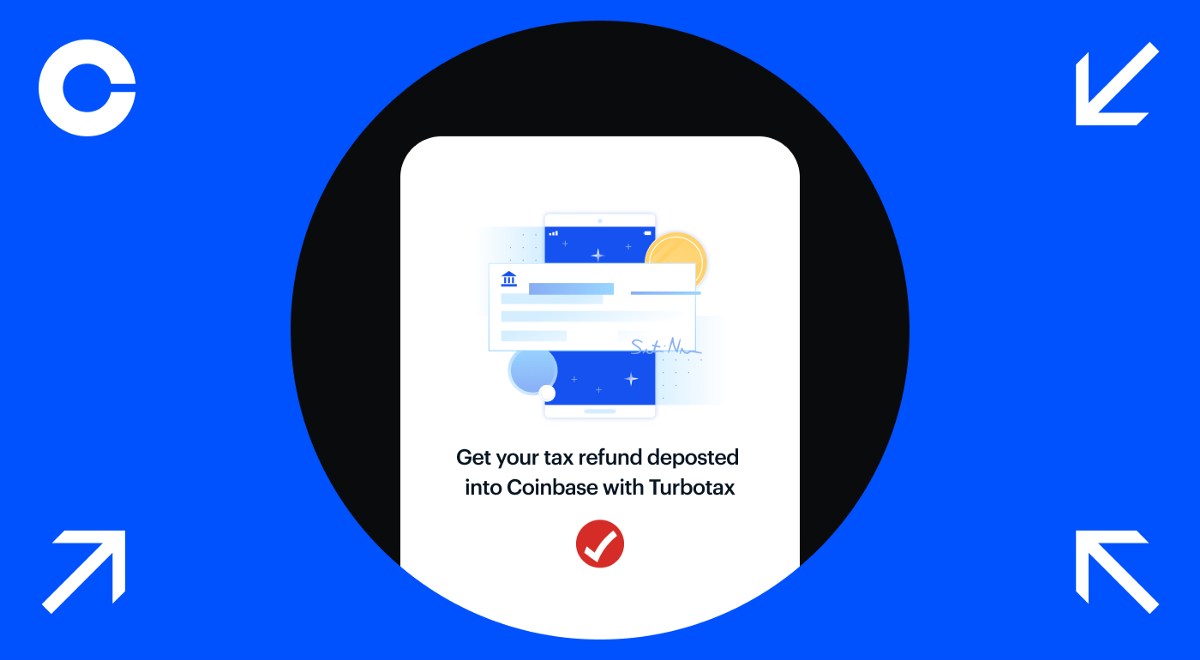
With tax season officially underway, customers expecting a refund might be wondering what to do with their extra cash. Now, Coinbase customers can get tax refunds automatically deposited into Coinbase as USD, where it can be immediately converted into crypto, when they file with TurboTax. Customers will receive their full refund and can choose to save, invest, or spend it. Tax season can be stressful, but now there’s an easy way to put refunds to work.
Put your refund to work on Coinbase
According to the National Retail Federation, 62% of US taxpayers who expect to receive a refund this year plan to put the money towards savings, while 27% plan to use it for everyday spending. Our customers are increasingly thinking about how to incorporate crypto in their savings and everyday spending: putting money towards assets they think will increase in value, holding yield-bearing assets, and spending and earning with Coinbase. This year, customers can deposit refunds into Coinbase fee-free to start immediately putting their money to work. They can choose to get refunds deposited into 100+ cryptocurrencies from stablecoins to yield-bearing assets so they can trade or earn interest. Or, they can choose to receive refunds in USD so they can be ready for any trade or to spend with their Coinbase Visa® Card (if they choose to spend USD). All incoming tax refunds will be deposited without any fees².
File with TurboTax to deposit your refund into Coinbase
You can deposit your refund into Coinbase when you file with TurboTax. Here’s how:
Begin filing your taxes from the Coinbase section of the TurboTax website
Login using your TurboTax credentials and complete your tax return (plus, Coinbase customers get up to $20 off)
After your tax refund has been calculated, TurboTax will ask you to enter account details to receive your refund. Find and tap on the Coinbase option and we’ll help you set up your direct deposit account³
You will follow a few simple steps to activate your account and select the crypto (or USD) in which you want to receive your tax refund
When prompted, tap on the Manual option to view your Coinbase account and routing number⁴
Go back to TurboTax and enter your Coinbase account and routing number as the destination for your tax refund. You’ll use MetaBank as the name of the bank
You can manage your direct deposit settings and view your account and routing number at any time from coinbase.com/direct-deposit
Coinbase is committed to giving everyone instant and easy access to the cryptoeconomy. Last year, we started helping customers get paid in crypto and receive expense reimbursements in crypto. We’ll continue to enable new use cases that allow customers to transition more of their financial lives to the cryptoeconomy.
We’re also committed to making tax season as easy as possible. Visit www.coinbase.com/taxes for a personalized guide to your crypto taxes⁵.
¹If you choose to receive your refund in crypto, Coinbase will automatically convert the amount from US dollars to crypto with no trading fees. Choosing to receive your refund in crypto is an optional Coinbase offer.
²No Coinbase trading fees but a spread applies when we buy, sell, or trade cryptocurrencies. Other standard fees may apply, and will be shared during direct deposit sign-up.
³You can deposit a maximum of $25,000 per day.
⁴Coinbase account and routing number is for deposits only, withdrawals will be rejected.
⁵Coinbase doesn’t provide tax advice. Information here is provided to help you understand your taxes, but should be reviewed before you use it to file your taxes. Please work with a professional.
The Coinbase Card is issued by MetaBank®, N.A., Member FDIC, pursuant to a license from Visa U.S.A. Inc. The Coinbase Card is powered by Marqeta. You may use Coinbase Card to make purchases anywhere Visa Debit cards are accepted.
As most of us were enjoying some R&R over Christmas break, Coinbase Cloud protocol specialist Elias Simos was scouring the web for the most interesting crypto charts of 2021: 69 of them to be exact.
In the latest Around The Block podcast, we sit down with Elias and discuss some of the most interesting data points from the year, and what it all means for the future. (High level takeaways below)
Metaverse and smart contract assets outperform
Price isn’t everything, but the two top performing assets in 2021 are indicative of broader trends throughout the year. 2021’s best performing assets were:
Metaverse gaming tokens
Smart contract platform tokens
The governance tokens of gaming worlds Axie Infinity (AXS) and The Sandbox (SAND) each posted 16,000 and 13,000 percent gains respectively. Meanwhile, platform tokens from Polygon, Terra, Solana, and Fantom, all posted 8,000% gains or more.
Given that play-to-earn gaming had a breakout year, and layer 1s not named Ethereum saw strong adoption, these trends should be of no surprise. Now let’s dig a bit deeper.
The state of Layer 1s
Ethereum’s native token (ETH) did a modest 2X over the year, while it was somewhat of a rough year for Ethereum DeFi blue chips, with the DeFiPulse index down 80% over the year vs ETH.
The price of DeFi assets doesn’t tell the entire story, however. TVL of Ethereum DeFi applications showed tremendous growth over the year, and the number of unique Ethereum addresses interacting with DeFi protocols 4x’ed.
DefiLlama and Decentral Park Capital
Regardless, ETH killers and sidechains won the year when measured by growth of overall market share.
DefiLlama and Decentral Park Capital
The great migration & the EVM standard
In May, there was $200M sitting in Ethereum bridges. That number climbed to $20B by the end of the year, underscoring the great migration of value from Ethereum to other ecosystems.
Remember that the EVM is essentially the brain of Ethereum that performs computations for the network. When other Layer 1s adopt the EVM, it makes deploying existing applications on new networks easier for developers, in addition to making it easier for users to migrate to these new chains.
The dominance of value on EVM compatible chains (Avalanche, Polygon, etc) suggest that a standard is forming around the EVM. This should ultimately keep Ethereum as the gravitational center of the smart contracting world, as ETH applications and assets will be natively interoperable with most other chains.
Rise of the app chains
While EVM chains still dominate the landscape, the end of 2021 saw a rise in value on Tendermint chains. Recall that Tendermint is a standard popularized by Cosmos, that lets developers build application specific blockchains that are capable of interoperating with one another.
Building app-specific chains in the past came with significant opportunity cost, because they were cut off from most liquidity and users. With the growth of Tendermint chains like Osmosis (AMM), Umee (lending), and Stargaze (NFTs), that’s becoming less of an issue.
Now that these app specific chains have a widening array of use cases and liquidity that they can interoperate with, look for more builders to take advantage of customizability that these chains offer in 2022.
The ENS airdrop + DAOs
In 2021, ENS reminded everyone of Web3’s native user acquisition strategy: the airdrop.
ENS (Ethereum Name Service) addresses are best thought of as email addresses that you can send money to (e.g. Jimbo.eth). After 5 years in development, the project shifted to a DAO model, and airdropped ENS governance tokens to every user with an ENS address.
Since the ENS DAO treasury collects revenue from new .eth registrations, revenue for the newly minted ENS DAO treasury ramped up significantly: another testament to how much a well orchestrated airdrop can move the needle.
Dune Analytics, matoken.eth
Beyond ENS, DAOs had a strong year, evident by the growing usage in key pieces of DAO infrastructure. Gnosis Safe, which is the most popular multisig wallet DAOs use to manage their treasuries, saw 3x growth in both the number of Safes and transactions executed in 2021. Snapshot, a tool that helps DAOs execute off-chain votes with on-chain verification, exhibited strong growth as well.
EN-EFF-TEES
Activity on the dominant platform for NFTs tells you all you need to know about the breakout year NFTs enjoyed.
Dune Analytics, Richard Chen
OG NFT CryptoPunks saw 60x YoY growth, reaching a total volume of 650K ETH, or $1.7B at current prices. This figure however, includes a flashloan powered $500M wash sale — a powerful reminder of how much subjectivity there is in on-chain data.
The second most notable NFT project of the year was Bored Ape Yacht Club, which went from a niche community to the celebrity NFT of choice, including the likes of Steph Curry, Shaq, Justin Bieber, Jimmy Fallon, Paris Hilton, among others. At one point the BAYC floor (price of the cheapest NFT in the collection) momentarily flipped the CryptoPunks floor.
In the heat of new issuances flooding the market, and older NFT collections achieving billion dollar market caps, the average price of NFTs changing hands did a 150x from 0.1 ETH to roughly 15 ETH by year end.
Dune Analytics, Richard Chen
One of the most interesting NFT launches of the year was Loot (covered here), which let anyone mint 1 of 8,000 NFTs that could form the basis of a Dungeons and Dragon style RPG game. Initial excitement was skyhigh, before fizzling out as time went on.
Dune Analytics
While Loot’s flame may have dimmed, it was still a landmark year for NFT based gaming, with the breakaway success of Axie Infinity bringing play-to-earn and GameFi narratives to the forefront. As the data shows, Axie Infinity NFT volume dwarfs that of any prior NFT based game.
CryptoSlam and The Block
Lastly, while Ethereum was the center of the NFT show, marketplaces appear to be springing up across multiple chains. The data shows that lower fee environments are enabling different types of user activity. Solana’s Magic Eden, for example, has more transactions than OpenSea since users are unencumbered by exorbitant gas fees.
More in Elias’s epic thread
Beyond being chock-full of illuminating data points on the year in crypto and Web3, the full thread underscores the beauty of on-chain data and the increased maturity of the industry. The ability for one person to put together a dataset this rich is a testament to all of the great data providers the industry now has at our disposal.