Privacy coins and zero-knowledge technology, which some use to obfuscate the identity of sends/receivers and transaction amounts, have gained enormous popularity in recent years due to mounting regulatory surveillance against the crypto sector. But despite their rapid rise in market cap, critics continue to scrutinize such class of assets as enablers for masking illicit activities.
In an exclusive interview with Cointelegraph, Oliver Gale, CEO, and co-founder of the Panther Protocol (ZKP), elaborated on the technology behind its privacy decentralized finance, or DeFi, solutions and why it’s necessary for today’s crypto space:
CT: How much did you raise from your recent token sale, and what does your roadmap look like from here?
OG: We’ve raised over $30 million in total. For Panther protocol, we did several private sale rounds, and then we did a public sale on November the 23rd, which was 90 minutes long, and raised over $20 million during that time. The second question is around the roadmap itself, so Panther Protocol is a multi-chain privacy protocol with several zero-knowledge, data disclosure tools built into it; what we’re delivering in January is our minimum viable product (MVP).
We have multiple deployments this month. And that will be delivering an MVP that allows staking on Polygon and transferability of the ERC-20 token to ZKP token. And then, I estimate 30 to 60 days later; we’re going to deploy the complete v1.0 MVP, which will have the multi-asset privacy pools and multi-asset staking pools that are the shielded tools in which Panther assets can use be transacted privately. And that will also come with a version of ZK reveals, which is the mechanism by which users can voluntarily disclose their transaction data for compliance purposes or tax reporting purposes, etc. So that’s what can be expected across Q1.
We have over five EVM compatible partnerships in place to deploy Panther v1 on Near, Flare, etc. These shielded pools are being deployed across different chains. And then, our team is building a ZK-driven interchange across other chains, and the goal is to allow these assets to be swapped securely, with low fees, low and high transaction throughput.
CT: What’s the underlying cryptography behind these assets?
OG: So the multi-asset shielded pools are based on ZK-SNARKS. So you have a combination. The shielded pools are, you know, a version of mixer technology with the ability to split join transfer assets. Then we use ZK snarks for proof of ownership. So essentially, transactions happen within the multi-asset shielded pools. And, and then the mechanism for data disclosure reveals is another ZK snark circuit, which is set up to allow Essentially a trusted provider to provide proof that can be verified on the planter network of some data condition being met. And that while it’s been applied to compliance is our first use case, and were put in ZK reveals into production with launched out, which is essentially a launch is launched out is what it sounds like.
CT: Skeptics would say that private networks using zero-knowledge cryptography could become enablers of illicit transactions. What are your thoughts on the matter?
OG: In my view, if you build technology and have no intention of facilitating aiding and abetting or enabling crime, you are not guilty of any crime. But why is privacy needed? Our white paper has this; the bottom line is that actors who are under surveillance behave differently from those who are not. In other words, the exact behavior of our societies is impacted by being watched. So inevitably, there are going to be bad actors.
But I’ve never seen a gun on trial. You don’t put tools on trial; you put people on trial. And the overwhelming consensus of our global society, for all of the tools and technologies we use, is that if the device is more beneficial for the majority than the minority who abuse it, then you use it. And if that weren’t the case, then I’m not sure we would have any kitchen knives because knives are used for criminal activity by a minority. So any attempt to put privacy technology or blockchain technology on trial because a minority abused the system is an argument that can be extrapolated to anything in life.
Polygon (MATIC), a layer-two network designed for scaling and application infrastructure development on Ethereum (ETH), has been making the rounds among blockchain enthusiasts as of late. From its $1 billion investment into zero-knowledge technology to co-launching a $200 million Web 3.0 social media initiative up to integrating with Opera’s web browser to make its decentralized apps accessible to 80 million Android mobile users, the network’s momentum is going strong.
But partnerships and business aside, the technological capacities of the network, especially when compared to Ethereum, are also attracting the attention of many blockchain developers. In an exclusive interview with Cointelegraph, Polygon co-founder Sandeep Nailwal talked about the extent of the network’s adoption.
Cointelegraph: What are the current gas prices and transaction speeds for Polygon? And how does that compare to Ethereum?
Sandeep Nailwal (SN): From the Polygon Scan Explorer, you can see that the average block time is around 2.3 seconds. As for Ethereum, that is 15 seconds. And then the gas fees, you can see 0.001 MATIC tokens; this is a point fraction of a penny.
CT: Have there been any notable nonfungible token (NFT) drops on the Polygon network recently?
SN: None of them have become like CryptoPunks or anything, but I think Polygon’s biggest kind of support is from the gaming companies […] They all added to NFT. If you go to market, talk to any random 10 different gaming teams, they will tell you six to seven are building on Polygon.
But the notable drops on NFT, the biggest, have been Dolce and Gabbana, the brand. They made a $7 million sale recently. There are other big luxury premium watch brands, and these guys are coming in. Apart from that […] Elon Musk minted an NFT. Jack Dorsey minted NFT of his first-ever tweet, and […] Mark Cuban — all those were on Polygon networks only.
#NFT sales have seen astronomical growth since 2020.
2020 total sales: $340 million 2021 total sales: $9 billion (so far)
Let’s see what happens in 2022, with NFTs in sports, gaming, and #metaverses now gaining traction. https://t.co/VDD8v2YwVo via @cointelegraph
CT: What are some popular decentralized apps built on the Polygon blockchain? And what does their total value locked (TVL) look like?
SN: Polygon is now used by all the decentralized finance applications in Ethereum. The only one remaining was Uniswap. And the community signaled a week back that they are also launching on Polygon now. So as for the popular DApps, I would say Uniswap, Aave, Decentraland, etc. I think the TVL across the bridges is around $5 billion or $6 billion.
CT: What is your objective for investing in zero-knowledge technology?
SN: We had committed $1 billion for zero-knowledge technology, which we believe is the holy grail of blockchain scaling. And privacy is the second element — that’s one thing where everybody gets confused. So you use ZK to verify computations back on Ethereum without sending back the entire data. Instead, you simply provide proof that everything was correctly computed on layer two and put a […] succinct proof back to Ethereum.
CT: In your opinion, would further Ethereum upgrades empower the network’s capacity to match that of layer-two solutions?
SN: Even if 2.0 comes in here, that will not provide enough scalability. Next year, the proof-of-stake [PoS] upgrade will keep everything the same; like Ethereum has 13 transactions per second [TPS] right now, maybe it will go to 20 TPS [after PoS], but not more than that. So that does not add anything to scalability. And let’s say in three to five years, even if the sharding comes, we’ll have a projection of 64 shards. And with each acting at 20 transactions per second, but that’s still 1,280 transactions per second overall, right? That’s still not enough for the entire world.
Related: Uniswap v3 contracts deployment on Polygon approved with 99.3% consensus
CT: What does Polygon’s adoption currently look like?
SN: There are 3,000 plus active development teams on it. This was posted by Alchemy some time back. It should actually be up to 5,000. The daily active users on Polygon have become 50% more than Ethereum, and with gaming NFTs, we are seeing so much happening on Polygon.
Do Kwon, cofounder of Terraform Labs, was recently served subpoenas by the US Securities and Exchange Commission during Messari’s mainnet event, leading Kwon and Terraform to preemptively sue the SEC. On Unconfirmed, Kwon discusses:
what Terraform Labs does and how it is building its DeFi ecosystem around TerraUSD ($UST)
why Terraform Labs created its synthetics protocol, Mirror, and how it works
what Do thinks about the SEC’s investigation into Mirror
what happened to Do at Messari’s mainnet event
why the SEC’s approach to crypto regulation does not impact Do very much
what Do thinks about how US regulators are treating crypto companies
how Do would regulate the crypto industry
why he believes the current state of crypto regulation doesn’t work in a global context
why he says the SEC couldn’t do anything to TerraUSD — even if it wanted to
what two characteristics are critical in building a decentralized protocol
how the crypto industry could improve security in light of the $130 million Cream Finance hack
The concept of NFTs (non-fungible tokens) causing an explosion in the art world is of course not surprising for pundits who have been following the evolution of NFTs since Crypto Kitties. The opportunities that NFT technology can provide is core to why there is so much interest.
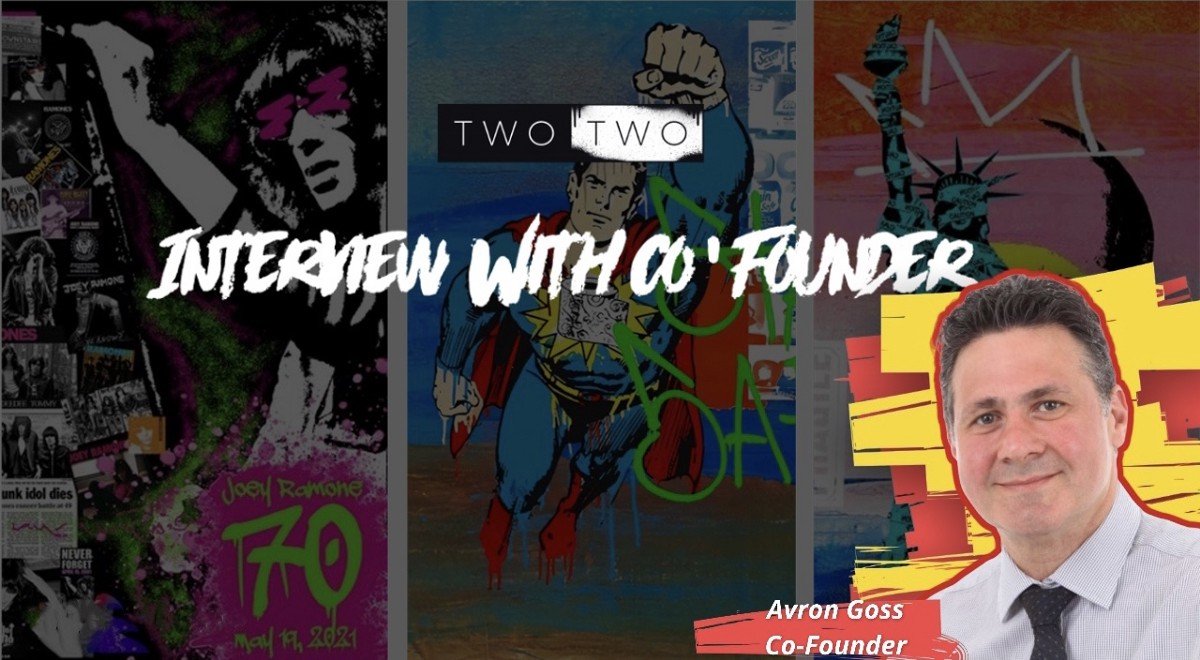
TWO TWO is an extreme art gallery that has jumped on the NFT bandwagon in a big way and we have here with us the co-founder Avron Goss who will give us more details of how TWO TWO is navigating art and technology in this new digital art frontier.
Q. Please introduce yourself and what you do at TWO TWO.
My name is Avron Goss and I am one of the co-founders of TWO TWO along with Steven Meistrich and Stacey Maites. I have spent my career building successful businesses globally. I attribute my success to my determined and steadfast nature combined with my process and deliverable oriented approach which I developed while studying Biomedical Engineering and then through the early part of my career in Accenture. Success of a company always comes down to ensuring the community gets a product that they want and need. At TWO TWO my primary focus is to build the platform, processes and team to deliver a thriving token economy. My co-founders are focussed on building a global network of galleries and acquitting world class established and emerging artists for the galleries. We are all passionate about what we do and work well together. I have known and worked with Steven for over 25 years now and Steven has known Stacey for even longer.
Q. Can you describe what TWO TWO is about?
For far too long the art market has been controlled by the elite. Galleries and auction houses control which artists are brought to market and, typically, each gallery works with a small select group of high net worth individuals who receive preferential treatment. When you consider that 82% of art sales are made in the US, China and the UK and that most galleries serve about 75 core customers it is not hard to see that the majority of the world are cut off from access to art.
“At TWO TWO we bring a collection of progressive street, urban and graffiti works seldom seen in galleries, let alone as a single exhibit.”
– Stacey Maites, Co-Founder TWO TWO
There have been a number of attempts in the past to break this, going all the way back to the Salon des Refuses of 1863 which displayed the works of Gustave Courbet, Edouard Manet, Camille Pissarro and Johan Jongkind; all of whose works had been rejected for display by the Parisian galleries because they did not meet the taste requirements of Emperor Napoleon III. Fast forward 150 years and we now have the blockchain, a technology that truly enables the removal of intermediaries. Combine this with NFTs and DeFi and this has profound implications for art.
TWO TWO enables a global community to be the gallery and to find and enable the next Banksy. Talent is no-longer confined to the hallowed and dusty halls of well-known auction houses where only a select few get a seat.
As a gallery, TWO TWO sets out to blur the distinction between real and virtual art and its vision goes beyond that. We are now able to blur the boundaries between the art enthusiasts and the artists too.
Q. Can you explain how the TWO TWO token (X22) functions with the TWO TWO ecosystem as well as its real-world utility?
The TWO TWO ecosystem is built out of a number of real world and virtual components. This includes the TWO TWO Gallery that is about to open in Resorts World Las Vegas, 3rd Party Galleries, Artists, the X22 Foundation, X22 holders and liquidity providers. The X22 token provides the mechanism that enables all these components to work together seamlessly.
“There is no point in creating a token that has no real-world utility. People must clearly understand its use and be given plenty of opportunity to use it.”
– Avron Goss, Co-Founder TWO TWO
There are a number of real world uses for the X22 token, with the following being some of the most critical uses:
Gallery Membership Fees Starting with the TWO TWO Gallery, galleries can pay membership fees in X22 tokens to access the X22 community. The gallery will be required to purchase an agreed amount of X22 tokens monthly from the community which will then be paid to X22 Foundation who will lock up the tokens in the treasury. In return, the gallery will obtain marketing access to the X22 community. This is the first step to making the community the gallery.
Art Loans Loans will be made to artists and art projects using a portion of the X22 Foundation’s liquidity pool. In return the artist will be expected to sell their works through X22 member galleries, ensuring access to the X22 community. They will also, of course, be expected to repay the loan and pay stability fees to the Foundation an agreed amount of X22 which they will have to acquire on the open market from the X22 community. The stability fees will be paid to the X22 Foundation and locked in the treasury.
Hosted Nodes and Liquidity Mining X22 holders who provide stability to the network by staking on hosted nodes and by providing liquidity to DEXs will be rewarded with additional X22 tokens. In addition, community members who provide liquidity to the X22 Foundation liquidity pool and lock up this liquidity will also be rewarded with X22 tokens.
Voting on the DAO In addition to all the above, X22 tokens held in each hosted node will give the holder a vote on a one-to-one basis in all votes on the DAO. This is the final piece which enables the community to be the gallery as it makes them decision makers.
Q. Thanks, that was a very comprehensive breakdown of the utility of the X22 token within the TWO TWO ecosystem. We understand your seed investment was oversubscribed. How did you manage that?
We had a very simple philosophy when raising investment — add value. TWO TWO looks to provide value by delivering real world value and, in return, we looked for investors that understand that value and wish to bring value to TWO TWO. By demonstrating our real commitment to value we were able to find the investors that would create a synergistic relationship with us.
“We see our investors as partners in our business, by working collaboratively we can create value for the entire TWO TWO community.”
Steven Meistrich, Co-Founder TWO TWO
It is our belief that our investors see the value we bring by combining real world galleries with NFTs and DeFi. We are not about creating a marketplace, we are about creating a long term sustainable market.
Q. What do you see as some of the challenges your project and industry face?
I believe the crypto industry is facing the challenges of scaling and acceptance. Both of these issues are being addressed and will be resolved with time. From TWO TWO’s perspective we are solving these solutions in the following way:
Scaling: We believe that to successfully make the community the gallery we need to enable large and small community members to have equal access to our platform. As we are not building our own chain we cannot influence the speed of transactions, volume of transactions or gas fees directly. But we can choose the blockchain we operate on. Our philosophy is to be blockchain agnostic and support chains that support our community. We are therefore launching on both Ethereum and Binance Smart Chain to ensure that both gas fees and market reach are balanced.
Acceptance: Lobbying governments and regulatory bodies is outside of our expertise, but we do have one thing that is working in our favour right now. NFTs have captured the imagination of the non-crypto using community and our art gallery which manages real word and NFT art sales acts as a natural bridge for the non-crypto using community. We therefore see ourselves as an early real use case and an ability to grow crypto users globally.
Q. Any other exciting news you’d like to share?
We do have exciting news to share!
Firstly we are in the final stages of launching the X22 token which means that we are running IDOs (Initial DEX Offering) on the 1st July and the 8th July — this is the first real opportunity to grow the community. This will be followed very shortly by our TGE (Token Generation Event) which will then allow open trading of the X22 token. There is no point in launching a token without use so we are also going to be launching V1 of our platform at the same time as the TGE. For details please follow us on twitter and telegram.
From a gallery perspective, we have some truly unique NFTs which we are going to launch in July. One of them is going to be a one-of-one digital image taken from a never before printed negative of a photo taken of Jimi Hendrix at the Monterey Pops in 1967. This is a truly ultra-rare piece and if a target price is reached the buyer will also receive the negative. We also have a great line-up of some truly remarkable and well known artists, such as Nick Walker. Once again, follow us on twitter and telegram for announcements.
Thanks to Mr Avron Goss for the very informative and interesting interview!
More information on TWO TWO can be found at the following links: